Abstract—Priority is usually given to handover traffic in mobile communication but doing so has the tendency of increasing call blocking probability. It was said previously that non-prioritized call traffic channel assignment scheme reduces call blocking probability more than other basic channel assignment schemes at high handover traffic intensities. A comparison of channel assignment schemes by analysis and MATLAB simulation in this research has shown that dynamic guard channel assignment scheme based on channel utilization minimizes call blocking probability better than non-prioritized, prioritized guard channel and prioritized guard channel with queue/buffer. The wireless technology used was Mobile WiMAX with mobile assisted handover (MAHO) and the queueing policy employed was M/M/C/Q with FCFS service discipline.
Index Terms—Blocking-Probability, Buffer, Guard-Channel, Mobile-WiMAX, Receiver-Signal-Strength
I. INTRODUCTION
NE way of improving system performance during handover is by handover prioritization. Handover call traffic is usually given priority over new call traffic and this is done by setting aside a small portion of the system channel capacity referred to as the guard channel. Alternatively, priority can also, be provided by queueing or adding buffer to prevent termination of handover calls when all the channels are busy. This increases the level of priority given to the handover traffic and minimizes loss of traffic [1]. Moreover, for every implementation of quality of service (QoS), in any system, performance indicators are essential to assess the level of QoS delivery. Some of these indicators are waiting time in the system or queue, loss traffic, call blocking probability, call termination probability, throughput, and utilization to mention a few [2]. It was said in [2] that the channel assignment scheme without priority (also referred to as the non-prioritized call traffic assignment scheme) will give the smallest call
Manuscript received March 6, 2016; revised April 10, 2016.
A. A. Adewale is with Department of Electrical and Information Engineering, Covenant University, Canaanland, Ota, Ogun State, Nigeria. (corresponding author phone: +234-806-885-5772; e-mail: [email protected]).
S. N. John is with Department of Electrical and Information Engineering and he is now the Dean, College of Engineering, Covenant University, Canaanland, Ota, Ogun State, Nigeria. (e-mail: [email protected]).
E. R. Adagunodo is with Department of Computer Science and Engineering, Obafemi Awolowo University, Ile-Ife, Osun State, Nigeria. (e-mail: [email protected]).
blocking probability at high handover call traffic intensity compared with prioritized guard channel (PGC) and PGC with queue or buffer [2]. It calls for concern because some questions are begging for answers especially why should a prioritized guard channel scheme with increased level of priority (that is having queue) perform less than a scheme without any priority at higher traffic rate? This obviously exposed some design limitations in these schemes in relation to the call blocking probability of new calls as handover call traffic intensities becomes very high. Meanwhile, an investigation into the cause of this design flaws was carried out in this research by modeling and simulation approach.
The remainder of this paper is organized as follows: Section II is the literature study where some previous works in this area of research were reviewed regarding quality of service delivery in handover. The system modeling of the research is presented in Section III while the results of simulations carried out and the discussion are reported in Section IV followed by the conclusion in Section V.
II. LITERATUREREVIEW
In [4] two important parameters used to evaluate handover processes were forced termination probability and call blocking probability. It was also said that a handover is ideal if the call blocking probability is maintained while the force termination probability is reduced. The two prioritization schemes for handover are the guard channels and queueing of handover calls. Guard channel provides better utilization under dynamic guard scheme for handover calls thereby reducing dropping probability of handover calls but at the detriment of originating new calls in the cell because blocking probability of new calls might be increased because less number of channels is assigned. In such a situation, queues will result at the base station as a result of non-availability of assignable channels because all channels are busy. When the system assumes this state, new calls are blocked while ongoing handover calls are dropped. The handover calls buffered can be terminated before service if timed out hence, time interval between handover initiation and completion must be within the timeout interval. It was mentioned in [4] that a good call admission control (CAC) algorithm must improve the QoS of connected calls, and maximize utilization of all types of call traffic.
Meanwhile, in [5], it was said that existing works from literature address mostly fixed channel assignment (FCA) scheme while research on dynamic guard channel assignment scheme is not fully exhausted. It implies that the
Performance Comparison of Dynamic Guard
Channel Assignment with Buffered Prioritized
Scheme for Mobile WiMAX Network
Adeyinka A. Adewale, Member IAENG, Samuel N. John, and Emmanuel R. Adagunodo
size of the channels cannot be varied even when there are less traffic. In the fixed combined channels scheme, both the new calls and handover calls share a fixed number of channels on first come first served (FCFS) service discipline while the remaining channels are strictly reserved for the handover call traffic. This implies that undue higher blocking probability of handover calls is a faulty design with the popular knowledge that handover calls should be given priority over originating new calls in a cell. It was also said in [5] that sharing of the combined channels is undesirable and guard channel borrowing scheme was proposed by Alagu et al for the purpose of reduction of call blocking probability of new originating calls.
A prioritized handover scheme which integrated direction of movement of MS to the M+G scheme was implemented in [6] where M stands for mobile assisted handover (MAHO), GC is guard channels assignment techniques. It was based on an improved scheme for minimizing handover failure due to poor signal quality and the M/M/S/S model was adopted for the system. Uduak et al said that force termination probability and call blocking probability are important parameters used to evaluate handover techniques. Also, that mechanisms like guard channels and queueing of handover calls decreases force termination probability while increasing call blocking probability. However, the channel assignment technique used was fixed guard channel allocation and the signal strength factor were assumed values that is, the values were not computed from interaction of propagation or simulation parameters [6].
In [2], the performance comparison of three channel assignment schemes namely: non-prioritized handover (NP) scheme, prioritized guard channel (PGC) scheme and the prioritized guard channel scheme with buffer or queue (QPGC). The comparison was done to know which one reduces call dropping probability most. The simulation result showed that the prioritized guard channel assignment scheme reduced call dropping probability better than the non-prioritized scheme while the buffered PGC reduced the call dropping probability further than the other two. The NP scheme had the best performance on the basis of call blocking probability when the system was getting congested. The study carried out in [6] was improved upon in [7] that is extended to prioritized handover queueing scheme. Buffer was added to the MAHO+GC scheme proposed by Madan et al to solve the congestion problem in GSM systems handover. The FIFO queueing discipline was used for the fixed guard channel allocation while mobility factor and signal strength factor were assumed and varied from 0.7 to 0.9. The arrival rates were assumed as a Poisson distribution and the time variables were channel holding time and cell residence time. [7].
III. SYSTEM MODEL
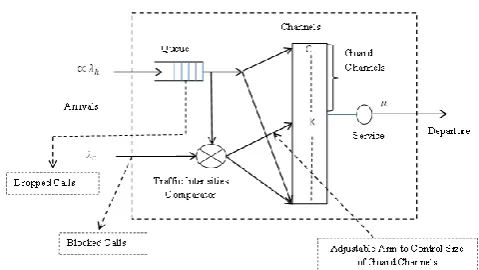
A diagrammatical representation of the DGC with queue is presented in Fig. 1, the system compares the traffic intensities of each call traffic types and varies the size of the guard channels (number of guard channels) based on the channel utilization defined in [5]. Since it has been said that dynamic channel allocation improves QoS, then is necessary to extend this study to the dynamic guard channel allocation
by analysis and simulation. That the DGC will average QoS better than other schemes and also, to compare its performance with the other schemes as it was done by Kacerginskis et al [2] and Xhafa et al [8].
Fig. 1: Diagrammatic Representation of Dynamic Guard Channel Assignment Scheme with Queue of Handover Calls Heterogeneous networks may differ in one or more aspects of operating frequency, bandwidth, modulation techniques and so on but modern mobile stations are equipped with GPS which can provide information about the location of the device, distance from BS and the velocity of the mobile terminal. This information if made available to the switching center can help improve handover decisions and reduce failure. In addition, signal strength is the basic requirement to initiate handover in wireless networks. Residual time and signal strength can be used to optimize vertical handover performance for mobile station (MS) of different velocities. Apart from received signal strength (RSS), other criteria for initiating handover decisions are distance between MS and BS, hysteresis margin, bit error rate, velocity of MS and pathloss. Multipath fading neglected at high frequencies because it is averaged out due to much shorter correlation distance as compared to shadow fading [9], [10]. Given the transmitted signal power as 𝑃𝑡, the RSS measured by the MS can be expressed as given in (1). The two measured values are from the current BS (𝑅𝑆𝑆𝑐𝑢𝑟) and new BS (𝑅𝑆𝑆𝑛𝑒𝑤). To combat the problem of ping-pong effect resulting from fluctuation of RSS measurement among neighboring base stations, RSS 𝑀𝑒𝑎𝑠𝑢𝑟𝑒𝑚𝑒𝑛𝑡 𝑅𝑆𝑆 = 𝑃𝑡− 𝑃𝐿(𝑑𝐵) (1) with threshold and hysteresis (RSS-TH) was proposed by Liton Paul et al [11] where it was said that RSS threshold (RSS-T) should not be used alone because crossover signal strength between current and new BS determines its effectiveness. In RSS with threshold (RSS-T), it is possible for the MS to have moved far into the new BS before any handover if the threshold is set quite low. The RSS with hysteresis (RSS-H) helps to prevent this anomaly by ensuring that handover occurs when the RSS of the new BS is stronger than the old BS by an hysteresis margin. The relationship between the handover decision parameters are shown in (3) and (4). The RSSthreshold is stabilized by the
hysteresis margin ∆𝐻 while the RSS of the new BS must be greater than the 𝑅𝑆𝑆𝑡ℎ𝑟𝑒𝑠 ℎ𝑜𝑙𝑑 for the execution to take place.
Therefore, handover initiation can only take place if and only if (2) holds in the neighborhood of the MS.
Handover initiation:
[image:2.595.312.552.105.240.2]Handover Threshold: RSSthr eshold = RSSdrop + ∆H (3) Handover decision:
RSSnew > RSSthreshold (4)
The signal strength factor α used by [4], [6] and [7] were assumed values and were not gotten from interplay of wireless signal propagation parameters which did not reflect the real world, hence, the received signal strength quality factor (RSS QF) 𝛼 was defined as in (5).
𝛼 =𝑅𝑆𝑆𝑛𝑒𝑤−𝑅𝑆𝑆𝑡ℎ 𝑟𝑒𝑠 ℎ 𝑜𝑙𝑑
𝑅𝑆𝑆𝑛𝑒𝑤 (5)
[image:3.595.306.548.314.516.2]Simply put, (5) is a ratio that compares the difference between received signal power of the new base station and handover threshold to the signal power of the base station. However, the threshold value used in this research considered the drifts between base station signals due to hysteresis as was mentioned in [10]. The direction of mobility was not considered as playing a major role in the states of the system as it was done in [7] because the signal strength is more paramount than direction and any losses due to blockage and multipath fading for the Mobile WiMAX network was taken care of by the free space path loss (FSPL) model. Mobile assisted handover (MAHO) was used so that the signal measurement from the MS can be used for handover decisions.
Fig. 2: One-dimensional Markov Chain for Prioritized Guard Channel Assignment Scheme
If the combined channel has a capacity of K then it implies that the guard channel capacity is C-K. A cut equation across each of the nodes of Fig. 2 till the last node of the system capacity, and simplifying gives the call dropping probability. Meanwhile, summing the probabilities of the states in the guard channels give the blocking probability of the system. By considering the ratio of traffic intensity and utilization of each channel band, traffic can be allocated to each band as needed per time. This makes the guard channel allocation dynamic and the state probability of the system is as given in (6).
𝑃 𝑖
=
𝜆𝑐+ 𝛼𝜆ℎ 𝑖
𝑖! 𝜇𝑖 . 𝑃 0 , 0 ≤ 𝑖 ≤ 1 − 𝛾𝑔 . 𝐶
𝜆𝑐+ 𝛼𝜆ℎ 1−𝛾𝑔 .𝐶. 𝛼𝜆ℎ𝑖− 1−𝛾𝑔 .𝐶
𝑖! 𝜇𝑖 . 𝑃 0 , 1 − 𝛾𝑔 . 𝐶 ≤ 𝑖 ≤ 𝐶
(6)
where the normalization constant is given as in (7)
P 0
= λc+ λh i
i! μi 1−γg .C
i=0
+ λc+ λh
1−γg .C. λ
hi− 1−γg .C i! μi
C
i= 1−γg .C+1
−1
(7)
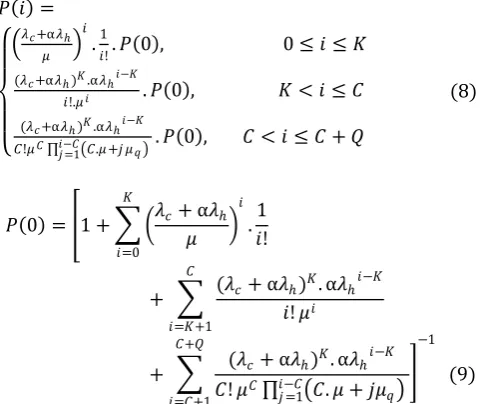
In prioritized guard channels assignment scheme, arrivals are not delayed before service but are blocked or dropped when the system assumed busy state that is when there are no more channels to service arrivals. The delay experienced by arriving customer traffics results essentially when buffers are introduced to reduce blocking and call termination probability. The steady-state probability for the prioritized guard channel with buffer considering RSS QF and the normalization condition P 0 is given below in (8) and (9) respectively [1], [7]. The implementation of this handover scheme by [6] was based on fixed guard channel allocation.
𝑃 𝑖 =
𝜆𝑐+α𝜆𝜇 ℎ 𝑖.1
𝑖!. 𝑃 0 , 0 ≤ 𝑖 ≤ 𝐾 (𝜆𝑐+α𝜆ℎ)𝐾.α𝜆ℎ𝑖−𝐾
𝑖!.𝜇𝑖 . 𝑃 0 , 𝐾 < 𝑖 ≤ 𝐶
(𝜆𝑐+α𝜆ℎ)𝐾.α𝜆ℎ𝑖−𝐾
𝐶!𝜇𝐶 𝑖−𝐶 𝐶.𝜇 +𝑗 𝜇𝑞 𝑗 =1
. 𝑃 0 , 𝐶 < 𝑖 ≤ 𝐶 + 𝑄
(8)
𝑃 0 = 1 + 𝜆𝑐+ α𝜆ℎ 𝜇
𝑖 .1
𝑖! 𝐾
𝑖=0
+ (𝜆𝑐+ α𝜆ℎ) 𝐾. α𝜆
ℎ𝑖−𝐾 𝑖! 𝜇𝑖
𝐶
𝑖=𝐾+1
+ (𝜆𝑐+ α𝜆ℎ) 𝐾. α𝜆
ℎ𝑖−𝐾 𝐶! 𝜇𝐶 𝐶. 𝜇 + 𝑗𝜇
𝑞 𝑖−𝐶
𝑗 =1 𝐶+𝑄
𝑖=𝐶+1
−1
(9)
The new call blocking probability is given by (10) while the call dropping probability is given by (11). 𝑃𝐶 𝐵 = 𝐶+𝑄𝑖=𝐾 𝑃(𝑖) (10)
𝑃𝐻 𝐷 = 𝐶+𝑄𝑗 =𝐾𝑃 𝑖 . 𝑃ℎ𝑇|𝑗 (11)
It follows from (10) that 𝑃 𝑖 = 𝐶 + 𝑄 is the probability that all the guard channels are busy and that the queue has reached position 𝑄 then, if 𝑃ℎ𝑇|𝑗 is the probability
that the handover request was terminated at a position 𝑗 + 1 on the queue, then the call dropping probability of a call traffic in the queue is a product of these two independent probabilities given by (11). According to [12], [7], 𝑃ℎ𝑇|𝑗 is
given by 𝑃ℎ𝑇|𝑗 = 1 −
𝜇𝑞
𝐶𝜇 +𝜇𝑞 1 −
𝜇𝑞
𝐶𝜇 +𝜇𝑞
1 2 𝑗 𝑄
𝑗 =1 (12)
The simulation experiment was carried in MATLAB7.5.0 (R2007b). The QoS parameters evaluated are new call blocking probability and handover call dropping probability.
Combined Channels Guard Channels i=k
λc +αλh
i=0 i=1 λc +αλh λc +αλh
µ 2µ
αλh
kµ (k+1)µ
c-1 c
αλh αλh
The queueing discipline considered was M/M/C/Q and service was by FCFS. Arrival rates were Poisson and the service rate exponentially distributed.
IV. SIMULATIONRESULTSANDDISCUSSION
The simulation studies were carried out for the purpose of comparison of performance of dynamic guard channel assignment scheme with the prioritized guard channel scheme with buffer. For some obvious reasons, the non-prioritized scheme and non-prioritized guard channel were included in the study on Mobile WiMAX network. Since the guard channel is the one being buffered, then it implies that only handover traffic arrivals are in the queues while the new call traffic are blocked. Therefore, to investigate related QoS issues, it is imperative that the evaluation be carried out when the system is congested with handover traffic.
Fig 3: Performance Comparison of Call Dropping Probabilities of the Three Handover Assignment Schemes
In Fig. 3, the performance evaluation of system’s call dropping probability for the three schemes is presented. When the handover call arrival rates were below 50calls/min, the call dropping probability of the NP and PGC were below 15% while that of the buffered PGC (QPGC) was still zero. When traffic arrivals reached 250calls/min, it was 80%, 75% and 35% respectively. This implies that handover call dropping probability was reduced drastically meaning that calls can be buffered and serviced before they are timed out between 92ms to 180ms according to [1].
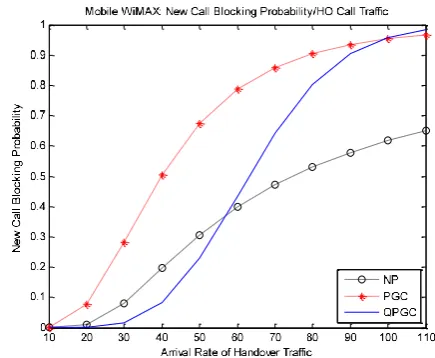
The new call blocking probability of the three schemes for lower handover call traffic arrival rate of Fig. 3 is presented in Fig. 4 and Fig. 5. Fig. 4 shows the tradeoff of QoS. The QPGC and PGC handover traffic assignment schemes attained the blocking state (100% blocking probability) of new call traffic at the BS when the handover call traffic arrival rate reached 150calls/min when the NP scheme call blocking probability was 65% as it can be seen in Fig. 4. The performance of the NP scheme is better off because both traffic types share all available channels on FCFS basis. It can be seen in Fig. 5 that the best service originating new calls can have at the BS at lower handover traffic arrival rate was provided by the QPGC scheme below
55calls/min and if the arrival rate is higher, then, the NP scheme will be more desirable to achieve lower call blocking probability.
Fig. 4: Performance Comparison of Call Blocking Probability of the Three Schemes
Fig. 5: Performance Comparison of Call Blocking Probability at Lower Handover Call Traffic Arrival Rate
Therefore, from the premise of arguments presented above, it is very much appropriate to investigate the effect of DGC without buffer on the parameters giving simulation result of Fig. 5 since DGC is meant to offset some of the tradeoffs of guard channel implementation by providing more combined channels when new call traffic load is high. It was said in [2] that when handover traffic intensity is low, the PGC with buffer should be used as channel assignment scheme for Mobile WiMAX network but that when handover traffic intensity is high, that the NP assignment scheme should be used. The investigation in Fig. 5 was extended to include dynamic guard channel (DGC) assignment scheme for the purpose of graphical performance comparison of the simulation results of the four channel assignment schemes as shown in Fig. 6. The simulation parameters used is shown in table 1.
[image:4.595.325.541.90.268.2] [image:4.595.69.280.273.451.2] [image:4.595.322.540.310.489.2]optimally better than non-prioritized scheme at lower call traffic arrival rate and handover traffic arrival rates, even
when the two arrival rates are symmetric that is equal or even. The symmetric consideration in the study makes it possible to draw inference that DGC averages QoS better than the PGC and NP as can be seen in the graph. This is because DGC outperforms the other three schemes from arrival rate of 10calls/min to the rate when the blocking probability is approaching unity for the QPGC which signifies congestion. Therefore, it can be said from this research that when call arrival rates are low, the buffered schemes can be used but when arrival rates are symmetric that getting equal (even), the dynamic guard channel (DGC) assignment scheme will give the lowest call blocking probability for Mobile WiMAX network traffic channel assignment.
Fig. 6: Performance Comparison of DGC with other Channel Assignment Schemes for Symmetric Arrival Rates
V. CONCLUSION
A simulation comparison of the handover traffic channel assignment schemes was done in this research. It was seen that the prioritized guard channel assignment scheme with buffer reduced handover call dropping probability more than any other channel assignment scheme. Moreover, it became
obvious that to every QoS improvement, there is always a compromise or tradeoff of some other QoS parameters no matter how little. While giving priority to handover traffic over new call traffic, non-prioritized channel assignment scheme was discovered to be a better option at traffic congestion. This research has proved it otherwise that among other reasons; it was because the guard channel of the prioritized scheme used in previous researches was fixed channel assignment based. However, it can be concluded that the prioritized guard channel with buffer can be used when the handover traffic intensity is low but when handover traffic intensity is high, the dynamic guard channel should be used because it will give a lower call blocking probability than the non-prioritized scheme and average QoS better than other channel assignment scheme.
REFERENCES
[1] N. D. Tripathi, N. J. H. Reed and H. F. VanLandingham, “Handoff in Cellular Systems”, IEEE Personnal Communication, December 1998, 1070-9916.
[2] E. Kacerginskis and L. Narbutaite, “Capacity and Handover Analysis in Mobile WiMAX”, Electronics and Electrical Engineering, ISSN 1392-1215, 2012. No. 3 (119).
[3] B.B.Madan, S. Dharmaraja, and K.S.Trivedi, “Combined Guard Channel and Mobile Assisted for Cellular Networks”, IEEE Transaction on Vehicular Technology, October, 2006.
[4] A. K. Gangwar and V. Singh, “Quality of Service Improvement, Handoff Prioritization and Channel Utilization for Cellular Network”, International Journal of Engineering Research Applications (IJERA) ISSN: 2248-9622, Vol. 4, Issue 10 (Part-2), October 2014, pp. 46-49 [5] S. Alagu and T. Meyyappan, “Efficient Utilization of Channels using
Dynamic Guard Channel Allocation with Channel Borrowing
Strategy in Handoffs” Available:
http://citeseerx.ist.psu.edu/viewdoc/summary?doi=10.1.1.302.8970 [6] U. I. Akpan, C. Kalu, A. K. Inyang, “Performance Analysis of
Prioritized Handoff Schemesin Wireless Systems”, Communications, Vol. 2, No. 1, 2014, pp.1-6. doi: 10.11648/j.com.20140201.11 [7] A. K. Inyang, F. K. Opara, U. I. Akpan, “Development of Efficient
Handoff Queueing Scheme for Minimizing Call Drop Due to Handoff Failure in GSM Systems”, International Journal of Engineering Research & Technology (IJERT), ISSN: 2278-0181, Vol.3 Issue4, April 2014.
[8] A. E. Xhafa and O.K. Tonguz (2004), “Dynamic Priority Queuing of Handover Calls in Wireless Networks: An Analytical Framework”, IEEE Journal on Selected Areas in Communications, Vol. X, No. Y, May, 2004.
[9] S. Pahal, B. Singh, A. Arora, “Performance Evaluation of Signal Strength and Rsidual Time based Vertical Handover in Heterogeneous Wireless Networks”, International Journal of Computing and Network Technology, No.1, 25-3 (2014).
[10] C. Hao, H. Liu, J. Zhan, “A Velocity-Adaptive Handover Scheme for Mobile WiMAX” Int. J. Communications, Network and System Sciences, 2009, 2, 874-878, December, 2009.
[11] C. P. Liton, “Handoff/Handover Mechanism for Mobility Improvement in Wireless Communication”, Global Journal of Researches in Engineering: Electrical and Electronics Engineering, vol13, issue 16 version 1.0, 2013. ISSN: 2249-4596.
[12] Q. A. Zeng and D. P. Agrawal (2002), “Handoff in Wireless Mobile Networks, an Handbook of Wireless Networks and Mobile Computing” (ed I. Stojmenović), John Wiley & Sons, Inc., New York, USA. doi: 10.1002/0471224561.
TABLEI
SIMULATION PARAMETERS AND ASSUMED VALUES
S/N Quantity Value
1 BS Transmitter Power
43dBm
2 BS Antenna gain 18dB
3 MS antenna gain 0 dB
4 Propagation model Free space model 5 BS antenna height +30m above ground 6 MS antenna height +2m above ground
7 Signal fading 12dB
8 System service rate 1/min 9 WiMAX carrier
frequency
3.5GHz
10 WiMAX coverage 5Km
11 RSS threshold 4dB
12 Number of channels 12 13 Number of guard
channels for static allocation
4
14 Buffer size 20
[image:5.595.36.269.94.300.2] [image:5.595.60.277.489.666.2]