1Department of Oncology, The First Affiliated Hospital of Henan University of Science and Technology, No. 24 Jing-Hua Road, Luoyang, Henan, China; 2Department of Neurology, Zhengzhou Central Hospital Affiliated to Zhengzhou University, Luoyang, Henan, China
Received October 17, 2015; Accepted January 6, 2016; Epub June 15, 2016; Published June 30, 2016
Abstract: Background: The association between ZBTB20 rs9841504 polymorphism and gastric cancer is inconclu-sive and contradictory. Therefore, we performed a meta-analysis. Methods: Online electronic databases (PubMed,
EMBASE, and Cochrane database) were searched Odds ratios (ORs) and corresponding 95% confidence intervals
(CIs) were calculated. Results: Four publications containing 6 case-control studies with a total of 7810 cases and
7840 controls were enrolled in this meta-analysis. We found that ZBTB20 rs9841504 polymorphism significantly
associated with decreased gastric cancer risk (OR = 0.78; 95% CI 0.67-0.91; P = 0.001). In the subgroup analysis by race, Asian with ZBTB20 rs9841504 polymorphism showed decreased gastric cancer risk (OR = 0.78; 95% CI 0.66-0.91; P = 0.002). But Hispanic with ZBTB20 rs9841504 polymorphism did not show decreased gastric cancer risk (OR = 0.91; 95% CI 0.54-1.53; P = 0.72). When the studies with adjusted by age, gender, and smoking were
included, ZBTB20 rs9841504 polymorphism also significantly associated with decreased gastric cancer risk (OR =
0.75; 95% CI 0.67-0.87; P<0.001). Even when the studies adjusted by age, gender, smoking and drinking, the result
was also significant (OR = 0.74; 95% CI 0.63-0.87; P = 0.0002). Conclusions: In conclusion, our meta-analysis study confirmed that ZBTB20 rs9841504 polymorphism might decrease to the risk for gastric cancer.
Keywords: ZBTB20, polymorphism, gastric cancer, meta-analysis
Introduction
Gastric cancer is the fifth most common malig
-nancy in the world [1]. In 2012, 952000 new cases were diagnosed and 723000 people died of the disease worldwide [1]. The manage-ment of gastric cancer is complex and requires a multidisciplinary approach [2]. Gastric cancer has been considered to be the result of envi-ronmental and genetic factors. However, the
specific mechanism remains obscure.
Zinc finger and BTB domain containing 20
(ZBTB20) is developmentally regulated in liver, and acts as a key repressor of AFP gene
tran-scription in liver, the specific ablation of which
in liver leads to thousands-fold increase in AFP mRNA levels in adulthood [3]. More interest-ingly, ZBTB20 is implicated in the reactivation of AFP in hepatocellular carcinoma [4]. Several studies suggested that ZBTB20 rs9841504
polymorphism was associated with the risk of gastric cancer. However, other studies did not
confirm the result [5-8]. Therefore, in order to
derive a more comprehensive estimation of the association between ZBTB20 rs9841504 poly-morphism and gastric cancer risk, we conduct-ed this meta-analysis.
Materials and methods
Literature search
Online electronic databases (PubMed, EMBASE, and Cochrane database) were searched using the search terms: ZBTB20 or Zinc finger and
BTB domain containing 20 and gastric cancer.
Additional studies were identified by a hand
Inclusion and exclusion criteria
The following inclusion criteria were used: (1) the study should have evaluated the associa-tion between the ZBTB20 rs9841504 polymor-phism and gastric cancer risk; (2) the study should have a case-control or cohort design; (3)
sufficient data should have been provided in
order to calculate odds ratios (OR) and 95%
confidence interval (CI). Studies were excluded
if any of the following conditions applied: (1) only abstracts or reviews were available,
with-out sufficient data; (2) animal studies; (3) stud -ies were repeated or publications overlapped. Data extraction
The following data were recorded from each
article: first author, years of publication, ethnic
-ity, gender, age, numbers of case and control, and adjustment. The data were extracted by two of the authors independently. Discrepancies between these two authors were resolved by discussion.
Quality assessment
The included studies were assessed indepen-dently by the two reviewers using the Newcastle-Ottawa Scale (NOS). The NOS employs a star rating system to assess quality from 3 broad perspectives of the study: (1) selection of the study groups, (2) comparability of the groups,
and (3) identification of the exposure (for
[image:2.612.98.520.78.506.2]case-control studies) or outcome of interest (for cohort studies). Scores ranged from 0 to 9 stars.
ly associated with decreased gastric cancer risk (OR = 0.78; 95% CI 0.67-0.91; P = 0.001). In the subgroup analysis by race, Asian with ZBTB20 rs9841504 polymorphism showed decreased gastric cancer risk (OR = 0.78; 95% CI 0.66-0.91; P = 0.002). But Hispanic with ZBTB20 rs9841504 polymorphism did not show decreased gastric cancer risk (OR = 0.91; 95% CI 0.54-1.53; P = 0.72). When the studies with adjusted by age, gender, and smoking were included, ZBTB20 rs9841504
polymor-phism also significantly associated with
de-creased gastric cancer risk (OR = 0.75; 95% CI 0.67-0.87; P<0.001). Even when the studies adjusted by age, gender, smoking and drinking,
the result was also significant (OR = 0.74; 95%
CI 0.63-0.87; P = 0.0002). All the results are listed in Table 3.
To determine the stableness of the result, we performed the sensitivity analysis by omitting one study at a time. We found that single study did not impact the pooled OR, indicating that the results of our research were statistically robust (Figure 3).
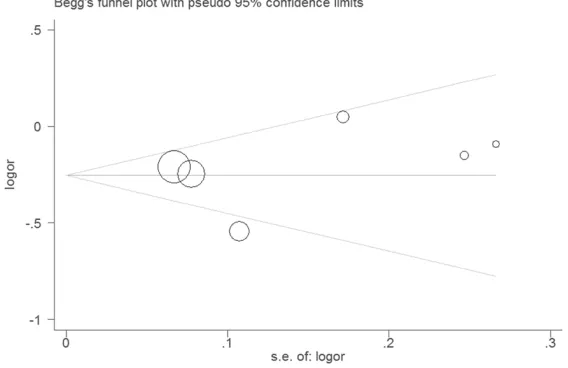
Funnel plot and Begg’s test were conducted to assess the publication bias. The shape of fun-Statistical analysis
The strength of association between ZBTB20 rs9841504 polymorphism and gastric cancer risk was assessed by calculating OR with 95% CI. A statistical test for heterogeneity was per-formed based on the Q statistic. The P > 0.10 of the Q-test indicated a lack of heterogeneity among studies. The summary OR estimate of each study was calculated by the
random-effects model. Stratified analysis was
per-formed by race. Potential publication bias was examined by funnel plot and Egger’s test. All statistical tests were performed with the soft-ware Reviewer Manager version 5.1 and STATA 12.0. A P value <0.05 was considered
statisti-cally significant.
Results
Characteristics of the studies
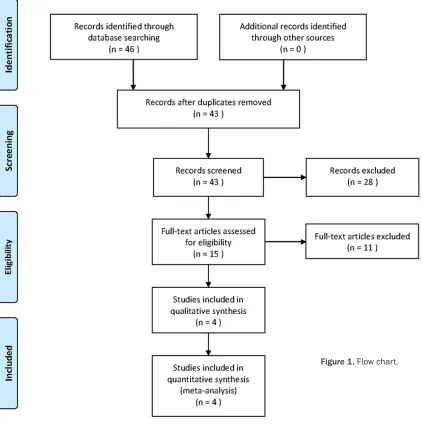
As shown in Figure 1, a total of 43 records were
initially identified. When the full-texts were
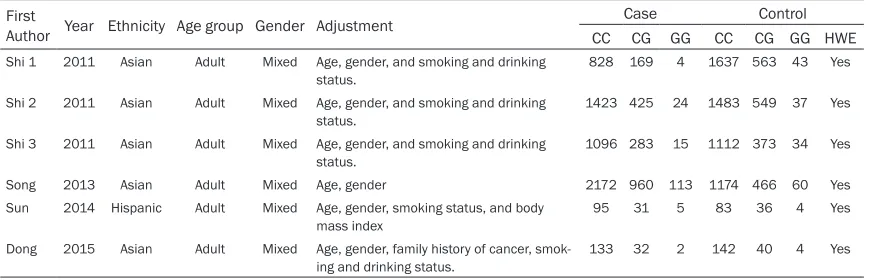
examined, we excluded 39 articles. Finally, 4 publications containing 6 case-control studies with a total of 7810 cases and 7840 controls were enrolled in this meta-analysis. The charac-teristics of the included studies were listed in
[image:3.612.90.526.85.225.2]Table 1. The NOS scores were listed in Table 2.
Quantitative data syn-thesis
As shown in Figure 2, we found that ZBTB- 20 rs9841504
poly-morphism significant -mass index
Dong 2015 Asian Adult Mixed Age, gender, family history of cancer,
smok-ing and drinksmok-ing status. 133 32 2 142 40 4 Yes
[image:3.612.92.410.271.364.2]HWE: Hardy-Weinberg equilibrium.
Table 2. Quality scores of the studies
Study Selection Comparability Outcome Overall quality
Shi 1 4 3 2 9
Shi 2 4 3 2 9
Shi 3 4 3 2 9
Song 4 2 2 8
Sun 4 2 3 9
TB20 rs9841504 po- lymorphism and gas-tric cancer risk. We found that ZBTB20 rs9841504
polymor-phism significantly
[image:4.612.95.517.75.194.2]as-sociated with decre- ased gastric cancer risk. In the subgroup analysis by race, Asi- an with ZBTB20 rs- 9841504 polymorph-
Figure 2. Meta-analysis of the association between ZBTB20rs9841504 polymorphism gastric cancer risk.
Figure 3. Sensitivity analysis of the association between ZBTB20rs9841504
[image:4.612.92.410.252.351.2]polymorphism gastric cancer risk.
Table 3. Meta-analysis results
Pheterogeneity Model OR (95% CI) P value Overall 0.04 R 0.78 (0.67-0.91) 0.001
Asian 0.03 R 0.78 (0.66-0.91) 0.002
Hispanic - R 0.91 (0.54-1.53) 0.72
Adjust
Age, gender, and smoking 0.09 R 0.75 (0.67-0.87) <0.001 Age, gender, smoking and drinking 0.06 R 0.74 (0.63-0.87) 0.0002
R, random effects model.
ism showed decreased gas-tric cancer risk. But Hispan- ic with ZBTB20 rs9841504 polymorphism did not show decreased gastric cancer risk. The association between ZBTB20 and other diseases were reported. Zhang et al. reported that a cognate ZBTB20 site in AFP promoter which mediates the postnatal repression of AFP gene in the liver [9]. Zhou et al. indicated that ZBTB20 as a crucial regu-lator governing the terminal differentiation of hypertrophic chondrocytes at least partial-ly through repression of Sox9 [10]. Jiang and colleagues nel plot was symmetry (Figure 4). Egger’s test
did not detect obvious publication bias (P = 0.99).
Discussion
This present meta-analysis of 6 case-control studies evaluated the association between ZB-
suggested that though specific deletion of tran -scription factor Zbtb20 in Sertoli cells has no
apparent influence on spermatogenesis, its specific localization in Sertoli cells makes Zbtb20 a useful marker for the identification of
[image:4.612.92.374.386.578.2]modu-lating TRP channels expression in nociceptors [12]. Cordeddu and coworkers found that a genetic link between these disorders and delin-eates the impact of ZBTB20 dysregulation on development, growth and metabolism [13]. In conclusion, our meta-analysis study
con-firmed that ZBTB20 rs9841504 polymorphism
might reduce the risk for gastric cancer. Disclosure of conflict of interest
None.
Address correspondence to: Xiaoshan Feng, De-
partment of Oncology, The First Affiliated Hospital of
Henan University of Science and Technology, No. 24 Jing-Hua Road, Luoyang 471003, Henan, China. Tel: +86-0379-64830609; E-mail: fengxiaoshanhn@ 163.com
References
[1] Siegel R, Ma J, Zou Z, Jemal A. Cancer statis-tics, 2014. CA Cancer J Clin 2014; 64: 9-29. [2] Coburn N, Seevaratnam R, Paszat L, Helyer L,
Law C, Swallow C, Cardosa R, Mahar A, Lourenco LG, Dixon M, Bekaii-Saab T, Chau I,
Church N, Coit D, Crane CH, Earle C, Mansfield
P, Marcon N, Miner T, Noh SH, Porter G, Posner MC, Prachand V, Sano T, van de Velde C, Wong S, McLeod R. Optimal management of gastric cancer: results from an international RAND/ UCLA expert panel. Ann Surg 2014; 259: 102-8.
[3] Xie Z, Zhang H, Tsai W, Zhang Y, Du Y, Zhong J,
Szpirer C, Zhu M, Cao X, Barton MC, Grusby
Jiang Y, Li Z, Chu M, Ma H, Chen J, Jin G, Tan W, Wu T, Zhang Z, Lin D, Shen H. A genome-wide
association study identifies new susceptibility
loci for non-cardia gastric cancer at 3q13.31 and 5p13.1. Nat Genet 2011; 43: 1215-1218. [6] Song HR, Kim HN, Kweon SS, Choi JS, Shim HJ,
Cho SH, Chung IJ, Park YK, Kim SH, Choi YD, Joo KW, Shin MH. Genetic variations in the PRKAA1 and ZBTB20 genes and gastric can-cer susceptibility in a Korean population. Mol Carcinog 2013; 52 Suppl 1: E155-160. [7] Sun Y, Gu J, Ajani JA, Chang DW, Wu X,
Stroehlein JR. Genetic and intermediate phe-notypic susceptibility markers of gastric cancer in Hispanic Americans: a case-control study. Cancer 2014; 120: 3040-3048.
[8] Dong Y, Chen J, Chen Z, Tian C, Lu H, Ruan J, Yang W. Evaluating the Association of Eight Polymorphisms with Cancer Susceptibility in a Han Chinese Population. PLoS One 2015; 10: e0132797.
[9] Zhang H, Cao D, Zhou L, Zhang Y, Guo X, Li H, Chen Y, Spear BT, Wu JW, Xie Z, Zhang WJ.
ZBTB20 is a sequence-specific transcriptional
repressor of alpha-fetoprotein gene. Sci Rep 2015; 5: 11979.
[10] Zhou G, Jiang X, Zhang H, Lu Y, Liu A, Ma X, Yang G, Yang R, Shen H, Zheng J, Hu Y, Yang X, Zhang WJ, Xie Z. Zbtb20 regulates the terminal differentiation of hypertrophic chondrocytes via repression of Sox9. Development 2015; 142: 385-93.
[11] Jiang X, Zhang H, Yin S, Zhang Y, Yang W, Zheng W, Wang L, Wang Z, Bukhari I, Cooke HJ, Iqbal
F, Shi Q. Specific deficiency of Plzf paralog,
[image:5.612.92.376.77.261.2]Zbtb20, in Sertoli cells does not affect sper-matogenesis and fertility in mice. Sci Rep 2014; 4: 7062.
Figure 4. Funnel plot of the association between ZBTB20rs9841504 poly-morphism gastric cancer risk.
K. MicroRNA122 is a key
regulator of α-fetoprotein expression and
influen-ces the aggressiveness of hepatocellular carcinoma. Nat Commun 2011; 2: 338.
[12] Ren AJ, Wang K, Zhang H, Liu A, Ma X, Liang Q, Cao D, Wood JN, He DZ, Ding YQ, Yuan WJ, Xie Z, Zhang WJ. ZBTB20 regulates nociception and pain sensation by modulating TRP chan-nel expression in nociceptive sensory neurons. Nat Commun 2014; 5: 4984.
[13] Cordeddu V, Redeker B, Stellacci E, Jongejan
A, Fragale A, Bradley TE, Anselmi M, Ciolfi A,
Cecchetti S, Muto V, Bernardini L, Azage M,