Online Sentence Segmentation for Simultaneous Interpretation
using Multi-Shifted Recurrent Neural Network
Xiaolin Wang Masao Utiyama Eiichiro Sumita
Advanced Translation Research and Development Promotion Center National Institute of Information and Communications Technology, Japan {xiaolin.wang,mutiyama,eiichiro.sumita}@nict.go.jp
Abstract
This paper is devoted to developing a re-current neural network (RNN) solution for segmenting the unpunctuated transcripts generated by automatic speech recognition for simultaneous interpretation. RNNs are effective in capturing long-distance depen-dencies and straightforward for online de-coding. Thus, they are ideal for the task compared to the conventionaln-gram lan-guage model (LM) based approaches and recent neural machine translation based approaches. This paper proposes a multi-shifted RNN to address the trade-off be-tween accuracy and latency, which is one of the key characteristics of the task. Ex-periments show that our proposed method improves the segmentation accuracy mea-sured in F1 by 21.1% while maintains ap-proximately the same latency, and reduces the BLEU loss to the oracle segmenta-tion by 28.6%, when compared to a strong baseline of the RNN LM-based method. Our online sentence segmentation toolkit is open-sourced1to promote the field.
1 Introduction
Simultaneous interpretation (SI) is to translate one spoken language into another spoken language in real time. Automated SI typically requires inte-grating two fundamental natural language process-ing technologies – automatic speech recognition (ASR) and machine translation (MT). Both tech-nologies have become quite capable after half a
c
°2019 The authors. This article is licensed under a Creative Commons 4.0 licence, no derivative works, attribution, CC-BY-ND.
1
https://github.com/arthurxlw/cytonNss
even cats were watching this video cats were watching other cats watch this video but what ’s important here is the creativity that it inspired amongst this techie geeky internet culture there were remixes someone made an old timey ver-sion and then it went international there were remixes someone made an old timey version
Table 1: Illustration of Input for Sentence Segmentation
century’s intensive study, but one problem makes it difficult for them to work together – the raw tran-scripts generated by ASR contains no segmenta-tion (see Table 1 for an example), while MT ex-pects segmented sentences as input.
Online sentence segmentation smoothly bridges the gap between ASR and MT through segment-ing the transcripts generated by ASR engines into sentences in real time. As a matter of fact, the task is non-trivial. The example presented in Table 1 is extracted from a TED talk 2, which is used in the experiments of this paper. Readers may find the raw sequence of words difficult to read. How-ever, the readability is greatly improved once it is segmented as follows,
• even cats were watching this video
• cats were watching other cats watch this video
• but what ’s important here is the creativity that it inspired amongst this techie geeky in-ternet culture
• there were remixes
• someone made an old timey version 2
• and then it went international
• there were remixes someone made an old timey version
Therefore, sentence segmentation is a meaningful natural language processing task. Correctly seg-menting an ASR transcript requires a certain level of understanding the content.
This paper proposes a multi-shifted RNN to ap-proach the problem of online sentence segmenta-tion, which shifts target signals by multiple dura-tions of time as illustrated by Table 2. This design emphasizes two central elements of the task – ac-curacy and latency. Usually, predicting a sentence boundary immediately after a last input word is not wise. Instead, waiting and checking a few words to make sure that a new sentence has started can raise the accuracy at the cost of latency. Shifting the tar-get signalsntime stamps right implements the idea of waiting and checking more words, but the opti-malnvaries on different textual contexts. There-fore, the proposed network learns multiple shifted target signals during training, and maintains multi-ple pathway of trading latency with accuracy dur-ing test. Experimental results demonstrate the ef-fectiveness of our proposed method.
The contributions of this paper include,
• proposing a multi-shifted RNN for online sentence segmentation;
• achieving competitive performance on a real-world corpus;
• releasing the source code for reproducibility.
The rest of the paper is organized as fol-lows. Section 2 reviews a baseline n-gram LM-based method which serves as a foundation of our method. Section 3 describes our method from the aspects of training, decoding and tuning. Sec-tion 4 presents the experiments. SecSec-tion 5 com-pares our method with some related works. Sec-tion 6 concludes this paper with a descripSec-tion on future works.
2 Baseline:N-gram LM-based Method N-gram LMs are used to segment unpunctuated transcripts by Stolcke et al. (1996; 1998) and Wang et al. (2016). They view sentence boundaries as hidden events occurring between the input words, and usen-gram LMs to compute the likelihood of
the input words with or without sentence bound-aries. Among them, the work of Wang et al.(2016) is the most related to this paper, because it ad-dresses segmenting in an online manner for SI. Suppose an input sequence of words is· · ·,wt−1,
wt, wt+1,· · ·. The following two hypotheses are considered,
• Hypothesis I: there is no sentence boundary
after the wordwt, which assumes that the un-derlying input remains the same as· · ·,wt−1, wt,wt+1,· · ·.
• Hypothesis II: there is a sentence boundary
after the word wt, which assumes that the underlying input is · · ·, wt−1, wt, h/si, hsi,
wt+1,· · · .
The segmentation is predicted by comparing the probabilities of the two sequences as,
st =
PthIIi
PthIi
= p(h/si|wtt−o+2)· p(wt+1|hsi)
p(wt+1|wtt−o−2)
· t−Yo+1
k=t+2
p(wk|wkt+1−1,hsi)
p(wk|wkk−−1o+1)
(1)
whereois the order of an-gram LM, andstis the confidence score of placing a sentence boundary afterwt. The left hand of the formula has one item forhsi, wt+1, . . . ,wt+o−1, respectively.
Theoret-ically, theo-1 future wordswt+1, . . . ,wt+o−1 are required when predicting the segmentation for the time stampt. Empirically, it is found that 1 or 2 future words is enough for accuracy while having the merit of low latency.
Time Stamp 1 2 3 4 5 6 7 8 9 10 11 12 13 . . .
Input i ’d like some tea and cake† that will be a very nice . . .
Target 0 0 0 0 0 0 1 0 0 0 0 0 0 . . .
Shift by 1 0 0 0 0 0 0 0 1 0 0 0 0 0 . . .
Shift by 2 0 0 0 0 0 0 0 0 1 0 0 0 0 . . .
Shift by 3 0 0 0 0 0 0 0 0 0 1 0 0 0 . . .
[image:3.595.87.509.72.145.2]Shift by 4 0 0 0 0 0 0 0 0 0 0 1 0 0 . . .
Table 2: Illustration of Multi-Shifted Target Signals for Sentence Segmentation. The input is a sequence of words. The target
signals are 0’s and 1’s where 1 means a sentence boundary after the current time stamp. The last four rows shift the target signals by 1 to 4 time units.†Suppose the sentence ends here.
u ]vP
ZEE > Ç Œí
ZEE > Ç Œî
ZEE > Ç Œï
Æš
Kµš‰µšD ‰‰]vP
^}(šu Æ Çš
Æšrí Çšrí
y š=í
Çš=í
Figure 1: Network Architecture of Multi-shifted RNN
Sen-tence Segmentor
proposed method addresses both issues; thus, it achieves even higher accuracy.
3 Our Method
3.1 Network Architecture
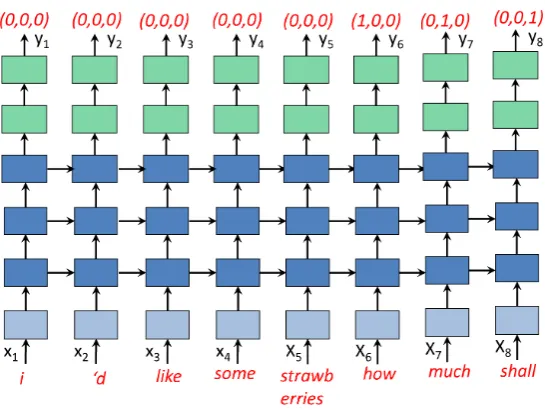
A network architecture inspired by RNN LM is adopted (illustrated by Figure 1). The network works in an online manner by taking one wordxt at each time stamptas input, and outputtingytfor sentence segmentation.
The outputyt is an (m+ 1)-dimensional vec-tor (yth1i, yht2i, . . ., ythmi, yhtm+1i), where ythki (
1 6 k 6 m) presented the confidence of putting a sentence boundary after the k-th word before the time stampt, whileyhtm+1iis imposed by the soft-max layer to sum up the probabilities to one. To be precise,
• yth1iindicated segmenting afterwt−1;
• yth2iindicated segmenting afterwt−2;
• . . .
• yhtmiindicated segmenting afterwt−m;
• yhtm+1iequals to1−yth1i−yth2i. . .−ythmi.
In contrast to LM-based methods, this design re-moves the use of a fixed number of future words. It enables the network to predict a sentence bound-ary flexibly to time stamps.
3.2 Training
The proposed network is trained on the samples extracted from neighboring sentences, and the training target is to match the output yt with the oracle segmentation signals. The following two paragraphs explain these two aspects in details.
3.2.1 Extracting Training Samples
SupposeS= (S1,S2, . . . ) is a sequence of sen-tences which are taken from continuous text. In other words,Si+1is the succeeding sentence ofSi.
SupposeSi= (wi1,w2i, . . . ,wnii) wherew
i t(16
t6ni) are theniwords in the sentence.
One training sample (Xi ,ni) is extracted from (Si,Si+1) as ( illustrated by Figure 2 ),
xt=
½ wi
t 16t6ni
wti+1−ni ni+ 16t6ni+m (2)
whereXi = (x1, x2, . . . , xni+m)is a sequence of input words.
3.2.2 Training Criterion
The desired value ofytis formulated as,
ythki=.
1 16t6ni, k=m+ 1
1 ni+ 16t6ni+m, k=t−ni
0 otherwise
(3)
[image:3.595.90.273.209.401.2]train-Figure 2: Unrolling a Sample on Multi-shifted RNN Sentence Segmentor. The ASR transcript is “i ’d like some strawberries
how much does it cost” where the first sentence ends after “strawberries”. Note thatyt’s last dimensionyth4i=1−yh
1i t −yh
2i t − yht3iis omitted for simplicity.
ing criterion,
E(S) =− E
(Xi,ni) Ã ni
X
t=1
log yhtm+1i
+
nXi+m
t=ni+1
log yht−nii
t
! (4)
Note that the equation 4 treats each dimension of the outputytseparately. Other sophisticated train-ing criteria that encourage the cooperation among different dimensions have been tried, such as
E(S) =− E
(Xi,ni) Ãni
X
t=1
log ythm+1i
+ nmaxi+m
t=ni+1
log yht−nii
t
¶ (5)
which requires only one of the output to be 1 if the corresponding position is a sentence bound-ary. However, decrease of segmentation accu-racy is observed from this kind of training crite-ria. We suspect that these criteria introduce de-pendency among the different dimensions, which reduces the robustness of the method and eventu-ally harms the performance. Therefore, the idea has been avoided.
3.3 Decoding
Decoding on the proposed network is to infer the position of sentence boundaries from a se-quence of real-number vectors yt. The decod-ing method should be both simple enough to
cause no additional latency, and effective enough to achieve competitive accuracy. Therefore, the threshold-latency hybrid decoding strategy pro-posed by Wang et al. (2016) is extended for the proposed network (illustrated by Figure 3).
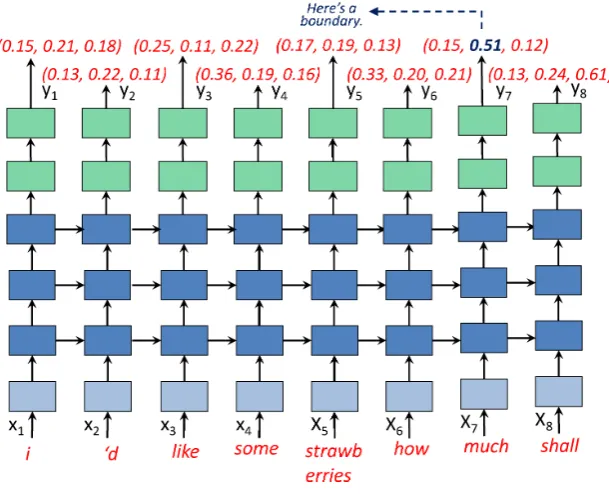
The extended decoding strategy uses an m-dimensional threshold vector θ=(θh1i, θh2i, . . .,
θhmi) to deal with the m-dimensional output y
t. The strategy works as, for each time stampt,
1. ifythkiexceedsθhki(k=m, m−1, . . . ,1),
setˆt=t−kand go to3;
2. if the buffered input exceed the maximum length, findargmaxt′,k(yth′ki−θhki), setˆt= t′−kand go to3;
3. predict a sentence boundary after ˆt, and restart the decoding fromˆt+ 1.
The method of tuningθis described in Section 3.4.
3.4 Tuning
This subsection first defines an empirical score to measure the overall performance of online sen-tence segmentation, which serves as a target for tuning; then presents an algorithm to search for the optimal threshold vector to maximize the score.
3.4.1 Performance Measurement
[image:4.595.163.436.67.272.2]Figure 3: Decoding a Sample on Multi-shifted RNN Sentence Segmentor. Suppose the threshold vector is(0.40,0.50,0.60). yh72iis the first value that exceeds the corresponding thresholdθh2i. This correctly predicts a sentence boundary after the time stamp 5. Note thatyt’s last dimensionyth4i=1−yh
1i t −yh
2i t −yh
3i
t is omitted for simplicity.
users often judge the performance based on sen-tences – how many predicted sensen-tences are cor-rect and how many oracle sentences are recalled. TheF1 score summarizes the precision and recall through calculating the harmonic mean as,
F1= 2 precision·recall
precision+recall. (6)
The latency of sentence segmentation is mea-sured as the average distance per word between the time stamp when a word is input to the segmentor, and the time stamp when this word is output as part of a sentence. Please see Section 4.2 on calculat-ing the latency of the oracle segmentation for an example.
An empirical score is proposed to summarize accuracy and latency, calculated as
score=F1−α·latency, (7)
The trade-off existed because a segmentor could either trade latency for accuracy by waiting for more input words to re-evaluate a prediction, or trade accuracy for latency by predicting boldly without waiting for more evidence brought by in-put words. The trade-off ratio α is set to 0.01 in this paper according to our observation on SI users and our test on practical sentence segmen-tors. Note that this ratio can be changed to fit
practical applications without the need to revise the proposed method.
3.4.2 Tuning Algorithm
Manually tuning the threshold vector θ for the proposed network is unfeasible as it hasm dimen-sions. Therefore, we propose to use a heuristic greedy search to maximize the score on a develop set, presented in Algorithm 1. The algorithm in-creases the efficiency by,
• prioritizing the threshold vectors whose par-ent have achieved high scores;
• pruning the search space by the heuristic that theθhki(k= 1. . . m) should be in descend-ing order.
The intuition for the second point is that a higher threshold should be given to the value derived from fewer future words, because the evidence under that circumstance is weaker.
4 Experiments
4.1 Experimental Setting
The corpora from the shared task in the interna-tional workshop on spoken language translation (IWSLT 2015) are used as the experimental cor-pora (Cettolo et al., 2015)3. The task is to translate
3
Algorithm 1 Tuning Threshold Vector
Require: θ0 ⊲a seed threshold vector Require: D ⊲a development set Require: µ ⊲a search step on threshold Require: ν ⊲a margin on score
1: Θ←[θ0: 0]⊲a sorted list of threshold vectors descending on the scores of their parents
2: s∗← −∞ ⊲the best score
3: θ∗ ←θ0 ⊲the best threshold vector
4: dict← {} ⊲a dictionary of visited threshold vectors
5: forθin the beginning ofΘdo
6: removeθfromΘ
7: ifθ′not indictthen
8: dict←dict∪ {θ}
9: s←decodeDusingθand evaluate
10: if s>s∗−νthen
11: if s > s∗then
12: s∗ ←s
13: θ∗ ←θ
14: end if
15: forkin1tom do
16: θ′ ←increase/decreaseθhkiby µ
17: if θ′hk−1i>θ′hki>θ′hk+1i
and0.06θ′hki61.0 then
18: Θ←Θ∪[θ′:s]
19: end if
20: end for
21: end if
22: end if
23: end for returnθ∗
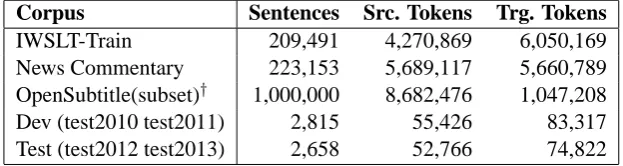
English TED talks into Chinese. Table 3 presents the statistics of the corpora. The news commen-tary corpora (Tiedemann, 2012)4 and a subset of the OpenSubtitles corpora (Lison and Tiedemann, 2016)5are used to scale up the in-domain training set in order to achieve higher performance.
The corpora are pre-processed using standard procedures for MT. The English text is tokenized using the toolkit released with the Europarl cor-pus (Koehn, 2005) and converted to lower case. The Chinese text is tokenized into Chinese char-acters and English words using the tool of
spli-tUTF8Characters.pl from the NIST Open
Ma-chine Translation 2008 Evaluation6
4http://opus.nlpl.eu/News-Commentary.php 5
http://opus.nlpl.eu/OpenSubtitles2016.php
6
ftp://jaguar.ncsl.nist.gov/mt/resources/
Two operations are applied in order to simu-late the transcripts generated by ASR following the setting in (Wang et al., 2016) and (Cho et al., 2017). First, because ASR engines normally do not produce punctuation, punctuation is removed from the text. Second, because ASR engines split output based on long pauses, and each of the output contains multiple sentences; every 10 neighboring sentences in the development and test set are con-catenated to form an input for sentence segmenta-tion.
Two baselines are used in the experiments. The first baseline is then-gram LM-based method pro-posed by Wang et al. (2016). The toolkit of SRILM (Stolcke, 2002)7 is used to build n-gram LMs with Kneser-Ney Smoothing and an order of 6.
The second baseline is an extension of the first one by replacing the n-gram LM with an RNN LM. The settings of RNN LM follow the large LSTM setting used by Zaremba et al. (2014) which consists of two layers of 1500 LSTM units (Hochreiter and Schmidhuber, 1997), and a vocabulary size of 10K. A dropout of 0.65 is ap-plied to the non-recurrent connections.
The proposed neural network adopts three layers of 512 LSTM units, and an input vocabulary size of 20K according to our pilot experiments. The output dimensionmis 6. A dropout of 0.50 is ap-plied to the non-recurrent connections. Larger net-works have been tried in our experiments, but no significant improvement has been observed.
Both the proposed network and RNN LM are trained using SGD with a start learning rate of 1.0. The cross-entropy on the development set is mea-sured after each epoch. When the development cross-entropy stops decreasing, the learning rate starts to decay by 0.5 per epoch. The training ter-minates when no improvement is made during 3 continuous attempts of decaying learning rates.
The numbers of future words for the two base-line methods are enumerated from 1 to 6, and the decoding thresholds are tuned by a grid search from -1.6 to 1.6 with a step of 0.2. The decoding threshold vector for the proposed method is tuned by Algorithm 1 with θ0 = (0.9, 0.8, 0.7, 0.6, 0.5, 0.4), µ= 0.1, andν = 0.04 . The maximum sen-tence length is set to 40 for all the methods, which covers approximately 95% development and test sentences.
7
Corpus Sentences Src. Tokens Trg. Tokens IWSLT-Train 209,491 4,270,869 6,050,169 News Commentary 223,153 5,689,117 5,660,789 OpenSubtitle(subset)† 1,000,000 8,682,476 1,047,208 Dev (test2010 test2011) 2,815 55,426 83,317 Test (test2012 test2013) 2,658 52,766 74,822
Table 3: Experimental Corpora.†The subset consists of the first one million sentence pairs.
The software is implemented using C++ and NVIDIA’s GPU-accelerated libraries. The exper-iments are run on a workstation equipped with an Intel Xeon CPU E5-2630 and a GPU Quadro M4000.
4.2 Evaluation after Training on Standard Set
The three methods – two baselines and the pro-posed method – first learn their models on the source side of the standard training set (Table 3). Then-gram LM-based method learns a 6-ordered
n-gram LM whose perplexity on the development set is 148.17. The RNN LM-based method learns an RNN LM with a development perplexity of 62.93. The proposed method learns a network model with a development cross entropy of 0.441. After that, each method tunes its decoding param-eters on the development set to maximize the score (the equation 6). In the end, each method decodes the test set using its learned method and tuned pa-rameters. The evaluation of the results is presented in Table 4.
The proposed method outperforms the stronger baseline of the RNN LM-based method by 18.8% on the measurement of score, which is quite large. The improvement is caused by the rise of the mea-surement of accuracy –F1– which is improved by 13.5%, and the stableness of the latency which is only enlarged by 3.4%. This result indicates that the architecture of the proposed network suits the task better than that of RNN LM. In addition, the RNN LM-based method outperforms the n-gram LM-based method by 67.7%. This confirms our expectation that RNN can model a sentence better thann-gram as it can capture long-distance depen-dencies.
The table also presents the latency of the oracle segmentation which assumes that every sentence is submitted to MT engines as soon as it ends. Sup-pose thei-th sentence hasliwords, the average la-tency per word would be
P
ili·(li−1)/2
P
ili . On the
ex-perimental test set in, the latency of the oracle seg-mentation is 8.126, and the latency of the proposed method is 12.386. This approximately means a de-lay of 4.2 words per sentence, which is acceptable in a real-world environment.
4.3 Evaluation after Adapting Models Trained on Scaled-up Set
Luong et al. (2015) and Cho et al. (2016) show that large-scale out-domain training data and model adaption can effective improve the quality of NMT models. They first train models on the union set of in-domain and out-domain data, and then adapt the models by resuming training on in-domain data only. Inspired by their work, we scale up the stan-dard training set to pursuit better performance for sentence segmentation (see Table 3 for details) .
Through scaling up training set and model adap-tation, the development perplexity of the RNN LM is reduced by 8.06% (from 62.93 to 57.86), and the development cross entropy of the model learned by the proposed method decreases by 0.082 (from 0.441 to 0.359).
Then-gram LM is adapted by linear interpreta-tion. The mixture weight is tuned to minimize the development perplexity, whose value turns out to be 0.7. The development perplexity of then-gram LM is reduced by 8.25% (from 148.16 to 135.93)
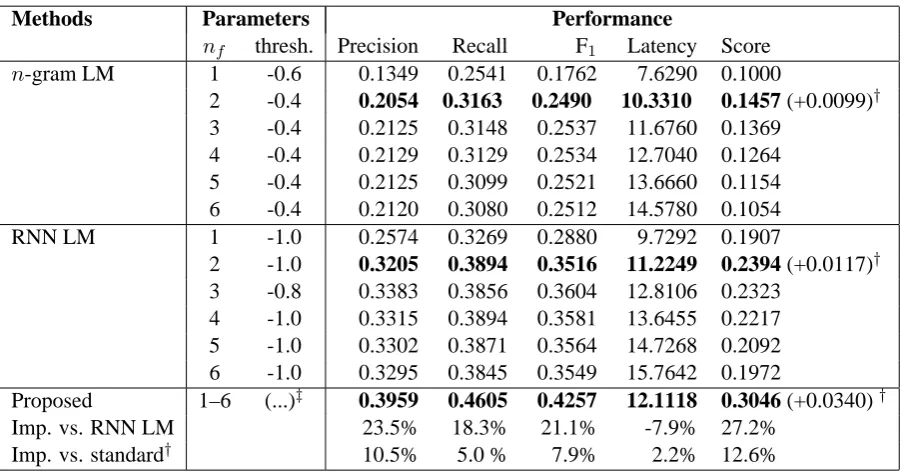
Each method again tunes its decoding parame-ters, and then decodes the test set as described in Section 4.2. Table 5 summarizes the results, and compares them with the previous ones on the stan-dard training set. The performance of all three methods is found to be improved, while the pro-posed method achieves the largest improvement.
Methods Parameters Performance
nf thresh. Precision Recall F1 Latency Score
Oracle 1.000 1.000 1.000 8.126 0.9187
n-gram LM 1 -0.6 0.1402 0.2432 0.1779 8.3410 0.0945 2 -0.6 0.1862 0.3087 0.2323 9.6480 0.1358 3 -0.6 0.1928 0.3005 0.2349 11.2520 0.1224 4 -0.6 0.1944 0.2993 0.2357 12.2930 0.1128 5 -0.6 0.1935 0.2959 0.2340 13.2410 0.1016 6 -0.6 0.1927 0.2937 0.2327 14.1570 0.0912 RNN LM 1 -0.8 0.2686 0.3213 0.2926 10.3503 0.1891 2 -0.6 0.3289 0.3683 0.3475 11.9733 0.2277 3 -0.8 0.3255 0.3743 0.3482 12.7531 0.2207 4 -0.8 0.3372 0.3845 0.3593 13.8317 0.2210 5 -0.8 0.3342 0.3822 0.3566 14.8643 0.2080 6 -0.8 0.3256 0.3740 0.3481 15.7449 0.1907 Proposed 1 – 6 (...)‡ 0.3583 0.4387 0.3945 12.3863 0.2706
[image:8.595.117.484.69.304.2]Improve† 8.9% 19.1% 13.5% -3.4% 18.8%
Table 4: Performance after Training on Standard Set.†Improvement versus the stronger baseline of RNN LM.‡The optimal threshold vector is (1.0, 0.8, 0.8, 0.5, 0.5, 0.3).
Methods Parameters Performance
nf thresh. Precision Recall F1 Latency Score
n-gram LM 1 -0.6 0.1349 0.2541 0.1762 7.6290 0.1000
2 -0.4 0.2054 0.3163 0.2490 10.3310 0.1457 (+0.0099)† 3 -0.4 0.2125 0.3148 0.2537 11.6760 0.1369
4 -0.4 0.2129 0.3129 0.2534 12.7040 0.1264 5 -0.4 0.2125 0.3099 0.2521 13.6660 0.1154 6 -0.4 0.2120 0.3080 0.2512 14.5780 0.1054
RNN LM 1 -1.0 0.2574 0.3269 0.2880 9.7292 0.1907
2 -1.0 0.3205 0.3894 0.3516 11.2249 0.2394 (+0.0117)† 3 -0.8 0.3383 0.3856 0.3604 12.8106 0.2323
4 -1.0 0.3315 0.3894 0.3581 13.6455 0.2217 5 -1.0 0.3302 0.3871 0.3564 14.7268 0.2092 6 -1.0 0.3295 0.3845 0.3549 15.7642 0.1972
Proposed 1–6 (...)‡ 0.3959 0.4605 0.4257 12.1118 0.3046 (+0.0340)†
Imp. vs. RNN LM 23.5% 18.3% 21.1% -7.9% 27.2%
Imp. vs. standard† 10.5% 5.0 % 7.9% 2.2% 12.6%
Table 5: Segmentation Performance after Adapting the Models Trained on Scaled-up Set.†Compared to the best score of each method on the standard training set.‡The optimal threshold vector is (0.9, 0.8, 0.5, 0.5, 0.5, 0.4)
happen on the RNN LM-based method. Therefore, adapting neural network models through resuming training is a very effective technique.
4.4 Evaluation of End-to-end Translation Quality
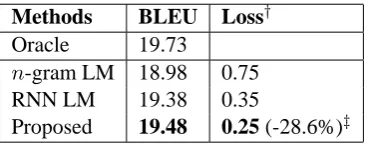
The best segmentations of each method, which are listed in Table 5 in bold font, are post-processed to recover case and punctuation, and then piped into
[image:8.595.74.528.351.587.2]Methods BLEU Loss† Oracle 19.73
n-gram LM 18.98 0.75 RNN LM 19.38 0.35
[image:9.595.91.278.70.142.2]Proposed 19.48 0.25 (-28.6%)‡
Table 6: Evaluation of End-to-end Translation Quality. †
Compared to the BLEU of the oracle sentence segmentation. ‡Compared to the stronger baseline of RNN LM.
in-house parallel corpus of approximately 21 mil-lion sentence pairs from various domains.
The translations are evaluated following the of-ficial guidelines of IWSLT 2015. The translations are aligned to reference sentences through edit dis-tance (Matusov et al., 2005). BLEU is calculated on cased tokens including Chinese characters and English words. Table 6 presents the results.
The results show that the proposed method achieves the highest BLEU, which is lower than that of the oracle segmentation only by 0.25. The improvement compared to the stronger baseline of the RNN LM-based method is 0.10 BLEU point, or 28.6% calculated by 0.10 / 0.35.
5 Related Works
Segmenting the unpunctuated transcripts gener-ated by ASR have attracted attentions from many researchers. A large variety of methods have been proposed.
Conditional random fields (CRFs) are used to approach the problem. Hassan et al. (2014) did a thorough treatment of this problem in 2014. How-ever, CRFs have been outperformed by neural net-works recently.
MT systems are used to approach the problem by Cho et al.(2015), Ha et al. (2015), Kzai et al. (2015), Cho et al. (2017), Pham et al. (2016), Klejch et al. (2016; 2017) and Przybysz et al. (2016). This approach builds MT systems to translate unpunctuated text into punctuated text which contains full stop marks as sentence bound-aries. The drawback of this approach is that MT systems normally expect complete sequences as input, which prevents them from working in an on-line manner. Cho et al. (2015; 2017) address the issue using sliding windows. A fixed-length sub-sequence of words are extracted from the stream of words, and then feed into MT systems. The short-age of this method is that the dependencies outside the sliding windows are ignored, which will
de-crease the accuracy. In contrast, our RNN-based method performs incremental decoding from the beginning of sentences, so it can capture all the de-pendencies within a whole sentence.
Pauses, or precisely the duration of silence be-tween two spoken words, which can be captured by ASR engines, are used to predict sentence bound-aries by F¨ugen et al. (2007) and Bangalore et al. (2012). However, studies on human interpreters reveal that segmenting merely by pauses is insuf-ficient, as human speakers might not pause be-tween sentences. The mean proportion of silence-based chunking by interpreters is 6.6% when the source is English, 10% when it is French, and 17.1% when it is German (Venuti, 2012). There-fore, this paper focuses on using linguistic infor-mation. Nevertheless, pauses can be directly inte-grated into our proposed method to boost perfor-mance.
There are several segmentation methods that target at splitting an input sentence into smaller pieces for simultaneous interpretation, such as Yarmohammadi et al. (2013), Oda et al. (2014), and Fujita et al. (2013). However, these meth-ods often assume that ASR transcripts have already been segmented into sentences, which is the task addressed by this paper. Therefore, our method is orthogonal to these methods, and it is possible to pipeline our proposed method with them.
6 Conclusion
In this paper, a multi-shifted RNN is proposed to solve the problem of segmenting the unpunctuated ASR transcripts for SI. The multi-shifted RNN ad-dresses the trade-off between accuracy and latency which are the two central elements of the problem. The experiments show that the proposed method greatly outperforms ann-gram LM-based method and an RNN LM-based method on accuracy, la-tency and end-to-end BLEU, under both a standard training set and a scaled-up training set.
Acknowledgement
References
Bahdanau, Dzmitry, Kyunghyun Cho, and Yoshua Ben-gio. 2014. Neural machine translation by jointly learning to align and translate. Proceedings of the
3rd International Conference on Learning Represen-tations., pages 1–15.
Bangalore, Srinivas, Vivek Kumar Rangarajan Srid-har, Prakash Kolan, Ladan Golipour, and Aura Jimenez. 2012. Real-time incremental speech-to-speech translation of dialogs. In Proceedings of the
2012 Conference of the North American Chapter of the Association for Computational Linguistics: Hu-man Language Technologies, pages 437–445.
Asso-ciation for Computational Linguistics.
Cettolo, Mauro, Jan Niehues, Sebastian St¨uker, Luisa Bentivogli, Roldano Cattoni, and Marcello Federico. 2015. The IWSLT 2015 evaluation campaign. In
IWSLT 2015, International Workshop on Spoken Language Translation.
Cho, Eunah, Jan Niehues, Kevin Kilgour, and Alex Waibel. 2015. Punctuation insertion for real-time spoken language translation. In Proceedings of the
Eleventh International Workshop on Spoken Lan-guage Translation.
Cho, Eunah, Jan Niehues, Thanh-Le Ha, Matthias Sper-ber, Mohammed Mediani, and Alex Waibel. 2016. Adaptation and combination of NMT systems: The KIT translation systems for IWSLT 2016. In
Pro-ceedings of the 13th International Workshop on Spo-ken Language Translation (IWSLT 2016).
Cho, Eunah, Jan Niehues, and Alex Waibel. 2017. Nmt-based segmentation and punctuation insertion for real-time spoken language translation. Proc.
In-terspeech 2017, pages 2645–2649.
F¨ugen, Christian, Alex Waibel, and Muntsin Kolss. 2007. Simultaneous translation of lectures and speeches. Machine Translation, 21(4):209–252.
Fujita, Tomoki, Graham Neubig, Sakriani Sakti, Tomoki Toda, and Satoshi Nakamura. 2013. Sim-ple, lexicalized choice of translation timing for si-multaneous speech translation. In INTERSPEECH, pages 3487–3491.
Ha, Thanh-Le, Jan Niehues, Eunah Cho, Mohammed Mediani, and Alex Waibel. 2015. The KIT trans-lation systems for IWSLT 2015. In Proceedings
of the twelveth International Workshop on Spoken Language Translation (IWSLT), Da Nang, Veitnam,
pages 62–69.
Hassan, Hany, Lee Schwartz, Dilek Hakkani-T¨ur, and Gokhan Tur. 2014. Segmentation and disfluency removal for conversational speech translation. In
Fifteenth Annual Conference of the International Speech Communication Association.
Hochreiter, Sepp and J¨urgen Schmidhuber. 1997. Long short-term memory. Neural computation,
9(8):1735–1780.
Klejch, Ondˇrej, Peter Bell, and Steve Renals. 2016. Punctuated transcription of multi-genre broadcasts using acoustic and lexical approaches. In Spoken
Language Technology Workshop (SLT), 2016 IEEE,
pages 433–440. IEEE.
Klejch, Ondˇrej, Peter Bell, and Steve Renals. 2017. Sequence-to-sequence models for punctuated tran-scription combining lexical and acoustic features. In
Acoustics, Speech and Signal Processing (ICASSP), 2017 IEEE International Conference on, pages
5700–5704. IEEE.
Koehn, Philipp, Hieu Hoang, Alexandra Birch, Chris Callison-Burch, Marcello Federico, Nicola Bertoldi, Brooke Cowan, Wade Shen, Christine Moran, Richard Zens, et al. 2007. Moses: Open source toolkit for statistical machine translation. In
Pro-ceedings of the 45th Annual Meeting of the Asso-ciation for Computational Linguistics on Interactive Poster and Demonstration Sessions, pages 177–180.
Association for Computational Linguistics.
Koehn, Philipp. 2005. Europarl: A parallel corpus for statistical machine translation. In Proceedings of MT
Summit, volume 5, pages 79–86.
Kzai, Michaeel, Brian Thompson, Elizabeth Salesky, Timothy Anderson, Grant Erdmann, Eric Hansen, Brian Ore, Katherine Young, Jeremy Gwinnup, Michael Hutt, and Christina May. 2015. The MITLL-AFRL IWSLT 2015 systems. In
Proceed-ings of the twelveth International Workshop on Spo-ken Language Translation (IWSLT), Da Nang, Veit-nam, pages 23–30.
Lison, Pierre and J¨org Tiedemann. 2016. OpenSub-titles2016: Extracting large parallel corpora from movie and TV subtitles.
Luong, Minh-Thang and Christopher D Manning. 2015. Stanford neural machine translation systems for spoken language domains. In Proceedings of the
International Workshop on Spoken Language Trans-lation, pages 76–79.
Luong, Thang, Hieu Pham, and Christopher D. Man-ning. 2015. Effective approaches to attention-based neural machine translation. In Proceedings of the
2015 Conference on Empirical Methods in Natu-ral Language Processing, pages 1412–1421, Lisbon,
Portugal, September. Association for Computational Linguistics.
Matusov, Evgeny, Gregor Leusch, Oliver Bender, Her-mann Ney, et al. 2005. Evaluating machine trans-lation output with automatic sentence segmentation. In IWSLT, pages 138–144. Citeseer.
Mikolov, Tom´aˇs, Martin Karafi´at, Luk´aˇs Burget, Jan ˇ
Cernock`y, and Sanjeev Khudanpur. 2010. Recurrent neural network based language model. In Eleventh
Oda, Yusuke, Graham Neubig, Sakriani Sakti, Tomoki Toda, and Satoshi Nakamura. 2014. Optimiz-ing segmentation strategies for simultaneous speech translation. In ACL (2), pages 551–556.
Pham, Ngoc-Quan, Matthias Sperber, Elizabeth Salesky, Thanh-Le Ha, Jan Niehues, and Alex Waibel. 2016. KIT’s Multilingual Neural Machine Translation systems for IWSLT 2017. In
Proceed-ings of the 14th International Workshop on Spoken Language Translation (IWSLT 2017), pages 42–47.
Przybysz, Pawel, Marcin Chochowski, Rico Sennrich, Barry Haddow, and Alexandra Birch. 2016. The Samsung and University of Edinburghs submission to IWSLT17. In Proceedings of the 14th
Interna-tional Workshop on Spoken Language Translation (IWSLT 2017), pages 23–28.
Stolcke, Andreas and Elizabeth Shriberg. 1996. Au-tomatic linguistic segmentation of conversational speech. In Spoken Language, 1996. ICSLP 96.
Pro-ceedings., Fourth International Conference on,
vol-ume 2, pages 1005–1008. IEEE.
Stolcke, Andreas, Elizabeth Shriberg, Rebecca A Bates, Mari Ostendorf, Dilek Hakkani, Madelaine Plauche, G¨okhan T¨ur, and Yu Lu. 1998. Automatic detec-tion of sentence boundaries and disfluencies based on recognized words. In Proceedings of 5th
Interna-tional Conference on Spoken Language Processing,
pages 2247–2250.
Stolcke, Andreas. 2002. SRILM - an extensible lan-guage modeling toolkit. In Proceedings of the 7th
International Conference on Spoken Language Pro-cessing.
Tiedemann, J¨org. 2012. Parallel Data, Tools and In-terfaces in OPUS. In LREC, volume 2012, pages 2214–2218.
Venuti, Lawrence. 2012. The translation studies reader. Routledge.
Wang, Xiaolin, Andrew Finch, Masao Utiyama, and Eiichiro Sumita. 2016. An efficient and effective online sentence segmenter for simultaneous inter-pretation. In Proceedings of the 3rd Workshop on
Asian Translation (WAT2016), pages 139–148,
Os-aka, Japan, December. The COLING 2016 Organiz-ing Committee.
Yarmohammadi, Mahsa, Vivek Kumar Rangarajan Sridhar, Srinivas Bangalore, and Baskaran Sankaran. 2013. Incremental segmentation and decoding strategies for simultaneous translation. In IJCNLP, pages 1032–1036.
Zaremba, Wojciech, Ilya Sutskever, and Oriol Vinyals. 2014. Recurrent neural network regularization.