A Perplexity-Based Method for Similar Languages Discrimination
Pablo Gamallo
CiTIUS
Univ. of Santiago de Compostela Galiza
Jose Ramom Pichel imaxin|software, Santiago de Compostela,
Galiza
I˜naki Alegria
IXA group
Univ. of the Basque Country UPV/EHU
Abstract
This article describes the system submit-ted by the Citius Ixa Imaxin team to the VarDial 2017 (DSL and GDI tasks). The strategy underlying our system is based on a language distance computed by means of model perplexity. The best model config-uration we have tested is a voting system making use of severaln-grams models of both words and characters, even if word unigrams turned out to be a very com-petitive model with reasonable results in the tasks we have participated. An error analysis has been performed in which we identified many test examples with no lin-guistic evidences to distinguish among the variants.
1 Introduction
Language detection is not a solved problem if the task is applied to the identification of simi-lar languages and varieties. Closely related lan-guages or language varieties are much more dif-ficult to identify and separate than languages be-longing to different linguistic families. In this article, we describe the system submitted by the Citius Ixa Imaxin team to the VarDial 2017. We have participated in two task: Discriminating be-tween Similar Languages (DSL) and German Di-alect Identification (GDI). The strategy underlying our system is based on comparing language mod-els using perplexity. Perplexity is defined as the in-verse probability of the test text given the model. Most of the best systems for language identifica-tion use probability-based metrics with n-grams models. This report paper (Zampieri et al., 2017) describes the shared task and compares all the pre-sented systems.
DSL is focused on discriminating between sim-ilar languages and national language varieties, in-cluding six different groups of related languages or language varieties:
• Bosnian, Croatian, and Serbian
• Malay and Indonesian
• Persian and Dari
• Canadian and Hexagonal French
• Argentine, Peninsular, and Peruvian Spanish
• Brazilian and European Portuguese
The objective of GDI is the identification of German varieties (four Swiss German dialect ar-eas: Basel, Bern, Lucerne, Zurich) based on speech transcripts.
Analysis about previous results on the two sce-narios can be found in Goutte et al. (2016) and Malmasi et al. (2015). The latter is focused on Arabic varieties but the scenario is similar to the GDI task.
2 Related Work
2.1 Language Identification and Similar Languages
Two specific tasks for language identification have attracted a lot of research attention in recent years, namely discriminating among closely related lan-guages (Malmasi et al., 2016) and language detec-tion on noisy short texts such as tweets (Zubiaga et al., 2015).
The Discriminating between Similar Languages (DSL) workshop (Zampieri et al., 2014; Zampieri et al., 2015; Goutte et al., 2016) is a shared task where participants are asked to train systems to discriminate between similar languages, language
varieties, and dialects. In the three editions or-ganized so far, most of the best systems were based on models built with high-order charactern -grams (>= 5) using traditional supervised learn-ing methods such as SVMS, logistic regression, or Bayesian classifiers. By contrast, deep learn-ing approaches based on neural algorithms did not perform very well (Bjerva, 2016).
In our previous participation (Gamallo et al., 2016) in the DSL 2016 shared task we pre-sented two very basic systems: classification with ranked dictionaries and Naive Bayes classifiers. The results showed that ranking dictionaries are more sound and stable across different domains while basic Bayesian models perform reasonably well on in-domain datasets, but their performance drops when they are applied on out-of-domain texts. We also observed that basic n-gram mod-els of characters and words work pretty well even if they are used with simple learning systems. In the current participation we decided to use basic
n-grams with a very intuitive strategy: to measure the distance between languages on the basis of the perplexity of their models.
2.2 Perplexity
The most widely-used evaluation metric for lan-guage models is the perplexity of test data. In language modeling, perplexity is frequently used as a quality measure for language models built with n-grams extracted from text corpora (Chen and Goodman, 1996; Sennrich, 2012). It has also been used in very specific tasks, such as to classify between formal and colloquial tweets (Gonz´alez, 2015).
3 Methodology
Our method is based on perplexity. Perplexity is a measure of how well a model fits the test data. More formally, the perplexity (called P P
for short) of a language model on a test set is the inverse probability of the test set. For a test set of sequences of characters CH = ch1, ch2, ..., chn and a language modelLM withn-gram probabili-tiesP(·)estimated on a training set, the perplexity PPofCHgiven a character-based n-gram model
LM is computed as follows:
P P(CH, LM) = n
v u u tYn
i
1
P(chi|chi−1 1) (1)
wheren-gram probabilitiesP(·)are defined in this way:
P(chn|chn−1 1) = C(ch
n−1 1 chn)
C(chn−1 1) (2)
Equation 2 estimates then-gram probability by dividing the observed frequency (C) of a particular sequence of characters by the observed frequency of the prefix, where the prefix stands for the same sequence without the last character. To take into account unseen n-grams, we use a smoothing technique based on linear interpolation.
A perplexity-based distance between two lan-guages is defined by comparing the n-grams of a text in one language with the n-gram model trained for the other language. Then, the perplex-ity of the test textCH in language L2, given the language modelLMof languageL1, can be used to define the distance,Distperp, betweenL1 and
L2:
Distperp(L1, L2) =P P(CHL2, LML1) (3)
The lower the perplexity ofCHL2givenLML1,
the lower the distance between languagesL1and
L2. The distanceDistperpis an asymmetric mea-sure.
In order to apply this measure to language identification given a test text, we compute the perplexity-based distance for all the language models and the test text, and the closest model is selected.
4 Experiments
4.1 Runs and Data
In the DSL task we have taken part in both tracks: closed and open. The open model was trained with the datasets released in previous DSL tasks (Mal-masi et al., 2016; Zampieri et al., 2015; Zampieri et al., 2014).
We prepared three runs for each task. All of them are based on perplexity but using different model configuration:
Run Accuracy F1 (micro) F1 (macro) F1 (weighted)
[image:3.595.152.447.62.119.2]run1 0.903 0.903 0.9025 0.9025 run2 0.9016 0.9016 0.9013 0.9013 run3 0.8791 0.8791 0.8787 0.8787
Table 1: Results for the DSL task (closed).
Run Accuracy F1 (micro) F1 (macro) F1 (weighted)
run1 0.9028 0.9028 0.9016 0.9016 run2 0.9069 0.9069 0.9065 0.9065 run3 0.8788 0.8788 0.8773 0.8773
Table 2: Results for the DSL task (open).
characters perform better than shorter ones. In previous experiments, this system configu-ration reached a similar score to the best sys-tem in the DSL Task 2016, namely 0.8926
accuracy, very close to0.8938reached by the best system in task A (C¸¨oltekin and Rama, 2016).
• Run2 uses perplexity with just 1-grams of words. In the development tests, we observed that this simple model is very stable over dif-ferent situations and tasks.
• Run3 also uses perplexity but with 7-grams of characters, since longn-grams of charac-ters tend to perform better than short ones.
4.2 Results
In the first task (Discriminating between Similar Languages) we submitted systems generated with both closed and open training.
4.2.1 DSL Closed
The results obtained by our runs in the DSL task are shown in Table 1. The random baseline (14 classes) is 0.071 and the references from the best system in 2016 is 0.8938 accuracy. However, it is worth noticing that 2016 and 2017 DSL tasks are not comparable because the varieties proposed for the two shared tasks are not exactly the same.
The table shows that best results are obtained using the two first configurations: Run1 and Run2. Let us notice that the second one reaches good re-sults even if it is based on a very simple models (just words unigrams). This is also true for the GDI task (see below in the Discussion section).
Our best run in task DSL achieved 0.903 accu-racy (9th position out of 11 systems) while the best system in this task reached 0.927.
hr bs sr
es-ar es-es es-pe fa-af fa-ir fr-ca fr-fr id my pt-br pt-pt
Predicted label hr
bs sr es-ar es-es es-pe fa-af fa-ir fr-ca fr-fr id my pt-br pt-pt
True label
Confusion Matrix
0.0 0.1 0.2 0.3 0.4 0.5 0.6 0.7 0.8 0.9
Figure 1: Confusion matrix: DSL run2
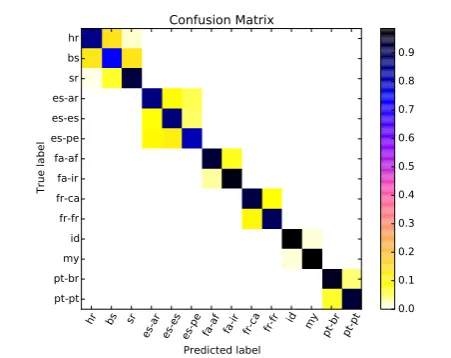
The confusion matrix for Run2 is shown in Fig-ure 1. Bosnian and Peruvian Spanish seem to be the most difficult languages/varieties to be distin-guished.
Comparing confusion matrices for Spanish vari-ants between Run1 and Run2, we can observe that although the results are similar in both cases, they guess and fail in a different way (Table 3). So, they seem to be quite complementary strategies.
4.3 DSL Open Training
[image:3.595.312.538.251.430.2]run1 run2
[image:4.595.181.420.61.131.2]es-ar es-es es-pe es-ar es-es es-pe es-ar 892 67 36 861 81 56 es-es 88 871 35 78 870 48 es-pe 111 126 763 87 104 809
Table 3: Confusion matrices in run1 and run2 for variants of Spanish
Run Accuracy F1 (micro) F1 (macro) F1 (weighted)
[image:4.595.156.445.165.220.2]run1 0.6262 0.6262 0.6118 0.6108 run2 0.6308 0.6308 0.613 0.612 run3 0.5921 0.5921 0.5785 0.5774
Table 4: Results for the GDI task.
4.4 GDI
The results for the GDI task are shown in Table 4. The majority class baseline is 0.258 and there were no previous results to compare with. However, the best results for Arabic dialects in VarDial 2016 (in similar conditions to GDI) were 0.513 (F-score).
The results are much lower than in DSL task. Several factors which can influence these results are the following:
• the GDI task has unbalanced test sets,
• the data are from speech transcription,
• the task itself is more difficult given the strong similarity of the varieties.
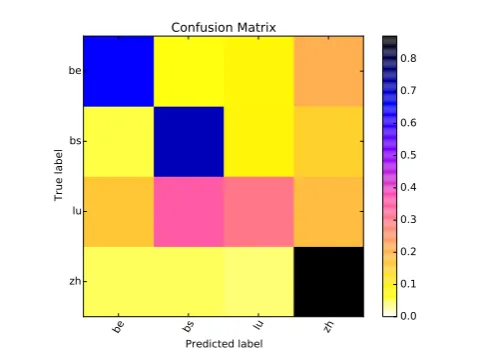
In this task, our best configuration is Run2, which, in spite of its simple model, improves the voting-based system. The confusion matrix for Run2 (see Figure 2) shows that the scores obtained for Lucerne dialect are very poor.
Run2 achieved 0.630 accuracy (8th position out of 10 systems) while the best system in this task reached 0.680. It is worth noticing that only two systems also involved in DSL 2016 task improve our results in GDI.
5 Discussion
The results show that our system, despite its sim-plicity, performs reasonably well. For the DSL task 2016 we obtained the second best perfor-mance even if the results are more discrete in 2017; and for the GDI task the results are better than the best score in 2016 for the Arabic Dialec-tal Identification task.
It can be underlined that the configuration of our run2 is very simple (just unigrams of words) and
be bs lu zh
Predicted label be
bs
lu
zh
True label
Confusion Matrix
0.0 0.1 0.2 0.3 0.4 0.5 0.6 0.7 0.8
Figure 2: confusion matrix: GDI run2
results using perplexity are very competitive. It could be considered as a baseline for the future.
In order to find key elements for further im-provement, we decided to carry out an analysis of errors on variants that we know quite well (vari-ants of Spanish).
5.1 Analysis of errors in Spanish
From the list of errors among Spanish texts ex-tracted from the evaluation carried on the devel-opment corpus we selected randomly 50 cases.
We decided to classify these texts on the follow-ing categories:
[image:4.595.311.554.259.441.2]Cases number freq.
not distinguishable 18 0.36 distinguishable by named entities 17 0.34 distinguishable by dialectal uses 7 0.14
[image:5.595.183.420.62.132.2]others 8 0.16
Table 5: Figures from error analysis on Spanish texts.
logrado cautivar al p´ublico amante del buen vino, siendo hoy el evento del sector m´as esperado del a˜no. is classified by our sys-tem as Spanish from Argentina (es-AR) but it was annotated as Spanish from Spain (es-ES). However, the text has no relevant dialec-tal characteristic.
• Distinguishable by named entities: including geographical names (Argentina,Galicia, ...), organizations (PP, PSOE), localization infor-mation (euro, peso, peruano, Buenos Aires, etc.). For instance: Los ingresos tributar-ios totales de la provincia ascendieron en marzo a 1.305.180.533,54 pesos, un 10,37 por ciento por encima del monto presupues-tado para ese mesis classified by our system as es-ES, but it contains the termpesoswhich refers to the Argentinian currency.
• Distinguishable by dialectal uses. These are cases in which it is possible to find words such asmam´aortercerizarthat are more fre-quent in some of the variants.
• Others: more complex cases in which it is difficult to make a decision since there are no clear language features from one partic-ular variety. In some of the examples, several hypotheses were possible.
The figures for each case are shown in Table 5. We can observe that the first two cases (i.e not distinguishable and distinguishable by named en-tities) are the more frequent in the test test.
5.2 Future Work
Based on the error analysis we are planning to test a variant of our system with two new features:
• The system will be provided with the none category for those cases where there is no enough evidence to make a decision. This can increase the precision of the system.
• The system will be enriched with lists (gazetteers) of named entities linked to the dialects or geographical locations. These gazetteers could be used to assign weights to
n-grams or as new features in the voting sys-tem. However, it will be necessary to con-sider the interferences that this new informa-tion might add to the system. For instance, in the following example (Es indudable que los que utilice en los partidos amistosos que ju-garemos contra Espa˜na, en Huelva el 28 de mayo, y ante M´exico...), the use of localized named entities could generate a false positive for Spanish from Spain (es-ES).
Additionally we intend to test the perplexity strategy to measure the distance among the lan-guage or dialects in a diachronic mode. This would allow us to observe the quantitative trans-formations of the languages/dialects and the rela-tions among them.
Finally, we will perform further experiments with different voting systems in order to find the most appropriate for our models.
Our perplexity-based system to measure the distance between languages is freely avail-able at https://github.com/gamallo/
Perplexity.
Acknowledgments
This work has been supported by a 2016 BBVA Foundation Grant for Researchers and Cultural Creators, by TelePares (MINECO, ref:FFI2014-51978-C2-1-R) and TADeep (MINECO, ref: TIN2015-70214-P) projects. It also has received financial support from the Conseller´ıa de Cultura, Educaci´on e Ordenaci´on Universitaria (accredita-tion 2016-2019, ED431G/08) and the European Regional Development Fund (ERDF).
References
Johannes Bjerva. 2016. Byte-based language identifi-cation with deep convolutional networks. In Pro-ceedings of the 3rd Workshop on Language Tech-nology for Closely Related Languages, Varieties and Dialects (VarDial), Osaka, Japan.
C¸a˘gri C¸¨oltekin and Taraka Rama. 2016. Discriminat-ing Similar Languages with Linear SVMs and Neu-ral Networks. In Proceedings of the Third Work-shop on NLP for Similar Languages, Varieties and Dialects (VarDial3), pages 15–24, Osaka, Japan. Stanley F. Chen and Joshua Goodman. 1996. An
em-pirical study of smoothing techniques for language modeling. InProceedings of the 34th Annual Meet-ing on Association for Computational LMeet-inguistics, ACL ’96, pages 310–318, Stroudsburg, PA, USA. Association for Computational Linguistics.
Pablo Gamallo, I˜naki Alegria, Jos´e Ramom Pichel, and Manex Agirrezabal. 2016. Comparing Two Basic Methods for Discriminating Between Similar Lan-guages and Varieties. In Proceedings of the Third Workshop on NLP for Similar Languages, Varieties and Dialects (VarDial3), pages 170–177, Osaka, Japan.
Meritxell Gonz´alez. 2015. An analysis of twitter cor-pora and the differences between formal and collo-quial tweets. InProceedings of the Tweet Transla-tion Workshop 2015, pages 1–7.
Cyril Goutte, Serge L´eger, Shervin Malmasi, and Mar-cos Zampieri. 2016. Discriminating Similar Lan-guages: Evaluations and Explorations.
Shervin Malmasi, Eshrag Refaee, and Mark Dras. 2015. Arabic Dialect Identification using a Parallel Multidialectal Corpus. In Proceedings of the 14th Conference of the Pacific Association for Computa-tional Linguistics (PACLING 2015), pages 209–217, Bali, Indonesia, May.
Shervin Malmasi, Marcos Zampieri, Nikola Ljubeˇsi´c, Preslav Nakov, Ahmed Ali, and J¨org Tiedemann. 2016. Discriminating between similar languages and arabic dialect identification: A report on the third dsl shared task. In Proceedings of the 3rd Workshop on Language Technology for Closely Re-lated Languages, Varieties and Dialects (VarDial), Osaka, Japan.
Rico Sennrich. 2012. Perplexity minimization for translation model domain adaptation in statistical machine translation. In Proceedings of the 13th Conference of the European Chapter of the Asso-ciation for Computational Linguistics, EACL ’12, pages 539–549, Stroudsburg, PA, USA. Association for Computational Linguistics.
Marcos Zampieri, Liling Tan, Nikola Ljubeˇsi´c, and J¨org Tiedemann. 2014. A report on the dsl shared task 2014. InProceedings of the First Workshop on Applying NLP Tools to Similar Languages, Varieties
and Dialects (VarDial), pages 58–67, Dublin, Ire-land.
Marcos Zampieri, Liling Tan, Nikola Ljubeˇsi´c, J¨org Tiedemann, and Preslav Nakov. 2015. Overview of the dsl shared task 2015. In Proceedings of the Joint Workshop on Language Technology for Closely Related Languages, Varieties and Dialects (LT4VarDial), pages 1–9, Hissar, Bulgaria.
Marcos Zampieri, Shervin Malmasi, Nikola Ljubeˇsi´c, Preslav Nakov, Ahmed Ali, J¨org Tiedemann, Yves Scherrer, and No¨emi Aepli. 2017. Findings of the VarDial Evaluation Campaign 2017. InProceedings of the Fourth Workshop on NLP for Similar Lan-guages, Varieties and Dialects (VarDial), Valencia, Spain.