Learning an Input Filter for Argument Structure Acquisition
Laurel Perkins Dept. of Linguistics University of Maryland College Park, MD 20742
Naomi H. Feldman Dept. of Linguistics & UMIACS
University of Maryland College Park, MD 20742
Jeffrey Lidz Dept. of Linguistics University of Maryland College Park, MD 20742
Abstract
How do children learn a verb’s argument structure when their input contains non-basic clauses that obscure verb transitiv-ity? Here we present a new model that infers verb transitivity by learning to fil-ter out non-basic clauses that were likely parsed in error. In simulations with child-directed speech, we show that this model accurately categorizes the majority of 50 frequent transitive, intransitive and alter-nating verbs, and jointly learns appropriate parameters for filtering parsing errors. Our model is thus able to filter out problematic data for verb learning without knowing in advance which data need to be filtered.
1 Introduction
Young language learners are limited by partial knowledge in identifying the structure of sentences they hear and of their language in general. This partial knowledge may lead to inaccurate parses of their input, resulting in data that are misleading about the true structure of their language. Here we investigate a problem of misleading data in verb learning: how learners identify verbs’ syntactic properties despite the presence of unknown gram-matical structures that obscure those properties.
We propose a new model for the acquisition of argument structure, the syntactic property of a verb that determines which types of clauses it can occur in (Chomsky, 1965; Chomsky, 1981; Grimshaw, 1990). We model how a learner can use verb dis-tributions to infer whether a verb can occur in a transitive clause with both a subject and an ob-ject, an intransitive clause with only a subob-ject, or both. This inference depends on the ability to accu-rately perceive the arguments in a clause: whether a clause has a subject and an object, or only a
sub-ject. Identifying these arguments is straightforward for “basic” clause types like (1) and (2), but more difficult for “non-basic” clause types that do not follow the subject-verb-object word order typical of English, like (3):
(1) John ate a sandwich. Amy threw a frisbee.
(2) John ate. (*Amy threw.)
(3) What did John eat? What did Amy throw?
A learner tracking when direct objects are present after the verb would notice that sentences like (1) contain both subjects and objects, and sen-tences like (2) contain only subjects. It would then follow thatthrowis obligatorily transitive whereas
eatcan alternate. But this strategy is complicated by the wh-object questions in (3). These questions do not have direct objects after the verb, but do have two arguments: the wh-wordwhatstands in for the verb’s object. These data may be misleading for a child who has not yet learned how to identify wh-questions in her language. She might note the absence of a direct object after the verb and per-ceive the sentences in (3) as intransitive, mistakenly concluding thatthrowcan alternate just likeeat.
To learn verb transitivity, learners need some way to filter out the non-basic clauses in their in-put; this ability is assumed in prominent theories of verb learning such as syntactic and semantic bootstrapping (Gleitman, 1990; Lidz and Gleitman, 2004; Pinker, 1984; Pinker, 1989). In this paper we present a Bayesian model that learns the pa-rameters for such a filter solely by tracking the distributions of verbs with and without direct ob-jects. The model does so under the assumption that some sentence observations will be generated in error, due to mis-parses of non-basic clauses like (3). In simulations with child-directed speech, we show that this model can learn the parameters for
filtering these parsing errors in order to categorize 50 verbs as transitive, intransitive, or alternating. We thus demonstrate that it is possible for a learner to learn an input filter for verb learning without knowing in advance what needs to be filtered.
2 Filtering Input
Many have proposed that learners need some way to filter the data they use in acquiring their language (Adriaans and Swingley, 2012; Lidz and Gleitman, 2004; Pearl and Lidz, 2009; Pinker, 1984). This filtering is important for theories of verb learn-ing under which children rely on systematic rela-tions between verbs’ syntactic properties and their meanings, e.g. semantic and syntactic bootstrap-ping (Fisher et al., 2010; Gleitman, 1990; Landau and Gleitman, 1985; Lasnik, 1989; Pinker, 1984; Pinker, 1989). Non-basic clauses obscure these relations, so learners need a way to filter them out of the data they use for verb learning.
Pinker (1984) posits two solutions: either par-ents might do the filtering and avoid producing these sentences in their children’s presence, or chil-dren might internally filter these sentences them-selves. Parental filtering does not seem to occur: even before their second birthday, English-learning children hear a large number of wh-questions (be-tween 10-17% of their total input), the majority of which do not follow the typical word order of En-glish (Stromswold, 1995). These non-basic clause types are thus prevalent in child-directed speech, necessitating a different filtering solution.
The second logical solution is internal filtering: perhaps children can filter out non-basic clauses themselves. This proposal implicitly assumes that children know which sentences to filter out. How-ever, experimental evidence suggests that children may not have the ability to recognize which sen-tences contain wh-questions before the age of 20 months, an age at which substantial verb learning is already taking place (Gagliardi et al., 2016). Fur-thermore, this ability may depend on prior verb knowledge. Identifying that sentences like (3) con-tain object wh-questions requires the learner to detect when a fronted phrase (likewhat, who, or
which NP) stands in relation to a verb that needs a patient argument and is locally missing one. But this requires the learner to know which verbs take patient arguments, in order to notice when those arguments are needed and missing. In other words, the learner needs to detect that these sentences
con-tain direct object gaps, rather than intransitive uses of these verbs— but in order to do so, the learner must know which verbs are transitive.
The filtering problem thus risks being circular: learners need to know which verbs are transitive in order to detect the signals of non-basic clause types like object wh-questions, but they also need to filter out sentences containing these clause types in order to learn which verbs are transitive. Pinker (1984) posits that children might avoid this problem by using sentence meaning, context, and intonation to identify a filter on their input. Our approach, by contrast, does not require learners to know the parameters of the input filter before they are able to learn verbs. Instead of fixing one of these pieces of knowledge to learn the other, children may jointly infer which verbs are transitive and the parameters for filtering sentences containing non-basic clauses. We thus model a learner who can filter out errors in parsing non-basic clauses, without needing to first identify where those errors came from.
3 Model
Our model uses the distribution of direct objects within and across verbs to infer both verb transi-tivity and the parameters for filtering non-basic clauses. We adopt a Bayesian framework, in which a learner observes a data pattern and infers the prob-ability of some properties of the system that may have generated that data. This framework conve-niently allows us to specify the alternative systems (verb transitivity properties vs. mis-parses of non-basic clauses) that our learner considers for the verb distributions it observes. Our model follows other Bayesian approaches to argument structure acqui-sition (Alishahi and Stevenson, 2008; Perfors et al., 2010), but considers a different problem than the one explored in that literature. Instead of learning which verb classes exist in a particular language, our model is designed to solve the problem of learn-ing which verbs map to which known transitivity classes despite input that obscures these mappings.
3.1 Generative Model
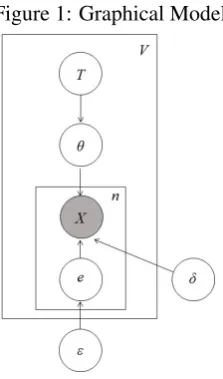
The model learns from observations of direct ob-jects or no direct obob-jects in sentences containing particular verbs. These observations are formalized as the Bernoulli random variableXin the graph-ical model in Figure 1. EachX(v) represents an
Figure 1: Graphical Model
contains a direct object and 0 if it does not. These observations can be generated by two processes: the transitivity of verbv, represented by the vari-ablesT andθin the upper half of the model, or an internal parsing error, represented by the variables e,, andδin the lower half of the model. We will describe each of these processes in turn.
In the upper half of the model, each X(v) is
conditioned on the parameterθ(v), a continuous
random variable defined for values from 0 to 1 inclusive. This parameter controls how frequently a verb v will be used with a direct object: the learner assumes that for every observationX(v),
a biased coin is flipped to determine whether the sentence contains a direct object, with probability θ(v), or does not, with probability1−θ(v).
The parameterθ(v)is conditioned on the variable
T(v), which represents the transitivity of verbv. T
is a discrete random variable that can take on three values, corresponding to transitive, intransitive, and alternating verbs. Each of these values determines a different distribution overθ. For the transitive category ofT,θalways equals 1: the verb should always occur with a direct object. For the intransi-tive category,θalways equals 0: the verb should never occur with a direct object. For the alternating category,θtakes a value between 0 and 1 inclusive. The prior probability distribution overθin this case is a uniformBeta(1,1)distribution.
In the lower half of the model, each Xis con-ditioned on a Bernoulli random variablee, which represents the input filter. Ife(iv)= 0, the observa-tion inXi(v)was generated byθ(v)andT(v), and
accurately reflects the transitivity of verbv. But if e(iv)= 1, the observation inXi(v)was generated by
an internal parsing error, meaning the learner did not have adequate grammatical knowledge to parse the sentence correctly. This observation was not generated byθ(v)andT(v), and may not accurately
reflect the transitivity of verbv, so it should be ignored for the purpose of inferringT(v). Eache(v)
is conditioned on the variable, which represents the probability of an internal parsing error occur-ring for any verb in the input. The model learns a single parameter value foracross all verbs.
The second parameter of the input filter is δ, which represents the probability of observing a di-rect object when an observation was generated by an internal parsing error. Thus, whether a sentence contains a direct object or no direct object depends on one of two biased coins. Ife(iv)= 0and the ob-servation accurately reflects the verb’s transitivity properties, then one biased coin is flipped and the sentence contains a direct object with probability θ(v). Ife(v)
i = 0and the observation was generated by a parsing error, then a different biased coin is flipped and the sentence contains a direct object with probabilityδ. Like,δis a shared parameter across all verbs. We assume that bothandδhave a uniformBeta(1,1)prior distribution.
3.2 Joint Inference
We use Gibbs sampling (Geman and Geman, 1984) to jointly inferT,, andδ, integrating overθand summing overe, with Metropolis-Hastings (Hast-ings, 1970) proposals forandδ.
We begin by randomly initializingandδ, and sampling values ofT for each verb given values for those input filter parameters. From observations of a verb with and without direct objects, the model determines which value ofT was most likely to have generated those observations. Fork(v)direct
objects inn(v)sentences containing verbv, we use
Bayes’ rule to compute the posterior probability of each value forT(v),
P(T(v)|k(v), , δ) =
P(k(v)|T(v), , δ)P(T(v)) X
T(v)
P(k(v)|T(v), , δ)P(T(v)) (4)
Bayes’ Rule tells us that the posterior probability of a particular value ofT givenk(v)and the other
model parameters is proportional to the likelihood, the probability ofk(v)given that value ofT and
T before seeing any data. We assume thatT is independent ofandδ, and that all three values of T have equal prior probability.
To calculate the likelihood, we must sum over e. This sum is intractable, but because all of the values ofefor the same verb and the same direct object status are exchangeable, we make the com-putation more tractable by simply considering how
manyerrors were generated for sentences with and without direct objects for a particular verb. We di-vide thek(v)observed direct objects for a verb into
k(1v)direct objects that were observed accurately andk0(v)direct objects that were observed in error. The totaln(v)observations for verbvare likewise
divided into n(1v) accurate observations andn(0v) errorful observations. We then calculate the like-lihood by marginalizing overn(1v)andk1(v), again assuming independence amongT,, andδ,
p(k(v)|T(v), , δ) = n(v)
X
n(1v)=0
k(v) X
k(1v)=0
p(k(v)|k(v)
1 , n(1v), δ)
p(k(1v)|n1(v), T(v))ip(n(v)
1 |) (5)
The first term in the inner sum is equivalent to p(k0(v)|n0(v), δ), assuming we known(v), the total
number of observations for a particular verb. This is the probability of observingk(0v)errorful direct objects out of n(0v) errorful observations, which follows a binomial distribution with parameterδ. The second term in the inner sum is the probabil-ity of observing k(1v) accurate direct objects out ofn(1v)accurate observations, which follows a bi-nomial distribution with parameter θ(v). Recall
thatθ(v)= 1for the transitive category ofT, and
θ(v)= 0for the intransitive category ofT. For the
alternating verb category,θ(v)is unknown, so we
integrate over all possible values ofθ(v)to obtain 1
n(1v)+1. The last term in (5) is the probability of
observingn(1v)accurate observations out of the to-taln(v) observations for verbv, which follows a
binomial distribution with parameter1−. After sampling values forT for each verb in the dataset, we then sample values forandδ. If T denotes the set of valuesT(1), T(2), ..., T(V), andk
denotes the full set of observations of direct objects k(1), k(2), ..., k(V)for allV verbs in the input, we
can define functions proportional to the posterior
distributions onandδ, f() ∝ p(|T, k, δ)and g(δ)∝p(δ|T, k, ), as
f() =p(k|T, , δ)p() (6)
g(δ) =p(k|T, , δ)p(δ) (7) where the likelihoodp(k|T, , δ)is the product over all verbsvofp(k(v)|T(v), , δ), as calculated in (5).
Within the Gibbs sampler, we resampleusing 10 iterations of a Metropolis-Hastings algorithm. We begin by randomly initializing. At each itera-tion, we propose a new value0, sampled from the
proposal distribution Q(0|) = N(,0.25).
Be-cause the proposal distribution is symmetric, this new value is accepted with probability
A=min
f(0)
f(),1
(8)
If the new value0 has higher probability givenT,
kandδunder equation (6), it is accepted. If it has lower probability under equation (6), it is accepted at a rate corresponding to the ratio of its probability and the probability of the old value of.
After sampling , we resample δ with 10 iter-ations of Metropolis-Hastings. The proposal and acceptance functions are analogous to those for. We ran multiple chains from different starting points to test convergence ofT,, andδ. For the simulations reported below, we ran 1,000 iterations of Gibbs sampling. We took every tenth value from the last 500 iterations as samples from the posterior distribution overT,, andδ.
4 Data
We tested the model on a dataset selected from the CHILDES Treebank (Pearl and Sprouse, 2013). We used four corpora of child-directed speech (803,188 total words), which were parsed using the Charniak or Stanford parser and hand-checked by undergraduates. See Table 1 for corpus details. Our dataset consists of sentences containing the 50 most frequent action verbs in these corpora that could be characterized as transitive, intransitive, or alternating. We excluded verbs that were obligato-rily ditransitive or frequently took clausal or verbal complements: these included mental state verbs (e.g. want), aspectual verbs (e.g. start), modals (e.g. should), auxiliaries (e.g. have), and light verbs (e.g.take).
Corpus # Children Ages # Words # Utterances
Brown- Adam, Eve, & Sarah, (Brown, 1973) 3 1;6-5;1 391,848 87,473 Soderstrom (Soderstrom et al., 2008) 2 0;6-1;0 90,608 24,130
Suppes (Suppes, 1974) 1 1;11-3;11 197,620 35,904
[image:5.595.117.488.63.115.2]Valian (Valian, 1991) 21 1;9-2;8 123,112 25,551
Table 1: Corpora of Child-Directed Speech.
English verb classes described in Levin (1993), supplemented by our own intuitions for verbs not represented in that work. These classes provide a target for learning meant to align with adult speaker intuitions, independent of the corpus data that the model learns from. The transitive and intransi-tive categories are conservaintransi-tive; verbs likejump
are considered alternating even though they occur infrequently in their possible transitive uses (e.g.
jump the horses over the fence). These target cate-gories thus set a high bar for our model to reach.
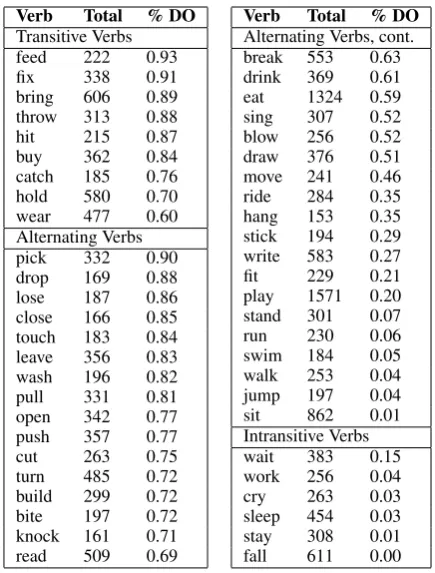
We then conducted an automated search over the Treebank trees for the total occurrences of each verb in the corpora, in all inflections, and the total occurrences with overt (pronounced) direct objects. These direct object counts included transitive basic clauses like those in (1), but not wh-object ques-tions with object gaps like those in (3). Table 2 lists these 50 verbs along with their counts and percentage occurrences with direct objects.
Verb Total % DO
Transitive Verbs feed 222 0.93
fix 338 0.91
bring 606 0.89 throw 313 0.88
hit 215 0.87
buy 362 0.84
catch 185 0.76 hold 580 0.70 wear 477 0.60 Alternating Verbs pick 332 0.90 drop 169 0.88 lose 187 0.86 close 166 0.85 touch 183 0.84 leave 356 0.83 wash 196 0.82 pull 331 0.81 open 342 0.77 push 357 0.77
cut 263 0.75
turn 485 0.72 build 299 0.72 bite 197 0.72 knock 161 0.71 read 509 0.69
Verb Total % DO
[image:5.595.76.294.444.731.2]Alternating Verbs, cont. break 553 0.63 drink 369 0.61 eat 1324 0.59 sing 307 0.52 blow 256 0.52 draw 376 0.51 move 241 0.46 ride 284 0.35 hang 153 0.35 stick 194 0.29 write 583 0.27 fit 229 0.21 play 1571 0.20 stand 301 0.07 run 230 0.06 swim 184 0.05 walk 253 0.04 jump 197 0.04 sit 862 0.01 Intransitive Verbs wait 383 0.15 work 256 0.04 cry 263 0.03 sleep 454 0.03 stay 308 0.01 fall 611 0.00
Table 2: Counts and percentage uses with direct objects (DO) of 50 verbs in dataset.
5 Simulations
We tested our model on the dataset described in the previous section. We compare our model’s performance to an oracle model that already knows the parameters of the input filter, and two baselines.
5.1 Joint Inference Model
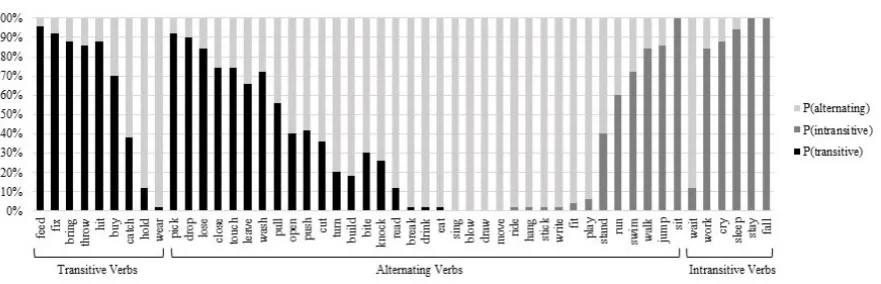
Figure 2 displays the posterior probability distri-butions over verb categories inferred by our joint inference model for each verb. Black bars represent the probability assigned to the transitive category, dark gray bars represent the probability assigned to the intransitive category, and light gray bars rep-resent the probability assigned to the alternating category. The true categories for each verb are shown below the horizontal axis. Figure 3 displays the posterior distributions inferred forandδ.
The percentage of verbs categorized correctly by the model is reported in Table 3. The model achieves highest accuracy in categorizing the in-transitive verbs: for all but one of these verbs, the model assigns highest probability to the intransitive category. The exception is the verbwait, which the model assigns highest probability under the alter-nating category. This is due to prevalent uses of temporal adjuncts, as inwait a minute, that were parsed as direct objects in the CHILDES Treebank. Thus, a learner who likewise misparses these ad-juncts as direct objects would infer thatwaitis an alternating rather than intransitive verb.
The model assigns 6 out of the 9 transitive verbs highest probability under the transitive category. Three transitive verbs are assigned highest proba-bility under the alternating rather than the transitive category:catch, hold,andwear. This is likely be-cause these verbs display different behavior than the other transitive verbs in the corpus. The verb
hold occurs frequently in verb-particle construc-tions (e.g. hold on), which might be treated dif-ferently than simple verbs by learners. The verbs
catchandwearappear to occur at much higher rates than other transitive verbs in non-basic clauses:
Figure 2: Posterior Distributions over Verb Categories (T), Joint Inference Model
Figure 3: Posterior Distributions overandδ
wh-object constructions (e.g. what are you wear-ing?). Whether learners likewise mis-classify these verbs, or can accommodate different rates of miss-ing direct objects within the set of transitive verbs, is a topic for further investigation.
The model assigns highest probability for most of the alternating verbs to the alternating verb cat-egory. There are 13 exceptions. The verbs pick, drop, lose, close, touch, leave, wash, andpullare assigned highest probability under the transitive category because they infrequently occur in their possible intransitive uses in child-directed speech. The verbs run, swim, walk, jump, andsit are as-signed highest probability under the intransitive cat-egory because these verbs very infrequently occur in their possible transitive uses. Thus, the model over-regularizes the alternating verbs that alternate infrequently, preferring the more deterministic tran-sitive and intrantran-sitive verb categories.
In order to evaluate the model’s inference of andδ, we estimated the true values of these param-eters in our dataset. The proportion of transitive verbs with missing direct objects in the dataset gives us an estimate of(1−δ)×, and the pro-portion of intransitive verbs with spurious direct objects (e.g. wait a minute) gives us an estimate
ofδ×. Solving these two equations, we find that δ = 0.18 and = 0.24. The posterior probabil-ity distribution overδ inferred by our model has a mean of 0.23, and the probability distribution overhas a mean of 0.22. Our model thus slightly over-estimates the value ofδand under-estimates the value of. However, it infers values for these parameters close to the true values in the corpus, enabling it to infer the correct transitivity properties for 2/3 of the verbs in our dataset.
5.2 Oracle Model
To evaluate our model’s performance, we compare it against an oracle model in whichδ is fixed to 0.18 andto 0.24 in order to reflect their estimated true values in our dataset. This allows us to see how our model compares to a model that knows the parameters for the input filter in advance.
The posterior probability distributions over verb categories inferred by the oracle model are dis-played in Figure 4. Our joint inference model per-forms identically to the oracle model with intransi-tive verbs, and almost as well with transiintransi-tive verbs: the oracle model succeeds in identifying one more transitive verb,catch, as transitive. Our joint infer-ence model performs better than the oracle model in categorizing alternating verbs: the oracle model has an even higher tendency to over-regularize the verbs that alternate infrequently.
Model % Transitive % Intransitive % Alternating % Total Verbs
Joint Inference 0.67 0.83 0.63 0.66
Oracle 0.77 0.83 0.54 0.62
No-Filter Baseline 0.00 0.00 1.00 0.70
[image:7.595.128.474.61.115.2]Random Baseline 0.33 0.33 0.34 0.34
Table 3: Percentages of Verbs Categorized Correctly.
Figure 4: Posterior Distributions over Verb Categories (T), Oracle Model
the best-case oracle model not merely because it infers an input filter, but because it infers the best parameters for such a filter given our dataset.
5.3 No-Filter Baseline
We’ve seen that our model accurately categorizes 2/3 of the verbs in our dataset by inferring appropri-ate parameters of a filter on its input, and performs comparably overall with a model that knows those parameters in advance. To determine how much the input filter matters in this inference, we com-pare our model to a baseline that lacks this filter. We can instantiate a model with no filter by setting to zero, representing zero probability of parsing errors. Because every verb in our dataset occurs some but not all of the time with direct objects, and this model assumes there are no parsing errors to filter out, it assigns every verb to the alternating cat-egory. It thus categorizes 100% of the alternating verbs correctly, achieving 70% overall accuracy be-cause alternating verbs make up 70% of our dataset. However, this accuracy comes at the cost of failing to categorize any verbs as transitive or intransitive. Our joint inference model performs substantially better in this regard, categorizing the majority of transitive and intransitive verbs correctly. Thus, an input filter is important for differentiating alternat-ing from non-alternatalternat-ing verbs.
5.4 Random Baseline
We finally compare our model against a baseline that assigns verbs randomly to transitivity cate-gories, assuming that each value ofT has equal prior probability. For each verb in our dataset this model flips a fair 3-sided coin to determine its tran-sitivity category. This model thus categorizes 1/3 of the transitive, intransitive, and alternating verbs correctly, resulting in 34% overall accuracy. Our joint inference model performs significantly better on each verb class, and nearly twice as well overall.
5.5 Summary
We find that inferring an appropriate filter on the input matters for verb transitivity learning, but that the parameters of this input filter can be learned. Our model performs comparably to an oracle model that knows these values in advance. It performs substantially better in categorizing transitive and intransitive verbs than a baseline model that lacks an input filter altogether, and performs twice as well overall as a random baseline. These results demonstrate that our model is able to infer reason-able values for the input filter parameters, allowing it to accurately categorize the majority of transitive, intransitive, and alternating verbs.
6 Discussion
[image:7.595.75.523.166.313.2]struc-ture acquisition. Our model accurately categorizes 2/3 of the most frequent transitive, intransitive, and alternating verbs in child-directed speech on the basis of their distributions with and without di-rect objects, by learning to filter out sentences that were likely mis-parsed. This enables the learner to avoid drawing faulty inferences about verb tran-sitivity from non-basic clause types, such as wh-object questions, that may be mistaken for intran-sitive clauses. Our model performs substantially better than baseline models that lack an input fil-ter and performs comparably to an oracle model that knows these input filter parameters in advance, demonstrating that this input filter both matters for verb learning and can be learned.
Our model offers a novel solution to the prob-lem of identifying an appropriate input filter for verb learning (Lidz and Gleitman, 2004; Pinker, 1984) : where previous approaches have implicitly assumed that children must have a way of identify-ing the sentences to be filtered, our model learns an input filter without knowing its parameters in advance. Instead, the learner infers the input filter parameters jointly with verb transitivity. This re-duces the prior knowledge needed for initial verb learning: the child does not need to identify which sentences likely contain wh-questions and other non-basic clause types as a prerequisite for learn-ing which verbs are transitive. Note that we do not claim that the Bayesian joint inference performed by our model represents the exact algorithms per-formed by child learners; although there is sub-stantial literature on young children’s statistical inference capabilities (Gomez and Gerken, 2000), this model is intended only as a proof of concept that such joint inference is possible.
The model makes two types of errors in infer-ring verb categories. First, it is unable to correctly categorize some transitive and intransitive verbs that behave differently than other verbs in their category, such ascatch, hold, wear, andwait. Fur-ther investigation is necessary to determine wheFur-ther these verbs pose difficulties for child learners as well. A second type of error is over-regularizing alternating verbs that alternate infrequently: the model prefers to assign these verbs to the transitive and intransitive categories. This is an example of a learner preferring a more deterministic analysis for probabilistic input, a tendency also found in child learners in artificial language studies (Hudson Kam and Newport, 2009). The error-filtering mechanism
we present here could thus potentially provide a way to model other forms of over-regularization in learning.
Other future directions include extending this model to cross-linguistic data, particularly to lan-guages with free object-drop. Chinese, Korean, and Japanese have a syntactic mechanism for dropping the direct object of any transitive verb, unlike in English where object-drop is a lexical property of specific verbs. As as result, learners of these lan-guages might be subject to even higher rates of pars-ing errors if they perceive object-drop sentences as intransitive. For this reason, these languages are potentially problematic for syntactic bootstrapping strategies that rely on learners accurately identify-ing transitive verbs (Lee and Naigles, 2005; Lee and Naigles, 2008). But if appropriate parameters for filtering out problematic object-drop construc-tions in these languages can be inferred, our model may help address concerns with the feasibility of syntactic bootstrapping in these languages.
Finally, this model learns verb transitivity by effectively filtering out sentences containing non-basic clause types, without identifying what these clause types are. But children do eventually learn to identify non-basic constructions in their language. If children initially filter out certain sentences as parsing errors for the purposes of verb learning, they must eventually learn that many of these sen-tences are generated by systematic syntactic op-erations, such as those that create wh-questions in English. In future work, we aim to investigate whether a learner can identify which non-basic con-structions are present in sentences that were parsed in error. Learning verb transitivity can likely help the child identify these constructions: if a child ex-pects a direct object for a verb and encounters sen-tences where this object does not appear, that child may be compelled to examine those anomalous sentences to determine the cause of the missing object. Thus, a strategy of filtering out non-basic constructions by initially treating them as parsing errors may eventually help the learner identify not only verb transitivity, but also the nature of those non-basic constructions themselves.
References
Frans Adriaans and Daniel Swingley. 2012. Distribu-tional learning of vowel categories is supported by
prosody in infant-directed speech. Proceedings of
the 34th Annual Conference of the Cognitive Science Society, pages 72–77.
Afra Alishahi and Suzanne Stevenson. 2008. A com-putational model of early argument structure
acqui-sition. Cognitive Science, 32:789834.
Roger Brown. 1973. A First Language: The Early
Stages. Harvard University Press, Cambridge, MA.
Noam Chomsky. 1965.Aspects of the theory of syntax.
MIT Press, Cambridge, MA.
Noam Chomsky. 1981. Lectures on government and
binding. Foris Publications.
Cynthia Fisher, Yael Gertner, Rose M. Scott, and
Sylvia Yuan. 2010. Syntactic bootstrapping.
Wi-ley Interdisciplinary Reviews: Cognitive Science, 1(2):143–149.
Annie Gagliardi, Tara M. Mease, and Jeffrey Lidz. 2016. Discontinuous development in the acquisition of filler-gap dependencies: Evidence from 15-and
20-month-olds.Language Acquisition, 23(3):1–27.
Stuart Geman and Donald Geman. 1984. Stochas-tic relaxation, Gibbs distributions, and the Bayesian
restoration of images. IEEE-PAMI, 6:721–741.
Lila R. Gleitman. 1990. The structural sources of verb
meanings. Language acquisition, 1(1):3–55.
Rebecca L. Gomez and LouAnn Gerken. 2000. Infant artificial language learning and language acquisition. Trends in Cognitive Sciences, 4(5):178–186.
Jane Grimshaw. 1990. Argument Structure. MIT
Press, Cambridge, MA.
W. K. Hastings. 1970. Monte Carlo sampling meth-ods using Markov chains and their applications. Biometrika, 57(1):97–109.
Carla L. Hudson Kam and Elissa L. Newport. 2009. Getting it right by getting it wrong: When learners
change languages.Cognitive Psychology, 59:30–66.
Barbara Landau and Lila R. Gleitman. 1985.
Lan-guage and Experience: Evidence from the Blind Child. Harvard University Press.
Howard Lasnik. 1989. On certain substitutes for nega-tive data. In Robert J. Matthews and William
De-mopoulos, editors, Learnability and linguistic
the-ory, pages 89–105. Kluwer, Dordrecht.
Joanne N. Lee and Letitia R. Naigles. 2005. The in-put to verb learning in mandarin chinese: A role for
syntactic bootstrapping. Developmental Psychology,
41(3):529–540.
Joanne N. Lee and Letitia R. Naigles. 2008. Mandarin learners use syntactic bootstrapping in verb
acquisi-tion. Cognition, 106(2):1028–1037.
Beth Levin. 1993. English Verb Classes and
Alter-nations: A Preliminary Investigation. University of Chicago Press, Chicago, IL.
Jeffrey Lidz and Lila R. Gleitman. 2004. Yes, we still
need Universal Grammar. Cognition, 94:85–93.
Lisa Pearl and Jeffrey Lidz. 2009. When domain-general learning fails and when it succeeds:
Identify-ing the contribution of domain specificity. Language
Learning and Development, 5:235–265.
Lisa Pearl and Jon Sprouse. 2013. Syntactic islands and learning biases: Combining experimental syntax and computational modeling to investigate the
lan-guage acquisition problem. Language Acquisition,
20(1):23–68.
Amy Perfors, Joshua B. Tenenbaum, and Elizabeth Wonnacott. 2010. Variability, negative evidence, and the acquisition of verb argument constructions. Journal of Child Language, 37:607–642.
Steven Pinker. 1984. Language Learnability and
Lan-guage Development. Cambridge, MA: Harvard Uni-versity Press.
Steven Pinker. 1989. Learnability and Cognition: The
Acquisition of Argument Structure. Cambridge, MA: MIT Press.
Melanie Soderstrom, Megan Blossom, Irena Foygel, and James L. Morgan. 2008. Acoustical cues and grammatical units in speech to two preverbal infants. Journal of Child Language, 35:869–902.
Karen Stromswold. 1995. The Acquisition of
Sub-ject and ObSub-ject Wh-questions. Language
Acquisi-tion, 4(1/2):5–48.
Patrick Suppes. 1974. The semantics of children’s
lan-guage. American Psychologist, 29:103–114.
Virginia Valian. 1991. Syntactic subjects in the early
speech of American and Italian children. Cognition,