Transfer Learning and Sentence Level Features for Named Entity
Recognition on Tweets
Pius von D¨aniken
SpinningBytes AG Mark CieliebakZHAW
Abstract
We present our system for the WNUT 2017 Named Entity Recognition challenge on Twitter data. We describe two modi-fications of a basic neural network archi-tecture for sequence tagging. First, we show how we exploit additional labeled data, where the Named Entity tags differ from the target task. Then, we propose a way to incorporate sentence level features. Our system uses both methods and ranked second for entity level annotations, achiev-ing an F1-score of40.78, and second for surface form annotations, achieving an F1-score of39.33.
1 Introduction
Named Entity Recognition (NER) is an impor-tant Natural Language Processing task. Its goal is to tag entities such as names of people and locations in text. State-of-the-art systems can achieve F1-scores of up to 92 points on English news texts (Chiu and Nichols, 2015). Achiev-ing good performance on more complex domains such as user generated texts on social media is still a hard problem. The best system submitted for the WNUT 2016 shared task achieved an F1-score of 52.41 on English Twitter data (Strauss et al., 2016).
In this work, we present our submission for the WNUT 2017 shared task on “Novel and Emerg-ing Entity Recognition” (Derczynski et al.,2017). We extend a basic neural network architecture for sequence tagging (Chiu and Nichols, 2015; Col-lobert et al.,2011) by incorporating sentence level feature vectors and exploiting additional labeled data for transfer learning. We build on and take inspiration from recent work from (Falkner et al.,
2017;Sileo et al.,2017) on NER for French Twit-ter data (Lopez et al.,2017).
Our submitted solution reached an F1-score of
41.76 for entity level annotations and 57.98 on surface form annotations. This places us second on entity level annotations, where the best sys-tem achieved an F1-score of41.90, and fourth on surface form annotations, where the best system achieved an F1-score of66.59.
2 System Description
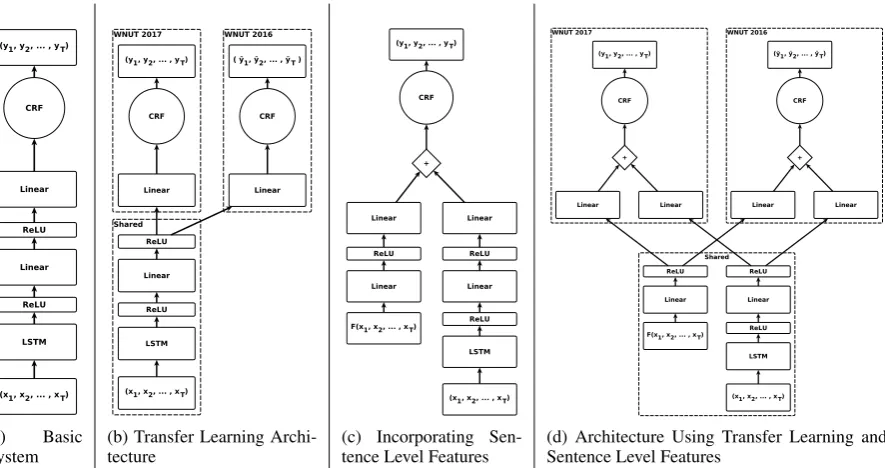
Our solution is based on a sequence labeling sys-tem that uses a bidirectional LSTM (Hochreiter and Schmidhuber, 1997) which extracts features for training a Conditional Random Field (Sut-ton and McCallum, 2012). We apply a trans-fer learning approach, since previous research has shown that this can improve sequence labeling systems (Yang et al., 2017). More precisely, we modify the base system to allow for joint training on the WNUT 2016 corpus (Strauss et al.,2016), which uses a different tag set than our target task. In addition, we extend the system to incorporate sentence level feature vectors. All these methods are combined to build the system that we used for our submission to the WNUT 2017 shared task. Figure1shows an overview of the different archi-tectures, which are described in detail in the fol-lowing sections.
2.1 Basic Sequence Labeling System
Figure1ashows an overview of our base system. We use a bidirectional Long Short Term Mem-ory network (LSTM) (Hochreiter and Schmidhu-ber,1997) to learn the potential function for a lin-ear chain Conditional Random Field (CRF) (Sut-ton and McCallum,2012) to predict a sequence of Named Entity tagsy1:T from a sequence of feature vectorsx1:T. This is based on an architecture pre-viously used in (Chiu and Nichols,2015), which
(a) Basic
[image:2.595.85.528.61.295.2]System (b) Transfer Learning Archi-tecture (c) Incorporating Sen-tence Level Features (d) Architecture Using Transfer Learning andSentence Level Features Figure 1: Overview Of The Different Network Architectures Used
achieved state-of-the-art performance for Named Entity Recognition on the English CoNLL 2003 data set (Tjong Kim Sang and De Meulder,2003). Bidirectional LSTM: For every word in wt in a given input sentence w1:T, we first compute a feature vector xt, which is the concatenation of all the word level features described in Sec-tion 2.5. The sequence of feature vectorsx1:T is then fed to a bidirectional LSTM. The output of both the forward and backward LSTM are con-catenated to get o1:T, which get passed through a Rectified Linear Unit, (ReLU) (Nair and Hin-ton, 2010). Every ot ∈ o1:T then gets passed through a fully connected feed-forward network with one hidden layer andReLU activation: st=
W2 relu(W1ot+b1) +b2. LetNtagsbe the num-ber of possible NER-tags,do the dimension ofot anddhthe dimension of the hidden layer. The re-sulting vectorst ∈ RNtags represents a score for every possible tag y at time step t. The values
W1 ∈ Rdh×do, b1 ∈ Rdh, W2 ∈ RNtags×dh and b2 ∈ RNtags are weights of the feed-forward
net-work.
Conditional Random Field: A linear chain CRF models the conditional probability of an output se-quencey1:T given an input sequencex1:T as:
p(y1:T|x1:T) = Z(x1
1:T) T
Y
t=1
eφ(yt−1,yt,x1:T,t,Θ)
(1)
whereZ(x1:T)is a normalization constant:
Z(x1:T) =
X
∀y1:T
T
Y
t=1
eφ(yt−1,yt,x1:T,t,Θ) (2)
φis a potential function parametrized by a set of parametersΘ. In our case we use:
φ(yt−1, yt, x1:T, t,Θ ={θ, A}) =
sθ,yt,t(x1:T) +Ayt−1,yt
(3)
Letθbe the parameters of the network described above. Then sθ,yt,t(x1:T) is the score that the
network parametrized by θ outputs for tag yt at time step t given the input sequence x1:T. A ∈ RNtags×Ntagsis a matrix such thatAi,j is the score
of transitioning from tagito tagj.
2.2 Transfer Learning
In this setting we use the WNUT 2016 cor-pus (Strauss et al., 2016) as an additional source of labeled data. The idea is to train the upper layers of the neural network on both datasets to improve its generalization ability. It was shown in (Yang et al.,2017) that this can improve the sys-tem performance. Figure1bgives an overview of our transfer learning architecture.
Modified Architecture: We share all network lay-ers except for the last linear projection to get sep-arate tag scores for each data set:
s2016t =W22016relu(W1ot+b1) +b20162 s2017
t =W22017relu(W1ot+b1) +b20172 (4)
The resulting tag scores get fed to separate CRFs, which have separate transition matricesA2016and A2017.
Training: During training we alternately use a batch from each dataset and backpropagate the loss of the corresponding CRF.
2.3 Incorporating Sentence Level Features Figure 1c shows how we include sentence level features into our architecture. In this setting we take an additional feature vector fsent =
F(x1:T)∈Rdsentfor each input sentencex1:T. Modified Architecture: We use an additional feed-forward network to extract tag scoresssent∈ RNtags from the sentence feature vectorfsent:
ssent=W2,sentrelu(W1,sentfsent+b1,sent) +b2,sent
The dimensions used are: W1,sent ∈ Rdh,sent×dsent, b1,sent ∈ Rdh,sent, W2,sent ∈
RNtags×dh,sent and b2,sent ∈ RNtags. The value
dh,sent is the dimension of the hidden layer of the feed-forward network. Let s1:T,word be the scores that the basic network described in Section2.1outputs for sequencex1:T. To get the final scoress1:T fed to the CRF we addssent to everyst,word ∈s1:T,word:st=ssent+st,word. 2.4 Combined System
The combined system adds the sentence level fea-tures to the transfer learning architecture. We share all layers except the linear projections to tag scores for both sentence features and word features in a manner analogous to Sections 2.2 and 2.3. The resulting architecture is shown in Figure1d.
<PAD> <PAD>
<PAD> <PAD> A n t o n i n a Input Sequence
Character Embeddings
Filter Maps Convolution Max
[image:3.595.312.521.65.209.2]Pooling Feature Vector
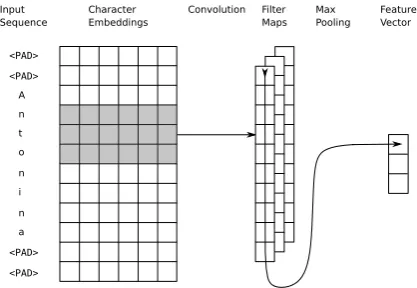
Figure 2: Neural Network used to extract character level features
2.5 Features
Word Embeddings: We use the FastText (Bo-janowski et al., 2016) library to compute word embeddings. We train the model on a corpus of 200 million tweets and all tweets from the WNUT 2016 and WNUT 2017 corpora. The vocabulary contains all words occurring at least 10 times. Other parameters use the default values set by the library1. In particular, the size of the context win-dow is set to 5 and the embedding dimension is
100.
This results in an embedding matrix Eword ∈
RNvocab×100, where Nvocab is the number of
unique tokens in the WNUT 2016 and WNUT 2017 corpora. FastText predicts embedding vec-tors for words that were out-of-vocabulary during training by considering character n-grams of the word. The embedding matrixEwordis not updated during training.
Word Capitalization Features: Following (Chiu and Nichols, 2015) we add explicit capitaliza-tion features, since capitalizacapitaliza-tion informacapitaliza-tion is lost during word embedding lookups. The6 fea-ture options are: all capitalized, uppercase ini-tial, all lower cased, mixed capitalization, emoji
and other. An embedding matrix EwordCap ∈
R6×dwordCap is used to feed these features to the
network and updated during training via back-propagation. EwordCapis initialized using normal Glorot initialization.
Character Convolution Features: A convolu-tional neural network is used to extract addiconvolu-tional character level features. Its architecture is shown in Figure2. First, we add special padding tokens
1https://github.com/facebookresearch/
on both sides of the character sequencew, to ex-tend it to a target length, lw,max. If there is an odd number of paddings, the additional padding is added on the right. For sequences longer than
lw,max, only the first lw,max characters are used. An embedding matrix Echar ∈ RNc×dc maps characters to Rdc vectors. Nc is the number of
unique characters in the dataset with the addition of the padding token.
UsingEchar, we embed the padded sequencew and getCw ∈Rlw,max×dc. A set ofmconvolution filters∈Rdc×his then applied toCw. This results
inm feature mapsMi ∈Rlw,max−h+1, which are passed through aReLU activation. The final fea-ture vectorF ∈ Rm is attained by max pooling, such thatFi = maxMi.
The embedding matrix is initialized using uni-form Glorot initialization. Themconvolution fil-ters are initialized using normal Glorot initializa-tion.
Character Capitalization Convolution Fea-tures: Analogous to the word capitalization fea-tures, we use additional character capitalization features. The feature options are: upper, lower,
punctuation, numeric and other. We apply a neural network with the same architecture as de-scribed above to extract the final character capital-ization feature vector.
Sentence Embeddings: In (Pagliardini et al., 2017) the authors introduce sent2vec, a new method for computing sentence embeddings. They show that these embeddings provide im-proved performance for several downstream tasks. To train the sent2vec model, we use the same training set as the one used for word embeddings and we use default values for all the model param-eters2. In particular, the resulting sentence feature vectors are inR100.
3 Experiments
We implemented the system described in Sec-tion2.4using the Tensorflow framework3.
We monitored the systems performance during training and aborted experiments that had an F1-score of less than40 after two epochs (evaluated on the development set). We let successful exper-iments run for the full6epochs (cf. Section3.2). For the submission to WNUT 2017, we ran6 suc-cessful experiments and submitted the one which
2https://github.com/epfml/sent2vec
3https://www.tensorflow.org/
Parameter Value
lw,max 30
NtagsWNUT 2016 21
NtagsWNUT 2017 13
dwordCap 6
dc 15
LSTM hidden units 64
dh,word 128
dh,sent 128
m 10
h 3
Dropout rate 0.3
Learning Rate 0.003
Gradient Clip Norm 2
Batch size 100
[image:4.595.347.487.59.282.2]Number of epochs 6
Table 1: Model Parameters
had the highest entity level F1-score on the devel-opment set.
3.1 Preprocessing
Tokenization: Since the WNUT 2016 and WNUT 2017 corpora are in the CoNLL format, they are al-ready tokenized. To tokenize the additional tweets used for training word and sentence embeddings (cf. Section2.5), we use the Twitter tokenizer pro-vided by the Python NLTK library4.
Token Substitution: We perform some simple pattern-based token substitutions. To normalize Twitter user handles, we substitute every word starting with an@character by a special user to-ken. Similarly, all words starting with the prefix
httpare replaced by a url token. Finally, for words longer than one character, we remove up to one initial#character.
3.2 Model Parameters
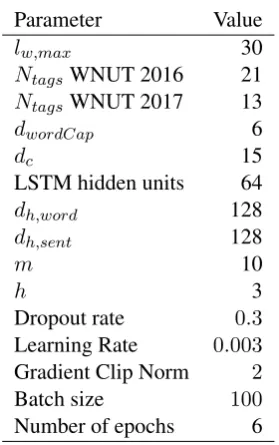
Table1shows the parameters used for training the model.
3.3 Experiments Performed After The Submission
Following the submission, we conducted addi-tional experiments to investigate the influence of the transfer learning approach and sent2vec fea-tures on the system performance.
4http://www.nltk.org/api/nltk.
Precision (%) Recall (%) F1 Mean Stddev Mean Stddev Mean Stddev Surface Forms 45.55 0.47 34.94 0.87 39.54 0.55 Entities Overall 47.23 0.55 36.33 0.83 41.06 0.52 Corporation 8.81 0.99 10.86 1.62 9.70 1.14 Creative Work 22.41 2.55 11.03 1.50 14.73 1.73 Group 39.27 7.47 9.49 2.20 15.13 2.86 Location 58.55 2.88 47.11 1.79 52.12 0.66 Person 57.82 1.60 63.60 1.10 60.55 0.84 Product 22.47 2.17 7.87 1.93 11.60 2.38
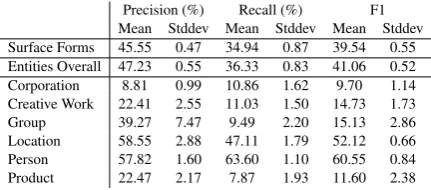
Table 2: Aggregated performance of all experi-ments, run before the submission, evaluated on the test set
Precision (%) Recall (%) F1
Surface Forms 45.47 34.66 39.33
Entities Overall 47.09 35.96 40.78
Corporation 8.24 11.67 9.66
Creative Work 21.92 11.76 15.31
Group 31.71 9.22 14.29
Location 58.95 44.80 50.91
Person 57.67 61.97 59.74
Product 20.00 5.13 8.16
Table 3: Performance of the submitted annotations evaluated on the test set
For each of the4systems described in Section2, we ran6experiments. We use the same parameters as shown in Section3.2.
4 Results
Table 2 shows precision, recall and F1-score of our system. We compute the mean and standard deviations over the 6 successful experiments we considered for submission (cf. Section 3). Ta-ble3shows the breakdown of the performance of the annotations we submitted for the WNUT 2017 shared task.
Table4shows the performance of the different subsystems proposed in Section2. We report the mean and standard deviation over the 6 experi-ments we performed after submission, for every system.
All reported scores were computed using the evaluation script provided by the task organizers.
5 Discussion
From table 4 we can see that using sent2vec features increases precision and decreases recall slightly, leading to an overall lower performance compared to the basic system. The transfer learn-ing system shows a more substantial decrease in precision and increase in recall and overall
per-forms best out of the4 systems. Combination of the two approaches is counterproductive and out-performs the basic system only slightly.
During training we observed that restarting ex-periments as described in Section 3was only nec-essary when using sent2vec features.
One weakness of our transfer learning setting is that the two datasets we used have almost identical samples and only differ in their annotations. The WNUT 2016 corpus uses 10 entity classes: com-pany, facility, Geo location, movie, music artist,
other,person,product,sports team, andTV show. Further work is needed to study the effect of using an unrelated data set for transfer learning.
6 Conclusion
We described a deep learning approach for Named Entity Recognition on Twitter data, which extends a basic neural network for sequence tagging by us-ing sentence level features and transfer learnus-ing. Our approach achieved 2nd place at the WNUT 2017 shared task for Named Entity Recognition, obtaining an F1-score of40.78.
For future work, we plan to explore the power of transfer learning for NER in more depth. For instance, it would be interesting to see how anno-tated NER data for other languages or other text types affects the system performance.
References
Piotr Bojanowski, Edouard Grave, Armand Joulin, and Tomas Mikolov. 2016. Enriching word vec-tors with subword information. ArXiv e-prints
https://arxiv.org/abs/1607.04606.
Jason P. C. Chiu and Eric Nichols. 2015. Named En-tity Recognition with Bidirectional LSTM-CNNs. ArXiv e-printshttps://arxiv.org/abs/1511.08308.
Ronan Collobert, Jason Weston, L´eon Bottou, Michael Karlen, Koray Kavukcuoglu, and Pavel Kuksa. 2011. Natural language processing (almost) from scratch. Journal of Machine Learning Research 12:2493–2537.
Leon Derczynski, Eric Nichols, Marieke van Erp, and Nut Limsopatham. 2017. Results of the WNUT2017 Shared Task on Novel and Emerging Entity Recognition. InProceedings of the 3rd Work-shop on Noisy, User-generated Text (W-NUT) at EMNLP. ACL.
Entities Surface Forms
[image:6.595.71.527.62.140.2]Precision (%) Recall (%) F1 Precision (%) Recall (%) F1 Mean Stddev Mean Stddev Mean Stddev Mean Stddev Mean Stddev Mean Stddev Basic System 58.77 3.72 32.47 1.23 41.74 0.70 56.53 3.80 30.75 1.37 39.73 0.71 Transfer Learning 48.17 1.34 37.55 1.43 42.16 0.52 46.31 1.31 35.86 1.51 40.38 0.62 Sent2Vec Features 59.51 1.73 30.91 0.52 40.67 0.41 57.30 1.98 29.20 0.58 38.66 0.46 Combined System 50.41 3.19 36.04 2.10 41.88 0.69 48.60 3.00 34.50 2.36 40.20 0.99
Table 4: Performance of the different subsystems evaluated on the test set, after the submission
transfer learning. Conf´erence sur l’Apprentissage Automatique.
Xavier Glorot and Yoshua Bengio. 2010. Understand-ing the difficulty of trainUnderstand-ing deep feedforward neu-ral networks. InProceedings of the Thirteenth In-ternational Conference on Artificial Intelligence and Statistics. PMLR, Chia Laguna Resort, Italy, vol-ume 9 of Proceedings of Machine Learning Re-search, pages 249–256.
Sepp Hochreiter and J¨urgen Schmidhuber. 1997. Long short-term memory. Neural Comput. 9(8):1735– 1780.
Diederik P. Kingma and Jimmy Ba. 2014. Adam: A Method for Stochastic Optimization. ArXiv e-prints
https://arxiv.org/abs/1412.6980.
Cdric Lopez, Ioannis Partalas, Georgios Balikas, Nadia Derbas, Amlie Martin, Coralie Reutenauer, Frdrique Segond, and Massih-Reza Amini. 2017. French named entity recognition in twitter challenge. Tech-nical report.
Vinod Nair and Geoffrey E. Hinton. 2010. Rectified linear units improve restricted boltzmann machines. InProceedings of the 27th International Conference on Machine Learning (ICML-10). Omnipress, pages 807–814.
Matteo Pagliardini, Prakhar Gupta, and Martin Jaggi. 2017. Unsupervised Learning of Sentence Embed-dings using Compositional n-Gram Features. ArXiv e-printshttps://arxiv.org/abs/1703.02507.
Razvan Pascanu, Tomas Mikolov, and Yoshua Bengio. 2012. On the difficulty of train-ing Recurrent Neural Networks. ArXiv e-prints
https://arxiv.org/abs/1211.5063.
Damien Sileo, Camille Pradel, Philippe Muller, and Tim Van de Cruys. 2017. Synapse at CAp 2017 NER challenge: Fasttext crf. Conf´erence sur l’Apprentissage Automatique.
Nitish Srivastava, Geoffrey Hinton, Alex Krizhevsky, Ilya Sutskever, and Ruslan Salakhutdinov. 2014. Dropout: A simple way to prevent neural networks from overfitting. J. Mach. Learn. Res.15(1):1929– 1958.
Benjamin Strauss, Bethany E. Toma, Alan Ritter, Marie-Catherine de Marneffe, and Wei Xu. 2016. Results of the WNUT16 named entity recognition
shared task. InThe 2nd Workshop on Noisy User-generated Text. pages 138–144.
Charles Sutton and Andrew McCallum. 2012. An introduction to conditional random fields. Found. Trends Mach. Learn.4(4):267–373.
Erik F. Tjong Kim Sang and Fien De Meulder. 2003. Introduction to the CoNLL-2003 shared task: Language-independent named entity recognition. In Proceedings of the Seventh Conference on Natu-ral Language Learning at HLT-NAACL 2003 - Vol-ume 4. Association for Computational Linguistics, Stroudsburg, PA, USA, CONLL ’03, pages 142– 147.