Simple Queries as Distant Labels for Predicting Gender on Twitter
Chris Emmery1,2 and Grzegorz Chrupała1 and Walter Daelemans2 1TiCC, Tilburg University, 5000 LE Tilburg, The Netherlands
2CLiPS, University of Antwerp, Prinsstraat 13, B-2000 Antwerpen, Belgium {c.d.emmery, g.a.chrupala}@uvt.nl
Abstract
The majority of research on extracting missing user attributes from social media profiles use costly hand-annotated labels for supervised learning. Distantly super-vised methods exist, although these gener-ally rely on knowledge gathered using ex-ternal sources. This paper demonstrates the effectiveness of gathering distant la-bels for self-reported gender on Twitter us-ing simple queries. We confirm the reli-ability of this query heuristic by compar-ing with manual annotation. Moreover, using these labels for distant supervision, we demonstrate competitive model perfor-mance on the same data as models trained on manual annotations. As such, we of-fer a cheap, extensible, and fast alternative that can be employed beyond the task of gender classification.
1 Introduction
The popularity of social media that rely on rich self-representation of users (e.g. Facebook, LinkedIn) make them a valuable resource for con-ducting research based on demographic tion. However, the volume of personal informa-tion users provide on such platforms is generally restricted to their personal connections only, and therefore off-limits for scientific research. Twitter, on the other hand, allows only a restricted amount of structured personal information by design. As a result, their users tend to connect with people out-side of their social circle more frequently, making many profiles and communication publicly acces-sible. A wide variety of research has long picked up on the interesting characteristics of this micro-blogging service, which is well facilitated by the Twitter REST API.
The applied Natural Language Processing (NLP) domain of author profiling aims to infer unknown user attributes, and is therefore broadly used to compensate for the lack thereof on Twitter. While previous research has already proven to be quite effective at this task using predictive mod-els trained on manual annotations, the process of hand-labelling profiles is costly. Even for the os-tensibly straight-forward task of annotating gen-der, a large portion of Twitter users purposefully avoids providing simple indicators such as real names or profile photos including a face. Conse-quently, this forces annotators to either dive deep into the user’s timeline in search for linguistic cues, or to make decisions based on some personal interpretation, for which they have shown to of-ten incorrectly apply stereotypical biases (Nguyen et al.,2014;Flekova et al.,2016).
We show that running a small collection of ad-hoc queries for self-reports of gender once (“I’m a male, female, man, woman” etc.) — provides dis-tant labels for 6,610 profiles with high confidence in one week worth of data. Employing these for distant supervision, we demonstrate them to be an accurate signal for gender classification, and form a reliable, cheap method that has competitive per-formance with models trained on costly human-labelled profiles. Our contributions are as follows:
• We demonstrate a simple, extensible method for gathering self-reports on Twitter, that competes with expensive manual annotation.
• We publish the IDs, manual annotations, as well as the distant labels for 6.6K Twitter pro-files, spanning 16.8M tweets.
The data, labels, and our code to collect more data and reproduce the experiments is made avail-able open-source at https://github.com/ cmry/simple-queries.
2 Related Work
Author profiling applies machine learning to lin-guistic features within a piece of writing to make inferences regarding its author. The ability to make such inferences was first discussed for gen-der byKoppel et al.(2002), and initially applied to blogs (Argamon et al.,2007;Rosenthal and McK-eown,2011;Nguyen et al.,2011). Later, the work extended to social media — encompassing a wide variety of attributes such as gender, age, personal-ity, location, education, income, religion, and po-litical polarity (Eisenstein et al., 2011; Alowibdi et al.,2013;Volkova et al.,2014;Plank and Hovy,
2015;Volkova and Bachrach, 2016). Apart from relevancy in marketing, security and forensics, au-thor profiling has shown to positively influence several text classification tasks (Hovy,2015).
Gender profiling research on Twitter generally takes a data-driven, open-vocabulary approach us-ing bag of words, or bag of n-gram features (Alowibdi et al., 2013;Ciot et al.,2013; Verhoe-ven et al., 2016), applying supervised classifica-tion using manually annotated profiles. However, distant supervision has as of yet only looked at non-textual cues for this task, unlike for example age, personality, and mental health (e.g.Al Zamal et al.,2012;Plank and Hovy, 2015;Coppersmith et al.,2015). For gender,Burger et al.(2011) and
Li et al. (2014) collect links to external profiles, whereasAl Zamal et al.(2012) andLi et al.(2015) use a list with gender-associated names. Both of these approaches rely on continuous monitoring of streaming data, and utilize indicators that are typ-ically easy cues for annotators, thereby omitting profiles that would be costly to annotate. In con-trast, our method only has to be repeated once a week, and includes a different set of users where sampling is not influenced by external resources.
3 Data Collection
To empirically compare distant labels (i.e. ob-tained using heuristics) with manual annotations, we require both data containing self-reports, and corpora with hand-labelled Twitter profiles for comparison.
Distant Labels The profiles in our corpus
were collected on March 6th, 2017 — using the
Twitter Search API1 to query for messages
self-1https://dev.twitter.com/rest/public/
search
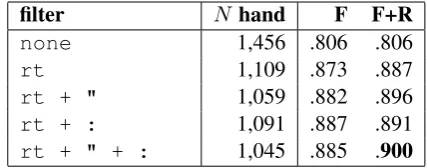
filter N hand F F+R
none 1,456 .806 .806
rt 1,109 .873 .887
rt + " 1,059 .882 .896
rt + : 1,091 .887 .891
[image:2.595.308.522.62.146.2]rt + " + : 1,045 .885 .900
Table 1: Several filter rules applied to the dis-tant labels (effectively removing those matching the rules), their impact on both data reduction (N
hand-labelled) and agreement increase. Agree-ment is specified for: only applying these filters (F), and in combination with the rules from Table2
(F+R), and reflects the amount of correct distant labels compared to the manual labels.
reporting gender: e.g.{I’ / I a}m a {man, woman, male, female, boy, girl, guy, dude, gal}. For each retrieved tweet, the timeline of the associated author was collected (up to 3,200 tweets) between Match 6th and 8th.
Note that the maximum retrieval history for the Search API is limited to tweets from the past week. Hence, our set of queries collected 19,307 profiles spanning results for one week only.
This method has some inherent advantages in addition to the ones mentioned in Section 2: it guarantees to a large extent that the profiles gath-ered are primarily English (95% of all associated tweets), collects data from active users (average of 2,500 tweets per timeline), and generally avoids bots, or other spam profiles (0,2%2of all profiles).
Finally, with gender profiling being considered a binary male/female classification task for much of the previous research and corpora, it also prevents including users that might not identify with the bi-nary framework in which gender is typically cast.3
Manual Evaluation To evaluate the accuracy of
our distant labels, a random sub-sample was man-ually labelled for gender by two annotators using a full profile view (κ = 0.78), resulting in 1,456 agreed on labels. Based on the initial results (see Table 1), several rules were constructed to filter (thereby removing) any profiles the query tweet matched to. First, we observed that many tweets (31%) containedrt— indicating a retweet. Sim-ilar to tweets containing quotes (5%), or colons
2Bots were identified during annotation.
3Accordingly, this method could be applied in future
Location Rule set
anywhere according to, deep down
[image:3.595.72.298.62.147.2]before query feel like, where, (as) if, hoping, assume(s/d) (that), think, expect (that), then, (that) means, imply-ing, guess, think(s), tells me Table 2: Rules applied to the distant labels to flip the assumed gender. Their location can be any-wherein the tweet, or rightbeforethequery(e.g. “Sometimes I think I’m a girl”).
(2%), these are generally not self-reports (e.g.
"random guy: I’m a man. . ."), and were there-fore removed. Overall, the filters increased agree-ment with our manual annotations, simultaneously causing a decrease to 6,610 profiles. This method however ensures a high accuracy of the distant la-bels, which should outweigh the amount of data.
In addition to these filters, several rules were constructed to deal with linguistic cues that make it highly likely for the gender to be the opposite of the literal report (see Table 2) — thus indi-cating the label should be flipped. Examples in-clude “according to the Internet, I’m a girl”, and “Don’t just assume I’m a guy”. For a detailed overview of their effect on the overall agreement, see F+R in Table 1. The ad-hoc list presented here improved agreement about .015. Note that despite being constructed by manual inspection of the mismatches between annotations and the dis-tant labels, our filters, rules, and even the initial query can be extended with some creativity.
Preparation To compare our distant labels to
annotated alternatives, we include Volkova et al.
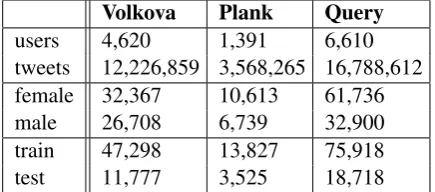
(2014)’s crowd-sourced corpus, and the manually labelled corpus byPlank and Hovy(2015). Hence-forth, these external corpora will be referred to as Volkova and Plank respectively. The timelines of their provided user IDs where gathered between April 1st and 7th 2017 (see Table3for further
de-tails on their sizes).
The timelines for all corpora—including our Query corpus—were divided in batches of 200 tweets, as most related work follows this setup. Afterwards, each batch is provided with either a distant, or manual label, depending on the set of origin. This implies that users with less than 200 tweets were excluded, as well as any consecutive tweets that would not exactly fit into a batch of 200. The corpora were divided between a (gender
Volkova Plank Query
[image:3.595.308.526.63.159.2]users 4,620 1,391 6,610 tweets 12,226,859 3,568,265 16,788,612 female 32,367 10,613 61,736 male 26,708 6,739 32,900 train 47,298 13,827 75,918 test 11,777 3,525 18,718
Table 3: Various metrics of the Twitter corpora annotated with gender used in this research. The train and test sizes reflect the amount of batches of 200 tweets.
stratified) train and a test set by user ID. This guar-antees that there is no bleed of batches from any user between any of the splits (refer to Table3for the final split sizes). Other than tokenisation using
spaCy(Honnibal and Johnson,2015), no special preprocessing steps were taken. We removed pri-marily non-English batches usinglangdetect4
(Shuyo,2010), as well as the original query tweets containing self-reports. The latter was done to avoid our queries being most characteristic for some batches.
4 Experiment
For document classification,fastText5 (Joulin
et al.,2016) was employed; a simple linear model with one hidden embedding layer that learns sen-tence representations using bag of words or n -gram input, producing a probability distribution over the given classes using the softmax func-tion. It therefore follows the same architecture as the continuous bag of words model fromMikolov et al.(2013), replacing the middle word with a la-bel. Joulin et al. (2016) demonstrate the model performs well on both sentiment and tag predic-tion tasks, significantly speeding up training and test time compared to several recent models.
Gender predictions were made using a typical set of n-gram features as input; token uni-grams and bi-grams, and character tri-grams. We incor-porate only those grams that occur more than three times during training. As the corpora are quite small, we use embeddings with only 30 dimen-sions, a learning rate of 0.1, and a bucket size of 1M. All models are trained for 10 epochs. Given thatfastTextuses Hogwild (Recht et al.,2011)
4https://github.com/Mimino666/
langdetect
5https://github.com/facebookresearch/
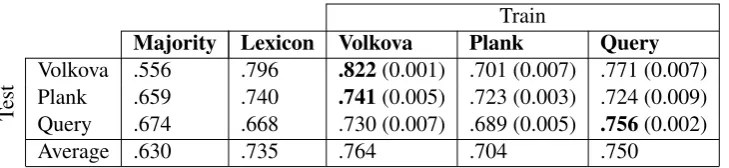
Train
Majority Lexicon Volkova Plank Query
Volkova .556 .796 .822(0.001) .701 (0.007) .771 (0.007) Test PlankQuery .659.674 .740.668 .741.730 (0.007) .689 (0.005)(0.005) .723 (0.003) .724 (0.009).756(0.002)
[image:4.595.122.487.61.145.2]Average .630 .735 .764 .704 .750
Table 4: Individual accuracy scores and averages for majority baseline (Majority), the lexicon of Sap et al.(2014), and the three models (trained on Volkova, Plank, and our dataset respectively) evaluated on the test set for each corpus. Standard deviation is reported after repeating the same experiment 20 times.
for parallelising Stochastic Gradient Descent, ran-domness in the vector representations cannot be controlled using a seed. To estimate the standard deviation in the results, we ran each experiment 20 times. To evaluate how our distantly supervised model compares to using manual annotations, we trained all models in this same configuration for all three corpora. Each model was then evaluated on the test set for each corpus.
5 Results
Table4shows accuracy scores for this 3x3 experi-mental design, as well as a majority baseline score (always predicting female), and an average over the three test sets for each model. We closely re-produced the results from Volkova and Bachrach
(2016); despite the difference in user6 and tweet
samples, exact split order, and their use of more features including style and part-of-speech tags, our performance approaches their reported .84 ac-curacy score. Plank and Hovy(2015) do not pro-vide classification results for gender on their data. For comparison to state-of-the-art gender classifi-cation for English, the lexicon ofSap et al.(2014) is included in the results. Their work also com-pares with Volkova et al. (2014), and reports a higher score (.90) for their random sample setup than reproduced in our batch evaluation (.80).
Despite the fact that the model trained on the Volkova corpus performs best on both annotated corpora (Volkova and Plank), the difference is fairly small compared to our distantly supervised model — the latter of which somewhat expectedly performs best on its associated test set. On av-erage, the Query and Volkova trained models only differ .014 in accuracy score, and the Query model outperforms the lexicon approach by .015. How-ever, the more significant comparison is the out of sample performance for these two models and
6We could only retrieve 4,620 of the reported 4,998.
the lexicon model on the Plank test set. Here, re-sults are comparable between Query and Volkova, with a .017 difference, and higher standard devia-tion. However, here the lexicon approach outper-forms the Query model with .016. Not only does this show our distant labels to be be comparable with hand labels, our models also seems to yield favourable performance over state of the art.
6 Conclusion
We use simple queries for self-reports to train a gender classifier for Twitter that has competi-tive performance to those trained on costly hand-annotated labels — showing minimal differences. These should be considered in light of the manual effort put into gathering the annotations, however. Labelling Twitter users with our set of queries yields up to 45,000 hits per 15 minutes (API rate limits considered), and therefore finishes in sev-eral minutes. Retrieving the timelines for the ini-tial 19,307 users took roughly 21 hours. Including preprocessing (3 hours) and running fastText
(a few minutes) the entire pipeline is encourag-ingly cheap, even considering time, and can fea-sibly be repeated on a weekly basis.
References
Faiyaz Al Zamal, Wendy Liu, and Derek Ruths. 2012. Homophily and latent attribute inference: Infer-ring latent attributes of twitter users from neighbors. ICWSM270.
Jalal S Alowibdi, Ugo A Buy, and Philip Yu. 2013. Empirical evaluation of profile characteristics for gender classification on twitter. InMachine Learn-ing and Applications (ICMLA), 2013 12th Interna-tional Conference on. IEEE, volume 1, pages 365– 369.
Shlomo Argamon, Moshe Koppel, James W Pen-nebaker, and Jonathan Schler. 2007. Mining the blogosphere: Age, gender and the varieties of
self-expression. First Monday12(9).
John D Burger, John Henderson, George Kim, and Guido Zarrella. 2011. Discriminating gender on twitter. InProceedings of the Conference on Empiri-cal Methods in Natural Language Processing. Asso-ciation for Computational Linguistics, pages 1301– 1309.
Morgane Ciot, Morgan Sonderegger, and Derek Ruths. 2013. Gender inference of twitter users in
non-english contexts. InEMNLP. pages 1136–1145.
Glen Coppersmith, Mark Dredze, Craig Harman, and Kristy Hollingshead. 2015. From adhd to sad: An-alyzing the language of mental health on twitter
through self-reported diagnoses. NAACL HLT 2015
page 1.
Jacob Eisenstein, Noah A Smith, and Eric P Xing. 2011. Discovering sociolinguistic associations with structured sparsity. InProceedings of the 49th An-nual Meeting of the Association for Computational Linguistics: Human Language Technologies-Volume 1. Association for Computational Linguistics, pages 1365–1374.
Lucie Flekova, Jordan Carpenter, Salvatore Giorgi, Lyle Ungar, and Daniel Preotiuc-Pietro. 2016. An-alyzing biases in human perception of user age and
gender from text. In Proceedings of the 54th
An-nual Meeting of the Association for Computational Linguistics, ACL. pages 843–854.
Matthew Honnibal and Mark Johnson. 2015. An im-proved non-monotonic transition system for
depen-dency parsing. In Proceedings of the 2015
Con-ference on Empirical Methods in Natural Language Processing. Association for Computational Linguis-tics, Lisbon, Portugal, pages 1373–1378.
Dirk Hovy. 2015. Demographic factors improve clas-sification performance. InACL. pages 752–762.
Armand Joulin, Edouard Grave, Piotr Bojanowski, and Tomas Mikolov. 2016. Bag of tricks for efficient text classification. arXiv preprint arXiv:1607.01759.
Moshe Koppel, Shlomo Argamon, and Anat Rachel Shimoni. 2002. Automatically categorizing writ-ten texts by author gender. Literary and Linguistic Computing17(4):401–412.
Jiwei Li, Alan Ritter, and Eduard H Hovy. 2014. Weakly supervised user profile extraction from twit-ter. InACL (1). pages 165–174.
Jiwei Li, Alan Ritter, and Dan Jurafsky. 2015. Learning multi-faceted representations of individu-als from heterogeneous evidence using neural
net-works. arXiv preprint arXiv:1510.05198.
Tomas Mikolov, Kai Chen, Greg Corrado, and
Jef-frey Dean. 2013. Efficient estimation of word
representations in vector space. arXiv preprint
arXiv:1301.3781.
Dong Nguyen, Noah A Smith, and Carolyn P Ros´e. 2011. Author age prediction from text using
lin-ear regression. In Proceedings of the 5th
ACL-HLT Workshop on Language Technology for Cul-tural Heritage, Social Sciences, and Humanities. Association for Computational Linguistics, pages 115–123.
Dong-Phuong Nguyen, RB Trieschnigg, A Seza Do˘gru¨oz, Rilana Gravel, Mari¨et Theune, Theo Meder, and FMG de Jong. 2014. Why gender and age prediction from tweets is hard: Lessons from a crowdsourcing experiment. Association for Compu-tational Linguistics.
Barbara Plank and Dirk Hovy. 2015. Personality traits on twitter—or—how to get 1,500 personality tests
in a week. In Proceedings of the 6th Workshop
on Computational Approaches to Subjectivity, Sen-timent and Social Media Analysis. pages 92–98.
Benjamin Recht, Christopher Re, Stephen Wright, and Feng Niu. 2011. Hogwild: A lock-free approach to parallelizing stochastic gradient descent. In Ad-vances in Neural Information Processing Systems. pages 693–701.
Sara Rosenthal and Kathleen McKeown. 2011. Age prediction in blogs: A study of style, content, and online behavior in pre-and post-social media genera-tions. InProceedings of the 49th Annual Meeting of the Association for Computational Linguistics: Hu-man Language Technologies-Volume 1. Association for Computational Linguistics, pages 763–772.
Maarten Sap, Gregory Park, Johannes C Eichstaedt, Margaret L Kern, David Stillwell, Michal Kosinski, Lyle H Ungar, and H Andrew Schwartz. 2014. De-veloping age and gender predictive lexica over social media .
Ben Verhoeven, Walter Daelemans, and Barbara Plank. 2016. Twisty: a multilingual twitter stylometry
cor-pus for gender and personality profiling. In
Pro-ceedings of the 10th Annual Conference on Lan-guage Resources and Evaluation (LREC 2016). ELRA, ELRA, Portoroˇz, Slovenia.
Svitlana Volkova and Yoram Bachrach. 2016. Inferring perceived demographics from user emotional tone
and user-environment emotional contrast. In
Pro-ceedings of the 54th Annual Meeting of the Associa-tion for ComputaAssocia-tional Linguistics, ACL.
Svitlana Volkova, Glen Coppersmith, and Benjamin Van Durme. 2014. Inferring user political
prefer-ences from streaming communications. InACL (1).