Sequential Dialogue Context Modeling for Spoken Language
Understanding
Ankur Bapna
Gokhan T¨ur
Google Research, Mountain ViewDilek Hakkani-T¨ur
{gokhan.tur, dilek, larry.heck}@ieee.org
Larry Heck
Abstract
Spoken Language Understanding (SLU) is a key component of goal oriented di-alogue systems that would parse user ut-terances into semantic frame representa-tions. Traditionally SLU does not uti-lize the dialogue history beyond the pre-vious system turn and contextual ambigu-ities are resolved by the downstream com-ponents. In this paper, we explore novel approaches for modeling dialogue con-text in a recurrent neural network (RNN) based language understanding system. We propose the Sequential Dialogue Encoder Network, that allows encoding context from the dialogue history in chronologi-cal order. We compare the performance of our proposed architecture with two context models, one that uses just the previous turn context and another that encodes dialogue context in a memory network, but loses the order of utterances in the dialogue his-tory. Experiments with a multi-domain di-alogue dataset demonstrate that the pro-posed architecture results in reduced se-mantic frame error rates.
1 Introduction
Goal oriented dialogue systems help users with ac-complishing tasks, like making restaurant reserva-tions or booking flights, by interacting with them in natural language. The capability to understand user utterances and break them down into task spe-cific semantics is a key requirement for these sys-tems. This is accomplished in the spoken language understanding module, which typically parses user utterances into semantic frames, composed of do-mains, intents and slots (Tur and De Mori,2011), that can then be processed by downstream
dia-u1 Can you get me a restaurant reservation ?
s Sure, where do you want to go ?
u2 table for 2 at Pho Nam
↓ ↓ ↓ ↓ ↓ ↓
S O O B-# O B-Rest I-Rest
D restaurants
I reserve restaurant
Figure 1: An example semantic parse of an utter-ance (u2) with slot (S), domain (D), intent (I) an-notations, following the IOB (in-out-begin) repre-sentation for slot values.
logue system components. An example semantic frame is shown for a restaurant reservation related query in Figure1.
As the complexity of the task supported by a di-alogue system increases, there is a need for an increased back and forth interaction between the user and the agent. For example, a restaurant reservation task might require the user to spec-ify a restaurant name, date, time and number of people required for the reservation. Additionally, based on reservation availability, the user might need to negotiate on date, time, or any other at-tribute with the agent. This puts the burden of parsing in-dialogue contextual user utterances on the language understanding module. The com-plexity increases further when the system supports more than one task and the user is allowed to have goals spanning multiple domains within the same dialogue. Natural language utterances are often ambiguous, and the context from previous user and system turns could help resolve the errors aris-ing from these ambiguities.
In this paper, we explore approaches to im-prove dialogue context modeling within a Recur-rent Neural Network (RNN) based spoken lan-guage understanding system. We propose a novel model architecture to improve dialogue context modeling for spoken language understanding on a
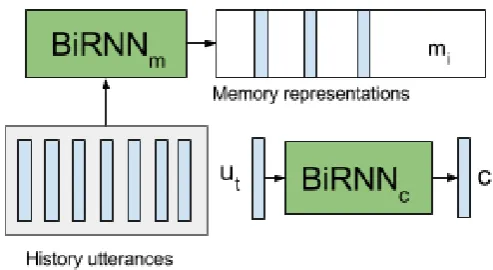
Figure 2: Architecture of the Memory and current utterance context encoder. multi-domain dialogue dataset. The proposed
ar-chitecture is an extension of Hierarchical Recur-rent Encoder Decoders (HRED) (Sordoni et al.,
2015), where we combine the query level encod-ings with a representation of the current utterance, before feeding it into the session level encoder. We compare the performance of this model to a RNN tagger injected with just the previous turn context and a single hop memory network that uses an at-tention weighted combination of the dialogue con-text (Chen et al.,2016;Weston et al.,2014). Furthermore, we describe a dialogue recombi-nation technique to enhance the complexity of the training dataset by injecting synthetic domain switches, to create a better match with the mixed domain dialogues in the test dataset. This is, in principle, a multi-turn extension of (Jia and Liang, 2016). Instead of inducing and compos-ing grammars to synthetically enhance scompos-ingle turn text, we combine single domain dialogue sessions into multi-domain dialogues to provide richer con-text during training.
2 Related Work
The task of understanding a user utterance is typ-ically broken down into 3 tasks: domain classi-fication, intent classification and slot-filling (Tur and De Mori, 2011). Most modern approaches to Spoken language understanding involve ing machine learning models on labeled train-ing data (Young, 2002;Hahn et al., 2011; Wang et al., 2005, among others). More recently, re-current neural network (RNN) based approaches have been shown to perform exceedingly well on spoken language understanding tasks (Mesnil et al.,2015;Hakkani-T¨ur et al.,2016;Kurata et al.,
2016, among others). RNN based approaches have also been applied successfully to other tasks for
di-alogue systems, like didi-alogue state tracking ( Hen-derson, 2015; Henderson et al., 2014;Perez and Liu, 2016, among others), policy learning (Su et al.,2015) and system response generation (Wen et al.,2015,2016, among others).
In parallel, joint modeling of tasks and addition of contextual signals has been shown to result in per-formance gains for several applications. Modeling domain, intent and slots in a joint RNN model was shown to result in reduction of overall frame er-ror rates (Hakkani-T¨ur et al.,2016). Joint model-ing of intent classification and language modelmodel-ing showed promising improvements in intent recog-nition, especially in the presence of noisy speech recognition (Liu and Lane,2016).
Similarly, models incorporating more context from dialogue history (Chen et al., 2016) or se-mantic context from the frame (Dauphin et al.,
2014;Bapna et al.,2017) tend to outperform mod-els without context and have shown potential for greater generalization on spoken language under-standing and related tasks. (Dhingra et al.,2016) show improved performance on an informational dialogue agent by incorporating knowledge base context into their dialogue system. Using dialogue context was shown to boost performance for end to end dialogue (Bordes and Weston,2016) and next utterance prediction (Serban et al.,2015).
In the next few sections, we describe the proposed model architecture, the dataset and our dialogue recombination approach. This is followed by ex-perimental results and analysis.
3 Model Architecture
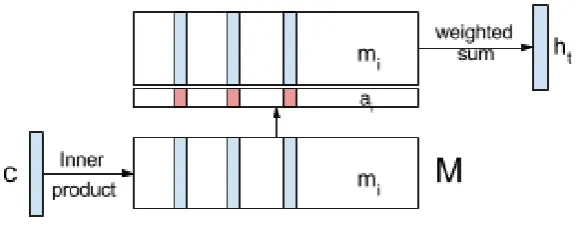
Figure 3: Architecture of the dialogue context encoder for the cosine similarity based memory network.
{u1, u2...ut} and at time step t we are trying to output the parse of a user utteranceut, givenDt. Let any utteranceukbe a sequence of tokens given by{xk
1, xk2...xknk}.
We divide the model into 2 components, the con-text encoder that acts on Dt to produce a vector representation of the dialogue context denoted by
ht = H(Dt), and the tagger, which takes the di-alogue context encodinght, and the current utter-anceutas input and produces the domain, intent and slot annotations as output.
3.1 Context Encoder Architectures
In this section we describe the architectures of the context encoders used for our experiments. We compare the performance of 3 different architec-tures that encode varying levels of dialogue con-text.
3.1.1 Previous Utterance Encoder
This is the baseline context encoder architecture. We feed the embeddings corresponding to to-kens in the previous system utterance, ut−1 =
{xt−1
1 , xt−2 1...xt−nt−11}, into a single Bidirectional
RNN (BiRNN) layer with Gated Recurrent Unit (GRU) (Chung et al.,2014) cells and 128 dimen-sions (64 in each direction). The embeddings are shared with the tagger. The final state of the con-text encoder GRU is used as the dialogue concon-text.
ht=BiGRUc(ut−1) (1) 3.1.2 Memory Network
This architecture is identical to the approach de-scribed in (Chen et al., 2016). We encode all dialogue context utterances, {u1, u2...ut−1}, into
memory vectors denoted by {m1, m2, ...mt−1}
using a Bidirectional GRU (BiGRU) encoder with 128 dimensions (64 in each direction). To add temporal context to the dialogue history
utter-ances, we append special positional tokens to each utterance.
mk =BiGRUm(uk) for 0≤k≤t−1 (2)
We also encode the current utterance with another BiGRU encoder with 128 dimensions (64 in each direction), into a context vector denoted by c, as in equation 3. This is conceptually depicted in Figure2
c=BiGRUc(ut) (3)
Let M be a matrix with the ith row given by
mi. We obtain the cosine similarity between each memory vector,mi, and the context vectorc. The softmax of this similarity is used as an attention distribution over the memoryM, and an attention weighted sum of M is used to produce the dia-logue context vectorht(Equation 4). This is con-ceptually depicted in Figure 3.
a=softmax(Mc)
ht=aTM (4)
3.1.3 Sequential Dialogue Encoder Network
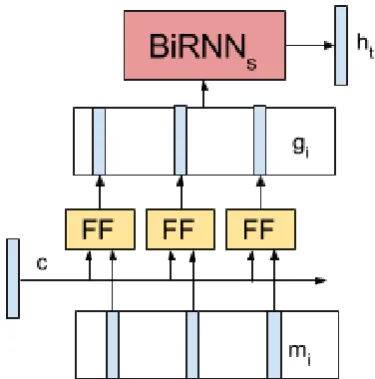
We enhance the memory network architecture de-scribed above by adding a session encoder ( Sor-doni et al., 2015) that temporally combines a joint representation of the current utterance en-coding, c, (Eq. 3) and the memory vectors,
{m1, m2...mt−1}, (Eq. 2).
We combine the context vectorcwith each mem-ory vector mk, for1 ≤ k ≤ nk, by concatenat-ing and passconcatenat-ing them through a feed forward layer (FF) to produce 128 dimensional context encod-ings, denoted by{g1, g2...gt−1}(Eq. 5).
di-Figure 4: Architecture of the Sequential Dialogue Encoder Network. The feed-forward networks share weights across all memories.
mensional BiGRU layer. The final state of the ses-sion encoder represents the dialogue context en-codinght(Eq. 6).
ht=BiGRUs({g1, g2, ...gt−1}) (6)
The architecture is depicted in Figure 4.
3.2 Tagger Architecture
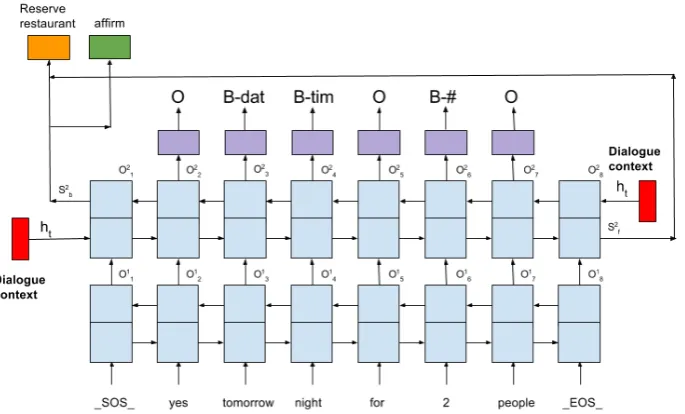
For all our experiments we use a stacked BiRNN tagger to jointly model domain classification, in-tent classification and slot-filling, similar to the approach described in (Hakkani-T¨ur et al.,2016). We feed learned 256 dimensional embeddings cor-responding to the current utterance tokens into the tagger.
The first RNN layer uses GRU cells with 256 di-mensions (128 in each direction) as in equation 7. The token embeddings are fed into the token level inputs of the first RNN layer to produce the token level outputso1 ={o1
1, o12...o1nt}.
o1 =BiGRU1(ut) (7)
The second layer uses Long Short Term Mem-ory (LSTM) (Hochreiter and Schmidhuber,1997) cells with 256 dimensions (128 in both dimen-sions). We use a LSTM based second layer since that improved slot-filling performance on the val-idation set for all architectures. We apply dropout to the outputs of both layers. The initial states of both forward and backward LSTMs of the second tagger layer are initialized with the dialogue en-codinghtas in equation 8. The token level out-puts of the first RNN layer, o1, are fed as input
into the second RNN layer to produce token level outputso2={o2
1, o22...o2nt}and the final states2.
o2, s2 =BiLST M2(o1, ht) (8) The final state of the second layer, s2, is used as
input to classification layers for domain and intent classification.
pdomain=softmax(Us2)
pintent=sigmoid(V s2) (9)
The token level outputs of the second layer, o2, are used as input to a softmax layer that outputs the IOB slot labels. This results in a softmax layer with2N+1dimensions for a domain withNslots.
psloti =softmax(Soi2) for 0≤i≤nt
(10) The architecture is depicted in Figure 5.
4 Dataset
We crowd sourced multi-turn dialogue sessions for 3 tasks: buying movie tickets, searching for a restaurant and reserving tables at a restaurant. Our data collection process comprises of two steps: (i) Generating user-agent interactions comprising of dialog acts and slots based on the interplay of a simulated user and a rule based dialogue policy. (ii) Using a crowd sourcing platform to elicit nat-ural language utterances that align with the seman-tics of the generated interactions.
The goal of the spoken language understanding module of our dialogue system is to map each user utterance into frame based semantics that can be processed by the downstream components. Ta-bles describing the intents and slots present in the dataset can be found in the appendix.
[image:4.595.76.264.64.254.2]Figure 5: Architecture of the stacked BiRNN tagger. The dialogue context obtained from the context encoder is fed into the initial states of the second RNN layer.
Domain Attributes
movies date, movie, num tickets, theatre name, time
find-restaurants category, location, meal, price range, rating, restaurant name reserve-restaurant date, num people, restaurant name, time
Table 1: List of attributes supported for each domain.
system actions. Based on the chosen user dialogue act, the rule based policy might make a backend call to inquire for restaurant or movie availabil-ity. Based on the user act and the backend re-sponse the system responds back with a dialogue act or a combination of dialogue acts, based on a hand designed rule based policy. These gener-ated interactions were then translgener-ated to their nat-ural language counterparts and sent out to crowd-workers for paraphrasing into natural language human-machine dialogues.
The simulator and policy were also extended to handle multiple goals spanning different domains. In this set-up, the user goal for the simulator would include multiple tasks and slot values could be conditioned on the previous task, for example, the simulator would ask for booking a table ”after the movie”, or search for a restaurant ”near the the-ater”. The set of slots supported by the simulator is enumerated in Table 1. We collected 1319 di-alogues for restaurant reservation, 976 didi-alogues for finding restaurants and 1048 dialogues for buy-ing movie tickets. All sbuy-ingle domain datasets were
used for training. The multi-domain simulator was used to collect 467 dialogues for training, 50 for validation and 273 for the test set. Since the natural language dialogues were paraphrased ver-sions of known dialogue- act and slot combina-tions, they were automatically labeled. These la-bels were verified by an expert annotator, and turns with missing annotations were manually annotated by the expert.
5 Dialogue Recombination
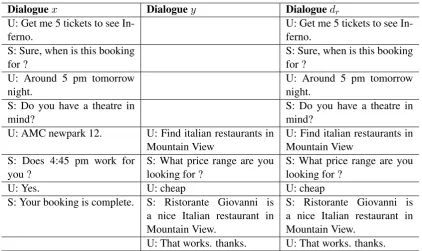
Dialoguex Dialoguey Dialoguedr U: Get me 5 tickets to see
In-ferno. U: Get me 5 tickets to see In-ferno.
S: Sure, when is this booking
for ? S: Sure, when is this bookingfor ?
U: Around 5 pm tomorrow
night. U: Around 5 pm tomorrownight.
S: Do you have a theatre in
mind? S: Do you have a theatre inmind?
U: AMC newpark 12. U: Find italian restaurants in
Mountain View U: Find italian restaurants inMountain View S: Does 4:45 pm work for
you ? S: What price range are youlooking for ? S: What price range are youlooking for ?
U: Yes. U: cheap U: cheap
S: Your booking is complete. S: Ristorante Giovanni is a nice Italian restaurant in Mountain View.
S: Ristorante Giovanni is a nice Italian restaurant in Mountain View.
[image:6.595.88.511.60.311.2]U: That works. thanks. U: That works. thanks.
Table 2: A sample dialogue obtained from recombining a dialogue from the movies and find-restaurant datasets.
The key idea behind the recombination approach is the conditional independence of sub-dialogues aimed at performing distinct tasks (Grosz and Sidner, 1986). We exploit the presence of task intents, or intents that denote a switch in the primary task the user is trying to perform, since they are a strong indicator of a switch in the focus of the dialogue. We exploit the independence of the sub-dialogue following these intents from the previous dialogue context, to generate synthetic dialogues with multi-domain context. The recom-bination process is described as follows:
Let a dialogue d be defined as a sequence of turns and corresponding semantic la-bels (domain, intent and slot annotations)
{(td1, fd1),(td2, fd2), ...(tdnd, fdnd}. To obtain a re-combined dataset composed of dialogues from datasetdataset1anddataset2, we repeat the
fol-lowing steps 10000 times, for each combination of (dataset1, dataset2) from the three single domain datasets.
• Sample dialoguesxandyfromdataset1and
dataset2respectively.
• Find the first user utterance labeled with a task intent iny. Let this be turnl.
• Randomly sample an insertion point in dia-loguex. Let this be turnk.
• The new recombined dialogue is
{(tx1, fx1), ...(txk, fxk),(tyl, fyl),
...(tyny, fyny)}.
A sample dialogue generated using the above pro-cedure is described in table 2. We drop the ut-terances from dialogue x following the insertion point (turn k) in the recombined dialogue since these turns become ambiguous or confusing in the absence of preceding context. In a sense our ap-proach is one of partial dialogue recombination. 6 Experiments
We compare the domain classification, intent clas-sification and slot-filling performances, and the overall frame error rates of the encoder-decoder, memory network and sequential dialogue encoder network on the dataset described above. The frame error rate of a SLU system is the percentage of utterances where it makes a wrong prediction i.e. any of domain, intent or slot is predicted in-correctly.
Model Domain F1 Intent F1 Slot Token F1 Frame Error Rate
ED 0.937 0.865 0.891 31.87%
MN 0.964 0.890 0.896 26.72%
SDEN 0.960 0.870 0.896 31.31%
ED + DR 0.936 0.885 0.911 30.72%
MN + DR 0.968 0.902 0.904 27.48%
SDEN + DR 0.975 0.898 0.926 25.85%
Table 3: Test set performances for the encoder decoder (ED) model, Memory Network (MN) and the Sequential Dialogue Encoder Network (SDEN) with and without recombined data (DR).
utterance MN+DR SDEN+DR
hi! 0.00 0.13
hello ! i want to buy movie tickets for8pm at cinelux plaza 0.05 0.34
which movie , how many , and what day ? 0.13 0.24
Trolls,6tickets for today
True ED+DR MN+DR SDEN+DR
Domain buy-movie-tickets movies movies movies
Intent contextual contextual contextual contextual
date today today today today
num tickets 6 6 6 6
movie Trolls Trolls - Trolls
Table 4: Dialogue from the test set with predictions from Encoder Decoder with recombined data (ED+DR), Memory Network with recombined data (MN+DR) and Sequential Dialogue Encoder Net-work with dialogue recombination (SDEN+DR).Tokens that have been italicized in the dialogue were out of vocabulary or replaced with special tokens. The columns to the right of the dialogue history detail the attention distributions. For SDEN+DR, we use the magnitude of the change in the session GRU state as a proxy for the attention distribution. Attention weights might not sum up to 1 if there is non-zero attention on history padding.
We restrict the model vocabularies to contain only tokens occurring more than 10 times in the train-ing set, to prevent over-fitttrain-ing to traintrain-ing set enti-ties. Digits were replaced with a special ”#” token to allow better generalization to unseen numbers. The dialogue history was padded to 40 utterances for batch processing. We report results with and without the recombined dataset in Table3.
7 Results
The encoder decoder model trained on just the previous turn context performs worst on almost all metrics, irrespective of the presence of recom-bined data. This can be explained by worse per-formance on in-dialogue utterances, where just the previous turn context isn’t sufficient to accurately identify the domain, and in several cases, the in-tents and slots of the utterance.
The memory network is the best performing model in the absence of recombined data, indicating that
the model is able to encode additional context effectively to improve performance on all tasks, even when only a small amount of multi-domain data is available.
The Sequential dialogue encoder network per-forms slightly worse than the memory network in the absence of recombined data. This could be ex-plained by the model over-fitting to the single do-main context seen during training and failure to utilize context effectively in a multi-domain set-ting. In the presence of recombined dialogues it outperforms all other implementations.
con-utterance MN+DR SDEN+DR
hello 0.01 0.10
hello . i need to buy tickets at cinemark redwood downtown20for xd at
6:00pm 0.00 0.06
which movie do you want to see at what time and date . 0.00 0.04
I didn’t understand that. 0.00 0.03
please tell which movie , the time and date of the movie 0.01 0.02 the movie is queen of katwe today and the number of tickets is4 0.00 0.00
So 4 tickets for the6:00pm showing 0.02 0.01
yes 0.01 0.01
I bought you4tickets for the6 : 00pm showing of queen of katwe at
cinemark redwood downtown20 0.06 0.04
thank you 0.03 0.03
i want aBrazilianrestaurant 0.61 0.29
which one ofFogo de Cho Braziliansteakhouse ,Espetus Churrascaria
san mateo orFogo de Chowould you prefer 0.02 0.26
Fogo de Cho Braziliansteakhouse
True ED+DR MN+DR SDEN+DR
Domain find-restaurants movies find-restaurants find-restaurants
Intent affirm(restaurant) - -
-restaurant
name FogoBraziliande steak-Cho house
- - Fogo de Cho
[image:8.595.71.536.59.388.2]Brazilian steak-house
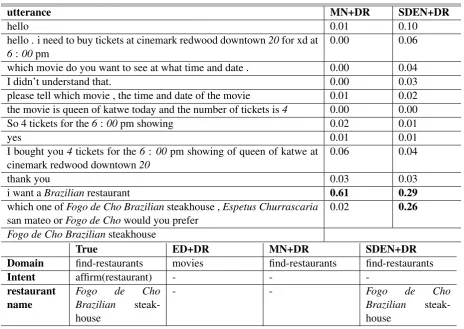
Table 5: Dialogue from the test set with predictions from Encoder Decoder with recombined data (ED+DR), Memory Network with recombined data (MN+DR) and Sequential Dialogue Encoder Net-work with dialogue recombination (SDEN+DR). Tokens that have been italicized in the dialogue were out of vocabulary or replaced with special tokens. The columns to the right of the dialogue history detail the attention distributions. For SDEN+DR, we use the magnitude of the change in the session GRU state as a proxy for the attention distribution. Attention weights might not sum up to 1 if there is non-zero attention on history padding.
text has a regularization-like effect on the models. Similar effects were observed by (Jia and Liang,
2016), where training with longer, synthetically-augmented utterances resulted in improved se-mantic parsing performance on a simpler test set. This is also supported by the observation that per-formance improvements obtained by addition of recombined data increase as the complexity of the model increases.
8 Discussion and Conclusions
Table 4demonstrates an example dialogue from the test set, along with the gold and model annota-tions from all 3 models. We observe that Encoder Decoder (ED) and Sequential Dialogue Encoder Network (SDEN) are able to successfully identify the domain, intent and slots, while the Memory Network (MN) fails to identify the movie name.
Looking at the attention distributions, we notice that the MN attention is very diffused, whereas SDEN is focusing on the most recent last 2 utter-ances, which directly identify the domain and the presence of themovie slot in the final user utter-ance. ED is also able to identify the presence of a
moviein the final user utterance from the previous utterance context.
two utterances, SDEN is able to successfully com-bine context from the dialogue to correctly iden-tify the domain and the restaurant name from the user utterance, despite the presence of several out-of-vocabulary tokens.
The above two examples hint that SDEN performs better in scenarios where multiple history ut-terances encode complementary information that could be useful to interpret user utterances. This is usually the case in more natural goal oriented dialogues, where several tasks and sub tasks go in and out of the focus of the conversation (Grosz,
1979).
On the other hand, we also observed that SDEN performs significantly worse in the absence of re-combined data. Due to its complex architecture and a much larger set of parameters SDEN is prone to over-fitting in low data scenarios.
In this paper, we collect a multi-domain dataset of goal oriented human-machine conversations and analyze and compare the SLU performance of multiple neural network based model architectures that can encode varying amounts of context. Our experiments suggest that encoding more context from the dialogue, and enabling the model to com-bine contextual information in a sequential order results in a reduction in overall frame error rate. We also introduce a data augmentation scheme to generate longer dialogues with richer context, and empirically demonstrate that it results in perfor-mance improvement for multiple model architec-tures.
9 Acknowledgements
We would like to thank Pararth Shah, Abhinav Rastogi, Anna Khasin and Georgi Nikolov for their help with the user-machine conversation data collection and labeling. We would also like to thank the anonymous reviewers for their insight-ful comments.
References
Ankur Bapna, Gokhan T¨ur, Dilek Hakkani-T¨ur, and Larry Heck. 2017. Towards zero-shot frame seman-tic parsing for domain scaling. InIn Proceedings of the Interspeech. Stockholm, Sweden.
Antoine Bordes and Jason Weston. 2016. Learn-ing end-to-end goal-oriented dialog. arXiv preprint arXiv:1605.07683.
Y.-N. Chen, D. Hakkani-T¨ur, G. Tur, J. Gao, and L. Deng. 2016. End-to-end memory networks with
knowledge carryover for multi-turn spoken language understanding. In Proceedings of the Interspeech. San Francisco, CA.
Junyoung Chung, Caglar Gulcehre, KyungHyun Cho, and Yoshua Bengio. 2014. Empirical evaluation of gated recurrent neural networks on sequence model-ing.arXiv preprint arXiv:1412.3555.
Y. Dauphin, G. Tur, D. Hakkani-T¨ur, and L. Heck. 2014. Zero-shot learning and clustering for seman-tic utterance classification. In Proceedings of the ICLR.
Bhuwan Dhingra, Lihong Li, Xiujun Li, Jianfeng Gao, Yun-Nung Chen, Faisal Ahmed, and Li Deng. 2016. End-to-end reinforcement learning of dia-logue agents for information access. arXiv preprint arXiv:1609.00777.
Barbara J Grosz. 1979. Focusing and description in natural language dialogues. Technical report, DTIC Document.
Barbara J Grosz and Candace L Sidner. 1986. Atten-tion, intentions, and the structure of discourse. Com-putational linguistics12(3):175–204.
S. Hahn, M. Dinarelli, C. Raymond, F. Lefevre, P. Lehnen, R. De Mori, A. Moschitti, H. Ney, and G. Riccardi. 2011. Comparing stochastic ap-proaches to spoken language understanding in multi-ple languages.IEEE Transactions on Audio, Speech, and Language Processing19(6):1569–1583. D. Hakkani-T¨ur, G. Tur, A. Celikyilmaz, Y.-N. Chen,
J. Gao, L. Deng, and Y.-Y. Wang. 2016. Multi-domain joint semantic frame parsing using bi-directional RNN-LSTM. InProceedings of the In-terspeech. San Francisco, CA.
Matthew Henderson. 2015. Machine learning for dia-log state tracking: A review. InProceedings of The First International Workshop on Machine Learning in Spoken Language Processing.
Matthew Henderson, Blaise Thomson, and Jason D Williams. 2014. The second dialog state tracking challenge.
Sepp Hochreiter and J¨urgen Schmidhuber. 1997. Long short-term memory. Neural computation
9(8):1735–1780.
Robin Jia and Percy Liang. 2016. Data recombina-tion for neural semantic parsing. arXiv preprint arXiv:1606.03622.
G. Kurata, B. Xiang, B. Zhou, and M. Yu. 2016. Leveraging sentence-level information with encoder LSTM for semantic slot filling. InProceedings of the EMNLP. Austin, TX.
Bing Liu and Ian Lane. 2016. Joint online spoken lan-guage understanding and lanlan-guage modeling with recurrent neural networks. CoRR abs/1609.01462.
G. Mesnil, Y. Dauphin, K. Yao, Y. Bengio, L. Deng, D. Hakkani-T¨ur, X. He, L. Heck, G. Tur, and D. Yu. 2015. Using recurrent neural networks for slot fill-ing in spoken language understandfill-ing. IEEE Trans-actions on Audio, Speech, and Language Processing
23(3):530–539.
Julien Perez and Fei Liu. 2016. Dialog state tracking, a machine reading approach using memory network.
arXiv preprint arXiv:1606.04052.
Jost Schatzmann, Blaise Thomson, Karl Weilhammer, Hui Ye, and Steve Young. 2007. Agenda-based user simulation for bootstrapping a pomdp dialogue sys-tem. InHuman Language Technologies 2007: The Conference of the North American Chapter of the Association for Computational Linguistics; Com-panion Volume, Short Papers. Association for Com-putational Linguistics, pages 149–152.
Iulian Vlad Serban, Alessandro Sordoni, Yoshua Bengio, Aaron C. Courville, and Joelle Pineau. 2015. Hierarchical neural network generative mod-els for movie dialogues. CoRR abs/1507.04808.
http://arxiv.org/abs/1507.04808.
Pararth Shah, Dilek Hakkani-T¨ur, and Larry Heck. 2016. Interactive reinforcement learning for task-oriented dialogue management.
Alessandro Sordoni, Yoshua Bengio, Hossein Va-habi, Christina Lioma, Jakob Grue Simonsen, and Jian-Yun Nie. 2015. A hierarchical recur-rent encoder-decoder for generative context-aware query suggestion. In Proceedings of the 24th ACM International on Conference on Informa-tion and Knowledge Management. ACM, New York, NY, USA, CIKM ’15, pages 553–562.
https://doi.org/10.1145/2806416.2806493.
Pei-Hao Su, David Vandyke, Milica Gasic, Nikola Mrksic, Tsung-Hsien Wen, and Steve Young. 2015. Reward shaping with recurrent neural networks for speeding up on-line policy learning in spoken dia-logue systems. arXiv preprint arXiv:1508.03391. Gokhan Tur and Renato De Mori. 2011. Spoken
lan-guage understanding: Systems for extracting seman-tic information from speech. John Wiley & Sons. Y.-Y. Wang, L. Deng, and A. Acero. 2005. Spoken
lan-guage understanding - an introduction to the statis-tical framework. IEEE Signal Processing Magazine
22(5):16–31.
Tsung-Hsien Wen, Milica Gasic, Nikola Mrksic, Lina M Rojas-Barahona, Pei-Hao Su, David Vandyke, and Steve Young. 2016. Multi-domain neural network language generation for spoken di-alogue systems.arXiv preprint arXiv:1603.01232. Tsung-Hsien Wen, Milica Gasic, Nikola Mrksic,
Pei-Hao Su, David Vandyke, and Steve Young. 2015. Semantically conditioned lstm-based natural lan-guage generation for spoken dialogue systems.
arXiv preprint arXiv:1508.01745.
Jason Weston, Sumit Chopra, and Antoine Bor-des. 2014. Memory networks. arXiv preprint arXiv:1410.3916.
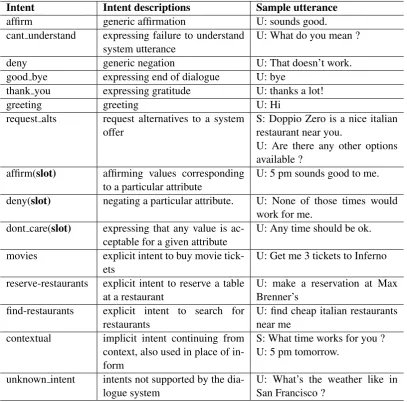
Table 6: Supported Intents:List of intents and dialogue acts supported by the user simulator, with de-scriptions and representative examples. Acts parametrized withslotcan be instantiated for any attribute supported within the domain.
Intent Intent descriptions Sample utterance
affirm generic affirmation U: sounds good.
cant understand expressing failure to understand
system utterance U: What do you mean ?
deny generic negation U: That doesn’t work.
good bye expressing end of dialogue U: bye
thank you expressing gratitude U: thanks a lot!
greeting greeting U: Hi
request alts request alternatives to a system
offer S: Doppio Zero is a nice italianrestaurant near you. U: Are there any other options available ?
affirm(slot) affirming values corresponding
to a particular attribute U: 5 pm sounds good to me. deny(slot) negating a particular attribute. U: None of those times would
work for me. dont care(slot) expressing that any value is
ac-ceptable for a given attribute U: Any time should be ok. movies explicit intent to buy movie
tick-ets U: Get me 3 tickets to Inferno
reserve-restaurants explicit intent to reserve a table
at a restaurant U: make a reservation at MaxBrenner’s find-restaurants explicit intent to search for
restaurants U: find cheap italian restaurantsnear me contextual implicit intent continuing from
context, also used in place of in-form
S: What time works for you ? U: 5 pm tomorrow.
unknown intent intents not supported by the
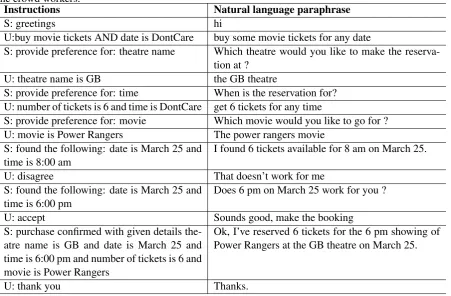
Table 7: Sample dialogue: Sample dialogue generated using a crowd working platform. The LHS consists of the instructions shown to the crowd workers based on the dialog act interactions between the user simulator and the rule based policy. The RHS describes the natural language dialog generated by the crowd workers.
Instructions Natural language paraphrase
S: greetings hi
U:buy movie tickets AND date is DontCare buy some movie tickets for any date
S: provide preference for: theatre name Which theatre would you like to make the reserva-tion at ?
U: theatre name is GB the GB theatre
S: provide preference for: time When is the reservation for? U: number of tickets is 6 and time is DontCare get 6 tickets for any time
S: provide preference for: movie Which movie would you like to go for ? U: movie is Power Rangers The power rangers movie
S: found the following: date is March 25 and
time is 8:00 am I found 6 tickets available for 8 am on March 25.
U: disagree That doesn’t work for me
S: found the following: date is March 25 and
time is 6:00 pm Does 6 pm on March 25 work for you ?
U: accept Sounds good, make the booking
S: purchase confirmed with given details the-atre name is GB and date is March 25 and time is 6:00 pm and number of tickets is 6 and movie is Power Rangers
Ok, I’ve reserved 6 tickets for the 6 pm showing of Power Rangers at the GB theatre on March 25.