Improving Update Summarization via Supervised ILP and Sentence
Reranking
Chen Li1, Yang Liu1, Lin Zhao2
1 Computer Science Department, The University of Texas at Dallas Richardson, Texas 75080, USA
2 Research and Technology Center, Robert Bosch LLC Palo Alto, California 94304, USA
{chenli,[email protected]}
Abstract
Integer Linear Programming (ILP) based sum-marization methods have been widely adopted recently because of their state-of-the-art per-formance. This paper proposes two new mod-ifications in this framework for update sum-marization. Our key idea is to use discrimi-native models with a set of features to mea-sure both the salience and the novelty of words and sentences. First, these features are used in a supervised model to predict the weights of the concepts used in the ILP model. Sec-ond, we generate preliminary sentence candi-dates in the ILP model and then rerank them using sentence level features. We evaluate our method on different TAC update summariza-tion data sets, and the results show that our system performs competitively compared to the best TAC systems based on the ROUGE evaluation metric.
1 Introduction
Update summarization has attracted significant re-search focus recently. Different from generic extrac-tive summarization, update summarization assumes that users already have some information about a given topic from an old data set, and thus for a new data set the system aims to generate a summary that contains as much novel information as possi-ble. This task was first introduced at DUC 2007 and then continued until TAC 2011. It is very useful to chronological events in real applications.
Most basic update summarization methods are variants of multi-document summarization methods, with some consideration of the difference between the earlier and later document sets (Boudin et al.,
2008; Fisher and Roark, 2008; Long et al., 2010; Bysani, 2010). One important line is to use graph-based co-ranking. They rank the sentences in the earlier and later document sets simultaneously by considering the sentence relationship. For example, Li et al. (2008) was inspired by the intuition that “a sentence receives a positive influence from the sentences that correlate to it in the same collection, whereas receives a negative influence from the sen-tences that correlates to it in the different (or previ-ously read) collection’, and proposed a graph based sentence ranking algorithm for update summariza-tion. Wan (2012) integrated two co-ranking pro-cesses by adding some strict constraints, which led to more accurate computation of sentences’ scores for update summarization. A similar method was also applied earlier by (Wan et al., 2011) for mul-tilingual news summarization. In addition, genera-tive models, such as topic models, have also been adopted for this task. For example, Delort and Alfonseca (2012) proposed a novel nonparametric Bayesian approach, a variant of Latent Dirichlet Al-location (LDA), aiming to distinguish between com-mon information and novel information. Li et al. (2012) borrowed the idea of evolutionary cluster-ing and proposed a three-level HDP (Hierarchical Dirichlet Process) model to represent the diversity and commonality between aspects discovered from two different document data sets.
One of the most competitive summarization meth-ods is based on Integer Linear Programming (ILP). It has been widely adopted in the generic sum-marization task (Martins and Smith, 2009; Berg-Kirkpatrick et al., 2011; Woodsend and Lapata, 2012; Li et al., 2013a; Li et al., 2013b; Li et al., 2014). In this paper, we use the ILP summarization
framework for the update summarization task, and make improvement from two aspects, with the goal to more discriminatively represent both the salience and novelty of words and sentences. First, we use supervised models and a rich set of features to learn the weights for the bigram concepts used in the ILP model. Second, we design a sentence rerank-ing component to score the summary candidate sen-tences generated by the ILP model. This second reranking approach allows us to explicitly model a sentence’s importance and novelty, which comple-ments the bigram centric view in the first step of ILP sentence selection. Our experimental results on mul-tiple TAC data sets demonstrate the effectiveness of our proposed method.
2 Proposed Update Summarization System
2.1 ILP Framework for Summarization
The core idea of the ILP based summarization method is to select the summary sentences by maxi-mizing the sum of the weights of the language con-cepts that appear in the summary. Bigrams are of-ten used as the language concepts in this method. Gillick et al. (2009) stated that the bigrams gave consistently better performance than unigrams or tri-grams for a variety of ROUGE measures. The as-sociation between the language concepts and sen-tences serves as the constraints. This ILP method is formally represented as below (see (Gillick et al., 2009) for more details):
max Piwici (1)
s.t. ci ∈ {0,1} ∀i sj ∈ {0,1} ∀j
sjOccij ≤ci
X
j
sjOccij ≥ci
P
jljsj ≤L
whereciandsjare binary variables that indicate the
presence of a concept and a sentence respectively.lj
is the sentence length andLis the maximum length (word number) of the generated summary. wi is a
concept’s weight and Occij means the occurrence
of conceptiin sentencej. The first two inequalities associate the sentences and concepts. They ensure that selecting a sentence leads to the selection of all
the concepts it contains, and selecting a concept only happens when it is present in at least one of the se-lected sentences.
2.2 Bigrams Weighting for Salience and Novelty
In the above ILP-based summarization method, how to determine the concepts and measure their weights is the key factor impacting the system performance. Intuitively, if we can successfully identify the im-portant key bigrams used in the ILP system, or as-sign large weights to those important bigrams, the generated summary sentences will contain as many important bigrams as possible, and thus resulting in better summarization performance. The oracle ex-periment in (Gillick et al., 2008) showed that if they use the bigrams extracted from the human written summaries as the input of the ILP system, much bet-ter ROUGE scores can be obtained than using the automatically selected bigrams, suggesting the im-portance of using the right concepts. (Gillick et al., 2009) used document frequency as the weight of a bigram. They also provided some justification for document frequency as a weighting function in that paper.
For update summarization, intuitively we need to not only identify the salience of the bigram, but also incorporate bigrams’ novelty in their weights. Therefore, only using the document frequency as the weight in the objective function is insufficient. We thus propose to use a supervised framework for the bigram weight estimation in the ILP model. The new objective function is:
max Pi(θ·f(bi))ci (2)
We replace the heuristicwi in Formula (1) with a
feature based one: f(bi) represents the features for
a bigrambi, andθis a weight vector for these
fea-tures. Constraints remain the same as before in the ILP method.
Feature 8 and 17, the summary is generated by a general unsupervised ILP-based summarization system from the given old data set. The idea of Feature 9 and 10 was first introduced by (Bysani, 2010); here we applied it to bigrams. dfmax is
the number of documents in the data set (10 in the TAC data), which can be thought of the maximum value of document frequency for a bigram. Fea-ture 11 is interpolated n-gram document frequency, which was first introduced by (Ng et al., 2012):
αP
wu∈Sdfnew(wu)+(1−α)Pwb∈Sdfnew(wb)
|S| , where wu
and wb are unigrams and bigrams respectively in
sentenceS. Feature 18 and 19 are variants of Fea-tures 11, where instead of document frequency (df
in the formula above), bigram and unigram’s nov-elty and uniqueness values are used. Among these features, the feature values of feature 4, 5 and 6 are discrete. In this study, we discretized all the other continuous values into ten categories according to the value range in the training data.
To train the model (feature weights), we use the average perceptron strategy (Collins, 2002) to up-date the feature weights whenever the hypothesis by the ILP decoding process is incorrect. Binary class labels are used for bigrams in the learning process, that is, we only consider whether a bigram is in the system generated summary or human summaries, not their term or document frequency. We use a fixed learning rate (0.1) in training.
2.3 Sentence Reranking on ILP Results
In the ILP method, sentence selection is done by considering the concepts that a sentence contains. It is difficult to add indicative features in this frame-work to explicitly represent the sentence’s salience, and more importantly, its novelty for the update summarization task. This information is only cap-tured by the weights of the bigrams using the method described above. Therefore, we propose to use a two-step approach, where an initial ILP module first selects some sentences and then a reranking module uses sentence level features to rerank them to gener-ate the final summary. We expect this step of mod-eling sentences directly can complement the bigram
1Note that we do not use all the sentences in the ILP module.
The ‘relevant’ sentences are those that have at least one bigram with document frequency larger than or equal to three.
Bigram Level Features Importance Related Features
1. dfnew(b): document frequency in new data
set
2. normalized term frequency in all filtered rel-evant sentences1
3. sentence frequency in all relevant sentences 4. do bigram words appear in topic’s query ? 5. is the bigram in the first 1/2/3 position of that sentence?
6. is the bigram in the last 1/2/3 position of that sentence?
Novelty Related Features
7.dfold(b): document frequency in old data set
8. normalized term frequency in the summary from old data set
9. bigram novelty valuen(b) = dfolddfnew(b)+(dfmaxb)
10. bigram uniqueness value u(b) = 0 if
dfold(b)>0; otherwiseu(b) = dfdfmaxnew(b)
Sentence Level Features Importance Related Features
11. interpolated n-gram document frequency 12. sentence position in that document
13. is the sentence in the first 1/2/3 position in that document?
14. is the sentence in the last 1/2/3 position in that document?
15. sentence length
16. sentence similarity with topic’s query
Novelty Related Features
17. sentence similarity with the summary from old data set
18. interpolated n-gram novelty 19. interpolated n-gram uniqueness
Table 1: Features in the supervised ILP model for weight-ing bigrams.
can-didate sentences. This is expected to better eval-uate the salience and the novelty of the sentences. We use a regression model (SVR) for this rerank-ing purpose. When trainrerank-ing the model, a sentence’s ROUGE2 score compared with the human gener-ated summary is used as the regression target. Af-ter reranking, we just select the top sentences that satisfy the length constraint to form the final sum-mary. In this work we do not use any redundancy removal (e.g., MMR method). This is because the ILP decoding process tries to find a global optimal set maximizing the concept coverage, subject to the length constraint, and thus already considers redun-dancy among sentences. Typically when the initial set (i.e., the output from the first ILP step) is not too big, redundancy is not a big problem.
3 Experiments and Results
3.1 Data and Experiment Setup
We evaluate our methods using several recent TAC data sets, from 2008 to 2011. Every topic has two sets of 10 documents (Set A and B). The update task aims to create a 100-word summary from Set B given a topic query and Set A. When evaluating on one year’s data, we use the data from the other three years as the training set. This applies to both the su-pervised ILP method and the sentence reranking re-gression model. All the summaries are evaluated us-ing ROUGE (Lin, 2004). An academic free solver2
does all the ILP decoding and libsvm3 is used for
SVR implementation.
3.2 Results
Table 2 and Table 3 show the R2 and R-SU4 values on different TAC data sets for the following systems.
• ILP baseline. This is the unsupervised ILP-based summarization system (Gillick et al., 2009), in which only bigrams with document frequency greater than 2 are used in the ILP summarization process, and weight wi is the
document frequency of that bigram.
• TAC best. This is the best result in the TAC update summarization evaluation.4 Note that
2http://www.gurobi.com
3http://www.csie.ntu.edu.tw/˜cjlin/libsvm/
4The ID of the TAC best system from 2008 to 2011 is
14,40,16 and 43.
there is limited research on update summariza-tion and we cannot find better published results for these data sets than the TAC best systems.
• Supervised ILP. This is our supervised ILP method where bigram weights are learned dis-criminately. It is the one-step system that gen-erates the summary with the target length. We use the same bigram set as the ILP baseline sys-tem. For this method, we show results using different features: only using the importance features; and using all the features. This is used to evaluate the impact of the novelty features on the update summarization task.
• Two-step method: supervised ILP followed by sentence reranking. We generate 200 (value of
N) words summary in the ILP system. Two different configurations are also used: with and without the sentence novelty features in the sentence ranking module. All the features (in-cluding the novelty features) are used in the ILP pre-selection step.
• Sentence ranking without ILP. In this experi-ment, we do not use the ILP summarization module to generate candidate sentences first, but just apply sentence ranking to the entire data set. Then MMR is leveraged to select the final summary sentences. Again, we present re-sults using different feature sets.
2008 2009 2010 2011 ILP Baseline 8.55 8.84 7.04 8.63
TAC Best 10.10 10.41 8.00 9.58 Supervised ILP
w/o novelty features 9.18 9.06 7.39 9.20 w all features 9.4 9.28 7.76 9.46 2-step: Supervised ILP + Sentence Ranking w/o novelty features 9.65 9.47 7.97 9.70
w all features 9.99 9.61 8.11 9.99 Sentence Ranking w/o ILP
[image:5.612.90.284.57.215.2]w/o novelty features 9.25 9.10 7.41 9.18 w all features 9.42 9.32 7.70 9.43
Table 2: ROUGE-2 results on TAC 2008-2011 data.
2008 2009 2010 2011 ILP Baseline 12.17 12.54 10.57 12.01 NIST Best 13.66 13.95 11.97 13.08
Supervised ILP
w/o novelty features 12.57 12.94 11.01 12.76 w all features 12.78 13.21 11.61 12.95
2-step: Supervised ILP + Sentence Ranking w/o novelty features 13.10 13.65 11.98 13.24
w all features 13.61 13.77 12.20 13.42 Sentence Ranking w/o ILP
[image:5.612.326.522.86.202.2]w/o novelty features 12.60 12.99 11.25 12.73 w all features 12.85 13.31 11.50 12.90
Table 3: ROUGE-SU4 results on TAC 2008-2011 data.
for all the methods, adding the novelty related fea-tures always performs better than that without them, proving the effect of our novelty features for update summarization.
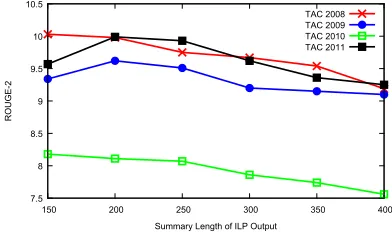
Lastly we evaluate the effect of the summary length from the ILP module on the two-step summa-rization systems. Figure 1 shows the performance whenN changes from 150 to 400. We can see that there is some difference in the patterns for different data sets, and the best results are obtained whenN
is around 150 to 250. When the first ILP module produces many sentence candidates, it is likely that there is redundancy among them. In this case, redun-dancy removal approaches such as MMR need to be used to generate the final summary. In addition, for a large candidate set, our current regression model also faces some challenges due to its limited features used in sentence reranking. Addressing these
prob-lems is our future work.
7.5 8 8.5 9 9.5 10 10.5
150 200 250 300 350 400
ROUGE-2
Summary Length of ILP Output
TAC 2008 TAC 2009 TAC 2010 TAC 2011
Figure 1: ROUGE-2 results when varying the output length for the first ILP selection step.
4 Conclusions
In this paper, we adopt the supervised ILP frame-work for the update summarization task. A set of rich features are used to measure the importance and novelty of the bigram concepts used in the ILP model. In addition, we proposed a re-selection com-ponent to rank candidate sentences generated by the ILP model based on sentence level features. Our experiment results show that our features and the reranking procedure both help improve the summa-rization performance. This pilot research points out new directions for generic or update summarization based on the ILP framework.
Acknowledgments
We thank the anonymous reviewers for their detailed and insightful comments on earlier drafts of this pa-per. The work is partially supported by NSF award IIS-0845484 and DARPA Contract No. FA8750-13-2-0041. Any opinions, findings, and conclusions or recommendations expressed are those of the author and do not necessarily reflect the views of the fund-ing agencies.
References
Taylor Berg-Kirkpatrick, Dan Gillick, and Dan Klein. 2011. Jointly learning to extract and compress. In
Proceedings of ACL.
[image:5.612.90.284.255.415.2]Praveen Bysani. 2010. Detecting novelty in the context of progressive summarization. InProceedings of the NAACL Student Research Workshop.
Michael Collins. 2002. Discriminative training meth-ods for hidden markov models: Theory and experi-ments with perceptron algorithms. InProceedings of EMNLP.
Jean-Yves Delort and Enrique Alfonseca. 2012. Dual-sum: a topic-model based approach for update sum-marization. InProceedings of EACL.
Seeger Fisher and Brian Roark. 2008. Query-focused supervised sentence ranking for update summaries. In
Proceeding of TAC.
Dan Gillick, Benoit Favre, and Dilek Hakkani-tur. 2008. The ICSI summarization system at tac 2008. In Pro-ceedings of TAC.
Dan Gillick, Benoit Favre, Dilek Hakkani-Tur, Berndt Bohnet, Yang Liu, and Shasha Xie. 2009. The ICSI/UTD summarization system at tac 2009. In Pro-ceedings of TAC.
Wenjie Li, Furu Wei, Qin Lu, and Yanxiang He. 2008. PNR2: Ranking sentences with positive and negative reinforcement for query-oriented update summariza-tion. InProceedings of Coling.
Jiwei Li, Sujian Li, Xun Wang, Ye Tian, and Baobao Chang. 2012. Update summarization using a multi-level hierarchical dirichlet process model. In Proceed-ings of COLING.
Chen Li, Fei Liu, Fuliang Weng, and Yang Liu. 2013a. Document summarization via guided sentence com-pression. InProceedings of the EMNLP.
Chen Li, Xian Qian, and Yang Liu. 2013b. Using super-vised bigram-based ilp for extractive summarization. InProceedings of ACL.
Chen Li, Yang Liu, Fei Liu, Lin Zhao, and Fuliang Weng. 2014. Improving multi-documents summarization by sentence compression based on expanded constituent parse trees. InProceedings of EMNLP.
Chin-Yew Lin. 2004. Rouge: a package for automatic evaluation of summaries. InProceedings of ACL. Chong Long, Minlie Huang, and Xiaoyan Zhu. 2010.
Summarizing multidocuments by information dis-tance. InProceedings of TAC.
Andre F. T. Martins and Noah A. Smith. 2009. Summa-rization with a joint model for sentence extraction and compression. In Proceedings of the ACL Workshop on Integer Linear Programming for Natural Language Processing.
Jun-Ping Ng, Praveen Bysani, Ziheng Lin, Min-Yen Kan, and Chew-Lim Tan. 2012. Exploiting category-specific information for multi-document summariza-tion. InProceedings of COLING.
Xiaojun Wan, Houping Jia, Shanshan Huang, and Jian-guo Xiao. 2011. Summarizing the differences in mul-tilingual news. InProceedings of SIGIR.
Xiaojun Wan. 2012. Update summarization based on co-ranking with constraints. InProceedings of COLING. Kristian Woodsend and Mirella Lapata. 2012. Multiple