Improving Text Normalization via Unsupervised Model and
Discriminative Reranking
Chen Li and Yang Liu The University of Texas at Dallas
Computer Science Department chenli,[email protected]
Abstract
Various models have been developed for normalizing informal text. In this paper, we propose two methods to improve nor-malization performance. First is an unsu-pervised approach that automatically iden-tifies pairs of a non-standard token and proper word from a large unlabeled cor-pus. We use semantic similarity based on continuous word vector representation, to-gether with other surface similarity mea-surement. Second we propose a reranking strategy to combine the results from differ-ent systems. This allows us to incorporate information that is hard to model in indi-vidual systems as well as consider multi-ple systems to generate a final rank for a test case. Both word- and sentence-level optimization schemes are explored in this study. We evaluate our approach on data sets used in prior studies, and demonstrate that our proposed methods perform better than the state-of-the-art systems.
1 Introduction
There has been a lot of research efforts recently on analysis of social media text (e.g., from Twit-ter and Facebook) (RitTwit-ter et al., 2011; Owoputi et al., 2013; Liu et al., 2012b). One challenge in processing social media text is how to deal with the frequently occurring non-standard words, such as bday (meaning birthday), snd (meaning sound) and gl (meaning girl) . Normalizing informal text (changing non-standard words to standard ones) will ease subsequent language processing mod-ules.
Text normalization has been an important topic for the text-to-speech field. See (Sproat et al., 2001) for a good report of this problem. Recently, much research on normalization has been done
for social text domain, which has many abbrevi-ations or non-standard tokens. A simple approach for normalization would be applying traditional spell checking model, which is usually based on edit distance (Damerau, 1964; Levenshtein, 1966). However, this model can not well handle the non-standard words in social media text due to the large variation in generating them.
Another line of work in normalization adopts a noisy channel model. For a non-standard to-ken A, this method finds the most possible stan-dard word Sˆ based on the Bayes rule: Sˆ =
argmaxP(S|A) = argmaxP(A|S) ∗ P(S). Different methods have been used to compute
P(A|S). Pennell and Liu (2010) used a CRF se-quence modeling approach for deletion-based ab-breviations. Liu et al. (2011) further extended this work by considering more types of non-standard words without explicit pre-categorization for non-standard tokens.
In addition, the noisy channel model has also been utilized on the sentence level. Choudhury et al. (2007) used a hidden Markov model to sim-ulate SMS message generation, considering the non-standard tokens in the input sentence as emis-sion states in HMM and labeling results as pos-sible candidates. Cook and Stevenson (2009) ex-tended work by adding several more subsystems in this error model according to the most common non-standard token’s formation process.
Machine translation (MT) is another commonly chosen method for text normalization. It is also used on both the token and the sentence level. Aw et al. (2006) treated SMS as another language, and used MT methods to translate this ‘foreign lan-guage’ to regular English. Contractor et al. (2010) used an MT model as well but the focus of their work is to utilize an unsupervised method to clean noisy text. Pennell and Liu (2011) firstly intro-duced an MT method at the token level which translates an unnormalized token to a possible
rect word.
Recently, a new line of work surges relying on the analysis of huge amount of twitter data, of-ten in an unsupervised fashion. By using con-text information from a large corpus, Han et al. (2012) generated possible variant and normaliza-tion pairs, and constructed a dicnormaliza-tionary of lexical variants of known words, which are further ranked by string similarity. This dictionary can facilitate lexical normalization via simple string substitu-tion. Hassan and Menezes (2013) proposed an ap-proach based on the random walk algorithm on a contextual similarity bipartite graph, constructed from n-gram sequences on a large unlabeled text corpus. Yang and Eisenstein (2013) presented a unified unsupervised statistical model for text nor-malization.
2 Previous Normalization Methods Used in Reranking
In this work we adopt several normalization meth-ods developed in previous studies. The following briefly describes these previous approaches. Next section will introduce our proposed methods using unsupervised learning and discriminative rerank-ing for system combination.
2.1 Character-block level MT
Pennell and Liu (2011) proposed to use a character-level MT model for text normalization. The idea is similar to traditional translation, except that the translation unit is characters, not words. Formally, for a non-standard word
A = a1a2...an , the MT method finds the most likely standard word S = s1s2...sm (ai and si are the characters in the words): S =
argmaxP(S|A) = argmaxP(A|S)P(S) =
argmaxP(a1a2...an|s1s2...sm)P(s1s2...sm) whereP(a1a2...an|s1s2...sm)is from a character-level translation model, andP(s1s2...sm)is from a character-level language model. (Li and Liu, 2012a) modified this approach to perform the translation at the character-block level in order to generate better alignment between characters (analogous to the word vs. phrase based alignment in traditional MT). This system generates one ranked list of word candidates.
2.2 Character-level Two-step MT
Li and Liu (2012b) extended the character-level MT model by incorporating the pronunciation
in-formation. They first translate non-standard words to possible pronunciations, which are then trans-lated to standard words in the second step. This method has been shown to yield high coverage (high accuracy in its n-best hypotheses). There are two candidate lists generated by this two-step MT method. The first one is based on the pronuncia-tion list produced in the first step (some phonetic sequences directly correspond to standard words). The second list is generated from the second trans-lation step.
2.3 Character-Block level Sequence Labeling
Pennell and Liu (2010) used sequence labeling model (CRF) for normalizing deletion-based ab-breviation at the character-level. The model labels every character in a standard word as ‘Y’ or ‘N’ to represent whether it appears or not in a possible abbreviation token. The features used for the clas-sification task represent the character’s position, pronunciation and context information. Using the sequence labeling model, a standard word can generate many possible non-standard words. A re-verse look-up table is used to store the correspond-ing possible standard words for the non-standard words for reverse lookup during testing. Liu et al. (2011) extended the above model to handle other types of non-standard words. (Li and Liu, 2012a) used character-blocks (same ones as that in the character-block MT method above) as the units in this sequence labeling framework. There is one list of word candidates from this method.
2.4 Spell Checker
The forth normalization subsystem is the Jazzy Spell Checker1, which is based on edit distance and integrates a phonetic matching algorithm as well. This provides one list of hypotheses.
3 Proposed Method
All the above models except the Spell Checker are supervised methods that need labeled data con-sisting of pairs of non-standard words and proper words. In this paper we propose an unsupervised method to create the lookup table of the non-standard words and their corresponding proper words offline. We further propose to use differ-ent discriminative reranking approaches to com-bine multiple individual systems.
1
3.1 Unsupervised Corpus-based Similarity for Normalization
Previous work has shown that unlabeled text can be used to induce unsupervised word clusters that can improve performance of many supervised NLP tasks (Koo et al., 2008; Turian et al., 2010; T¨ackstr¨om et al., 2012). We investigate using a large unlabeled Twitter corpus to automatically identify pairs of non-standard words and their cor-responding standard words.
We use the Edinburgh Twitter corpus (Petro-vic et al., 2010), and a dictionary obtained from http://ciba.iciba.com/ to identify all the in-vocabulary and out-of-in-vocabulary (OOV) words in the corpus. The task is then to automatically find the corresponding OOV words (if any) for each dictionary word, and the likelihood of each pair. The key question is how to compute this likelihood or similarity.
We propose to use an unsupervised method based on the large corpus to induce dense real-valued low-dimension word embedding and then use the inner product as a measure of semantic similarity. We use the continuous bag-of-words model that is similar to the feedforward neural network language model to compute vector rep-resentations of words. This model was first in-troduced by (Mikolov et al., 2013). We use the tool word2vec2 to implement this model. Two constraints are used in order to eliminate unlikely word pairs: (I) OOV words need to begin with the same letter as the dictionary standard word; (II) OOV words can only consist of English letter and digits.
In addition to considering the above semantic similarity, for the normalization task, we use other information including the surface character level similarity based on longest common sequence be-tween the two tokens, and the frequency of the to-ken. The final score between a dictionary wordw and an OOV wordtis:
sim(w, t) = longest common stringlength(t) (w, t)
∗log(T ermF req(t))
∗inner product(vec(w), vec(t))
∗ longest common seqlength(t) (w, t) (1)
The first and second term share the same property of visual prime value used in (Liu et al., 2012a).
2
https://code.google.com/p/word2vec/
The third term is the vector-based semantic simi-larity of the two words, calculated by our proposed model. The last term is the length of longest com-mon sequence between the two words divided by the length of the OOV word.
Using this method, we can identify all the pos-sible OOV words for each dictionary word based on an unlabeled large corpus. Each pair has a similarity score. Then a reverse lookup table is created to store the corresponding possible stan-dard words for each non-stanstan-dard word, which is used during testing. This framework is similar to the sequence labeling method described in Sec-tion 2.3 in the sense of creating the mapping ta-ble between the OOV and dictionary words. How-ever, the difference is that this is an unsupervised method whereas the sequence labeling uses super-vised learning to generate possible candidates.
3.2 Reranking for System Combination
3.2.1 Word Level Reranking
Each of the above systems has its own strength and weakness. The MT model and the sequence la-beling models have better precision, the two-step MT model has a broader coverage of candidates, and the spell checker has a high confidence for simple non-standard words. Therefore combining these systems is expected to yield better overall results. We propose to use a supervised maximum entropy reranking model to combine our proposed unsupervised method with those described in Sec-tion 2 (4 systems that have 5 candidate lists). The features we used in the normalization reranking model are shown in Table 1. This maxent rerank-ing method has shown success in many previous work such as (Charniak and Johnson, 2005; Ji et al., 2006).
Features:
1.Boolean value to indicate whether a candidate is on the list of each system. There are 6 lists and thus 6 such fea-tures.
2.A concatenation of the 6 boolean features above. 3.The position of this candidate in each candidate list. If this candidate is not on a list, the value of this feature is -1 for that list.
4.The unigram language model probability of the candi-date.
5.Boolean value to indicate whether the first character of the candidate and non-standard word is the same. 6.Boolean value to indicate whether the last character of the candidate and non-standard word is the same.
Table 1: Features for Reranking.
indi-vidual systems, and the last three features com-pare the candidate with the non-standard word. It is computationally expensive to include informa-tion represented in the last three features in the in-dividual systems since they need to consider more candidates in the normalization step; whereas in reranking, only a small set of word candidates are evaluated, thus it is more feasible to use such global features in the reranking model. We also tried some other lexical features such as the length difference of the non-standard word and the can-didate, whether non-standard word contains num-bers, etc. But they did not obtain performance gain. Another advantage of the reranker is that we can use information about multiple systems, such as the first three features.
3.2.2 Sentence Level Reranking and Decoding
In the above reranking method, we only use infor-mation about the individual words. When contex-tual words are available (in sentences or Tweets), we can use that information. If a sentence con-taining OOV words is given during testing, we can perform standard sentence level Viterbi decod-ing to combine information from the normaliza-tion candidates and language model scores.
Furthermore, if sentences are available during training (not just isolated word pairs as used in all the previous supervised individual systems and the Maxent reranking above), we can also use contex-tual information for training the reranker. This can be achieved in two different ways. First, we add the Language Model score from context words as features in the reranker. In this work, in addition to the features in Table 1, we add a trigram probabil-ity to represent the context information. For every candidate of a non-standard word, we use trigram probability from the language model. The trigram consists of this candidate, and the previous and the following token of the non-standard word. If the previous/following word is also a non-standard to-ken, then we calculate the trigram using all of their candidates and then take the average. After adding the additional LM probability feature, the same Maxent reranking method as above is used, which optimizes the word level accuracy.
The second method is to change the training ob-jective and perform the optimization at the sen-tence level. The feature set can be the same as the word level reranker, or with the additional contex-tual LM score features. To train the model (feature
weights), we perform sentence level Viterbi de-coding on the training set to find the best hypoth-esis for each non-standard word. If the hypothe-sis is incorrect, we update the feature weight us-ing structured perceptron strategy (Collins, 2002). We will explore these different feature and train-ing configurations for reranktrain-ing in the followtrain-ing experiments.
4 Experiments
4.1 Experimental Setup
The following data sets are used in our experi-ments. We use Data 1 and Data 2 as test data, and Data 3 as training data for all the supervised mod-els.
• Data 1: 558 pairs of non-standard tokens and standard words collected from 549 tweets in 2010 by (Han and Baldwin, 2011).
• Data 2: 3,962 pairs of non-standard tokens and standard words collected from 6,160 tweets between 2009 and 2010 by (Liu et al., 2011).
• Data 3: 2,333 unique pairs of non-standard tokens and standard words, collected from 2,577 Twitter messages (selected from the Edinburgh Twitter corpus) used in (Pennell and Liu, 2011). We made some changes on this data, removing the pairs that have more than one proper words, and sentences that only contain such pairs.3
• Data 4: About 10 million twitter messages selected from the the Edinburgh Twitter cor-pus mentioned above, consisting of 3 million unique tokens. This data is used by the un-supervised method to create the mapping ta-ble, and also for building the word-based lan-guage model needed in sentence level nor-malization.
The dictionary we used is obtained from http://ciba.iciba.com/, which includes 75,262 En-glish word entries and their corresponding pho-netic symbols (IPA symbols). This is used in var-ious modules in the normalization systems. The number of the final standard words used to create the look-up table is 10,105 because we only use the words that have the same number of character-block segments and phones. These 10,105 words
3
cover 90.77% and 93.74% standard words in Data set 1 and Data set 2 respectively. For the non-standard words created in the CRF model, they cover 80.47% and 86.47% non-standard words in Data set1 and Data set 2. This coverage using the non-standard words identified by the new unsuper-vised model is 91.99% and 92.32% for the two data sets, higher than that by the CRF model.
During experiments, we use CRF++ toolkit 4 for our sequence labeling model, SRILM toolkit (Stolcke, 2002) to build all the language models, Giza++ (Och and Ney, 2003) for automatic word alignment, and Moses (Koehn et al., 2007) for translation decoding in three MT systems.
4.2 Isolated Word Normalization Experiments
Table 2 shows the isolated word normalization re-sults on the two test data sets for various systems. The performance metrics include the accuracy for the top-1 candidate and other top-N candidates. Coverage means how many test cases correct an-swers can be obtained in the final list regardless of its positions. The top part presents the results on Data Set 1 and the bottom shows the results on Data Set 2. We can see that our proposed unsu-pervised corpus similarity model achieves better top-1 accuracy than the other individual systems described in Section 2. Its top-n coverage is not always the best – the 2-step MT method has advan-tages in its coverage. The results in the table also show that reranking improves system performance over any of the used individual systems, which is expected. After reranking, on Data set 1, our sys-tem yields better performance than previously re-ported ones. On Data set 2, it has better top-1 ac-curacy than (Liu et al., 2012a), but slightly worse top-N coverage. However, the method in (Liu et al., 2012a) has higher computational cost because of the calculation of the prime visual values for each non-standard word on the fly during testing. In addition, they also used more training data than ours.
4.3 Sentence Level Normalization Results
We have already seen that after reranking we ob-tain better word-level normalization performance, for both top-1 and other top-N candidates. One follow-up question is whether this improved per-formance carries over to sentence level
normaliza-4
http://crfpp.googlecode.com/
System Accuracy %
Top1 Top3 Top10 Top20 Cover
Data 1
MT 61.81 73.53 78.50 79.57 80.00
MT21 39.61 52.93 63.59 65.36 65.72
MT22 53.64 68.56 77.44 80.46 88.10
SL 53.29 61.99 69.09 71.92 75.85
SC 50.27 56.31 56.84 57.02 57.02
UCS 61.81 69.98 74.60 76.55 82.17
Rerank 77.14 86.96 93.04 94.82 95.90
Sys1 75.69 n/a n/a n/a n/a
Sys2 73 81.9 86.7 89.2 94.2
Data 2
MT 55.02 63.3 66.99 67.77 68.00
MT21 35.64 47.65 54.67 56.01 56.4
MT22 49.02 62.49 70.99 74.86 80.07
SL 46.52 55.05 61.21 62.97 66.21
SC 51.16 55.48 55.88 55.88 55.88
UCS 57.29 65.75 70.55 72.64 80.84
Rerank 74.44 84.57 90.25 92.37 93.5
Sys1 69.81 82.51 92.24 93.79 95.71
Sys2 62.6 75.1 84 87.5 90.7
Sys3 73.04 n/a n/a n/a n/a
Table 2: MT: Character-block Level MT; MT21&MT22: First&Second step in Character-level Two-step MT; SL: Sequence Labeling sys-tem; SC: Spell Checker; UCS: Unsupervised Cor-pus Similarity Model; Sys1 is from (Liu et al., 2012a); Sys2 is from (Li and Liu, 2012a); Sys3 is from (Yang and Eisenstein, 2013).
tion when context information is used via the in-corporation of a language model. Since detecting which tokens need normalization in the first place is a hard task itself in social media text and is an open question currently, similar to some previous work, we assume that we already know the non-standard words that need to be normalized for a given sentence. Then the sentence-level normal-ization task is just to find which candidate from the n-best lists for each of those already ‘detected’ non-standard words is the best one. We use the tweets in the Data set 1 described above because Data set 2 only has token pairs but not sentences.
in Section 3.2.1, i.e., features based on the words only, without the additional trigram LM probabil-ity feature; reranker 2 and 4 use the additional LM probability feature. About training, reranker 1 and 2 use the Maxent reranking that is trained and op-timized for the word level; reranker 3 and 4 use structure perceptron training at the sentence level. Note that all of the systems perform Viterbi decod-ing durdecod-ing testdecod-ing to determine the final top one candidate for each non-standard word in the sen-tence. The scores from the reranked normalization output and the LM probabilities are combined in decoding. From the results, we can see that adding contextual information (LM probabilities) as fea-tures in the reranker is useful. When this feature is not used, using sentence-level training objec-tive benefits (reranker 3 outperforms 1); however, when this feature is used, performing sentence-level training via structure perceptron is not useful (reranker 2 outperforms 4), partly because the con-textual information is incorporated in the features already and using it in sentence-level decoding for training is redundant and does not bring additional gain. Finally compared to the previously report results, our system performs the best.
System Acc % System Acc %
Reranker1 84.30 Reranker2 86.91
Reranker3 85.03 Reranker4 85.37
Sys1 84.13 Sys2 82.23
Table 3: Sentence level normalization results on Data Set 1 using different reranking setups. Sys1 is from (Liu et al., 2012a); Sys2 is from (Yang and Eisenstein, 2013). Acc % is the top one accuracy.
4.4 Impact of Unsupervised Corpus Similarity Model
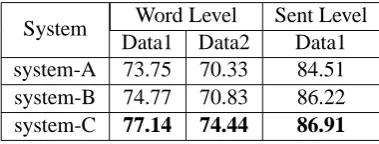
Our last question is regarding unsupervised model importance in the reranking system and contribu-tions of its different similarity measure compo-nents. We conduct the following two experiments: First, we removed the new model and just use the other remaining models in reranking (five candi-date lists). Second, we kept this new model but changed the corpus similarity measure (removed the third item in Eq(1) that represents the seman-tic similarity). This way we can evaluate the im-pact of the semantic similarity measure based on the continuous word vector representation.
Table 4 shows the word level and sentence
re-sults on Data set 1 and 2 using these different setups. Because of space limit, we only present the top one accuracy. The other top-n results have similar patterns. Sentence level normaliza-tion uses the Reranker 2 described above. We can see that there is a degradation in both of the new setups, suggesting that the unsupervised method itself is beneficial, and in particular the word vec-tor based semantic similarity component is crucial to the system performance.
System Word Level Sent Level
Data1 Data2 Data1
system-A 73.75 70.33 84.51
system-B 74.77 70.83 86.22
[image:6.595.321.511.212.284.2]system-C 77.14 74.44 86.91
Table 4: Word level and Sentence level normaliza-tion results (top-1 accuracy in %) after reranking on Data Set 1 and 2. System-A is without using the unsupervised model, system-B is without its semantic similarity measure, and system-C is our proposed system.
5 Conclusions
In this paper, we proposed a novel normalization system by using unsupervised methods in a large corpus to identify non-standard words and their corresponding proper words. We further combine it with several previously developed normalization systems by a reranking strategy. In addition, we explored different sentence level reranking meth-ods to evaluate the impact of context information. Our experiments show that the reranking system not only significantly improves the word level nor-malization accuracy, but also helps the sentence level decoding. In the future work, we plan to ex-plore more useful features and also leverage pair-wise and link reranking strategy.
Acknowledgments
References
Aiti Aw, Min Zhang, Juan Xiao, Jian Su, and Jian Su. 2006. A phrase-based statistical model for sms text normalization. In Processing of COLING/ACL.
Eugene Charniak and Mark Johnson. 2005. Coarse-to-fine n-best parsing and maxent discriminative reranking. In Proceedings of the 43rd ACL.
Monojit Choudhury, Rahul Saraf, Vijit Jain, Animesh Mukherjee, Sudeshna Sarkar, and Anupam Basu. 2007. Investigation and modeling of the structure of texting language. IJDAR.
Michael Collins. 2002. Discriminative training meth-ods for hidden markov models: Theory and exper-iments with perceptron algorithms. In Proceedings
of EMNLP.
Danish Contractor, Tanveer A. Faruquie, L. Venkata Subramaniam, and L. Venkata Subramaniam. 2010. Unsupervised cleansing of noisy text. In
Proceed-ings of COLING.
Paul Cook and Suzanne Stevenson. 2009. An unsu-pervised model for text message normalization. In
Proceedings of NAACL.
Fred J Damerau. 1964. A technique for computer de-tection and correction of spelling errors.
Communi-cations of the ACM, 7(3):171–176.
Bo Han and Timothy Baldwin. 2011. Lexical normali-sation of short text messages: Makn sens a #twitter. In Proceeding of 49th ACL.
Bo Han, Paul Cook, and Timothy Baldwin. 2012. Au-tomatically constructing a normalisation dictionary for microblogs. In Proceedings of the 2012 EMNLP.
Hany Hassan and Arul Menezes. 2013. Social text normalization using contextual graph random walks. In Proceedings of ACL.
Heng Ji, Cynthia Rudin, and Ralph Grishman. 2006. Re-ranking algorithms for name tagging. In
Pro-ceedings of the Workshop on Computationally Hard Problems and Joint Inference in Speech and Lan-guage Processing.
Philipp Koehn, Hieu Hoang, Alexandra Birch, Chris Callison-Burch, Marcello Federico, Nicola Bertoldi, Brooke Cowan, Wade Shen, Christine Moran, Richard Zens, Chris Dyer, Ondrej Bojar, Alexandra Constantin, Evan Herbst, and Evan Herbst. 2007. Moses: Open source toolkit for statistical machine translation. In Proceedings of ACL.
Terry Koo, Xavier Carreras, and Michael Collins. 2008. Simple semi-supervised dependency parsing. In Proceedings of ACL.
Vladimir I Levenshtein. 1966. Binary codes capable of correcting deletions, insertions and reversals. In
Soviet physics doklady, volume 10, page 707.
Chen Li and Yang Liu. 2012a. Improving text nor-malization using character-blocks based models and system combination. In Proceedings of COLING
2012.
Chen Li and Yang Liu. 2012b. Normalization of text messages using character- and phone-based machine translation approaches. In Proceedings of 13th
In-terspeech.
Fei Liu, Fuliang Weng, Bingqing Wang, and Yang Liu. 2011. Insertion, deletion, or substitution?: normal-izing text messages without pre-categorization nor supervision. In Proceedings of the 49th ACL: short
papers.
Fei Liu, Fuliang Weng, and Xiao Jiang. 2012a. A broad-coverage normalization system for social me-dia language. In Proceedings of the 50th ACL.
Xiaohua Liu, Ming Zhou, Xiangyang Zhou,
Zhongyang Fu, and Furu Wei. 2012b. Joint
inference of named entity recognition and normal-ization for tweets. In Proceedings of ACL.
Tomas Mikolov, Kai Chen, Greg Corrado, and Jeffrey Dean. 2013. Efficient estimation of word represen-tations in vector space. Proceedings of Workshop at
ICLR.
Franz Josef Och and Hermann Ney. 2003. A sys-tematic comparison of various statistical alignment models. Computational Linguistics, 29(1):19–51.
Olutobi Owoputi, Brendan O’Connor, Chris Dyer, Kevin Gimpel, Nathan Schneider, and Noah A. Smith. 2013. Improved part-of-speech tagging for
online conversational text with word clusters. In
Proceedings of NAACL.
Deana Pennell and Yang Liu. 2010. Normalization of text messages for text-to-speech. In ICASSP.
Deana Pennell and Yang Liu. 2011. A character-level machine translation approach for normalization of sms abbreviations. In Proceedings of 5th IJCNLP.
Sasa Petrovic, Miles Osborne, and Victor Lavrenko. 2010. The edinburgh twitter corpus. In Proceedings
of NAACL.
Alan Ritter, Sam Clark, Oren Etzioni, et al. 2011.
Named entity recognition in tweets: an experimental study. In Proceedings of EMNLP.
Richard Sproat, Alan W. Black, Stanley F. Chen, Shankar Kumar, Mari Ostendorf, and Christopher
Richards. 2001. Normalization of non-standard
words. Computer Speech & Language, 15(3):287– 333.
Andreas Stolcke. 2002. SRILM-an extensible
lan-guage modeling toolkit. In Proceedings of
Oscar T¨ackstr¨om, Ryan McDonald, and Jakob Uszko-reit. 2012. Cross-lingual word clusters for direct transfer of linguistic structure. In Proceedings of
NAACL.
Joseph Turian, Lev-Arie Ratinov, and Yoshua Bengio. 2010. Word representations: A simple and general method for semi-supervised learning. In
Proceed-ings of ACL.
Yi Yang and Jacob Eisenstein. 2013. A log-linear
model for unsupervised text normalization. In