AODVB: Ad hoc On-Demand Distance Vector with Black
Hole Avoidance
Venkatesh
Department of Computer Science and
Engineering,University Visvesvaraya College of
Engineering Bangalore, India
Raj Mohammed
Department of Computer Science and
Engineering,University Visvesvaraya College of
Engineering, Bangalore, India
ABSTRACT
A Wireless ad-hoc network is a temporary network set up by nodes moving arbitrary in the places that have no network infrastructure. The nodes find a path to the destination node using routing protocols. However, due to security vulnerabilities of the routing protocols, wireless ad-hoc networks are unprotected to attacks of the malicious nodes. One of these attacks is the Black Hole Attack against network integrity absorbing all data packets in the network. Since the data packets do not reach the destination node on account of this attack, data loss will occur. In this paper work, we propose A AODVB (Ad hoc On-Demand Distance Vector with Black-hole Avoidance) protocol for avoiding black-hole attack. AODVB forms link disjoint multi-path during path discovery to provide greater path selection in order to avoid malicious nodes in the path using legitimacy table maintained by each node in the network. Non-malicious nodes gradually isolate the black-hole nodes based on the values collected in their legitimacy table and avoid them while making path between source and destination. We simulated AODV protocol with and without Black-hole attack and our solution AODVB protocol. From our simulation results AODV network has normally 3.21 % data loss and if a Black Hole Node is introducing in this network data loss is increased to 92.59 %. When we used AODVB protocol in the same network, the data loss decreased to 65 %.
Keywords
Black Hole Attack, link disjoint multi-path, legitimacy table.
1.
INTRODUCTION
As wireless ad-hoc networks lack an infrastructure, they are exposed to a lot of attacks. One of these attacks is the Black Hole attack. In the Black Hole attack, a malicious node absorbs all data packets in itself, similar to a hole which sucks in everything in. In this way, all packets in the network are dropped. A malicious node dropping all the traffic in the network makes use of the vulnerabilities of the route discovery packets of the on demand protocols, such as AODV. In route discovery process of AODV protocol, intermediate nodes are responsible to find a fresh path to the destination, sending disovery packets to the neighbor nodes. Malicious nodes do not use this process and instead, they immediately respond to the source node with false information as though it has fresh enough path to the destination. Therefore source node sends its data packets via the malicious node to the destination. assuming it is a true path. Black Hole attack may occur due to a malicious node which is deliberately misbehaving, as well as a damaged node interface
.
2.
RELATED WORK
The methods proposed to avoid blackhole earlier fall broadly into two categories. The first category is of those which modify specific well known routing protocols such as AODV, DSR and OLSR to avoid/detect blackhole attack during route reply [1] [2]. The second category is of those which adopt an extra monitoring system such as a watchdog, confidant protocol or intrusion detection system [3] [4]. There are several methods proposed to add security measures for routing protocols to avoid attacks [5] - [12].
Shurman et. al. [1] proposed two different approaches to solve the blackhole attack problem. First, the sender node verifies the authenticity of the node that initiates the RREP packet by utilizing the redundancy of the network. Second, each node stores the last and received sent packet sequence number. If there is any mismatch then an ALARM indicates the existence of a black hole node. However, this approach unable to detect multiple blackhole attacks.
Tamilselvan et. al. [2] proposed an enhancement of the AODV protocol by introducing fidelity table. The RREPs are collected in the response table and the fidelity level of each RREP is checked and one is selected having the highest level. After acknowledgement is received, the fidelity level of the node is updated proving it safe and reliable. However, updating the fidelity table of each node by broadcasting it to other nodes results in congestion and also the selection of wrong RREP from the response table cause another route request flooding.
Marti et. al. [3] described the misbehavior detection using the watchdog and the pathrater. The watchdog identifies misbehaving nodes by listening promiscuously to the next node transmission whereas the pathrater uses the knowledge from the watchdog to choose a path that is most likely to deliver packets. This technique is imperfect due to limited transmit power, collision and partial dropping.
Burchegger et. al. [4] described the confidant protocol where each node monitor the behavior of its next hop and this information is given to the reputation system which makes decisions based on ratings about providing or accepting route from it. However, the use of reputation system makes this protocol impractical to include in adhoc network.
source node judges the validity of the route. In this protocol, the RREP control packet is modified to contain the information about next hop. After receiving RREP, the source node will again send RREQ to the node specified as next hop in the received RREP.
Sanjay Ramaswamy, et al [6] proposed a method for identifying multiple black hole nodes. They are first to propose solution for cooperative black hole attack. They slightly modified AODV protocol by introducing data routing information table (DRI) and cross checking. Every entry of the node is maintained by the table. They rely on the reliable nodes to transfer the packets.
Hesiri Weerasinghe et. al. [7] proposed the solution which discovers the secure route between source and destination by identifying and isolating cooperative black hole nodes. This algorithm uses a methodology to identify multiple black hole nodes working collaboratively as a group to initiate cooperative black hole attacks. This protocol is a slightly modified version of AODV protocol by introducing Data Routing Information (DRI) table and cross checking using Further Request (FREQ) and Further Reply (FREP).
All material on each page should fit within a rectangle of 18 x 23.5 cm (7" x 9.25"), centered on the page, beginning 2.54 cm (1") from the top of the page and ending with 2.54 cm (1") from the bottom. The right and left margins should be 1.9 cm (.75”). The text should be in two 8.45 cm (3.33") columns with a .83 cm (.33") gutter.
3.
PROPOSED AODVB ROUTING
PROTOCOL
The routing protocol AODVB is based on AODV and it can efficiently avoid multiple blackhole attacks during path setup between source and destination. When intermediate nodes reply to source node, few nodes in the path may have multiple paths to the destination but it eventually chooses only one path to destination node. In AODVB, every node maintains the legitimacy of their neighbor nodes to form the correct path to destination node. In the path discovery of AODVB, an intermediate node will attempt to create a route that does not go through a node whose legitimacy ratio crosses the lower threshold level. Therefore, malicious nodes will be gradually avoided by other non-malicious nodes in the network. Compared with AODV, the proposed AODVB has the following differences in message format and type. RREQ Packet: RREQ in AODVB has additional 𝑓𝑖𝑟𝑠𝑡_𝑜𝑝 field shown in Fig. 3. This field is used to store the IP address of the first hop after it left the originator. Intermediate nodes would not process the RREQs which has the same 𝑓𝑖𝑟𝑠𝑡_𝑜𝑝 field value. AODVB creates link disjoint multiple paths in path discovery phase using 𝑓𝑖𝑟𝑠𝑡_𝑜𝑝 field but during path setup (RREP) it chooses only single link which has the higher legitimacy ratio among multiple links towards source and destination discussed later.
Types
J R D G U Reserved
Hop
Count
𝑓𝑖𝑟𝑠𝑡
_
𝑜𝑝
RREQ ID
[image:2.595.321.536.157.228.2]Originator IP Address
Originator Seq Number
Destination IP Address
Destination Seq Number
Figure 1. RREQ in AODVB
REP Packet: RREP in AODVB has one additional field called 𝑜𝑟𝑖𝑔𝑖𝑛𝑎𝑡𝑜𝑟 as shown in Fig. 4 This field is used to store the identity of the node (can be intermediate or destination node) who is claiming a path to the destination. This field value is being stored in the 𝐹𝑖𝑟𝑠𝑡_𝑜𝑝 field of routing table when node receives RREP.
Types R A Reserved Prefix Size Hop Count Source IP Address
Destination IP Address Destination Seq Number
Lifetime 𝑂𝑟𝑖𝑔𝑖𝑛𝑎𝑡𝑜𝑟
Figure 2: RREP packet in AODVB
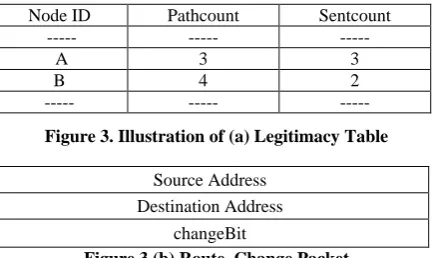
Legitimacy Table: In AODVB, each node maintains a legitimacy table as shown in Fig.3(a) to choose the most legitimate node (among the multiple backward disjoint link to source node and next hop to destination) while sending RREP back to source node. Legitimacy table contains three fields: 𝑁𝑜𝑑𝑒𝐼𝐷, 𝑃𝑎𝑡𝑐𝑜𝑢𝑛𝑡 and 𝑆𝑒𝑛𝑡𝑐𝑜𝑢𝑛𝑡. 𝑁𝑜𝑑𝑒𝐼𝐷 Field stores the IP address of the node whose legitimacy is being recorded. 𝑃𝑎𝑡𝑐𝑜𝑢𝑛𝑡 Field specifies the number of times the node has been chosen in the route and the 𝑆𝑒𝑛𝑡𝑐𝑜𝑢𝑛𝑡 field describes the number of times connection to destination have been successful node through the 𝑁𝑜𝑑𝑒𝐼𝐷.
These two count field are also used to define the Legitimacy Ratio = (𝑆𝑒𝑛𝑡𝑐𝑜𝑢𝑛𝑡/(𝑃𝑎𝑡𝑐𝑜𝑢𝑛𝑡+1)) of a 𝑁𝑜𝑑𝑒𝐼𝐷 which indicates the confidence of node in performing its intended function of correct routing. A higher legitimacy ratio means higher possibility of a node being non-malicious.
Node ID Pathcount Sentcount
--- --- ---
A 3 3
B 4 2
--- --- ---
Figure 3. Illustration of (a) Legitimacy Table
Source Address Destination Address
changeBit
Figure 3 (b) Route_Change Packet
Route_Change Packet: This is an additional packet used in the AODVB protocol shown in Fig. 5 (b). The packet has only three fields and it is used by nodes (a) to inform the first node in the backward path (having multiple entries for destination) to change the route to another path which has next highest legitimacy ratio and (b) to flush the counter of all nodes in the backward path. 𝑐𝑎𝑛𝑔𝑒𝐵𝑖𝑡 in the packet has special purpose i.e it will be set to 1 by the first node in the backward path which has multiple entries to the destination node, so that other nodes in the backward path would not switch the route to another path.
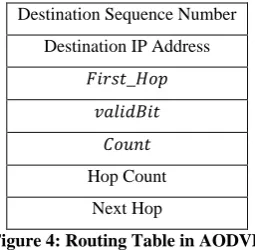
[image:2.595.320.538.429.558.2] [image:2.595.58.288.656.753.2]destination through next hop may not be correct; value 1 specifies that the path to the destination is free from malicious nodes and value -1 indicates entry has not been chosen for data transfer. 𝑐𝑜𝑢𝑛𝑡 field denotes the number of RREPs received with same sequence number for the entry but its value would be -1 if the entry has been created after RREQ arrival.
Destination Sequence Number Destination IP Address
𝐹𝑖𝑟𝑠𝑡_𝐻𝑜𝑝
𝑣𝑎𝑙𝑖𝑑𝐵𝑖𝑡
𝐶𝑜𝑢𝑛𝑡
[image:3.595.103.231.158.283.2]Hop Count Next Hop
Figure 4: Routing Table in AODVB
HELLO Packet: AODVB modifies the function of HELLO packet. In AODVB, HELLO packet are also used to broadcast the 𝑁𝑜𝑑𝑒𝐼𝐷 whose legitimacy ratio cross the lower threshold level among its 1-hop away neighbors. If a node’s neighbor has an entry to 𝑁𝑜𝑑𝑒𝐼𝐷 in its legitimacy table and legitimacy ratio of sending node is higher than the upper threshold level, then neighbors will update their legitimacy table for 𝑁𝑜𝑑𝑒𝐼𝐷 so that malicious node will not be able to grab the route through them.
4.
PROCEDURE FOR RECEIVING
RREQ IN AODVB PROTOCOL
[image:3.595.63.273.563.744.2]In AODVB, each node uses three fields: source IP, sequence number and 𝑓𝑖𝑟𝑠𝑡_𝑜𝑝 to determine whether an RREQ is duplicate or not whereas AODV uses only first two fields. For an intermediate node, if the hop count in the RREQ is larger than the hop count of the entry in the routing table which has the same sequence number and source IP, then RREQ is directly dropped. A node would create multiple entries (multiple link disjoint path) when the sequence number is same; hop count is smaller and the 𝑓𝑖𝑟𝑠𝑡_𝑜𝑝 field value is different from the existing reverse entries. However, the destination node replies to each RREQ inspite of the values in hop count and 𝑓𝑖𝑟𝑠𝑡_𝑜𝑝 field of RREQ when the sequence number is equal or larger than the existing entry.
Figure 5: RREQ processing in AODVB
Fig. 5 illustrates a situation, in which S and D represent the source and the destination respectively. The arrow represents the RREQ broadcasting traces; the first box represents the 𝑓𝑖𝑟𝑠𝑡_𝑜𝑝 of the RREQ; second box represents the hop count and the third box represents the sequence of the RREQ arrivals at the node. As the nodes A, B and C received RREQs, they find hop count in the RREQ is 1. Therefore, they place their own IP addresses into the 𝑓𝑖𝑟𝑠𝑡_𝑜𝑝 field of the RREQ and then broadcast the packet after adding 1 to the hop count.
Accordingly, node E receives the first RREQ from node A and creates a reverse entry with hop count=2, 𝑓𝑖𝑟𝑠𝑡_𝑜𝑝=A, 𝑣𝑎𝑙𝑖𝑑𝐵𝑖𝑡=1 and 𝑐𝑜𝑢𝑛𝑡=-1. Then, it continues to broadcast the RREQ after adding 1 to the hop count. Later, node E receives another RREQ from node B, the RREQ has the same source IP and sequence number as the previous RREQ from A and the hop count is smaller or equal to the entry in the routing table but a different 𝑓𝑖𝑟𝑠𝑡_𝑜𝑝. Therefore, node E would create another reverse entry in its routing table and drop the RREQ. Similarly, node F process both RREQ arrival from node B and C. In sequence, node I will receive RREQ from node E, F and J. The first two arrivals of RREQ are processed by node I in a similar way to node E in previous case. But on receipt of last RREQ from node J, node I would drop the RREQ without creating a reverse entry because the hop count (i.e. 4) is larger than the hop count in the existing entries created by the previous two RREQs although the 𝑓𝑖𝑟𝑠𝑡_𝑜𝑝 is same. Node G receives two RREQ from node E and node I respectively with the same hop count; however it creates reverse entry for the first arrival of RREQ and drops the second RREQ because the 𝑓𝑖𝑟𝑠𝑡_𝑜𝑝 fields of both are same.
5.
PROCEDURE FOR RECEIVING
RREP IN AODVB ROUTING
PROTOCOL
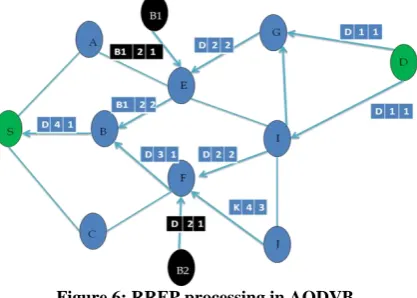
chosen among multiple backward entries because of its high legitimacy ratio; the first box represents the 𝑜𝑟𝑖𝑔𝑖𝑛𝑎𝑡𝑜𝑟 of the RREP; second box represents the hop count and the third box represents the sequence of the RREP arrivals at the node. B1 is one blackhole node where B1 replies with its own identity and B2 with the destination node identity (spoofing). We have assumed that the node G knows a path to the destination node via node M. Node G receives two RREP from the destination. On receipt of RREP, G will create forward entry towards destination and forwards the packet to the only backward entry node E. After second RREP arrival, node G finds an entry to the destination having same sequence number. Therefore, it retains a single entry towards destination which has least hop count i.e first entry and sets the 𝑐𝑜𝑢𝑛𝑡 field in the routing entry to 2. When node I receives the reply, it would check its legitimacy table to find which backward entries (E or F) has higher
Figure 6: RREP processing in AODVB
legitimacy ratio and eventually chooses node F. In sequence, node F receive three replies, i.e from B2, I and J. Node B2 replies with higher sequence number and spoofs the destination node identity in the 𝑜𝑟𝑖𝑔𝑖𝑛𝑎𝑡𝑜𝑟 field, whereas, node K replies with its own identity. Next hop would have been chosen on the following criteria:
If reply from I and J are having same sequence number, then node F would create two forward entries; first towards either I or J based on their legitimacy ratio if they have same hop count to destination, otherwise to the node which has lower hop count to destination with 𝑐𝑜𝑢𝑛𝑡 field set to 2; and the second entry towards B2. Node F will choose first entry for forwarding data packets by setting its 𝑣𝑎𝑙𝑖𝑑𝐵𝑖𝑡=0 and others 𝑣𝑎𝑙𝑖𝑑𝐵𝑖𝑡=-1 because first entry 𝑐𝑜𝑢𝑛𝑡 field is higher than second entry which means the higher possibility of correct path through first entry.
If reply of node K has an older sequence number of node D, then each reply has different sequence number. Node F would create three entries for each reply comes from B2, I and J respectively. The RREPs having destination address in the 𝑜𝑟𝑖𝑔𝑖𝑛𝑎𝑡𝑜𝑟 field had a higher probability of correct path to destination than other RREPs because RREP originated by other nodes (than destination node) may claiming an older path to destination. Since two replies had different sequence number with the 𝑜𝑟𝑖𝑔𝑖𝑛𝑎𝑡𝑜𝑟 field containing destination address (it means any of them comes from malicious node), node F would choose forward entry whose next hop has higher legitimacy ratio inspite of their hop count by setting its 𝑣𝑎𝑙𝑖𝑑𝐵𝑖𝑡=0 and others with -1. If both entries have similar legitimacy ratio, then node F randomly choose any of them.
Accordingly, node E receives the first reply from B1 and it copies the reply content into the routing entry and forward the reply to the backward entry having higher legitimacy ratio i.e . When node E received another reply from node G which had 𝑜𝑟𝑖𝑔𝑖𝑛𝑎𝑡𝑜𝑟 field filled with the destination address and different sequence number with an existing entry, then node E sets the second entry for data transfer regardless of the legitimacy ratio of next hop by setting its 𝑣𝑎𝑙𝑖𝑑𝐵𝑖𝑡=0 and others 𝑣𝑎𝑙𝑖𝑑𝐵𝑖𝑡=-1. But, it will not delete previous entry, because the second RREP could have been generated by malicious node by spoofing destination address (not in this case). Node B will perform in a similar way to node E. After the source node receives the reply, it starts sending data packet to the destination node. While forwarding data packet, each node in the path will set the counter to an interval so that it would get data packet reply or 𝑅𝑜𝑢𝑡𝑒_𝐶𝑎𝑛𝑔𝑒 packet within the interval time. Otherwise, as the node counter interval period expires, it would increment the 𝑃𝑎𝑡𝑐𝑜𝑢𝑛𝑡 field of the next hop in the legitimacy table and send the 𝑅𝑜𝑢𝑡𝑒_𝐶𝑎𝑛𝑔𝑒 packet to the backward entry node. Counter interval is 𝑡 = (15− 𝐻𝑜𝑝𝐶)(2{𝑑/𝑣} + 𝛿) where 𝑣 is the velocity of the light, 𝑑 is the maximum transmission range, 𝛿 is the processing time of the node, 𝐻𝑜𝑝𝐶 is the hopcount between the source node and the intermediate node which set the counter and 15 is assumed as maximum hop count in the adhoc network.
We have assumed that S, B, F and B2 is the path formed for the RREQ sent by the source node. Nodes in the path i.e S, B and F will set the counter as they forward the data packet. Since B2 is the blackhole node, it will drop the packet. When the counter interval of node F expires, it would increment the 𝑃𝑎𝑡𝑐𝑜𝑢𝑛𝑡 field of node B2 in its legitimacy table and delete the corresponding entry in the routing table and send the 𝑅𝑜𝑢𝑡𝑒_𝐶𝑎𝑛𝑔𝑒 packet to node B with 𝑐𝑎𝑛𝑔𝑒𝐵𝑖𝑡 set to 1 (because node F has change the path to node I). Node B flushes the counter and does not make a decision to switch to next path because the node ahead in the route already had changed the path by setting 𝑐𝑎𝑛𝑔𝑒𝐵𝑖𝑡=1, then each node send the 𝑅𝑜𝑢𝑡𝑒_𝐶𝑎𝑛𝑔𝑒 packet along reverse route unless source node reached.
Assume remaining entries in the routing table of node F towards destination node results in to dropping, then Node F on last entry would send 𝑅𝑜𝑢𝑡𝑒_𝐶𝑎𝑛𝑔𝑒 packet to node B with 𝑐𝑎𝑛𝑔𝑒𝐵𝑖𝑡=0. After the complete data has been transferred, destination node will send final data acknowledgement (REP_ACK) packet back to source node. Each node in the path will change the sequence number of the forwarding entry as listed in the REP_ACK packet and set the 𝑣𝑎𝑙𝑖𝑑𝐵𝑖𝑡=1 in the routing entry; delete other entries in the table towards destination; and increment the 𝑃𝑎𝑡𝑐𝑜𝑢𝑛𝑡 and 𝑆𝑒𝑛𝑡𝑐𝑜𝑢𝑛𝑡 field of the previous hop and next hop of REP_ACK in the legitimacy table.
6.
PERFORMANCE MATRICS
We choose the following parameters to give an idea of behavior and reliability of AODVB protocol:
a. Packet Delivery Ratio: it is ratio of number of packets delivered to destination to the total number of packets sent by the source in presence of blackhole nodes.
c. Node Speed: it is the speed of nodes moving in the network and we shall check the performance of AODVB on different node speed
d. Pause Time: it is used as mobility metric that expresses the period of node in pause but cannot reflect other information such as a node location or velocity. It is used to find the behavior of AODVB before and after the node start movingly.
7.
SIMULATION RESULTS
[image:5.595.323.534.77.242.2]In our example we have taken 7 nodes. All nodes are randomly distributed in area of 500*500 square meter with each node having radio range of 250 meters. All nodes are having the same configuration. Node-2 will act as sender whereas node-5 will be the receiver. node-0 will behave as the black-hole node in the network. Node 0 being a Black Hole AODV Node absorbs the packets in the connection from Node 2 to Node 5. Figure 9 shows how the Black Hole AODV Node absorbs the traffic.
[image:5.595.55.280.303.447.2]Figure 7: Node 0 (Black Hole Node) absorbs the connection Node 2 to Node 5
Figure 8: Packets received and lost in AODV
[image:5.595.325.531.342.483.2]The above graph is plotted for packet received and lost parameters for AODV protocol where there is no black-hole in the network. The loss is because of network and high mobility of the nodes. Whereas the below graph is for same parameters but in the presence of black-hole attack. Here the packets received and lost are shown as zero because the legitimate. receiver did not receive any packets the black-hole node consumed all data packets.
Figure 9: Packets received and lost in AODV with 1 blackhole.
[image:5.595.62.275.481.637.2]The above graph is plotted for packet received and lost parameters for AODVB protocol where there is one blackhole in the network. Even in the presence of blackhole node the AODVB protocol detects it and sends data to legitimate receiver. The loss is because of network and high mobility of the nodes.
Figure 10 End to End Delay for both AODV and AODVB
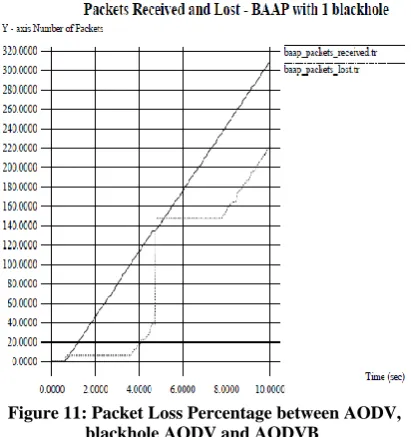
Figure 11: Packet Loss Percentage between AODV, blackhole AODV and AODVB.
[image:5.595.326.532.505.724.2]blackhole it is increased to 99%. Our protocol AODVB gives less loss in the presence of even blackhole.
8.
CONCLUSION
Having simulated the Black Hole Attack, we saw that the packet loss is increased in the ad-hoc network. graphs of simulation results show the difference between the number of packets lost in the network with and without a Black Hole Attack. This also shows that Black Hole Attack affects the overall network connectivity and the data loss could show the existence of the Black Hole Attack in the network. If the number of Black Hole Nodes is increased then the data loss would also be expected to increase.
We can understand from simulation results AODV network has normally 3.21 % data loss and if a Black Hole Node is introducing in this network data loss is increased to 92.59 %. As 3.21 % data loss already exists in this data traffic, Black Hole Node increases this data loss by 89.38 %. When we used AODVB protocol in the same network, the data loss decreased to 65 %. These two results show that our solution reduces the Black Hole effects by 24.38 % as packet loss in a network using AODVB and where there is no black holes increases to 75,62 %.
9.
REFERENCES
[1] M.A. Shurman, S.M. Yoo, and S. Park, “Black hole attack in mobile adhoc networks,” 42nd ACM Southeast Regional Conf., 2004, pp. 11-14.
[2] L. Tamilselvan, and V. Sankaranarayanan, “Prevention of cooperative black hole attack in manet”, Journal of Networks, Vol. (5), 2008, pp.13-20.
[3] S. Marti, T. Giuli, K. Lai, and M. Baker, “Mitigating routing misbehavior in mobile adhoc networks”, Proceedings of the ACM Conf. on Mobile Computing and Networking (Mobicom), 2000, pp. 255-265. [4] S. Buchegger, and J. Le Boudec, “A testbed for
misbehavior detection in mobile adhoc networks-how much can watchdogs really do”, Technical Report IC/2003/72 EPFL-DI-ICA, 2003. pp. 32-41.
[5] H. Deng, W. Li, and D. P. Agrawal. “Routing Security in Adhoc Networks.” In: IEEE Communications Magazine, Vol. 40, No. 10, pp. 70-75, Oct. 2002.
[6] Sanjay Ramaswamy, Huirong Fu, Manohar Sreekantaradhya, John Dixon, and Kendall Nygard, “Prevention of Cooperative Black Hole Attack in Wireless Ad Hoc Networks”, 2003. International
Conference on Wireless Networks (ICWN-03), Las Vegas, Nevada.
[7] Hesiri Weerasinghe and Huirong Fu, Member of IEEE, Preventing Cooperative Black Hole Attacks in Mobile Adhoc Networks: Simulation Implementation And Evaluation, IJSEA,Vol2,No.3,July 2008.
[8] Y.C. Hu, D.B. Johnson, and A. Perrig, “SEAD: Secure Efficient Distance Vector Routing for Mobile Wireless Ad hoc Networks,” Proc. 4th IEEE Workshop on Mobile Computing Systems and Applications, Callicoon, NY, June 2002, pp. 3-13.
[9] Y.C. Hu, A. Perrig, and D.B. Johnson, “Ariadne: A Secure On-Demand Routing Protocol for Ad hoc Networks,” Proc. 8th ACM Int’l. Conf. Mobile Computing and Networking (Mobicom’02), Atlanta, Georgia, September 2002, pp. 12- 23.
[10] Kimaya Sanzgiti, Bridget Dahill, Brian Neil Levine, Clay shields, Elizabeth M, Belding-Royer, “A secure Routing Protocol for Ad hoc networks” In Proceedings of the 10th IEEE International Conference on Network Protocols (ICNP’ 02), 2002.
[11] S. Yi, P. Naldurg, and R. Kravets, “Security-Aware Ad hoc Routing for Wireless Networks,” Proc. 2nd ACM Symp. Mobile Ad hoc Networking and Computing (Mobihoc’01), Long Beach, CA, October 2001, pp. 299-302.
[12] M. Zapata, ―Secure Ad Hoc On-Demand Distance Vector (SAODV), Internet draft, draft-guerrero-manet-saodv-01.txt, 2002.
[13] The Network Simulator Wiki. [Online]. http://nsnam.isi.edu/nsnam/index.php/
[14] The Network Simulator – ns-2. [Online]. Available: http://www.isi.edu/nsnam/ns/
[15] M. Greis. Tutorial for the Network Simulator NS2.
[Online]. Available: http://
www.isi.edu/nsnam/ns/tutorial/
[16] C.Perkins, “(RFC) Request for Comments – 3561”, Category: Experimental, Network, Working Group, July 2003.