On a Dynamic Optimization Technique for Resource
Allocation Problems in a Production Company
Chuma R. Nwozo1, Charles I. Nkeki2
1Department of Mathematics, University of Ibadan, Ibadan, Nigeria 2Department of Mathematics, University of Benin, Benin City, Nigeria
Email: [email protected], [email protected]
Received May 7, 2012; revised June 10, 2012; accepted June 24, 2012
ABSTRACT
This paper examines the allocation of resource to different tasks in a production company. The company produces the same kinds of goods and want to allocate m number of tasks to 50 number of machines. These machines are subject to breakdown. It is expected that the breakdown machines will be repaired and put into operation. From past records, the company estimated the profit the machines will generate from the various tasks at the first stage of the operation. Also, the company estimated the probability of breakdown of the machines for performing each of the tasks. The aim of this paper is to determine the expected maximize profit that will accrue to the company over T horizon. The profit that will
accrued to the company was obtained as N4,571,100,000 after 48 weeks of operation. At the infinty horizon, the
profit was obtained to be N20,491,000,000. It was found that adequate planning, prompt and effective maintainance can enhance the profitability of the company.
Keywords: Dynamic Optimization; Resource Allocation; Company; Machines; Tasks
1. Introduction
We consider the allocation of tasks to different machines in a production company. A certain number of machines is proposed to be purchased at the beginning of a plan- ning horizon. From statistics, the company has an esti- mate of the profit each tasks is to yield at the first stage of operation. Also, the company estimates the probability of breakdown of the machines allocated to each tasks. When a machine breaks down, it goes in for repairs after which it returns to the factory for re-allocation at the be- ginning of the next period.
In this paper, we formulate the problem as a dynamic optimization (DO). Our approach builds on previous re- search. [1] used the stochastic programming technique of dynamic Programming in financial asset allocation prob- lems for designing low-risk portfolios. [2] proposed the idea of using a parsimonious sufficient static in an appli- cation of approximate dynamic programming to invent- tory management. [3] described an algorithm for com- puting parameter values to fit linear and separable con- cave approximations to the value function for large-scale problems in transportation and logistics. [4] described a more complicated variation of the algorithm that im- plores execution time and memory requirements. The improvement is critical for practical applications to real- istic large-scale problems. [5] used DO for large-scale
asset management problems for both single and multiple assets. [6] extended an approximate DO method to opti- mize the distribution operations of a company manufac- turing certain products at multiple production plants and shipping to different customer locations for sales. [7] considered the allocation of buses from a single station to different routes in a transportation company in Nigeria.
In this section, we consider the methodology adopted in this paper. We start with the problem formulation.
2. Problem Formulation
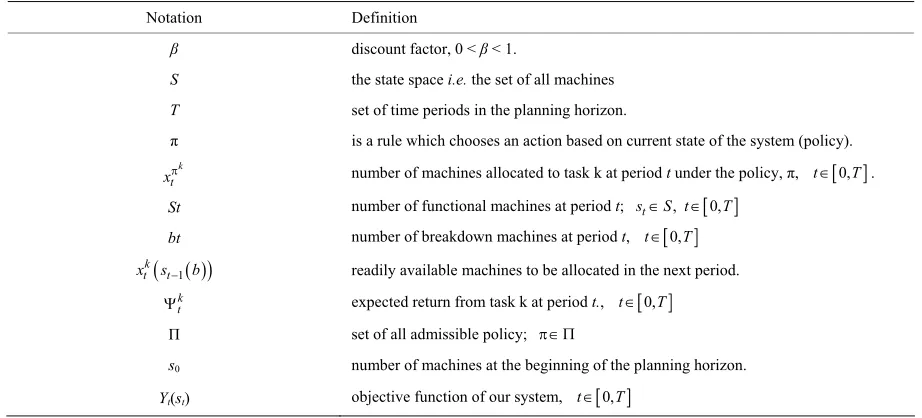
in Table 1.
In the next subsection, we define the one-period ex- pected profit function and formulate the problem as a dynamic program.
3. The Objective and One-Period Expected
Profit Function
If the profit for allocating the k task to the machines at period t is t , the state of the machines is st, number of
machines allocated to operate on task k at period t under policy π, is tk
k
x
1
k
t t t
and the number of break down machines is bt, then the profit that will accrue to the company over
T-horizon is given by
0 1
T m k
t k
x s b
1
k
t t
x s b
0,1, ,
.The expected maximum profit that will accrue to the company under policy π is given by
0 1
max
t t
T m t k
t t t
x X s t k
s E
(1)subject to
1
1
, k
m
t t t
K
x s b s
t T; 1, ,
(2)
0, 1, ,
k
t
x t T k m
Note: X(st) is the set of possible solution of problem
(1). Conditioning (1) on stS. We now have the
following optimization problem (3)
Problem (1.3) maximizes the expected profit over X(st)
subject to
' 1 1
max k
t t
T m t k
t t t x X s t t k
s
E x
s b st St
1
1
, 0,1, ,
k
m
t t t
k
. (3)
x s b s t T
:S R
For the profit function
1
m k
T T T T
k
, if we accumulate the profit of the first T-stage and add to it the terminal profit
s s
,
then (3) becomes
1
' 1 1
max T m t k k
t t t t t
x X s t t k T
T T t
s E x s b
s s S
' 1
1
, 0,1, ,
k
m
t t t
k
(4)
x s b s t T
0, 1, , ; 1, ,
k
t
. subject to
t T k m
k
P x
1
, 1, 2, ,
m k k t k
P x t T
x .
4. Dynamic Programming Formulation and
Optimality
Using st as the state variable at period t and S as the state
space, we can formulate the problem as a dynamic
pro-gram. The number of breakdown machines for task k at
period t is given by k t , where Pk is the probability of
break down machines for task k. Hence, total number of break down machines for all the tasks is given by
.
[image:2.595.309.538.189.340.2]We therefore have that
Table 1. Notations and their Definitions. Notation Definition
β discount factor, 0 < β< 1.
S the state space i.e. the set of all machines
T set of time periods in the planning horizon.
π is a rule which chooses an action based on current state of the system (policy).
k
t
x number of machines allocated to task k at period t under the policy, π, t0,T . St number of functional machines at period t; stS t, 0,T
bt number of breakdown machines at period t, t 0,T
k
1
t t
x s b
k t
readily available machines to be allocated in the next period.
expected return from task k at period t., t 0,T
Π set of all admissible policy;
s0 number of machines at the beginning of the planning horizon.
[image:2.595.67.528.528.737.2]1
m k
t k t
k
b P x
, 1, ,
k k t
.
Let st be the number of machines to be allocated in pe-
riod t and let α be the percentage of break down (but re- paired) machines that are expected to join the functional ones in period t, then the transformation equation for the system is given by
1
1
1 m
t t
k
s s P
x t T, 1, , k
k t
. (5)
Observe that the transformation equation is a random variable.
We now set 1 – α = β in (5) to have,
1 1
m
t t k
s s P
x t T
. (6)
In this case, the optimal policy can be found by comput-ing the value functions through the optimization problem
1 k
t t
t t
1
max t
m k
t t t
x X s k
t t
F s x
E F s
s bS s
, 1, 2, , . t
(7)
subject to
1
1 k
m
t t k
x s b s
t T, , ;T t 0
; 1, ,
Equivalently,
1
1
, 1
k
m
t t t t
k
x s b s t
. (8)0, 1, ,
k
t
x t T k m
0
t
.
Since all the available functional machines must be allocated in the next period, we have that
t T
, for all , which is the slack variable.
We show that (4) is equivalent to (7), and then use (4) and (7) interchangeably. The theorem below establish this claim.
Lemma 1.1: Let st be a state variable that captures the
relevant history up to time t, and let t st1 be some
function measured at t’ ≥t + 1 conditionalon the random variable st. Then,
t' t 1
tE E s sEt' st
.
For the proof, see [3].
Theorem 1.1: Suppose that t st
t
satisfies (4) and
t
F s satisfies (7), then t
st F st
t
. Proof: We are to show that t st F st
t
T T
T. We first use a standard method of DP. Obviously
T sT FT s
s
.
Suppose that it hold for t + 1, t + 2, ···, T, then we show that it is true for t.
We now write
1 1
1
' ' '
' 1 1
max
max
( ) k
t
k
t
m k
t t t t t
x X s k
T m
k
t t t
x t t k
T
T T t t
F s x s b
E E x s b
s S s
Applying Lemma 1.1, we have
1
( ) 1
1
' ' '
' 1 1
max
max
( ) k
t
k
t
m k
t t t t t
x X s k
T m
k
t t t
t t k x
T
T T t t
F s x s b
E E x s b
s S s
k
t t
x
When we condition on s b
, we obtain
11 ' 1
max
.
k
t
T m k
t t t t t T T t
x X s t t k
t t
s E x s b s s
s
F
For any given objective function, we desire to find the best possible policy, π, that optimizes it, that is, we search for
* max
t st t st
1 1
1
1 1
1 1
1
max
max
k k
t
k k
t
m k
t t t t t
k x X s
t t m
k
t t t k
x X s
m k
t t k t
k
F s x s b
E F s
x s b
F s P x
.
This is obtained by solving the optimality equation
t t
(9)
If we find the set of F’s that solves (9), then we have found the policy that optimizes s
. The result be-low establishes this claim.
Theorem 1.2: The expression F st t is a solution
to equation (1.9) if and only if
* max
t st F st t Yt st
.
The if part: This is shows by induction that
*
t t t t
F s s , for all stSandt0,1, ,T1.
T sT T sT T sT
,
F
Since
, we have that
*
T T
for all sT and F s T sT .
*
t t t t t t
F
Suppose that s s s , for t = n + 1,
n + 2, ···, T, and let
m k
k
s b
1
max k
n
n n n n
k x X s
n n
F s x
F s 1 1 1 1 . n m k k n k P x
By inductio
n hypothesis,
*
1 1
n n
1 1
n n
F s s . So
w
1 n1 , ' t1.
e have
1
1
1 max k k n m k
n n n n n
k x X s
m k
n n k
k
F s x s b
s P x
s s
Also, we have that n1
sn1 *n1
sn1 for anar
1 n1 , ' t 1
ence bitrary policy, , h
k
k
1 1 1 max( ),for all
= max .
k n
m
n n n n n
k x X s
m k
n n k
k
n n n
n n
F s x s b
s P x
s s
s s
Only if part: We sho r any 0, there exists
n n
1 1 1 1 1 1 1 1 1 1 1 1 1 1 1 1 1 1 1 1 1 + 1 + k k k k m k n n n km k
n n k n
k m
k n n n k
m k
n n k n
k m
k n n n k
m k
n n k n
k m
k n n n k
m k
n n k n
k
F s x s b
F s P x T n
x s b
F s P x T n
x s b
F s P x T n
x s b
F s P x
w that fo that satisfies the following:
n sn T n
F s (10)
fine n
nWe now de F s as follows:
1 1 1 1 n m k k n k b P x
m k
k
s
1
max k
n
n n n n
k x X s
n n
F s x
F s
(11)Let n
n
x s be the decision rule that solves (1) and
satisfies the fo
1
1 1 1 n m k k n b P x
(12)We now prove (10) by induction. Assume that it is true fo
1 n1 , ' t1
llowing:
F s
1 k
m k
n n n n
k
n n
k
x s
F s
r t = n + 1, n + 2, ···, T. But,
max m k
kF s x
1
1
1
k n
n n n n n
k x X s
m k
n n k
k
s b
s P x
s s
We now use the induction hypothesis which says
n sn F sn n T n
, so that n n
n n T nF s T n
Hence,
* *n n n n
n n n n
T n s T n
F s s
s
This result shows that solving the optimality also gives the optimal value function.
*
equation
Theorem 1.3: 1) Let B(s) be the set of all bounded
real-valued functions F: S→R. The mapping Γ: B(s) → B(s) is a contraction.
2) The operator Γ has a unique fixed point (given by
F*).
3) For any F, F F .
4) For any F, if ΓF ≤ F, then F* ≤ ΓtF, V
1,
.Note:Γ is call ic
0,
t
ed dynam p ogramming operator ( ], for more detail).
r See
[5
Theorem 1.4: For any bounded return or scoring
functions F1: S→R and F2: S→R, and for all t = 0, 1, 2,
3, ···, the inequality below holds
1
2
1
2
max t t tmax
s S F s F s s S F s F s
See [8].
The next result shows that as T→∞, F*(s) →ΓTF( s),
V s S . Thus, the profit per stage must be bounded i.e.
1 k m k kx s b
,where μ is a positive constant.
We now state this claim formally as follows:
unded return or scoring
s0), T→∞ that is, Theorem 1.5: For any bo
0 Tlim
0 , 0T
F s F s V s S .
Proof: Let H be a positive integer, s0S and policy π = {π0, π1, ···}, we can dec pose the return
1k
t
s
into the portion received over the first H stages and over the remaining stages.
k
k
t
t t t
s b
s b
But
om
0
0 1
lim t t
T t k
F s E x b
1
T m t k
0
0 1 1
lim t t t
T t k H
F s E x s b
10 1 1
1
lim
k
T m t k
m t k
t t t k
T m t k T t H k
E x
E x
1 1
lim T m t k k
t t t
T E t H k x s b t 1
H t H
N
N
Since t
t H
is a geom gression and 0 < β <1.
etric pro Now
H 1m
0
0 1
k
t k t t t t k
F s E x s b
1
HN
using this relations, it follows that
01
t
H m
0 1 0
max 1
max .
1
k
t
H H
s S
H t k
H t t t
t k H
H s S
N
F s s
E s x s b
N
F s s
By taking the maximum over π, we obtain for all S0
and H.
*
0 max
1 t
H s S
F s s
*
0 0 1 max ,
t
H
H
H H
s S
N
N
F s F s s
and by taking the unit as H→∞, we have
* *
0 0 0
lim
H
HF s F
s F s
Hence, *
0 lim 0 , 0
H .
H
F s F s V s S
mization problem con- verges to a fixed point F* in an infinite horizon.
value iteration algorithm for finite a ite
stage to solve our problem. The algorithm converges to an
This result shows that our opti
We use nd infin
optimal policy.
Step 1: Initialization
Set F s0
0 0 V s0S. Set n = 0Set 0 < β < 1
Fix a tolerance parameter, ε > 0.
2: For each n
Step s S, calculate
1
max m k k
n n n n
k
n k n
k
1
n
1 n
x X k
1
m
n
F s x s b
F P x
(13)
Let xn+1 be the decision vector that solve (13). Step 3: For β = 1:
If
s
1
1 ,set , 1
n
n Fn x x F Fn
F and stop;
else set n = n + 1and return to step 2.
Step 4: For 0 < β < 1;
If 1
1 , set n , 1
n n
1
2 n
F x x F F
F
an = n + 1 and return to step 2.
The theorem below guarantees the convergent of the
al m.
Theorem 1.6: If the algorithm with stopping parame- +1,
th
d result stop; else set n
gorith
ter ε, terminates at iteration n with value function Fn
en
*
1 2
n
F F (14)
In addition, if xε is the optimal decision rule and k F is the value of this policy, then
*
FF . (15)
This theorem implies that Fk is the fixed point of
the equation F = Γ(xε)F. Since xε is the decision that
solves ΓFn+1, it implies that Γ(xε)Fn + 1 = ΓFn+1. Since
* *
1 1 1 1
n n n n
F F F F F F ,
Fn+1 = ΓFn and Γ is contraction, we have that
1 1 1
n n n
F F F F
and
*
1 1
1
n n n
F F F F
(16)
t the value iteration algorithm stops when
Bu
1
1 2
n n
F F
(17)
*1
1 (The feasible region for stage t).
2
(18)
1 2
n
F F
Similarly, 1
2
n
F F
Therefore,
*
1
n n
F F F * 1
2 2
F F F
.
5. Computational Result
A production company in Nigeria proposed to purc se 50 machines that can perform nine different tasks. These
wn. The Table 2 gives
o maximize profit over T
ho
t1
ha
machines are subject to breakdo information of their decisions.
The company further estimated that out of the number of breakdown machines per week, 95% will join the functional ones for the next period.
The aim of the company is t rizon
Let st represents the number of machines to be
allo-cated in the next period, so that k
t t
s x s b . Since
s0
horizon,
f breakdown machines, and
is the number of machines at the beginning of the planning
1
m k k t k
P x
is the total number o
1 19 20
m
k t k
P x
e next period of operation, we have that
k
is expected to join the functional machines in th
1 1 20k
which is our transformation equ
1 m , , 1, ,1
k
t t k t
s s
P x t T T ,ation and is a random variable.
We can now express our one-period expected return function as follows:
1t t
x s b (19)
, , 1, ,1
m
T T .
1
0k t t t
x s b
Since the company cannot allocate negative resources
to any one task, we write , t = T, T –
1, ···, 1; k = 1, ···, m.
Of course, (19) is the same as
maxk
t t
s E
T m tk
k
t
1 1
t
xX t k
subject to
1
11
k
t t t
k
x s b s t
1 1 1
1
1 1
1 1
1
max
, 1, ,1,
max
1
, 20
k k
t
k k
t
m k
T t t t t t T t
x X k
m k
t t t t
x X k
m k
T t k t
k
F s x s b EF s
t T T
x s b
EF s P x
,
0 k t
x
t = T, T – 1, ···, 1, and , t = T, T – 1, ···, 1; k = 1, ···,m.
Note: Our problem has 9 tasks and 48 periods.
Hence, m = 9 and T = 48. Set 1 9
.
Therefore,
1 1 2 3 45 6 7 8
9
1 2 3 4
1 1
5 6 7
8 9
max 180000 150000 192000 240000
228000 120000 168000 222000
300000
1 2 1 2 5
20 11 10 13 21
3 1 1
13 12 9
4 5
15 18
1, 2, , k
T t
t t t t
x X
t t t t
t
T t t t t t
t t t
t t
F s
x x x x
x x x x
x
F s x x x x
x x x
x x
T
48;t48, 47, ,1.
9
1 1
, 48, 47, ,1, k
t t
k
x S t
0 k
[image:6.595.58.539.681.737.2]x
Table 2. The Expected Initial Profit and Probability of Breakdown Machines.
Machines Task x1 Task x2 Task x3 Task x4 Task x5 Task x6 Task x7 Task x8 Task x9 (20) subject to:
t , t = 48, 47, ···, 1; k = 1, ···, 9 which is a
paramet-ric linear programming problem with 9 variables.
A program using MatLab was used for (20). At the end, the following results were obtained.
The profit over 48 weeks is given by
Initial Expected Profit (in Naira) 180,000 150,000 192,000 240,000 228,000 120,000 168,000 222,000 300,000
48F 0 91
1
4,571,1 0,000.
o
s N s
By theorem 1.5, as T approach infinity, FT(s0)
ap-proaches F(s0),
422000 9
N
422000 50
0
N
0 0
0 0
lim T 409820000
T
lim
20, 491,000,000.
T T
F s F s
F s N s
N
and the al policy 9
0
t
optim x s , (t = 1, 2, ···), approaches
the lim
Discussion: Figure 1 shows the expected profit that
will accrued to the company over a period of 48 weeks. We found that at 48 weeks, the maximum profit that
it zero.
accrued to the company to be N4,571,100,000. Figure
[image:7.595.66.276.318.490.2]2 shows the expected profit that will accrued to the
[image:7.595.70.275.528.700.2]Figure 1. The Expected Profit that will accrued to the Company over a Period of 48 weeks.
Figure 2. The Expected Profit that will accrued to the Company over an Infinite Period.
an an e w It nd t
infinity, the maximum profit that will accrued to the an
comp y over infinit eeks. was fou that a
comp y to be N20, 491,0
6. Conclusion
Many production companies have for long been allocat- ing resources to different tasks without putting into con-sideration certain factors that may hinder the realization of their objectives. This paper dealt with allocation of machines to tasks in order to maximize profit over finite and infinite horizon. Careful analysis of the situation reveals that adequate planning, prompt and effective maintainance can enhances the profitability of the com-pany.
REFERENCES
[1] J. M. Mulvey and H. Vladimirou, “Stochastic Network Programming for Financial Planning Problems,” Manage-
00,000.
ment Science, Vol. 38, No. 11, 1992, pp. 1642-1664. doi:10.1287/mnsc.38.11.1642
[2] B. Van Roy, D. P. Bertsekas, Y. Lee and J. N. Tsitsiklis, “A Neuro-Dynamic Programming Approach to Retailer
Inventory M the 36th IEEE
Conference
anagement,” Proceedings of
on Decision and Control, San Diego, 10-12 , pp. 4052-4057.
C.1997.652501 December 1997
doi:10.1109/CD
gramming, Elsevier, Amsterdam, 2003, pp. 555-635. [5] W. B. Powell, “Approximate Dynamic Programming for
Asset Manag versity, Princeton,
2004.
6. rogramming Algorithm for [3] W. B. Powell, “A Comparative Review of Alternative
Algorithms for the Dynamic Vehicle Allocation Prob- lem,” In: B. Golden and A. Assad, Eds., Vehicle Routing: Methods and Studies, North Holland, Amsterdam, 1988, pp. 249-292.
[4] W. B. Powell and H. Topaloglu, “Stochastic Program- ming in Transportation and Logistics,” In: A. Ruszczyn- ski and A. Shapiro, Eds., Handbook in Operation Re- search and Management Science, Volume on Stochastic Pro
ement,” Princeton Uni
[6] H. Topaloglu and S. Kunnumkal, “Approximate Dynamic Programming Methods for an Inventory Allocation Prob-lem under Uncertainty,” Cornell University, Ithaca, 200 [7] C. I. Nkeki, “On A Dynamic P
Resource Allocation Problems,” Unpublished M.Sc. The-sis, University of Ibadan, Ibadan, 2006.