A Comparative Study of different Oject Tracking
Methods in a Video
Norah Almohaimeed
Department of Computer Science College of Computer
Qassim University
Master Prince
Department of Computer Science College of Computer
Qassim University
ABSTRACT
Visual Object Tracking (VOT) is the most salient and an ongo-ing exploration field amongst the several disciplines of computer vision. The importance of this technology is due to the exten-sive range of applications such as robot navigation, human com-puter interaction, video surveillance, etc. The process of object tracking involves segmenting areas of a video scene and track-ing its position, motion and occlusion. However, problems can ap-pear during tracking on account of multiple issues including cam-era motion, object-to-object and object-to-scene occlusions, non-rigid structures, object and scene changes in patterns and appear-ance and abrupt object movement. The aim of this paper is to ex-amine, analyze and provide a shortlist of the most ubiquitous ob-ject tracking techniques. This accomplish by providing a compre-hensive review of the tracking process which involve object de-tection methods, object representation and features selection and object tracking over multiple frames. Object tracking methods are compared whilst elaborating upon the advantages and limitations.
General Terms
Visual Object Tracking
Keywords
Object detection,Object representation, Object tracking , Video surveillance
1. INTRODUCTION
Visual Object Tracking (VOT) is a relatively modern phenomenon occurred within the computer vision discipline. It is based on prin-ciples, which are linked to image or video frame processing. The data contained within this image or frame is captured and ana-lyzed based on specific parameters, which allow an output to be generated accordingly. Two key steps facilitate this capability that include detection and representation of the object. Detection in-volves determining object existence whilst representation inin-volves its detection[18]. Object tracking is therefore concerned with veri-fying the existence of an object within a video frame[19]. Object tracking can be defined as the estimation of object trajec-tory in the image plane as it moves from one frame to another. Tracking works through permanent label assignment of an object present in many video frames. Object tracking can be approached
in different ways based on factors such as suitability of object rep-resentation, specific use of image features, and object modeling pa-rameters such as shape, appearance and motion. These factors are contingent upon the object and its environment. As a consequence, many tracking methods have been developed which take into con-sideration the aforementioned factors whilst stressing specific fea-tures over others [31]. The accuracy of tracking is contingent upon two factors including object detection and modeling. The flow di-agram in Figure 1, illustrates the main steps associated with object tracking.
Video Sequence
Object Detection
Object Modeling
[image:1.595.324.548.383.422.2]Object Tracking
Fig. 1. Object tracking steps.
The first step of tracking objects in a video sequence involves ob-ject detection. This helps us to determine which obob-ject needs to be tracked followed by modeling presence of the object within a single frame. The last stage involves specifically focusing on, and tracking the desired object [12].
2. OBJECT DETECTION
Object Detection
Optical Flow Frame
Differencing
Background Subtraction
[image:2.595.65.282.74.187.2]Recursive Non-recursive
Fig. 2. Object detection methods [24].
2.1 Frame Differencing
This method is used in environments with static backgrounds with moving objects. In fact, objects of tracking interest are not station-ary. They appear in different positions in consecutive frames [24]. It is possible to determine objects, which are moving by calculat-ing the difference between two consecutive frames and isolatcalculat-ing, where the movement is occurring. This form of detection is rela-tively easy and simple to carry out. Moreover, it can be applied to various environments which are dynamic in nature due to its adapt-ability. However, it can be difficult to acquire a complete outline of a moving object and could result in failed object detection or inaccurate results [25].
2.2 Optical Flow
The method which makes use of pattern of the apparent object mo-tion and edges in video sequences based on relative momo-tion between an observer and the scene is known as optic flow[15]. This method works by calculating the image optical flow field and carrying out clustering based on image optical flow distribution characteristics. This method is able to acquire complete movement data in addition to detecting the moving object. However, the main drawbacks to this method are it exhibits poor anti-noise capabilities, noise sensi-tivities, and requires a large number of calculations. These limita-tions restrict this method to non-real time applicalimita-tions [25].
2.3 Background Subtraction
It is possible to split a video sequence into complementary fore-ground and backfore-ground. The object of interest is typically located within the image foreground, whilst the background is typically of negligible interest. Removal of background from a video frame leaves the foreground, that containing the object of interest . Back-ground subtraction is more effective when the backBack-ground is al-ready known. For example, this method is highly applicable for surveillance cameras, which are motionless such as those found in road traffic surveillance. In this example, the road is perceived as being motionless which is advantageous, since the background has already been modeled. If the cameras are not motionless, then it needs to undertake background modeling prior to background sub-traction with the aim of generating a reference model. This takes place by comparing a reference model and detecting the object based on variation in video sequences [24]. The difference between video frames and reference frame pixels indicate that an object is moving. Therefore, background modeling has to be capable of rec-ognizing moving objects . Background subtraction can be imple-mented using simple algorithms, however, it may be sensitive to
changes in the exterior environment and is heavily impacted upon by interference [28]. It is possible to categorize background sub-traction algorithms into recursive and non-recursive categories:
a) Non recursive methods
This method uses a sliding window approach to estimate the background by storing a buffer of the previous L video frames. It then estimates the background through temporal variation analysis of each pixel in the buffer [26]. Due to this fact, only limited frame numbers are held in the buffer, errors caused by frames outside the buffer limit are not considered. Non recur-sive techniques require very large amounts of storage due to the need for large buffers. However, this type of problem is typi-cally mitigated by reducing video frame rates. Non recursive methods which are used commonly nowadays include non-parametric modeling, linear predictive filtering, median filter, and frame differencing [24].
b) Recursive methods
This method does not make use of a buffer for background estimation. Rather it updates a single background model recur-sively using an input frame. This means frames from a long time ago may impact the background model. Relatively speak-ing, recursive methods need less storage capacity, however, a background error may linger for a longer time [26]. Recursive methods which are commonly used nowadays include the mix-ture of Gaussians (MOG), Kalman filtering and approximated median filtering [24].
The main problem associated with background subtraction is spontaneously updating the background from each and every incoming video frame. This problem is compounded through problems such as bootstrapping, camouflage, shadows, mem-ory, illumination changes and motion taking place in the back-ground itself [28].
3. OBJECT MODELING
This plays a vital role in tracking because it categorizes an object of interest. Therefore, choosing the correct object model is critical for different applications. The object model defines the feature of inter-est and is used to inter-estimate tracking. Object modeling has two fea-tures, the first is object representation, and the second includes the features used to characterize an object. Effective tracking is contin-gent upon the correct object model selection. The range of object representations takes into account different models which are best suited for slightly different circumstances. For example, certain cir-cumstances require only simple models, whereas, other situations require complex object models to achieve effective tracking [12].
3.1 Object Representation
An entity which is intended to be tracked is termed as an object, and depending on the tracking application could be almost any-thing including people, vehicles, planes or birds etc. It is possible to represent an object by determining its size and shape [16]. The most common way of doing this is through the use of skeletal mod-els, articulated shapes, contours, silhouettes, points and primitive geometric shapes such as ellipses and rectangles [31] as shown in Figure 3.
a) Point
Fig. 3. Object representations[31]. (a) Centroid, (b) multiple points, (c) rectangular patch, (d) elliptical patch, (e) part-based multiple patches, (f) object skeleton, (g) complete object contour, (h) control points on object contour, (i) object silhouette.
spectrum of applications because of its processing simplicity, and the way points can be easily manipulated through algo-rithms [12]. It is possible to characterize an object relative to a set of points, which occupy a specific region of interest and is suitable for small area tracking applications [16].
b) Geometric shapes
An object can be represented based on a point in the simplest form. However, it does not totally cover the object dynam-ics. For example, rotation cannot be represented in this man-ner. This necessitates the use of more complicated parametric shapes. The most ubiquitous parametric shapes include those primitive geometric shapes such as circles, ellipses, squares, rectangles which are most suited for representing simple rigid objects. However, they can also be used for non-rigid objects after using adaptive methods. Geometric object tracking typi-cally uses rectangle representation for applications such as car tracking, and in low distortion object tracking scenarios e.g. people[12].
c) Articulate shape models
This method can be utilized to track different object portions which are of interest. This permits segments of the object to be tracked individually such as a person who can be broken down into a head, torso and limbs. Hence, this model is most suited for objects which are made up of smaller components and can be represented using simple geometries such as ellipses, circles and rectangle. This model links constituent parts to a kinematic model [12].
d) Skeletal model
This can be applied to an object and to both rigid and artic-ulated object types. A skeleton can be defined as a group of articulations that make up an object, which describe the de-pendencies and constraints within parts [12].
e) Object silhouette
This is also known as a blob and can be described as a non-disjoint, dense, binary mask which highlights an object. This method is most useful for pixel processing and it is possible to identify a moving object or a foreground by subtracting the background [12].
f) Contour
This method defines an object based on its contours and is advantageous over other methods due to its convenient non-parametric trade-off between storage needs and exhaustive ob-ject descriptors. Rather than complete silhouette storage, an object is described through the edges of its contours. This method can also represent non-rigid shapes efficiently [12].
Tracking is facilitated by representing a shape based on its appear-ance. From amongst the most ubiquitous appearance based meth-ods, the following have been summarised:
a. Probability density appearance model
This method can model objects in both parametric and non-parametric means, i.e. Gaussian and a mixture of Gaussians, and histograms respectively. Object appearance features such as texture and color can be estimated using probability densi-ties from the captured images [31].
b. Multiple-view object recognition
This method uses a set of views to model the object, where every view includes data concerning a small range of viewing condition. An object can be represented through two processes. The first involves clustering images, which represent different object views. The second is used when object information is widespread and used to form model view characteristics [16]. c. Active Appearance Models (AAMs)
These models consist of statistical data used to represent an ob-ject of interest via its grey level and shape appearance. These approaches take into account texture and shape which allow us to track the outline and appearance of an object simultane-ously. These methods also permit the reusability of data pro-vided through a tracker in a variety of other applications[12]. Despite this advantage, a training period is required by the sys-tem making use of AAM models. This can be undertaken us-ing sample data, for example, the principal component analysis method[31].
d. Templates
These can be created using silhouettes or simple geometric shapes. One of the advantages of using this method is that templates carry both appearance and spatial data. However, this method is only suitable for objects which have limited variation[31].
3.2 Object Features
a) Color Modeling
Two physical factors influence the color of an object. Firstly this includes the spectral power distribution of the illuminate, and secondly the object surface reflectance attributes. During the acquisition of an image, the RGB color space is commonly used to display color. However, RGB cannot be considered as being perceptually uniform. In other words, there is a differ-ence between the rendered RGB colors and those perceived by the human eye. This explains why color spaces such as LAB, YUV and HSV have been developed since they are more capa-ble of representing color in a perceptually uniform manner. De-spite this, colors can be negatively impacted because of noise. This explains why no single color space has been uniformly ac-cepted since multiple color spaces have been used for different tracking purposes [23].
b) Shape Modeling
This can only be applied to the geometric shape of an object and cannot be applied to the structural analysis. It is contingent upon extracting geometry of regions such as boxes and ellipses which highlight object motion and thus facilitating classifica-tion . Through a variety of methods including using points, sil-houettes, and boxes [16]. Edge is also used as a feature, where image intensities differ depending on object boundaries and can be detected using edge detection methods. The key fea-ture of edges includes being minimally sensitive to illumina-tion changes relative to color features. The majority of algo-rithms use Edge as the main agent in tracking objects [21]. c) Texture Modeling
The regular pattern and repetition of an element is termed tex-ture and can be used to distinguish between different image areas and segment or classify different regions[5]. This object feature can be used for object classification as well as tracking and is used to locate the region of interest. Texture can be de-fined as a measurement of surface intensity variation, which is used to describe attributes such as regularity and smoothness. Unlike the color space model, determining texture requires the precursor step of descriptor generation [22]. Texture can be difficult to represent, but one of the ways in which texture can be modeled is through using two dimensional gray level vari-ation. This collection of data permits pairs of pixels and their relative brightness to be computed based on contrast in direc-tion, coarseness and regularity which provides the necessary data detect texture [5]. Relative to color, texture features are less sensitive to changes in light [21].
d) Motion Modeling
This method is based on the principle that object motion pat-terns and attributes are sufficient to distinguish it from other objects. For example, the motion of human beings has been shown to be distinct from other animals. Therefore, features such as motion can be used to recognize types of human move-ment, in addition to human identification [22]. This method is based on motion periodicity and can be made to learn how ob-jects move and therefore categorize them effectively. This type of classification can be used with rigid and non-rigid objects. Although the tracking of rigid objects is easier because of mo-tion periodicity. It is known that a limited amount of periodic-ity data occurs in non-rigid objects. This type of features also makes use of optical flow [24]. Regional pixel identification can be determined using a dense field of displacement vectors defined as an optical flow. Image features such as brightness can be taken as a measure during optical flow computations when corresponding pixels have the same brightness in
consec-utive frames. Optical flow feature is typically utilized in track-ing applications and motion based object segmentation[5].
4. OBJECT TRACKING METHODS
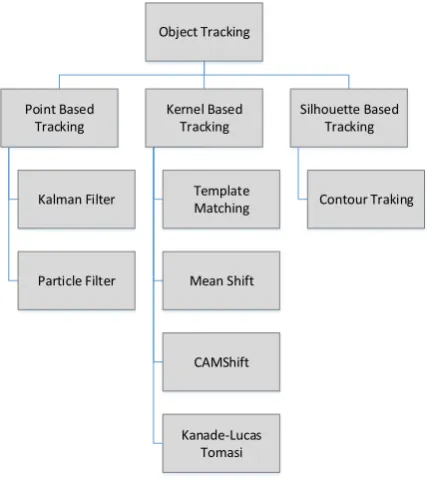
Following object detection and correct modeling, the next step in-volves tracking. Object tracking can be defined as a process which tracks an object over a time period by locating its position in each video frame[9]. There is three main object tracking classifications including point, silhouette and kernel based tracking. In the case of point tracker detection, this takes place in every frame. On the other hand, kernel or geometric area based tracking and contour based tracking require object detection to take place only once as the object first appears [28]. Object tracking can be subdivided as shown in Figure 4.
Object Tracking
Silhouette Based Tracking
Template Matching
Kalman Filter Contour Traking
Mean Shift Particle Filter
CAMShift
Kanade-Lucas Tomasi Kernel Based Tracking Point Based
[image:4.595.332.546.235.475.2]Tracking
Fig. 4. Object tracking sub categories.
4.1 Point-based Tracking
This method represents an object using points and the correlation between these points are based on points of the previous frame. There are a wide number of algorithms available for point track-ing purposes includtrack-ing Kalman Filter, Particle filter, etc. These methodologies are best suited for objects which can be simply taken as points. In the case of large objects, it is necessary to represent them using multiple points. One of the drawbacks of this method is that the presence of occlusions and misdetections cause points to become very complicated. Moreover, point tracking is unable to consider object entry and exit in the field of view [13].
a) Kalman Filter
and object existence verification at the predicted location. Prior to carrying out tracking, the motion model must be learned by the system through the use of sample image sequences [17]. A simple way to describe this filter is by describing it as a set of mathematical equations which implement a predictor-corrector type estimator, where the optimal reading reduces the estimated error covariance under specific conditions [20]. Through the use of a feedback control form, the filter calcu-lates the process state and then acquires feedback in the form of noisy measurements. As a consequence, the equations asso-ciated with this method fall into two subcategories, time update and measurement update equations. The time update equation is dedicated to projecting ‘forward’, the contemporary state and error covariance estimates to gain a priori estimates for the next step. The measurement update equation is dedicated to feedback. In other words, it incorporates a new measure-ment into a priori estimate to acquire an improved posterior estimate. The time update equation can also be considered as a predictor equation. On the other hand, the measurement update equation is to be considered as a corrector equation. The last estimation algorithm can be likened to a predictor-corrector al-gorithm which can be used for solving a number of problems [20], as demonstrated in Figure 5.
Time Update (“Predict”)
Measurement Update (“Correct”)
Fig. 5. Kalman filter cycle.
b) Particle filter
This method generates all the models for single variable prior to moving to the next variable. This method is advantageous when variables are dynamically generated and there are many variables. It also enables for another resampling to be under-taken. One disadvantage of using the Kalman filter is that state variables are assumed to be distributed using Gaussian meth-ods. As a consequence, the Kalman filter makes poor estima-tions of non-Gaussian distribution variables. Particle filtering is one solution to this drawback [6].
This method is also known as the sequential Monte Carlo. It is from the most common approaches used to recursively con-struct the posterior PDF of the state space using Monte Carlo integration. The solution is typically applied to tracking prob-lems by making use of the condensation algorithm. This type of filter makes use of algorithms which utilize color features, contours, or appearance models and can be described as be-ing a Bayesian sequential samplbe-ing method. It works by recur-sively approximating the posterior distribution whilst using a limited number of weighted samples consisting of two steps including prediction and updating [3].
The underlying principle of particle filters involve being able to represent any pdf using a set of samples i.e. particles. One
set of values is associated with each particle for the state vari-ables. Since this approach can be used to embody arbitrary dis-tributions, then it is highly applicable to multi-modal and non-Gaussian pdfs. The function works by determining an approx-imate representation of a complex model, i.e. an arbitrary pdf instead of using a simplified model (i.e. Gaussians using exact representation). This method works based on the following: 1. The initial belief state is required.
2. This is followed by an iteration consisting of three phases. i.e. prediction, update and resampling.
a) Prediction. Every particle is taken and an additional sample from the motion model, which is added to it. This newly formed cloud of particles will hold the resultant position from the motion model. The prior distribution of particles can be used to approximate the resultant distribution.
b) Update. Sensor measurements are acquired, and each particle is assigned a specific weight, which is equal to a ratio of sensor measurement observation for the state of a particle. These weights are then subject to normalization. So the total sum to 1.
c) Resampling. Selection of new particles takes place to ensure every particle persists relative to its current weight. The highly unlikely particles are not selected at the fringe, whilst the highly likely particles are sub-ject to replication at the cloud’s center. This ensures that the high probability regions have a high density. Thus representing the posterior distribution more ac-curately [30].
4.2 Kernel-based Tracking
This method uses appearance and representations of the object of interest using rectangular or ellipsoidal shapes. Through the mo-tion of each kernel on each frame, it is possible to track an ob-ject [11]. The motion of an obob-ject can be categorized in different ways including affine transformations, rotation and translation [24]. Several algorithms can be used for this purpose which differ de-pending on the quantity of object tracking, object representation and object motion estimation method. For example, in the case of real-time applications, it is common to represent objects using ge-ometric shapes. One of the drawbacks of using gege-ometric shapes is that they may not fully encapsulate the target object whilst back-ground elements may also found therein [11]. Different methods can be used for kernel tracking including the mean shift method, CAMShift, simple template matching, and Kanade-Lucas-Tomasi (KLT) tracking. A summary of these methods has been provided below.
a) Mean shift tracking
This tracking method represents a target through density based appearance models. The algorithm used for this tracking method represents the appearance model using the histogram (texture, color etc) [2]. This method uses an iterative approach of tracking, which involves, determining similar pattern distri-butions located within a sequence of frames [4]. It is possible to improve target representation and accuracy by utilizing the chamfer distance transform method. The chamfer method is also capable of reducing the distance between two color dis-tributions based on the Bhattacharya coefficient. This method can be characterized by discrete distribution of the sample and localized kernel.
1. Through the use of color features, it is possible to determine target probabilistic distribution in the first frame.
2. Distribution of the first and following frame can be com-pared.
3. Level of frame similarity can be determined using the Bhat-tacharya coefficient
4. Iterative loops will continue until the final frame [3]. In color based object tracking applications, the mean shift will be used due to its simplicity and robustness. Optimal results can be acquired whilst adhering to the following:
—One color is mainly used for the target object. —There is no color changing of the target object. —There are no automatic changes in target illumination. —The scene does not contain objects which are similar to the
target object.
—The background and the target object colors are different. —The target object does not exhibit full occlusion [11]. The use of color histograms for target representation is a com-mon phenomenon due to several advantageous characteristics including partial occlusion robustness, rotation and scaling in-dependence [32]. Moreover, this method has relatively low computational overhead due to its simplicity. Despite these ad-vantageous qualities, there are also several drawbacks to this method which include, an inability to change window scale when targets may be moving either away or towards the camera [8]. To mitigate this limitation, the continuous adaptive mean shift method has been forwarded (CAMShift) [10]. Moreover, Mean shift is incapable of tracking high speed objects within a frame [24]. This makes this method unsuitable for scenarios, where fast tracking of objects is required. However, this limi-tation can be partially mitigated using the mean shift algorithm together with the particle filter or Kalman filter [27].
b) Continuously adaptive mean-shift (CAMShift)
This method is built upon the principles found in mean shift and can be described as a lightweight and efficient tracking algorithm. The principal difference between mean shift and CAMShift is the latter uses continuously adaptive probabil-ity distributions. The main advantage of this approach is that it permits the probability distribution of a target to be recom-puted in every frame. This permits the target appearance, shape and size to change in every frame. On the other hand, mean shift implements static probability distributions, which cannot be updated [1]. However, the main disadvantage of using this method occurs, when there are similarities between the back-ground and the intended targets, which results in search win-dow divergence [10]. This method is based upon the following iterations:
1. The image is separated into different components by setting the region of interest (ROI) for the probability distribution image.
2. Mean shift search window is selected, which defines the target distribution location intended for tracking.
3. The color probability distribution is calculated for the re-gion that centered within the search window.
4. To determine the centroid of the probability image, the iter-ative mean shift algorithm is used. Both the central location and the zeroth moment (distribution area) can then be stored. 5. In the next frame, the mean location found previously in step 4 is used to re-enter the search window. This can be used to resize the window based on the zeroth moment func-tion. Following this operation steps 3, 4 and 5 are iteratively repeated [1].
The algorithm used by CAMShift is flexible enough to track the distribution of any feature variant for the intended target in an efficient, robust and lightweight manner [7]. Although this flexibility exists, this is more common to find targets be-ing represented usbe-ing color data, since this provides practical performance and low complexity. This method is perhaps more suitable for objects which have a constant and simple appear-ance. Therefore, it is not suitable for scenes made up of high levels of complexity. Examples include scenarios, where the color distribution under background are similar to the target, or if the target shifts its location in front of different objects which consist of varying colors. In this situation, the probabil-ity of tracking an object effectively is greatly reduced [10]. c) Simple Template Matching
This method uses reference images for tracking purposes and is relatively simple in nature. It uses a template matching method for examining areas of interest and is therefore classed as a brute force method. This method uses a verified reference im-age with the frame which is separated from a video but partly overlaps an object. This method is used to process digital im-ages in order to find a match in small parts of an image or an image that is equivalent in model in each frame. In the proce-dure, all potential positions of the template of the image of in-terest are considered and a numerical index is determined. That can be used to describe how effectively the model fits with the image position. This matching process takes place through the examination of every pixel in the image. In this case, the image of reference is acquired and then analyzed relative to succes-sive video frames [3] .
d) Kanade-Lucas-Tomasi (KLT) Tracking
Shi and Tomsi (1994) developed this method which is an ex-tension of the work undertaken by Lucas and Kanade (1981). Due to its effectiveness and widespread use, it has gained an increasing amount of interest by researchers involved in mo-tion tracking disciplines. The reasons why it is so appealing include the tracking algorithm itself, which allows features to be selected in an effective manner. KLT makes use of point features for tracking purposes which may include isolated pix-els or corners, since they are easily distinguished and repre-sent salient information for pinpointing the same features in following frames [29]. It is possible to acquire feature points for tracking purposes using several approaches. Of which the most common include this algorithm using the following: logic Eigen Features, SURF Features and Harris Corner Detector [17]. A simplified KLT algorithm is summarized as below: 1. In the first frame, the Harris corners are detected. 2. The motion for each Harris corner is then calculated
be-tween successive frames.
3. Each Harris point is tracked by linking motion vectors in each consecutive frame.
4. Using Harris detection to create new Harris points based on m frames, i.e. between 10-15 frames.
4.3 Silhouette-based Tracking
Due to the complexity of many types of objects, they cannot be represented effectively using simple geometric shapes due to their irregularity, e.g. fingers and hands. Silhouette based tracking is one mean of mitigating this limitation. This method tracks an object in every frame based on the generation of an object model from previous frames [2]. This type of tracking method is typically used for an entire object has to be tracked.
The most advantageous feature of this method is that it can be used to manage a variety of objects having different shapes. It is possi-ble to represent silhouettes in different ways. The most ubiquitous method makes use of a binary indicator function. This works by marking non-object regions with zeros and the object region with ones. Another aspect of silhouette tracking is occlusion handling. Silhouette tracker is also able to cope with split and merge of an object [31].
a) Contour tracking
This technique works by iteratively evolving an initial contour based on object location in previous frames to a new location in the current frame. The evolution of the contour is contingent upon object parts in the present frame overlapping the object in the prior frame. It is possible to use two different approaches, when tracking is based on contour evolution. The first method makes use of state space models, which are used for motion and contour shape modeling. The other method evolves the contour directly by reducing contour energy through direct minimization methods. For example, gradient descent. One of the most advantageous features of this method is its ability to manage object shapes of different varieties.
In this method, the silhouette can be represented implicitly through a function defined on a grid and can also be repre-sented explicitly to describe its boundary via a collection of control points [31].
5. COMPARISON OF VIDEO TRACKING
METHODS
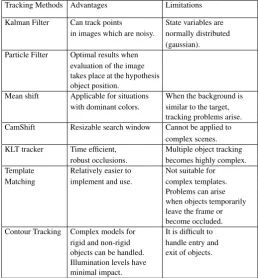
A qualitative comparison for different tracking techniques that have been used for object tracking in a different situation is presented in Tables 1 and 2 that summarize the key features of different tracking methods including tracking object quantity, occlusion, and specific pros and cons. Whilst illumination does not impact point tracking, this method is in need of external mechanisms to detect objects in a series of frames. Problems associated with occlusion typically oc-cur as objects entries or exits a frame and misdetections. However, Kernel and Silhouette tracking only require objects to be detected, as they first appear in a frame. Kernel tracking does not manage oc-clusion explicitly, and a major flaw of this method occurs because of object tracking acquired through primitive geometric represen-tation. This can lead to sections of an object remaining outside the defined shape which could be filled with part of the background. This problematic issue can happen in the case of both rigid and non-rigid shapes. Silhouette tracking exhibits good flexibility when representing an object. Because it is capable of managing differ-ent shapes, including non-rigid shapes, even if they are complex in nature. Similar results have been reported in [31], [21] and [17] studies.
6. CONCLUSION
[image:7.595.308.564.87.231.2]Object tracking and detection is a subset of computer vision dis-cipline, which aims to determine the whereabouts of an object in
Table 1. Comparison for different object tracking methods. (S: single, M: multiple, P: partial.)
Tracking Type of Number of Occlusion Optimal
Methods tracking objects
tracked
Handling
Kalman Filter Point tracking S Yes Yes
Particle Filter Point tracking M yes Yes
Mean shift Kernel Tracking S P No
CamShift Kernel Tracking S No No
KLT tracker Kernel Tracking S Yes Yes
Template Matching Kernel Tracking S P No
[image:7.595.308.567.263.542.2]Contour Tracking Silhouette Tracking M yes Yes
Table 2. Advantages and limitations of object tracking methods.
Tracking Methods Advantages Limitations
Kalman Filter Can track points State variables are in images which are noisy. normally distributed
(gaussian). Particle Filter Optimal results when
evaluation of the image takes place at the hypothesis object position.
Mean shift Applicable for situations When the background is with dominant colors. similar to the target,
tracking problems arise. CamShift Resizable search window Cannot be applied to
complex scenes. KLT tracker Time efficient, Multiple object tracking
robust occlusions. becomes highly complex. Template Relatively easier to Not suitable for
Matching implement and use. complex templates.
Problems can arise when objects temporarily leave the frame or become occluded. Contour Tracking Complex models for It is difficult to
rigid and non-rigid handle entry and objects can be handled. exit of objects. Illumination levels have
minimal impact.
7. REFERENCES
[1] John G Allen, Richard YD Xu, and Jesse S Jin. Object track-ing ustrack-ing camshift algorithm and multiple quantized feature spaces. InProceedings of the Pan-Sydney area workshop on Visual information processing, pages 3–7. Australian Com-puter Society, Inc., 2004.
[2] J ATHANESIOUS and P Suresh. Implementation and com-parison of kernel and silhouette based object tracking. Inter-national Journal of Advanced Research in Computer Engi-neering & Technology, pages 1298–1303, 2013.
[3] J Joshan Athanesious and P Suresh. Systematic survey on object tracking methods in video. International Journal of Advanced Research in Computer Engineering & Technology (IJARCET), 1(8):pp–242, 2012.
[4] Bhakti Baheti, Ujjwal Baid, and Sanjay Talbar. An approach to automatic object tracking system by combination of sift and ransac with mean shift and klt. InAdvances in Signal Process-ing (CASP), Conference on, pages 254–259. IEEE, 2016. [5] Vaijinath V Bhosle and Vrushsen P Pawar. Texture
segmen-tation: different methods.International Journal of Soft Com-puting and Engineering (IJSCE), 3(5):69–74, 2013.
[6] Gary Bishop, Greg Welch, et al. An introduction to the kalman filter. Proc of SIGGRAPH, Course, 8(27599-3175):59, 2001.
[7] Gary Bradski and Adrian Kaehler.Learning OpenCV: Com-puter vision with the OpenCV library. ” O’Reilly Media, Inc.”, 2008.
[8] Gary R Bradski. Computer vision face tracking for use in a perceptual user interface. 1998.
[9] Joshua Candamo, Matthew Shreve, Dmitry B Goldgof, Deb-orah B Sapper, and Rangachar Kasturi. Understanding tran-sit scenes: A survey on human behavior-recognition algo-rithms.IEEE transactions on intelligent transportation sys-tems, 11(1):206–224, 2010.
[10] Ebrahim Emami and Mahmood Fathy. Object tracking us-ing improved camshift algorithm combined with motion seg-mentation. InMachine Vision and Image Processing (MVIP), 2011 7th Iranian, pages 1–4. IEEE, 2011.
[11] Kaijen Hsiao, Jason Miller, and Henry de Plinval-Salgues. Particle filters and their applications.Cognitive Robotics, 4, 2005.
[12] Anand Singh Jalal and Vrijendra Singh. The state-of-the-art in visual object tracking.Informatica, 36(3), 2012.
[13] Kinjal A Joshi and Darshak G Thakore. A survey on mov-ing object detection and trackmov-ing in video surveillance sys-tem.International Journal of Soft Computing and Engineer-ing, 2(3):44–48, 2012.
[14] Salil Kapur and Nisarg Thakkar.Mastering OpenCV Android Application Programming. Packt Publishing Ltd, 2015. [15] Upal Mahbub, Hafiz Imtiaz, and Md Atiqur Rahman Ahad.
An optical flow based approach for action recognition. In Computer and Information Technology (ICCIT), 2011 14th International Conference on, pages 646–651. IEEE, 2011. [16] Shipra Ojha and Sachin Sakhare. Image processing
tech-niques for object tracking in video surveillance-a survey. In Pervasive Computing (ICPC), 2015 International Conference on, pages 1–6. IEEE, 2015.
[17] divya s padmavathi S. Survey on tracking algorithms. In-ternational Journal of Engineering Research & Technology (IJERT), 3, 2014.
[18] Payal Panchal, Gaurav Prajapati, Savan Patel, Hinal Shah, and Jitendra Nasriwala. A review on object detection and tracking methods.International Journal for Research in Emerging Sci-ence and Technology, 2(1):7–12, 2015.
[19] Himani S Parekh, Darshak G Thakore, and Udesang K Jaliya. A survey on object detection and tracking methods. Interna-tional Journal of Innovative Research in Computer and Com-munication Engineering, 2(2):2970–2978, 2014.
[20] Hitesh A Patel and Darshak G Thakore. Moving object track-ing ustrack-ing kalman filter.International Journal of Computer Science and Mobile Computing, 2(4):326–332, 2013. [21] Sandeep Kumar Patel and Agya Mishra. Moving object
track-ing techniques: A critical review.Indian Journal of Computer Science and Engineering, 4(2):95–102, 2013.
[22] Suraj Pramod Patil. Techniques and methods for detection and tracking of moving object in a video. 2015.
[23] Fatih Porikli and Alper Yilmaz. Object detection and track-ing. InVideo Analytics for Business Intelligence, pages 3–41. Springer, 2012.
[24] Kirubaraj Ragland and P Tharcis. A survey on object detec-tion, classification and tracking methods. Int. J. Eng. Res. Technol, 3:622–628, 2014.
[25] Rupali S Rakibe and Bharati D Patil. Background subtraction algorithm based human motion detection.International Jour-nal of scientific and research publications, 3(5):2250–3153, 2013.
[26] S Cheung Sen-Ching and Chandrika Kamath. Robust tech-niques for background subtraction in urban traffic video. In Visual Communications and Image Processing 2004, volume 5308, pages 881–893. International Society for Optics and Photonics, 2004.
[27] A. Shivhare and V. Choudhary. Object tracking in video us-ing mean shift algorithm: A review.International Journal of Computer Science and Information Technologies, 2015. [28] Gandham Sindhuja and MS Renuka Devi. A survey on
de-tection and tracking of objects in video sequence. Interna-tional Journal of Engineering Research and General Science, 3(2):418–426, 2015.
[29] Supannee Tanathong and Impyeong Lee. The improvement of klt for real-time feature tracking from uav image sequence. Dimension (pixels), 4288:2848, 2009.
[30] Changjiang Yang, Ramani Duraiswami, and Larry Davis. Fast multiple object tracking via a hierarchical particle filter. In Computer Vision, 2005. ICCV 2005. Tenth IEEE International Conference on, volume 1, pages 212–219. IEEE, 2005. [31] Alper Yilmaz, Omar Javed, and Mubarak Shah. Object
track-ing: A survey. Acm computing surveys (CSUR), 38(4):13, 2006.

![Fig. 2.Object detection methods [24].](https://thumb-us.123doks.com/thumbv2/123dok_us/9295559.426922/2.595.65.282.74.187/fig-object-detection-methods.webp)
![Fig. 3.Object representations[31]. (a) Centroid, (b) multiple points, (c)rectangular patch, (d) elliptical patch, (e) part-based multiple patches, (f)object skeleton, (g) complete object contour, (h) control points on objectcontour, (i) object silhouette.](https://thumb-us.123doks.com/thumbv2/123dok_us/9295559.426922/3.595.57.288.66.239/representations-centroid-rectangular-elliptical-multiple-skeleton-objectcontour-silhouette.webp)