© 2019, IRJET | Impact Factor value: 7.34 | ISO 9001:2008 Certified Journal | Page 1323
Survey of Suicides Committed in India from 2001-2012
Yuvasri Raghavan
1, Shubham Agarwal
21, 2
BTech Graduate, School of Computer Engineering and Technology, MIT Academy of Engineering, Pune, India.
---***---Abstract -
Suicide is an act of taking one's life. There couldbe multiple reasons for why a person chooses to do so. This act however prevailing, can still be truncated. An analytical study of all the demographics involved in a suicide will help curb the rates of suicide in a densely populated country like India. This study will help design suicide prevention campaigns according to topographical factors.
Key Words: Suicide Analysis, R Programming, Descriptive Analytics.
1. INTRODUCTION
Suicide is among the top three causes of death among youth worldwide. According to the WHO [1], every year, almost one million people die from suicide and 20 times more people attempt suicide; a global mortality rate of 16 per 100,000, or one death every 40 seconds and one attempt every 3 seconds, on average. Suicide worldwide was estimated to represent 1.8% of the total global burden of disease in 1998; in 2020, this figure is projected to be 2.4% in countries with market and former socialist economies. Every suicide is a tragedy that affects families, communities and entire countries and has long-lasting effects on the people left behind. Suicide occurs throughout the lifespan and was the second leading cause of death among 15-29-year-olds globally in 2016. Suicide does not just occur in high-income countries but is a global phenomenon in all regions of the world. In fact, over 79% of global suicides occurred in low- and middle-income countries in 2016. Suicide is a serious public health problem; however, suicides are preventable with timely, evidence-based and often low-cost interventions. For national responses to be effective, a comprehensive multisectoral suicide prevention strategy is needed.
1.1 Background
Suicides are preventable. There are a number of measures that can be taken at population, sub-population and individual levels to prevent suicide and suicide attempts. Suicide is a complex issue and therefore suicide prevention efforts require coordination and collaboration among multiple sectors of society, including the health sector and other sectors such as education, labor, agriculture, business, justice, law, defense, politics, and the media. These efforts must be comprehensive and integrated as no single approach alone can make an impact on an issue as complex as suicide.
1.2 Objective
Although suicide is a deeply personal and an individual act, suicidal behaviour is determined by a number of
individual and social factors. With such increasing numbers in suicide, it becomes mandatory to analyse and understand why one commits suicide. Studying this pattern will help understand the factors and evaluate them on a demographic front. Suicides occur as a result of multiple factors, perhaps of high complexity. This complexity can be lessened by conducting research and study of adequate expertise. Many non-governmental organizations can take up programs to curb suicides if solid research on these factors that actually lead to suicidal tendencies is well established since suicide rates are observed to be greater in areas having advanced health systems.
2. DATASET USED
Suicide is a major concern and requires serious attention, a proper system to perform suicide analysis and prediction using reliable data. The approach to suicide analysis is not restricted to one method or medium. If performed systematically, research to detect suicide ideation from myriad of sources will become a powerful tool in future that will guide family members of people vulnerable to suicides to identify suicidal tendency at early stages.
The dataset used [2] has a total of 12 years observations from 2001 – 2012 which contains the details of natural & un-natural accidents, traffic accidents and suicides. Major causes of accidental deaths are traffic accidents, drowning, lightning, heart attacks, accidental fire, falls, poisoning. Major causes of suicides are family problems, illness, bankruptcy or indebtedness. This data helps the analytical study of suicide by providing relevant data over the years regarding deaths, by suicide and by other reasons as well.
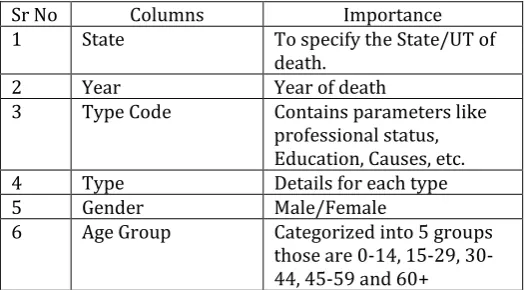
[image:1.595.303.566.619.764.2]A summary of the columns used in the dataset is given below in the table 1.
Table -1: Feature description
Sr No Columns Importance 1 State To specify the State/UT of
death. 2 Year Year of death
3 Type Code Contains parameters like professional status, Education, Causes, etc. 4 Type Details for each type 5 Gender Male/Female
© 2019, IRJET | Impact Factor value: 7.34 | ISO 9001:2008 Certified Journal | Page 1324
2. FACTORS AFFECTING SUICIDE
A person dies by suicide every 13.3 minutes in the United States, according to the latest data from the American Foundation for Suicide Prevention (AFSP). Suicide can affect anyone, but there are certain characteristics and conditions associated with increased risk. The decision of committing suicide is rooted on various factors, although the prime factor may vary from person to person. In the dataset used, multifarious factors were observed that led people to commit this bizarre crime. According to the article published by WHO in their mental health section [3], socio-economic, cultural and religious factors are prevalent when suicides are considered in Asia. Bankruptcy or sudden change in economic status is one of the crucial factors. In a condition of financial crisis when a debtor cannot meet the loan amount, and is struggling peculiarly, the symptoms, like depression, are more likely to lead those suffering with a significantly low ability to clearly see their situation for what it really is and not what they think it really is. Chronic pain and illness are important factors as well. The excruciating pain that patients suffering from various ailments makes people consider taking away their lives instead of enduring such harsh pain on a daily basis. Emotional turmoil, like the loss of a close one, heartbreak and relationship failures, failure in examination, fall in social reputations, barrenness, impotence cause immense disturbance to the mental state of any sane person. This hinders the person’s ability to think with sanity and in such a situation, the person may find solace in ending one’s life rather than gathering courage to fight the situation. Career and social life related issues play an important role as well. Unemployment, workplace stress, professional quandary may not seem like a momentous factor, but in reality, a lot of people succumb to the social expectations in today’s world. When they cannot cope up, they tend to give up on their entire existence.
3. ANALYSIS OF SUICIDES
After collecting data, background and factors relevant to suicide, a clear insight as to the why suicides occur and the demographics related to it was missing. To help understand the given domain with greater clarity, descriptive analytics was deployed to illustrate the points using a visual medium. The same is intimated in the following.
Gender-wise analysis of suicide:
[image:2.595.311.557.73.269.2]Gender plays an important role while analyzing suicides. As mentioned by McGirr A et. al [4] in the paper about gender and risk factors for suicide, a correlation between gender and suicide was observed by using a psychological autopsy method. After doing the analytical research, a bar graph is plotted showing the contrast between the total per cent of males who committed suicide versus the females.
Fig -1: Comparison between genders
Age-wise analysis of suicide:
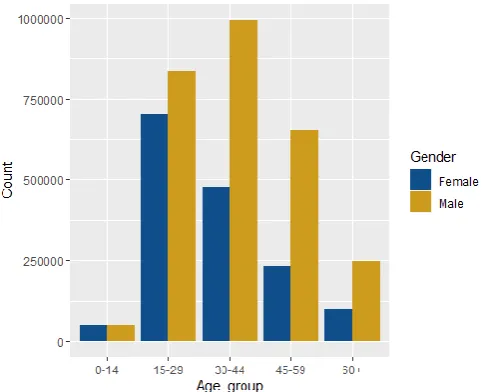
Age is an important feature while interpreting suicides. Milic CT [5] proposed a paper with the objective of determining and the influence of age in suicidal occurrence. The bar graph below illustrates the count of suicides per age group which helps gain deeper understanding of the correlation between age and suicide.
Fig -2: Comparison between age groups
Analysis by education level:
[image:2.595.312.554.410.606.2]© 2019, IRJET | Impact Factor value: 7.34 | ISO 9001:2008 Certified Journal | Page 1325
Fig -3: Comparison between education levelAnalysis by social status:
Social status is crucial when interpreting suicides. A novel paper proposed by Mahmoud Keyvanara et. al. [6] addresses social class status and examines its relationship with suicidal tendencies and occurrences. The research suggests a prevalence of relationship between social status and suicides.
Fig -4: Comparison between social status
Analysis by professional profile:
[image:3.595.311.558.75.306.2]Professional profile is important to consider while analyzing suicides. As mentioned in the paper written by S.E Roberts e.t. al [7], occupations have risks associated to suicides. The plot below illustrates the same.
Fig -5: Comparison between professional profile
Analysis by means adopted for suicide:
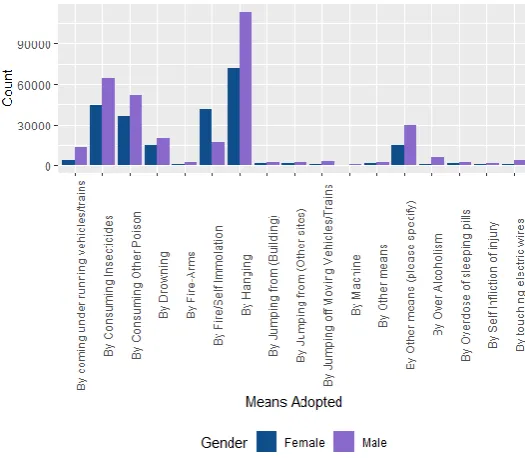
Means adopted for suicide portray the various conditions which help understand and analyze suicides. The graph below depicts the count of various different means adopted for suicide by each gender.
Fig -6: Comparison between means adopted
Age-wise analysis of major causes of suicide:
[image:3.595.312.575.418.647.2] [image:3.595.40.283.449.654.2]© 2019, IRJET | Impact Factor value: 7.34 | ISO 9001:2008 Certified Journal | Page 1326
Ages 0 – 14:Fig -7: Major causes of suicide for ages 0 - 14
Ages 15 -29:
Fig -8: Major causes of suicide for ages 15 – 29
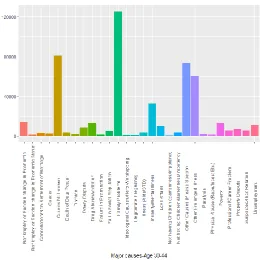
[image:4.595.316.577.98.358.2]Ages 30 -44:
Fig -9: Major causes of suicide for ages 30 - 44
[image:4.595.63.573.402.671.2]Ages 45 -59:
[image:4.595.317.577.412.673.2]© 2019, IRJET | Impact Factor value: 7.34 | ISO 9001:2008 Certified Journal | Page 1327
Ages 60 and above:Fig -11: Major causes of suicide for ages 60+
Analysis by causes per year:
[image:5.595.40.301.98.336.2]The plot below shows the causes of suicide per year along with the total count.
Fig -12: Causes of suicide per year
State-wise analysis:
[image:5.595.41.295.425.643.2]The graph below depicts the suicide count for the states with the highest count and those with the least.
Fig -13: Comparison of suicide count between states
3. CONCLUSIONS DRAWN
Analytic study on the dataset used for surveying suicides help understand the demographics associated with suicide.
The study revealed that males are more likely to attempt suicide that women. Male suicides are 1.779% higher than female.
Age group of 15-29 has the highest suicide rate. Age groups 0-14, 15-29, 30-44, 45-59 and 60+ have suicides rates of 2.27%, 35.38%, 33.94%, 20.41% and 8% respectively.
The research revealed that population having middle school education have the highest suicide rate.
Analysis of the social status of the suicide victims indicated that married people are the most likely to commit suicide. The suicide rate of married people is 70.81%, of unmarried is 21.85%, that of widower is 4.27% and that of separated is 2.64%.
Maharashtra state has the highest count of suicide; whereas Lakshadweep has the least.
Suicide by hanging was seen as the most frequent means of suicide.
The reason for suicide found most common is family problems.
© 2019, IRJET | Impact Factor value: 7.34 | ISO 9001:2008 Certified Journal | Page 1328
mitigating this problem. The results of the study may provehelpful while designing campaigns to eradicate suicide.
REFERENCES
[1] Suicide. Retrieved from
https://www.who.int/mental_health/prevention/suic ide/suicideprevent/en/
[2] Shri Vivek Gogia. Accidental Death & Suicides in India.
Retrieved from https://data.gov.in/dataset-group-name/accidental-deaths-and-suicides
[3] Lakshmi Vijayakumar, Jane Pirkis, Tran Thanh Huong,
Paul Yip, Rohini De A. Seneviratne and Herbert Hendin, “Socio-economic, Cultural and Religious Factors Affecting Suicide Prevention in Asia,” WHO, 2008, pp. 19-30, ISBN: 978 92 41596893.
[4] McGirr A, Séguin M, Renaud J, Benkelfat C, Alda M,
Turecki G, “Gender and risk factors for suicide: evidence for heterogeneity in predisposing mechanisms in a psychological autopsy study,” The Journal of Clinical Psychiatry, vol 67, Oct. 2006, doi: 10.4088/jcp.v67n1018
[5] Milić CT, “Age as a suicide risk factor,” Vojnosanit Pregl.,
Apr. 2000.
[6] Mahmoud Keyvanara, Seyed Ghafour Mousavi, and
Zahra Karami, “Social Class Status and Suicide Characteristics: A Survey among Patients Who Attempted Suicide in Isfahan,” Mater Sociomed, 2013, doi: 10.5455/msm.2013.25.56-59
[7] S. E. Roberts, B. Jaremin, and K. Lloyd, “High-risk
occupations for suicide,” Psychol Med, Jun. 2013, doi: 10.1017/S0033291712002024
[8] Erkki T, Markus M, Henriksson HM. Suicide in major