ISSN Online: 2161-7643 ISSN Print: 2161-7635
DOI: 10.4236/ojdm.2018.83006 May 18, 2018 65 Open Journal of Discrete Mathematics
Cyclically Interval Total Coloring of the One
Point Union of Cycles
Shijun Su
1, Wenwei Zhao
2, Yongqiang Zhao
3*1School of Science, Hebei University of Technology, Tianjin, China
2School of Instrument Science and Opto-Electronics Engineering, Hefei University of Technology, Hefei, China 3School of Science, Shijiazhuang University, Shijiazhuang, China
Abstract
A total coloring of a graph G with colors 1,2, , t is called a cyclically inter-val total t-coloring if all colors are used, and the edges incident to each vertex
( )
v V G∈ together with v are colored by
(
d vG( )
+1)
consecutive colorsmodulo t, where d vG
( )
is the degree of the vertex v in G. The one point un-ion ( )kn
C of k-copies of cycle Cn is the graph obtained by taking v as a common vertex such that any two distinct cycles Cn′ and Cn′′ are edge dis-joint and do not have any vertex in common except v. In this paper, we study the cyclically interval total colorings of ( )k
n
C , where n≥3 and k≥2.
Keywords
Total Coloring, Interval Total Coloring, Cyclically Interval Total Coloring, Cycle, One Point Union of Cycles
1. Introduction
We denote the sets of vertices and edges in a graph G by V G
( )
and E G( )
, respectively. For a vertex x V G∈( )
, we denote the degree of x in G by d xG( )
, and we use ∆( )
G to denote the maximum degree of vertices of G.For an arbitrary finite set A, we denote the number of elements of A by A. We use to denote the set of positive integers. An arbitrary nonempty subset of consecutive integers is called an interval. An interval with the minimum ele-ment p and the maximum element q is denoted by
[ ]
p q, . An interval D is called a h-interval if D h= .A total coloring of a graph G is a function mapping E G V G
( )
( )
to How to cite this paper: Su, S.J., Zhao, W.W. and Zhao, Y.Q. (2018) Cyclically Interval Total Coloring of the One Point Union of Cycles. Open Journal of Discrete Mathematics, 8, 65-72.
https://doi.org/10.4236/ojdm.2018.83006
Received: March 26, 2018 Accepted: May 15, 2018 Published: May 18, 2018
Copyright © 2018 by authors and Scientific Research Publishing Inc. This work is licensed under the Creative Commons Attribution International License (CC BY 4.0).
DOI: 10.4236/ojdm.2018.83006 66 Open Journal of Discrete Mathematics
α of a graph G and for any v V G∈
( )
, let[ ]
,{
( )
}
{
( )
| is incident to}
S
α
v =α
v α
e e v .An interval total t-coloring of a graph G is a total coloring of G with colors
1,2, , t such that at least one vertex or edge of G is colored by i i, 1,2, ,= t, and for any x V G∈
( )
, the set S[ ]
α
,x is a(
d xG( )
+1)
-interval. A graph G isinterval total colorable if it has an interval total t-coloring for some positive in-teger t. The concept of interval total coloring was first introduced by Petrosyan
[3].
Recently, Zhao and Su [4] generalized the concept interval total coloring to the cyclically interval total coloring as follow. A total t-coloring α of a graph G is called a cyclically interval total t-coloring of G, if for any x V G∈
( )
, S[ ]
α
,x isa
(
d xG( )
+1)
-interval, or[ ] [ ]
1, \t Sα
,x is a(
t d x− G( )
−1)
-interval. A graphG is cyclically interval total colorable if it has a cyclically interval total t-coloring for some positive integer t.
For any t∈, we denote by Ft the set of graphs for which there exists a cyclically interval total t-coloring. Let F=
t≥1Ft. For any graph G∈F, the minimum and the maximum values of t for which G has a cyclically interval to-tal t-coloring are denoted by w Gc( )
τ and W Gτc
( )
, respectively. It is clear that for any G∈F, the following inequality is true:( )
G w G W Gc( )
c( )
V G( )
E G( )
.τ τ
χ
′′ ≤ ≤ ≤ +The one point union ( )k n
C of k-copies of cycle Cn is the graph obtained by taking v as a common vertex such that any two distinct cycles Cn′ and Cn′′ are edge disjoint and do not have any vertex in common except v. In this paper, we study the cyclically interval total colorability of ( )k
n
C . Let
( )
( )k k1( )
in i n
V C =
=V Cand V C
( ) {
ni = v v1i, , ,2i vni}
, where Cni is the i-th copy of Cn and i∈[ ]
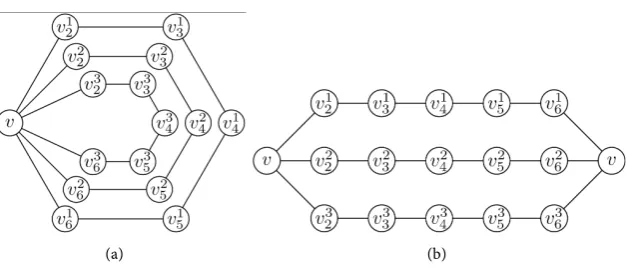
1,k . Without loss of generality, we may assume that the common vertex v of thek-copies of cycle Cn is the first vertex in each cycle, i.e., v v v= =11 12= = v1k. For example, the graphs in Figure 1 are all ( )3
6
C . Note that in the paper we al-ways use the kind of diagram like (b) in Figure 1 to denote ( )k
n
C .
All graphs considered in this paper are finite undirected simple graphs.
2. Main Results
Vaidya and Isaac [5] studied the total coloring of ( )k n
C and got the following result.
Theorem 1 (Vaidya and Isaac) For any integers n≥3 and k≥2 ,
( )
( )
k 2 1n
C k
χ
′′ = + .Now we consider the cyclically interval total colorings of ( )k n
C , show that ( )k
n
DOI: 10.4236/ojdm.2018.83006 67 Open Journal of Discrete Mathematics (a) (b)
Figure 1. (a) ( )3
6
C ; (b) Another diagram of ( )3 6
C .
( )
( )
k cn
W Cτ .
Theorem 2 For any integers n≥3 and k≥2, c
( )
( )k 2 1n
w Cτ = k+ .
Proof. Suppose that n≥3 and k≥2. Let
( )
( )k k1 in i n
V C =
=C , where i nC is the i-th copy of Cn. Let V C
( ) {
ni = v v1i, , ,2i vni}
, where i∈[ ]
1,k . Without loss of generality, we may assume that the common vertex v of the k-copies of cyclen
C is the first vertex in each cycle, i.e., 1 2
1 1 1k
v v v= = = = v . Now we define a total
(
2k+1)
-coloring α of the graph ( )kn
C as follows: Case 1. n≡0 mod3
(
)
.Let
( )
v 1,α
=( )
[ ]
[ ]
[ ]
[ ]
(
(
)
)
[ ]
[ ]
(
)
2 1, 2, , 1, and 1 mod3 ; 2 , 2, , 1, and 0 mod3 ; 2 1, 2, , 1, and 2 mod3 ,
j i
j i n j k i
v j i n j k i
j i n j k i
α
− ∈ ∈ ≡
= ∈ ∈ ≡
+ ∈ ∈ ≡
(
)
[ ]
[ ]
[ ]
[ ]
(
(
)
)
[ ]
[ ]
(
)
1
2 1, 1, , 1, and 2 mod3 ; 2 , 1, , 1, and 1 mod3 ; 2 1, 1, , 1, and 0 mod3 ,
j j i i
j i n j k i
v v j i n j k i
j i n j k i
α +
− ∈ ∈ ≡
= ∈ ∈ ≡
+ ∈ ∈ ≡
where vnj+1=v1j =v for any j∈
[ ]
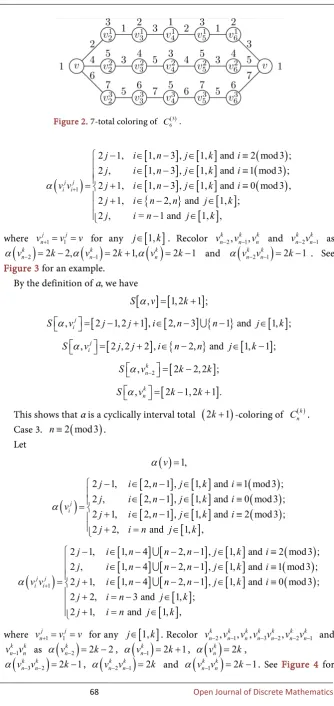
1,k . See Figure 2 for an example. By the definition of α, we have[ ] [
, 1,2 1 ;]
S
α
v = k+[
]
[ ]
[ ]
, j 2 1,2 1 , 2, and 1, .
i
S
α
v = j− j+ i∈ n j∈ kThis shows that α is a cyclically interval total
(
2k+1)
-coloring of ( )k nC .
Case 2. n≡1 mod3
(
)
.Let
( )
v 1,α
=( )
[
]
[ ]
(
)
[
]
[ ]
(
)
[
]
[ ]
(
)
{
}
[ ]
[ ]
2 1, 2, 3 , 1, and 1 mod3 ; 2 , 2, 3 , 1, and 0 mod3 ; 2 1, 2, 3 , 1, and 2 mod3 ;
2 2, 2, and 1, ;
2 1, 1 and 1, ,
j i
j i n j k i
j i n j k i
v j i n j k i
j i n n j k
j i n j k
α
− ∈ − ∈ ≡
∈ − ∈ ≡
= + ∈ − ∈ ≡
+ ∈ − ∈
− = − ∈
[image:3.595.218.532.65.200.2]DOI: 10.4236/ojdm.2018.83006 68 Open Journal of Discrete Mathematics
Figure 2. 7-total coloring of ( )3
6 C .
(
)
[
]
[ ]
(
)
[
]
[ ]
(
)
[
]
[ ]
(
)
{
}
[ ]
[ ]
12 1, 1, 3 , 1, and 2 mod3 ; 2 , 1, 3 , 1, and 1 mod3 ; 2 1, 1, 3 , 1, and 0 mod3 ,
2 1, 2, and 1, ;
2 , = 1 and 1, ,
j j i i
j i n j k i
j i n j k i
v v j i n j k i
j i n n j k
j i n j k
α + − ∈ − ∈ ≡ ∈ − ∈ ≡ = + ∈ − ∈ ≡ + ∈ − ∈ − ∈
where vnj+1=v1j =v for any j∈
[ ]
1,k . Recolor vnk−2,v vnk−1, nk and v vnk−2 nk−1 as( )
vnk 2 2k 2,( )
vnk1 2k 1,( )
vnk 2 1kα
− = −α
− = +α
= − andα
(
v vnk−2 nk−1)
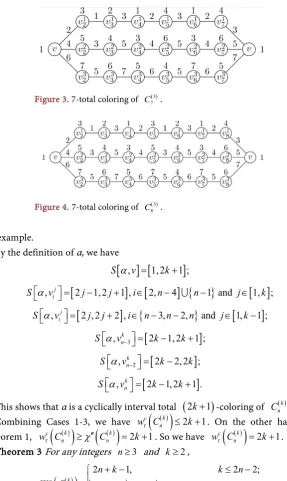
=2 1k− . SeeFigure 3 for an example.
By the definition of α, we have
[ ] [
, 1,2 1 ;]
S
α
v = k+[
]
[
]
{
}
[ ]
, j 2 1,2 1 , 2, 3 1 and 1, ;
i
S
α
v = j− j+ i∈ n− n− j∈ k[
]
{
}
[
]
, j 2 ,2 2 , 2, and 1, 1 ;
i
S
α
v = j j+ i∈ −n n j∈ k−[
]
2
, k 2 2,2 ;
n
S
α
v− = k− k[
]
, k 2 1,2 1 .
n
S
α
v = k− k+This shows that α is a cyclically interval total
(
2k+1)
-coloring of ( )k nC .
Case 3. n≡2 mod3
(
)
.Let
( )
v 1,α
=( )
[
]
[ ]
(
)
[
]
[ ]
(
)
[
]
[ ]
(
)
[ ]
2 1, 2, 1 , 1, and 1 mod3 ; 2 , 2, 1 , 1, and 0 mod3 ; 2 1, 2, 1 , 1, and 2 mod3 ; 2 2, and 1, ,
j i
j i n j k i
j i n j k i
v
j i n j k i
j i n j k
α
− ∈ − ∈ ≡ ∈ − ∈ ≡ = + ∈ − ∈ ≡ + = ∈ (
)
[
] [
]
[ ]
(
)
[
] [
]
[ ]
(
)
[
] [
]
[ ]
(
)
[ ]
[ ]
12 1, 1, 4 2, 1 , 1, and 2 mod3 ; 2 , 1, 4 2, 1 , 1, and 1 mod3 ; 2 1, 1, 4 2, 1 , 1, and 0 mod3 ; 2 2, 3 and 1, ;
2 1, and 1, ,
j j i i
j i n n n j k i
j i n n n j k i
v v j i n n n j k i
j i n j k
j i n j k
α + − ∈ − − − ∈ ≡ ∈ − − − ∈ ≡ = + ∈ − − − ∈ ≡ + = − ∈ + = ∈
where vnj+1=v1j =v for any j∈
[ ]
1,k . Recolor vnk−2,v v v vnk−1, ,nk nk−3 nk−2,v vnk−2 nk−1 and 1k k
n n
v v− as
α
( )
vnk−2 =2k−2,α
( )
vnk−1 =2k+1,α
( )
vnk =2k,(
v vnk3 nk2)
2 1k [image:4.595.261.495.68.165.2]DOI: 10.4236/ojdm.2018.83006 69 Open Journal of Discrete Mathematics
Figure 3. 7-total coloring of ( )3
7
[image:5.595.222.510.64.546.2]C .
Figure 4. 7-total coloring of ( )3
8
C .
an example.
By the definition of α, we have
[ ] [
, 1,2 1 ;]
S
α
v = k+[
]
[
]
{
}
[ ]
, j 2 1,2 1 , 2, 4 1 and 1, ;
i
S
α
v = j− j+ i∈ n− n− j∈ k[
] {
}
[
]
, j 2 ,2 2 , 3, 2, and 1, 1 ;
i
S
α
v = j j+ i∈ −n n− n j∈ k−[
]
3
, k 2 1,2 1 ;
n
S
α
v− = k− k+[
]
2
, k 2 2,2 ;
n
S
α
v− = k− k[
]
, k 2 1,2 1 .
n
S
α
v = k− k+This shows that α is a cyclically interval total
(
2k+1)
-coloring of ( )k nC .
Combining Cases 1-3, we have c
( )
( )k 2 1n
w Cτ ≤ k+ . On the other hand, by
Theorem 1, c
( )
( )k( )
( )k 2 1n n
w Cτ ≥
χ
′′ C = k+ . So we have w Cτc( )
n( )k =2k+1. Theorem 3 For any integers n≥3 and k≥2,( )
( )
(
22 2)
1, 2 1, 22 1.2; 2 2k c
n
n k k n
W C n k n k k n
n τ
+ − ≤ −
≥ − + + − ≥ −
−
Proof. Suppose that n≥3 and k≥2. We consider the following two cases.
Case 1. k≤2n−2.
Now we define a total
(
2n k+ −1)
-coloring α of the graph ( )k nC as follows: Let
( )
v 1,α
=( )
j 2 2,[ ]
2, and[ ]
1, ;i
v i j i n j k
α
= + − ∈ ∈(
v vi ij j1)
2i j 1,i[ ]
1, andn j[ ]
1, ,kα
+ = + − ∈ ∈DOI: 10.4236/ojdm.2018.83006 70 Open Journal of Discrete Mathematics
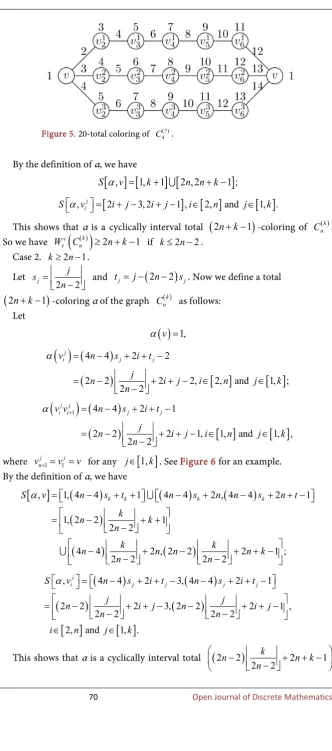
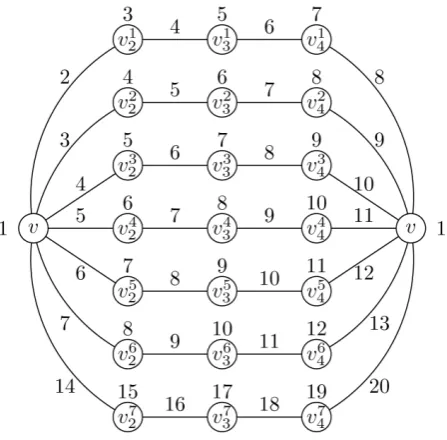
Figure 5. 20-total coloring of ( )7
4
C .
By the definition of α, we have
[ ] [
, 1, 1] [
2 ,2 1 ;]
S
α
v = k+ n n k+ −[
]
[ ]
[ ]
, j 2 3,2 1 , 2, and 1, .
i
S
α
v = i j+ − i j+ − i∈ n j∈ kThis shows that α is a cyclically interval total
(
2n k+ −1)
-coloring of ( )k nC .
So we have c
( )
( )k 2 1n
W Cτ ≥ n k+ − if k≤2n−2.
Case 2. k≥2n−1.
Let 2 2 j j s n
= − and tj= −j
(
2n−2)
sj. Now we define a total(
2n k+ −1)
-coloring α of the graph ( )k nC as follows: Let
( )
v 1,α
=( )
(
)
(
)
[ ]
[ ]
4 4 2 2
2 2 2 2, 2, and 1, ;
2 2
j
i j j
v n s i t
j
n i j i n j k
n
α = − + + −
= − + + − ∈ ∈ −
(
)
(
)
(
)
[ ]
[ ]
1 4 4 2 1
2 2 2 1, 1, and 1, ,
2 2
j j
i i j j
v v n s i t
j
n i j i n j k
n
α + = − + + −
= − + + − ∈ ∈
−
where vnj+1=v1j =v for any j∈
[ ]
1,k . See Figure 6 for an example. By the definition of α, we have[ ]
(
)
(
)
(
)
(
)
(
)
(
)
, 1, 4 4 1 4 4 2 , 4 4 2 1
1, 2 2 1
2 2
4 4 2 , 2 2 2 1 ;
2 2 2 2
k k k k
S v n s t n s n n s n t
k
n k
n
k k
n n n n k
n n
α = − + + − + − + + −
= − + + − − + − + + − − −
(
)
(
)
(
)
(
)
[ ]
[ ]
, 4 4 2 3, 4 4 2 1
2 2 2 3, 2 2 2 1 ,
2 2 2 2
2, and 1, .
j
i j j j j
S v n s i t n s i t
j j
n i j n i j
n n
i n j k
α = − + + − − + + − = − + + − − + + − − − ∈ ∈
This shows that α is a cyclically interval total
(
2 2)
2 1 2 2k
n n k
n
− + + −
−
DOI: 10.4236/ojdm.2018.83006 71 Open Journal of Discrete Mathematics
Figure 6. 20-total coloring of ( )7
4
C .
-coloring of ( )k n
C . So we have
( )
( )(
2 2)
2 1 2 2k c
n k
W C n n k
n
τ ≥ − − + + −
for any
2 1
k≥ n− .
3. Generalization
The one point of union C( )k of any k cycles
1 2
1, 2, ,
k k
n n n
C C C is the graph ob-tained by taking v as a common vertex such that any two distinct cycles i
i n
C
and jj n
C are edge disjoint and do not have any vertex in common except v. By the proof of Theorem 2, the following definitions are well defined.
Definition 4 A partial
(
i i, 1+)
-total coloring of Cn(
n≥3)
is a coloring( )
( ) { }
1[
]
:V Cn E Cn \ v i 1, 2i
α
→ − + such thatα
( )
v v1 2 =i ,α
( )
v vn 1 = +i 1and S
α
,vj is an interval for each j∈[ ]
2,n . A partial(
i i, 1+)
′-totalcolor-ing of Cn
(
n≥3)
is a coloringα
′:V C( )
n E C( ) {
n \ ,v v1 n}
→ −[
i 2, 1i+]
such that
α
′( )
v v1 2 =i,α
′( )
v vn 1 = +i 1 and Sα
′,vj is an interval for each[ ]
2,j∈ n .
Now we consider the cyclically interval total colorings of C( )k .
Theorem 5 For any integer k≥2, w Cc
( )
( )k 2k 1τ = + .
Proof. Suppose that graph C( )k is the one point of union of cycles
1 2
1, 2, ,
k k
n n n
C C C . Let
( ) {
i 1, , ,2 i}
i i i i
n n
V C = v v v , where i∈
[ ]
1,k . Without loss ofgenerality, we may assume that the common vertex v of the k cycles ii n
C is the first vertex in each cycle, i.e., 1 2
1 1 1k
v v v= = = = v . Now we define a total
(
2 1k+)
-coloring α of the graph C( )k as follows: Letα
( )
v =1,i ni C
α
be a partial(
2 ,2 1i i+)
-total coloring of iin
C for each i∈
[
1,k−1]
, and k nk Cα
be apartial
(
2 ,2 1k k+)
′-total coloring of kk nDOI: 10.4236/ojdm.2018.83006 72 Open Journal of Discrete Mathematics In this section, we consider the one point of union C( )k of k cycles with
dif-ferent length, show that C( )k ∈F, get the exact values of w Cτc
( )
( )k , and the further research maybe more interesting.Acknowledgements
We thank the editor and the referee for their valuable comments. The work was supported in part by the Natural Science Foundation of Hebei Province of China under Grant A2015106045, and in part by the Institute of Applied Mathematics of Shijiazhuang University.
References
[1] Vizing, V.G. (1965) Chromatic Index of Multigraphs. Doctoral Thesis, Novosibirsk. (In Russian)
[2] Behzad, M. (1965) Graphs and Their Chromatic Numbers. Ph.D. Thesis, Michigan State University.
[3] Petrosyan, P.A. (2007) Interval Total Colorings of Complete Bipartite Graphs. Pro-ceedings of the CSIT Conference, 84-85.
[4] Zhao, Y. and Su, S. (2017) Cyclically Interval Total Colorings of Cycles and Middle Graphs of Cycles. Open Journal of Discrete Mathematics, 7, 200-217.
https://doi.org/10.4236/ojdm.2017.74018