http://wrap.warwick.ac.uk
Original citation:
Ene, Alina and Vakilian, Ali (2014) Improved approximation algorithms for
degree-bounded network design problems with node connectivity requirements. In: 46th Annual
ACM Symposium on Theory of Computing, New York, USA, 31 May - 3 Jun 2014.
Published in: Proceedings of the 46th Annual ACM Symposium on Theory of Computing
pp. 754-763.
Permanent WRAP url:
http://wrap.warwick.ac.uk/64302
Copyright and reuse:
The Warwick Research Archive Portal (WRAP) makes this work by researchers of the
University of Warwick available open access under the following conditions. Copyright ©
and all moral rights to the version of the paper presented here belong to the individual
author(s) and/or other copyright owners. To the extent reasonable and practicable the
material made available in WRAP has been checked for eligibility before being made
available.
Copies of full items can be used for personal research or study, educational, or not-for
profit purposes without prior permission or charge. Provided that the authors, title and
full bibliographic details are credited, a hyperlink and/or URL is given for the original
metadata page and the content is not changed in any way.
Publisher’s statement:
"© ACM, 2014. This is the author's version of the work. It is posted here by permission of
ACM for your personal use. Not for redistribution. The definitive version was published in
Proceedings of the 46th Annual ACM Symposium on Theory of Computing, (2014)
http://doi.acm.org/10.1145/2591796.2591837
"
A note on versions:
The version presented here may differ from the published version or, version of record, if
you wish to cite this item you are advised to consult the publisher’s version. Please see
the ‘permanent WRAP url’ above for details on accessing the published version and note
that access may require a subscription.
Improved Approximation Algorithms for Degree-bounded
Network Design Problems with Node Connectivity
Requirements
Alina Ene
∗[email protected]
Ali Vakilian
†[email protected]
ABSTRACT
We considerdegree bounded network design problems with element and vertex connectivity requirements. In the degree boundedSurvivable Network Design(SNDP) problem, the in-put is an undirected graphG= (V, E) with weightsw(e) on the edges and degree boundsb(v) on the vertices, and con-nectivity requirements r(uv) for each pair uv of vertices. The goal is to select a minimum-weight subgraphH of G
that meets the connectivity requirements and it satisfies the degree bounds on the vertices: for each pairuvof vertices,H
hasr(uv) disjoint paths betweenuandv; additionally, each vertexvis incident to at mostb(v) edges inH. We give the first (O(1), O(1)·b(v)) bicriteria approximation algorithms for the degree-bounded SNDP problem with element con-nectivityrequirements and for several degree-boundedSNDP problems withvertex connectivity requirements. Our algo-rithms construct a subgraphHwhose weight is at mostO(1) times the optimal such that each vertexvis incident to at most O(1)·b(v) edges in H. We can also extend our ap-proach to network design problems in directed graphs with out-degree constraints to obtain (O(1), O(1)·b+(v)) bicrite-ria approximation.
1.
INTRODUCTION
Network design is an important area in combinatorial op-timization and approximation algorithms with several prac-tical applications. Many problems that arise in real-world networks can be modeled as follows: we are given a weighted
∗Center of Computational Intractability, Princeton
sity; Department of Computer Science and DIMAP, Univer-sity of Warwick. This work was done while the author was a student at University of Illinois at Urbana-Champaign. Supported in part by NSF grant CCF-1016684 and a Chi-rag Foundation graduate fellowship.
†CSAIL, MIT. This work was done while the author was
a student at University of Illinois at Urbana-Champaign. Supported in part by NSF grant CCF-1016684 and a Siebel Scholar award.
Permission to make digital or hard copies of all or part of this work for personal or classroom use is granted without fee provided that copies are not made or distributed for profit or commercial advantage and that copies bear this notice and the full citation on the first page. To copy otherwise, to republish, to post on servers or to redistribute to lists, requires prior specific permission and/or a fee.
STOC’14 New York City, New York USA
Copyright 20XX ACM X-XXXXX-XX-X/XX/XX ...$15.00.
graph and the goal is to choose a minimum weight subgraph that meets certain connectivity requirements between pairs of vertices. This framework captures well-studied problems such as the Minimum Spanning Tree, the Minimum Steiner
TreeandForest, and their generalizations to higher
connec-tivity. A central problem in this area is theSurvivable
Net-work Design(SNDP) problem in which the input is an
undi-rected edge-weighted graphG= (V, E) together with integer connectivity requirementsr(uv) for each pairuvof vertices. The objective is to select a minimum weight subgraphH of
Gthat satisfies the connectivity requirements for all pairs of vertices. In the edge connectivity SNDP (EC-SNDP) prob-lem, the subgraphH satisfies the connectivity requirements if, for each pairuvof vertices,Hcontainsr(uv)edge disjoint paths between u and v. In the vertex connectivity SNDP (VC-SNDP) problem, the paths are required to beinternally vertex disjoint. In addition to edge and vertex connectivity, another notion of connectivity that plays an important role in this area is the notion of element connectivity. In this setting, the vertices of the graph are partitioned into two sets, the set R of reliable vertices and the set W of unre-liable vertices. The vertices ofW and the edges are called elements. The element connectivity of a pairuvof vertices is the maximum number of element-disjoint paths fromuto
v; these paths do not share any unreliable nodes or edges, but they may share reliable nodes. In theelement connec-tivity SNDP (Elem-SNDP) problem, the paths are required to beelement disjoint.
Survivable network design problems have received consid-erable attention over the years and their study has led to the development of powerful algorithmic tools based on pri-mal dual and iterated rounding. In a celebrated paper [11], Jain gave a 2-approximation forEC-SNDPbased on iterated rounding, which was later extended to element connectiv-ity by Fleischer et al. [4]. Vertex connectivconnectiv-ity network de-sign problems such as theRootedk-Connectivityproblem,k
-Connected Subgraph, andVC-SNDPhave been studied
exten-sively over the past decade, leading to several breakthroughs in terms of both algorithms and hardness.
In this paper, we consider thedegree bounded variants of these problems in which we are additionally given a degree bound b(v) for each vertex v and the goal is to select a minimum weight subgraphH that satisfies the connectivity requirements and moreover the degree inH of each vertexv
the degree constraints and thus the problem is inapprox-imable. A long line of work has focused on designing bicri-teriaapproximation algorithms that construct a low weight spanning tree that violates the degree bounds by a small amount (see [9, 12, 13, 10, 19] and references thereof). This sequence of results culminated with the result of Singh and Lau [19] that settled the approximability of the problem; the algorithm of [19] constructs a spanning tree with weight at most the optimal that violates each degree constraint by at mostone, and it is based on iterated rounding.
In a subsequent breakthrough, Lau et al. [14] and Lau and Singh [16] extended the iterated rounding framework to degree boundedSNDP problems. An important contri-bution of the work of [14, 16] is the development of iter-ated rounding techniques that can simultaneously handle covering constraints corresponding to the SNDP problem andpackingconstraints corresponding to the degree bounds. These techniques have led to several powerful results for de-gree bounded network design problems; we refer the reader to the recent book of Lau, Ravi, and Singh [15] for an overview of these results. We remark that these results fo-cus almost entirely onedge connectivity problems, and the iterated rounding techniques of [14, 16] are not sufficient for the element and vertex connectivity settings. It was only recently that Nutov gave the first approximation algorithms for several degree bounded network design problems with element and vertex connectivity requirements [18]. We re-mark that these algorithms lead to degree violations that are exponential in the maximum requirementkof any pair. Shortly after, Fukunaga et al. [8, 7] significantly improved the best guarantees for these problems in which the degree violations are only polynomial ink.
1.1
Our techniques and contributions
The main question left open by the recent work on degree bounded network design problems with element and vertex connectivity requirements is whether we can simultaneously achieve a constant factor approximation in both the weight of the solution and the violation on the degrees. In this paper, we answer this question affirmatively for the degree boundedElem-SNDPproblem and several vertex connectiv-ity problems. Our work closes the gap between several edge connectivity problems and their element or vertex counter-parts by providing approximation algorithms that nearly match the best guarantees for the edge connectivity setting. As it is common in this area, we use iterated rounding tech-niques but our analyses are a departure from the approach of Fukunaga and Ravi [8] and Fukunaga, Nutov, and Ravi [7]. Our main technical insight is inspired by the work of Nutov [18] and it takes advantage of the special structure of theSNDP problem. More precisely, our algorithms con-sider the problem of covering biset functions that belong to a proper sub-class of skew bisupermodular functions; this sub-class is general enough to allow us to use the iterated rounding framework but it has additional structure that we exploit in the analysis. This is a departure from most of the previous work — including the work on edge connectivity problems — that solves the more general problem of cover-ing an arbitrary skew (bi)supermodular function; we defer the definitions related to biset functions to Section 2. We now give the precise statements of our main results.
In the following, we say that an algorithm achieves an (α, βb(v)+γ) bicriteria approximation if it always constructs
a solutionH whose weight is at mostαtimes the weight of the optimal solution such that the degree inHof each vertex
vis at mostβb(v) +γ.
Our first result is an (O(1), O(1)·b(v)) bicriteria approxi-mation for the degree boundedElem-SNDPproblem.
Theorem 1.1. There is a polynomial time approximation algorithm for the degree bounded Elem-SNDP problem in undirected graphs that achieves an (O(1), O(1)·b(v)) bicri-teria approximation.
By combining the result above with the reduction of Chuzhoy and Khanna [3], we obtain the following result for the degree boundedVC-SNDP.
Corollary 1.2. There is a polynomial time ap-proximation algorithm for the degree bounded VC-SNDP problem in undirected graphs that achieves an (O(k3logn), O(k3logn)·b(v))bicriteria approximation. Our next result is for thek-Connected Subgraphproblem. An undirected graph G is k-vertex-connected (or k-connected for short) if it has at least k+ 1 vertices and the removal of any set of k−1 vertices leaves a connected graph. In
the k-Connected Subgraph problem, we are given an
edge-weighted undirected graph G = (V, E) and the goal is to select a minimum-weight spanning subgraphH= (V, E0) of
Gsuch thatH isk-connected.
Thek-Connected Subgraphproblem has been studied
ac-tively over the last decade; we refer the reader to the work of Cheriyan of Vegh [2] for an overview of the approximation results that are known for the problem. In a recent break-through result, Cheriyan and Vegh [2] gave the first constant factor approximation for instances of the k-Connected
Sub-graphproblem in which the number of vertices nis not too
small compared tok. In this paper, we extend the result of [2] to the degree-bounded setting.
Theorem 1.3. There is a polynomial time approxima-tion algorithm for the degree bounded k-Connected
Sub-graph problem in undirected graphs that achieves an
(O(1), O(1)·b(v))bicriteria approximation when|V| ≥(k−
1)3−k.
TheRootedk-Connectivityproblem is a well-studied problem
that has several applications in combinatorial optimization. The input consists of an edge-weighted undirected graph
G = (V, E), an integer k, and a vertex r called the root. The goal is to select a minimum-weight spanning subgraph
H = (V, E0) of G such that H contains k internally ver-tex disjoint paths from rtov for each vertexv∈V − {r}. Frank and Tardos [6] gave an exact polynomial time algo-rithm for the directed version of the problem, which implies a 2-approximation for the undirected problem. In this pa-per, we give the first (O(1), O(1)·b(v)) approximation for the degree boundedRootedk-Connectivityproblem.
Theorem 1.4. There is a polynomial time approximation algorithm for the degree boundedRootedk-Connectivity prob-lem in undirected graphs that achieves an(O(1), O(1)·b(v)) bicriteria approximation.
Theorem 1.5. There is a polynomial time
approxi-mation algorithm for the degree bounded Rooted k
-Outconnectivityproblem in directed graphs that achieves an
(O(1), O(1)·b+(v))bicriteria approximation.
Table 1 summarizes our main results and the best approxi-mations for the problems we consider that were given in pre-vious work. We refer the reader to [8] for additional results and references on degree bounded network design problems with element and vertex connectivity requirements.
1.2
Related work
Survivable network design problems have been studied ex-tensively, and the edge connectivity problems have received the most attention. In a seminal paper [11], Jain gave a 2-approximation forEC-SNDPbased on iterated rounding.
TheEC-SNDPproblem can be viewed as acut covering
prob-lem. By Menger’s theorem, a subgraphH is a feasible so-lution for theEC-SNDPinstance if and only if, for any cut (S, V−S), there aref(S) = maxu∈S, v∈V−Sr(uv) edges ofH
that are crossing the cut. Thus the problem is equivalent to finding a minimum-weight subgraphH thatcovers this set functionf, that is,|δH(S)| ≥f(S) for each setS. Jain’s
al-gorithm is based on a natural LP relaxation for the problem of covering such a set functionf using a graph. He showed that, if the function f satisfies certain uncrossing proper-ties, any basic solution to the LP for coveringf has an edge variable whose fractional value is at least 1/2 (or there is an edge variable whose fractional value is zero, in which case we can simply remove the edge from the graph). The algorithm iteratively rounds up variables with fractional value at least 1/2 and resolves the LP for the residual problem until the resulting integral solution becomes feasible.
Fleischer et al. [4] generalized Jain’s result to the Elem-SNDPproblem. The element connectivity problem requires us to work with a functionf that is defined on pairs of sets (or bisets) instead of sets; we defer the precise definitions to Section 2. Fleischer et al. proved an analogous result on the structure of basic solutions to the LP relaxation for covering a functionf defined on pairs of sets. This result also crucially relies on certain uncrossing properties of the function f and it gives a 2-approximation for Elem-SNDP via iterated rounding.
Vertex connectivity problems such as the k-Connected
Subgraphproblem andVC-SNDPare considerably more
chal-lenging than their edge and element counterparts. One of the reasons for this discrepancy is that our current it-erated rounding techniques are unsuitable for this setting, since the uncrossing properties that play a key role for edge and element connectivity do not hold for vertex connectiv-ity. Aazami et al. [1] showed that there exist basic solutions for the natural LP relaxation for thek-Connected Subgraph problem in which each variable is at most Θ(1/√k). Most of the algorithmic results for vertex connectivity problems are obtained via reductions to element connectivity (or more generally, to the problem of covering a skew bisupermodu-lar function). Chuzhoy and Khanna [3] showed that the
VC-SNDPproblem can be reduced to solvingO(k3logn)
in-stances of theElem-SNDPproblem, wherenis the number of vertices in the graph; this reduction gives anO(k3logn) ap-proximation for the vertex connectivity problem. An inter-esting and challenging open question in this area is whether there is an algorithm forVC-SNDPthat achieves an approx-imation guarantee that depends only onk; the lognfactor is
unavoidable using the techniques of Chuzhoy and Khanna and new insights are needed to resolve this question. In particular, it seems fruitful to understand whether we can extend some of the iterated rounding techniques to the ver-tex connectivity setting, and we hope that the work in this paper will provide some insights in this direction.
The study ofdegree boundednetwork design problems has led to the development of new and powerful iterated round-ing techniques. Lau et al. [14] and Lau and Sround-ingh [16] ex-tended the iterated rounding approach of Jain to the setting in which we have mixed covering and packing constraints; the former are the cut covering constraints capturing the
EC-SNDP problem and the latter are degree bound
con-straints on the vertices. The breakthrough results of Lau et al. [14] and Lau and Singh [16] give a (2,2b(v) + 3) ap-proximation and a (2, b(v) +O(k)) approximation for the degree bounded EC-SNDPproblem. The former result was improved to (2,2b(v) + 2) by Louis and Vishnoi [17]. The techniques developed in these papers have been extended to a variety of problems with edge connectivity requirements; we refer the reader to [15] for more details. The element and vertex connectivity problems have proved to be more challenging with these techniques. The results of [14] and [16] can be extended to the element connectivity setting pro-vided that the degree bounds are only on theterminals1and removing this restriction required additional insights.
Recently, Nutov [18] considered several degree bounded network design problems with element and vertex connec-tivity requirements. Nutov showed that one can combine the augmentation framework of Williamson et al. [20] with iterated rounding techniques in order to construct a solu-tion that violates the degree bounds by a multiplicative factor that is exponential in k. Some of Nutov’s results include an (O(logk), O(2k)b(v)) approximation for
Elem-SNDPandRooted k-Connectivity, and an (O(k), O(2k)b(v)) approximation for k-Connected Subgraph; the latter result holds for all values of k. Shortly after, Fukunaga and Ravi [8] significantly improved the approximation guaran-tees for these problems; their algorithms are based on it-erated rounding and their analyses use a novel technical in-sight. The results of [8] include an (O(k), O(k)b(v)) approxi-mation forElem-SNDP, a (4,2b(v)+O(k)) approximation for Rooted k-Connectivity, a (2,2b+(v) +O(k)) approximation
for Rooted k-Outconnectivity, and an (O(k), b(v) +O(k2)) approximation for k-Connected Subgraph; the latter re-sult holds for all values of k. In joint work with Nutov [7], the authors of [8] strengthened their analysis and ob-tained an (O(1), O(1)b(v) +O(k)) approximation for Elem-SNDP. By combining the approach of Cheriyan and Vegh [2] for the k-Connected Subgraph problem without degree bounds with the algorithm of [8] for the degree bounded
Rooted k-Connectivity problem and the algorithm of [7]
for the degree bounded Elem-SNDP problem, one obtains an (O(1), O(1)b(v) +O(k)) approximation for the degree bounded k-Connected Subgraph problem when the number of nodes is at least (k−1)3−k.
2.
PRELIMINARIES
2.1
Bisets and biset functions
1A vertex is a terminal if it participates in a pair with
Problem Previous work This paper
Elem-SNDP (O(1), O(1)b(v) +O(k)) [7] (O(1), O(1)b(v))
k-Connected Subgraph(n= Ω(k3)) (O(1), O(1)b(v) +O(k)) [8, 7, 2] (O(1), O(1)b(v))
Rootedk-Connectivity (O(1), O(1)b(v) +O(k)) [8] (O(1), O(1)b(v))
VC-SNDP (O(k3logn), O(k3logn)(b(v) +O(k)) [7] (O(k3logn), O(k3logn)b(v))
[image:5.612.80.536.52.124.2]Rootedk-Outconnectivity (O(1), O(1)b+(v) +O(k)) [8, 7] (O(1), O(1)b+(v))
Figure 1: Summary of results.
In this section, we introduce some definitions and nota-tion; we follow the conventions used in previous work such as [18]. We start with some definitions related to bisets and biset functions.
Let V be a ground set. A biset A = (A, A0) is a pair of sets such that A ⊆ A0 ⊆V. We refer toA and A0 as the inner and outer parts of A, respectively. We refer to the setA0−A as the boundary ofAand we use bd(A) to denote the setA0−A. We define the intersection, union, and difference of two bisetsA= (A, A0) andB= (B, B0) as follows:A∩B= (A∩B, A0∩B0),A∪B= (A∪B, A0∪B0), A−B= (A−B0, A0−B).
We define a partial order ⊆on bisets as follows. IfA= (A, A0) and B= (B, B0) are two bisets, we haveA⊆ Bif and only ifA⊆B andA0⊆B0. IfA⊆B, we say thatAis contained inB. Note thatA∩B⊆A,A∩B⊆B,A−B⊆A, andB−A⊆B.
Two bisets A = (A, A0) and B = (B, B0) aredisjoint if
A∩B is empty; if A and B are not disjoint, they are in-tersecting. They arestrongly disjointifA0∩B andA∩B0
are both empty; if AandB are not strongly disjoint, they are overlapping. A family of bisets isbilaminar if, for any two bisetsAandBin the family, one of the following holds: A⊆B,B⊆A, or Aand Bare disjoint. A family of bisets is strongly bilaminar if, for any two bisets Aand Bin the family, one of the following holds: A⊆B,B⊆A, orAand Bare strongly disjoint.
Letf: 2V×2V →Zbe a function on bisets. The function
fisbisupermodular if, for any two bisetsAandB, we have
f(A) +f(B)≤f(A∩B) +f(A∪B).
The function isintersectingbisupermodular if the inequality above holds for any two bisetsAandBthat intersect. The function ispositively bisupermodular if the inequality above holds for any two bisets Aand Bsuch that f(A)> 0 and
f(B) > 0. The function is positively intersecting bisuper-modular if the inequality above holds for any two bisetsA andBsuch thatAandBintersect,f(A)>0, andf(B)>0. The functionf isbisubmodular if−fbisupermodular.
The functionfisbinegamodularif, for any two bisetsAand B, we have
f(A) +f(B)≤f(A−B) +f(B−A).
The functionf isbiposimodular if−fis binegamodular.
The functionf isskew bisupermodular if, for any two bisets AandB, we have
f(A)+f(B)≤max{f(A∩B)+f(A∪B), f(A−B)+f(B−A)}.
The function is positively skew bisupermodular if the in-equality holds for any two bisetsAandBsuch thatf(A)>0 andf(B)>0.
IfFis a set of undirected edges, we letδF(A) be the set of all edgese∈Fsuch thatehas one endpoint inAand the other endpoint inV −A0. We let χ(δF(A)) be the characteristic vector ofδF(A), i.e., the|F|-dimensional vector that has an entry for each edgee∈F that is equal to 1 ife∈δF(A) and 0 otherwise.
The following lemmas are well-known (see e.g., [15]).
Lemma 2.1. For any set F of edges and any positive
weight function w on F, the functionf(A) =w(δF(A)) is both bisubmodular and biposimodular. That is, for any two bisetsAandB, we have
• w(δF(A)) +w(δF(B))≥w(δF(A∩B)) +w(δF(A∪B)), and
• w(δF(A)) +w(δF(B))≥w(δF(A−B)) +w(δF(B−A)).
The proof of the following lemma is a straightforward case analysis.
Lemma 2.2. For any two bisetsAandB, we have
• |bd(A)|+|bd(B)|=|bd(A∩B)|+|bd(A∪B)|, and
• |bd(A)|+|bd(B)|=|bd(A−B)|+|bd(B−A)|+2|bd(A)∩ bd(B)|.
2.2
Problem definitions
In this section, we formally define the problems we con-sider in this paper. Using Menger’s theorem, we formu-late the problems as covering certain biset functions. Let
G= (V, E) be an undirected graph and letf: 2V×2V →
R be a biset function. We say that G covers f if we have
|δG(A)| ≥f(A) for each bisetA. When the vertex setV is clear from the context, we simply say that a setF of edges coversf, i.e., we have|δF(A)| ≥f(A) for each bisetA.
In the following, if H is an undirected graph andv is a vertex inH, we letδH(v) denote the set of edges ofH that
are incident tov. IfH is a directed graph andvis a vertex ofH, we letδH−(v) andδH+(v) denote the set of all arcs ofH
that are entering and leavingv, respectively.
Degree-bounded Elem-SNDP. Let G = (V, E) be an
undirected graph with weights w(e) on the edges and de-gree boundsb(v) on the nodes. The vertices ofV are parti-tioned into two sets, the setRof reliable vertices and the set
W of unreliable vertices. The vertices ofW and the edges are called elements. The element-connectivity of a pairuv
of nodes is the maximum number of element-disjoint paths fromutov; these paths do not share any unreliable nodes or edges, but they may share reliable nodes. Two verticesu
r(uv)-element-connected inH and|δH(v)| ≤b(v) for each
vertexv.
Let relt : 2V ×2V → Z+ be a biset function such that
relt(A) = maxu∈A,v∈V−A0r(uv) if bd(A)⊆W and relt(A) = 0 otherwise. Letfelt: 2V×2V →Zbe the biset function such that felt(A) = relt(A)− |bd(A)|. By Menger’s theorem, a subgraphH satisfies the element connectivity requirements if and only if|δH(A)| ≥felt(A) for each bisetA.
Lemma 2.3 (Fleischer et al. [4]). The functions relt andfelt are positively skew bisupermodular.
Degree-bounded VC-SNDP.LetG= (V, E) be an
undi-rected graph with weights w(e) on the edges and degree boundsb(v) on the nodes. The vertex-connectivity of a pair
uv of vertices is the maximum number of paths between
uandv that are internally vertex disjoint. Two verticesu
andvare`-vertex-connected if their vertex connectivity is at least`. In theDegree-bounded VC-SNDPproblem, in addi-tion to the graphG, we are given integer requirementsr(uv) for each pairuvof vertices. The goal is to select a minimum-weight subgraphH ofGsuch that each pairuv∈V ×V of vertices isr(uv)-vertex-connected inH and|δH(v)| ≤b(v)
for each vertexv.
Degree-bounded k-Connected Subgraph. Let G =
(V, E) be an undirected graph with weights w(e) on the edges and degree boundsb(v) on the vertices. A graph H
isk-vertex-connected if each pairuvof vertices isk vertex connected in H. In theDegree-bounded k-Connected
Sub-graphproblem, the goal is to select a minimum-weight
span-ning subgraph H = (V, E0) of G such thatH is k -vertex-connected and|δH(v)| ≤b(v) for each vertexv.
Let rsg : 2V ×2V →Z+ be the following biset function:
rsg(A) =kifA6=∅andA06=V, and rsg(A) = 0 otherwise. Let fsg : 2V ×2V → Z be the biset function such that
fsg(A) = rsg(A)− |bd(A)| for each biset A. By Menger’s theorem, a subgraphH isk-vertex-connected if and only if
|δH(A)| ≥fsg(A) for each bisetA.
Degree-bounded Rooted k-Connectivity. Let G =
(V, E) be an undirected graph with weights w(e) on the edges and degree boundsb(v) on the vertices. A vertexrisk -vertex-connected inHto each other vertex if, for any vertex
v∈V − {r}, the pairrvisk-vertex-connected inH. In the
Degree-bounded Rootedk-Connectivityproblem, we are given
a root vertexrand the goal is to select a minimum-weight subgraphH ofGsuch that the rootrisk-vertex-connected inHto every other vertex and|δH(v)| ≤b(v) for each vertex
v.
Let rrc : 2V ×2V → Z+ be a biset function such that
rrc(A) =kifA6=∅andr∈V−A0, and rrc(A) = 0 otherwise. Let frc : 2V ×2V → Z be the biset function such that
frc(A) = rrc(A)− |bd(A)|. By Menger’s theorem, the root is
k-vertex-connected inH to every other vertex if and only if
|δH(A)| ≥frc(A) for each bisetA. The following lemma is well-known, see for instance [5, 18].
Lemma 2.4 ([5]). The functions rrc and frc are
posi-tively intersecting bisupermodular.
Degree-bounded Rootedk-Outconnectivity. LetG=
(V, E) be a directed graph with weightsw(e) on the edges and out-degree boundsb+(v) on the vertices. In the
Degree-bounded Rootedk-Outconnectivity problem, we are given a
root vertex r and the goal is to select a minimum-weight subgraph H of G such that, for each vertexv ∈ V − {r}, there arekinternally vertex disjoint paths inH fromrtov
and, for each vertexv∈V,|δ+
H(v)| ≤b
+(v).
3.
MAIN TECHNICAL RESULTS AND
AP-PLICATIONS
In this section, we state our main technical results and their applications to the degree-bounded network design problems that we consider in this paper.
Our algorithms for network design problems in undirected graphs use the following abstract problem as a subroutine.
Definition 3.1 (Degree-bounded Residual Cover).
Let G = (V, E) be an undirected graph with weights
w(e) on the edges and degree bounds b(v) on the ver-tices. In the Degree-bounded Residual Cover problem, we are given a function f : 2V ×2V → Z satisfying
f(A) = r(A)− |bd(A)| − |δF(A)|for each bisetA, whereris a biset function andF ⊆E is a set of edges, and the goal is to select a minimum weight set F0 ⊆E−F of edges such that |δF0(A)| ≥ f(A) for each bisetA and |δF0(v)| ≤ b(v)
for each vertexv.
One of our main contributions is an iterated rounding algo-rithm for the Degree-bounded Residual Cover problem that achieves an (O(1), O(1)b(v)) approximation provided that the requirement function r satisfies a certain technical con-dition. The following theorem states our main result for undirected graphs. We prove the theorem in Section 4.
Theorem 3.2. Consider an instance of the
Degree-bounded Residual Coverproblem in which the functionf
sat-isfiesf(A) = r(A)− |bd(A)| − |δF(A)|, whereris an integer-valued biset function andF ⊆E is a set of edges. LetOPT
be the weight of an optimal solution for the instance. Sup-pose thatrandf satisfy the following conditions:
• For each biset(A, A0)and each vertexv∈A0−A, we haver((A, A0))≤r((A, A0−v)).
• The functionf is positively skew bisupermodular. Then there is a polynomial time iterated rounding algorithm that selects a set F0 ⊆E−F of edges such that w(F0) ≤
3OPTand|δF0(v)| ≤ |δF(v)|+ 6b(v) + 5for each vertexv.
We remark that the requirement function arising from in-stances of SNDP satisfies the technical conditions imposed by Theorem 3.2, since the requirement of a biset is the max-imum requirement of a pair separated by the biset and thus removing a vertex from the boundary of a biset cannot de-crease the requirement. We use this observation to show that Theorem 3.2 immediately implies an (O(1), O(1)b(v)) approximation forElem-SNDP.
In order to get a (O(1), O(1)b(v)) approximation for the
Elem-SNDP problem, we apply Theorem 3.2 with F = ∅,
f =felt, and r = relt, wherefelt and relt are the functions
defined in Section 2.2. It is straightforward to verify that reltsatisfies the first condition of the theorem. Additionally,
felt satisfies the second condition by Lemma 2.3. Therefore
we have the following result.
Theorem 3.3. There is a polynomial time(3,6b(v) + 5)
We can also prove an analogue of Theorem 3.2 for directed graphs; we defer this result to a longer version of this paper. As a corollary, we obtain the following result.
Theorem 3.4. There is a polynomial time (3,6b+(v) + 3) approximation for the Degree-bounded Rooted k
-Outconnectivityproblem in directed graphs.
We can reduce the degree-bounded Rooted k-Connectivity problem in undirected graphs to the degree-boundedRooted
k-Outconnectivityproblem in directed graphs as follows. We
first make the graph directed by bidirecting each edge; more precisely, we replace each undirected edgeuvby two directed edges,uv* andvu*, and we setw(uv*) =w(vu*) =w(uv). For each vertexv, we set b+(v) = b(v). Note that the
result-ing instance of the degree-boundedRootedk-Outconnectivity problem has a solution of weight at most 2OPT that sat-isfies the out-degree constraints, where OPTis the weight of the optimal solution for the degree-bounded Rooted k
-Connectivity instance. Thus, using Theorem 3.4, we can
find in polynomial time a setF of directed edges such that
w(F) ≤ 6OPT and |δF+(v)| ≤ 6b+(v) + 3 for each vertex
v. LetF0 be the set of undirected edges corresponding to
F. We can show that F0 is a (6,7b(v) + 3)-approximate solution to the initialRootedk-Connectivityinstance as fol-lows. The setF0has weight at most 6OPTand itk-connects each vertex to the root. Thus it suffices to show that each vertex v has degree at most 7b(v) + 3 in F0. We have
|δF0(v)| ≤ |δ−
F(v)|+|δ
+
F(v)| ≤ |δ
−
F(v)|+ 6b(v) + 3. It is
well-known that, in an inclusion-minimal solution to theRooted
k-Outconnectivityproblem, all in-degrees are at mostk(each
vertex other than the root has in-degree exactlyk). Thus we have|δ−F(v)| ≤k≤b(v) and hence|δF0(v)| ≤7b(v) + 3.
Theorem 3.5. There is a polynomial time(6,7b(v) + 3) approximation for theDegree-bounded Rootedk-Connectivity problem in undirected graphs.
Now we turn our attention to the k-Connected Subgraph problem in undirected graphs. In the following, we show how to extend the algorithm of Cheriyan and Vegh [2] for
the k-Connected Subgraph problem to the degree-bounded
setting. We start with a high-level overview of the algo-rithm of [2].
Recall from Section 2.2 that the k-Connected Subgraph problem is equivalent to covering a biset function fsg
sat-isfying fsg(A) = rsg(A)− |bd(A)| for each biset A. The requirement rsg(A) of a biset Ais equal tok ifAis a non-trivial biset (A 6= ∅ and A0 6= V) and it is equal to zero otherwise. If the functionfsg was positively skew
bisuper-modular, we could use the algorithm of Fleischer et al. [4] to construct a 2-approximate cover of the function. Unfortu-nately, the functionfsg is not positively skew
bisupermod-ular (since rsg is not positively skew bisupermodular). The
key insight in [2] is that, if the number of nodes is large2
compared to k, we can partially cover some of the bisets so that the residual function becomes positively skew bisu-permodular. More precisely, Cheriyan and Vegh show that we can find a set F ⊆ E of edges such that the function
g(A) = rsg(A)− |bd(A)| − |δF(A)|is positively skew bisu-permodular. Once we haveF, we can use the algorithm of
2
Cheriyan and Vegh [2] showed that n ≥ k3(k−1) +k
suffices. Fukunaga et al. gave a simple proof that shows thatn≥(k−1)3−ksuffices [7].
Fleischer et al. [4] to select a setF0⊆E−F of edges that cover the residual function g. The setF∪F0 is a feasible cover of fsg. The preprocessing phase that constructs the
setF of edges proceeds in two steps which we now sketch. In the first step, we pick an arbitrary subsetR1consisting
ofkvertices. Once we haveR1, we construct an instance of
the Rooted k-Outconnectivity problem as follows. We start
with our (undirected) graphGand we make it directed by bidirecting each of its edges; each undirected edge is replaced by two directed edges, one in each direction, each of which has the same weight as the original edge. Then we introduce a root vertexr1 and we add a directed edge fromr1 to each
vertex in R1; these edges receive weight zero. This gives
us an instance of theRootedk-Outconnectivityproblem with root r1, and we use an algorithm for the problem — such
as the algorithm of Frank and Tardos [6] — to find a set
F1of directed edges that providekinternally vertex disjoint
paths fromr1 to each vertex inV; the set F1 corresponds
to a setF10⊆Ein the undirected graphG.
Once we have the setF10, we proceed to the second step.
Let R2 be an appropriately chosen set consisting of k
ver-tices; we will describe how to choose R2 later. Now we
construct a second instance of theRootedk-Outconnectivity problem as follows. We start with the graphG. We set the weight of each edge inF10 to zero (the weights of the edges
inE−F10 remain unchanged). Finally, we make the graph
directed by bidirecting each of the edges. We add a rootr2
and a zero-weight edge from r2 to each vertex in R2. We
solve the resulting instance of theRootedk-Outconnectivity problem and find a setF2 of directed edges that providek
internally vertex disjoint paths fromr2to each vertex inV;
the set F2 corresponds to a setF20 ⊆E−F10 of undirected
edges.
If the number of nodes is large, for any setR1ofkvertices
and any solution F1 for the firstRooted k-Outconnectivity
instance, we can find in polynomial time a setR2 ofk
ver-tices satisfying the following key property. Consider the secondRootedk-Outconnectivity instance that we construct based on F1, and let F2 be a solution for this instance.
Let F10 and F
0
2 be the undirected edges corresponding to
F1 and F2, respectively. Let g be the function such that
g(A) = rsg(A)−|bd(A)|−|δF0
1∪F20(A)|. Then the functiongis
positively skew bisupermodular. The second preprocessing step uses such a setR2. This completes our overview of the
preprocessing phase and thus of the algorithm of Cheriyan and Vegh.
Now we turn our attention to the degree bounded k
-Connected Subgraph problem. Consider an instance of the
degree bounded problem in which the number of nodes in the graph is at least (k−1)3−k. Let F∗
be an optimal solution for the instance and let OPTbe its weight. The algorithm follows the high level outline described above. We first perform the following preprocessing phase. We proceed in two steps.
In the first step, we pick an arbitrary setR1consisting of
k vertices and we define the first instance of theRooted k
-Outconnectivity problem as before. Additionally, we assign
out-degree bounds to the vertices as follows: b+(v) = b(v) for each vertex v. Using the algorithm in Theorem 3.4, we construct a solutionF1 for the resulting instance of the
degree-bounded Rootedk-Outconnectivity problem. Let F10
be the set of undirected edges corresponding toF1. We have
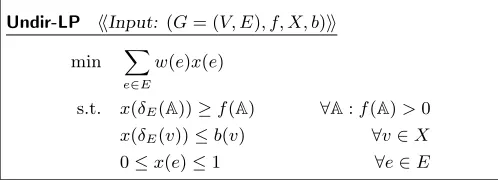
Undir-LP hhInput: (G= (V, E), f, X, b)ii
min X
e∈E
w(e)x(e)
s.t. x(δE(A))≥f(A) ∀A:f(A)>0
x(δE(v))≤b(v) ∀v∈X
[image:8.612.54.303.58.148.2]0≤x(e)≤1 ∀e∈E
Figure 2: LP relaxation for theDegree-bounded
Resid-ual Cover problem in undirected graphs.
vertexv.
In the second step, we pick a set R2 consisting ofk
ver-tices; we constructR2 using the approach of Cheriyan and
Vegh [2] mentioned above. We define the second instance of
theRooted k-Outconnectivity problem as before.
Addition-ally, we assign out-degree bounds to the vertices as follows:
b+(v) =b(v) for each vertexv. Using the algorithm in
Theo-rem 3.4, we construct a solutionF2for the resulting instance
of the degree-bounded Rooted k-Outconnectivity problem. LetF20 be the set of undirected edges corresponding toF2.
We havew(F20)≤w(F2)≤6OPTand|δF20(v)| ≤7b(v) + 3
for each vertexv. This completes the preprocessing phase. Let g be the biset function such that g(A) = rsg(A)−
|bd(A)| − |δF10∪F20(A)|for each bisetA. Note thatF
∗−
(F10∪
F20) coversg. As mentioned above, we chooseR2 in such a
way that the functiongis positively skew bisupermodular. Additionally, it is straightforward to verify that rsgsatisfies
the first condition of Theorem 3.2. Thus we can apply The-orem 3.2 with F = F10 ∪F20, f = g, r = rsg, and degree
bounds given bybin order to get a coverF30 ofg. We have
w(F30) ≤ 3OPT and |δF0
3(v)| ≤ |δF10∪F20(v)|+ 6b(v) + 5 ≤
2(7b(v) + 3) + 6b(v) + 5 for each vertexv. Our final solution isF=F10∪F20∪F30.
It follows from the discussion above thatF is a feasible cover offsg of weight at most 15OPT. Moreover, we have |δF(v)| ≤4(7b(v) + 3) + 6b(v) + 5 for each vertexv.
Theorem 3.6. There is a polynomial time(15,34b(v) + 17)approximation for the Degree-boundedk-Connected
Sub-graphproblem in undirected graphs with at least(k−1)3−k
nodes.
4.
ITERATED ROUNDING ALGORITHM
FOR UNDIRECTED GRAPHS
In this section, we prove Theorem 3.2. Our algorithm for
the Degree-bounded Residual Cover problem is based on a
standard iterated rounding approach; we give the algorithm in Figure 3. Our main contribution is the following key theorem that shows that the algorithm terminates with a feasible solution.
Theorem 4.1. Consider an iteration of Undir-algo. Let
G0= (V, E0)be the residual subgraph at the beginning of this iteration. LetF0 be the set of edges selected in the previous iterations. Let X0 be the set of vertices that have degree bounds, and letb0 :X0 →Rbe the degree bounds on X0 at the beginning of this iteration. Letf0: 2V ×2V →Zbe the function satisfyingf0(A) = r(A)− |A0−A| − |δF∪F0(A)|for
Undir-Algo hhInput: hG= (V, E),r, F, X, biii
LetE0←E−F,F0← ∅,X0←X
Letb0(v)←b(v) for eachv∈X
WhileE0 is non-empty Letf0: 2V ×2V →
Zsuch that
f0(A) = r(A)− |bd(A)| − |δF∪F0(A)|for each bisetA
Compute an optimal basic solution toUndir-LP for the input (G0= (V, E0), f0, X0, b0)
If there is an edgee∈E0such thatx(e) = 0
E0←E0− {e} hhRemoveefrom the graphii
If there is an edgee=uv∈E0 such thatx(e)≥1/3
F0←F0∪ {e} hhAddeto the solutionii
E0←E0− {e} hhRemoveefrom the graphii
Ifu∈X0
b0(u)←b0(u)−x(e) Ifv∈X0
b0(v)←b0(v)−x(e) Else
Letv∈X0be a vertex such that
|δE0(v)| ≤ |δF(v)|+ 3b(v) + 5
X0←X0− {v} hhDrop degree bound onvii
ReturnF0
Figure 3: Iterated rounding algorithm for the
Degree-bounded Residual Coverproblem in undirected graphs.
each biset A. If x is a basic solution to Undir-LP for the input(G0, f0, X0, b0), one of the following holds:
• There is an edgee∈E0 such thatx(e) = 0.
• There is an edgee∈E0 such thatx(e)≥1/3.
• There is a vertexv∈X0 such that|δE0(v)| ≤ |δF(v)|+
3b(v) + 5.
Our proof of Theorem 4.1 is inspired by the approach of Nutov [18]. The proof of the theorem is quite technical and we omit it from this extended abstract; at the end of this section, we give a simpler proof that shows a weaker version of the theorem with larger constants. We remark that the weaker theorem suffices to show (O(1), O(1)b(v)) approxi-mations for all the problems we consider.
Using Theorem 4.1, we can analyze the iterated rounding algorithm as follows. It follows that the algorithm termi-nates and it outputs a feasible cover of f. Additionally, since each edge added to the solution satisfiesx(e)≥1/3, it is straightforward to verify that the weight of the solution is at most 3OPT. Thus it suffices to upper bound the degree of each vertex in the final solution. The proof of the follow-ing lemma is straightforward and it is based on the fact that each edge that is added to the solution satisfiesx(e)≥1/3.
Lemma 4.2. Consider an iteration of Undir-algo. LetF0
be the set of edges selected in the previous iterations, let
X0 be the set of vertices that have degree bounds, and let
the iteration. For each vertexv ∈ X0, we have|δF0(v)| ≤
3(b(v)−b0(v)),whereb(v) is the initial degree bound onv.
Using Theorem 4.1 and a straightforward inductive argu-ment, we get the following theorem.
Theorem 4.3. Let F0 be the solution constructed by
Undir-algo. The setF0 satisfies the following:
• |δF0(A)| ≥f(A) for each bisetA. • The total weight ofF0 is at most3OPT.
• For each vertexv,|δF0(v)| ≤ |δF(v)|+ 6b(v) + 5.
Theorem 3.2 is an immediate corollary of Theorem 4.3. Thus it only remains to prove Theorem 4.1. In the following sub-section, we prove a weaker version of the theorem that high-lights the main ideas behind the proof.
4.1
A weaker version of Theorem 4.1
In this section, we prove the following weaker version of Theorem 4.1. We consider the variant of Undir-algo that removes the degree bound constraint of a vertexv if
|δE0(v)| ≤4|δF(v)|+ 12b(v) + 12. We refer to the modified
algorithm as Undir-algo-weaker. The two algorithms only differ in the body of the Else statement.
Theorem 4.4. Consider an iteration of
Undir-algo-weaker. Let G0 = (V, E0) be the residual subgraph at the
beginning of this iteration. LetF0be the set of edges selected in the previous iterations. LetX0 be the set of vertices that have degree bounds, and letb0:X0→Rbe the degree bounds onX0at the beginning of this iteration. Letf0: 2V×2V →Z be the function satisfyingf0(A) = r(A)−|A0−A|−|δF∪F0(A)|
for each bisetA. Ifxis a basic solution toUndir-LPfor the input(G0, f0, X0, b0), one of the following holds:
• There is an edgee∈E0 such thatx(e) = 0.
• There is an edgee∈E0 such thatx(e)≥1/3.
• There is a vertexv∈X0such that|δE0(v)| ≤4|δF(v)|+
12b(v) + 12.
We devote the rest of this section to the proof of Theo-rem 4.4. We start with the following theoTheo-rem whose proof is based on a standard uncrossing argument [4].
Theorem 4.5 (Corollary 4.6 in [4]). Letxbe a ba-sic solution to Undir-LPfor an input (G= (V, E), f, X, b). Iff is positively skew bisupermodular, there is a collection
Lof bisets and a set C ⊆X of vertices with the following properties:
• For each bisetA∈ L,x(δE(A)) =f(A)>0.
• For each vertexv∈C,x(δE(v)) =b(v).
• The familyLis strongly bilaminar.
• |L|+|C|=|E|.
• The vectors{χ(δE(A))|A∈ L} ∪ {χ(δE(v))|v∈C}
are linearly independent.
Note that the functionf0 is positively skew bisupermodu-lar. To see this, recall thatf0(A) =f(A)− |δF0(A)|for each
bisetA, wherefis the input function for theDegree-bounded
Residual Coverinstance. As stated in Theorem 3.2, the
func-tionf is positively skew bisupermodular. By Lemma 2.1, the function|δF0(·)|is bisubmodular and biposimodular.
Thus we can apply Theorem 4.5 to x and (G0 = (V, E0), f0, X0, b0) in order to get a collection L of tight bisets and a set C of tight vertices. (A biset A is tight
if x(δE0(A)) = f0(A), and a vertex v ∈ X0 is tight if
x(δE0(v)) =b0(v).)
We assume for contradiction that we have 0< x(e)<1/3 for each edge e ∈ E0 and |δE0(v)| > 4|δF(v)|+ 12b(v) +
12 for each vertex v ∈ X0. We use L and C to derive a contradiction as follows. Note that we may assume thatLis non-empty, since otherwise we already have a contradiction. We have two tokens for each edge in E0; the total number of tokens is therefore 2|E0|. Our goal is to show that we can rearrange the tokens so that each biset in L gets at least 2 tokens, each vertex in Cgets at least 2 tokens, and each maximal biset in Lgets at least 4 tokens. If we can reassign the tokens so that these conditions are satisfied, it would then follow that the number of tokens is greater than 2(|L|+|C|) = 2|E0|, which is a contradiction.
We view L as a rooted forest. A biset B is a child of a biset A 6= B if B ⊆ A and there does not exist a biset C ∈ L − {A,B} such that B ⊆ C ⊆ A. A biset B is a descendant of a biset A if B ⊆ A (note that a biset is a descendant of itself); Bis a proper descendant of AifB is a descendant of Aand B 6=A. A biset is a leaf if it does not have any proper descendants and it is a root if it is a maximal biset of L. (A bisetA is a maximal biset ofLif there does not exist a bisetB∈ L − {A}such thatA⊆B.)
We will need the following standard lemma, which follows from the fact that the vectors {χ(δE0(S))|S∈ L}are
lin-early independent,f0 is integer valued, and 0< x(e)<1/3 for each edgee∈E0.
Lemma 4.6. LetAbe a biset that has a unique childBin
L. Then one of the following holds:
• δE0(A)−δE0(B)orδE0(B)−δE0(A)has at least4edges. • δE0(A)−δE0(B) and δE0(B)−δE0(A) are both
non-empty.
Now we turn our attention to the token argument. We start by assigning the tokens toL ∪C as follows. For each biset A∈ L, let in(A) be the set of all edgesewith one endpoint inAand the other inA0. SinceLis strongly bilaminar, for each edgee∈E0 there is at most oneminimal bisetA∈ L such thate∈in(A). Additionally, for each vertexv, there is at most oneminimal biset of Lthat containsvin its inner part.
Initial token assignment. Each edge e = uv ∈ E0 has
two tokenste,uandte,v, one for each endpoint. The edgee
distributes its tokens toL ∪Cas follows.
(Rule A) Ifu∈C, the tokente,u is assigned tou(similarly
for the casev∈C).
(Rule B) Ifu /∈C, the tokente,uis assigned to the minimal
biset A= (A, A0) ∈ Lsuch that e ∈δE0(A) and
u ∈ A. If there does not exist such a biset, the tokente,u is assigned to the minimal bisetBsuch thate∈in(B) (similarly for the casev /∈C).
It follows from the discussion above that each token is as-signed to at most one member of L ∪C. We will reassign some of the tokens in two stages. We will need the following key definition.
Definition 4.7. A bisetA∈ Lisrelevant for a vertex
v∈V if all of the following conditions hold:
• The vertex v is on the boundary of Abut not on the boundary of the child ofA.
Lemma 4.8. Let vbe a vertex in V. IfLis a bilaminar family, the relevant bisets ofvare pairwise disjoint.
Proof: LetA1 andA2 be two bisets inLthat are relevant
bisets forv. Suppose for contradiction thatA1 and A2 are
not disjoint. Since L is bilaminar, we have A1 ⊆ A2 or
A2 ⊆A1. Without loss of generality, assumeA2 ⊆A1. Let
B1be the unique child ofA1inL. Suppose for contradiction
thatA2⊆B1. SinceA2⊆B1⊆A1andvis on the boundary
of bothA1 and A2, it follows thatvis on the boundary of
B1. But this contradicts the fact thatA1 is a relevant biset
forv. Therefore A2 6⊆B1. SinceLis bilaminar, eitherA2
andB1 are disjoint orB1 ⊆A2. IfB1 andA2 are disjoint,
A1 has at least two children, which contradicts the fact that
A1 is relevant forv(each relevant biset has only one child).
Therefore we must haveB1 ⊆A2 ⊆A1. SinceB1 is a child
ofA1andA16=A2, we must haveB1=A2. But this cannot
happen, sincevis on the boundary ofA2 butvis not on the
boundary ofB1. 2
Our token argument relies on the following key theorem that we prove at the end of the section.
Theorem 4.9. Let v be a vertex in C. Let ρ(v) be the
number of bisets in L that are relevant for v. We have 2ρ(v) + 6≤ |δE0(v)|.
Once we have Theorem 4.9, we can rearrange the tokens as follows.
First token reassignment. After the initial token
assign-ment, each vertex inC receives |δE0(v)| tokens. For each
vertexv∈C, we reassign some of the tokens ofvas follows. For each bisetA ∈ L that is relevant for v, the vertex v gives two tokens toA. Additionally,vgives 4 tokens to the minimal bisetA= (A, A0)∈ Lsuch thatv∈A.
Note that each vertexvgives 2ρ(v) + 4 tokens, whereρ(v) is the number of bisets in L that are relevant for v. By Theorem 4.9, each vertexv ∈ C has at least 2 tokens left over after the first token reassignment.
Second token reassignment. Now we consider the bisets
inL. Each biset inLhas some tokens that were assigned by the initial token assignment and the first token reassignment. We show that we can rearrange these tokens so that each biset inLhas at least two tokens and each maximal biset in
Lhas at least 4 tokens.
Theorem 4.10. We can rearrange the tokens of the bisets
in L such that each biset gets at least 2 tokens and each maximal biset inLgets at least4tokens.
Proof Sketch: Recall that we view Las a rooted forest.
We consider each tree ofLseparately. Let T be a tree of
L. We prove the theorem by induction on the height of the treeT.
Let A= (A, A0) be a leaf biset ofT. Since x(δE0(A)) =
f0(A)≥1 andx(e)<1/3 for each edge, we have|δE0(A)| ≥
4. Consider an edgee∈δE0(A) and letvbe the endpoint of
ethat is in A. Ifv∈C,Areceives 4 tokens fromv in the first token reassignment. Otherwise, A receives the token
te,vin the initial token assignment (by (Rule B)). It follows
thatAhas at least 4 tokens.
LetA= (A, A0) be a non-leaf biset ofT. For each child B of A, it follows by induction that we can rearrange the tokens in the subtree rooted at Bin such a way that each biset in the subtree gets at least 2 tokens andBgets at least 4 tokens. A childBofAhas 4 tokens and it gives 2 of them to A. IfA has at least two children, it receives at least 4 tokens from its children and we are done.
Therefore we may assume thatA has only one child B. The bisetAreceives 2 tokens fromBand therefore it suffices to show thatAreceived 2 other tokens. In the following, we show thatAreceived 2 additional tokens in the initial token assignment and the first token reassignment.
LetE1=δE0(A)−δE0(B) andE2=δE0(B)−δE0(A). By
Lemma 4.6, one of the following holds: |E1| ≥4,|E2| ≥4,
orE1andE2are both non-empty. We consider each of these
cases in turn.
Suppose that|E1| ≥4. Consider an edgee∈E1 and let
ube the endpoint ofethat is in A. Ifu∈C,Areceives 4 tokens fromuin the first token reassignment, sinceAis the minimal biset ofLthat containsuin its inner part. Ifu /∈C, Areceives the tokente,uin the initial token assignment (by
(Rule B)). ThusAreceives at least 4 additional tokens. Suppose that|E2| ≥4. Consider an edgee∈E2 and let
v be the endpoint of e that is in A0−B0. Note thatA is the minimal biset such that e∈in(A). SinceLis strongly bilaminar and B is the unique child of A, one can verify that there does not exist a bisetS= (S, S0)∈ L such that
e ∈ δE0(S) and v ∈ S. Thus, if v /∈ C, A receives the
token te,v in the initial token assignment (by (Rule B)). If
v∈C,Areceives at least 2 tokens fromvin the first token reassignment: ifv is on the boundary ofA,Ais a relevant biset forv; otherwise,Ais the minimal biset such thatv∈A. ThereforeAreceives at least 2 additional tokens.
Finally, suppose thatE1andE2are both non-empty. Let
e be an edge in E1 and let u be the endpoint of e that is
in A. If u ∈ C, A receives 4 tokens from u in the first token reassignment, sinceAis the minimal biset of Lthat containsuin its inner part. Ifu /∈C,Areceives the token
te,u in the initial token assignment (by (Rule B)). Let e0
be an edge in E2 and letvbe the endpoint ofe0 that is in
A0−B0. Ifv ∈ C, A receives at least 2 tokens fromv in the first token reassignment: if vis on the boundary ofA, Ais a relevant biset forv; otherwise,Ais the minimal biset such thatv∈A. Ifv /∈C,Areceives the tokente0,v in the
initial token assignment (by (Rule B)); this follows from the fact that there does not exist a bisetS = (S, S0) such that
e0∈δE0(S) andv∈S. ThusAreceives at least 2 additional
tokens. 2
Thus, after reassigning the tokens, each vertex in C has at least 2 tokens, each biset in Lhas at least 2 tokens, and each maximal biset in Lhas at least 4 tokens. SinceL is non-empty, the total number of tokens is strictly greater than 2(|L|+|C|) = 2|E0|, which is a contradiction. Thus it only remains to prove Theorem 4.9; we give the proof in the remainder of the section.
Proof of Theorem 4.9. Consider a vertexv∈C. We
par-tition the bisets that are relevant forvinto two categories: (i) bisets Asuch that |in(A)∩δE0(v)| ≥ 4, and (ii) bisets
Asuch that |in(A)∩δE0(v)|< 4. Letρ1(v) and ρ2(v)
Proposition 4.11. Letvbe a vertex inC. Let ρ1(v)be
the number of bisets A such that A is relevant for v and
|in(A)∩δE0(v)| ≥4. Thenρ1(v)≤ |δE0(v)|/4.
Proof: By Lemma 4.8, any two bisets that are
rele-vant for v are disjoint. Therefore the edge sets {in(A)∩
δE0(v)|Ais relevant forv}are pairwise disjoint. Thus we
haveρ1(v)≤ |δE0(v)|/4. 2
Lemma 4.12. Let v be a vertex in C. Let ρ2(v) be the
number of bisetsAsuch thatAis relevant forvand|in(A)∩
δE0(v)| < 4. Then ρ2(v) ≤ |δF∪F0(v)| and thus ρ2(v) ≤
(|δE0(v)| −12)/4.
Note that Theorem 4.9 follows from Proposition 4.11 and Lemma 4.12. We devote the rest of this section to the proof of Lemma 4.12.
A key insight is that, ifAis a biset in the second category, then in(A) contains an edge ofδF∪F0(v). More precisely, we
have the following lemma. We remark that this is the only place where we use the fact that the requirement function r satisfies r((A, A0))≤r(A, A0−v) for each biset (A, A0) and each vertexv∈A0−A.
Lemma 4.13. Letv be a vertex and letA= (A, A0) be a tight biset that contains v on its boundary. If δF∪F0(v)∩
in(A) is empty,|δE0(v)∩in(A)| ≥4.
Proof Sketch: Let B = (A, A0 − {v}). We claim that
x(δE0(B))−x(δE0(A))≥1. To see this, note that we have
x(δE0(B))−x(δE0(A))≥f0(B)−f0(A), sincexis feasible and
Ais tight. One can verify thatf0(B)−f0(A)≥1 as follows. Recall thatf0(S) =r(S)− |bd(S)| − |δF∪F0(S)|for each biset
S. We haver(B)≥r(A) (see the statement of Theorem 3.2). Additionally,|bd(B)|=|bd(A)| −1. Therefore
f0(B)−f0(A)≥1 +|δF∪F0(A)| − |δF∪F0(B)|.
Since δF∪F0(v) ∩ in(A) is empty, we have δF∪F0(A) =
δF∪F0(B) and thusf0(B)−f0(A)≥1.
Sincex(δE0(B))−x(δE0(A))≥1 andx(e)<1/3 for each
edgee∈E0, one can verify that|δE0(B)−δE0(A)| ≥4. Since
δE0(B)−δE0(A)⊆δE0(v)∩in(A), the lemma follows. 2
Proof of Lemma 4.12:By Lemma 4.13, for each bisetAin
the second category, in(A)∩δF∪F0(v) is non-empty. Since the
bisets in the second category are disjoint (by Lemma 4.8), we haveρ2(v)≤ |δF∪F0(v)|.
To complete the proof, we note that|δF∪F0(v)| ≤ |δF(v)|+
3b(v) ≤(|δE0(v)| −12)/4: since Undir-algo-weaker only
se-lects edges whose fractional value is at least 1/3, we have
|δF0(v)| ≤ 3b(v); additionally, by our assumption on the
vertices ofC, we have|δE0(v)|>4|δF(v)|+ 12b(v) + 12. 2
Acknowledgements
The authors thank Chandra Chekuri and Andreas Wiese for their comments on the exposition.
5.
REFERENCES
[1] A. Aazami, J. Cheriyan, and B. Laekhanukit. A bad example for the iterative rounding method for mincost k-connected spanning subgraphs.Discrete
Optimization, 2012.
[2] J. Cheriyan and L. V´egh. Approximating minimum-cost k-node connected subgraphs via independence-free graphs. InProc. of IEEE FOCS, pages 30–39, 2013.
[3] J. Chuzhoy and S. Khanna. An
O(k3logn)-approximation algorithm for
vertex-connectivity survivable network design.Theory of Computing, 8:401–413, 2012.
[4] L. Fleischer, K. Jain, and D. P Williamson. Iterative rounding 2-approximation algorithms for
minimum-cost vertex connectivity problems.Journal of Computer and System Sciences, 72(5):838–867, 2006.
[5] A. Frank. Rooted k-connections in digraphs.Discrete Applied Mathematics, 157(6):1242–1254, 2009. [6] A. Frank and ´E. Tardos. An application of
submodular flows.Linear algebra and its applications, 114:329–348, 1989.
[7] T. Fukunaga, Z. Nutov, and R. Ravi. Iterative rounding approximation algorithms for
degree-bounded node-connectivity network design. arXiv preprint arXiv:1203.3578, 2013.
[8] T. Fukunaga and R. Ravi. Iterative rounding approximation algorithms for degree-bounded node-connectivity network design. InProc. of IEEE FOCS, pages 263–272, 2012.
[9] M. F¨urer and B. Raghavachari. Approximating the minimum-degree steiner tree to within one of optimal. Journal of Algorithms, 17(3):409–423, 1994.
[10] M. X. Goemans. Minimum bounded degree spanning trees. InProc. of IEEE FOCS, pages 273–282, 2006. [11] K. Jain. A factor 2 approximation algorithm for the generalized steiner network problem.Combinatorica, 21(1):39–60, 2001.
[12] J. K¨onemann and R. Ravi. A matter of degree: Improved approximation algorithms for
degree-bounded minimum spanning trees. InProc. of ACM STOC, pages 537–546, 2000.
[13] J. K¨onemann and R. Ravi. Primal-dual meets local search: approximating msts with nonuniform degree bounds.SIAM Journal on Computing, 34(3):763–773, 2005.
[14] L. C. Lau, J. Naor, M. R. Salavatipour, and M. Singh. Survivable network design with degree or order constraints.SIAM Journal on Computing, 39(3):1062–1087, 2009.
[15] L. C. Lau, R. Ravi, and M. Singh.Iterative methods in combinatorial optimization, volume 46. Cambridge University Press, 2011.
[16] L. C. Lau and M. Singh. Additive approximation for bounded degree survivable network design. InProc. of ACM STOC, pages 759–768, 2008.
[17] A. Louis and N. K. Vishnoi. Improved algorithm for degree bounded survivable network design problem. In Proc. of SWAT, pages 408–419, 2010.
[18] Z. Nutov. Degree-constrained node-connectivity. In Proc. of LATIN, pages 582–593, 2012.
[19] M. Singh and L. C. Lau. Approximating minimum bounded degree spanning trees to within one of optimal. InProc. of ACM STOC, pages 661–670, 2007. [20] D. P. Williamson, M. X. Goemans, M. Mihail, and