warwick.ac.uk/lib-publications
A Thesis Submitted for the Degree of PhD at the University of Warwick
Permanent WRAP URL:
http://wrap.warwick.ac.uk/96714
Copyright and reuse:
This thesis is made available online and is protected by original copyright. Please scroll down to view the document itself.
Please refer to the repository record for this item for information to help you to cite it. Our policy information is available from the repository home page.
III
Factors affecting psychological
help-seeking in men
Robert O’Flaherty
Thesis submitted in partial fulfilment of the requirements for the degree of
Doctor of Clinical Psychology
Coventry University, Faculty of Health and Life Sciences &
University of Warwick, Department of Psychology
IV
Table of Contents
FACTORS AFFECTING PSYCHOLOGICAL HELP-SEEKING IN MEN ... III
List of Tables and Figures ... IX
List of Abbreviations ... X
Acknowledgements ... XI
Declaration ... XII
Summary of Chapters ... XIII
CHAPTER 1: BARRIERS TO DISCLOSURE IN MALE SURVIVORS OF
SEXUAL ABUSE: A SYSTEMATIC REVIEW OF THE LITERATURE ... 1
1.1 Abstract ... 2
1.2 Introduction ... 3
1.2.1 Sexual Abuse ... 3
1.2.2 Sexual Abuse of Males ... 3
1.2.2.1 Rates of Sexual Abuse in Males ... 4
1.2.2.2 The Sexual Abuse of Males by Females ... 5
1.2.2.3 Psychological and Behavioural Effects of SA in Male Survivors ... 6
1.2.3 Disclosure and Help-Seeking ... 7
1.2.4 Disclosure and Help-Seeking in Men ... 8
1.2.5 Rationale and Aims for Systematic Review ... 9
1.3 Method... 11
1.3.1 Ethics ... 11
1.3.2 Systematic Literature Search ... 11
1.3.3 Inclusion/Exclusion Criteria ... 14
1.3.4 Classification of Studies ... 16
V
1.3.5.1 Inter-rater Reliability ... 20
1.3.6 Characteristics of the Literature ... 20
1.4 Results ... 37
1.4.1 Unwillingness to Acknowledge the SA ... 37
1.4.2 The Nature of the Abuse and Abuser Factors ... 38
1.4.3 Perceptions of Sexual Orientation ... 41
1.4.4 Stigma and Shame ... 42
1.4.5 Mistrust of Others and Services ... 44
1.5 Discussion ... 46
1.5.1 Implications of Findings for Disclosure and Help-Seeking ... 47
1.5.2 Barriers to Disclosure and Help-Seeking and the Theory of Planned Behaviour 49 1.5.3 Clinical Implications ... 51
1.5.4 Limitations ... 54
1.5.5 Suggestions for Future Research ... 56
1.6 Conclusion ... 57
1.7 References ... 58
CHAPTER 2: FACTORS AFFECTING PSYCHOLOGICAL HELP-SEEKING IN MEN, USING THE THEORY OF PLANNED BEHAVIOUR ... 70
2.1 Abstract ... 71
2.2 Introduction ... 72
2.2.1 The Problem with Men’s Mental and Physical Health ... 72
2.2.2 Help-Seeking in Men ... 73
2.2.3 The Theory of Planned Behaviour... 75
2.2.4 The Evidence Base for the TPB ... 77
VI
2.3 Method... 80
2.3.1 Ethics Application Process ... 80
2.3.2 Research Design ... 81
2.3.3 Participants ... 81
2.3.4 Measuring Instruments ... 82
2.3.4.1 General Help-Seeking Questionnaire – Vignette Version (GHSQ-V, Wilson, Deane, Ciarrochi, & Rickwood, 2005) ... 83
2.3.4.2 Perceived Devaluation-Discrimination Scale (PDD, Link et al., 1989) ... 84
2.3.4.3 Attitudes Toward Seeking Professional Psychological Help – Short Form (ATSPPH-SF, Fischer & Farina, 1995) ... 85
2.3.5 Data Analysis... 85
2.4 Results ... 86
2.4.1 Demographic Information ... 86
2.4.2 Aim 1: For Which Form of Mental Health Problem are Men Most Likely to Seek Help? ... 87
2.4.3 Aim 2: For Mental Health Problems in General, Which Form of Help-Seeking Source are Men Most Likely to Turn to for Support? ... 90
2.4.4 Aim 3: Which is the Most Popular Help Source for Particular Mental Health Problems for Men? ... 92
2.4.5 Aim 4: In terms of men’s behavioural beliefs, do they view seeking help from professionals for psychological problems as a worthwhile action to take? Are these beliefs held across different age groups? ... 95
2.4.6 Aim 5: In terms of men’s normative beliefs, do they tend to stigmatise psychological problems? Are these beliefs held across different age groups? ... 97
VII
2.4.8 Aim 7: In terms of men’s MHL, do they tend to emphasise a degree of accurate knowledge about mental health problems? Are these beliefs held across
different age groups? ... 100
2.4.9 Aims 8&9: How well is the TPB model able to predict professional help-seeking intentions in Men? Is the predictive accuracy of the TPB model improved by adding the MHL variable to the model? ... 102
2.5 Discussion ... 103
2.5.1 How useful is the TPB for Explaining Help-Seeking for Psychological Difficulties in Men? ... 104
2.5.2 Who Do Men Seek Help From? ... 105
2.5.3 Men, Masculinity and Help-Seeking. ... 107
2.5.4 Clinical Implications ... 108
2.5.5 Limitations ... 110
2.5.6 Recommendations for Future Research ... 112
2.6 Conclusion ... 113
2.7 References ... 115
CHAPTER 3: REFLECTIONS ON BEING A MALE TRAINEE CLINICAL PSYCHOLOGIST AND RESEARCHING THE TOPIC OF MEN’S MENTAL HEALTH ... 125
3.1 Introduction ... 126
3.2 Choosing a Research Topic ... 127
3.3 Being a Man in a Predominantly Female Profession ... 128
3.4 Being a Male Trainee Clinical Psychologist ... 130
3.5 Being a Man and Researching Men’s Issues ... 132
VIII
3.7 Being a Male Clinical Psychologist ... 136
3.8 Conclusion ... 138
3.9 References ... 139
APPENDICES ... 141
Appendix A: Sexual Abuse: A Journal of Research and Treatment - Instructions to Authors ... 142
Appendix B: Ethics Certificate for Systematic Review ... 144
Appendix C: Quality Assessment Checklist ... 145
Appendix D: The Journal of Men’s Studies - Instructions to Authors... 146
Appendix E: Ethics Certificate for Empirical Study ... 149
Appendix F: Full Online Survey ... 150
Appendix G: Data Analysis Assumptions ... 168
Appendix H: SPSS Output for Aims 1-9 ... 171
Aim 1 ... 171
Aim 2 ... 172
Aim 3 ... 173
Aim 4 ... 176
Aim 5 ... 177
Aim 6 ... 178
Aim 7 ... 179
IX
List of Tables and Figures
Chapter 1: Systematic Review
Table 1 Search Terms 12
Table 2 Inclusion and Exclusion Criteria 14
Figure 1 Adapted PRISMA Flow Diagram Illustrating the
Selection Procedure
18
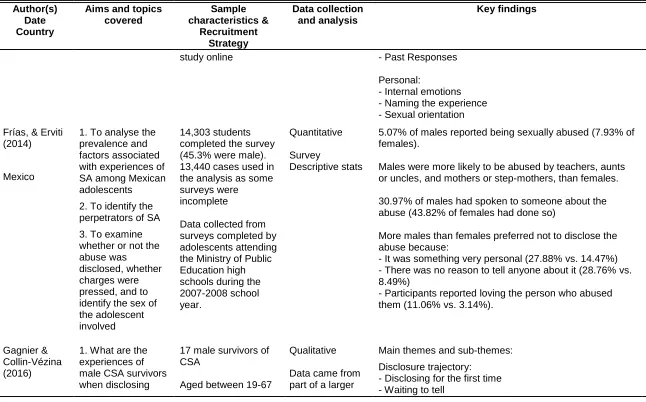
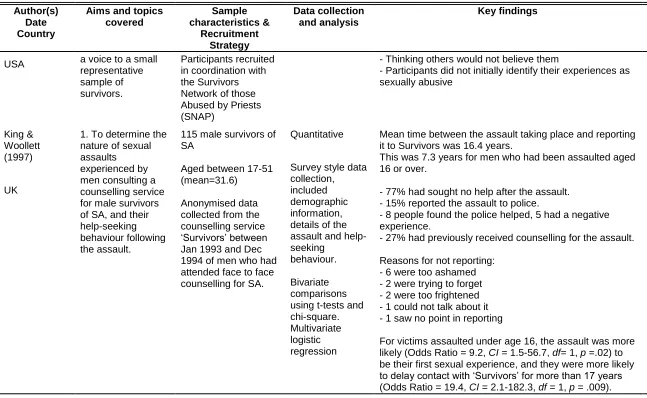
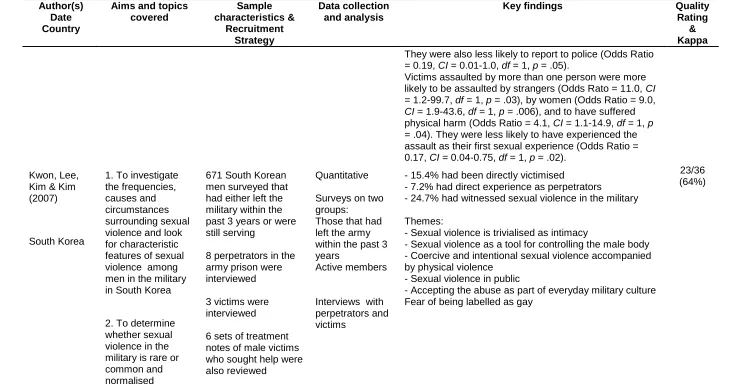
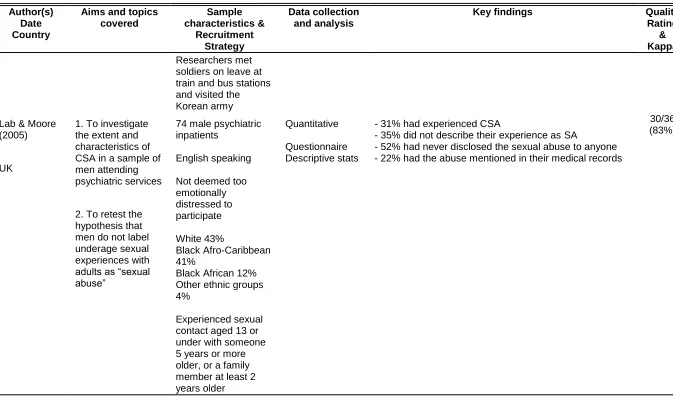
Table 3 Summary of Study Characteristics 22-36
Chapter 2: Empirical Paper
Figure 1 The Theory of Planned Behaviour 75
Table 1 Inclusion and Exclusion Criteria 81
Table 2 Ethnicity of Participants 86
Table 3 Highest Level of Education Achieved 87
Table 4 Matrix Format Illustrating Output from GHSQ-V for Aim 1 88
Figure 2 Estimated Marginal Means Across Health Conditions 89
Table 5 Matrix Format Illustrating Output from GHSQ-V for Aim 2 90
Figure 3 Estimated Marginal Means Across Help Sources 91
Table 6 Matrix Format Illustrating Output from GHSQ-V for Aim 3 92
Table 7 Means from ANOVA Descriptive Data 93
Figure 4 Means Plot for Attitudes Toward Seeking Professional
Psychological Help across Age Groups
95
Figure 5 Means Plot for Stigma Toward People with Mental
Health Problems across Age Groups
97
Figure 6 Means Plot for Level of Perceived Self-Efficacy across
Age Groups
99
X
List of Abbreviations
BPS British Psychological Society
CSA Child Sexual Abuse
GRC Gender Role Conflict
IAPT Improving Access to Psychological
Therapies
MHL Mental Health Literacy
MHP Mental Health Practitioner
SA Sexual Abuse
XI
Acknowledgements
I would like to express my thanks to all of the men who gave their time to
complete the survey, and everybody who ‘liked’, shared and re-tweeted the
study on social media, showed a genuine interest in it and gave me
feedback. I was overwhelmed by the response, and found your support
incredibly encouraging.
I would also like to thank my supervisors Dr Tom Patterson and Dr Anthony
Colombo for their ongoing guidance and support. Your feedback has been
invaluable.
Bryan, Carly, Eleanor, Kayleigh, Laura, Lee, Lizzie, Lucky, Ruth and Suze –
thank you all for sharing this journey with me. I could not have wished for a
better cohort.
Finally, I would like to give a massive thank you to my parents, Paul, Kerry,
XII
Declaration
This thesis has been written for submission as partial fulfilment of the
requirements for the Clinical Psychology Doctorate Programme of Coventry
University and the University of Warwick. It has not been submitted for a
degree at any other university. This thesis was conducted under the
academic supervision of Dr Tom Patterson and Dr Anthony Colombo. Apart
from these collaborations this thesis is my own work. The nominated
journals for publication of chapters 1 and 2 are the Sexual Abuse: A Journal
of Research and Treatment and The Journal of Men’s Studies respectively
(see Appendix A & D for instructions to authors). Authorship of papers will
be shared with the above supervisors where appropriate.
Word count (excluding tables, figures, references and appendices)
Chapter 1: 8,025
Chapter 2: 7,942
Chapter 3: 3,331
XIII
Summary of Chapters
This thesis focuses on the psychology of men, and in particular the factors
that are associated with their disclosure and help-seeking experiences in
two particular contexts: following sexual abuse and when experiencing a
psychological difficulty. This thesis consists of three chapters:
Chapter 1 is a systematic review of the literature, investigating the barriers
to disclosure and help-seeking for male survivors of sexual abuse. Five
barriers were identified: unwillingness to acknowledge the abuse, the
nature of the abuse and abuser factors, perceptions of sexual orientation,
stigma and shame, and mistrust of others and services. These barriers are
discussed within the context of masculinity. Clinical implications are
discussed, such as the importance of training in the sexual abuse of men
for professional staff groups.
Chapter 2 is a vignette based empirical study which explores factors
associated with help-seeking for psychological difficulties in men. The study
used the theory of planned behaviour as a guiding framework in order to
test a number of hypotheses. Data were collected using an online survey
and participants were men aged 18-65, living in the UK, who were recruited
via social media. Perceived behavioural control and attitudes toward
seeking professional psychological help were significant variables within the
theory of planned behaviour model. Men were most likely to endorse
seeking help from their intimate partners and GPs and least likely from
helplines and religious leaders. Clinical implications are discussed and
areas of future research recommended.
Chapter 3 is a reflective paper which discusses how the topic of the thesis
originated. This paper reflects on the experiences of being a male trainee
clinical psychologist in a predominantly female profession, as well as in
relation to carrying out research on male psychology. The paper concludes
with final thoughts about how the work started in this thesis can be
1
Chapter 1:
Barriers to
disclosure in male survivors of
sexual abuse: A systematic
review of the literature
Prepared for submission to Sexual Abuse: A Journal of Research and
Treatment (see Appendix A for author guidelines).
2
1.1 Abstract
The present review aimed to critically evaluate the empirical evidence on
the barriers to disclosure and help-seeking for male survivors of sexual
abuse. A systematic search of the literature, including five databases and
citations, identified 20 studies which met the criteria for inclusion. Five
salient barriers to disclosure and help-seeking were identified:
unwillingness to acknowledge the abuse, the nature of the abuse and
abuser factors, perceptions of sexual orientation, stigma and shame, and
mistrust of others and services. These findings are discussed within the
context of masculinity and male rape myths, which appeared to permeate
all five barriers identified in the current review. Important clinical
implications include a need for more training to be provided for staff on the
sexual abuse of men and boys. A need for further research on facilitators to
disclosure and help-seeking for male survivors of sexual abuse was also
identified.
3
1.2 Introduction
1.2.1 Sexual Abuse
A number of different terms and definitions are used to refer to ‘sexual
abuse’ (SA) and types of SA in the literature, including, sexual assault,
sexual victimisation, sexual coercion, sexual violence, rape, and incest
(Artime, McCallum, & Peterson, 2014). This paper will consider SA in its
broadest sense, as “any non-consensual sexual acts perpetrated against a
man” (Isely & Gehrenbeck-Shim 1997, p.160), and child sexual abuse
(CSA) as any form of sexual contact which occurs “before the age of 18 in
which the perpetrator was at least five years older” (Artime et al., 2014,
p.313), or as “forced sexual contact with a perpetrator of any age before 18”
(Artime et al., 2014, p.313).
1.2.2 Sexual Abuse of Males
There are a number of myths surrounding the sexual abuse of males
(Watkins & Bentovim, 2000). These include that males are hardly ever
sexually abused, that males are only abused by gay men, and that males
who have been sexually abused are less psychologically affected than
females. The evidence-base in relation to these myths will now briefly be
4
1.2.2.1 Rates of Sexual Abuse in Males
Historically, limited statistical evidence on male SA perpetuated the belief
that the phenomenon itself did not occur frequently (King, Coxell, & Mezey,
2000). The difficulty in obtaining accurate data on male SA centres on
problems with the legal definition of the offence. For example, male rape
was not formally recognised by English law until 1994 (King & Woolett,
1997), and by American law until 2012 (Artime, McCallum, & Peterson,
2014; Department of Justice, 2012). Sexual abuse has been framed as an
offence against women within the larger violence against women literature
by activists and feminist scholars (Young, Pruett, & Colvin, 2016).
In the absence of formal crime statistics, a number of research studies have
attempted to gauge the prevalence of male SA within the general
population. With variations in methodology, definitions of SA, populations
studied and time frames considered they have led to disparities across
studies (Peterson, Voller, Polusny, & Murdoch, 2011), as the findings are
revealing. For example, research suggests that between 5% and 15% of
men in the general population report having been victims of childhood
sexual abuse (Briere & Elliott, 2003; Finkelhor, Hotaling, Lewis, & Smith,
1990; World Health Organisation, 2006). In adulthood this figure is thought
to be up to 7% (Elliott, Mok & Briere, 2004), and as high as 17% in gay or
5 However, until recently, male survivors have not been considered a
research priority (Easton, Saltzman, & Willis, 2014), which has “rendered
them almost invisible” in the literature (Gagnier & Collin-Vézina, 2016, p.
222). Even when male survivors are included in studies, the numbers are
often too small to separate the data based on gender (Gagnier &
Collin-Vézina, 2016; Sorsoli, Kia-Keating, & Grossman, 2008).
1.2.2.2 The Sexual Abuse of Males by Females
In their study, Cook, Morisky, Williams, Ford, and Gee (2016) found that 6%
of a sample of 8108 US men who completed a national survey reported
being the victim of forced sex by a female perpetrator. In addition, Krahe,
Scheinberger-Olwig, and Bieneck (2003) conducted two studies and
reported a prevalence rate of 25.1% and 30.1% respectively.
Kissing/petting was the most frequently reported unwanted sexual activity,
followed by sexual intercourse and oral sex. Krahe, Waizenhofer, and
Moller (2003) found that 9.3% of women in their study admitted to having
used aggressive methods (such as exploiting a man’s incapacitated state,
verbal pressure, and physical force) to coerce a man into sexual activities.
Research by Struckman-Johnson and Struckman-Johnson (1992) on
college students has found that participants were more likely to accept male
rape myths (such as that men cannot be on the receiving end of sexual
6 these myths have also been found among professionals. For example,
Donnelly and Kenyon (1996) found that male law enforcement officers did
not acknowledge that men could be victims of sexual abuse, and female
crisis centre workers believed women almost never committed sexual
abuse and that men are rarely victims.
1.2.2.3 Psychological and Behavioural Effects of SA in
Male Survivors
Sexual abuse can have numerous long term psychological effects on men
such as low self-esteem, depression, self-blame, guilt, anger, anxiety, sleep
disorders, trauma, and self-harm (Briere, Evans, Runtz, & Wall, 1988;
Frazier, 1993; King et al., 2002; Romano & De Luca, 2001), and these can
last into old age (Talbott et al., 2009). One consequence of these
psychological effects can be behavioural changes across the lifespan. Men
and boys may present with aggression, criminal activity, drug and alcohol
use, school truancy, running away, family or marital problems, violence,
and suicide attempts (Amos et al., 2008; Butler, Donovan, Fleming, Levy, &
Kaldor, 2001; Darves-Bornoz, Choquet, Ledoux, Gasquet, & Manfredi,
1998; Dube et al., 2005; Garnefski & Arends, 1998). The number of
incidents of SA experienced by men, along with being injured by a
caregiver, and exposure to other trauma has been linked with higher levels
on a number of these mental health symptoms (Banyard, Williams, &
7 Additionally, numerous studies on men have found a link between
experiencing sexual abuse in childhood with an increased risk of being
sexually victimised in adulthood (Coxell, King, Mezey, & Gordon, 1999;
Desai, Arias, Thompson, & Basile, 2002). Men with a history of
experiencing SA are more likely to have higher rates of sexual risk-taking
behaviours, as well as being more likely to be diagnosed with a sexually
transmitted infection (de Visser, Smith, Rissel, Richters, & Grulich, 2003;
Kalichman & Rompa, 1995; Kalichman et al., 2001).
1.2.3 Disclosure and Help-Seeking
The terms “disclosure” and “help-seeking” are often used interchangeably
in the literature (Campbell, Greeson, Fehler-Cabral, & Kennedy, 2015).
However, “disclosure” is more commonly used to describe the process of
informing someone about the abuse, usually an informal source such as a
friend or family member. “Help-seeking” is typically used to describe the
process of informing a formal help provider, such as the police or a doctor
(Campbell et al., 2015). For the purpose of this paper both terms will be
used interchangeably to refer to the process of telling another about the
abuse regardless of the relationship between the survivor and the person
they tell.
Survivors of sexual abuse usually wait many years or even decades until
8 during childhood about being sexually abused (Alaggia, 2010; London,
Bruck, Ceci, & Shuman, 2005; O’Leary & Barber, 2008), even though they
may have been experiencing considerable distress (Romano & De Luca,
2001). Disclosure can be conceptualised as a complex and life-long
process, rather than a discrete one-off event (Gagnier & Collin-Vézina,
2016; Hunter, 2011).
No matter at what point in the lifespan sexual abuse is disclosed it is often a
complex and painful step to take (Ahrens, Standsell & Jennings, 2010).
Disclosing SA is usually critical to securing treatment or early intervention
(Sorsoli, Kia-Keating, & Grossman, 2008), and prompt disclosure has also
been found to moderate symptom severity and reduce the likelihood of
further victimisation (Kogan, 2004).
1.2.4 Disclosure and Help-Seeking in Men
Although disclosing and seeking help for SA is complex, painful and difficult
for both sexes, this process can be made more difficult for males because
of the masculine norms and values that dominate Western patriarchal
societies. For example, that men should be seen as dominant and powerful,
whereas survivors of sexual abuse are often seen as victims, which can
sometimes be equated to being weak and powerless (Alaggia, 2010;
9 Some studies have found that even when men do seek medical help after
an assault they rarely disclose the sexual aspect of it and subsequently do
not report the incident to the police (Isely, & Gehrenbeck-Shim, 1997;
Walker, Archer, & Davies, 2005).
Interestingly, a study by Masho and Alvanzo (2010) found that only 17.6%
of male victims sought professional help. Treatment services are often
designed primarily to meet the needs of female survivors (Donnelly &
Kenyon, 1996; Hooper & Warwick, 2006), and there have been calls for
health services to consider the effectiveness of how they address men’s
needs and problems (Lab, Feigenbaum, & De Silva, 2000).
1.2.5 Rationale and Aims for Systematic Review
The amount of research on male survivors of SA is relatively small, and the
evidence is especially limited in terms of male disclosure following sexual
abuse (Young et al., 2016). What research has shown is that the
consequences of SA in males are significant, and that a better
understanding of the barriers regarding men’s disclosure and help-seeking
for SA is needed.
For the purpose of the present review the term “barrier” has been defined
10 else about his … victimisation or seek formal services for help in the
aftermath of the victimisation” (Allen, Ridgeway & Swan, 2015, p. 104).
In order to improve services for male survivors and to help facilitate
disclosure and help-seeking in this marginalised group, it is important to
understand what exactly the barriers are that impede male survivors in
seeking help. Thus, the aim of the present study is to systematically review
the literature in the area of disclosure and help-seeking in male survivors of
sexual abuse in order to answer the main research question, which is:
1. What are the barriers to disclosure and help-seeking in men who
have been sexually abused?
It is hoped that by answering the above question that the present review will
be able to identify salient implications for clinical practice, that are informed
by the current evidence base. It is also hoped that the present literature
11
1.3 Method
1.3.1 Ethics
Before the review was conducted, ethical approval was sought and granted
from the Coventry University Ethics Board. Project ID number: P50278. See
appendix B for ethics certificate.
1.3.2 Systematic Literature Search
A systematic search of the literature for studies which investigated the
experiences of men who have been survivors of SA and also examined
their experiences or views of disclosure or help-seeking was carried out
between November 2016 and January 2017. The most relevant databases
covering literature within psychology, social criminology, and nursing were
searched, which included: Applied Social Sciences Index and Abstracts
(ASSIA), Cumulative Index to Nursing and Allied Health Literature
(CINAHL), Medline, PsychInfo and Web of Science. The reference lists of
the final extracted articles were examined by hand for additional relevant
12
Table 1: Search terms
Main Concepts Synonyms Location
Males Boy* Male(1) Men
Title Abstract
Sexual Abuse Child sex abuse(1) Incest
Rape Sex*
Sexual abuse(1) Sexual offences(1)
Title Abstract
Help-Seeking Disclos* Help seeking
Help seeking behaviour(1)
Title Abstract
(1) These search terms were terms found in certain databases which were ‘expanded’ to include relevant sub-categories.
Table 1 presents an overview of the key search terms used in the
databases. These terms included the main concepts and their synonyms,
which were males (boy*, male, and men); sexual abuse (child sex abuse,
incest, rape, sex*, sexual abuse, and sexual offences); and help-seeking
(disclos*, help seeking, and help-seeking behaviour). All of these terms
were searched for within the titles and abstracts. An initial search revealed
that the additional term “barrier” was too narrow and omitted useful
literature. Therefore only the broader terms of “disclosure” and
13 The Boolean search strategy for each of the five databases was:
PsychInfo: sexual abuse (expanded) OR sex offences (expanded) OR
incest OR rape OR sex* AND human male (expanded) OR men OR boy*
OR male AND help seeking behaviour (expanded) OR disclos*.
Medline: sex offences (expanded) OR sex abuse OR incest OR rape OR
sex* AND male OR men OR boy* AND help seeking OR disclos*.
CINAHL: sex abuse OR sexual abuse (expanded) OR sex assault OR child
abuse (expanded) OR incest OR rape OR sex* AND males OR men OR
boy* AND help seeking OR disclos* OR help seeking behaviour
(expanded).
ASSIA: child sex abuse (expanded) OR sexual assault OR incest OR rape
or sex abuse OR sex* AND men (expanded) OR boy* OR male and help
seeking (expanded) OR disclos*.
Web of Science: sex abuse OR sexual assault OR sex offence OR rape OR
incest OR sex* AND men OR male OR boy* AND help seeking OR disclos*
OR abuse reporting (expanded).
Where the option was available the population was set as male, the
language was set to English and non peer reviewed studies were filtered
out.
A general initial screening of the article titles and abstracts was conducted
to exclude any articles that may not have been identified through the search
14 process articles which did not appear to focus on the topic of this review of
sexual abuse and help-seeking in male survivors of SA were also screened
out.
1.3.3 Inclusion/Exclusion Criteria
Table 2: Inclusion and exclusion criteria
Criteria Include Exclude
Gender Male only studies Mixed sex studies that separate the data for males and females
Female only studies Mixed sex studies that do not separate the data for males and females Age when abuse took
place
All ages N/A
Type of participant Survivors of sexual abuse Non-survivors / general population
Geography Western countries Non-Western countries Disclosure data Study findings discussing
barriers of disclosure and help-seeking
Studies that failed to consider the barriers and only report disclosure rates Studies that examined police interview techniques and disclosure during this process
Type of sexual abuse All forms of non-consensual sexual contact, or sexual contact before the age of 18 in which the perpetrator was at least 5 years older
Studies that combined the data of sexual abuse with other forms of abuse e.g. intimate partner violence, for purpose of analysis
Perpetrator All kinds N/A
Language of paper English Non-English
Table 2 highlights the inclusion and exclusion criteria used in the present
systematic review. Studies were included if the participants were male, or if
both genders were included in the study but the results were reported
15 male SA, it was decided not to impose an age limit in terms of when the
sexual abuse took place, as SA can happen at any point in a man’s life,
however, the reasons for not disclosing this abuse may be similar across
the lifespan (Masho & Alvanzo, 2010). Studies were included if at least
some of the participants were survivors of SA. As the number of studies in
the area is limited, studies conducted in Western countries were included,
provided that the full text article was accessible in English. Studies that
included some discussion of the barriers of disclosure or help-seeking were
included. The present review also considered articles that included any
form of SA such as incest and rape. A preliminary review of the literature
indicated that most studies did not select participants based on who
perpetrated the sexual abuse (e.g. family member, partner, stranger etc.).
Therefore the present review considered abuse from all types of
perpetrators.
Articles were excluded if they only examined participants’ perceptions from
the general population (i.e. non-specified survivors), or from professional
groups (e.g. police or psychologists). In terms of geography, studies which
were conducted in non-Western countries were excluded on the grounds
that notions of male gender role, masculinity and homosexuality may differ
greatly from Western countries (e.g. the disclosure of being sexually
abused by a male perpetrator may be confounded with extra barriers such
as the illegality of homosexuality). Those articles which only reported
16 excluded. Studies that focused on children’s disclosure in a professional
setting, such as during police interviews where abuse has already been
suspected were excluded as the present review aimed to look at first hand
disclosure of men within the general population.
1.3.4 Classification of Studies
References from all five database searches were collated using EndNote
Online, a reference management software package. The process in which
the studies were selected followed the Preferred Reporting Items for
Systematic Reviews and Meta-Analyses (PRISMA) guidelines (Moher,
Liberati, Tetzlaff, Altman, & The PRISMA Group, 2009). This selection
process is demonstrated in Figure 1.
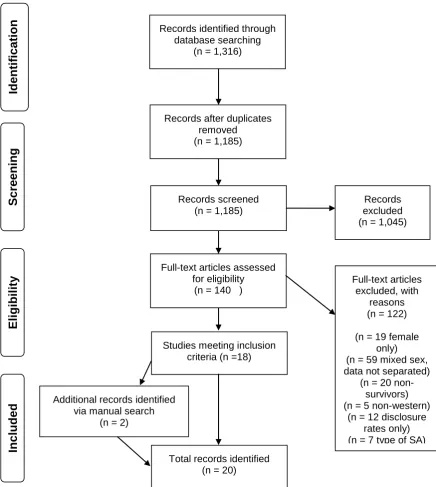
During the identification phase 1,316 articles were identified through
database searches. 131 duplicates were removed and the remaining 1,185
records’ titles and abstracts were screened. This resulted in 1,045 records
being excluded as they were not relevant to the aims of the present review.
The full texts of the remaining 140 articles were reviewed against the
inclusion and exclusion criteria and a further 122 articles were excluded
because they were not relevant to the review aims or did not meet its
inclusion criteria. This resulted in 18 relevant studies which satisfied the
review’s inclusion criteria. Manual searches of the reference list of the 18
17 exclusion criteria. Therefore a total of 20 studies were retained for quality
18
Figure 1: Adapted PRISMA flow diagram illustrating the selection procedure (Moher et al., 2009).
Records identified through database searching
(n = 1,316)
S c re e ning Inc lude d E li gibil ity Ide nt ific a tion
Additional records identified via manual search
(n = 2)
Records after duplicates removed
(n = 1,185)
Records screened (n = 1,185)
Records excluded (n = 1,045)
Full-text articles assessed for eligibility
(n = 140 )
Full-text articles excluded, with
reasons (n = 122) (n = 19 female
only) (n = 59 mixed sex, data not separated)
(n = 20 non-survivors) (n = 5 non-western)
(n = 12 disclosure rates only) (n = 7 type of SA) Studies meeting inclusion
criteria (n =18)
19
1.3.5 Quality Assessment
The final 20 papers were then assessed for quality using the quality
assessment framework developed by Caldwell, Henshaw and Taylor
(2005). This framework was considered suitable for the current review
because it can be used with both quantitative and qualitative papers. The
full list of questions can be found in appendix C. The checklist rates each
section of the paper against a range of quality indicators over 18 questions.
For each question a score of 0 (not met), 1 (partially met), and 2 (fully met)
can be awarded, meaning that the highest score that be achieved is 36.
Scores were then converted into a percentage, with a higher score
indicating a higher quality.
No arbitrary cut-off score was used to exclude studies. Instead, the quality
rating assessment scores were considered qualitatively to establish the
overall quality of each paper, as well as the paper’s unique contribution to
the literature. However, if a paper scored under 50% then its shortcomings
would have been considered in relation to what its data added to the
review. For example, if a paper scored a quality rating of 40% but was the
only paper to discuss the experiences of men in the military who had been
sexually abused then this still may have been included in the review, with
20
1.3.5.1 Inter-rater Reliability
To enhance the reliability of the quality assessment, five papers were also
selected at random to be rated independently by another researcher, using
the same quality assessment criterion. A Cohen’s Kappa (k) test was used
to statistically compare one researcher’s rating with the other to give a
Kappa coefficient score for each of the 5 papers. These scores are reported
in Table 3, and there was an overall coefficient reliability value of k=0.810
which, represents a very strong pattern of inter-rater reliability (Altman,
1999).
Over the full 20 studies the quality rating ranged from 58% to 100%,
indicating acceptable quality levels across the 20 studies. Consequently no
studies were excluded through the quality assessment process.
1.3.6 Characteristics of the Literature
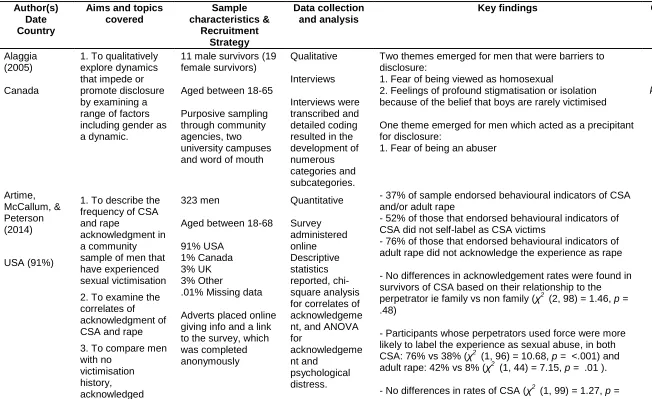
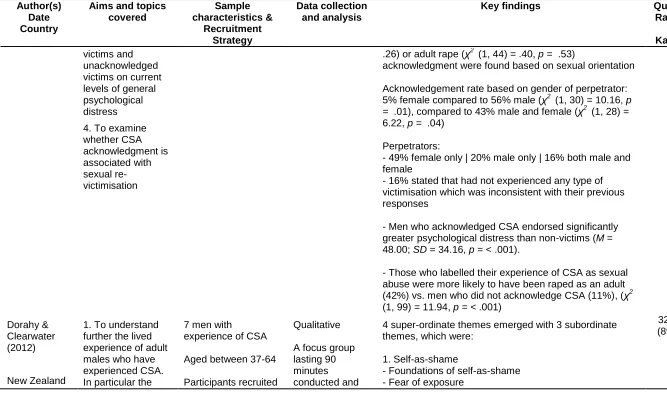
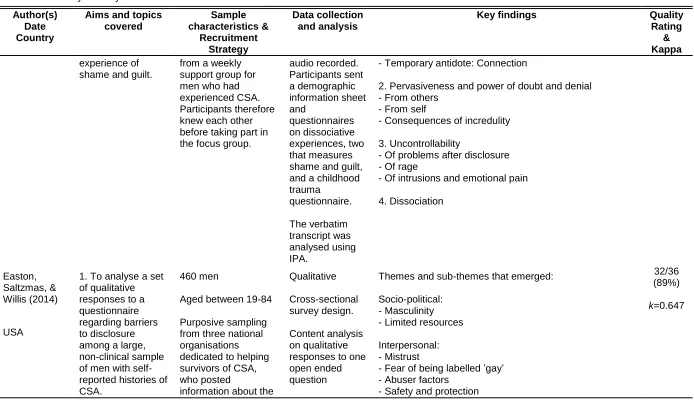
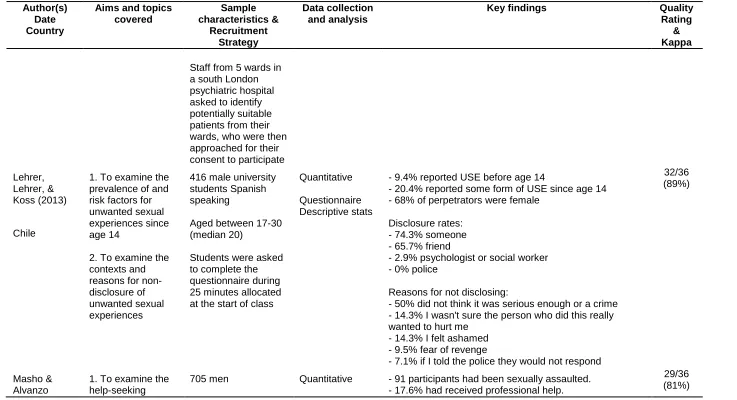
A summary of the key characteristics of the 20 studies included in this
systematic review are provided in Table 3. The studies included were
conducted in following countries: Australia (1), Canada (3), Chile (1),
Mexico (1), New Zealand (1), South Korea (1), Sweden (1), UK (2), and
USA (9). They were published between the years 1997 and 2016. The
studies used a mixture of qualitative (e.g. IPA, grounded theory, and
thematic analysis) and quantitative (e.g. surveys) methodology. Participants
21 samples, people with mental health problems, survivors of clergy abuse
22
Author(s) Date Country
Aims and topics covered Sample characteristics & Recruitment Strategy Data collection and analysis
Key findings Quality Rating & Kappa Alaggia (2005) Canada
1. To qualitatively explore dynamics that impede or promote disclosure by examining a range of factors including gender as a dynamic.
11 male survivors (19 female survivors) Aged between 18-65 Purposive sampling through community agencies, two university campuses and word of mouth
Qualitative Interviews Interviews were transcribed and detailed coding resulted in the development of numerous categories and subcategories.
Two themes emerged for men that were barriers to disclosure:
1. Fear of being viewed as homosexual
2. Feelings of profound stigmatisation or isolation because of the belief that boys are rarely victimised One theme emerged for men which acted as a precipitant for disclosure:
1. Fear of being an abuser
31/36 (86%) k=0.670 Artime, McCallum, & Peterson (2014) USA (91%)
1. To describe the frequency of CSA and rape
acknowledgment in a community sample of men that have experienced sexual victimisation 2. To examine the correlates of acknowledgment of CSA and rape 3. To compare men with no
victimisation history, acknowledged
323 men
Aged between 18-68 91% USA
1% Canada 3% UK 3% Other
.01% Missing data Adverts placed online giving info and a link to the survey, which was completed anonymously Quantitative Survey administered online Descriptive statistics reported, chi-square analysis for correlates of acknowledgeme nt, and ANOVA for
acknowledgeme nt and
psychological distress.
- 37% of sample endorsed behavioural indicators of CSA and/or adult rape
- 52% of those that endorsed behavioural indicators of CSA did not self-label as CSA victims
- 76% of those that endorsed behavioural indicators of adult rape did not acknowledge the experience as rape - No differences in acknowledgement rates were found in survivors of CSA based on their relationship to the perpetrator ie family vs non family (χ2 (2, 98) = 1.46, p =
.48)
- Participants whose perpetrators used force were more likely to label the experience as sexual abuse, in both CSA: 76% vs 38% (χ2 (1, 96) = 10.68, p = <.001) and adult rape: 42% vs 8% (χ2
(1, 44) = 7.15, p = .01 ). - No differences in rates of CSA (χ2 (1, 99) = 1.27, p =
[image:34.842.76.728.115.514.2]32/36 (89%)
23
Author(s) Date Country
Aims and topics covered Sample characteristics & Recruitment Strategy Data collection and analysis
Key findings Quality Rating
& Kappa
victims and unacknowledged victims on current levels of general psychological distress 4. To examine whether CSA acknowledgment is associated with sexual re-victimisation
.26) or adult rape (χ2 (1, 44) = .40, p = .53)
acknowledgment were found based on sexual orientation Acknowledgement rate based on gender of perpetrator: 5% female compared to 56% male (χ2 (1, 30) = 10.16, p = .01), compared to 43% male and female (χ2 (1, 28) = 6.22, p = .04)
Perpetrators:
- 49% female only | 20% male only | 16% both male and female
- 16% stated that had not experienced any type of victimisation which was inconsistent with their previous responses
- Men who acknowledged CSA endorsed significantly greater psychological distress than non-victims (M = 48.00; SD = 34.16, p = < .001).
- Those who labelled their experience of CSA as sexual abuse were more likely to have been raped as an adult (42%) vs. men who did not acknowledge CSA (11%), (χ2 (1, 99) = 11.94, p = < .001)
Dorahy & Clearwater (2012)
New Zealand
1. To understand further the lived experience of adult males who have experienced CSA. In particular the
7 men with
experience of CSA Aged between 37-64 Participants recruited
Qualitative A focus group lasting 90 minutes conducted and
4 super-ordinate themes emerged with 3 subordinate themes, which were:
1. Self-as-shame
- Foundations of self-as-shame - Fear of exposure
[image:35.842.73.740.117.514.2]32/36 (89%)
24
Author(s) Date Country
Aims and topics covered Sample characteristics & Recruitment Strategy Data collection and analysis
Key findings Quality Rating
& Kappa
experience of shame and guilt.
from a weekly support group for men who had experienced CSA. Participants therefore knew each other before taking part in the focus group.
audio recorded. Participants sent a demographic information sheet and questionnaires on dissociative experiences, two that measures shame and guilt, and a childhood trauma questionnaire. The verbatim transcript was analysed using IPA.
- Temporary antidote: Connection
2. Pervasiveness and power of doubt and denial - From others
- From self
- Consequences of incredulity 3. Uncontrollability
- Of problems after disclosure - Of rage
- Of intrusions and emotional pain 4. Dissociation
Easton, Saltzmas, & Willis (2014)
USA
1. To analyse a set of qualitative responses to a questionnaire regarding barriers to disclosure among a large, non-clinical sample of men with self-reported histories of CSA.
460 men
Aged between 19-84 Purposive sampling from three national organisations dedicated to helping survivors of CSA, who posted
information about the
Qualitative Cross-sectional survey design. Content analysis on qualitative responses to one open ended question
Themes and sub-themes that emerged: Socio-political:
- Masculinity - Limited resources Interpersonal: - Mistrust
- Fear of being labelled ’gay’ - Abuser factors
- Safety and protection
32/36 (89%)
[image:36.842.77.771.108.510.2]k=0.647
25
Author(s) Date Country
Aims and topics covered Sample characteristics & Recruitment Strategy Data collection and analysis
Key findings Quality Rating
& Kappa
study online - Past Responses Personal:
- Internal emotions - Naming the experience - Sexual orientation Frías, & Erviti
(2014)
Mexico
1. To analyse the prevalence and factors associated with experiences of SA among Mexican adolescents 2. To identify the perpetrators of SA 3. To examine whether or not the abuse was
disclosed, whether charges were pressed, and to identify the sex of the adolescent involved
14,303 students completed the survey (45.3% were male). 13,440 cases used in the analysis as some surveys were
incomplete
Data collected from surveys completed by adolescents attending the Ministry of Public Education high schools during the 2007-2008 school year.
Quantitative Survey
Descriptive stats
5.07% of males reported being sexually abused (7.93% of females).
Males were more likely to be abused by teachers, aunts or uncles, and mothers or step-mothers, than females. 30.97% of males had spoken to someone about the abuse (43.82% of females had done so)
More males than females preferred not to disclose the abuse because:
- It was something very personal (27.88% vs. 14.47%) - There was no reason to tell anyone about it (28.76% vs. 8.49%)
- Participants reported loving the person who abused them (11.06% vs. 3.14%).
32/36 (89%)
Gagnier & Collin-Vézina (2016)
1. What are the experiences of male CSA survivors when disclosing
17 male survivors of CSA
Aged between 19-67
Qualitative Data came from part of a larger
Main themes and sub-themes: Disclosure trajectory:
- Disclosing for the first time - Waiting to tell
[image:37.842.77.723.114.516.2]36/36 (100%)
26
Author(s) Date Country
Aims and topics covered Sample characteristics & Recruitment Strategy Data collection and analysis
Key findings Quality Rating
& Kappa
Canada their abuse? 2. How do these experiences differ or resemble one another?
(average 47) 6 chose to be interviewed in English, 11 chose French
Participants recruited through community and mental health organisations that offered support to survivors of sexual abuse in 4 large Canadian cities study. Transcripts from telephone interviews Phenomenologic al method and interpretive description used to analyse the data
- Stereotypes contributing to delayed disclosure - Trying to forget
- Breaking the isolation as a motivator to disclosure - Impact of various forms of media on disclosure Disclosure Experiences
- Positive disclosure experiences - Negative disclosure experiences - Desire to protect others
- Support in a non therapeutic context - Experiences of non disclosure - Disclosing with ease
Hunter (2011)
Australia
1. How and when do people decide to tell others about their early sexual experiences with adults?
9 men, 13 women Aged between 25-70. Participants recruited via press releases and interviews on local radio.
Qualitative Narrative inquiry
Themes particularly relevant to males: Shame:
- About hidden homosexuality - Of becoming homosexual - Of being labelled as homosexual
27/36 (75%) Isely, Isely, Freiburger, & McMackin (2008)
1. To explore the immediate and long term impact of sexual abuse on men abused by the clergy, and to give
9 male survivors of SA by members of the Catholic clergy. Aged between 31-67.
Qualitative Interviews Theme analysis
Pertinent findings for current review:
- Most feared they were somehow attracting men and questioned their sexual identity
- Shame & guilt, and not wanting others to find out - Severe betrayal of trust by someone deemed as trustworthy
21/36 (58%)
[image:38.842.75.709.111.515.2]k=0.831
27
Author(s) Date Country
Aims and topics covered Sample characteristics & Recruitment Strategy Data collection and analysis
Key findings Quality Rating
& Kappa
USA a voice to a small representative sample of survivors.
Participants recruited in coordination with the Survivors Network of those Abused by Priests (SNAP)
- Thinking others would not believe them
- Participants did not initially identify their experiences as sexually abusive
King & Woollett (1997)
UK
1. To determine the nature of sexual assaults
experienced by men consulting a counselling service for male survivors of SA, and their help-seeking behaviour following the assault.
115 male survivors of SA
Aged between 17-51 (mean=31.6)
Anonymised data collected from the counselling service ‘Survivors’ between Jan 1993 and Dec 1994 of men who had attended face to face counselling for SA.
Quantitative
Survey style data collection, included demographic information, details of the assault and help-seeking
behaviour. Bivariate comparisons using t-tests and chi-square. Multivariate logistic regression
Mean time between the assault taking place and reporting it to Survivors was 16.4 years.
This was 7.3 years for men who had been assaulted aged 16 or over.
- 77% had sought no help after the assault. - 15% reported the assault to police.
- 8 people found the police helped, 5 had a negative experience.
- 27% had previously received counselling for the assault. Reasons for not reporting:
- 6 were too ashamed - 2 were trying to forget - 2 were too frightened - 1 could not talk about it - 1 saw no point in reporting
For victims assaulted under age 16, the assault was more likely (Odds Ratio = 9.2, CI = 1.5-56.7, df= 1, p =.02) to be their first sexual experience, and they were more likely to delay contact with ‘Survivors’ for more than 17 years (Odds Ratio = 19.4, CI = 2.1-182.3, df = 1, p = .009).
[image:39.842.76.723.112.510.2]24/36 (67%)
28
Author(s) Date Country
Aims and topics covered Sample characteristics & Recruitment Strategy Data collection and analysis
Key findings Quality Rating
& Kappa
They were also less likely to report to police (Odds Ratio = 0.19, CI = 0.01-1.0, df = 1, p = .05).
Victims assaulted by more than one person were more likely to be assaulted by strangers (Odds Rato = 11.0, CI
= 1.2-99.7, df = 1, p = .03), by women (Odds Ratio = 9.0,
CI = 1.9-43.6, df = 1, p = .006), and to have suffered physical harm (Odds Ratio = 4.1, CI = 1.1-14.9, df = 1, p
= .04). They were less likely to have experienced the assault as their first sexual experience (Odds Ratio = 0.17, CI = 0.04-0.75, df = 1, p = .02).
Kwon, Lee, Kim & Kim (2007)
South Korea
1. To investigate the frequencies, causes and circumstances surrounding sexual violence and look for characteristic features of sexual violence among men in the military in South Korea
2. To determine whether sexual violence in the military is rare or common and normalised
671 South Korean men surveyed that had either left the military within the past 3 years or were still serving
8 perpetrators in the army prison were interviewed 3 victims were interviewed 6 sets of treatment notes of male victims who sought help were also reviewed
Quantitative Surveys on two groups:
Those that had left the army within the past 3 years
Active members
Interviews with perpetrators and victims
- 15.4% had been directly victimised
- 7.2% had direct experience as perpetrators
- 24.7% had witnessed sexual violence in the military Themes:
- Sexual violence is trivialised as intimacy
- Sexual violence as a tool for controlling the male body - Coercive and intentional sexual violence accompanied by physical violence
- Sexual violence in public
- Accepting the abuse as part of everyday military culture Fear of being labelled as gay
[image:40.842.51.780.117.504.2]23/36 (64%)
29
Author(s) Date Country
Aims and topics covered Sample characteristics & Recruitment Strategy Data collection and analysis
Key findings Quality Rating
& Kappa
Researchers met soldiers on leave at train and bus stations and visited the Korean army Lab & Moore
(2005)
UK
1. To investigate the extent and characteristics of CSA in a sample of men attending psychiatric services
2. To retest the hypothesis that men do not label underage sexual experiences with adults as “sexual abuse”
74 male psychiatric inpatients
English speaking Not deemed too emotionally distressed to participate White 43% Black Afro-Caribbean 41%
Black African 12% Other ethnic groups 4%
Experienced sexual contact aged 13 or under with someone 5 years or more older, or a family member at least 2 years older
Quantitative Questionnaire Descriptive stats
- 31% had experienced CSA
- 35% did not describe their experience as SA
- 52% had never disclosed the sexual abuse to anyone - 22% had the abuse mentioned in their medical records
[image:41.842.81.754.111.510.2]30/36 (83%)
30
Author(s) Date Country
Aims and topics covered Sample characteristics & Recruitment Strategy Data collection and analysis
Key findings Quality Rating
& Kappa
Staff from 5 wards in a south London psychiatric hospital asked to identify potentially suitable patients from their wards, who were then approached for their consent to participate Lehrer,
Lehrer, & Koss (2013)
Chile
1. To examine the prevalence of and risk factors for unwanted sexual experiences since age 14
2. To examine the contexts and reasons for non-disclosure of unwanted sexual experiences
416 male university students Spanish speaking
Aged between 17-30 (median 20)
Students were asked to complete the questionnaire during 25 minutes allocated at the start of class
Quantitative Questionnaire Descriptive stats
- 9.4% reported USE before age 14
- 20.4% reported some form of USE since age 14 - 68% of perpetrators were female
Disclosure rates: - 74.3% someone - 65.7% friend
- 2.9% psychologist or social worker - 0% police
Reasons for not disclosing:
- 50% did not think it was serious enough or a crime - 14.3% I wasn't sure the person who did this really wanted to hurt me
- 14.3% I felt ashamed - 9.5% fear of revenge
- 7.1% if I told the police they would not respond
32/36 (89%)
Masho & Alvanzo
1. To examine the help-seeking
705 men Quantitative - 91 participants had been sexually assaulted. - 17.6% had received professional help.
[image:42.842.67.804.115.515.2]29/36 (81%)
31
Author(s) Date Country
Aims and topics covered Sample characteristics & Recruitment Strategy Data collection and analysis
Key findings Quality Rating
& Kappa
(2010)
USA
behaviours of men who have been sexually abused or assaulted in a community-based sample.
Older than 17 Sexual assault victims (n=91): 72.4% white 27.6% other Population based cross sectional study, using an
independent, equal-probability sample drawn to represent the population of Virginia. Telephone survey, using random-digit-dialling method. Logistic regression was used to analyse the data
Significant predictors of help-seeking were:
- Physical injury (OR = 10.91, 95% CI = 1.99-21.25) - Perpetration by family or friend (OR = 6.16, 95% CI = 1.45-29.9)- Threat at the time of the incident (OR = 7.56, 95% CI = 2.13-26.57)
Monk-Turner & Light (2010)
USA
1. To understand better what key factors shaped the likelihood of ever seeking counselling among adult men who had
experienced SA.
219 males who were survivors of SA. 79% White
9% African American Data drawn from the 1994-1996 Violence and Threats of Violence Against Women and Men in the United States Survey. Men who ever reported being a
Quantitative Data were collected through telephone interviews. Logistic regression analysis was used to analyse the data.
- 88% did not report the assault to police.
- Only one variable was significantly related to help-seeking. Results showed that men who reported that penetration had occurred during the assault were 58% less likely to see counselling (b = -.85, eb = .42, SE = .35,
p≤ .01)
- All other variables were non-significant: -- Using drugs (b = -.13, eb = 0.88, SE =0 .46) -- Weapon used (b = 1.99, eb =7 .31, SE = 1.09) -- Threatened (b = -.42, eb = .65, SE = .43) -- Reported injuries (b = -.51, eb = .60, SE = .67) -- Sought medical care (b = -1.20, eb = .30, SE = 1.02)
31/36 (86%)
32
Author(s) Date Country
Aims and topics covered Sample characteristics & Recruitment Strategy Data collection and analysis
Key findings Quality Rating
& Kappa
survivor of SA or rape were included.
-- White (b = -.48, eb = .62, SE = .45)
-- Reported to police (b = -.25, eb = .78, SE = .53) (p values for these variables were not reported) Priebe &
Svedin (2008)
Sweden
1. To investigate disclosure patterns associated with recipients of disclosure, abuse characteristics, socio-demographic variables, perception of parents when growing up, and current perceived mental health, separate for boys and girls
2. To examine predictors of non-disclosure, separate for boys and girls
2,015 boys (2,324 girls) All were third year students at secondary school from the capital city, a large port town, and three smaller cities in Sweden. Mean age was 18.15 years. The director of each participating
community was asked to give permission for the research. Students in selected classes then asked to give consent to take part.
Quantitative Questionnaires with a total of 65 questions, taking 30-60 minutes to complete. Data analysed using univariate and multivariate analyses.
- 23% of boys and 65% of girls reported experience of SA.
- The disclosure rate was 69% for boys and 81% for girls; however this was most often to a friend.
- 45.5% of boys and 17.3% of girls did not answer the questions about disclosure. Boy non-completers were two times more likely to have one or both parents
unemployed (aOR = 2.18, CI = 1.49-3.19)
- 8.3% of the adolescents had talked to a professional about the abuse.
- The more severe the abuse, the less likely boys and girls spoke to either parent or a sibling. More severe abuse was also associated with lower rates of disclosure to professionals for boys (OR = .15, CI = .03-.71), but higher rates for girls (OR = 3.12, CI = 1.13-8.61), - Non-disclosing boys were more often sexually abused by a family member or friend, were more often studying a vocational program and lived more often with both parents than boy disclosers Non-disclosing boys perceived their parents during childhood more often as less caring in combination with lower overprotection, than boy disclosers.
- Adolescents who experienced SA reported significantly more mental health symptoms (girls: M(SD): abused 15.38 (4.68), not abused 14.00 (4.68), t (df) = -6.79 (2298), p≤ .001; boys: M(SD): abused 14.21 (4.71), not
31/36 (86%)
33
Author(s) Date Country
Aims and topics covered Sample characteristics & Recruitment Strategy Data collection and analysis
Key findings Quality Rating
& Kappa
abused 12.65 (4.37), t (df) = -6.31 (703.20), p≤ .001), and in general non-disclosers reported more symptoms than disclosers (girls: M(SD): discloser 15.27 (4.71), non-discloser 16.26 (4.7), t (df) = -2.89 (1232), p = .004; boys:
M(SD): discloser 13.97 (4.55), non-discloser 15.53 (4.80),
t (df) = -2.45 (246), p =.015). Sorsoli,
Kia-Keating, & Grossman (2008)
USA
With regards to male survivors of CSA:
1. To whom and in what contexts have they disclosed these experiences? 2. What do they have to say about these disclosure events?
3. What are their perceptions of the positive and negative aspects of their disclosure experiences, including both incentives and barriers to disclosure?
16 men who were survivors of CSA 11 Caucasian 2 African American 1 Puerto Rican 1 part Native American 1 African Cuban Aged between 24-61. 9 heterosexual 5 gay
2 bisexual
Participants recruited from men who responded to flyers posted a numerous institutions in the community.
2 in depth semi-structured interviews, lasting between 2-3 hours each, taking place approximately a week apart. Data were analysed using a grounded theory approach to coding and the use of
conceptually clustered matrices.
Three major themes and sub-themes emerged from the data:
Personal:
- Cognitive awareness - Intentional avoidance - Difficulty approaching topic - Difficulty with articulation - Emotional readiness - Shame
- Emotional safety Relational:
- Fear of specific negative repercussions - General relational disruptions
- Isolation
- Relational beliefs Socio-cultural: - Unacceptability
34/36 (94%)
k=0.727
34
Author(s) Date Country
Aims and topics covered Sample characteristics & Recruitment Strategy Data collection and analysis
Key findings Quality Rating
& Kappa
A brief telephone screening was then conducted. Teram, Stalker, Hovey, Schachter, & Lasiuk (2006) Canada
1. To inform an understanding of male survivors’ experiences, particularly in relation to their encounters with health
professionals
49 male survivors 46 female survivors 18 years or older English speaking All experienced CSA Self-selected through responding to adverts placed in health agencies offering support to survivors of sexual abuse
Qualitative Interviews and focus groups Method of analysis not explicitly specified
Themes and sub-themes identified:
Lack of concern regarding sexual abuse of boys by women
- Male survivors abused by women are considered to be ‘lucky’
- Perpetrators often only seen as male Homophobia
- Assumed to be gay
- Struggled with own sexual identity - Their own homophobia of other men
- The image of male survivors as potential perpetrators Manhood and the vulnerability for victims
- Men don't cry
- Men's difficulty acknowledging and expressing feelings Malecentric communication
- Services clearly acknowledging the experiences of men
27/36 (75%) Turchik, McLean, Rafie, Hoyt, Rosen, & Kimerling (2013)
1. To gain a better understanding of the perceived barriers to
accessing military sexual trauma related care for
20 male veterans who had experienced military sexual trauma but had not accessed mental health care Sample recruited via
Qualitative Semi-structured interviews lasting approx. 45 min Analysed using
Themes and sub-themes identified: - Stigma-related barriers
- Not wanting to talk about problems - Embarrassment/shame
- Privacy/Confidentiality - Self-blame
- Not important or serious enough
[image:46.842.78.719.114.518.2]33/36 (92%)
35
Author(s) Date Country
Aims and topics covered Sample characteristics & Recruitment Strategy Data collection and analysis
Key findings Quality Rating
& Kappa
USA
male veterans
2. To explore men's preferences
concerning the gender of health care providers
Veterans Health Administration, who had screened positive for MST, but had not received any MST related mental health care.
99 men with an address 25 miles from interview centre selected and mailed until a target of 20 participants was reached
grounded theory - Sensitivity and reactions of a provider - Fear that they won't be believed Gender-related barriers
- Men less affected than women - Masculinity
- Provider gender preferences Knowledge Barriers
- Lack of knowledge about service availability - Financial concerns regarding services
Weiss (2010)
USA
1. To explore and deconstruct the shame of sexual victimisation by highlighting the ways in which shame is socially constructed and culturally mediated
20 male victims (116 female victims) Males:
74% under 25 year old
38% white 25% black 38% other races Data were extracted from sexual victimisation narratives collected Qualitative Survey Open ended question narrative analysed using grounded theory approach.
Themes and sub-themes identified: Men’s shame narratives:
- The disempowered victim - The emasculated victim - The exposed victim
31/36 (86%)
[image:47.842.78.781.111.507.2]k=0.852
36
Author(s) Date Country
Aims and topics covered Sample characteristics & Recruitment Strategy Data collection and analysis
Key findings Quality Rating
& Kappa
by the National Crime victimisation survey in the USA from an open ended question Shame narratives were then identified and included in the study.
Young, Pruett, & Colvin (2016)
USA
1. To compare the documented call narratives of male sexual assault survivors with female sexual assault survivors who called a telephone hotline, with the intent to understand better the help-seeking behaviour and experiences of male sexual assault survivors.
58 male SA survivors (58 female SA survivors)
Aged between 15-61 Data came from documentation of hotline calls from a sexual assault centre from callers who called between 2008-2012.
58 male survivors were identified and 58 females were randomly selected for comparison.
Mixed methods approach. Quantitative variables: duration of call, sex of victim, age, date of assault, severity of call,
urgent/non-urgent, what was provided to each caller (e.g. information, empathy & referral) Summative content analysis
- No significant differences between males and females based on severity of calls (stats not reported)
Themes identified for male callers: - Hotline used due to limited or no support - Used to access counselling only
- Distrust of others
- Confusion around boundaries
[image:48.842.80.773.111.498.2]32/36 (89%)