The Changeability of the Stress Mindset and its Relation to Mental Well-being:
A randomized controlled trial
Helen Brand
1827588
University of Twente
Author Note
Helen Brand, Department of Behavioral Sciences, Positive Psychology and Technology,
University of Twente.
This research was supervised by Dr. Marijke Schotanus-Dijkstra and Prof. Dr. Ernst
Bohlmeijer.
Correspondence concerning this article should be addressed to Helen Brand.
Abstract
Background: Up until now there is little research known about the changeability of the stress
mindset and the relation to mental well-being. The current study aimed at investigating whether
a stress mindset can, in fact, be changed to the more optimistic view of the stress-is-enhancing
mindset. Moreover, it was tested whether the mental well-being of a person may increase
consequentially.
Methods: A randomized controlled trial was conducted in which a total of 104 participants were
randomly assigned to either a stress-mindset condition (n = 52) or a control condition (n = 52).
The stress mindset condition included an informative text about the beneficial aspects of stress
and was aimed at changing participants stress mindset to the optimistic stress-is-enhancing
mindset. Participants were measured on the MHC-SF and the Stress Mindset Measure at
baseline and posttest (one week after baseline).
Results: Results revealed that there was a marginally significant (t (102) = 1.78, p = .078)
change in participants stress mindset in the experimental condition towards a
stress-is-enhancing mindset. However, the results did not demonstrate the hypothesized mediating effect
of the change to a stress-is-enhancing mindset between the condition on change in well-being
(p = .358, b= -.03, 95% CI [-.81, .01]).
Limitations: The study did not investigate the long-term effects of the manipulation as the
posttest was directly administered after the intervention and no follow-up was carried out.
Conclusion:An informative text can be an effective intervention in order to change a person's
mindset to a more optimistic view. However, more research is needed in order to clarify the
influence of mindset change on mental well-being.
Introduction
Nowadays humans seem to be experiencing an increasing amount of stress. It goes as
far as that the World Health Organization explained stress to be the “Health Epidemic of the
21st Century” (Fink, 2016, p.1). Throughout the lay population, the belief about the negative
nature of stress is widespread, and the dominant perspective of society highlights the negative
consequences of stress on the physical health and well-being of a person. Moreover, a majority
of self-report scales measuring the amount of perceived stress are representing the negative
aspects of stress by using negatively formulated items. Thereby, the negative side of stress is
accentuated, and focus laid on possibilities of eliminating stress instead of optimizing one's own
stress response (e.g., Cohen, Kamarck, & Mermelstein, 1983).
However, there are certain possible beneficial aspects of stress that are often not
considered (Jamieson, et al., 2018). Every individual experiences stress in another way,
depending on one’s individual vulnerability and the type of task. Research has shown that stress
is a highly personal construct that can result in adaptive or maladaptive outcomes depending on
factors such as context and duration (Fink, 2016). Recent research suggests that the negative
and positive effects of stress are also influenced by means of the individuals’ beliefs about the
nature of stress (Crum, Salovey & Achor, 2013). However, it is yet unknown whether such
beliefs can be changed. Could the negative effects of stress be changed as well?
Consequences of Stress
Stress seems to be a construct that can be observed in many aspects of our lives and is
a widely discussed topic in a sheer amount of scientific research. However, research has not
been able yet to define stress, as there are numerous different understandings of the concept.
One of the major definitions of stress has been given by Selye (1987), stating that stress is a
nonspecific response of the body to any demand. Based on this definition of stress, other
adversity in our goal-related efforts” (Crum, Salovey & Achor, 2013, p.4) or environmental
demands that exceed one's perception of being able to cope with those demands (Fink, 2016).
The deliberating consequences of chronic stress are well known in society and may lead
to serious consequences in an individual's physical and psychological health and well-being
(Bargiel-Matusiewicz, Stelmachowska, & Omar, 2016). Referred to as distress, this type of
stress has numerous consequences, such as anxiety, increased rates of heart attack, addiction
and other disorders (Fink, 2016; Selye, 1987; Crum, Salovey & Achor, 2013).
However, stress does not always compromise the health and well-being of an individual.
Distinguishing positive stress from the negative form of stress, Selye (1987) labelled the
pleasant stress eustress. Ultimately, stress was considered to induce physiological arousal in
order to improve functioning, stress also yields positive outcomes and plays a major role in the
development of abilities to survive and flourish (Crum, & Lyddy, 2014). Eustress highlights
those good outcomes and effects of stress that may help us to achieve goals and keeps us
motivated to finish tasks (Bargiel-Matusiewicz, Stelmachowska, & Omar, 2016).
In general, it can be said that stress is caused by a stressor, an external or internal threat
experienced by the individual, that elicits a specific response: a stress response
(Bargiel-Matusiewicz, Stelmachowska, & Omar, 2016). Any change in a person's stress level does
require a specific bodily response in order to deal with the specific situation and return to the
originally calm state. Whereas eustress might elicit a stress response consisting of excitement
and approaching, distress might lead to panic and avoidance (Selye, 1987).
Stress Mindset
Research conducted by Crum, Salovey and Achor (2013) suggests that the negative, as
well as positive effects of stress, are mainly influenced by an individual's mindset about the
ultimate nature of stress. A stress mindset can be defined as a mental frame that shapes our
beliefs surrounding the attributes of the certain event (Crum, & Lyddy, 2014). Although a
mindset generates from conscious experiences, it is applied unconsciously and automatic,
organizing the information and shaping one's thought habits (Crum, & Lyddy, 2014). The study
by Crum, Salovey and Achor (2013) identified two different mindsets representing one’s beliefs
about stress. Individuals holding the belief that stress has a negative outcome and debilitating
effects on one's performance and well-being, experience a stress-is-debilitating mindset. In
contrast, people holding a stress-is-enhancing mindset believe that stress does have a positive
impact on those outcomes (Crum, Salovey & Achor, 2013).
Results of the study showed that besides the variables traditionally seen as influential
on the stress response, such as the amount of stress and ways of coping, an individual's stress
mindset is conceptually distinct. In other words, a stress mindset was found to be an additional
meaningful influence on the stress response, the manner in which stress is psychologically
experienced and behaviorally approached (Crum, Salovey & Achor, 2013). It was proposed that
the stress-is-enhancing mindset is associated with an optimal level of arousal, being defined as
the right amount of arousal to achieve the necessary demands while not exceeding the amount
of necessary arousal and thereby diminishing one's own actions. In contrast, the
stress-is-debilitating mindset was related to extremely high levels of arousal, having the effect of
compromising one's actions. These higher states of arousal during a stress response can be
debilitating, causing a negative impact on health, performance and well-being (Crum, & Lyddy,
2014). As the stress mindset, one holds influences the stress response and thereby also the level
of arousal, mindlessly fixating upon the mindset that stress-is-debilitating may cause serious
damage in a person’s level of well-being.
The relation between Stress Mindset and Mental Well-being
Research has found that the stress mindset one holds can have consequences not only
individual but also for the individual's well-being. As one of the first studies investigating the
relation between stress-mindset and well-being, Crum, Salovey and Achor (2013) demonstrated
that the stress mindset was positively related to levels of well-being. More precisely, individuals
endorsing a stress-is-enhancing mindset stated higher levels of well-being, in terms of overall
satisfaction with life. Relations between mindsets and well-being have also been found when
taking into account other mindsets that an individual may hold. A study conducted by Norton,
Anik, Aknin, and Dunn (2011) reported that people holding the negative life mindset that life
is short and hard showed significantly lower well-being, measured in overall life satisfaction.
Both studies showed the possible influence of mindsets on well-being. Although the effects of
one's mindset are not absolute and, for example, stress can have debilitating or enhancing effects
no matter which stress mindset one represents, the mindset can alter and influence the effects
of stress (Crum, & Lyddy, 2014).
A different study that investigated the relation between stress mindset and psychological
well-being among University students, found an indirect effect between those measures. A
significant influence was found of the stress mindset on psychological well-being when
proactive behaviour mediated the relation (Keech, Hagger, O'Callaghan, & Hamilton, 2018).
Focussing on psychological well-being, in contrast to the before mentioned studies, the study
by Keech, Hagger, O'Callaghan, and Hamilton (2018) provided more insight into the relation
between stress mindset and mental well-being. However, well-being is a multidimensional
concept that consists of psychological, emotional and social well-being and thereby concerns
positive feelings, emotions and positive functioning as an individual as well as within society
(Lamers, Westerhof, Bohlmeijer, ten Klooster, & Keyes, 2011).
Until now, little research examined the relation between stress mindset and mental
well-being, mostly not including emotional and social well-being. The focus has to be laid on the
stress mindset on health and overall well-being, the thought arises of whether an improvement
in mental well-being can be made by influencing one's mindset. This suggestion is based on
studies examining the relation between mindset change and a consequential change of
well-being (eg., Crum, Salovey & Achor, 2013; Norton, Anik, Aknin, & Dunn, 2011).
The changeability of the Stress-Mindset and influence on Well-Being
A stress mindset has a great influence not only on the level of stress, but consequently
also on well-being, such as life satisfaction and psychological well-being (eg., Crum, Salovey
& Achor, 2013; Keech, Hagger, O’Callaghan, & Hamilton, 2018). Research examining the
stress mindset has already shown that simple interventions can help to change a person's beliefs
about the nature of stress. For example, Crum, Salovey and Achor (2013) found that by means
of watching a short movie about the nature of stress, participants stress mindset could be
influenced. Participants either watched a short film giving factual information about the
enhancing nature of stress or the debilitating nature of stress. The control condition did not
receive any video for the intervention. Results demonstrated that participants did change their
mindset, corresponding to their signed condition. In the stress-is-enhancing condition, people
developed a more positive mindset towards stress, whereas the stress-is-debilitating group
experienced a more negative image of stress afterwards. This not only had an influence on the
perceived nature of stress, but also elicited a positive or negative change in work performance,
satisfaction with life, and increased energy (Crum, Salovey, & Achor, 2013).
A study wherein college students were enrolled in a stress management course in order
to assess its effectiveness on eliciting a change in stress mindset demonstrated similar results
(Wegmann, Moshman, & Rubin, 2017). Students in the experimental condition received a stress
management course with different exercises promoting a stress-is-enhancing philosophy. In the
students in the experimental condition held a more stress-is-enhancing mindset at the end of the
experiment (Wegmann, Moshman, & Rubin, 2017).
Unravelling the effects of interventions aimed at changing people's stress mindsets, it
was found that generating a stress-is-enhancing mindset could improve responses to both
challenging and threatening stress. Adopting a stress-is-enhancing mindset was related to an
increase in positive emotions when receiving challenging or threatening stress (Crum, Akinola,
Martin, & Fath, 2017). Positive emotions are considered to be an important factor in the level
of mental well-being (Lamers, Westerhof, Bohlmeijer, ten Klooster, Keyes, 2011). Thus, the
relation between a change to a stress-is-enhancing mindset and an increase in positive emotions
demonstrates the important influence of stress mindsets on mental well-being. It seems that a
stress-is-debilitating mindset is indeed changeable to a stress-is-enhancing mindset and that
mental well-being may increase consequentially.
Current Research
The purpose of this study is to test whether a stress mindset can, in fact, be changed and
whether the mental well-being of a person may increase consequentially. First, it is
hypothesized that a person's mindset is related to a person's mental well-being. Thereby, the
stress-is-enhancing mindset will be hypothesized to be related to higher levels of mental
well-being, whereas the stress-is-debilitating mindset is hypothesized to be related to lower levels of
mental well-being. Secondly, it will be hypothesized that a person's stress-is-debilitating
mindset can be changed by reading an informative text about the benefits and positive aspects
of stress. Therefore, participants in the experimental condition will be more likely to change
their stress-is-debilitating mindset than participants in the control condition. Lastly, it is
expected that mental well-being is more improved after the manipulation for those who changed
Methods Design
The design of this study was a parallel, double-blind RCT research. Participants were
randomly assigned to one of the two conditions (allocation ratio 1:1), comparing the stress
mindset condition with the control condition. Measurements were obtained at two-time points,
firstly at baseline and secondly on the day of the intervention (one week after baseline). This
study was approved by the ethics committee of the University of Twente. All participants gave
their online informed consent before participating in the study.
Participants and Procedure
All the participants were sampled based on convenience. They were self-selected by
means of the social networks of the researchers. Participants were 18 years or older, able to
understand the German language fluently and agreed to take part in the study by signing an
informed consent at the beginning. The research involved online questionnaires which were
administered in German, implemented through Qualtrics and the link to the questionnaires
distributed to the participants via email. Participants always had three days to complete each
survey. At recruitment, the participants were asked to give their first name and their email
address, to which the baseline survey was sent. In total 202 participants were recruited to take
part in the study, wherefrom 155 participants completed the baseline questionnaire, and were
randomized and assigned to the conditions. The current study was part of broader research about
mindset change that also included another experimental condition to which 51 participants were
assigned. This study only focused on the experimental conditions of the stress mindset and the
control condition. Participants in the other experimental condition were not relevant for this
study and consequently excluded from the rest of the intervention and analysis.
Based on their randomly assigned condition, participants received a specific
received a text about the enhancing nature of stress, whereas participants in the control
condition received a text about five personality types respectively. After the completion of the
survey, participants were thanked for their time and participation and debriefed about the
experimental groups. Figure 1 shows the flowchart of participants.
Figure1.: Flowchart of the participants
Conditions
All the intervention texts were written and translated by means of the researchers, as
well as proofread by other researchers in order to ensure that all texts are as equal as possible
in terms of length and structure. Participants in all conditions were instructed to read the text
carefully and afterwards explain what they just read. This was done in order to assure that every
Stress Mindset intervention group. The text provided to the stress mindset group stated that having a positive view on stress may have beneficial effects on one's personal
growth, health and overall performance (Appendix A). The text was based upon the results of
the study by Crum, Salovey and Achor in 2013.
Control group. The text provided to the control group referred to ‘The Big Five’, giving information that the big five do not only refer to the main animals in Africa but also constitute
the main five personality traits to which psychologists refer (Appendix C). This topic was used
for the control group text as it was ought to be informative for a layperson, however not likely
to change one's mindset. A text of approximately the same length and in psychological language
was used in order for the participants to not notice that they were in the control group.
Measures
The 14 items MHC-SF (Keyes, 2009) was used to measure the level of mental
well-being (eg ‘During the past month, how often did you feel happy?’). The 3 items about emotional
well-being measured happiness, interest in life, and life-satisfaction. Six items represented
psychological well-being and measured self-acceptance, environmental mastery, positive
relations with others, personal growth, autonomy and purpose in life, whereas the last five items
about social well-being measured social contribution, social integration, social growth, social
acceptance and social coherence. Participants indicated their answers on a six-point Likert scale
from ‘never’ (0), to ‘every day’ (5). Individuals total scores ranged from 0 to 5 on the
MHC-SF, with higher scores indicating higher levels of mental well-being. Participants scores could fall into one of three categories with regard to their level of well-being. Considering norm tables
from a Dutch population (M = 2.98, SD = .85), participants could demonstrate low mental
well-being with a score below 2.13, medium level of mental well-well-being with a score between 2.13
and 3.83, and a high level of mental well-being when scoring above 3.83 (Lamers, Westerhof,
being was created by means of subtracting the being score at baseline from the
well-being score at post-test, whereas a higher change score indicates a greater change in the level
of well-being and a lower change score represents a smaller change in the level of well-being
from pre to post-test. Overall the MHC-SF demonstrated good psychometric properties with an
excellent internal consistency (Cronbach’s alpha = .89; Lamers et al., 2011). The current study
also demonstrated good internal consistency at baseline (α = 0.88).
The 8-item Stress Mindset Measure (Crum, Salovey, & Achor, 2013) was used to
measure an individual's mindset with regard to how one perceives stress (e.g., ‘The effects of
stress are negative and should be avoided'). Thereby, it assessed whether an individual has a
stress-is-enhancing mindset or a stress-is-debilitating mindset. Participants answered each item
on a five-point Likert scale ranging from ‘strongly disagree' (0), to ‘strongly agree' (4). The
total scores of the Stress Mindset Measure could range from 0 to 4 and were obtained by reverse
coding the four negative formulated items (items 1,3,5,7). Higher scores represented the
mindset that stress is enhancing, whereas lower scores represented the mindset that stress is
debilitating. Taking into account the measurement details of Crum, Akinola, Martin and Fath
(2017), participants scores up until 2 were defined as the stress-is-debilitating mindset, and
scores of 2 and higher were considered as the stress-is-enhancing mindset. A stress mindset
change score was created by means of subtracting the stress mindset score at baseline from the
stress mindset score at post-test, whereas a higher change score indicated a greater change in
stress mindset and a lower change score represented a smaller change in stress mindset from
pre to post-test. Overall the Stress Mindset Measure demonstrated good internal consistency (α
= .86) in a study by Crum, Salovey and Achor (2013) as well as in the current study at baseline
Statistical Analysis
For all statistical analyses, SPSS version 22.0 and 2-tailed tests with a significance level
< 0.05 was used. By means of the Expectation Maximization Algorithm (EM), missing data on
the post-test was imputed for the MHC-SF and the stress-mindset measure. The chosen method
was found to be highly valid and reliable in comparison to other imputation techniques
(Blankers, Koeter, & Schippers, 2010). Due to similar results to the protocol analysis, only the
intention to treat analysis will be reported.
All data indicated at baseline were used in order to calculate the descriptive statistics of
the an mean scores on the outcome measures of the participants. The baseline characteristics
between conditions and between dropouts and completers were analyzed using either Pearson
χ2–tests or independent samples t-test. Person χ2–tests were used to analyze categorical
outcomes, whereas continuous outcomes were analyzed by means of independent samples
t-test. Drop-outs were defined as participants who either did not take finish the second survey or
who did not read the intervention texts. Within-condition differences and between condition
differences on the outcome measures of well-being and stress mindset were analyzed using
paired samples t-test or independent samples t-test, respectively. In order to calculate the
Cohen's d effect sizes for the between-group differences and within group differences the
following formula was used according to Cohen (1988) 𝑀2 − 𝑀1 𝑆𝐷 𝑝𝑜𝑜𝑙𝑒𝑑.
To examine whether a person's mindset is related to a person’s well-being (H1), a
Pearson correlation coefficient was calculated. The analysis was conducted using the baseline
measures of the MHC-SF and Stress Mindset Measure. In order to test if a person’s stress
mindset can be changed by means of an intervention (H2), more specifically whether the stress
mindset changed significantly more in the experimental than the control condition, an
independent samples t-test was conducted. The difference between the stress mindset condition
differences of the intervention condition on the stress mindset measure, between baseline and
posttest, were analyzed using paired samples t-test. To examine whether the level of well-being
improved more after manipulation for those who changed their stress mindset (H3), a mediation
analysis was conducted. The mediation analysis was conducted according to the procedure
proposed by Preacher and Hayes (2008) using the PROCESS tool (Hayes, 2012). The condition
(coded 2 for the stress mindset group and 3 for the control group) was used as an independent
variable X, the wellbeing change score (posttest - baseline) as the dependent variable Y, and
the mindset change score (posttest - baseline) as the mediator variable M. As path a may be
considered the effect of X on M, whereas the effect of M on Y, while accounting for X, is
represented by path b. The direct effect of X on Y, while partially controlling for M is
demonstrated by path c’. Lastly, the total indirect effect of X on Y is represented by path c. By
means of the PROCESS tool, an unstandardized regression coefficient for each path of the
mediation model was calculated. 10.000 bootstrapped resamples were used as an indication for
the bias-corrected (BC) 95 % confidence interval (CI). The effects of the analysis were
considered significant when the BC 95% CI did not include zero.
Results
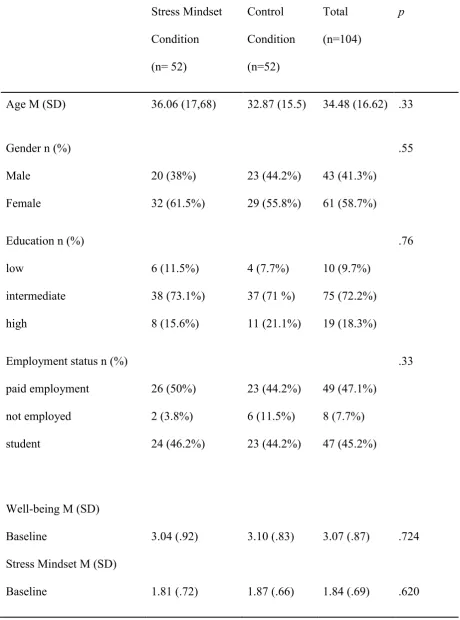
Table 1. summarizes the baseline characteristics and outcome measures (at baseline) of
the participants in the sample. The age range represented in the sample was 18 to 84, and 58.7%
of the participants were female. Participants mainly demonstrated an intermediate education
level and were mostly either paid employees or students. Participants total mean score on
well-being and stress mindset at baseline can be seen in Table 1., whereas at posttest participants
scored 3.21 (SD = .89) on well-being and had a score of 2.18 (SD = .62) on the stress mindset
measure. The baseline characteristics of the participants and the outcome measures at baseline
Table 1. Demographics (baseline) and Outcome Measures of Participants and between Group
Differences in the Intervention Group, Control Group, and the total Sample.
Stress Mindset Condition (n= 52) Control Condition (n=52) Total (n=104) p
Age M (SD) 36.06 (17,68) 32.87 (15.5) 34.48 (16.62) .33
Gender n (%)
Male Female 20 (38%) 32 (61.5%) 23 (44.2%) 29 (55.8%) 43 (41.3%) 61 (58.7%) .55
Education n (%)
low intermediate high 6 (11.5%) 38 (73.1%) 8 (15.6%) 4 (7.7%)
37 (71 %)
11 (21.1%) 10 (9.7%) 75 (72.2%) 19 (18.3%) .76
Employment status n (%)
paid employment not employed student 26 (50%) 2 (3.8%) 24 (46.2%) 23 (44.2%) 6 (11.5%) 23 (44.2%) 49 (47.1%) 8 (7.7%) 47 (45.2%) .33
Well-being M (SD)
Baseline
Stress Mindset M (SD)
* p < .05.
Dropouts
Dropouts were defined as participants that either did not finish the survey or indicated
that they did not read the intervention text. Overall 76 participants completed the survey,
accounting for 73.1%, and resulting in a dropout rate of 26.9% (n = 28). The dropout rate did
not significantly differ between the intervention and the control condition (χ2 (1) = 1.76, p=
.185) and no significant differences were found among baseline characteristics between
dropouts and completers.
The relation between Stress Mindset and Well-Being
The first hypothesis stated that a person’s stress mindset is related to a person’s mental
well-being, with the stress-is-enhancing mindset being related to higher levels of well-being,
and the stress-is-debilitating mindset being related to lower levels of well-being. A bivariate
correlation analysis, between the baseline measures of well-being and stress mindset, was not
significant and showed no relation between a stress mindset and the level of mental well-being
at baseline (r (102) = .056, p = .57). However, a bivariate correlation between stress mindset
and well-being at posttest was significant. An increase in the stress mindset, from a
stress-is-debilitating to a stress-is-enhancing mindset, was moderately positively correlated with an
increase in the level of well-being of the sample, r = .202, p = .04. Therefore, the first hypothesis
is rejected, as there was no significant relationship found between stress mindset and mental
Impact on Stress Mindset
The second hypothesis stated that a person's stress-is-debilitating mindset can be
changed by reading an informative text about the benefits and positive aspects of stress. A
paired samples t-test revealed significant differences within the stress mindset condition
between baseline and posttest measures on stress mindset, t (51) = -6.37, p = .000. The effect
size according to Cohen (1988) was d= 0.71, which indicates a medium to strong effect within
the group. The difference within the control condition between baseline and posttest measures
on stress mindset was found to be significant as well, t (51) = -3.16) p = .003. The effect size
for this within group difference was d = 0.33, implying a small to medium effect (Cohen, 1988).
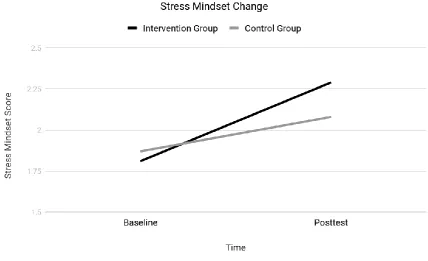
However, as the difference between the conditions on the stress mindset at posttest
appeared to be marginal significant with an adjusted alpha level of .01 (t (102) = 1.78, p = .078;
Table 2.), the second hypothesis can be accepted. There was a change of the stress mindset,
from a stress-is-debilitating mindset to a stress-is-enhancing mindset, from baseline to posttest,
in the intervention condition compared to the control condition. The effect of the between-group
difference can be considered small to medium with a score of d = 0.34 (Cohen, 1988). At
baseline, 61.5% of participants in the intervention condition demonstrated a
stress-is-debilitating mindset and 38.5% participants held a stress-is-enhancing mindset, whereas at
posttest 61.5% participants demonstrated the stress-is-enhancing mindset. The change in the
Fig. 2: Effect of Manipulation Condition on Stress Mindset at Posttest.
Mediation
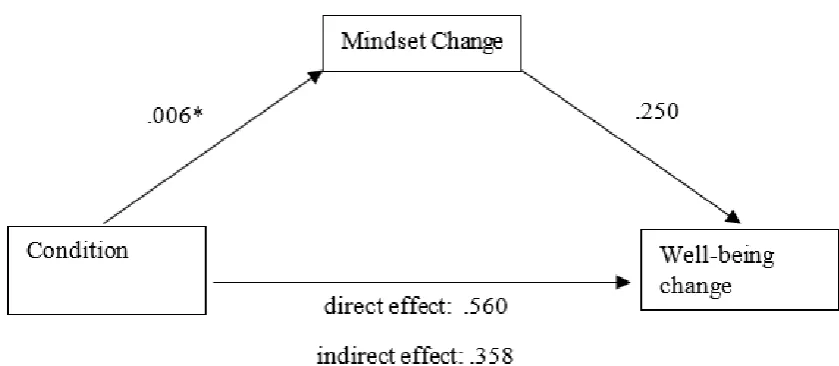
The third hypothesis stated that mental well-being would improve more after the
manipulation for those who changed their stress mindset to a stress-is-enhancing mindset. The
effect of path a of the mediation model was significant (p = .006), whereas path b as well as
path c’ where not significant (p = .250; p = .560). The analysis revealed no significant c path,
which indicated that there was no indirect effect of the manipulation condition X on change in
mental well-being Y, by means of changing the stress mindset M (b= -.03, 95% CI [-.81, .01]).
Thus, the manipulation condition does not have an indirect effect on the change in the level of
well-being of the participants through changing the mindset of the participants from a
stress-is-debilitating mindset to a stress-is-enhancing mindset. Thereby the third hypothesis can be
Fig. 3.: Mediation model on the effect of the condition on well-being change, * p < .05.
Discussion
The purpose of this paper was to investigate the relation between a person’s mindset
towards stress and the individual's level of mental well-being. Specifically, the aim was to
determine whether a change in the individual's stress mindset could be evoked by means of
written information about mindsets and whether a change in the mindset may be accompanied
by a change of the individual’s level of mental well-being. The results of the current study
demonstrate a change in the participants' mindset, from a stress-is-debilitating mindset to a
stress-is-enhancing mindset. However, the experimental condition did not show a significant
change in mental well-being as a consequence of a change in the stress mindset.
Firstly, in disagreement with the first hypothesis, no significant positive correlation was
found between stress mindset and mental well-being at baseline, suggesting that there is no
relation between those two measures in the current study. A stress-is-enhancing mindset was
not, as expected, related to higher levels of mental well-being. Other studies examining the
relationship between stress mindset and well-being mainly focussed on well-being as defined
by the participants' level of satisfaction with life (Crum, Salovey, & Achor, 2013). Despite
definition of well-being might be the explanation for the missing significant results.
Additionally, in the study by Crum, Salovey and Achor (2013) researchers controlled for the
amount of the variable of stress and coping abilities when investigating the relationship between
stress mindset and well-being. The experienced amount of stress and coping abilities of a person
might be confounding variables that intervene and influence the relationship between the
stress-is-enhancing mindset and higher levels of mental well-being.
Moreover, participants in the study by Crum, Salovey and Achor (2013) were
employees of a big company undergoing drastic changes, such as downsizing of employees,
whereas the current study reflects a sample of the general population. Employees fearing to lose
their jobs might experience higher levels of stress and lower levels of well-being, which might
have an influence on the presented stress mindsets in the sample. Indeed, the sample of the
study by Crum, Salovey and Achor (2013) demonstrated a slightly higher stress-is-debilitating
mindset with a lower mean of 1.62 (SD = .67; Crum, Salovey, & Achor, 2013), in contrast to
the current studies mean score of the stress mindset at baseline was 1.84 (SD = .69). A more
extreme stress-is-debilitating mindset might thus be more significantly correlating with levels
of mental well-being. However, the results demonstrated that the mindset at posttest was indeed
positively correlated to the level of mental well-being. The idea of more extreme stress-mindset
scores relating more significantly to the level of mental well-being might be seen there as well.
With a higher mean score at posttest of 2.18 (SD = .62), participants demonstrated a
stress-is-enhancing mindset that was significantly related to mental well-being.
Until now, no other study confirmed the relation between the stress mindset and mental
well-being (emotional, psychological and social) as defined by means of this study. Thus, the
results of the current study are novel and solely relate to other studies focusing on life
satisfaction and performance as measures of well-being in support of the current findings
stress mindset and mental being, consisting of social, emotional and psychological
well-being in order to clarify the findings.
The second hypothesis stated that a person’s stress-is-debilitating mindset could be
changed by means of an informative text about the benefits and positive aspects of stress.
Supporting this hypothesis, the results demonstrated a significant change of the
stress-is-debilitating mindset to a stress-is-enhancing mindset, from baseline to posttest, in the
experimental condition compared to the control condition. Those findings are in line with a
study conducted by Wegmann, Moshman, and Rubin (2017) investigating the changeability of
the stress mindset in university students, by means of a semester-long stress management
course. Their results revealed that students in the experimental condition developed a more
stress-is-enhancing mindset compared to the control group after the intervention. Findings of
the current study confirm that the change of a stress mindset is possible by means of an
intervention.
However, the current study adds that a smaller intervention is sufficient to significantly
change people's mindset from a stress-is-debilitating mindset to a stress-is-enhancing mindset.
An extensive intervention program such as the semester-long management course it not
necessary to change the stress mindset, as an informative text about the beneficial aspects of
stress is sufficient. This might be especially important when considering the possibilities of the
mental health sector in general. Knowing that a short intervention, such as providing an
informative text about positive aspects of stress, is sufficient in changing people's stress
mindset, interventions helping people to cope with stress or other mental illnesses might profit
from the short possibility to intervene. Thereby, a significant change could be evoked in a
number of people by means of lower costs and efforts, due to a simple intervention.
Additionally, the current study focused on changing the stress mindset in a general population
of the college sector by choosing university students. The added value of the possible stress
mindset change from debilitating to enhancing in the general population, shows higher
representativeness, as up until now research on stress mindset change mainly focussed on a
sample in the business or college sector (eg., Crum, Salovey, & Achor, 2013; Wegmann,
Moshman, & Rubin,2017). Overall, the findings present the changeability of the
stress-is-debilitating mindset fairly and verify the findings of other studies.
The third hypothesis stated that mental well-being improved more after the
manipulation for those who changed their stress mindset to a stress-is-enhancing mindset. The
results of the mediation analysis were not significant. Despite assumptions, the change in the
mindset did not significantly mediate the relationship between the different conditions and the
level of well-being at the end of the intervention. To our knowledge, no research exists that was
comparable to the investigation of the changeability of the stress mindset mediating the
relationship between the condition and mental well-being. Therefore, research representing
similar effects will be explained and used as a comparison for the results of the third hypothesis.
For example, one of the few studies investigated the possibility of the changeability of the stress
mindset and consequential change in psychological symptoms and work performance. Results
demonstrated that participants did change their mindset towards the stress-is-enhancing mindset
and reported improved psychological symptoms in relation to mood and anxiety and better work
performance (Crum, Salovey & Achor 2013). Due to the fact that the current study focussed on
the effect on mental well-being, whereas the study by Crum, Salovey and Achor (2013)
concentrated on psychological symptoms, it may be suggested that the type of health outcome
is relevant. Thus, there might be an effect of the stress mindset change on psychological
symptoms, however not on mental well-being.
A study by Marten (2017) examined the mediating effect of eustress and distress on the
effect a stress-is-enhancing mindset has on health, associating eustress with better health.
Distress was found to mediate the effect of the stress-is-debilitating mindset on health,
associating distress with worse health. The fact that the perception of stress appeared to be the
main indicator for either positive or negative relation of the mindset with health, it might be an
explanation for the missing significant mediation effect in the current study. It may be
concluded that the mindset one holds has an influence on the experience of stress and the way
of coping with stressful situations.
Additionally, as eustress was found to be related to positive emotions, it may be
suggested that it also has an influence on mental well-being. Thereby, a person's stress mindset
influences the according type of stress, which in turn has an influence on mental well-being
(Marten, 2017). This is supported by the fact that the health outcomes in the study by Marten
(2017) consisted of different measures, among others vitality, social functioning and mental
health, which appear to be aspects of mental well-being. As the results of the second hypothesis
demonstrate that there was a change in the participant's stress mindset, a mediating role of
eustress might explain why there was no consequential change in mental well-being and the
hypothesis had to be rejected. Concluding, it may be considered that eustress and distress did
mediate the change in the stress mindset and the change in mental well-being per condition.
Strength and Limitations
Several strengths can be acknowledged for the present study. Firstly, an
intention-to-treat analysis was conducted in order to impute the missing data at posttest. Secondly, the
current study is one of the few studies examining the stress mindset and its relation to mental
well-being, including emotional, social and psychological well-being, In addition, this was one
of the few studies trying to interfere and change the mindset of a person by means of an
intervention text about the beneficial aspects and consequences of stress. The online assessment
of socially desirable answers was minimized. Moreover, by means of personally recruiting
participants, researchers were able to reach high representativeness for the sample. This also
enabled an allocation of diverse groups. As earlier studies of stress mindset change mainly
focussed on samples of either students or employees in an organization (eg., Crum, Salovey, &
Achor, 2013; Wegmann, Moshman, & Rubin,2017). Lastly, the study demonstrates a good
randomization procedure, as it was carried out by a researcher not involved in the recruitment
of the participants.
However, there also are limitations that need to be taken into account. Firstly, the study
did not investigate the long-term effect of the intervention. Due to the fact that the posttest was
directly administered after the intervention and no follow-up survey was conducted, the
long-term effects on the stress mindset and mental well-being are not visible. It may be possible that
more participants did change their mindset in the long-term, despite not changing it directly
after the intervention. In contrast to this, the immediate change in mindset could also be
attributed to a spontaneous reaction towards the intervention. Thus, in the following weeks,
participants might have changed their mindset back to their original one, which might have an
influence on the person's well-being as well. Additionally, the chosen stress mindset
questionnaire was not available or validated in German. Due to this fact, questionnaires had to
be translated by means of the researchers. Despite examination and correction by means of
another independent researcher, those were not validated versions and were not tested
beforehand. Further, another limitation is that it could not be said with certainty if all of the
participants did read the intervention text. By means of a manipulation check, a question in the
survey about the content of the intervention text, the bias was minimized. However, it is still
unclear whether participants fully and thoroughly read the intervention text. Lastly, the study
study was conducted via e-mail and researcher thereby had no influence on the environment in
which participants did the study.
Implications and Future Research
The findings of this study may be relevant to the general public as human society
experiences an increasing amount of stress. Knowing about the effects of one's own stress
mindset on mental well-being may help people to change their perceptions and thereby enhance
their well-being. An implication for future research might be to lay focus on replicating the
study and verifying the results, as this seemed to be the first study relating the stress mindset to
mental well-being. More information on the relationship between those two concepts needs to
be found in order to lay a basis for practical implications. As the study did not include a
follow-up survey, it might be important for future research to investigate the long-term effects of the
intervention. By means of this, it can be said whether individuals still held the
stress-is-enhancing mindset after some time passed. Thereby, the intensity of mindset change can be
demonstrated and also found out whether an informative text about the beneficial aspects of
stress influences a stress mindset over a longer period.
Future research should also focus on the possible mediating role of eustress and distress
and whether they have a mediating role between the stress mindset and mental well-being.
Knowing more about a change in a person's mindsets and its consequences on the experience
of either eustress or distress may give insight into the possibilities of controlling stressful
outcomes by means of a positive mindset.
Furthermore, it would be important to focus also on other types and amounts of stress,
such as the difference between the effects of prolonged and short stress, or acute and chronic
stress. As situations may differ in the amount and type of experienced stress the mindset one
holds might have a different influence on the stress response and may change less easily under
impact on an individual, there might also be a difference in the willingness to change one's
mindset.
Conclusion
In conclusion, the current study enabled a novel view on the changeability of the stress
mindset and its relation to mental well-being. Results provide evidence for the possibility of a
change from a stress-is-debilitating mindset towards a stress-is-enhancing mindset by means of
an informative text intervention. Despite the fact that at baseline there was no correlation found
between the stress mindset and mental well-being, the significant relation between the stress
mindset and levels of mental well-being at posttest support the important association between
both constructs indicated by prior research (eg., Crum, Salovey, & Achor, 2013). Even though
findings yield significant results in the changeability of the stress mindset and the overall
relation to mental well-being, the intervention condition did not show to have an effect on
mental well-being. In contrast to expectations set by earlier research, the change from a negative
to a positive stress mindset did not elicit an increase in mental well-being (eg., Crum, Salovey,
References
Bargiel-Matusiewicz, K., Stelmachowska, P., & Omar, H. A. (2016). The role of stress in
assessing life satisfaction and self-efficacy among prison officers. Dynamics of Human
Health, 3(4). Retrieved from: https://uknowledge.uky.edu/pediatrics_facpub/237
Blankers, M., Koeter, M.W., Schippers, G.M. (2010). Missing data approaches in eHealth
research: simulation study and a tutorial for nonmathematically inclined researchers.
Journal of Medical Internet Research, 12(5), 54.
Cohen, S., Kamarck, T., & Mermelstein, R. (1983). A global measure of perceived stress.
Journal of Health and Social Behavior, 24, 385–396. doi:10.2307/2136404
Crum, A. J., Akinola, M., Martin, A., & Fath, S. (2017). The role of stress mindset in shaping
cognitive, emotional, and physiological responses to challenging and threatening
stress. Anxiety, Stress, & Coping, 30(4), 379-395.
Crum, A., & Lyddy, C. (2014). The Power of Mindsets and the Art of Stressing Mindfully.
The Wiley Blackwell handbook of mindfulness, 948.
Crum, A. J., Salovey, P., & Achor, S. (2013). Rethinking stress: The role of mindsets in
determining the stress response. Journal of personality and social psychology, 104(4),
716. doi: 10.1037/a0031201
Cohen, J. (1988). Statistical power analysis for the behavioral sciences (2nd Ed.). Hillsdale,
NJ: Erlbaum.
Fink, G. (2016). Stress, definitions, mechanisms, and effects outlined: lessons from anxiety.
In Stress: Concepts, cognition, emotion, and behavior (pp. 3-11). Academic Press.
Hayes, A. F. (2012). PROCESS: A versatile computational tool for observed variable
mediation, moderation, and conditional process modeling [White paper]. Retrieved
Jamieson, J. P., Crum, A. J., Goyer, J. P., Marotta, M. E., & Akinola, M. (2018). Optimizing
stress responses with reappraisal and mindset interventions: An integrated model.
Anxiety, Stress, & Coping, 31(3), 245-261. doi: 10.1080/10615806.2018.1442615
Keyes, C.L.M. (2009). Atlanta: Brief description of the mental health continuum short form
(MHC-SF). Retrieved from
http://www.aacu.org/sites/default/files/MHC-SFEnglish.pdf
Lamers, S.M.A., Westerhof, G.J., Bohlmeijer, E.T., ten Klooster, P.M., & Keyes, C.L.M.
(2011). Evaluating the psychometric properties of the Mental Health Continuum-Short
Form (MHCSF). Journal of Clinical Psychology, 67(1), 99-110. doi:10.1002/jclp.20741
Marten, F. (2017). The Mediating Effect of Eustress and Distress on the Relation between the
Mindset towards Stress and Health (Bachelor's thesis, University of Twente).
Norton, M. I., Anik, L., Aknin, L. B., & Dunn, E. W. (2011). Is life nasty, brutish, and short?
Philosophies of life and well-being. Social Psychological and Personality Science,
2(6),570-575. doi: 10.1177/1948550611401425
Selye, H. (1987). Stress. Sterling Educational Film.
Wegmann, J., Moshman, R. A., & Rubin, L. (2017). Is it Possible to Change the Way College
Students Think About Stress? The Benefits of a Stress Management Course. Research
Days Student Posters. 8. Retrieved from:
Appendix A
Stress mindset
The beneficial nature of stress.
Did you know that stress is beneficial for your health and personal growth? Although stress is
being portrayed in a negative way in the media and by the people around us, there is also a
positive side of experiencing stress. For example, people who believe that stress is positive have
higher energy levels, show better workplace performance, are more satisfied with their life in
general and have fewer symptoms of depression and anxiety. How do you interpret a stressful
situation? Do you find stress negative or positive?
Recent scientific studies have shown that experiencing stress puts the body and the brain
in an optimal condition to function in order to fulfill the demands and tasks asked for. Therefore,
the attention is focused on the demands and this will boost memory and performance. Stress is
an essential ingredient of being able to fulfill everyday tasks as well as more difficult
challenges. Thus, individuals who perceive stress as a necessary and positive aspects of life are
more likely to succeed and feel happy.
Taken together, if you believe that stress is positive, this can have a great beneficial
Appendix B
Control Group
The Big Five.
Did you know that ‘The Big Five’ are not only animals but also indicate your personality?
While the big five animals in Africa refer to the five animals most difficult to hunt on foot - the
lion, leopard, rhinoceros, elephant and cape buffalo - psychologists use the term to describe the
five core traits of your personality:
1. Openness to experience: curious, broad range of interests, try new things.
2. Conscientiousness: thoughtfulness and planning, organized, attention to detail.
3. Extraversion: sociable, talkative, assertive, outgoing and energized.
4. Agreeableness: trust, kindness, cooperative, care about other people.
5. Neuroticism: emotional unstable, mood swings, gets upset easily.
Recent scientific studies have shown that both biological and environmental influences
play a role in shaping our personalities. Studies also suggest that these big five personality traits
tend to be relatively stable over the course of adulthood. It is important to note that each of the
five personality factors represents a range between two extremes. For example, extreme
extraversion versus extreme introversion, and neuroticism (emotional instability) versus
emotional stability. In the real world, most people lie somewhere in between the two polar ends
of each dimension.
Taken together, your personality can be categorized into five main personality traits
Appendix C
Debriefing Document
Dear participant,
In the past 2 weeks, you took part in the study investigating how people perceive new
information. We sincerely thank you for your invested time to participate! We are very happy
with the way in which everyone was involved and has done their best to complete all surveys.
With the data from this study, we can find answers to important scientific questions and we
hope to gain more insight in how people perceive and react to new information. We will now
inform you about the real set-up of the study and its aim.
Set-up of the study. In total, XX people participated in the study. They were divided into
3 different groups of equal size and every group received a different text to read before the
second survey. If you are interested, you can read those texts on the following pages (or skip
these by clicking on the arrow to go to the next page). One text was about how people perceive
stress, one text was about how people perceive life and one text was about personality. The
latter text was used as a control condition, we expected no change in your perceptions or beliefs
after reading this text. However, we did expect that the so called 'stress mindset' or 'life-mindset'
would change in a beneficial way, by reading the other two texts.
Aim of the study. The aim of this study was to analyse whether the different mindsets
(about stress or about life) could be changed with appropriate information. We also test whether
such information influences your mental well-being in a beneficial way. The used texts conform
to current scientific knowledge and we were curious whether people perceive, believe or act
differently after reading some of the latest insights from science.
In order to not bias or distort the results, we kept back the true aim of the study. We
expect some first results in a few months, although a scientific paper about the results will
insights we used as input for the texts about the stress or life mindset, we give you some reading
tips below. Again, we thank you very much for your invested time and participation!
Reading tips. https://www.tandfonline.com/doi/abs/10.1080/10615806.2016.1275585 (about