A Novel Text Classifier Based on Quantum Computation
Ding Liu, Xiaofang Yang, Minghu Jiang
Laboratory of Computational Linguistics, School of Humanities,
Tsinghua University, Beijing , China
[email protected] [email protected]
[email protected]
Abstract
In this article, we propose a novel classifier based on quantum computation theory. Differ-ent from existing methods, we consider the classification as an evolutionary process of a physical system and build the classifier by us-ing the basic quantum mechanics equation. The performance of the experiments on two datasets indicates feasibility and potentiality of the quantum classifier.
1
Introduction
Taking modern natural science into account, the quantum mechanics theory (QM) is one of the most famous and profound theory which brings a world-shaking revolution for physics. Since QM was born, it has been considered as a significant part of theoretic physics and has shown its power in explaining experimental results. Furthermore, some scientists believe that QM is the final prin-ciple of physics even the whole natural science. Thus, more and more researchers have expanded the study of QM in other fields of science, and it has affected almost every aspect of natural sci-ence and technology deeply, such as quantum computation.
The principle of quantum computation has al-so affected a lot of scientific researches in com-puter science, specifically in computational mod-eling, cryptography theory as well as information theory. Some researchers have employed the principle and technology of quantum computa-tion to improve the studies on Machine Learning (ML)(Aїmeur et al., 2006; Aїmeur et al., 2007; Chen et al., 2008; Gambs, 2008; Horn and Gottlieb, 2001; Nasios and Bors, 2007), a field which studies theories and constructions of sys-tems that can learn from data, among which clas-sification is a typical task. Thus, we attempted to
build a computational model based on quantum computation theory to handle classification tasks in order to prove the feasibility of applying the QM model to machine learning.
In this article, we present a method that con-siders the classifier as a physical system amena-ble to QM and treat the entire process of classifi-cation as the evolutionary process of a closed quantum system. According to QM, the evolu-tion of quantum system can be described by a unitary operator. Therefore, the primary problem of building a quantum classifier (QC) is to find the correct or optimal unitary operator. We ap-plied classical optimization algorithms to deal with the problem, and the experimental results have confirmed our theory.
The outline of this paper is as follows. First, the basic principle and structure of QC is intro-duced in section 2. Then, two different experi-ments are described in section 3. Finally, section 4 concludes with a discussion.
2
Basic principle of quantum classifier
As we mentioned in the introduction, the major principle of quantum classifier (QC) is to consid-er the classificonsid-er as a physical system and the whole process of classification as the evolution-ary process of a closed quantum system. Thus, the evolution of the quantum system can be de-scribed by a unitary operator (unitary matrix), and the remaining job is to find the correct or optimal unitary operator.
2.1 Architecture of quantum classifier
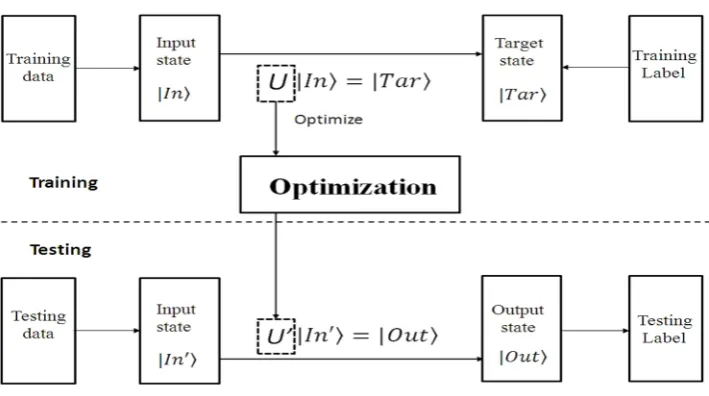
The architecture and the whole procedure of data processing of QC are illustrated in Figure 1. As is shown, the key aspect of QC is the optimiza-tion part where we employ the optimizaoptimiza-tion algo-rithm to find an optimal unitary operator .
Figure 1. Architecture of quantum classifier
The detailed information about each phase of the process will be explained thoroughly in the fol-lowing sections.
2.2 Encode input state and target state
In quantum mechanics theory, the state of a physical system can be described as a superposi-tion of the so called eigenstates which are or-thogonal. Any state, including the eigenstate, can be represented by a complex number vector. We use Dirac’s braket notation to formalize the data as equation 1:
| ⟩ = | ⟩ (1)
where | ⟩ denotes a state and ∈ ℂ is a com-plex number with = ⟨ | ⟩ being the projec-tion of | ⟩ on the eigenstate | ⟩. According to quantum theory, denotes the probability am-plitude. Furthermore, the probability of | ⟩ col-lapsing on | ⟩ is P( ) =∑ || || .
Based on the hypothesis that QC can be con-sidered as a quantum system, the input data should be transformed to an available format in quantum theory — the complex number vector. According to Euler’s formula, a complex number
z can be denoted as = with r≥ , ∈ ℝ. Equation 1, thus, can be written as:
| ⟩ = | ⟩ (2)
where and denote the module and the phase of the complex coefficient respectively.
For different applications, we employ different approaches to determine the value of and . Specifically, in our experiment, we assigned the term frequency, a feature frequently used in text classification to , and treated the phase as a constant, since we found the phase makes little contribution to the classification.
For each data sample , we calculate the corresponding input complex number vector by equation 3, which is illustrated in detail in Figure 2.
| ⟩ = ∙ | (3)
Figure 2. Process of calculating the input state
Each eigenstate | denotes the correspond-ing , resulting in m eigenstates for all the samples.
As is mentioned above, the evolutionary pro-cess of a closed physical system can be described by a unitary operator, depicted by a matrix as in equation 4:
| ⟩ = | ⟩ (4)
section 2.3. We encode the target state in the similar way. Like the Vector Space Model(VSM), we use a label matrix to represent each class as in Figure 3.
Figure 3. Label matrix
For each input sample , we generate the corresponding target complex number vector according to equation 5:
| ⟩ = ∙ | (5)
where each eigenstate | represents the corre-sponding , resulting in w eigenstates for all the labels. Totally, we need + eigen-states, including features and labels.
2.3 Finding the Hamiltonian matrix and the Unitary operator
As is mentioned in the first section, finding a unitary operator to describe the evolutionary pro-cess is the vital step in building a QC. As a basic quantum mechanics theory, a unitary operator can be represented by a unitary matrix with the property = , and a unitary operator can also be written as equation 6:
= ℏ (6)
where H is the Hamiltonian matrix and ℏ is the reduced Planck constant. Moreover, the Hamil-tonian H is a Hermitian matrix with the property
= ( )∗= . The remaining job, therefore, is to find an optimal Hamiltonian matrix.
Since H is a Hermitian matrix, we only need to determine ( + ) free real parameters, provided that the dimension of H is (m+w). Thus, the problem of determining H can be regarded as a classical optimization problem, which can be resolved by various optimization algorithms (Chen and Kudlek, 2001). An error function is defined as equation 7:
( ) =
∑( , )∈
(7)
where T is a set of training pairs with , , denoting the target, input, and output state respectively, and is determined by as equation 8:
| ⟩ = ℏ | ⟩ (8)
In the optimization phase, we employed sever-al optimization sever-algorithm, including BFGS, Ge-neric Algorithm, and a multi-objective optimiza-tion algorithm SQP (sequential quadratic pro-gramming) to optimize the error function. In our experiment, the SQP method performed best out-performed the others.
3
Experiment
We tested the performance of QC on two differ-ent datasets. In section 3.1, the Reuters-21578 dataset was used to train a binary QC. We com-pared the performance of QC with several classi-cal classification methods, including Support Vector Machine (SVM) and K-nearest neighbor (KNN). In section 3.2, we evaluated the perfor-mance on multi-class classification using an oral conversation datasets and analyzed the results.
3.1 Reuters-21578
The Reuters dataset we tested contains 3,964 texts belonging to “earnings” category and 8,938 texts belonging to “others” categories. In this classification task, we selected the features by calculating the score of each term from the “earnings” category (Manning and Schütze, 2002).
Figure 4. Classification accuracy for Reuters-21578 datasets
Generally speaking, the QC trained by a large training set may not always has an ideal perfor-mance. Whereas some single training sample pair led to a favorable result when we used only one sample from each category to train the QC. Actually, some single samples could lead to an accuracy of more than 90%, while some others may produce an accuracy lower than 30%. Therefore, the most significant factor for QC is the quality of the training samples rather than the quantity.
3.2 Oral conversation datasets
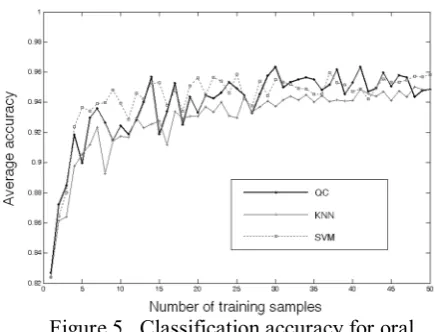
[image:4.595.74.289.69.237.2]Besides the binary QC, we also built a multi-class version and tested its performance on an oral conversation dataset which was collected by the Laboratory of Computational Linguistics of Tsinghua university. The dataset consisted of 1,000 texts and were categorized into 5 classes, each containing 200 texts. We still took the term frequency as the feature, the dimension of which exceeded 1,000. We, therefore, utilized the pri-mary component analysis (PCA) to reduce the high dimension of the features in order to de-crease the computational complexity. In this ex-periment, we chose the top 10 primary compo-nents of the outcome of PCA, which contained nearly 60% information of the original data. Again, we focused on the performance of QC trained by small-scale training sets. We selected 100 samples from each class to construct the training pool and took the rest of the data as the testing sets. Same to the experiment in section 3.1, we randomly selected the training samples from the training pool ten times to train QC, SVM, and KNN classifier respectively and veri fied the models on the testing sets, the results of which are shown in Figure 5.
Figure 5. Classification accuracy for oral conversation datasets
4
Discussion
We present here our model of text classification and compare it with SVM and KNN on two da-tasets. We find that it is feasible to build a super-vised learning model based on quantum mechan-ics theory. Previous studies focus on combining quantum method with existing classification models such as neural network (Chen et al., 2008) and kernel function (Nasios and Bors, 2007) aim-ing to improve existaim-ing models to work faster and more efficiently. Our work, however, focus-es on developing a novel method which explorfocus-es the relationship between machine learning model with physical world, in order to investigate these models by physical rule which describe our uni-verse. Moreover, the QC performs well in text classification compared with SVM and KNN and outperforms them on small-scale training sets. Additionally, the time complexity of QC depends on the optimization algorithm and the amounts of features we adopt. Generally speaking, simulat-ing quantum computsimulat-ing on classical computer always requires more computation resources, and we believe that quantum computer will tackle the difficulty in the forthcoming future. Actually, Google and NASA have launched a quantum computing AI lab this year, and we regard the project as an exciting beginning.
Acknowledgments
This work was supported by the National Natural Science Foundation in China (61171114), State Key Lab of Pattern Recognition open foundation, CAS. Tsinghua University Self-determination Research Project (20111081023 & 20111081010) and Human & liberal arts development founda-tion (2010WKHQ009)
References
Esma Aїmeur, Gilles Brassard, and Sébastien Gambs. 2006. Machine Learning in a Quantum World. Ca-nadian AI 2006
Esma Aїmeur, Gilles Brassard and Sébastien Gambs. 2007. Quantum Clustering Algorithms. Proceed-ings of the 24 th International Conference on Ma-chine Learning
Joseph C.H. Chen and Manfred Kudlek. 2001. Duality of Syntex and Semantics – From the View Point of Brain as a Quantum Computer. Proceedings of Re-cent Advances in NLP
Joseph C.H. Chen. 2001. Quantum Computation and Natural Language Processing. University of Ham-burg, Germany. Ph.D. thesis
Joseph C.H. Chen. 2001. A Quantum Mechanical Approach to Cognition and Representation. Con-sciousness and its Place in Nature,Toward a Sci-ence of Consciousness.
Cheng-Hung Chen, Cheng-Jian Lin and Chin-Teng Lin. 2008. An efficient quantum neuro-fuzzy clas-sifier based on fuzzy entropy and compensatory operation. Soft Comput, 12:567–583.
Fumiyo Fukumoto and Yoshimi Suzuki. 2002. Ma-nipulating Large Corpora for Text Classification. Proceedings of the Conference on Empirical Meth-ods in Natural Language Processing
Sébastien Gambs. 2008. Quantum classification, arXiv:0809.0444
Lov K. Grover. 1997. Quantum Mechanics Helps in Searching for a Needle in a Haystack. Physical Re view Letters, 79,325–328
David Horn and Assaf Gottlieb. 2001. The Method of Quantum Clustering. Proceedings of Advances in Neural Information Processing Systems .
Christopher D. Manning and Hinrich Schütze. 2002. Foundations of Statistical Natural Language Pro-cessing. MIT Press. Cambridge, Massachu-setts,USA.
Nikolaos Nasios and Adrian G. Bors. 2007. Kernel-based classification using quantum mechanics. Pat-tern Recognition, 40:875–889
Hartmut Neven and Vasil S. Denchev. 2009. Training a Large Scale Classifier with the Quantum Adia-batic Algorithm. arXiv:0912.0779v1
Michael A. Nielsen and Isasc L. Chuang. 2000. Quan-tum Computation and QuanQuan-tum Information, Cam-bridge University Press, CamCam-bridge, UK.
Masahide Sasaki and and Alberto Carlini. 2002. Quantum learning and universal quantum matching machine. Physical Review, A 66, 022303