Unsupervised Dependency Parsing with Transferring
Distribution via Parallel Guidance and Entropy Regularization
Xuezhe Ma Department of Linguistics
University of Washington Seattle, WA 98195, USA
Fei Xia
Department of Linguistics University of Washington
Seattle, WA 98195, USA [email protected]
Abstract
We present a novel approach for induc-ing unsupervised dependency parsers for languages that have no labeled training data, but have translated text in a resource-rich language. We train probabilistic pars-ing models for resource-poor languages by transferring cross-lingual knowledge from resource-rich language with entropy reg-ularization. Our method can be used as a purely monolingual dependency parser, requiring no human translations for the test data, thus making it applicable to a wide range of resource-poor languages. We perform experiments on three Data sets — Version 1.0 and version 2.0 of Google Universal Dependency Treebanks and Treebanks from CoNLL shared-tasks, across ten languages. We obtain state-of-the art performance of all the three data sets when compared with previously studied unsupervised and projected pars-ing systems.
1 Introduction
In recent years, dependency parsing has gained universal interest due to its usefulness in a wide range of applications such as synonym gener-ation (Shinyama et al., 2002), relgener-ation extrac-tion (Nguyen et al., 2009) and machine trans-lation (Katz-Brown et al., 2011; Xie et al., 2011). Several supervised dependency parsing algorithms (Nivre and Scholz, 2004; McDonald et al., 2005a; McDonald et al., 2005b; McDon-ald and Pereira, 2006; Carreras, 2007; Koo and Collins, 2010; Ma and Zhao, 2012; Zhang et al., 2013) have been proposed and achieved high pars-ing accuracies on several treebanks, due in large part to the availability of dependency treebanks in a number of languages (McDonald et al., 2013).
However, the manually annotated treebanks that these parsers rely on are highly expensive to cre-ate, in particular when we want to build treebanks for resource-poor languages. This led to a vast amount of research on unsupervised grammar in-duction (Carroll and Charniak, 1992; Klein and Manning, 2004; Smith and Eisner, 2005; Cohen and Smith, 2009; Spitkovsky et al., 2010; Blun-som and Cohn, 2010; Mareˇcek and Straka, 2013; Spitkovsky et al., 2013), which appears to be a natural solution to this problem, as unsupervised methods require only unannotated text for training parsers. Unfortunately, the unsupervised gram-mar induction systems’ parsing accuracies often significantly fall behind those of supervised sys-tems (McDonald et al., 2011). Furthermore, from a practical standpoint, it is rarely the case that we are completely devoid of resources for most lan-guages.
In this paper, we consider a practically moti-vated scenario, in which we want to build statisti-cal parsers for resource-poor target languages, us-ing existus-ing resources from a resource-rich source language (like English).1 We assume that there are absolutely no labeled training data for the target language, but we have access to parallel data with a resource-rich language and a sufficient amount of labeled training data to build an accurate parser for the resource-rich language. This scenario ap-pears similar to the setting in bilingual text pars-ing. However, most bilingual text parsing ap-proaches require bilingual treebanks — treebanks that have manually annotated tree structures on both sides of source and target languages (Smith and Smith, 2004; Burkett and Klein, 2008), or have tree structures on the source side and trans-lated sentences in the target languages (Huang et
1For the sake of simplicity, we refer to the resource-poor language as the “target language”, and resource-rich language as the “source language”. In addition, in this study we use En-glish as the source resource-rich language, but our methodol-ogy can be applied to any resource-rich languages.
al., 2009; Chen et al., 2010). Obviously, bilingual treebanks are much more difficult to acquire than the resources required in our scenario, since the la-beled training data and the parallel text in our case are completely separated. What is more impor-tant is that most studies on bilingual text parsing assumed that the parser is applied only on bilin-gual text. But our goal is to develop a parser that can be used in completely monolingual setting for each target language of interest.
This scenario is applicable to a large set of lan-guages and many research studies (Hwa et al., 2005) have been made on it. Ganchev et al. (2009) presented a parser projection approach via paral-lel text using the posterior regularization frame-work (Graca et al., 2007). McDonald et al. (2011) proposed two parser transfer approaches between two different languages — one is directly trans-ferred parser from delexicalized parsers, and the other parser is transferred using constraint driven learning algorithm where constraints are drawn from parallel corpora. In that work, they demon-strate that even the directly transferred delexi-calized parser produces significantly higher ac-curacies than unsupervised parsers. Cohen et al. (2011) proposed an approach for unsupervised dependency parsing with non-parallel multilingual guidance from one or more helper languages, in which parallel data is not used.
In this work, we propose a learning frame-work for transferring dependency grammars from a resource-rich language to resource-poor lan-guages via parallel text. We train probabilistic parsing models for resource-poor languages by maximizing a combination of likelihood on par-allel data and confidence on unlabeled data. Our work is based on the learning framework used in Smith and Eisner (2007), which is originally de-signed for parser bootstrapping. We extend this learning framework so that it can be used to trans-fer cross-lingual knowledge between diftrans-ferent lan-guages.
Throughout this paper, English is used as the source language and we evaluate our approach on ten target languages — Danish (da), Dutch (nl), French (fr), German (de), Greek (el), Italian (it), Korean (ko), Portuguese (pt), Spanish (es) and Swedish (sv). Our approach achieves significant improvement over previous state-of-the-art unsu-pervised and projected parsing systems across all the ten languages, and considerably bridges the
[image:2.595.310.534.62.105.2]Economic news had little effect on financial markets Root
Figure 1: An example dependency tree.
gap to fully supervised dependency parsing per-formance.
2 Our Approach
Dependency trees represent syntactic relationships through labeled directed edges between heads and their dependents. For example, Figure 1 shows a dependency tree for the sentence, Economic news
had little effect on financial markets, with the
sen-tence’s root-symbol as its root. The focus of this work is on building dependency parsers for target languages, assuming that an accurate English de-pendency parser and some parallel text between the two languages are available. Central to our ap-proach is a maximizing likelihood learning frame-work, in which we use an English parser and par-allel text to estimate the “transferring distribution” of the target language parsing model (See Section 2.2 for more details). Another advantage of the learning framework is that it combines both the likelihood on parallel data and confidence on unla-beled data, so that both parallel text and unlaunla-beled data can be utilized in our approach.
2.1 Edge-Factored Parsing Model
In this paper, we will use the following notation: xrepresents a generic input sentence, andy rep-resents a generic dependency tree. T(x) is used to denote the set of possible dependency trees for sentence x. The probabilistic model for de-pendency parsing defines a family of conditional probability pλ(y|x) over all y given sentence x, with a log-linear form:
pλ(y|x) =Z(1x)exp X
j
λjFj(y,x)
(1)
whereFj are feature functions, λ = (λ1, λ2, . . .) are parameters of the model, and Z(x) is a nor-malization factor, which is commonly referred to as the partition function:
Z(x) = X
y∈T(x)
exp X
j
λjFj(y,x)
A common strategy to make this parsing model ef-ficiently computable is to factor dependency trees into sets of edges:
Fj(y,x) = X
e∈y
fj(e,x). (3)
That is, dependency tree y is treated as a set of edges eand each feature function Fj(y,x) is equal to the sum of all the featuresfj(e,x).
We denote the weight function of each edgeeas follows:
w(e,x) = exp X j
λjfj(e,x)
(4)
and the conditional probability pλ(y|x) has the following form:
pλ(y|x) = Z(1x) Y
e∈y
w(e,x) (5)
2.2 Model Training
One of the most common model training meth-ods for supervised dependency parser is Maxi-mum conditional likelihood estimation. For a su-pervised dependency parser with a set of train-ing data{(xi,yi)}, the logarithm of the likelihood (a.k.a. the log-likelihood) is given by:
L(λ) =X i
logpλ(yi|xi) (6)
Maximum likelihood training chooses parameters such that the log-likelihood L(λ)is maximized.
However, in our scenario we have no labeled training data for target languages but we have some parallel and unlabeled data plus an En-glish dependency parser. For the purpose of transferring cross-lingual information from the English parser via parallel text, we explore the model training method proposed by Smith and Eisner (2007), which presented a generalization of K function (Abney, 2004), and related it to an-other semi-supervised learning technique, entropy regularization (Jiao et al., 2006; Mann and Mc-Callum, 2007). The objective K function to be minimized is actually the expected negative log-likelihood:
K = −X
i X
yi
˜
p(yi|xi) logpλ(yi|xi)
= X
i
D(˜pi||pλ,i) +H(˜pi) (7)
where p˜i(·) def= ˜p(·|xi) and pλ,i(·) def= pλ(·|xi).
˜
p(y|x) is the “transferring distribution” that re-flects our uncertainty about the true labels, and we are trying to learn a parametric modelpλ(y|x)by minimizing theKfunction.
In our scenario, we have a set of aligned par-allel data P = {xsi,xti, ai}where ai is the word alignment for the pair of source-target sentences
(xs
i,xti), and a set of unlabeled sentences of the
target languageU ={xti}. We also have a trained English parsing model pλE(y|x). Then theK in equation (7) can be divided into two cases, accord-ing to whetherxi belongs to parallel data setP or unlabeled data setU. For the unlabeled examples {xi ∈ U}, some previous studies (e.g., (Abney,
2004)) simply use a uniform distribution over la-bels (e.g., parses), to reflect that the label is un-known. We follow the method in Smith and Eis-ner (2007) and take the transferring distribution
˜
pi to be the actual current belief pλ,i. The total
contribution of the unsupervised examples to K then simplifies toKU = P
xi∈U
H(pλ,i), which may
be regarded as the entropy item used to constrain the model’s uncertaintyHto be low, as presented in the work on entropy regularization (Jiao et al., 2006; Mann and McCallum, 2007).
But how can we define the transferring distri-bution for the parallel examples {xti ∈ P}? We define the transferring distribution by defining the
transferring weight utilizing the English parsing
modelpλE(y|x)via parallel data with word align-ments:
˜
w(et,xt i) =
(
wE(es,xis), ifet align−→ es wE(etdelex,xsi), otherwise
(8) where wE(·,·) is the weight function of the En-glish parsing model pλE(y|x), and etdelex is the delexicalized form2 of the edge et. From the definition of the transferring weight, we can see that, if an edge etof the target language sentence xt
i is aligned to an edge es of the English
sen-tence xsi, we transfer the weight of edge et to the corresponding weight of edge es in the En-glish parsing model pλE(y|x). If the edge et is not aligned to any edges of the English sen-tence xsi, we reduce the edge et to the delexical-ized form and calculate the transferring weight in the English parsing model. There are two
tages for this definition of the transferring weight. First, by transferring the weight function to the corresponding weight in the well-developed En-glish parsing model, we can project syntactic in-formation across language boundaries. Second, McDonald et al. (2011) demonstrates that parsers with only delexicalized features produce consid-erably high parsing performance. By reducing unaligned edges to their delexicalized forms, we can still use those delexicalized features, such as part-of-speech tags, for those unaligned edges, and can address problem that automatically generated word alignments include errors.
From the definition of transferring weight in equation (8), the transferring distribution can be defined in the following way:
˜
p(y|x) = ˜1
Z(x) Y
e∈y ˜
w(e,x) (9)
where
˜
Z(x) =X y
Y
e∈y ˜
w(e,x) (10)
Due to the normalizing factorZ˜(x), the transfer-ring distribution is a valid one.
We introduce a multiplier γ as a trade-off be-tween the two contributions (parallel and unsuper-vised) of the objective function K, and the final objective functionK′ has the following form:
K′ = −X
xi∈P X
yi ˜
p(yi|xi) logpλ(yi|xi)
+ γ X
xi∈U
H(pλ,i)
= KP +γKU (11)
KP and KU are the contributions of the parallel and unsupervised data, respectively. One may re-gard γ as a Lagrange multiplier that is used to constrain the parser’s uncertainty H to be low, as presented in several studies on entropy regulariza-tion (Brand, 1998; Grandvalet and Bengio, 2004; Jiao et al., 2006).
2.3 Algorithms and Complexity for Model Training
To train our parsing model, we need to find out the parametersλthat minimize the objective function K′ in equation (11). This optimization problem is typically solved using quasi-Newton numeri-cal methods such as L-BFGS (Nash and Nocedal, 1991), which requires efficient calculation of the
objective function and the gradient of the objec-tive function.
The first item (KP) of theK′ function in equa-tion (11) can be rewritten in the following form:
KP = −
X
xi∈P
X
yi ˜
p(yi|xi) X
e∈yi
logw(e,xi)
− logZ(xi) (12)
and according to equation (1) and (3) the gradient ofKP can be written as:
∂KP
∂λj =
X
xi∈P
∂p˜(yi|xi) logpλ(yi|xi)
∂λj
= X
xi∈P X
yi ˜
p(yi|xi) X
e∈yi
fj(e,xi)
−X
yi
pλ(yi|xi) X
e∈yi
fj(e,xi)
(13)
According to equation (9), p˜(y|x) can also be factored into the multiplication of the weight of each edge, so both KP and its gradient can be calculated by running theO(n3)inside-outside al-gorithm (Baker, 1979; Paskin, 2001) for projec-tive parsing. For non-projecprojec-tive parsing, the anal-ogy to the inside algorithm is the O(n3) matrix-tree algorithm based on Kirchhoff’s Matrix-Tree Theorem, which is dominated asymptotically by a matrix determinant (Koo et al., 2007; Smith and Smith, 2007). The gradient of a determinant may be computed by matrix inversion, so evaluating the gradient again has the sameO(n3)complexity as evaluating the function.
The second item (KU) of the K′ function in equation (11) is the Shannon entropy of the pos-terior distribution over parsing trees, and can be written into the following form:
KU = −
X
xi∈U
X
yi
pλ(yi|xi)X e∈yi
logw(e,xi)
− logZ(xi) (14)
and the gradient ofKU is in the following: ∂KU
∂λj = X
xi∈U
∂pλ(yi|xi) logpλ(yi|xi)
∂λj
=−X
yi
pλ(yi|xi) logpλ(yi|xi)Fj(yi,xi)
+ X
yi
pλ(yi|xi) logpλ(yi|xi)
· X
yi
pλ(yi|xi)Fj(yi,xi)
#sents/#tokens
training dev test
Version 1.0
de 2,200/30,460 800/12,215 1,000/16,339 es 3,345/94,232 370/10,191 300/8,295 fr 3,312/74,979 366/8,071 300/6,950 ko 5,308/62,378 588/6,545 298/2,917 sv 4,447/66,631 493/9,312 1,219/20,376
Version 2.0
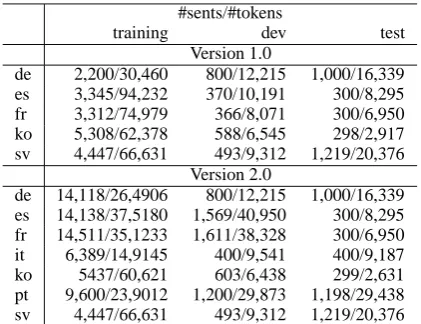
[image:5.595.75.286.61.223.2]de 14,118/26,4906 800/12,215 1,000/16,339 es 14,138/37,5180 1,569/40,950 300/8,295 fr 14,511/35,1233 1,611/38,328 300/6,950 it 6,389/14,9145 400/9,541 400/9,187 ko 5437/60,621 603/6,438 299/2,631 pt 9,600/23,9012 1,200/29,873 1,198/29,438 sv 4,447/66,631 493/9,312 1,219/20,376
Table 1: Data statistics of two versions of Google Universal Treebanks for the target languages.
Similar with the calculation ofKP,KU can also be computed by running the inside-outside algo-rithm (Baker, 1979; Paskin, 2001) for projective parsing. For the gradient of KU, both the two multipliers of the second item in equation (15) can be computed using the same inside-outside algo-rithm. For the first item in equation (15), anO(n3) dynamic programming algorithm that is closely related to the forward-backward algorithm (Mann and McCallum, 2007) for the entropy regularized CRF (Jiao et al., 2006) can be used for projective parsing. For non-projective parsing, however, the runtime rises toO(n4). In this paper, we focus on projective parsing.
2.4 Summary of Our Approach
To summarize the description in the previous sec-tions, our approach is performed in the following steps:
1. Train an English parsing model pλE(y|x), which is used to estimate the transferring dis-tributionp˜(y|x).
2. Prepare parallel text by running word align-ment method to obtain word alignalign-ments,3and prepare the unlabeled data.
3. Train a parsing model for the target lan-guage by minimizing the objectiveK′ func-tion which is the combinafunc-tion of expected negative log-likelihood on parallel and unla-beled data.
3The word alignment methods do not require additional resources besides parallel text.
# sents
500 1000 2000 5000 10000 20000 da 12,568 25,225 49,889 126,623 254,565 509,480 de 13,548 26,663 53,170 133,596 265,589 527,407 el 14,198 28,302 56,744 143,753 286,126 572,777 es 15,147 29,214 57,526 144,621 290,517 579,164 fr 15,046 29,982 60,569 153,874 306,332 609,541 it 15,151 29,786 57,696 145,717 288,337 573,557 ko 3,814 7,679 15,337 38,535 77,388 155,051 nl 13,234 26,777 54,570 137,277 274,692 551,463 pt 14,346 28,109 55,998 143,221 285,590 571,109 sv 12,242 24,897 50,047 123,069 246,619 490,086
Table 2: The number of tokens in parallel data used in our experiments. For all these corpora, the other language is English.
3 Data and Tools
In this section, we illustrate the data sets used in our experiments and the tools for data preparation.
3.1 Choosing Target Languages
Our experiments rely on two kinds of data sets: (i) Monolingual Treebanks with consistent anno-tation schema — English treebank is used to train the English parsing model, and the Treebanks for target languages are used to evaluate the parsing performance of our approach. (ii) Large amounts of parallel text with English on one side. We se-lect target languages based on the availability of these resources. The monolingual treebanks in our experiments are from the Google Universal De-pendency Treebanks (McDonald et al., 2013), for the reason that the treebanks of different languages in Google Universal Dependency Treebanks have consistent syntactic representations.
The parallel data come from the Europarl cor-pus version 7 (Koehn, 2005) and Kaist Corcor-pus4. Taking the intersection of languages in the two kinds of resources yields the following seven lan-guages: French, German, Italian, Korean, Por-tuguese, Spanish and Swedish.
The treebanks from CoNLL shared-tasks on dependency parsing (Buchholz and Marsi, 2006; Nivre et al., 2007) appear to be another reasonable choice. However, previous studies (McDonald et al., 2011; McDonald et al., 2013) have demon-strated that a homogeneous representation is criti-cal for multilingual language technologies that re-quire consistent cross-lingual analysis for down-stream components, and the heterogenous repre-sentations used in CoNLL shared-tasks treebanks weaken any conclusion that can be drawn.
4http://semanticweb.kaist.ac.kr/home/
[image:5.595.306.527.64.160.2]DTP DTP† PTP† -U +U OR de 58.50 58.46 69.21 73.72 74.01 78.64 es 68.07 68.72 72.57 75.32 75.60 82.56 fr 70.14 71.13 74.60 76.65 76.93 83.69 ko 42.37 43.57 53.72 59.72 59.94 89.85 sv 70.56 70.59 75.87 78.91 79.27 85.59 Ave 61.93 62.49 69.19 72.86 73.15 84.67
Table 3: UAS for two versions of our approach, to-gether with baseline and oracle systems on Google Universal Treebanks version 1.0. “Ave” is the macro-average across the five languages.
For comparison with previous studies, never-theless, we also run experiments on CoNLL tree-banks (see Section 4.4 for more details). We eval-uate our approach on three target languages from CoNLL shared task treebanks, which do not ap-pear in Google Universal Treebanks. The three languages are Danish, Dutch and Greek. So totally we have ten target languages. The parallel data for these three languages are also from the Europarl corpus version 7.
3.2 Word Alignments
In our approach, word alignments for the paral-lel text are required. We perform word alignments with the open source GIZA++ toolkit5. The paral-lel corpus was preprocessed in standard ways, se-lecting sentences with the length in the range from 3 to 100. Then we run GIZA++ with the default setting to generate word alignments in both direc-tions. We then make the intersection of the word alignments of two directions to generate one-to-one alignments.
3.3 Part-of-Speech Tagging
Several features in our parsing model involve part-of-speech (POS) tags of the input sentences. The set of POS tags needs to be consistent across lan-guages and treebanks. For this reason we use the universal POS tag set of Petrov et al. (2011). This set consists of the following 12 coarse-grained tags: NOUN (nouns), VERB (verbs), ADJ (adjectives), ADV (adverbs), PRON (pronouns), DET (determiners), ADP (prepositions or postpo-sitions), NUM (numerals), CONJ (conjunctions), PRT (particles), PUNC (punctuation marks) and X (a catch-all for other categories such as abbrevi-ations or foreign words).
POS tags are not available for parallel data in the Europarl and Kaist corpus, so we need to
pro-5
https://code.google.com/p/giza-pp/
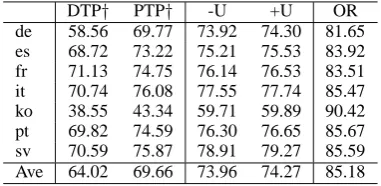
[image:6.595.320.511.62.155.2]DTP† PTP† -U +U OR de 58.56 69.77 73.92 74.30 81.65 es 68.72 73.22 75.21 75.53 83.92 fr 71.13 74.75 76.14 76.53 83.51 it 70.74 76.08 77.55 77.74 85.47 ko 38.55 43.34 59.71 59.89 90.42 pt 69.82 74.59 76.30 76.65 85.67 sv 70.59 75.87 78.91 79.27 85.59 Ave 64.02 69.66 73.96 74.27 85.18
Table 4: UAS for two versions of our approach, to-gether with baseline and oracle systems on Google Universal Treebanks version 2.0. “Ave” is the macro-average across the seven languages.
vide the POS tags for these data. In our experi-ments, we train a Stanford POS Tagger (Toutanova et al., 2003) for each language. The labeled train-ing data for each POS tagger are extracted from the training portion of each Treebanks. The aver-age tagging accuracy is around 95%.
Undoubtedly, we are primarily interested in ap-plying our approach to build statistical parsers for resource-poor target languages without any knowledge. For the purpose of evaluation of our approach and comparison with previous work, we need to exploit the gold POS tags to train the POS taggers. As part-of-speech tags are also a form of syntactic analysis, this assumption weakens the applicability of our approach. Fortunately, some recently proposed POS taggers, such as the POS tagger of Das and Petrov (2011), rely only on la-beled training data for English and the same kind of parallel text in our approach. In practice we can use this kind of POS taggers to predict POS tags, whose tagging accuracy is around 85%.
4 Experiments
In this section, we will describe the details of our experiments and compare our results with previ-ous methods.
4.1 Data Sets
As presented in Section 3.1, we evaluate our pars-ing approach on both version 1.0 and version 2.0 of Google Univereal Treebanks for seven lan-guages6. We use the standard splits of the treebank for each language as specified in the release of the data7. Table 1 presents the statistics of the two ver-sions of Google Universal Treebanks. We strip all
6
Japanese and Indonesia are excluded as no practicable parallel data are available.
7
Google Universal Treebanks V1.0
de es fr ko sv
# sents PTP† -U +U PTP† -U +U PTP† -U +U PTP† -U +U PTP† -U +U
500 63.23 70.79 70.93 70.09 72.32 72.64 72.24 74.64 74.90 47.71 56.87 57.22 71.70 75.88 76.13 1000 65.61 71.71 71.86 70.90 73.44 73.67 72.95 75.07 75.35 47.83 57.65 58.15 72.38 76.55 77.03 2000 66.52 72.33 72.48 72.01 73.57 73.81 73.69 75.88 76.22 48.37 58.19 58.44 73.65 77.86 78.12 5000 67.79 73.06 73.31 72.34 74.30 74.79 74.31 76.02 76.29 53.02 58.57 59.04 74.88 78.48 78.70 10000 68.44 73.59 73.92 72.48 74.86 75.26 74.43 76.14 76.34 53.61 59.17 59.55 75.34 78.78 79.08 20000 69.21 73.72 74.01 72.57 75.32 75.60 74.60 76.55 76.93 53.72 59.72 59.94 75.87 78.91 79.27
Google Universal Treebanks V2.0
de es fr ko it
# sents PTP† -U +U PTP† -U +U PTP† -U +U PTP† -U +U PTP† -U +U
500 60.10 71.07 71.39 69.52 72.97 73.28 71.10 74.57 74.70 40.09 56.60 57.10 72.80 75.67 75.94 1000 61.76 72.15 72.39 70.78 73.48 73.79 72.14 75.13 75.43 40.44 57.55 57.93 73.55 76.43 76.67 2000 65.35 72.73 73.04 71.75 74.10 74.35 73.21 75.78 76.06 40.87 58.11 58.43 74.44 76.99 77.39 5000 67.86 73.32 73.62 72.43 74.55 74.83 74.14 75.83 76.02 40.90 58.48 58.96 75.07 77.10 77.34 10000 68.70 73.71 74.02 72.85 74.80 74.95 74.53 75.97 76.17 41.29 59.13 59.44 75.65 77.50 77.71 20000 69.77 73.92 74.30 73.22 75.21 75.53 74.75 76.14 76.53 43.34 59.71 59.89 76.08 77.55 77.74
[image:7.595.76.521.62.272.2]pt # sents PTP† -U +U 500 71.34 74.41 74.68 1000 71.91 74.48 75.08 2000 72.93 75.10 75.32 5000 73.78 75.88 75.98 10000 74.40 75.99 76.15 20000 74.59 76.30 76.65
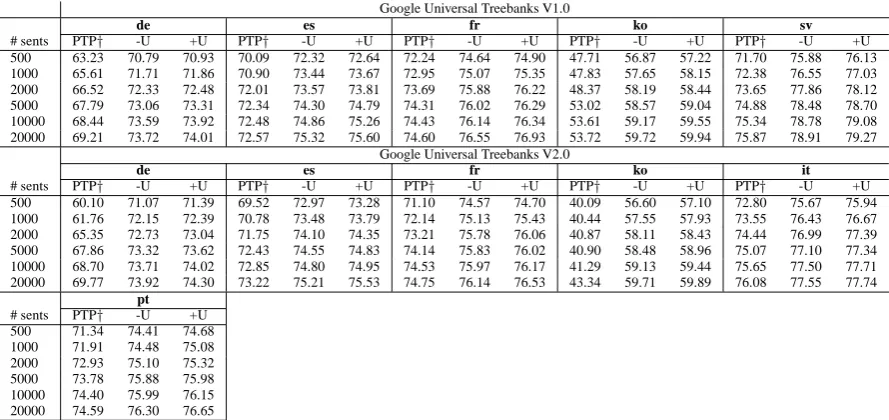
Table 5: Parsing results of our approach with different amount of parallel data on Google Universal Treebanks version 1.0 and 2.0. We omit the results of Swedish for treebanks version 2.0 since the data for Swedish from version 2.0 are exactly the same with those from version 1.0.
the dependency annotations off the training por-tion of each treebank, and use that as the unla-beled data for that target language. We train our parsing model with different numbers of parallel sentences to analyze the influence of the amount of parallel data on the parsing performance of our ap-proach. The parallel data sets contain 500, 1000, 2000, 5000, 10000 and 20000 parallel sentences, respectively. We randomly extract parallel sen-tences from each corpora, and smaller data sets are subsets of larger ones. Table 2 shows the number of tokens in the parallel data used in the experi-ments.
4.2 System performance and comparison on Google Universal Treebanks
For the comparison of parsing performance, we run experiments on the following systems:
DTP: The direct transfer parser (DTP) proposed
by McDonald et al. (2011), who train a delex-icalized parser on English labeled training data with no lexical features, then apply this parser to parse target languages directly. It is based on the transition-based dependency parsing paradigm (Nivre, 2008). We di-rectly cite the results reported in McDon-ald et al. (2013). In addition to their orig-inal results, we also report results by re-implementing the direct transfer parser based on the first-order projective dependency pars-ing model (McDonald et al., 2005a) (DTP†).
PTP The projected transfer parser (PTP)
de-scribed in McDonald et al. (2011). The results of the projected transfer parser re-implemented by us is marked as “PTP†”.
-U: Our approach training on only parallel data
without unlabeled data for the target lan-guage. The parallel data set for each language contains 20,000 sentences.
+U: Our approach training on both parallel and
unlabeled data. The parallel data sets are the ones contains 20,000 sentences.
OR: the supervised first-order projective
depen-dency parsing model (McDonald et al., 2005a), trained on the original treebanks with maximum likelihood estimation (equation 6). One may regard this system as an oracle of transfer parsing.
Parsing accuracy is measured with unlabeled at-tachment score (UAS): the percentage of words with the correct head.
and up to 6.22% for Korean and 4.80% for Ger-man. For the other three languages, the improve-ments are remarkable, too — 2.33% for French, 3.03% for Spanish and 3.40% for Swedish. By adding entropy regularization from unlabeled data, our full model achieves average improvement of 0.29% over the “-U” setting. Moreover, our ap-proach considerably bridges the gap to fully super-vised dependency parsers, whose average UAS is 84.67%. For the results on treebanks version 2.0, we can get similar observation and draw the same conclusion.
4.3 Effect of the Amount of Parallel Text
Table 5 illustrates the UAS of our approach trained on different amounts of parallel data, together with the results of the projected transfer parser re-implemented by us (PTP†). We run two ver-sions of our approach for each of the parallel data sets, one with unlabeled data (+U) and the other without them (-U). From table 5 we can get three observations. First, even the parsers trained with only 500 parallel sentences achieve considerably high parsing accuracies (average 70.10% for ver-sion 1.0 and 71.59% for verver-sion 2.0). This demon-strates that our approach does not rely on a large amount of parallel data. Second, when gradually increasing the amount of parallel data, the parsing performance continues improving. Third, entropy regularization with unlabeled data makes mod-est improvement on parsing performance over the parsers without unlabeled data. This proves the ef-fectiveness of the entropy regularization from un-labeled data.
4.4 Experiments on CoNLL Treebanks
To make a thorough empirical comparison with previous studies, we also evaluate our system without unlabeled data (-U) on treebanks from CoNLL shared task on dependency parsing (Buch-holz and Marsi, 2006; Nivre et al., 2007). To fa-cilitate comparison, we use the same eight Indo-European languages as target languages: Danish, Dutch, German, Greek, Italian, Portuguese, Span-ish and SwedSpan-ish, and same experimental setup as McDonald et al. (2011). We report both the results of the direct transfer and projected transfer parsers directly cited from McDonald et al. (2011) (DTP and PTP) and re-implemented by us (DTP†and PTP†).
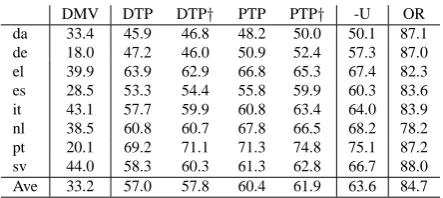
Table 6 gives the results comparing the model without unlabeled data (-U) presented in this work
DMV DTP DTP† PTP PTP† -U OR
[image:8.595.307.529.60.159.2]da 33.4 45.9 46.8 48.2 50.0 50.1 87.1 de 18.0 47.2 46.0 50.9 52.4 57.3 87.0 el 39.9 63.9 62.9 66.8 65.3 67.4 82.3 es 28.5 53.3 54.4 55.8 59.9 60.3 83.6 it 43.1 57.7 59.9 60.8 63.4 64.0 83.9 nl 38.5 60.8 60.7 67.8 66.5 68.2 78.2 pt 20.1 69.2 71.1 71.3 74.8 75.1 87.2 sv 44.0 58.3 60.3 61.3 62.8 66.7 88.0 Ave 33.2 57.0 57.8 60.4 61.9 63.6 84.7
Table 6: Parsing results on treebanks from CoNLL shared tasks for eight target languages. The results of unsupervised DMV model are from Table 1 of McDonald et al. (2011).
to those five baseline systems and the oracle (OR). The results of unsupervised DMV model (Klein and Manning, 2004) are from Table 1 of McDon-ald et al. (2011). Our approach outperforms all these baseline systems and achieves state-of-the-art performance on all the eight languages.
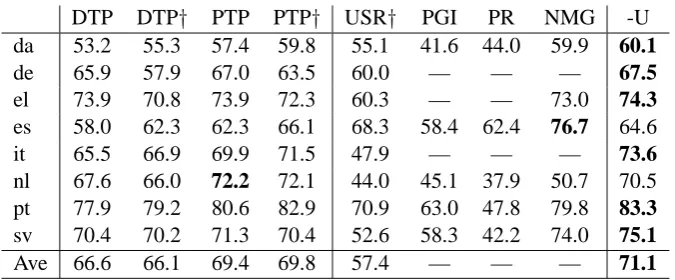
In order to compare with more previous meth-ods, we also report parsing performance on sen-tences of length 10 or less after punctuation has been removed. Table 7 shows the results of our system and the results of baseline sys-tems. “USR†” is the weakly supervised system of Naseem et al. (2010). “PGI” is the phylogenetic grammar induction model of Berg-Kirkpatrick and Klein (2010). Both the results of the two systems are cited from Table 4 of McDonald et al. (2011). We also include the results of the unsupervised dependency parsing model with non-parallel mul-tilingual guidance (NMG) proposed by Cohen et al. (2011)8, and “PR” which is the posterior reg-ularization approach presented in Gillenwater et al. (2010). All the results are shown in Table 7.
From Table 7, we can see that among the eight target languages, our approach achieves best pars-ing performance on six languages — Danish, Ger-man, Greek, Italian, Portuguese and Swedish. It should be noted that the “NMG” system utilizes more than one helper languages. So it is not di-rectly comparable to our work.
4.5 Extensions
In this section, we briefly outline a few extensions to our approach that we want to explore in future work.
DTP DTP† PTP PTP† USR† PGI PR NMG -U
da 53.2 55.3 57.4 59.8 55.1 41.6 44.0 59.9 60.1
de 65.9 57.9 67.0 63.5 60.0 — — — 67.5
el 73.9 70.8 73.9 72.3 60.3 — — 73.0 74.3
es 58.0 62.3 62.3 66.1 68.3 58.4 62.4 76.7 64.6
it 65.5 66.9 69.9 71.5 47.9 — — — 73.6
nl 67.6 66.0 72.2 72.1 44.0 45.1 37.9 50.7 70.5
pt 77.9 79.2 80.6 82.9 70.9 63.0 47.8 79.8 83.3
sv 70.4 70.2 71.3 70.4 52.6 58.3 42.2 74.0 75.1
[image:9.595.131.469.60.200.2]Ave 66.6 66.1 69.4 69.8 57.4 — — — 71.1
Table 7: UAS on sentences of length 10 or less without punctuation from CoNLL shared task treebanks. “USR†” is the weakly supervised system of Naseem et al. (2010). “PGI” is the phylogenetic grammar induction model of Berg-Kirkpatrick and Klein (2010). Both the “USR†” and “PGI” systems are im-plemented and reported by McDonald et al. (2011). “NMG” is the unsupervised dependency parsing model with non-parallel multilingual guidance (Cohen et al., 2011). “PR” is the posterior regularization approach presented in Gillenwater et al. (2010). Some systems’ results for certain target languages are not available as marked by —.
4.5.1 Non-Projective Parsing
As mentioned in section 2.3, the runtime to com-puteKUand its gradient isO(n4). One reasonable speedup, as presented in Smith and Eisner (2007), is to replace Shannon entropy with R´enyi entropy. The R´enyi entropy is parameterized byα:
Rα(p) = 1−1αlog X
y
p(y)α (16)
With R´enyi entropy, the computation of KU and its gradient isO(n3), even for non-projective case.
4.5.2 Higher-Order Models for Projective Parsing
Our learning framework can be extended to higher-order dependency parsing models. For ex-ample, if we want to make our model capable of utilizing more contextual information, we can ex-tend our transferring weight to higher-order parts:
˜
w(pt,xt i) =
(
wE(ps,xis), ifpt align−→ ps
wE(ptdelex,xsi), otherwise
(17) wherep is a small part of treeythat has limited interactions. For projective parsing, several al-gorithms (McDonald and Pereira, 2006; Carreras, 2007; Koo and Collins, 2010; Ma and Zhao, 2012) have been proposed to solve the model training problems (calculation of objective function and gradient) for different factorizations.
4.5.3 IGT Data
One possible direction to improve our approach is to replace parallel text with Interlinear Glossed Text (IGT) (Lewis and Xia, 2010), which is a semi-structured data type encoding more syntactic information than parallel data. By using IGT Data, not only can we obtain more accurate word align-ments, but also extract useful cross-lingual infor-mation for the resource-poor language.
5 Conclusion
In this paper, we propose an unsupervised pro-jective dependency parsing approach for resource-poor languages, using existing resources from a resource-rich source language. By presenting a model training framework, our approach can uti-lize parallel text to estimate transferring distribu-tion with the help of a well-developed resource-rich language dependency parser, and use unla-beled data as entropy regularization. The exper-imental results on three data sets across ten target languages show that our approach achieves signif-icant improvement over previous studies.
Acknowledgements
References
Steven Abney. 2004. Understanding the Yarowsky al-gorithm. Computational Linguistics, 30:2004.
James K. Baker. 1979. Trainable grammars for speech recognition. In Proceedings of 97th meeting of the
Acoustical Society of America, pages 547–550.
Taylor Berg-Kirkpatrick and Dan Klein. 2010. Phylo-genetic grammar induction. In Proceedings of
ACL-2010, pages 1288–1297, Uppsala, Sweden, July.
Phil Blunsom and Trevor Cohn. 2010. Unsupervised induction of tree substitution grammars for
depen-dency parsing. In Proceedings of EMNLP-2010,
pages 1204–1213, Cambridge, MA, October.
Matthew Brand. 1998. Structure learning in
con-ditional probability models via an entropic prior
and parameter extinction. Neural Computation,
11(5):1155–1182.
Sabine Buchholz and Erwin Marsi. 2006. CoNLL-X shared task on multilingual dependency parsing. In
Proceeding of CoNLL-2006, pages 149–164, New
York, NY.
David Burkett and Dan Klein. 2008. Two languages are better than one (for syntactic parsing). In
Pro-ceedings of EMNLP-2008, pages 877–886,
Hon-olulu, Hawaii, October.
Xavier Carreras. 2007. Experiments with a
higher-order projective dependency parser. In
Proceed-ings of the CoNLL Shared Task Session of EMNLP-CONLL, pages 957–961.
Glenn Carroll and Eugene Charniak. 1992. Two
experiments on learning probabilistic dependency grammars from corpora. In Proceedings of
Work-ing Notes of the Workshop Statistically-Based NLP Techniques.
Wenliang Chen, Jun’ichi Kazama, and Kentaro Tori-sawa. 2010. Bitext dependency parsing with bilin-gual subtree constraints. In Proceedings of
ACL-2010, pages 21–29, Uppsala, Sweden, July.
Shay Cohen and Noah A. Smith. 2009. Shared lo-gistic normal distributions for soft parameter tying in unsupervised grammar induction. In Proceedings
of NAACL/HLT-2009, pages 74–82, Boulder,
Col-orado, June.
Shay B. Cohen, Dipanjan Das, and Noah A. Smith. 2011. Unsupervised structure prediction with non-parallel multilingual guidance. In Proceedings of
EMNLP-2011, pages 50–61, Edinburgh, Scotland,
UK., July.
Dipanjan Das and Slav Petrov. 2011.
Unsuper-vised part-of-speech tagging with bilingual
graph-based projections. In Proceedings of
ACL/HLT-2011, pages 600–609, Portland, Oregon, USA, June.
Kuzman Ganchev, Jennifer Gillenwater, and Ben
Taskar. 2009. Dependency grammar induction
via bitext projection constraints. In Proceedings of
ACL/AFNLP-2009, pages 369–377, Suntec,
Singa-pore, August.
Jennifer Gillenwater, Kuzman Ganchev, Jo˜ao Grac¸a, Fernando Pereira, and Ben Taskar. 2010. Sparsity in dependency grammar induction. In Proceedings of
the ACL 2010 Conference Short Papers, pages 194–
199, Uppsala, Sweden, July.
Joao V. Graca, Lf Inesc-id, Kuzman Ganchev, and Ben Taskar. 2007. Expectation maximization and pos-terior constraints. In Advances in NIPS, pages 569– 576.
Yves Grandvalet and Yoshua Bengio. 2004. Semi-supervised learning by entropy minimization. In
Ad-vances in Neural Information Processing Systems.
Liang Huang, Wenbin Jiang, and Qun Liu. 2009.
Bilingually-constrained (monolingual) shift-reduce
parsing. In Proceedings of EMNLP-2009, pages
1222–1231, Singapore, August.
Rebecca Hwa, Philip Resnik, Amy Weinberg, Clara Cabezas, and Okan Kolak. 2005. Bootstrapping parsers via syntactic projection across parallel texts.
Natural Language Engineering, 11:11–311.
Feng Jiao, Shaojun Wang, Chi-Hoon Lee, Russell
Greiner, and Dale Schuurmans. 2006.
Semi-supervised conditional random fields for improved sequence segmentation and labeling. In
Proceed-ings of COLING/ACL-2006, pages 209–216,
Syd-ney, Australia, July.
Jason Katz-Brown, Slav Petrov, Ryan
McDon-ald, Franz Och, David Talbot, Hiroshi Ichikawa, Masakazu Seno, and Hideto Kazawa. 2011. Train-ing a parser for machine translation reorderTrain-ing. In
Proceedings of EMNLP-2011, pages 183–192,
Ed-inburgh, Scotland, UK., July.
Dan Klein and Christopher Manning. 2004. Corpus-based induction of syntactic structure: Models of de-pendency and constituency. In Proceedings of
ACL-2004, pages 478–485, Barcelona, Spain, July.
Philipp Koehn. 2005. Europarl: A Parallel Corpus for Statistical Machine Translation. In Conference
Proceedings: the tenth Machine Translation Sum-mit, pages 79–86, Phuket, Thailand. AAMT, AAMT.
Terry Koo and Michael Collins. 2010. Efficient third-order dependency parsers. In Proceedings of
ACL-2010, pages 1–11, Uppsala, Sweden, July.
Terry Koo, Amir Globerson, Xavier Carreras, and Michael Collins. 2007. Structured predicition
mod-els via the matrix-tree theorem. In Proceedings
of EMNLP-CONLL 2007, pages 141–150, Prague,
William D. Lewis and Fei Xia. 2010. Developing odin: A multilingual repository of annotated lan-guage data for hundreds of the world’s lanlan-guages.
LLC, 25(3):303–319.
Xuezhe Ma and Hai Zhao. 2012. Fourth-order depen-dency parsing. In Proceedings of COLING 2012:
Posters, pages 785–796, Mumbai, India, December.
Gideon S. Mann and Andrew McCallum. 2007. Ef-ficient computation of entropy gradient for semi-supervised conditional random fields. In
Proceed-ings of NAACL/HLT-2007, pages 109–112,
Strouds-burg, PA, USA.
David Mareˇcek and Milan Straka. 2013.
Stop-probability estimates computed on a large corpus improve unsupervised dependency parsing. In
Pro-ceedings of ACL-2013, pages 281–290, Sofia,
Bul-garia, August.
Ryan McDonald and Fernando Pereira. 2006. Online learning of approximate dependency parsing algo-rithms. In Proceedings of EACL-2006, pages 81–88, Trento, Italy, April.
Ryan McDonald, Koby Crammer, and Fernando
Pereira. 2005a. Online large-margin training of
dependency parsers. In Proceedings of ACL-2005, pages 91–98, Ann Arbor, Michigan, USA, June 25-30.
Ryan McDonald, Fernando Pereira, Kiril Ribarov, and Jan Hajic. 2005b. Non-projective dependency pars-ing uspars-ing spannpars-ing tree algorithms. In Proceedpars-ings
of HLT/EMNLP-2005, pages 523–530, Vancouver,
Canada, October.
Ryan McDonald, Slav Petrov, and Keith Hall. 2011. Multi-source transfer of delexicalized dependency parsers. In Proceedings of EMNLP-2011, pages 62– 72, Edinburgh, Scotland, UK., July.
Ryan McDonald, Joakim Nivre, Yvonne Quirmbach-Brundage, Yoav Goldberg, Dipanjan Das, Kuz-man Ganchev, Keith Hall, Slav Petrov, Hao Zhang, Oscar T¨ackstr¨om, Claudia Bedini, N´uria Bertomeu Castell´o, and Jungmee Lee. 2013. Uni-versal dependency annotation for multilingual
pars-ing. In Proceedings of ACL-2013, pages 92–97,
Sofia, Bulgaria, August.
Tahira Naseem, Harr Chen, Regina Barzilay, and Mark Johnson. 2010. Using universal linguistic knowl-edge to guide grammar induction. In Proceedings of
EMNLP-2010, pages 1234–1244, Cambridge, MA,
October.
Stephen G. Nash and Jorge Nocedal. 1991. A numer-ical study of the limited memory bfgs method and truncated-newton method for large scale optimiza-tion. SIAM Journal on Optimization, 1(2):358–372.
Truc-Vien T. Nguyen, Alessandro Moschitti, and Giuseppe Riccardi. 2009. Convolution kernels on constituent, dependency and sequential structures
for relation extraction. In Proceedings of
EMNLP-2009, pages 1378–1387, Singapore, August.
Joakim Nivre and Mario Scholz. 2004. Deterministic dependency parsing of English text. In Proceedings
of COLING-2004, pages 64–70, Geneva,
Switzer-land, August 23-27.
Joakim Nivre, Johan Hall, Sandra K¨ubler, Ryan Mc-donald, Jens Nilsson, Sebastian Riedel, and Deniz Yuret. 2007. The conll 2007 shared task on depen-dency parsing. In Proceeding of EMNLP-CoNLL
2007, pages 915–932, Prague, Czech.
Joakim Nivre. 2008. Algorithms for deterministic in-cremental dependency parsing. Comput. Linguist., 34(4):513–553, December.
Mark A. Paskin. 2001. Cubic-time parsing and
learning algorithms for grammatical bigram models. Technical Report, UCB/CSD-01-1148.
Slav Petrov, Dipanjan Das, and Ryan T. McDonald.
2011. A universal part-of-speech tagset. CoRR,
abs/1104.2086.
Yusuke Shinyama, Satoshi Sekine, and Kiyoshi Sudo. 2002. Automatic paraphrase acquisition from news articles. In Proceeding of HLT-2002, pages 313– 318.
Noah A. Smith and Jason Eisner. 2005. Contrastive estimation: Training log-linear models on unlabeled data. In Proceedings of ACL-2005, pages 354–362, Ann Arbor, Michigan, June.
David A. Smith and Jason Eisner. 2007. Bootstrapping feature-rich dependency parsers with entropic pri-ors. In Proceedings of EMNLP/CoNLL-2007, pages 667–677, Prague, Czech Republic, June.
David A. Smith and Noah A. Smith. 2004. Bilin-gual parsing with factored estimation: Using En-glish to parse Korean. In Proceedings of
EMNLP-2004, pages 49–56.
David A. Smith and Noah A. Smith. 2007. Probabilis-tic models of nonporjective dependency trees. In
Proceedings of EMNLP-CONLL 2007, pages 132–
140, Prague, Czech, June.
Valentin I. Spitkovsky, Hiyan Alshawi, and Daniel Ju-rafsky. 2010. From baby steps to leapfrog: How “less is more” in unsupervised dependency parsing. In Proceedings of NAACL/HLT-2010, pages 751– 759, Los Angeles, California, June.
Valentin I. Spitkovsky, Hiyan Alshawi, and Daniel Ju-rafsky. 2013. Breaking out of local optima with count transforms and model recombination: A study in grammar induction. In Proceedings of
EMNLP-2013, pages 1983–1995, Seattle, Washington, USA,
Kristina Toutanova, Dan Klein, Christopher D. Man-ning, and Yoram Singer. 2003. Feature-rich part-of-speech tagging with a cyclic dependency network. In Proceedings of NAACL/HLT-2003, pages 252– 259.
Jun Xie, Haitao Mi, and Qun Liu. 2011. A novel dependency-to-string model for statistical machine translation. In Proceedings of EMNLP-2011, pages 216–226, Edinburgh, Scotland, UK., July.
Hao Zhang, Liang Huang, Kai Zhao, and Ryan
Mc-Donald. 2013. Online learning for inexact