A Topic Model for Building Fine-grained Domain-specific Emotion
Lexicon
Min Yang‡ Baolin Peng§ Zheng Chen§ Dingju Zhu*†,¶ Kam-Pui Chow‡
†School of Computer Science, South China Normal University, Guangzhou, China
‡Department of Computer Science, The University of Hong Kong, Hong Kong
{myang,chow}@cs.hku.hk
§Department of Computer Science, Beihang University, Beijing, China
[email protected], [email protected]
¶Shenzhen Institutes of Advanced Technology, Chinese Academy of Sciences, Shenzhen, China
Abstract
Emotion lexicons play a crucial role in sen-timent analysis and opinion mining. In this paper, we propose a novel Emotion-aware LDA (EaLDA) model to build a domain-specific lexicon for predefined emotions that include anger, disgust, fear, joy, sad-ness, surprise. The model uses a mini-mal set of domain-independent seed words as prior knowledge to discover a domain-specific lexicon, learning a fine-grained emotion lexicon much richer and adap-tive to a specific domain. By comprehen-sive experiments, we show that our model can generate a high-quality fine-grained domain-specific emotion lexicon.
1 Introduction
Due to the popularity of opinion-rich resources (e.g., online review sites, forums, blogs and the microblogging websites), automatic extraction of opinions, emotions and sentiments in text is of great significance to obtain useful information for social and security studies. Various opinion min-ing applications have been proposed by different researchers, such as question answering, opinion mining, sentiment summarization, etc. As the fine-grained annotated data are expensive to get, the un-supervised approaches are preferred and more used in reality. Usually, a high quality emotion lexi-con play a significant role when apply the unsuper-vised approaches for fine-grained emotion classi-fication.
*Dingju Zhu is the corresponding author
Thus far, most lexicon construction approaches focus on constructing general-purpose emotion lexicons (Stone et al., 1966; Hu and Liu, 2004; Wilson et al., 2005; Dong and Dong, 2006). How-ever, since a specific word can carry various tions in different domains, a general-purpose emo-tion lexicon is less accurate and less informative than a domain-specific lexicon (Baccianella et al., 2010). In addition, in previous work, most of the lexicons label the words on coarse-grained dimen-sions (positive, negative and neutrality). Such lex-icons cannot accurately reflect the complexity of human emotions and sentiments. Lastly, previous emotion lexicons are mostly annotated based on many manually constructed resources (e.g., emo-tion lexicon, parsers, etc.). This limits the applica-bility of these methods to a broader range of tasks and languages.
To meet the challenges mentioned above, we propose a novel EaLDA model to construct a domain-specific emotion lexicon consisting of six primary emotions (i.e., anger, disgust, fear, joy, sadness and surprise). The proposed EaLDA model extends the standard Latent Dirichlet Allo-cation (LDA) (Blei et al., 2003) model by employ-ing a small set of seeds to guide the model gener-ating topics. Hence, the topics consequently group semantically related words into a same emotion category. The lexicon is thus able to best meet the user’s specific needs. Our approach is a weakly su-pervised approach since only some seeds emotion sentiment words are needed to lanch the process of lexicon construction. In practical applications, asking users to provide some seeds is easy as they usually have a good knowledge what are important in their domains.
Extensive experiments are carried out to evalu-ate our model both qualitatively and quantitatively using benchmark dataset. The results demonstrate that our EaLDA model improves the quality and the coverage of state-of-the-art fine-grained lexi-con.
2 Related Work
Emotion lexicon plays an important role in opin-ion mining and sentiment analysis. In order to build such a lexicon, many researchers have in-vestigated various kinds of approaches. However, these methods could roughly be classified into two categories in terms of the used information. The first kind of approaches is based on thesaurus that utilizes synonyms or glosses to determine the sen-timent orientation of a word. The availability of the WordNet (Miller, 1995) database is an impor-tant starting point for many thesaurus-based ap-proaches (Kamps et al., 2004; Hu and Liu, 2004; Esuli and Sebastiani, 2006). The second kind of approaches is based on an idea that emotion words co-occurring with each others are likely to convey the same polarity. There are numerous studies in this field (Turney and Littman, 2003; Wiebe and Riloff, 2005; Esuli and Sebastiani, 2006; Barbosa and Feng, 2010).
Most of the previous studies for emotion lexi-con lexi-construction are limited to positive and nega-tive emotions. Recently, to enhance the increas-ingly emotional data, a few researches have been done to identity the fine-grained emotion of words (Strapparava and Mihalcea, 2007; Gill et al., 2008; Rao et al., 2012). For example, Gill et al. (2008) utilize computational linguistic tools to identity the emotions of the words (such as, joy, sadness, ac-ceptance, disgust, fear, anger, surprise and antici-pation). While, this approach is mainly for pub-lic use in general domains. Rao et al. (2012) propose an method of automatically building the word-emotion mapping dictionary for social emo-tion detecemo-tion. However, the ememo-tion lexicon is not outputed explicitly in this paper, and the approach is fully unsupervised which may be difficult to be adjusted to fit the personalized data set.
Our approach relates most closely to the method proposed by Xie and Li (2012) for the construction of lexicon annotated for polarity based on LDA model. Our approach differs from (Xie and Li, 2012) in two important ways: first, we do not ad-dress the task of polarity lexicon construction, but
instead we focus on building fine-grained emotion lexicon. Second, we don’t assume that every word in documents is subjective, which is impractical in real world corpus.
3 Algorithm
In this section, we rigorously define the emotion-aware LDA model and its learning algorithm. We descrige with the model description, a Gibbs sam-pling algorithm to infer the model parameters, and finally how to generate a emotion lexicon based on the model output.
3.1 Model Description
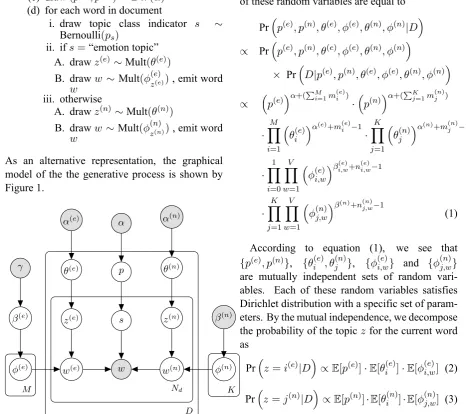
Like the standard LDA model, EaLDA is a gen-erative model. To prevent conceptual confusion, we use a superscript “(e)” to indicate variables re-lated to emotion topics, and use a superscript “(n)” to indicate variables of non-emotion topics. We as-sume that each document has two classes of topics:
M emotion topics (corresponding toM different emotions) andKnon-emotion topics (correspond-ing to topics that are not associated with any emo-tion). Each topic is represented by a multinomial distribution over words. In addition, we assume that the corpus vocabulary consists ofV distinct words indexed by{1, . . . , V}.
For emotion topics, the EaLDA model draws the word distribution from a biased Dirichlet prior Dir(βk(e)). The vector βk(e) ∈ RV is constructed with βk(e) := γ0(e)(1V −Ωk) + γ1(e)Ωk, for k ∈
{1, . . . , M}. Ωk,w = 1if and only if wordwis a seed word for emotionk, otherwiseΩk,w= 0. The scalars γ0(e) and γ1(e) are hyperparameters of the model. Intuitively, when γ1(e) > γ0(e), the biased prior ensures that the seed words are more proba-bly drawn from the associated emotion topic.
The generative process of word distributions for non-emotion topics follows the standard LDA def-inition with a scalar hyperparameterβ(n).
For each word in the document, we decide whether its topic is an emotion topic or a non-emotion topic by flipping a coin with head-tail probability (p(e), p(n)), where (p(e), p(n)) ∼ Dir(α). The emotion (or non-emotion) topic is sampled according to a multinomial distribution Mult(θ(e)) (or Mult(θ(n))). Here, both θ(e) and
θ(n) are document-level latent variables. They
We summarize the generative process of the EaLDA model as below:
1. for each emotion topick∈ {1, . . . , M}, draw
ϕ(ke) ∼Dir(βk(e))
2. for each non-emotion topick ∈ {1, . . . , K}, drawϕ(kn)∼Dir(β(n))
3. for each document
(a) drawθ(e)∼Dir(α(e)) (b) drawθ(n) ∼Dir(α(n)) (c) draw(p(e), p(n))∼Dir(α) (d) for each word in document
i. draw topic class indicator s ∼ Bernoulli(ps)
ii. ifs=“emotion topic” A. drawz(e)∼Mult(θ(e)) B. draww ∼ Mult(ϕ(e)
z(e)), emit word
w
iii. otherwise
A. drawz(n)∼Mult(θ(n))
B. draww ∼Mult(ϕ(zn(n))), emit word
w
[image:3.595.67.534.228.642.2]As an alternative representation, the graphical model of the the generative process is shown by Figure 1.
.
. w.
w(e) .. w(n) z(e)
.
z(n)
.
s
.
θ(e)
.
θ(n)
.
p
. α(e)
.
α(n)
. α
.
ϕ(e) .. ϕ(n)
β(e)
.
β(n)
. γ .. M ... K ... Nd ... D .
Figure 1: The Emotion-aware LDA model.
3.2 Inference Algorithm
Assuming hyperparametersα,α(e),α(n), andβ(e),
β(n), we develop a collapsed Gibbs sampling
algo-rithm to estimate the latent variables in the EaLDA model. The algorithm iteratively takes a wordw
from a document and sample the topic that this word belongs to.
Let the whole corpus excluding the current word be denoted by D. Let n(i,we) (or n(j,wn)) indicate the number of occurrences of topic i(e) (or topic
j(n)) with wordwin the whole corpus. Letm(e)
i (or m(jn)) indicate the number of occurrence of topici(e) (or topicj(n)) in the current document. All these counts are defined excluding the current word. Using the definition of the EaLDA model and the Bayes Rule, we find that the joint density of these random variables are equal to
Pr
(
p(e), p(n), θ(e), ϕ(e), θ(n), ϕ(n)|D)
∝ Pr
(
p(e), p(n), θ(e), ϕ(e), θ(n), ϕ(n))
× Pr
(
D|p(e), p(n), θ(e), ϕ(e), θ(n), ϕ(n))
∝ (p(e))α+(
∑M
i=1m(ie))
·(p(n))α+(
∑K
j=1m(jn))
·∏M
i=1
(
θ(ie))α(e)+m
(e) i −1
·∏K
j=1
(
θj(n))α(n)+m
(n) j −1
·∏1
i=0
V
∏
w=1
(
ϕ(i,we))β
(e)
i,w+n(i,we)−1
· K ∏ j=1 V ∏ w=1 (
ϕ(j,wn))β(n)+n
(n) j,w−1
(1)
According to equation (1), we see that
{p(e), p(n)}, {θ(e)
i , θj(n)}, {ϕi,w(e)} and {ϕ(j,wn)} are mutually independent sets of random vari-ables. Each of these random variables satisfies Dirichlet distribution with a specific set of param-eters. By the mutual independence, we decompose the probability of the topiczfor the current word as
Pr
(
z=i(e)|D)∝E[p(e)]·E[θi(e)]·E[ϕ(i,we)] (2)
Pr
(
z=j(n)|D)∝E[p(n)]·E[θ(n)
i ]·E[ϕ(j,wn)] (3) Then, by examining the property of Dirichlet distribution, we can compute expectations on the right hand side of equation (2) and equation (3) by
E[p(e)] = α+
∑1
i=0m(ie)
2α+∑Mi=1m(ie)+∑Kj=1m(jn)(4)
E[p(n)] = α+
∑K
j=1m(jn)
E[θi(e)] = α(e)+m(ie) Mα(e)+∑M
i′=1m(ie′)
(6)
E[θj(n)] = α(e)+m (n)
j
Kα(n)+∑K
j′=1m(jn′)
(7)
E[ϕ(i,we)] = β (e)
i,w+n(i,we)
∑V
w′=1
(
βi,w(e)′+n(i,we)′
) (8)
E[ϕ(j,wn)] = β (n)
j,w+n(j,wn)
V β(n)+∑V
w′=1n(j,wn)′
(9)
Using the above equations, we can sample the topicz for each word iteratively and estimate all latent random variables.
3.3 Constructing Emotion Lexicon
Our final step is to construct the domain-specific emotion lexicon from the estimatesϕ(e) andϕ(n) that we obtained from the EaLDA model.
For each word w in the vocabulary, we com-pare the M + 1 values {ϕ1(e,w), . . . , ϕ(M,we) } and
1
K
∑K
i=1ϕ(i,wn). Ifϕ(i,we) is the largest, then the word
w is added to the emotion dictionary for the ith emotion. Otherwise, K1 ∑Ki=1ϕ(i,wn) is the largest among the M + 1 values, which suggests that the wordw is more probably drawn from a non-emotion topic. Thus, the word is considered neu-tral and not included in the emotion dictionary.
4 Experiments
In this section, we report empirical evaluations of our proposed model. Since there is no metric ex-plicitly measuring the quality of an emotion lexi-con, we demonstrate the performance of our algo-rithm in two ways: (1) we perform a case study for the lexicon generated by our algorithm, and (2) we compare the results of solving emotion classifica-tion task using our lexicon against different meth-ods, and demonstrate the advantage of our lexicon over other lexicons and other emotion classifica-tion systems.
4.1 Datasets
We conduct experiments to evaluate the effective-ness of our model on SemEval-2007 dataset. This is an gold-standard English dataset used in the 14th task of the SemEval-2007 workshop which focuses on classification of emotions in the text. The at-tributes include the news headlines, the score of
emotions of anger, disgust, fear, joy, sad and sur-prise normalizing from 0 to 100. Two data sets are available: a training data set consisting of 250 records, and a test data set with 1000 records. Fol-lowing the strategy used in (Strapparava and Mi-halcea, 2007), the task was carried out in an unsu-pervised setting for experiments.
In experiments, data preprocessing is performed on the data set. First, the texts are tokenized with a natural language toolkit NLTK1. Then, we re-move non-alphabet characters, numbers, pronoun, punctuation and stop words from the texts. Finally, Snowball stemmer2 is applied so as to reduce the vocabulary size and settle the issue of data spare-ness.
4.2 Emotion Lexicon Construction
We first settle down the implementation details for the EaLDA model, specifying the hyperparameters that we choose for the experiment. We set topic numberM = 6,K = 4, and hyperparametersα=
0.75,α(e)=α(n)= 0.45,β(n)= 0.5. The vector
β(e)is constructed from the seed dictionary using γ = (0.25,0.95).
As mentioned, we use a few domain-independent seed words as prior information for our model. To be specific, the seed words list contains 8 to 12 emotional words for each of the six emotion categories.3 However, it is important to note that the proposed models are flexible and do not need to have seeds for every topic.
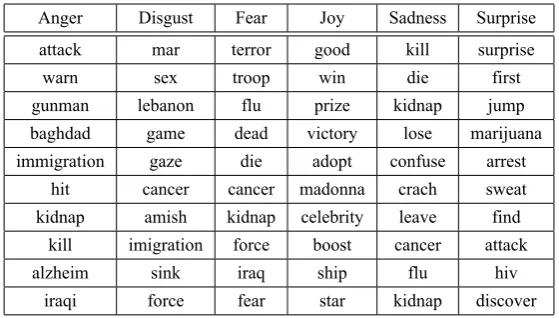
Example words for each emotion generated from the SemEval-2007 dataset are reported in Ta-ble 1. The judgment is to some extent subjective. What we reported here are based on our judgments what are appropriate and what are not for each emotion topic. From Table 1, we observe that the generated words are informative and coherent. For example, the words “flu” and “cancer” are seem-ingly neutral by its surface meaning, actually ex-pressing fear emotion for SemEval dataset. These domain-specific words are mostly not included in any other existing general-purpose emotion lexi-cons. The experimental results show that our al-gorithm can successfully construct a fine-grained domain-specific emotion lexicon for this corpus that is able to understand the connotation of the words that may not be obvious without the context.
1
http://www.nltk.org 2
http://snowball.tartarus.org/
Anger Disgust Fear Joy Sadness Surprise
attack mar terror good kill surprise warn sex troop win die first gunman lebanon flu prize kidnap jump baghdad game dead victory lose marijuana immigration gaze die adopt confuse arrest
hit cancer cancer madonna crach sweat kidnap amish kidnap celebrity leave find
kill imigration force boost cancer attack alzheim sink iraq ship flu hiv
[image:5.595.159.439.61.220.2]iraqi force fear star kidnap discover
Table 1: Part of Emotion example words
Algorithm Anger Disgust Fear Joy Sadness Surprise
WordNet-Affect 6.06% - - 22.81% 17.31% 9.92% SWAT 7.06% - 18.27% 14.91% 17.44% 11.78%
UA 16.03% - 20.06% 4.21% 1.76% 15.00% UPAR7 3.02% - 4.72% 11.87% 17.44% 15.00% EaLDA 16.65% 10.52% 26.21% 25.57% 36.85% 20.17%
Table 2: Experiment results for emotion classification in term of F1 score
4.3 Document-level Emotion Classification
We compare the performance between a popular emotion lexicon WordNet-Affect (Strapparava and Valitutti, 2004) and our approach for emotion clas-sification task. We also compare our results with those obtained by three systems participating in the SemEval-2007 emotion annotation task: SWAT, UPAR7 and UA. The emotion classification results is evaluated for each emotion category separately. For each emotion category, we evaluates it as a bi-nary classification problem. In the evaluation of emotion lexicons, the binary classification is per-formed in a very simple way. For each emotion category and each text, we compare the number of words within this emotion category, and the aver-age number of words within other emotion cate-gories, to output a binary prediction of 1 or 0. This simple approach is chosen to evaluate the robust-ness of our emotion lexicon.
In the experiments, performance is evaluated in terms of F1-score. We summarize the results in Table 2. As an easy observation, the emotion lex-icon generated by the EaLDA model consistently and significantly outperforms the WordNet-Affect emotion lexicon and other three emotion classifi-cation systems. In particular, we are able to obtain an overall F1-score of 10.52% for disgust classifi-cation task which is difficult to work out using
pre-viously proposed methods. The advantage of our model may come from its capability of exploring domain-specific emotions which include not only explicit emotion words, but also implicit ones.
5 Conclusions and Future Work
In this paper, we have presented a novel emotion-aware LDA model that is able to quickly build a fine-grained domain-specific emotion lexicon for languages without many manually constructed re-sources. The proposed EaLDA model extends the standard LDA model by accepting a set of domain-independent emotion words as prior knowledge, and guiding to group semantically related words into the same emotion category. Thus, it makes the emotion lexicon containing much richer and adaptive domain-specific emotion words. Exper-imental results showed that the emotional lexicons generated by our algorithm is of high quality, and can assist emotion classification task.
References
Stefano Baccianella, Andrea Esuli, and Fabrizio Sebas-tiani. 2010. Sentiwordnet 3.0: An enhanced lexical resource for sentiment analysis and opinion mining. InLREC, volume 10, pages 2200–2204.
Luciano Barbosa and Junlan Feng. 2010. Robust senti-ment detection on twitter from biased and noisy data. InProceedings of the 23rd International Conference on Computational Linguistics: Posters, pages 36– 44. Association for Computational Linguistics.
David M Blei, Andrew Y Ng, and Michael I Jordan. 2003. Latent dirichlet allocation.the Journal of ma-chine Learning research, 3:993–1022.
Zhendong Dong and Qiang Dong. 2006. HowNet and the Computation of Meaning. World Scientific.
Andrea Esuli and Fabrizio Sebastiani. 2006. Senti-wordnet: A publicly available lexical resource for opinion mining. InProceedings of LREC, volume 6, pages 417–422.
Alastair J Gill, Robert M French, Darren Gergle, and Jon Oberlander. 2008. The language of emotion in short blog texts. InCSCW, volume 8, pages 299– 302.
Minqing Hu and Bing Liu. 2004. Mining and summa-rizing customer reviews. InProceedings of the tenth ACM SIGKDD international conference on Knowl-edge discovery and data mining, pages 168–177. ACM.
Jaap Kamps, MJ Marx, Robert J Mokken, and Maarten De Rijke. 2004. Using wordnet to measure semantic orientations of adjectives.
George A Miller. 1995. Wordnet: a lexical database for english. Communications of the ACM, 38(11):39– 41.
Yanghui Rao, Xiaojun Quan, Liu Wenyin, Qing Li, and Mingliang Chen. 2012. Building word-emotion mapping dictionary for online news. InSDAD 2012 The 1st International Workshop on Sentiment Dis-covery from Affective Data, page 28.
Philip J Stone, Dexter C Dunphy, and Marshall S Smith. 1966. The general inquirer: A computer approach to content analysis.
Carlo Strapparava and Rada Mihalcea. 2007. Semeval-2007 task 14: Affective text. In Proceedings of the 4th International Workshop on Semantic Evalu-ations, pages 70–74. Association for Computational Linguistics.
Carlo Strapparava and Alessandro Valitutti. 2004. Wordnet affect: an affective extension of wordnet. InLREC, volume 4, pages 1083–1086.
Peter D Turney and Michael L Littman. 2003. Measur-ing praise and criticism: Inference of semantic orien-tation from association.ACM Transactions on Infor-mation Systems (TOIS), 21(4):315–346.
Janyce Wiebe and Ellen Riloff. 2005. Creating subjec-tive and objecsubjec-tive sentence classifiers from unanno-tated texts. InComputational Linguistics and Intel-ligent Text Processing, pages 486–497. Springer.
Theresa Wilson, Janyce Wiebe, and Paul Hoffmann. 2005. Recognizing contextual polarity in phrase-level sentiment analysis. InProceedings of the con-ference on human language technology and empiri-cal methods in natural language processing, pages 347–354. Association for Computational Linguis-tics.