Munich Personal RePEc Archive
Preference Cloud Theory: Imprecise
Preferences and Preference Reversals
Bayrak, Oben and Hey, John
Centre for Environmental and Resource Economics
2015
Online at
https://mpra.ub.uni-muenchen.de/71782/
Preference Cloud Theory: Imprecise Preferences and Preference Reversals Oben K. Bayrak and John D. Hey1
This paper presents a new theory, called Preference Cloud Theory, of
decision-making under uncertainty. This new theory provides an
explanation for empirically-observed Preference reversals. Central to the
theory is the incorporation of preference imprecision which arises because
of individuals’ vague understanding of numerical probabilities. We combine
this concept with the use of the Alpha model (which builds on Hurwicz’s
criterion) and construct a simple model which helps us to understand
various anomalies discovered in the experimental economics literature that
standard models cannot explain.
Key Words: Imprecise Preferences; Preference Reversals; Decision under Uncertainty; Anomalies in Expected Utility Theory
JEL Classification: D81
1
Oben K. Bayrak (corresponding author), PhD Candidate, Department of Forest Economics, SLU and CERE
(Center for Resource and Environmental Economics), Skogsmarksgränd, Umeå, 901 83, +46 727469175, [email protected]
John D. Hey, Professor, Department of Economics, University of York, Heslington, York, YO1 10DD,
1.
Introduction
Suppose you are asked to state your subjective value for a lottery ticket which gives 10 dollars with a
probability of 0.3 and zero otherwise: Can you pin your value down to a single precise number or do
you end up with a range of values? Our preference imprecision argument states that individuals
most likely end up having an interval; preferences are not as precise as standard theory presumes
(for evidence, see: Butler and Loomes, 1988, 2007, 2011; Dubourg et al, 1994, 1996; and Morrison,
1998). Such imprecision might explain observed anomalies of standard theory (Butler and Loomes
2011). Most importantly, imprecision might be the explanation of the anomalies, despite
researchers’ efforts, in the last four decades, focusing on precise but non-standard preferences such
as loss aversion.
Suppose now you are assigned to be a buyer. You are most likely to state a value close to the lower
bound of this range; the converse is true when you are assigned to be a seller. The model presented
in this paper answers two key questions: what is the psychological mechanism behind the formation
of this range?; how do individuals select one value from this range? It also shows how the
incorporation of imprecision can provide an explanation for preference reversals.
For the first question our theory proposes that imprecision arises due to the decision-maker’s vague
understanding of the probabilities involved. The empirical support for this assertion comes from the
psychophysics literature; see Budescu et al (1988). In an experiment reported by them subjects
were asked to state bids for lotteries; in the lotteries the probabilities were represented numerically,
graphically or verbally. The results suggested that bids and attractiveness ratings are almost identical
under the different representations (See Budescu and Wallsten (1990) and Bisantz et al (2005) for
further evidence). Wallsten and Budescu (1995) explain that the similarity of behavior under
different representation modes is due to similarities in the vague understanding of probabilities. We
subjects use this range in their calculations2. There is also implicit evidence from Plott and Zeiler
(2005) and Isoni et al (2011) who find that the endowment effect is observed only for the lottery
tickets, but not for ordinary market goods such as mugs and candies.
Zimmer (1984) introduced a useful insight from an evolutionary perspective: he noted that the
probability concept in a numerical sense is a relatively new concept, appearing as recently as the 17th
century. However, people were communicating uncertainty via verbal expressions long before
probability was codified in mathematical terms. Zimmer further suggested that people process
uncertainty in a verbal manner and make their decisions based on this processed information, not
on the numerical information. We therefore assume that decision makers map any given objective
probability into an interval. This implies that people end up with a range of expected utilities (EUs)
and they do not have prior knowledge about their “true” EU from this range. For the second
question, pinning down this range to a single value can be modelled as decision problem under
ambiguity. We use the Alpha Model (embodying Hurwicz’s criterion) to provide a valuation of the
prospect, given as the weighted average of the worst and the best possible EU. The next section
formalises these ideas.
2.
Theory
In order to give the intuition of the theory we focus on two-outcome lotteries. Let Sbe a finite state
space, with elements s1ands2; letx1andx2be the corresponding consequences. We assume that
1 2u x u x , whereu
. is the individual’s Neumann-Morgenstern utility function. For each statethere is an objective probability; call thempand1p. The crucial point of our theory is that
individuals perceive these probabilities vaguely, and hencepis mapped to a range:
p,p
. Asfar as the individual is concerned, the worst situation is when probabilityp is allocated to states1
(and probability1 p to states2, and the best situation is when probabilityp is allocated to
states1(and probability1 p to states2). So the worst and best expected utilities are
p
u x1 1 p
u x2 and
p
u x1 1 p
u x2 respectively.At this point PCT uses the Alpha Max-Min criterion to evaluate the lottery. This gives
1 1
2 1
1 1
2EU p u x p u x p p u x p u x
(1)
One can think of such a decision-maker as a mixture of a pessimist and an optimist:of the time he
or she assumes the worst, and1of the time the best.
The parameter we call the imprecision level; our theory postulates that it is a function ofp(the
objective probability) and (the individual-specific sophistication level). A relatively unsophisticated
individual would display a relatively high imprecision . For example, stock brokers and gamblers
who are expected to be more familiar with the concept of probability exhibit lower imprecision than
the ordinary man.
As far as the shape of
,p
is concerned we assume that individuals exhibit no imprecision if theprobability is 0 or 1 since the events occurring with these probabilities are not probabilistic events in
daily language, that is, the event either never happens or always happens. Secondly, imprecision
reaches a maximum at 0.5 because it implies the event is neither likely nor unlikely, this
‘incommensurability’ makes it difficult to derive a meaning from this probability. Finally, for
simplicity we assume that
,p
is symmetric aroundp0.5.3.
Explaining Preference Reversals
We show how preference reversals can arise with our model. We illustrate using the CRRA utility
function foru
.( ) a
Fora0, the function is concave, implying risk aversion. For simplicity, we focus on P and $ bets
that give either a positive payoff or zero: P-bet
x p, ;0
and $-bet
y q, ;0
withy x 0and1 p q 0 wherep and q are the winning probabilities, andxandyare the winning prizes of the
P-bet and $-bet, respectively.
If the individual prefers the P-bet over the $-bet in the choice task, we can write:
$
EU P bet EU bet
(2)
a
1
a
a
1
ap x p x q y p y
(3)
Thus the critical value for in determining whether the P-bet preferred to the $-bet is:
* 2 a a a ay q x p
y x
(4)
If the actualis greater than*the individual chooses the P-bet; if lower the $-bet.
When we come to valuations we need to tell a different story. Let us consider willingness-to-accept.
Take the P-bet. Imagine that the individual owns the P-bet and is asked the minimum amount for
which he or she would sell it – the WTA. If it is sold the individual has WTA (presumably an amount
less thanx), and the worst thing that can ‘happen’ to the individual is that the P-bet would have
paid outx, and the best thing that can ‘happen’ to the individual is that the P-bet would have paid
out 0. So the pessimist attaches weightpto the possibility of gettingx, while the optimist
attaches weightp . So we get
1 a 1 a
P bet
u WTA p x p x (5)
Similarly,
1 $ 1 a a betu WTA q y q y (6)
** 2 a a a ax p y q
y x
(7)
Ifis greater**the individual values the $-bet higher than the P-bet; if it is lower the P-bet is
valued higher.
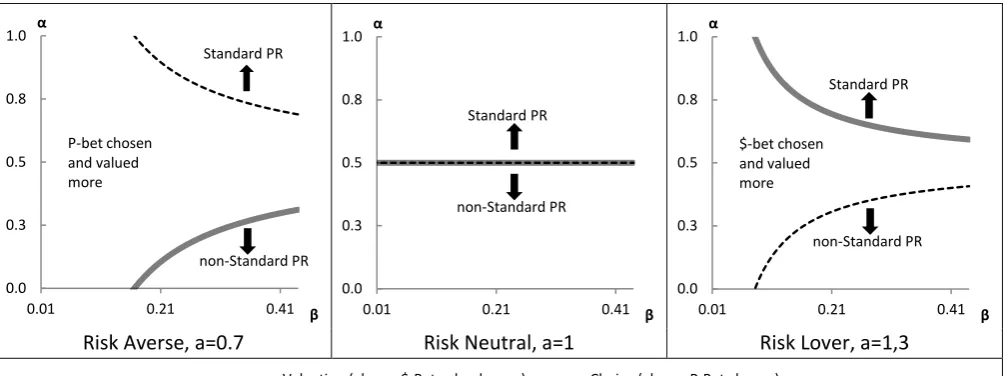
We explore the parameters of PCT in three cases: risk neutral, risk averse and a risk loving. Consider
[image:7.595.48.552.290.478.2]Figure 2, where r set to 1; P-bet
1.25,0.8;0 ,
$-bet
5,0.2;0
3Figure 1
Risk Averse, a=0.7 Risk Neutral, a=1 Risk Lover, a=1,3
The dashed line shows the**boundary and the solid line is the*boundary. Above the dashed
line the $-bet is valued higher and above the solid gray line the P-bet is chosen; the region between
the two lines is called the consistency range where the chosen bet is valued more. For a risk-neutral
individual, in the case of imprecision(0),a standard Preference reversal occurs if 0.5, when it
is lower than 0.5, the model predicts a non-standard Preference reversal. For a risk-averse
individual, in the consistency range individual chooses the P-Bet and values it higher; whereas for
the risk loving case the $-Bet is chosen and valued more. This makes sense: the P-bet would be more
3
For the imprecision level, we use
,p p
1p
, there is no particular reason behind choosing this, except it is simple and satisfies the assumptions of the theory. We normalize the expected value (EV) of the P bet by setting its payoff equal to1 / ;p ris the EV of the $ bet as a ratio of the EV of the P-bet. Therefore the winning prize of the $ bet equalsr/ .p0.0 0.3 0.5 0.8 1.0
0.01 0.21 0.41
α β Standard PR
non-Standard PR P-bet chosen and valued more 0.0 0.3 0.5 0.8 1.0
0.01 0.21 0.41
α β Standard PR
non-Standard PR 0.0 0.3 0.5 0.8 1.0
0.01 0.21 0.41
α β Standard PR
non-Standard PR $-bet chosen and valued more 0.0 0.3 0.5 0.8 1.0
attractive for a risk-averse individual. Overall, in the case of imprecision( 0),a sufficiently high
level of pessimism results in a standard Preference Reversal while optimism implies a non-standard
Preference Reversal.
Next we consider the case in which the winning probabilities remain the same, but the winning prize
[image:8.595.158.440.276.462.2]of the $-Bet varies. Figure 3 shows the critical bounds for three cases:
Figure 2
Risk Averse, a=0.7
The dashed lines show the valuation boundary, and the solid lines show the choice boundary, for
three levels of r(0.8,1,1.2). For a risk-averse decision-maker, the consistency range shrinks asr
increases up to a certain level. The parameter values to induce standard and non-standard
preference reversals converge to the risk neutrality baseline case. However, above this critical level
ofr,the consistency range favors the $-bet and it expands asrincreases. Even if we increase the
relative attractiveness of the $-bet to extreme values, the model predicts that both standard and
non-standard preference reversals can be observed. 0.0
0.3 0.5 0.8 1.0
0.01 0.21 0.41
α
β
Standard PR
non-Standard PR Consistency
Range
0 1
0 0.5 1
Valuation (r=0.8)
Valuation (r=1)
Valuation (r=1.2)
Choice (r=0.8)
Choice (r=1)
4.
Conclusion
We demonstrated the intuition of the Preference Cloud Theory and explained the possible
preference reversals. In the same manner other anomalies of EUT can be explained such as
Endowment Effect and Allais Paradox. To best of our knowledge, this is the only theory that can
explain anomalies in Expected Utility theory without incorporating the loss aversion notion of the
REFERENCES
Arrow, Kenneth J. and Leonid Hurwicz, “An Optimality Criterion for Decision-Making under Ignorance.” In
Carter, C. F. and J. L. Ford, eds., Uncertainty and Expectations in Economics. Oxford: Basil Blackwell,
1972.
Bisantz, Ann M., Stephanie Schinzing Marsiglio, and Jessica Munch. 2005. “Displaying Uncertainty:
Investigating the Effects of Display Format and Specificity.” Human Factors: The Journal of the
Human Factors and Ergonomics Society 47 (4): 777–96.
Budescu, David V., Shalva Weinberg, and Thomas S. Wallsten. 1988. “Decisions Based on Numerically and
Verbally Expressed Uncertainties.” Journal of Experimental Psychology: Human Perception and
Performance 14 (2): 281.
Budescu, David V., and Thomas S. Wallsten. 1990. “Dyadic Decisions with Numerical and Verbal
Probabilities.” Organizational Behavior and Human Decision Processes 46 (2): 240–63.
Butler, David, and Graham Loomes. 1988. “Decision Difficulty and Imprecise Preferences.” Acta
Psychologica 68 (1–3): 183–96.
Butler, David J., and Graham C. Loomes. 2007. “Imprecision as an Account of the Preference Reversal
Phenomenon.” American Economic Review 97 (1): 277–97.
Butler, David, and Graham Loomes. 2011. “Imprecision as an Account of Violations of Independence and
Betweenness.” Journal of Economic Behavior & Organization 80 (3): 511–22.
Dubourg, W. R., M. W. Jones-Lee, and Graham Loomes. 1994. “Imprecise Preferences and the WTP-WTA
Disparity.” Journal of Risk and Uncertainty 9 (2): 115–33.
Dubourg, Jones-Lee, and Graham Loomes. 1997. “Imprecise Preferences and Survey Design in Contingent
Isoni, Andrea, Graham Loomes, and Robert Sugden. “The Willingness to Pay Willingness to Accept Gap,
the Endowment Effect, Subject Misconceptions, and Experimental Procedures for Eliciting
Valuations: Comment.” The American Economic Review 101, no. 2 (2011): 991–1011.
Morrison, Gwendolyn C. 1998. “Understanding the Disparity between WTP and WTA: Endowment Effect,
Substitutability, or Imprecise Preferences?” Economics Letters 59 (2): 189–94.
Plott, Charles R., and Kathryn Zeiler. “The Willingness to Pay-Willingness to Accept Gap, the ‘Endowment
Effect,’ Subject Misconceptions, and Experimental Procedures for Eliciting Valuations.” The American
Economic Review 95, no. 3 (June 1, 2005): 530–45.
Wallsten, Thomas S, Samuel Fillenbaum, and James A Cox. 1986. “Base Rate Effects on the Interpretations
of Probability and Frequency Expressions.” Journal of Memory and Language 25 (5): 571–87.
Wallsten, Thomas S., and David V. Budescu. 1995. “A Review of Human Linguistic Probability Processing:
General Principles and Empirical Evidence.” The Knowledge Engineering Review 10 (01): 43–62.
Zimmer, Alf C. 1984. “A Model for the Interpretation of Verbal Predictions.” International Journal of