A Study on Richer Syntactic Dependencies for Structured Language
Modeling
Peng Xu
Center for Language and Speech Processing Johns Hopkins University
Baltimore, MD 21218
Ciprian Chelba Microsoft Research One Microsoft Way Redmond, WA 98052
Frederick Jelinek
Center for Language and Speech Processing Johns Hopkins University
Baltimore, MD 21218
Abstract
We study the impact of richer syntac-tic dependencies on the performance of the structured language model (SLM) along three dimensions: parsing accu-racy (LP/LR), perplexity (PPL) and word-error-rate (WER, N-best re-scoring). We show that our models achieve an im-provement in LP/LR, PPL and/or WER over the reported baseline results us-ing the SLM on the UPenn Treebank and Wall Street Journal (WSJ) corpora, respectively. Analysis of parsing per-formance shows correlation between the quality of the parser (as measured by pre-cision/recall) and the language model per-formance (PPL and WER). A remarkable fact is that the enriched SLM outperforms the baseline 3-gram model in terms of WER by 10% when used in isolation as a second pass (N-best re-scoring) language model.
1 Introduction
The structured language model uses hidden parse trees to assign conditional word-level language model probabilities. As explained in (Chelba and Jelinek, 2000), Section 4.4.1, if the final best parse is used to be the only parse, the reduction in PPL —relative to a 3-gram baseline— using the SLM’s headword parametrization for word prediction is
about 40%. The key to achieving this reduction is a good guess of the final best parse for a given sen-tence as it is being traversed left-to-right, which is much harder than finding the final best parse for the entire sentence, as it is sought by a regular statistical parser. Nevertheless, it is expected that techniques developed in the statistical parsing community that aim at recovering the best parse for an entire sen-tence, i.e. as judged by a human annotator, should also be productive in enhancing the performance of a language model that uses syntactic structure.
The statistical parsing community has used var-ious ways of enriching the dependency structure underlying the parametrization of the probabilistic model used for scoring a given parse tree (Charniak, 2000) (Collins, 1999). Recently, such models (Char-niak, 2001) (Roark, 2001) have been shown to out-perform the SLM in terms of both PPL and WER on the UPenn Treebank and WSJ corpora, respectively. In (Chelba and Xu, 2001), a simple way of enriching the probabilistic dependencies in the CONSTRUC-TOR component of the SLM also showed better PPL and WER performance; the simple modifica-tion to the training procedure brought the WER per-formance of the SLM to the same level with the best as reported in (Roark, 2001).
tary syntactic dependencies obviates the need for interpolation with a 3-gram model in N-best re-scoring.
2 SLM Review
An extensive presentation of the SLM can be found in (Chelba and Jelinek, 2000). The model assigns a probability to every sentence
and ev-ery possible binary parse
. The terminals of are the words of
with POS tags, and the nodes of
are annotated with phrase headwords and non-terminal labels. Let
be a sentence of length
(<s>, SB) ... (w_p, t_p) (w_{p+1}, t_{p+1}) ... (w_k, t_k) w_{k+1}.... </s> h_0 = (h_0.word, h_0.tag)
[image:2.612.314.537.70.129.2]h_{-1} h_{-m} = (<s>, SB)
Figure 1: A word-parse -prefix
words to which we have prepended the sentence be-ginning marker<s>and appended the sentence end marker</s>so that <s>and </s>. Let
be the word -prefix of the sentence — the words from the beginning of the sentence up to the current position — and the word-parse -prefix. Figure 1 shows a word-parse -prefix; h_0, .., h_{-m} are the
ex-posed heads, each head being a pair (headword,
non-terminal label), or (word, POS tag) in the case of a root-only tree. The exposed heads at a given po-sition in the input sentence are a function of the word-parse -prefix.
2.1 Probabilistic Model
The joint probability of a word sequence
and a complete parse
can be broken up into:
!#"%$&')(+* ,-/.10 23 04 !#"65 287 $ 2:9 0 ' 2:9 0 (<;!#">= 2?7 $ 2:9 0 ' 2:9 0 &5 2 (@; ,BA 2 C 3 0 !#"D 2 C 7 $ 2E9 0 ' 2:9 0 &5 2 &= 2 &D 2 0:FGFGF D 2 C 9 0 (IH (1) where:J KML NML
is the word-parse
PORQ -prefix
J
is the word predicted by WORD-PREDICTOR JTS
is the tag assigned to
by the TAGGER JVU
[image:2.612.314.539.170.231.2]
OWQ is the number of operations the CON-STRUCTOR executes at sentence position before
...
T’_0
T_{-1} T_0 <s> T’_{-1}<-T_{-2}
h_{-1} h_0
h’_{-1} = h_{-2}
T’_{-m+1}<-<s>
h’_0 = (h_{-1}.word, NTlabel)
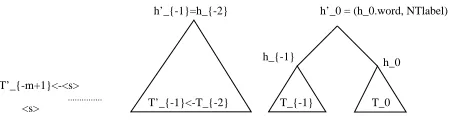
Figure 2: Result of adjoin-left under NT label
... T’_{-1}<-T_{-2} T_0 h_0 h_{-1} <s> T’_{-m+1}<-<s> h’_{-1}=h_{-2} T_{-1}
h’_0 = (h_0.word, NTlabel)
Figure 3: Result of adjoin-right under NT label
passing control to the WORD-PREDICTOR (the
U
-th operation at position k is the null transi-tion);
U
is a function of JYX
Z denotes the
[-th CONSTRUCTOR operation carried out at position k in the word string; the oper-ations performed by the CONSTRUCTOR are illus-trated in Figures 2-3 and they ensure that all possi-ble binary branching parses, with all possipossi-ble head-word and non-terminal label assignments for the
\
word sequence, can be generated. The
X X ]
2 sequence of CONSTRUCTOR operations at position grows the word-parse
OQ -prefix into a word-parse -prefix.
The SLM is based on three probabilities, each es-timated using deleted interpolation and parameter-ized (approximated) as follows:
!#"65 2/7 $ 2:9 0 ' 2:9 0 ( !#"65 287^_ & ^ 9 0 (<& (2) !#">= 2 7 5 2 &$ 2:9 0 ' 2:9 0 ( !#"6= 2 7 5 2 & ^_ & ^ 9 0 (@& (3) !#"D 2 C 7 $ 2 ' 2 ( !#"D 2 C 7^_ & ^ 9 0 ( F (4)
It is worth noting that if the binary branching struc-ture developed by the parser were always right-branching and we mapped the POS tag and non-terminal label vocabularies to a single type, then our model would be equivalent to a trigram lan-guage model. Since the number of parses for a given word prefix
grows exponentially with , `ba
Ndc `fehg
@i
The language model probability assignment for the word at position Q in the input sentence is made using:
!"65
2
.10
7
$
2
( *
2
2
!#">5
2
. 0
7
$
2
'
2
(<;"I$
2
&'
2
(<&
"I$
2
&'
2
( * !#"I$
2
'
2
(
7
2
2
!#"I$
2
'
2
(<& (5)
which ensures a proper probability normalization over strings
, where
is the set of all parses present in our stacks at the current stage .
Each model component —WORD-PREDICTOR, TAGGER, CONSTRUCTOR— is initialized from a set of parsed sentences after undergoing headword percolation and binarization, see Section 2.2. An N-best EM (Dempster et al., 1977) variant is then employed to jointly reestimate the model parameters such that the PPL on training data is decreased — the likelihood of the training data under our model is increased. The reduction in PPL is shown experi-mentally to carry over to the test data.
2.2 Headword Percolation And Binarization
As explained in the previous section, the SLM is ini-tialized on parse trees that have been binarized and the non-terminal (NT) tags at each node have been enriched with headwords. We will briefly review the headword percolation and binarization procedures; they are explained in detail in (Chelba and Jelinek, 2000).
The position of the headword within a constituent — equivalent to a context-free production of the type
, where T
are NT labels or POS tags (only for
Z
) — is specified using a rule-based approach.
Assuming that the index of the headword on the right-hand side of the rule is , we binarize the con-stituent as follows: depending on the
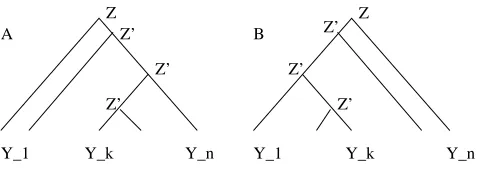
identity we apply one of the two binarization schemes in Fig-ure 4. The intermediate nodes created by the above binarization schemes receive the NT label
1. The choice among the two schemes is made according to a list of rules based on the identity of the label on the left-hand-side of a CF rewrite rule.
3 Enriching Syntactic Dependencies
The SLM is a strict left-to-right, bottom-up parser, therefore in Eq.( 2, 3, 4) the probabilities are
con-1
Any resemblance to X-bar theory is purely coincidental.
Z Z’
Z’
Z’ B
Z Z’
Z’
Z’ A
[image:3.612.314.553.68.157.2]Y_1 Y_k Y_n Y_1 Y_k Y_n
Figure 4: Binarization schemes
ditioned on the left contextual information. There are two main reasons we prefer strict left-to-right parsers for the purpose of language modeling (Roark, 2001):
J
when looking for the most likely word string given the acoustic signal (as required in a speech recognizer), the search space is orga-nized as a prefix tree. A language model whose aim is to guide the search must thus operate left-to-right.
J
previous results (Chelba and Jelinek, 2000) (Charniak, 2001) (Roark, 2001) show that a grammar-based language model benefits from interpolation with a 3-gram model. Strict left-to-right parsing makes it easy to combine with a standard 3-gram at the word level (Chelba and Jelinek, 2000) (Roark, 2001) rather than at sentence level (Charniak, 2001).
For these reasons, we prefer enriching the syntactic dependencies by information from the left context.
However, as mentioned in (Roark, 2001), one way of conditioning the probabilities is by annotat-ing the extra conditionannotat-ing information onto the node labels in the parse tree. We can annotate the training corpus with richer information and with the same SLM training procedure we can estimate the prob-abilities under the richer syntactic tags. Since the treebank parses allow us to annotate parent informa-tion onto the constituents, as Johnson did in (John-son, 1998), this richer predictive annotation can ex-tend information slightly beyond the left context.
extend the syntactic dependencies beyond this level, we enrich the non-terminal tag of a node in the binarized parse tree with the NT tag of the parent node, or the NT tag of the child node from which the headword is not being percolated (same as in (Chelba and Xu, 2001)), or we add the NT tag of the third most-recent exposed head to the history of the CONSTRUCTOR component. The three ways are briefly described as:
1. opposite (OP): we use the non-terminal tag of the child node from which the headword is not being percolated
2. parent (PA): we use the non-terminal tag of the parent node to enrich the current node
3. h-2: we enrich the conditioning information of the CONSTRUCTOR with the non-terminal tag of the third most-recent exposed head, but not the headword itself. Consequently, Eq. 4 becomes
!#"D
2
C
7
$
2
'
2
(* !#"D
2
C
7^_
&
^
9
0
&
^
9
F
=8(
We take the example from (Chelba and Xu, 2001) to illustrate our enrichment approaches. Assume that after binarization and headword percolation, we have a noun phrase constituent:
(NP_group (DT the) (NP’_group
(NNP dutch)
(NP’_group (VBG publishing) (NN group)))),
which, after enriching the non-terminal tags using the opposite and parent scheme, respectively, be-comes
(NP+DT_group (DT the) (NP’+NNP_group
(NNP dutch)
(NP’+VBG_group (VBG publishing) (NN group))))
and2
(NP+*_group (DT+NP the) (NP’+NP_group
(NNP+NP’ dutch)
(NP’+NP’_group (VBG+NP’ publishing) (NN+NP’ group)))).
2
The NP+* has not been enriched yet because we have not specified the NT tag of the parent of the NP group
A given binarized tree is traversed recursively in depth-first order and each constituent is enriched in the parent or opposite manner or both. Then from the resulting parse trees, all three components of the SLM are initialized and N-best EM training can be started.
Notice that both parent and opposite affect all three components of the SLM since they change the NT/POS vocabularies, but h-2 only affects the CON-STRUCTOR component. So we believe that if h-2 helps in reducing PPL and WER, it’s because we have thereby obtained a better parser. We should also notice the difference between parent and
op-posite in the bottom-up parser. In opop-posite scheme,
POS (part of speech) tags are not enriched. As we parse the sentence, two most-recent exposed heads will be adjoined together under some enriched NT label (Figure 2, 3), the NT label has to match the NT tag of the child node from which the headword is not being percolated. Since the NT tags of the chil-dren are already known at the moment, the opposite scheme actually restricts the possible NT labels. In the parent scheme, POS tags are also enriched with the NT tag of the parent node. When a POS tag is predicted from the TAGGER, actually both the POS tag and the NT tag of the parent node are hypoth-esized. Then when two most recent exposed heads are adjoined together under some enriched NT label, the NT label has to match the parent NT informa-tion carried in both of the exposed heads. In other words, if the two exposed heads bear different in-formation about their parents, they can never be ad-joined. Since this restriction of adjoin movement is very tight, pruning may delete some or all the good parsing hypotheses early and the net result may be later development of inadequate parses which lead to poor language modeling and poor parsing perfor-mance.
Model Word NT POS Parser baseline & h-2 10001 54 40 163 PA & h-2+PA 10001 570 620 1711 OP & h-2+OP 10001 970 40 2863 OP+PA &
[image:5.612.326.526.68.249.2]h-2+OP+PA 10001 3906 620 11719
Table 1: Vocabulary size comparison of the models
4 Experiments
With the three enrichment schemes described in Sec-tion 3 and their combinaSec-tions, we evaluated the PPL performance of the resulting seven models on the UPenn Treebank and the WER performance on the WSJ setup, respectively. In order to see the corre-spondence between parsing accuracy and PPL/WER performance, we also evaluated the labeled preci-sion and recall statistics (LP/LR, the standard pars-ing accuracy measures) on the UPenn Treebank cor-pus. For every model component in our experi-ments, deleted-interpolation was used for smooth-ing. The interpolation weights were estimated from separate held-out data. For example, in the UPenn Treebank setup, we used section 00-20 as training data, section 21-22 as held-out data, and section 23-24 as test data.
4.1 Perplexity
We have evaluated the perplexity of the seven dif-ferent models, resulting from applying parent,
op-posite, h-2 and their combinations. For each way of
initializing the SLM we have performed 3 iterations of N-best EM training. The SLM is interpolated with a 3-gram model, built from exactly the same training data and word vocabulary, using a fixed in-terpolation weight. As we mentioned in Section 3, the NT/POS vocabularies for the seven models are different because of the enrichment of NT/POS tags. Table 1 shows the actual vocabulary size we used for each model (for parser, the vocabulary is a list of all possible parser operations). The baseline model is the standard SLM as described in (Chelba and Je-linek, 2000).
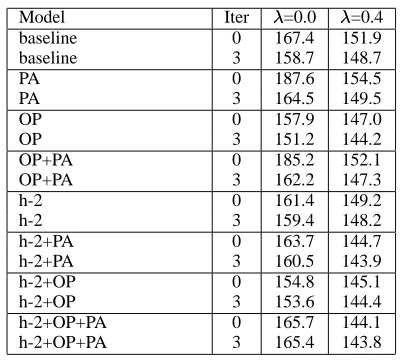
The PPL results are summarized in Table 2. The SLM is interpolated with a 3-gram model as shown in the equation:
B6
L
6
QTO
6
Model Iter =0.0 =0.4
baseline 0 167.4 151.9 baseline 3 158.7 148.7
PA 0 187.6 154.5
PA 3 164.5 149.5
OP 0 157.9 147.0
OP 3 151.2 144.2
OP+PA 0 185.2 152.1 OP+PA 3 162.2 147.3
h-2 0 161.4 149.2
h-2 3 159.4 148.2
h-2+PA 0 163.7 144.7 h-2+PA 3 160.5 143.9 h-2+OP 0 154.8 145.1 h-2+OP 3 153.6 144.4 h-2+OP+PA 0 165.7 144.1 h-2+OP+PA 3 165.4 143.8
Table 2: SLM PPL results
[image:5.612.84.289.69.135.2]Model Iter=0 Iter=3 LP LR LP LR baseline 69.22 61.56 69.01 57.82 PA 79.84 45.46 81.20 39.52 OP 74.55 62.97 72.54 59.76 OP+PA 82.58 45.57 83.62 39.54 h-2 73.72 72.27 73.24 71.13 h-2+PA 75.59 70.93 74.93 70.56 h-2+OP 76.91 73.89 76.11 72.65 h-2+OP+PA 78.35 66.04 77.73 64.95
Table 3: Labeled precision/recall(%) results
We should note that the PPL result of the 3-gram model is 166.6. As we can see from the table, without interpolating with the 3-gram, the
oppo-site scheme performed the best, reducing the PPL
of the baseline SLM by almost 5% relative. When the SLM is interpolated with the 3-gram, the
h-2+opposite+parent scheme performed the best,
re-ducing the PPL of the baseline SLM by 3.3%. How-ever, the parent and opposite+parent schemes are both worse than the baseline, especially before the EM training and with
=0.0. We will discuss the results further in Section 4.4.
4.2 Parsing Accuracy Evaluation
[image:5.612.332.521.281.390.2]Model Iter
0.0 0.2 0.4 0.6 0.8 1.0 baseline 0 13.0 13.1 13.1 13.1 13.0 13.4 13.7 PA 0 13.0 13.1 13.1 12.9 12.9 13.1 13.7 OP 0 12.8 12.7 12.8 12.8 12.7 13.1 13.7 OP+PA 0 13.1 13.3 12.9 13.0 12.9 13.1 13.7 h-2 0 12.5 12.7 12.5 12.6 12.9 13.2 13.7 h-2+
PA 0 12.7 12.8 13.0 12.7 12.7 13.0 13.7 h-2+
OP 0 12.3 12.3 12.4 12.6 12.7 12.8 13.7 h-2+
OP+
[image:6.612.73.300.71.219.2]PA 0 12.6 12.6 12.4 12.5 12.7 12.9 13.7
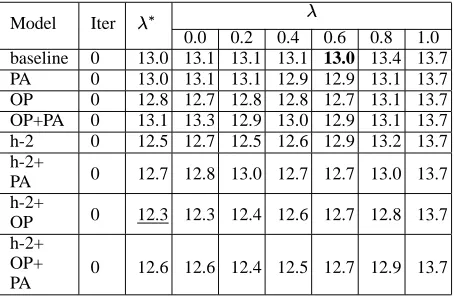
Table 4: N-best re-scoring WER(%) results
can be predicted before the parse of the sentence is ready for completion3, thus completing the parse with a series of special CONSTRUCTOR moves (see (Chelba and Jelinek, 2000) for details). The SLM allows right-branching parses which are not seen in the UPenn Treebank corpus and thus the evaluation against the UPenn Treebank is inherently biased.
It can also be seen that both the LP and the LR dropped after 3 training iterations: the N-best EM variant used for SLM training algorithm increases the likelihood of the training data, but it cannot guar-antee an increase in LP/LR, since the re-estimation algorithm does not explicitly use parsing accuracy as a criterion.
4.3 N-best Re-scoring Results
To test our enrichment schemes in the context of speech recognition, we evaluated the seven models in the WSJ DARPA’93 HUB1 test setup. The same setup was also used in (Roark, 2001), (Chelba and Jelinek, 2000) and (Chelba and Xu, 2001). The size of the test set is 213 utterances, 3446 words. The 20k words open vocabulary and baseline 3-gram model are the standard ones provided by NIST and LDC — see (Chelba and Jelinek, 2000) for details. The lat-tices and N-best lists were generated using the stan-dard 3-gram model trained on 45M words of WSJ. The N-best size was at most 50 for each utterance,
3
A parse is ready for completion when at the end of the sentence there are exactly two exposed headwords, the first of which if the start-of-sentence symbol and the second is an or-dinary word. See (Chelba and Jelinek, 2000) for details about special rules.
and the average size was about 23. The SLM was trained on 20M words of WSJ text automatically parsed using the parser in (Ratnaparkhi, 1997), bi-narized and enriched with headwords and NT/POS tag information as explained in Section 2.2 and Sec-tion 3. Because SLM training on the 20M words of WSJ text is very expensive, especially after enrich-ing the NT/POS tags, we only evaluated the WER performance of the seven models with initial statis-tics from binarized and enriched parse trees. The results are shown in Table 4. The table shows not only the results according to different interpolation weights
, but also the results corresponding to , a virtual interpolation weight. We split the test data into two parts,
and . The best interpolation weight, estimated from part
, was used to decode part , and vice versa. We finally put the decod-ing results of the two parts together to get the final decoding output. The interpolation weight
is vir-tual because the best interpolation weights for the two parts might be different. Ideally,
should be estimated from separate held-out data and then ap-plied to the test data. However, since we have a small number of N-best lists, our approach should be a good estimate of the WER under the ideal inter-polation weight.
As can be seen, the h-2+opposite scheme achieved the best WER result, with a 0.5% abso-lute reduction over the performance of the opposite scheme. Overall, the enriched SLM achieves 10% relative reduction in WER over the 3-gram model baseline result(
Q ).
The SLM enriched with the h-2+opposite scheme outperformed the 3-gram used to generate the lat-tices and N-best lists, without interpolating it with the 3-gram model. Although the N-best lists are al-ready highly restricted by the 3-gram model during the first recognition pass, this fact still shows the po-tential of a good grammar-based language model. In particular, we should notice that the SLM was trained on 20M words of WSJ while the lattice 3-gram was trained on 45M words of WSJ. However, our results are not indicative of the performance of SLM as a first pass language model.
4.4 Discussion
give better PPL results. However, in Table 2, we can see that this is not always the case. For ex-ample, the parent and opposite+parent schemes are worse than baseline in the first iteration when
=0.0, the h-2+parent and h-2+opposite+parent schemes are also worse than h-2 scheme in the first iteration when
=0.0.
Why wouldn’t more information help? There are two possible reasons that come to mind:
1. Since the size of our training data is small (1M words), the data sparseness problem (over-parameterization) is more serious for the more complicated dependency structure. We can see the problem from Table 1: the NT/POS vo-cabularies grow much bigger as we enrich the NT/POS tags.
2. As mentioned in Section 3, a potential problem of enriching NT/POS tags in parent scheme is that pruning may delete some hypotheses at an early time and the search may not recover from those early mistakes. The result of this is a high parsing error and thus a worse language model.
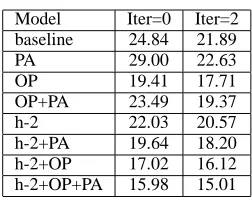
[image:7.612.316.535.210.392.2]Model Iter=0 Iter=2 baseline 24.84 21.89 PA 29.00 22.63 OP 19.41 17.71 OP+PA 23.49 19.37 h-2 22.03 20.57 h-2+PA 19.64 18.20 h-2+OP 17.02 16.12 h-2+OP+PA 15.98 15.01
Table 5: PPL for training data
In order to validate the first hypothesis, we eval-uated the training data PPL for each model scheme. As can be seen from Table 5, over-parameterization is indeed a problem. From scheme 2 to
h-2+opposite+parent, as we add more information to
the conditioning context, the training data PPL de-creases. The test data PPL in Table 2 does not follow this trend, which is a clear sign of over-parameterization.
Over-parameterization might also occur for
par-ent and opposite+parpar-ent, but it alone can not explain
the high PPL of training data for both schemes. The LP/LR results in Table 3 show that bad parsing
ac-curacy also plays a role in these situations. The la-beled recall results of parent and opposite+parent are much worse than those of baseline and other schemes. The end-of-sentence parse completion strategy employed by the SLM is responsible for the high precision/low recall operation of the parent and
opposite+parent models. Adding h-2 remedies the
parsing performance of the SLM in this situation, but not sufficiently.
160 180
PPL
12 13
14 WER
20 40
60 LR−Error
20 30
LP−Error
[image:7.612.122.248.409.509.2]baseline PA OP OP+PA h−2 h−2+PA h−2+OP h−2+OP+PA
Figure 5: Comparison of PPL, WER(%), Labeled precision/recall(%) error
It is very interesting to note that labeled recall and language model performance (WER/PPL) are well correlated. Figure 5 compares PPL, WER (
=0.0 at training iteration 0) and labeled precision/recall error(100-LP/LR) for all models. Overall, the la-beled recall is well correlated with the WER and PPL values. Our results show that improvement in the parser accuracy is expected to lead to improve-ment in WER.
1. The parser in (Roark, 2001) uses a “pick-and-choose” strategy for the conditioning informa-tion used in the probability models. This al-lows the parser to choose information depend-ing on the constituent that is bedepend-ing expanded. The SLM, on the other hand, always uses the same dependency structure that is decided be-forehand.
2. The parser in (Charniak, 2001) is not a strict left-to-right parser. Since it is top-down, it is able to use the immediate head of a constituent before it occurs, while this immediate head is not available for conditioning by a strict left-to-right parser such as the SLM. Consequently, the interpolation with the 3-gram model is done at the sentence level, which is weaker than in-terpolating at the word level.
Since the WER results in (Roark, 2001) are based on less training data (2.2M words total), we do not have a fair comparison between our best model and Roark’s model.
5 Conclusion and Future Work
We have presented a study on enriching the syn-tactic dependency structures in the SLM. We have built and evaluated the performance of seven dif-ferent models. All of our models improve on the baseline SLM in either PPL or WER or both. We have shown that adding the NT tag of the third most-recent exposed head in the parser model improves the parsing performance significantly. The improve-ment in parsing accuracy carries over to enhanc-ing language model performance, as evaluated by both WER and PPL. Furthermore, our best result shows that an uninterpolated grammar-based lan-guage model can outperform a 3-gram model. The best model achieved an overall WER improvement of 10% relative to the 3-gram baseline.
Although conditioning on more contextual infor-mation helps, we should note that some of our mod-els suffer from over-parameterization. One solu-tion would be to apply the maximum entropy esti-mation technique (MaxEnt (Berger et al., 1996)) to all of the three components of the SLM, or at least to the CONSTRUCTOR. That would also allow for fine-tuning of the particular syntactic dependencies
used in the model rather than the template based method we have used. Along these lines, the Max-Ent model has already shown promising improve-ments by combining syntactic dependencies in the WORD-PREDICTOR of the SLM (Wu and Khu-danpur, 1999).
References
A. L. Berger, S. A. Della Pietra, and V. J. Della Pietra. 1996. A maximum entropy approach to nat-ural language processing. Computational Linguistics, 22(1):39–72, March.
Eugene Charniak. 2000. A maximum-entropy-inspired parser. In Proceedings of the 1st Meeting of NAACL, pages 132–139, Seattle, WA.
Eugene Charniak. 2001. Immediate-head parsing for language models. In Proceedings of the 39th Annual Meeting and 10th Conference of the European Chapter of ACL, pages 116–123, Toulouse, France, July.
Ciprian Chelba and Frederick Jelinek. 2000. Structured language modeling. Computer Speech and Language, 14(4):283–332, October.
Ciprian Chelba and Peng Xu. 2001. Richer syntactic dependencies for structured language modeling. In Proceedings of the Automatic Speech Recognition and Understanding Workshop, Madonna di Campiglio, Trento-Italy, December.
Michael Collins. 1999. Head-Driven Statistical Models for Natural Language Parsing. Ph.D. thesis, Univer-sity of Pennsylvania.
A. P. Dempster, N. M. Laird, and D. B. Rubin. 1977. Maximum likelihood from incomplete data via the EM algorithm. In Journal of the Royal Statistical Society, volume 39 of B, pages 1–38.
Mark Johnson. 1998. Pcfg models of linguistic tree presentations. Computational Linguistics, 24(4):617– 636.
Adwait Ratnaparkhi. 1997. A linear observed time sta-tistical parser based on maximum entropy models. In Second Conference on Empirical Methods in Natural Language Processing, pages 1–10, Providence, RI.
Brian Roark. 2001. Robust Probabilistic Predictive Syn-tactic Processing: Motivations, Models and Applica-tions. Ph.D. thesis, Brown University, Providence, RI.