The Evolution QSOs—The Optical Luminosity Function
Irom Ablu Meitei1, K. Yugindro Singh2
1Department of Physics, Pettigrew College, Ukhrul, India 2Department of Physics, Manipur University, Canchipur, India
Email: [email protected], [email protected]
Received March 4, 2013; revised April 2, 2013; accepted April 10, 2013
Copyright © 2013 Irom Ablu Meitei, K. Yugindro Singh. This is an open access article distributed under the Creative Commons Attribution License, which permits unrestricted use, distribution, and reproduction in any medium, provided the original work is properly cited.
ABSTRACT
Using the data of the 2 Degree Field (2dF) QSO Redshift Survey (2QZ) and the associated 6 Degree Field (6dF) QSO Redshift Survey (6QZ) of the Anglo-Australian Telescope, a study of the Optical Luminosity Function of Quasi Stellar Objects (QSOs) has been made to understand the evolutionary scenario of QSOs. Different models for the QSO evolu- tion are studied. The two-power law model of the optical luminosity function with second order polynomial evolution is found to fit best the observed QSO optical luminosity function. We have also determined an improved evolutionary model which fits better than the second order polynomial evolution model. The best fit parameters for the observed op- tical luminosity function have been determined using the Levenberg-Marquardt algorithm of non-linear least square fit for a flat universe i.e., ΩΛ + Ωm = 1 and Ho = 70 km·s–1·Mpc–1. The observed slope of the log N − m curve i.e., 1.10 ± 0.01 reveals that there were more QSOs at larger distances (or look back times) than there are locally which, in turn, indicates that the QSOs are evolving. The observed value of <V/Vmax> is found to be greater than 0.5 for different values
of the cosmological constant which also hints strong evolution of the QSOs.
Keywords: Galaxies; Active
1. Introduction
The Quasi Stellar Objects (QSOs) constitute an evolving population. Their cosmological evolution was established by Schmidt (1968) [1] by applying the “V/Vmax” test. If
the evolution of an ensemble of the QSOs can be satis- factorily described, some clues as to the evolution of the individual sources may be apparent and these may lead to a better understanding of the physics of the QSO phe- nomenon [2]. Therefore, it is expected that the QSO evo- lution would throw light on the energy generation me- chanism in the Active Galactic Nuclei (AGNs). Such an evolutionary scenario would also reveal information on the relationship between the QSOs and the normal gal- axies. The QSOs represent an important phase of ga- lactic evolution. Some papers e.g. [3-6] proposed joint evolutionary models of galaxies and QSOs in which mergers between gas rich galaxies drive nuclear inflow of gas fueling the growth of supermassive black holes until feedback (e.g. galactic wind) energy from black hole growth expels the surrounding gas rendering the QSO as a briefly visible bright optical source. Lapi et al.
(2008) [7] proposed a model in which the QSO activity marked a transition between an earlier phase of violent
and heavily dust shrouded starburst activity which pro- motes rapid black hole growth, and a later phase of al- most passive evolution.
The luminosity function provides a basis for deter- mining the amount of matter in different forms in the universe [8]. The optical luminosity function of the QSOs and its evolution with redshift provides funda- mental information on the demographics of the overall population of the AGNs. It is a useful instrument to quantify the activity statistics of the AGNs [9]. The opti- cal luminosity function of the QSOs and the Seyfert nu- clei join smoothly. The shape, normalization and evolu- tion of the luminosity function are among the most basic descriptions of the QSO population and hence of the AGNs in general [10]. The optical luminosity function of QSOs as a function of redshift provides essential con- straints on how the population characteristics of the QSOs have changed with time (Koo & Kron, 1988) [2] and also provides constraints on the physical models of the QSOs [11]. Further, it may provide information on the models of structure formation in the early universe [12].
minosity function towards faint absolute magnitudes in their study of the QSO luminosity function of the 2dF- SDSS LRG and QSO (2SLAQ) survey. Clear evidence of downsizing was observed i.e. the number density of faint QSOs peaks at lower redshift than do the bright QSOs. The bright end of the QSO luminosity function tells us about the intrinsic properties of the QSO population dur- ing the time when the black holes are increasing in mass rapidly whereas the faint end of the QSO luminosity function tells us about the length of time QSOs spend at relatively low accretion rates [14]. Fontanot et al. 2007 [14] computed the QSO contribution to the UV back- ground at high redshift using the method proposed by Barger et al. 2003 [15] and confirmed that the QSO con- tribution to the UV background was insufficient for ion- izing the intergalactic medium at these redshifts.
A brief description of the 2QZ and the 6QZ data is given in Section 2. Simple tests for the evolution of the QSOs are described in Section 3 and the study of the optical luminosity function in Section 4.
2. The Data
The 2-degree Field (2dF) QSO Redshift Survey (2QZ) and the associated 6-degree Field (6dF) QSO Redshift Survey (6QZ) catalogues are used for the study of QSOs and their evolution. These surveys provide more than 23,500 QSOs in a single homogeneous survey covering almost five magnitudes in the bJ band (16 < bJ < 20.85).
The QSO candidates for the 2QZ and 6QZ surveys are selected based on the broadband ubJr colours for the automated plate measurement (APM) of UK Schmidt Telescope (UKST) photographic plates. Details are given in [16]. The survey region comprises of 30 UKST fields arranged in two 75˚ × 5˚ declination strips, one passing across the South Galactic Cap (SGP) centred on δ = –30˚ (SGP) strip and the other across the Northern Galactic Cap (NGP) centred on δ = 0˚ (referred to as the equato- rial strip, also known as the NGP strip) The SGP strip extends from α = 21h 40 to α = 3h 15 and the equatorial
strip from α = 9h 50 to α = 14h 50 (in B1950 coordinate
system). The total survey area is 721.6 deg2, when al-
lowance is made for regions of sky exercised around bright stars.
The QSO candidates were selected based on fulfilling at least one of the following colour criteria: u – bJ ≤ – 0.36; u – bJ≤ 0.12 – 0.8(bJ – r); bJ – r < 0.05. The u – bJ limit was tightened to u – bJ≤–0.50 for the 6QZ sample (bJ≤ 18.25) so as to reduce the high fraction of contami- nation by galactic stars (for details see [17]).
3. Simple Tests for Evolution of QSOs
3.1. The Log N – m TestWe can test whether the space density of a population of
a particular class of objects is constant or not by plotting the logarithm of the cumulative distribution, N as a func- tion of the apparent magnitude, m and measuring the slope. A slope dlogN(m)/dm > 0.6 indicates that the space density increases with distance [18,19]. The plot of log N
[image:2.595.312.533.538.685.2]versus m plot for the 2QZ and 6QZ QSOs is shown in
Figure 1. The apparent magnitude, m is taken in the bJ band. The slope of the most luminous QSOs is observed as 1.10 ± 0.01 which indicates that there were more QSOs at larger distances ( or look back times) than there are locally, i.e. there were more QSOs in the past, indi- cating a strong evolution of the QSOs.
3.2. The Luminosity—Volume Test (V/Vmax Test) The luminosity-volume test was devised by M. Schmidt [1] to test for the evolution of a population of objects. The test, also known as the V/Vmax test was first used by
Schmidt to study the space distribution of a complete sample of radio quasars from the 3CR catalogue. A uni- form distribution of objects is characterized by the <V/Vmax> value of 0.5 [18,19]. For the full sample of
2QZ and 6QZ QSOs the <V/Vmax> is 0.716 ± 0.002 for
ΩΛ = 0.7 universe. For the QSOs with 0.3 ≤ z≤ 2.3 the
<V/Vmax> value is 0.671 ± 0.002 for ΩΛ = 0.7. For ΩΛ =
0.3, 0.5 and 0.9 the values of <V/Vmax> are 0.648 ± 0.002,
0.674 ± 0.002 and 0.712 ± 0.002 respectively. These values of <V/Vmax> signify a strong evolution of the
QSOs.
4. The QSO Optical Luminosity Function
A binned estimate of the differential optical luminosity function has been determined using the 1/V estimator devised by Page & Carrera [20]. The QSOs in the red- shift range z = 0.3 to z = 2.3 are divided into eight equal intervals 0.3 ≤z≤ 0.55, 0.55 ≤z≤ 0.80, 0.80 ≤z≤ 1.05,1.05 ≤z≤ 1.30, 1.30 ≤z≤ 1.55, 1.55 ≤z≤ 1.80, 1.80 ≤z
≤ 2.05 and 2.05 ≤ z ≤ 2.30. Each redshift interval is binned into bins in absolute magnitude with bin width,
.
0.5
M
J
b
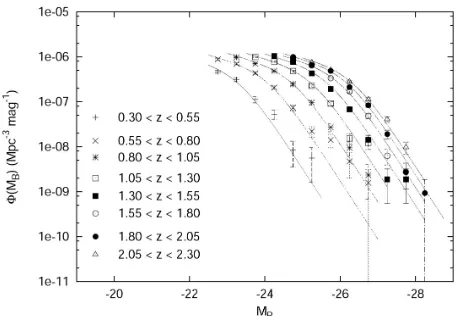
For ΩΛ = 0.7 universe, the binned luminosity function
is shown in Figure 2. We have used the Hubble constant,
Ho = 70 km·s–1·Mpc–1. The downturn at the faint end of
the luminosity function is due to incompleteness of the corresponding bins [21]. These incomplete bins are not included in our study of the QSO luminosity function. Similarly, for ΩΛ = 0.0, 0.3, 0.5 and 0.9 the incomplete
bins have been ignored. We have assumed a flat Uni- verse, i.e.ΩΛ + Ωm = 1. The routine mrqmin given in [22]
based on the Levenberg—Marquardt method and the as- sociated routines are used to fit the observed optical lu- minosity function to various models. Since the bright end of the luminosity function is steeper than the faint end despite the absence of a sharp break, a two-power-law function in the luminosity, LbJ is used to model the optical luminosity function,
LbJ,z
[9,17-19,23,24]:
, J
J J J J
b
b b b b
L z
L L L L
(1)In terms of magnitude,
,
0.4 1
0.4 1
10 10
J
bJ bJ bJ bJ
b M M M M
M z
(2)
The evolution of the luminosity function is given by the redshift dependence of the characteristic or break luminosity, J J or break magnitude,
J J
b b
b b
L L z
[image:3.595.309.537.486.644.2]M M z . Different models of the luminosity evo- lution are studied to determine the best fit parameters for different cosmologies ΩΛ = 0.0, 0.3, 0.5, 0.7 and 0.9.
Figure 2. Binned estimate of the optical luminosity function,
MbJ as a function of the absolute magnitude, MbJ in the bJ band for the 2QZ/6QZ QSOs in the redshift range 0.3
≤z≤ 2.3 for a flat Universe with cosmological constant, ΩΛ
= 0.7 and Hubble constant, Ho = 70 km·s–1·Mpc–1.
These models include 1)
0 1
LJ J
k
b b
L z L z , or equivalently,
0 2.5
1
J J
b b L
M z M k z , the power law evolu-
tion with redshift, z;
2)
0 101 22, or equivalently,J J
k z k z
b b
L z L
2
2 1
0 2.5
J J
b b L
M z M k k zk z , the second-order
polynomial evolution model;
3) LbJ
z LbJ
0 exp
k , or equivalently,
0 1.08J J
b b
M z M k , the exponential evolution with look-back time, τ.
These three models have already been used in several well-known papers e.g. [9,17,23,24].
To find an alternative model the exponent “2” of z in the second order polynomial evolution model is replaced by a parameter which is varied to give a value that mini- mizes the χ2. It is observed that the minimum of χ2 is
obtained when the parameter is 1.47. Thus, another lu- minosity evolution model given by
1.471 2
0 10
J J
k z k z
b b
L z L , or equivalently,
1.47
1 2
0 2.5
J J
b b L
M z M k k z k z
is determined. The luminosity functions and the predic- tions of the best fitting luminosity evolution model
and the best fit second order polynomial evolution model are shown in Figures 3 and 4 respec- tively. The best-fitting parameters, the χ2 values, the de-
grees of freedom ν, P(χ2) and the cosmological constant
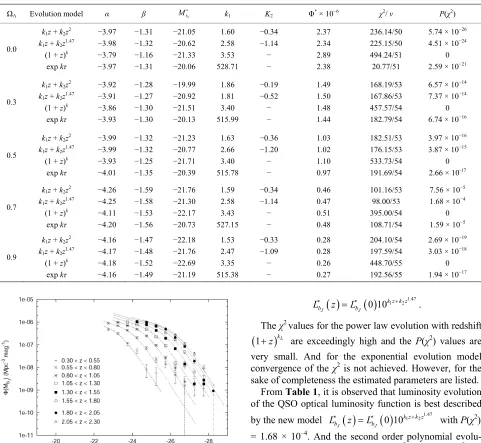
ΩΛ for different evolution models are given in Table 1.
1.47 1 2
k z k z
Figure 3. Binned estimate of the optical luminosity function,
MbJ as a function of the absolute magnitude, MbJ in the bJ band for the 2QZ/6QZ QSOs in the redshift range 0.3
≤z≤ 2.3 for a flat Universe with cosmological constant, ΩΛ
= 0.7 and Hubble constant, Ho = 70 km·s–1·Mpc–1. The dot-
ted lines denote the predictions of the best fitting two- p
[image:3.595.55.288.508.665.2]Table 1. The best fitting optical luminosity function model parameter for the QSOs with redshift 0.3 ≤ z ≤ 2.3 and
J b
M 22.5 for a flat universe i.e.ΩΛ + Ωm = 1 and Ho = 70 km·s–1·Mpc–1. The cosmological constant, ΩΛ, the evolution
models, the χ2, degrees of freedom ν and P(χ2) are also listed.
ΩΛ Evolution model α β MbJ
k1 K2 Φ* × 10−6 χ2/ ν P(χ2)
0.0
k1z + k2z2
k1z + k2z1.47
(1 + z)k exp kτ
−3.97 −3.98 −3.79 −3.97 −1.31 −1.32 −1.16 −1.31 −21.05 −20.62 −21.33 −20.06 1.60 2.58 3.53 528.71 −0.34 −1.14 − − 2.37 2.34 2.89 2.38 236.14/50 225.15/50 494.24/51 20.77/51
5.74 × 10⁻²⁶
4.51 × 10⁻²⁴
0 2.59 × 10⁻²¹
0.3
k1z + k2z2
k1z + k2z1.47
(1 + z)k exp kτ
−3.92 −3.91 −3.86 −3.93 −1.28 −1.27 −1.30 −1.30 −19.99 −20.92 −21.51 −20.13 1.86 1.81 3.40 515.99 −0.19 −0.52 − − 1.49 1.50 1.48 1.44 168.19/53 167.86/53 457.57/54 182.79/54
6.57 × 10⁻¹⁴
7.37 × 10⁻¹⁴
0 6.74 × 10⁻¹⁶
0.5
k1z + k2z2
k1z + k2z1.47
(1 + z)k exp kτ
−3.99 −3.99 −3.93 −4.01 −1.32 −1.32 −1.25 −1.35 −21.23 −20.77 −21.71 −20.39 1.63 2.66 3.40 515.78 −0.36 −1.20 − − 1.03 1.02 1.10 0.97 182.51/53 176.15/53 533.73/54 191.69/54
3.97 × 10⁻¹⁶
3.87 × 10⁻¹⁵
0 2.66 × 10⁻¹⁷
0.7
k1z + k2z2
k1z + k2z1.47
(1 + z)k exp kτ
−4.26 −4.25 −4.11 −4.20 −1.59 −1.58 −1.53 −1.56 −21.76 −21.30 −22.17 −20.73 1.59 2.58 3.43 527.15 −0.34 −1.14 − − 0.46 0.47 0.51 0.48 101.16/53 98.00/53 395.00/54 108.71/54
7.56 × 10⁻⁵
1.68 × 10⁻⁴
0 1.59 × 10⁻⁵
0.9
k1z + k2z2
k1z + k2z1.47
(1 + z)k exp kτ
−4.16 −4.17 −4.18 −4.16 −1.47 −1.48 −1.52 −1.49 −22.18 −21.76 −22.69 −21.19 1.53 2.47 3.35 515.38 −0.33 −1.09 − − 0.28 0.28 0.26 0.27 204.10/54 197.59/54 448.70/55 192.56/55
2.69 × 10⁻¹⁹
3.03 × 10⁻¹⁸
0 1.94 × 10⁻¹⁷
1.471 2
0 10
J J
k z k z
b b
L z L .
The χ2 values for the power law evolution with redshift
1z
kL are exceedingly high and the P(χ2) values arevery small. And for the exponential evolution model convergence of the χ2 is not achieved. However, for the
sake of completeness the estimated parameters are listed. From Table 1, it is observed that luminosity evolution of the QSO optical luminosity function is best described by the new model
1.47 with P(χ2)1 2
0 10
J J
k z k z
b b
L z L
= 1.68 × 10⁻⁴. And the second order polynomial evolu-
tion model is also acceptable with P(χ2) = 7.56 × 10⁻⁵.
The value of k1 is larger than the values reported in the
earlier papers e.g. [9,13,17,23,24]. The best fit bright end slope of the luminosity function is steeper as compared to the earlier results. The inclusion of QSOs with lower spectroscopic completeness, a large fraction of which goes to the fainter magnitudes might have contributed to the steepening of the luminosity function. However, the slope of the faint end of the luminosity function agrees well with the earlier results. The values of the constant k
for the model of exponential evolution with look-back time are found to be exceedingly high compared to the values reported in the above papers. The failure of the convergence of the χ2 to less than or equal to 0.01, which
Figure 4. Binned estimate of the optical luminosity function,
MbJ as a function of the absolute magnitude, MbJ in the bJ band for the 2QZ/6QZ QSOs in the redshift range 0.3
≤z≤ 2.3 for a flat Universe with cosmological constant, ΩΛ
= 0.7 and Hubble constant, Ho = 70 km·s–1·Mpc–1. The dot- ted lines denote the predictions of the best fitting two-power law with the second order polynomial evolution model.
The statistical errors on the individual parameters de- termined using Monte Carlo simulation are σ(Φ*) = 0.04
× 10–7 Mpc–3·mag–1; ; σ(k
1) = 0.06; σ(k2)
MbJ 0.05
we have used as the convergence criterion might be re- sponsible for the large value of k. The form of the look-back time coupled with the two-power-law form of the luminosity function might have led to the non- convergence.
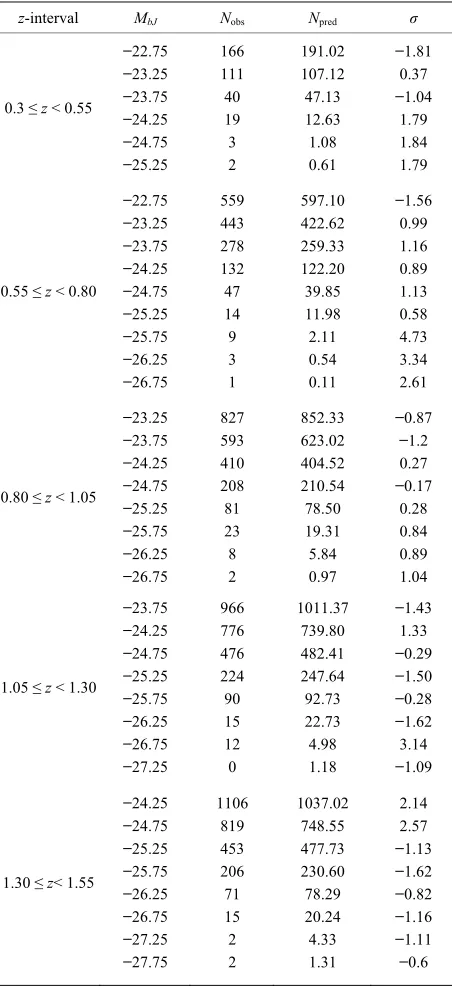
The number of the observed, Nobs and predicted, Npred QSOs for the best-fitting luminosity evolution model k1z
[image:5.595.59.285.244.737.2]+ k2z1.47 are given in Table 2.
Table 2. The number of the observed, Nobs and predicted,
Npred QSOs for the best-fitting luminosity evolution model
k1z + k2z1.47 using ; 0.3 ≤z ≤ 2.30 and ΩΛ = 0.7,
Ho = 70 km·s−1·Mpc−1 for a flat universe i.e.Ω
Λ + Ωm = 1. J
b
M 22.5
z-interval MbJ Nobs Npred σ
0.3 ≤z˂ 0.55
−22.75 −23.25 −23.75 −24.25 −24.75 −25.25 166 111 40 19 3 2 191.02 107.12 47.13 12.63 1.08 0.61 −1.81 0.37 −1.04 1.79 1.84 1.79
0.55 ≤z ˂ 0.80
−22.75 −23.25 −23.75 −24.25 −24.75 −25.25 −25.75 −26.25 −26.75 559 443 278 132 47 14 9 3 1 597.10 422.62 259.33 122.20 39.85 11.98 2.11 0.54 0.11 −1.56 0.99 1.16 0.89 1.13 0.58 4.73 3.34 2.61
0.80 ≤z ˂ 1.05
−23.25 −23.75 −24.25 −24.75 −25.25 −25.75 −26.25 −26.75 827 593 410 208 81 23 8 2 852.33 623.02 404.52 210.54 78.50 19.31 5.84 0.97 −0.87 −1.2 0.27 −0.17 0.28 0.84 0.89 1.04
1.05 ≤z ˂ 1.30
−23.75 −24.25 −24.75 −25.25 −25.75 −26.25 −26.75 −27.25 966 776 476 224 90 15 12 0 1011.37 739.80 482.41 247.64 92.73 22.73 4.98 1.18 −1.43 1.33 −0.29 −1.50 −0.28 −1.62 3.14 −1.09
1.30 ≤z˂ 1.55
−24.25 −24.75 −25.25 −25.75 −26.25 −26.75 −27.25 −27.75 1106 819 453 206 71 15 2 2 1037.02 748.55 477.73 230.60 78.29 20.24 4.33 1.31 2.14 2.57 −1.13 −1.62 −0.82 −1.16 −1.11 −0.6 Continued
1.55 ≤z ˂ 1.80
−24.75 −25.25 −25.75 −26.25 −26.75 −27.25 −27.75 −28.25 1025 704 366 183 54 7 3 0 951.32 660.67 381.36 159.92 51.62 13.99 2.52 0.62 2.38 1.68 −0.79 1.82 0.33 −1.87 0.30 −0.79
1.80 ≤z ˂ 2.05
−24.75 −25.25 −25.75 −26.25 −26.75 −27.25 −27.75 −28.25 1100 735 534 230 92 20 3 1 1088.33 786.36 504.13 249.59 86.67 22.29 5.74 1.044 0.35 −1.83 1.33 −1.24 0.57 −0.48 −1.14 −0.04
2.05 ≤z ˂ 2.30
−25.25 −25.75 −26.25 −26.75 −27.25 −27.75 −28.25 812 536 291 118 45 11 0 854.34 574.05 309.18 116.70 33.02 8.08 1.83 −1.45 −1.59 −1.03 0.12 2.05 1.03 −1.35
5. Conclusion
A study of the evolutionary scenario of the 2QZ and the associated 6QZ QSOs is carried out. A modest attempt is made to parameterize the QSO evolution using the opti- cal luminosity function. An improved evolutionary model in the framework of the two-power-law model of the optical luminosity function which fits the observed QSO optical luminosity function, is determined. The best fit parameters for the QSO optical luminosity function are also determined. A complete understanding of the optical luminosity function would reveal information on the AGN phenomena, the relation between the normal gal- axies and the AGNs and also about the structure forma- tion in the early universe. Of the five values of the cos- mological constant, ΩΛ, the χ2 value is found to be mi-
nimum for ΩΛ = 0.7 which agrees with the most widely
accepted value. This shows that the study of the optical luminosity function might provide a tool for estimation of the value of the cosmological constant. It is hoped that information contained in the QSO population in the form of the optical luminosity function would reveal the nature of the QSO energy source and help to constrain the val- ues of some of the cosmological parameters.
6. Acknowledgements
thors are thankful to the entire 2QZ/6QZ team.
REFERENCES
[1] M. Schmidt, “Space Distribution and Luminosity Func- tions of Quasi-Stellar Radio Sources,” The Astrophysical Journal, Vol. 151, No. 2, 1968, pp. 393-409.
doi:10.1086/149446
[2] D. C. Koo and R. G. Kron, “Spectroscopic Survey of QSOs to B = 22.5: The Luminosity Function,” The Astrophysi- cal Journal, Vol. 325, No. 1, 1988, pp. 92-102.
doi:10.1086/165984
[3] P. F. Hopkins, et al., “Black Holes in Galaxy Mergers: Evolution of Quasars,” The Astrophysical Journal, Vol. 630, No. 2, 2005, pp. 705-715. doi:10.1086/432438 [4] P. F. Hopkins, et al., “Luminosity-Dependent Quasar Life-
times: A New Interpretation of the Quasar Luminosity Function,” The Astrophysical Journal, Vol. 630, No. 2, 2005, pp. 716-720. doi:10.1086/432463
[5] P. F. Hopkins, et al., “A Unified, Merger-Driven Model of the Origin of Starbursts, Quasars, the Cosmic X-Ray Background, Supermassive Black Holes, and Galaxy Sphe- roids,” The Astrophysical Journal Supplement Series, Vol. 163, No. 1, 2006, pp. 1-49. doi:10.1086/499298
[6] P. Monaco and F. Fontanot, “Feedback from Quasar in Star-forming Galaxies and the Triggering of Massive Ga- lactic Winds,” Monthly Notices of the Royal Astronomical Society, Vol. 359, No. 1, 2005, pp. 283-294.
doi:10.1111/j.1365-2966.2005.08884.x
[7] A. Lapi, et al., “Quasar Luminosity Functions from Joint Evolution of Black Holes and Host Galaxies,” The As- trophysical Journal, Vol. 650, No. 1, 2006, pp. 42-56. doi:10.1086/507122
[8] P. Osmer, “Quasistellar Objects: Overview from Encyclo- pedia of Astronomy and Astrophysics. P. Murdin,” IOP Publishing Ltd., London, 2006.
[9] B. J. Boyle, T. Shanks, S. M. Croom, R. J. Smith, L. Mil- ler, N. Loaring and C. Heymans, “The 2dF QSO Redshift Survey—I. The Optical Luminosity Function of Quasi- Stellar Objects,” Monthly Notices of the Royal Astrono- mical Society, Vol. 317, No. 4, 2000, pp. 1014-1022. doi:10.1046/j.1365-8711.2000.03730.x
[10] T. Köhler, D. Groote, D. Reimers and L. Wisotzki, “The Local Luminosity Function of QSOs and Seyfert 1 Nu- clei,” Astronomy and Astrophysics, Vol. 325, 1997, pp. 502-510.
[11] M. G. Haenelt and M. J. Rees, “The Formation of Nuclei in Newly Formed Galaxies and the Evolution of the Qua-sar Population,” Monthly Notices of the Royal Astro-nomical Society, Vol. 263, 1993, pp. 168-178.
[12] G. Efstathiou and M. J. Rees, “High Redshift Quasars in the Cold Dark Matter Cosmogony,” Monthly Notices of the Royal Astronomical Society, Vol. 230, 1988, pp. 5-11.
[13] S. M. Croom, et al., “The 2dF-SDSS LRG and QSO Sur- vey: The SO Luminosity function at 0.4 < z < 2.6,”
Monthly Notices of the Royal Astronomical Society, Vol. 399, No. 4, 2009, pp. 755-772.
doi:10.1111/j.1365-2966.2009.15398.x
[14] F. Fontanot, S. Cristiani, P. Monaco, M. Nonino, E. Van- zella, W. N. Brandt, A. Grazian and J. Mao, “The Lumino- sity Function of High-Redshift Quasi-Stellar Objects. A Combined Analysis of Goods and SDSS,” Astronomy & Astrophysics, Vol. 461, No. 1, 2007, pp. 39-48.
doi:10.1051/0004-6361:20066073
[15] A. N. Barger, et al., “Very High Redshift X-Ray Selected Active Galactic Nuclei in the Chandra Deep Field—
North,” The Astrophysical Journal, Vol. 584, No. 2, 2003, pp. L61-l64. doi:10.1086/368407
[16] R. J. Smith, S. M. Croom, B. J. Boyle, T. Shanks, L. Mil- ler and N. S. Loaring, “The 2dF QSO Redshift Survey—
III. The Input Catalogue,” Monthly Notices of the Royal Astronomical Society, Vol. 359, No. 1, 2005, pp. 57-72. doi:10.1111/j.1365-2966.2005.08870.x
[17] S. M. Croom, R. J. Smith, B. J. Boyle, T. Shanks, L. Mil- ler, P. L. Outram and N. S. Loaring, “The 2dF QSO Red- shift Survey—XII. The Spectroscopic Catalogue and Lu- minosity Function,” Monthly Notices of the Royal Astro- nomical Society, Vol. 349, No. 4, 2004, pp. 1397-1418. doi:10.1111/j.1365-2966.2004.07619.x
[18] A. K. Kembhavi and J. V. Narlikar, “Quasars and Active Galactic Nuclei,” Cambridge University Press, Cambri- dge, 1999.
[19] B. M. Peterson, “An Introduction to Active Galactic Nu- clei,” Cambridge University Press, Cambridge, 1997. doi:10.1017/CBO9781139170901
[20] M. J. Page and F. J. Carrera, “An Improved Method of Con- structing Binned Luminosity Functions,” Monthly No- tices of the Royal Astronomical Society, Vol. 311, No. 2, 2000, pp. 433-440.
doi:10.1046/j.1365-8711.2000.03105.x
[21] G. T. Richards, et al., “The 2dF-SDSS LRG and QSO (2SLAQ) Survey: The z < 2.1 Quasar Luminosity Func- tion fro 5645 Quasars to g= 21.85,” Monthly Notices of the Royal Astronomical Society, Vol. 360, No. 3, 2005, pp. 839-852. doi:10.1111/j.1365-2966.2005.09096.x
[22] W. H. Press, S. A. Teukolsky, W. T. Vetterling and B. P. Flannery, “Numerical Recipes in Fortran 77,” Cambridge University Press, Cambridge, 1992.
[23] B. J. Boyle, T. Shanks and B. A. Peterson, “The Evolu- tion of Optically Selected QSOs II,” Monthly Notices of the Royal Astronomical Society, Vol. 235, 1988, pp. 935- 948.
[24] S. M. Croom, et al., “The 2dF QSO Redshift Survey,”