http://www.scirp.org/journal/ojg ISSN Online: 2161-7589 ISSN Print: 2161-7570
Facies Analysis and Depositional
Environment of Upper Permian
Rocks in Darin Section,
East-Central Iran
Bibi Haniyeh Emraninasab
1, Mohammad Hossein Adabi
2, Mahmood Reza Majidifard
3,
Nader Kohansal Ghadimvand
1*, Sohei Erfani
11Department of Geology, Islamic Azad University, North Tehran Branch, Tehran, Iran 2Department of Earth sciences, Shahid Beheshti University, Tehran, Iran
3Research Institute for Earth Sciences, Geology Survey of Iran, Tehran, Iran
Abstract
Deposits of Permian rocks in Kalmard Block are recognized with Khan Group, showing various characteristics in different outcrops. This group is made up of three informal formations, namely Chili, Sartakht and Hermez. Upper Permian deposits (Hermez Formation) are composed chiefly of laterit-ic and carbonate rocks. This formation is composed of 65.5 m lateritlaterit-ic soils, lateritic sandstone, limestone, dolomite and dolomitic limestone in the Darin section. This formation unconformably overlies middle Permian siliciclastic and evaporite deposits (Sartakht Formation), where as it is depicted underly-ing an erosional unconformity above lateritic deposits of lower Triassic (Sorkh Shale Formation). According to lithologic and microscopic investiga-tions, the deposits of Hermez Formation can be divided into 1 siliciclastic pe-trofacies and 14 carbonate microfacies. Field observations, along with micro-scopic examinations, have resulted in identifying tidal flat, lagoon, shoal and open marine environments in the rocks of the studied formation. Vertical changes of microfacies and depth variation curve point to the high thickness of the microfacies of lagoon, tidal flat and shoal environments and low thick-ness of open marine microfacies. Hermez Formation rocks in Darin section are deposited in a low-angle homoclinal ramp, mostly in the inner ramp, lo-cated in the southern Paleo-Tethys Ocean.
Keywords
Upper Permian, Kalmard Block, Hermez Formation, Depositional Environment
How to cite this paper: Emraninasab, B.H., Adabi, M.H., Majidifard, M.R., Gha-dimvand, N.K. and Erfani, S. (2017) Facies Analysis and Depositional Environment of Upper Permian Rocks in Darin Section, East-Central Iran. Open Journal of Geolo-gy, 7, 242-256.
https://doi.org/10.4236/ojg.2017.73017
Received: January 2, 2017 Accepted: March 18, 2017 Published: March 21, 2017
Copyright © 2017 by authors and Scientific Research Publishing Inc. This work is licensed under the Creative Commons Attribution International License (CC BY 4.0).
1. Introduction
Central Iran zone, shaped like a triangle and as one of the major, largest and most complex geological units in Iran, is located in the center of Iran. Structural model of this area consists of separate blocks, separated by deep faults, thereby exhibiting distinct characteristics. Kalmard Block, enjoying a northeastern trend, is situated between Kalmard faults in the east and those of Naein in the west [1].
2. Darin Section Position
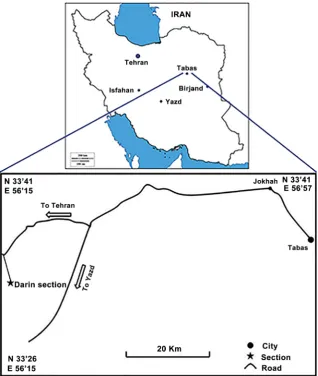
This section is located in the west of Tabas (at 1:250000 scale) [2] and northeast of Robate-khan village in Kalmard zone (at 1:100000 scale) [3] (eastern central Iran). It is formed by geographical coordinates of 33'32''09N and 56'09'07'E, and is located about 90 kilometers from Tabas-Yazd main road, accessible by an ele-ven-kilometer dirt road (Figures 1-3).
3. Methodology
[image:2.595.215.534.333.710.2]To determine the facies characteristics and depositional environment conditions
Figure 2. Satellite image of Hermez Formation in Darin section, separation of sediments age based on Tabas map (at 1:250000 scale) (Aghanabati, 1977).
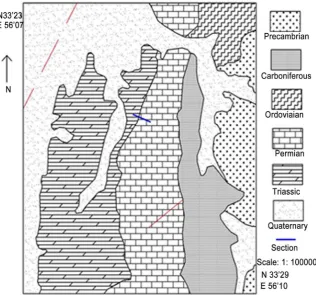
Figure 3. Geological map of Hermez Formation in Darin section (Aghanabati, 1977).
[image:3.595.216.533.343.638.2]in-cluding gradation, various depositional structures and various fossils are rec-orded. According to laboratory investigations, moreover, carbonate microscopic thin sections are used to reveal the characteristics of microscopic facies (namely, grain size and other textual features), diagenetic characteristics and microfossils. The petrofacies of siliciclastic rocks are identified by studying thin sections. Having collected data from thin sections, the depositional environment of this formation is interpreted and explained. Adopting Dickson’s 1965 method, Aliza-rin Red S is used to stain the thin sections to identify the type of carbonate min-erals (distinguishing calcite from dolomite) [4]. Folk classification scheme [5] is used to classify siliciclastic petrofacies, and Dunham [6] classification system, re-fined by Emry & Klovan in 1971 is employed to describe the composition of the carbonate microfacies [7]. Additionally, a comparison is made between vertical changes of microfacies and recent depositional environment using information gathered from Wilson, 1975; Carozzi, 1989; Tucker & Wright, 1990; Flügel, 2010 [8] [9] [10] [11].
4. Stratigraphy
Upper Permian deposits (Dzhulfian-Dorashamian stages), composed of sand-stone, limesand-stone, dolomite and dolomitic limesand-stone, are recognized by Hermez informal formation in Kalmard Block. One of the most comprehensive outcrops of Hermez Formation is situated in Darin section, in which deposits of Hermez Formation rocks have strike N18E, Dip 61NW and 65.5 m thickness. The lithol-ogy of Hermez Formation in Darin section is composed chiefly of sandstone, mestone, dolomite and dolomitic limestone, and, based on morphologic and li-thologic characteristics, can be divided into six units including: a sequence of reddish, old lateritic soils and lateritic sandstone with 6 m in thickness (unit 1), which has unconformably overlain carbonate and siliciclastic deposits of Chili Formation (lower Permian), medium-to-thick, gray dolomitic limestone with 8.5 m in thickness (unit 2), medium-to-thin, yellow dolomitic limestone with 6 m in thickness (unit 3), a sequence of dolomitic limestone and thick-to-medium, light gray lime dolomite with 30 m in thickness (unit 4), thick-to-medium, reddish yellow dolomite with a thickness of 4 m (unit 5) and 11-meter, thick-to-medium, dark gray limestones (unit 6). The unit unconformably underlies medium-to- thin, reddish sequence of shale and lateritic and oxidized siltstone belonging to Sorkh Shale Formation (Lower Triassic).
5. Investigating the Facies and Depositional Environment of
Hermez Formation in Darin Section
5.1. Facies Belt A: Tidal Flat Environment
This facies belt includes one petrofacies and five microfacies. A1 is a siliciclastic petrofacies while A2 to A5 are carbonate microfacies. These petrofacies and mi-crofacies are deposited in the supertidal and intertidal subenvironments, de-scribed as follow:
A1: Sublitharenite Petrofacies
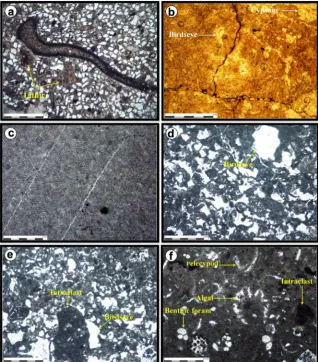
This petrofacies involves 45% immature, well-sorted but relatively poor- rounded quartz, together with 10% rock fragments with 2 mm in size. The aver-age size of grains ranges from 0.3 mm to 2 mm (Figure 4(a)).
A2: Dolomitized Fenestral Gypsiferous Mudstone Microfacies
[image:5.595.213.532.285.648.2]This facies is composed of 20% gypsum crystals in 0.2 mm size and fenestral fabric or bird’s eyes, lying within a lime mud matrix. This facies has undergone dolomitization process (Figure 4(b)).
A3: Oxidized Dolomudstone Microfacies
This microfacies consists of microcrystalline dolomite or dolomicrite, oxi-dized by Fe (Figure 4(c)).
A4: Fenestral Bioclast Mudstone/Wackstone Microfacies
This microfacies is completely covered by 5% to 10% microcrystalline lime mud and fenestral fabric or bird’s eye, intraclast and skeletal fragments (algae, benthic foraminifera, gastropod) (Figure 4(d)).
A5: Fenestral Bioclast Intraclast Wackstone Microfacies
The analysis of the structure of this microfacies shows a composition of in-traclast, 10% to 15% skeletal fragments and fenestral fabric or bird’s eye together with calcimicrobe algae, located within a lime mud matrix (Figure 4(e)).
A6: Fenestral Benthic Foraminifera Intraclast Pelecypod Algal Wack-stone/Packstone Microfacies
This microfacies hosts benthic foraminifera with 5% 0.2-mm-sized Globiva-vulina sp., 5% intraclast fragments with 0.2 mm in size, 5% pelecypoda with a size of 0.3 mm, 5% dasycladaceae algae with 0.3 mm in size and fenestral fabric and bird’s eye, situated in a lime mud matrix (Figure 4(f)).
Interpretation
Petrofacies and microfacies of this group are formed in the semi-arid to arid supratidal and intertidal environments. Petrofacies A1 is a sublitharenite petro-facies, formed in the supratidal subenvironment and a warm and humid clima-teas a result of intense chemical weathering [12] [13].
A5 proves the formation of this microfacies in an intertidal subenvironment [11] [21]. Microfacies A6, accompanying supratidal microfacies and containing fene-stral pores and limited lagoonal organisms, seems to be developed within an in-tertidal subenvironment [11].
5.2. Facies Belt B: Lagoon Environment
This facies belt is composed of three microfacies as follow: B1: Intraclast Benthic Foraminifera Wackstone Microfacies
The most abundant allochem of this microfacies is 8% Globivavulina, Textu-laria, Earlandias, as a benthic foraminiferal species, with 0.3 mm in size together with 5% 0.2-mm-sized intraclast fragments, all located within a micritic matrix (Figure 5(a)).
B2: Bioclast Intraclast Dasycladacea Packstone Microfacies
This microfacies hosts 30% dasycladacea algae, 30% intraclast fragments, 20% benthic foraminifera and 10% pelecypoda fragments with 0.3 mm in size, all of which are located in a micritic matrix. The grain size varies from 0.2 to 1.5 mm in size (Figure 5(b)).
B3: Gastropod Pelecypoda Wackstone Microfacies
This microfacies shows a composition of 8% pelecypoda and 5% gastropod, all scattered within a micritic matrix. The average size of grains is 0.4 mm (Figure 5 (c)).
Interpretation
Microfacies of this facies belt share such characteristics as presence of lime mud, non-skeletal grains including intraclast and lagoonal bioclasts such as benthic foraminifera, dasycladacea algae, pelecypoda and gastropod, capable of surviving in restricted and semi-restricted conditions [22]. The first common characteristics among microfacies of restricted lagoon environment are the presence of tranquility in their formation environment, and the second one is the high level of salinity in the depositional environment of the sediments of this group [23]. The distinctive feature of the microfacies of this group is due to the fabric type and grain size. The high percentage of green algae (dasycladacea), foraminifera, pelecypoda and gastropoda amongst the salient features of micro-facies B1 and B2 in the euphotic zone, where the water is shallow while nutrients are abundant [23] [24] [25] [26]. The high content of lime intraclast and their large size in microfacies B1 and B2 indicates that this microfacies belongs to high-energy lagoon and near shoal environments.
5.3. Facies Belt C: Shoal Environment
This facies belt consists of three microfacies as follow: C1: Ooid Grainstone Microfacies
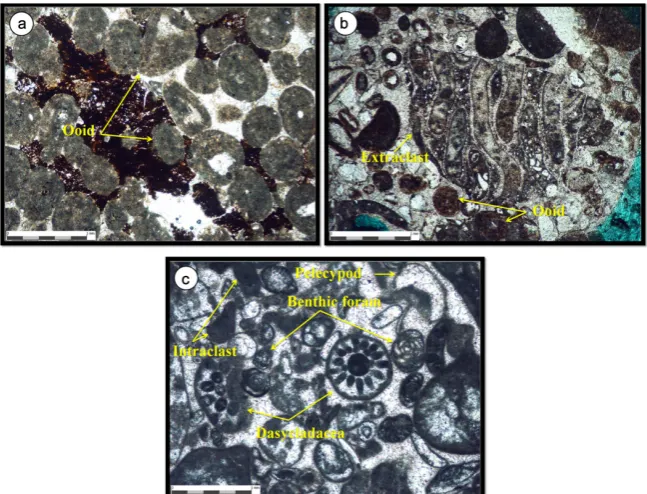
The major allochem in this microfacies is ooid, which constitutes 75% of the total sample and is 0.5 mm in diameter. The core of some ooids is composed of crinoid (Figure 6(a)).
Figure 5. Carbonate microfacies of lagoon environment in Hermez Formation, Darin section: (a) Intraclast benthic foraminifera wackstone microfacies; (b) Bioclast intraclast dasycladacea packstone microfacies; (c) Gostropod pelecypoda wackstone microfacies. 1 mm scale.
Figure 6. Carbonate microfacies of shoal environment in Hermez Formation, Darin section: (a) Ooid grainstone microfacies; (b) Sandy bioclast ooid extraclast grainstone microfacies; (c) Bioclast bryozoan grainstone microfacies. 1 mm scale.
[image:8.595.209.533.389.636.2]microfacies. The average size of the grains ranges from 0.2 to 3.5 mm (Figure 6(b)).
C3: Bioclast Bryozoan Grainstone Microfacies
This microfacies hosts various bioclast fragments including 40% crinoids with 1 mm in size, 10% intraclast with 0.4 mm in size and 15% medium-sorted and rounded quarts grains, located in a micritic matrix (Figure 6(c)).
Interpretation
This facies belt is formed in high-energy shoal setting and below the wave ef-fect due to the presence of non-skeletal fragments such as ooid, intraclast and extraclast and lack of limemud [27]. The presence of fully cement matrix, lack of limemud and size of the grains forming these microfacies indicate the high level of energy during the formation of this microfacies in a shoal environment [28] [29] [30]. The abundance of ooids and cross and plate lamination in microfacies C1 points to association of this microfacies with a high-energy and shallow en-vironment like shoal [31] [32]. Cross lamination mostly found in medium- grained sediments suggests a high-energy condition during the formation of this microfacies [21]. Similarly, a microfacies with medium to well sorted and rounded ooids is formed in the depositional environments of current age like southern coasts of Persian Gulf and the Bahamas at a depth of lower than 5 m. the presence of rounded intraclast in microfacies C2 indicates the high-energy and turbulent part of shoal environment [10]. According to the evidence, this microfacies can be associated with the outermost part of carbonate shoal, i.e. seaward shoal [10] [11] [33] [34]. Microfacies C3 consists of lagoonal skeletal fragments like benthic foraminifera, scattered in a sparite matrix. The evidence indicates that this microfacies is developed in a leeward shoal environment [8]. In this microfacies, moreover, intraclasts result from erosion and rip-up as well as erosion of older deposits by stormy currents [35].
5.4. Facies Belt D: Open Marine Environment
This facies belt is composed of three microfacies as follow: D1: Ostracod Wackstone Microfacies
This microfacies includes 10% 0.1 to 0.2-mm-sized ostracod and 3% 0.1-mm- sized radiolarian, located in a dark micritic matrix (Figure 7(a)).
D2: Dolomitized Archaeodiscus Radiolarian Wackstone/Packstone Mi- crofacies
This microfacies contains 30% radiolarian with 0.1 mm in size and 10% arc-haediscus with 0.3 mm in size, all scattered within a micritic matrix. It is note-worthy that dolomitization has influenced this microfacies (Figure 7(b)).
D3: Sandy Intraclast Bioclast Packstone Microfacies
The composition of this microfacies shows various bioclast fragments includ-ing 40% 1-mm-sized crinoid, 10% 0.4-mm-sized intraclast and 15% medium- sorted and rounded quartz grains, located in a micritic matrix (Figure 7(c)).
Interpretation
Figure 7. Carbonate microfacies of open marine environment of Hermez Formation in Darin section: (a) Ostracod wackstone microfacies; (b) Dolomitized archaeodiscus radiolarian wackstone/packstone microfacies; (c) Sandy intraclast bioclast packstone microfacies. 1 mm scale.
tracod [11] point to the formation of deposits in a low-energy and calm envi-ronment like open marine. The abundance of carbonate mud and a fall in the size of skeletal fragments in microfacies D1 and D2 suggest the deposition of these microfacies within deep and low-energy open marine environment [11]. Allochem has increased whereas micrite has decreased in microfacies D3. The presence of a small amount of cement, intraclasts and bioclasts like large crino-ids as well as high concentration of allochems in these microfacies indicates their formation in shallow and high-energy setting like supratidal or near shoal envi-ronments [11].
6. Depositional Environment Model of Hermez Formation in
Darin Section
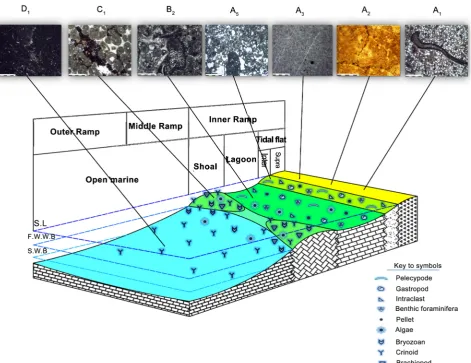
According to the microscopic and field observations, vertical relationship be-tween microfacies and the comparison made bebe-tween microfacies of Hermez Formation and current depositional microfacies, the depositional model of Hermez Formation in Darin section is presented in Figure 8. This model represents the position of the formation of siliciclastic petrofacies and carbonate microfacies of the mentioned facies in tidal flat, lagoon, shoal and open marine environments. Owning to the lack of calciturbidite, slumps, barrier reefs and oncolite as well as the presence of gradational facies, this petrofacies and its mi-crofacies are formed in a low-angle homoclinal carbonate-siliciclastic ramp [22]
[37] [38], located in the passive margin of southern Paleo-Tethys Ocean [39].
envi-ronment in Darin section indicates that shallow marine envienvi-ronment is observed in lower Permian, where various microfacies of Hermez Formation are depo-sited. As can be seen in the proposed model, the sublitharenite petrofacies is de-posited in an oxidized supratidal subenvironment, pointing to their formation in a warm and humid climate. Fenestral and bird’s-eye fabrics are common in in-tertidal microfacies. Deposits of lagoon environment are laid in a restricted to semi-restricted environment, separated from shoal environment by organisms like ooids, which contribute to its formation. Open marine environment is cha-racterized by the presence of radiolaria and ostracod fragments in a limemud matrix. Its thickness is reported to be less than other environments (Figure 8).
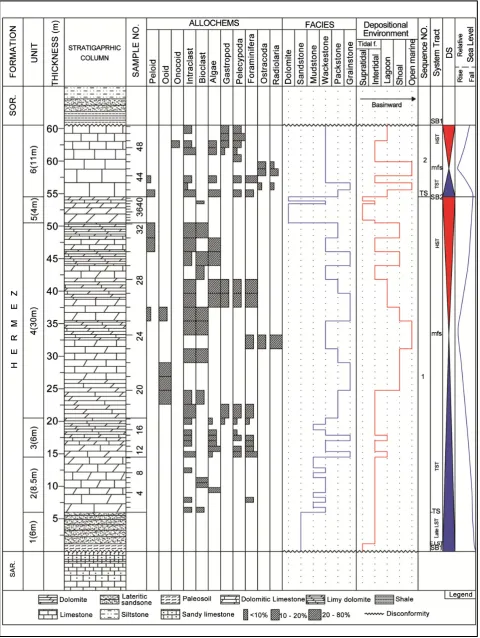
7. The Frequency Column of Microscopic Microfacies
[image:11.595.63.535.343.706.2]These microscopic microfacies consists of orthochem and allochem components, the type of matrix or cement and the type of skeletal and non-skeletal. The fre-quency percentage of allochem is computed by polarizing microscope and de-picted separately for each allochem. It is noteworthy that only two samples of unit1 are studied due to their lateritic and nonremovable nature (Figure 9).
8. Conclusions
Having analyzed the facies, depositional environment and sequence stratigraphy of the deposits of Khan Group (Hermez Formation) in Darin section, the re-searchers came up with the following results:
Upper Permian rocks (Dzhulfian-Dorashamian stages) are recognized by Hermez informal formation and consist of sandstone, limestone and dolomitic limestone. One of the most comprehensive outcrops of Hermez Formation is si-tuated in Darin section and is 65.5 m thick. According to the carbonate compo-sition of the rocks in this formation, accompanied by siliciclastic deposits (sand-stone of unite 1), deposits of this formation are formed in a warm and humid climate and close to the siliciclastic deposits supply. Investigating the lithofacies of the deposits of Hermez Formation in Darin section resulted in identifying 1 siliciclastic petrofacies and 14 carbonate microfacies. Regarding microscopic and field observations, siliciclastic petrofacies and carbonate microfacies of this sec-tion, facing sea from the coast, include: tidal flat environment, lagoon environ-ment, shoal environment and open marine environment. The vertical and lateral changes of microfacies and comparing them with late and early depositional en-vironments indicate that lack of calciturbidite deposits, slumps, barrier reef and oncolite and presence of gradational facies have caused the mentioned deposits to be formed in a low-angle homoclinal ramp, mostly in the inner ramp, located in the passive margin of southern Paleo-Tethys Ocean.
References
[1] Aghanabati, A. (2004) Geology of Iran. Geological Survey of Iran, Tehran, 606 p. [2] Aghanabati, A. (1977) Etudgeologique de la region de Kalmard (W. Tabas). Vol. 35,
Geological Survey of Iran, Tehran, 51-63.
[3] Azhdari, A. (1999) Geological Map and Report of Robate-Khan, on Scale of 1:100000. Geological Survey of Iran, Tehran.
[4] Dickson, J. (1965) A Modified Staining Technique for Carbonate in Thin Section.
Nature, 205, 587.
[5] Folk, R.L. (1974) Petrology of Sedimentary Rocks. Hemphill Publishing Company, Austin, 182.
[6] Dunham, R.J. (1962) Classification of Carbonate Rocks According to Depositional Texture. In: Ham, W.E., Ed., Classification of Carbonate Rocks: A Symposium, AAPG, Tulsa, No. 1, 108-121.
[7] Embry, A.F. and Klovan, J.E. (1971) A Late Devonian Reef Tract on Northeastern Banks Island. Canadian Petroleum Geology, 19, 730-781.
[8] Wilson, J.L. (1975) Carbonate Facies in Geologic History. Springer, New York, 471. https://doi.org/10.1007/978-1-4612-6383-8
[9] Carozzi, A.V. (1989) Carbonate Rocks Depositional Model. Prentice Hall, Upper Saddle River, 604.
[10] Tucker, M.E. and Wright V.P. (1990) Carbonate Sedimentology. Blackwell Science Ltd., Oxford, 496. https://doi.org/10.1002/9781444314175
[12] Bardossy, G. (1982) Karst Bauxites, Bauxite Deposits on Carbonate Rocks, Devel-opments in Economic Geology. Vol. 14, Elsevier, Amsterdam, 441.
[13] Ozlo, N. (1983) Trace-Element Content Karst Bauxites and Their Parent Rock in the Mediterranean Belt. Mineralium Deposita, 18, 469-476.
[14] Shinn, A. (1983) Tidal Flat Environment. In: Schlle, P.A., Debout, D.G. and Moore, C.H., Eds., Carbonate Depositional Environment, Vol. 33, AAPG, Tulsa, 173-210. [15] Adabi, M.H., Salehi, M.A. and Ghabeishavi, A. (2010) Depositional Environment,
Sequence Stratigraphy and Geochemistry of Lower Cretaceous Carbonates (Fah-liyan Formation), South-West Iran. Journal of Asian Earth Sciences, 39, 148-160. https://doi.org/10.1016/j.jseaes.2010.03.011
[16] Adabi, M.H., Kakemem, U. and Sadeghi, A. (2015) Sedimentary Facies Depositional Environment and Sequence Stratigraphy of Oligocene-Miocene Shallow Water Carbonate from the Rig Mountain, Zagros Basin (SW Iran). Carbonates and Evapo-rites, 31, 69-85.
[17] Butler, G.P., Harris, P.M. and Kendall, C.G. (1982) Recent Evaporites from the Abu-Dhabi Coastal Flats. In: Handford, C.R., Loucks, R.G. and Davies, G.R., Eds.,
Deposition and Diagenetic Spectra of Evaporites, Society for Sedimentary Geology, Tulsa, No. 3, 33-64. https://doi.org/10.2110/cor.82.01.0033
[18] Warren, J.K. (1989) Reservoir Analysis and Prediction in Carbonate Sequence Course. National Center Petroleum Geology and Geophysics, Adelaide, 164-205. [19] Adabi, M.H. (2009) Multistage Dolomitization of Upper Jurassic Mozduran
Forma-tion, Kopet-Dagh Basin, n.e. Iran. Carbonates and Evaporites, 25, 145-160. [20] Adabi, M.H. (2012) Sedimentary Geochemistry. 2nd Edition, Arian Zamin
Publica-tion, Tehran, 504.
[21] Bachmann, M. and Hirisch, F. (2006) Lower Cretaceous Carbonate Platform of the Eastern Levant (Galilee and the Golan Heights): Stratigraphy and Second-Order Sea-Level Change. Cretaceous Research, 27, 487-512.
https://doi.org/10.1016/j.cretres.2005.09.003
[22] Brandano, M., Frezza, V., Tomassetti, L. and Pedley, M. (2010) Facies Analysis and Paleoenvironmental Interpretation of the Late Oligocene Attard Member (Lower Coralline Limstone Formation) Malta. Sedimentalogy, 56, 1138-1158.
https://doi.org/10.1111/j.1365-3091.2008.01023.x
[23] Jamalain, M. and Adabi, M.H. (2015) Geochemistry, Microfacies and Diagenetic Evidences for Original Aragonite Mineralogy and Open Diagenetic System of Lower Cretaceous Carbonates Fahliyan Formation (kuh-e siah) Area, Zagros Basin, South Iran. Carbonates and Evaporites, 30, 77-98.
https://doi.org/10.1007/s13146-014-0211-8
[24] Boudagher-Fadel, M.K. and Lokier, S.W. (2005) Significant Miocene Larger Fora-minifera from South Central Java. Revue de Paleobiologie Geneve, 24, 291-309. [25] Basso, D., Nalin, R. and Nelson, C.S. (2009) Shallow-Water sporolithonrhodoliths
from North Island (New Zealand). Palaios, 24, 92-103. https://doi.org/10.2110/palo.2008.p08-048r
[26] Nebelsick, J.H., Rasser, D. and Lempp, J. (2012) Tracking paleoenvironmental Changes in Coralline Algal-Dominated Carbonates of the Lower Oligocene Calca-reniti di Castelgomberto Formation (MontiBerici, Italy). Facies, 59, 133-148. https://doi.org/10.1007/s10347-012-0349-6
778. https://doi.org/10.1016/j.jseaes.2005.06.013
[28] Betzler, C., Braga, J.C., Martin, J.M., Sanchez-Almazo, I.M. and Lindhorst, S. (2006) Closure of Aseaway: Stratigraphic Record and Facies (Guadix Basin, Southern Spain). International Journal of Earth Sciences, 95, 903-910.
https://doi.org/10.1007/s00531-006-0073-y
[29] Palma, R.M., Lopez Gomez, J. and Piethe, R.D. (2007) Oxfordian Ramp System (La Manga Formation) in the Bardas Area (Mendoza Province), Neuquen Basin, Ar-gantina: Facies and Depositional Sequence. Sedimentary Geology, 195, 113-134. https://doi.org/10.1016/j.sedgeo.2006.07.001
[30] Khatibi, M. and Adabi, M.H. (2013) Microfacies and Geochemical Evidence for Original Aragonite Mineralogy of a Forminifera-Dominated Carbonate Ramp Sys-tem in the Late Paleocene to Middle Eocene, Alborz Basin, Iran. Carbonates and Evaporites, 29, 155-175.
[31] Mass, J., Fenerci, M. and Pernarcic, E. (2003) Palaeobathymetric Reconstruction of Peritidal Carbonates, Late Barremian, Urgonian, Sequences of Provence (SE France). Palaeogeography, 200, 65-81.
https://doi.org/10.1016/S0031-0182(03)00445-0
[32] Sandullia, R. and Raspinib, A. (2004) Regional to Global Correlation of Lower Cre-taceous Shallow-Water Carbonates of the Southern Apennines and Dinarides, Southern Tethyan Margin. Sedimentary Geology, 165, 117-153.
https://doi.org/10.1016/j.sedgeo.2003.11.014
[33] Koehrer, B., Aigner, T. and Poeppelreiter, M. (2011) Field-Scale Geometries of Up-per Khuff Reservoir Geobodies in an Outcrop Analogue (Oman Mountains, Sulta-nate of Oman). Petroleum Geoscience, 17, 3-16.
https://doi.org/10.1144/1354-079310-009
[34] Maurer, F., Martini, R., Rettori, R., Hillgartner, H. and Cirilli, S. (2009) The Geolo-gy of Khuff Outcrop Analogues in the Musandam Peninsula, United Arab Emirates and Oman. Geo Arabia, 14, 125-158.
[35] Lasemi, Y. (1995) Platform Carbonate of the Upper Jurassic Mozduran Formation in the Kopet-Dagh Basin, NE Iran, Facies Paleoenvironment and Sequences. Sedi-mentary Geology, 99, 151-164. https://doi.org/10.1016/0037-0738(95)00041-6 [36] Adachi, N., Ezaki, Y. and Liu, J. (2004) The Origin of Peloids Immediately after the
End Permian Extinction, Guizhou Province, South China. Sedimentary Geology, 146, 161-178. https://doi.org/10.1016/j.sedgeo.2003.10.007
[37] Read, J.F. (1985) Carbonate Platform Facies Models. AAPG Bulletin, 69, 1-21. [38] Tucker, M.E. (2008) Sedimentary Petrology. 3rd Edition, Blackwell Publishing,
Ox-ford, 262.
Submit or recommend next manuscript to SCIRP and we will provide best service for you:
Accepting pre-submission inquiries through Email, Facebook, LinkedIn, Twitter, etc. A wide selection of journals (inclusive of 9 subjects, more than 200 journals)
Providing 24-hour high-quality service User-friendly online submission system Fair and swift peer-review system
Efficient typesetting and proofreading procedure
Display of the result of downloads and visits, as well as the number of cited articles Maximum dissemination of your research work