2017
If customer relationships are so important, why
does CRM implementation fail so often?
Russell Lemken
Iowa State UniversityFollow this and additional works at:
https://lib.dr.iastate.edu/etd
Part of the
Advertising and Promotion Management Commons, and the
Marketing Commons
This Dissertation is brought to you for free and open access by the Iowa State University Capstones, Theses and Dissertations at Iowa State University Digital Repository. It has been accepted for inclusion in Graduate Theses and Dissertations by an authorized administrator of Iowa State University Digital Repository. For more information, please [email protected].
Recommended Citation
Lemken, Russell, "If customer relationships are so important, why does CRM implementation fail so often?" (2017).Graduate Theses and Dissertations. 16063.
why does CRM implementation fail so often?
by
Russell Lemken
A dissertation submitted to the graduate faculty
in partial fulfillment of requirements for the degree of
DOCTOR OF PHILOSOPHY
Major: Business and Technology (Marketing)
Program of Study Committee: Sridhar Ramaswami, Co-major Professor
Sekar Raju, Co-major Professor Alicia L. Carriquiry
Marc H. Anderson Wei Zhang
The student author and the program of study committee are solely responsible for the
content of this dissertation. The Graduate College will ensure this dissertation is
globally accessible and will not permit alterations after degree is conferred.
Iowa State University
Ames, Iowa
2017
TABLE OF CONTENTS
Page
LIST OF FIGURES ... vii
LIST OF TABLES ... ix
ABSTRACT ... x
CHAPTER ONE - INTRODUCTION ... 1
1.1. Statement of the problem ... 1
1.2. Relevance to current literature ... 4
1.3. Research questions addressed ... 7
1.3.1. What specific practices and attitudes of teams contribute to DE? ... 8
1.3.2. Does DE have a meaningful impact on CRM results? ... 9
1.3.3. Can firms measure and try to influence the level of DE in their teams? ... 10
1.3.4. Research propositions tested ... 10
1.4. Mixed method approach to the research ... 11
1.5. Significance of the studies ... 13
CHAPTER TWO – ADDRESSING THE ROOT CAUSES OF CRM STRATEGY FAILURE ... 15
2.1. Three modes of strategy failure ... 15
2.1.1. Failure Mode I – Incompleteness of execution ... 17
2.1.2. Failure Mode II – Inability to execute ... 17
2.1.3. Failure Mode III – Mismatch with environmental conditions ... 18
2.2. DE through the lens of CRM strategy failure ... 18
2.4. Using DE to answer the research questions ... 23
2.4.1. Research Question I: What are the specific behaviors and practices that drive DE? ... 23
2.4.2. Research Question II: Does DE have a meaningful impact on CRM results? ... 24
2.4.3. Research Question III: Can DE in CRM teams be measured and managed? ... 24
2.4.4. The context for all three studies ... 24
2.4.5. The role of interdisciplinary teams in the research ... 25
2.4. A conceptual framework for the role of DE in CRM ... 26
2.4.1. Conceptual framework for disciplined execution ... 26
2.4.2. Five interdisciplinary team dimensions of DE and associated items ... 28
2.5. Operational definitions for key terms related to DE ... 29
2.5.1. Operational definitions for measures of disciplined execution of CRM strategy ... 30
2.5.2. Operational definitions for measures of CRM antecedents ... 31
2.5.3. Operational definitions for measures of CRM performance ... 32
2.6. Overview of research results – how DE was shown to address CRM strategy failure ... 34
CHAPTER THREE – A QUALITATIVE INVESTIGATION OF DISCIPLINED EXECUTION .... 37
3.1. Introduction to the first study using qualitative interviewing ... 37
3.2. Research method ... 39
3.2.1. Sample ... 39
3.2.2. Data collection and analysis ... 42
3.2.3. Checks for reliability and validity ... 44
3.3.1. Experts’ conception of strategy implementation failure from the first stage ... 46
3.4. Team-members’ concepts of CRM strategy implementation from the second stage ... 49
3.5. Factors affecting the use of CRM teams ... 52
3.5.1. Challenges in initiating CRM team strategies ... 54
3.6. Conclusions ... 56
3.6.1. Implications for practice ... 58
3.7. Directions for future research ... 61
CHAPTER FOUR: QUANTIFYING THE VALUE OF DE IN CRM TEAMS ... 62
4.1. Introduction of study two – quantifying the impact of disciplined execution ... 62
4.2. Theoretical framework and hypotheses ... 66
4.2.1. Definition of disciplined execution of marketing strategy (DE)... 67
4.2.2. Hypotheses ... 70
4.3. Research methods ... 72
4.3.1. Sample and procedure ... 73
4.3.2. Measurement ... 75
4.3.3. The use of Bayesian inference ... 77
4.3.4. Reliability and validity checks ... 80
4.4. Results of the quasi-experiment ... 83
4.4.1. Comparison of treatment and control firms ... 84
4.4.2. Effects of the level of disciplined execution on recurring revenue ... 85
4.6. Implications for theory and practice ... 89
4.7. Conclusions and directions for future research ... 91
4.7.1. Limitations and future research ... 92
CHAPTER FIVE: THE MEDIATING ROLE OF DE IN CRM TEAM PERFORMANCE ... 93
5.1. Introduction to Study three – survey testing the mediation effects of DE ... 93
5.2. Theoretical framework and hypotheses ... 95
5.2.1. Identifying relevant dimensions to measure DE ... 99
5.2.2. Identifying relevant items to measure antecedents and outcomes for DE ... 101
5.3. Research methods ... 103
5.3.1. Sample and procedure ... 104
5.3.2. Measurement ... 105
5.3.3. Measurement validity ... 107
5.4. Results of analysis ... 112
5.4.1. Mediation results ... 113
5.4.2. Evaluations of hypotheses ... 113
5.4.3. Discussion of results ... 115
5.3.2. Interpreting the impact on different performance measures ... 115
5.4.4. Implications for theory and practice ... 116
5.5. Conclusion and future directions ... 117
CHAPTER SIX: WHY SCHOLARS AND PRACTITIONERS SHOULD CARE ABOUT DE ... 119
6.1. The importance of DE research in critical areas of strategy theory ... 119
6.1.1. The role of DE in RBT-based scholarship ... 119
6.1.2. The use of microfoundations in strategy scholarship ... 120
6.1.3. The role of DE CRM strategy research... 122
6.2. Addressing practitioner concerns about CRM strategy and marketing efficacy ... 125
6.2.1. DE as a repeatable pattern of decisions and actions in implementation ... 125
6.3. Future directions for DE research ... 128
REFERENCES ... 131
LIST OF FIGURES
Page
Figure 1: Specific examples of tensions in CRM implementation ... 7
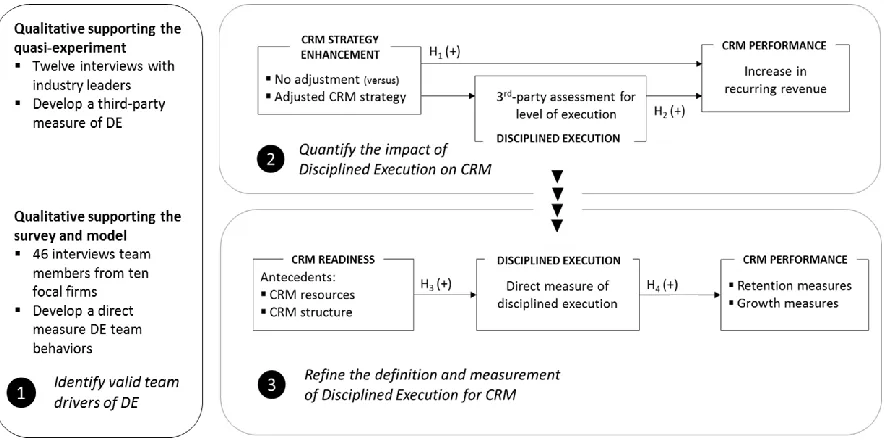
Figure 2: Structure of the three studies of disciplined execution ... 12
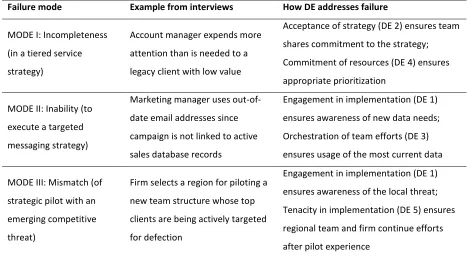
Figure 3: Examples of CRM failure modes and how DE addresses them ... 19
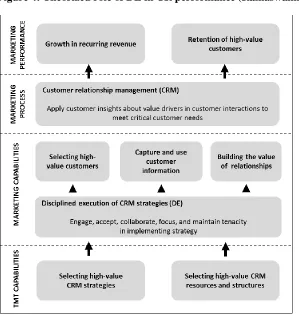
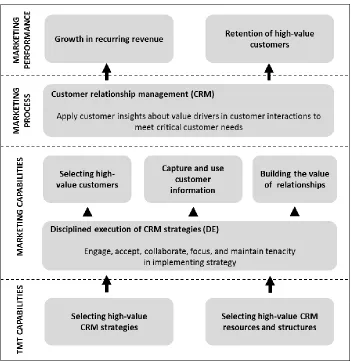
Figure 4: Theorized role of DE in CR performance (Ramaswami et al. 2009) ... 22
Figure 5: Conceptual framework for Disciplined Execution (DE) in CRM teams ... 27
Figure 6: Disciplined execution of marketing strategy (DE): ... 30
Figure 7: Senior management support of CRM implementation: ... 31
Figure 8: Team CRM performance measures (all other than recurring revenue):... 32
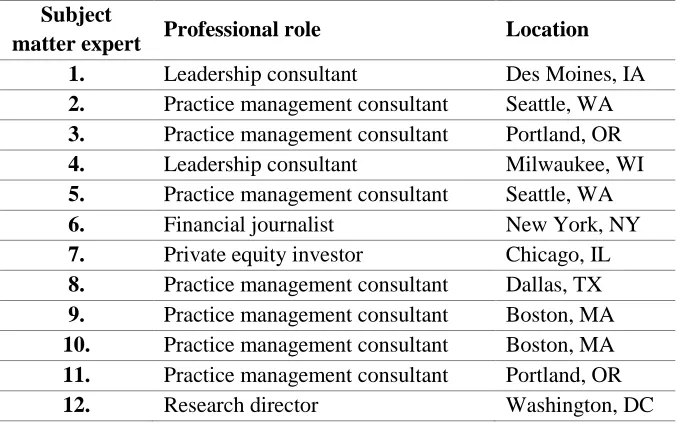
Figure 9: Sample characteristics of subject matter experts in Stage one ... 40
Figure 10: Sample characteristics of team-members in Stage two ... 42
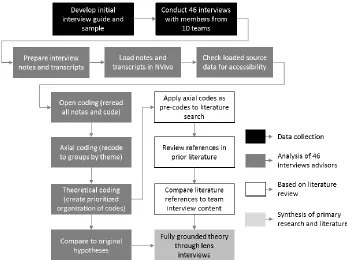
Figure 11: Qualitative analysis process for Stage two ... 42
Figure 12: Scale for interpreting Kappa values ... 45
Figure 13: Top motivations for firm leaders to adopt new CRM strategies ... 46
Figure 14: Five primary obstacles to CRM strategy implementation... 48
Figure 15: Chain of DE behaviors in CRM teams... 49
Figure 16: Outline of discussion guide for team-member interviews ... 50
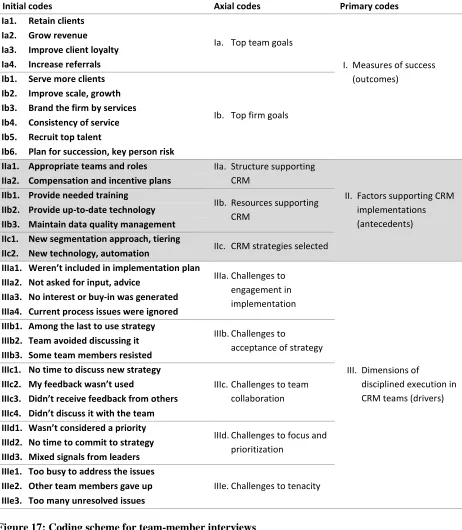
Figure 17: Coding scheme for team-member interviews ... 51
Figure 18: Addressing implementation challenges in CRM teams ... 52
Figure 19: Service Blueprint for Focal Firm C... 56
Figure 20: Service Blueprint for Focal Firm F ... 56
Figure 21: Service Blueprint for Focal Firm J ... 57
Figure 22: CRM team introduction tool to facilitate new roles ... 59
Figure 23: Format for CRM team meetings ... 60
Figure 25: Theorized model of the impact of DE on CRM performance ... 69
Figure 26: Measurement scale for third-party assessment of DE ... 74
Figure 27: Experimental treatment: An enhanced strategy from practice management program ... 75
Figure 28: Data provenance and definitions for variables in Study 2 quasi-experiment ... 76
Figure 29: Description of program management service from a provider ... 77
Figure 30: Theorized equation for the Control group comparison: ... 78
Figure 31: Theorized equation for the DE-level comparison ... 79
Figure 32: Posterior distributions for Control comparison (Model #1) ... 85
Figure 33: Posterior distributions for DE-level (Model #2) ... 87
Figure 34: Comparing recurring revenue by DE-level and firm-size ... 88
Figure 35: Theorized role of DE in CRM performance (Ramaswami et al. 2009) ... 96
Figure 36: Conceptual model for testing DE as a mediator ... 97
Figure 37: Research hypotheses ... 97
Figure 38: Chain of DE behaviors leading to success in CRM teams ... 99
Figure 39: Measurement items for DE – initial and final ... 101
Figure 40: Measurement items for DE antecedents – Initial and final ... 102
Figure 41: Measurement items for DE outcomes – Initial and final ... 103
Figure 42: Construct for measuring DE in CRM teams ... 107
Figure 43: Suggested procedure for developing better measures (Churchill 1979) ... 110
Figure 44: Results of mediation tests from team-member survey ... 114
Figure 45: Theorized role for DE in CRM performance (Ramaswami et al. 2009) ... 123
Figure 46: Payne and Frow (2005, p. 171) A Conceptual Framework for CRM Strategy ... 124
Figure 47: Five dimensions of DE – cognitive and behavioral sequence ... 126
LIST OF TABLES
Page
Table 1: Industry research on CRM implementation failure rates ... 63
Table 2: Correlation matrix for Control comparison (Model #1) ... 81
Table 3: Correlation matrix for DE-level comparison (Model #2)... 82
Table 4: Correlation matrix for DE scale development ... 83
Table 5: Results of Control group comparison (Model #1) ... 84
Table 6: Results of DE-level comparison (Model #2) ... 85
Table 7: Sample description (each respondent represents a different team and firm) ... 105
Table 8: Correlation matrix for Mediation model ... 109
Table 9: Exploratory factor analysis for DE team measures ... 111
Table 10: Effects of the antecedents on DE-level ... 112
ABSTRACT
Customer relationship management (CRM) is a strategic tenet for many leading firms and an
important area of research for marketing strategy scholars investigating strategy implementation. Yet, for
decades academic and industry researchers have reported a high rate of failure for CRM implementation
efforts. This dissertation describes a deep investigation of the microfoundations of strategy execution,
using both inductive and deductive techniques. The three studies demonstrate the importance of a new
strategy implementation construct called disciplined execution of strategy (DE), characterized through the
lens of CRM strategy execution. DE is not the implementation of ongoing marketing activities, but is a
marketing capability of interdisciplinary CRM teams that balances the demands of executing a new
strategy with their need to protect ongoing customers relationships from the disruption that comes with
change. DE is presented as a novel and compelling explanation for the variability of past CRM efforts,
CHAPTER ONE - INTRODUCTION
1.1. Statement of the problem
A fundamental precept of strategic marketing as a field of study is that the selection of strategy is a
critical factor in determining a firm’s ability to create a sustainable advantage (Day 1994; Hunt 1993). To
inform the process of selecting strategies, marketing scholars formulate and test theories about how the
performance of a given strategy may vary according to firm-level factors, like size and industry type, or
external conditions faced by the firm, like levels of competitiveness and technological reliance, among
many other factors (Hunt 1993; Varadarajan 2010). We believe there is an important determinant of
success in the marketing strategy process that sits between the selection of the strategy by top
management and its long-term success as part of the ongoing management of the marketing function. In
this dissertation, we seek to define and evaluate “disciplined execution of strategy” as a phenomenon in
strategic marketing that is critical in determining the outcomes of a marketing strategy and is wholly
separate from the selection of the strategy.
The studies in this dissertation focus on disciplined execution of customer relationship management
(CRM) strategies. A review of the published materials from both academics and practitioners that
characterize CRM produces numerous and varying perspectives and definitions (Payne and Frow 2005). I
adopt an updated and abbreviated form of the definition for CRM from Payne and Frow (2005, p. 168)
that emphasizes the strategic, interdisciplinary, and process-oriented view of CRM’s role in organizations:
“CRM describes a strategic emphasis on improving long-term performance of an
organization through sustained efforts to build enduring and mutually productive
relationships with selected customers. Organizations that adopt tenets of CRM unite
relationship marketing, customer service, product and service delivery, and technology
interdisciplinary coordination of customer knowledge, processes, and capabilities across
the organization.”
Based on this definition of CRM, I define disciplined execution of strategy (DE hereon) as the degree
to which interdisciplinary teams tasked with implementing a selected CRM strategy demonstrate specific
behaviors that lead to the ability to execute the new strategy while maintaining their customer
relationships. Executing a new CRM strategy introduces a paradox for teams responsible for the overall
success of CRM efforts. The changes to work processes, technology usage, and roles that come with new
CRM strategies can disrupt key customers relationships in the short term. Interdisciplinary CRM teams
must manage the effects of this disruption on customers while simultaneously implementing a new
strategy. We used extensive qualitative interviewing with senior executives who select CRM strategies
and with interdisciplinary team members tasked with implementing CRM strategies to identify the factors
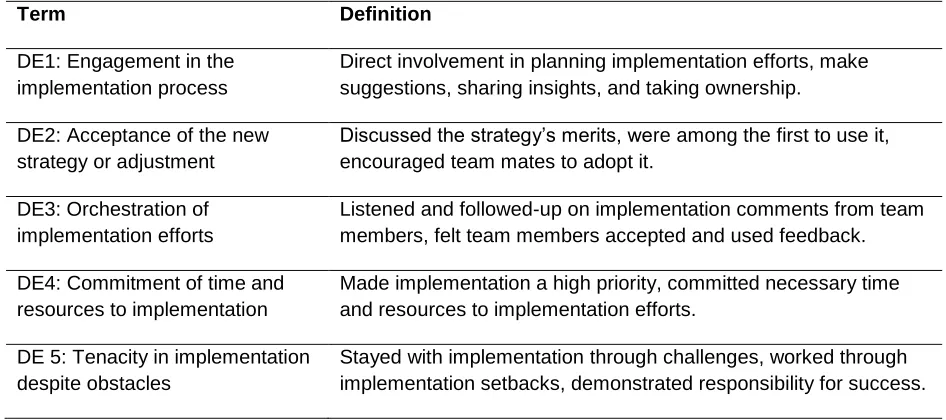
critical to successful implementation. These DE behaviors include the team’s [1] engagement in defining
the implementation approach, [2] acceptance and buy-in of the new strategy, [3] orchestration of
implementation among its members, [4] focus and prioritization of time and resources to implementation,
and [5] tenacity in supporting the strategy despite implementation challenges. We believe these behaviors
result in superior results because they address friction from multiple factors inherent to CRM teams – the
tension of maintaining existing customer relationships while adopting new strategies that may disrupt
long-term patterns of service, and the natural tension from the disparate interpretative schemes, goals, and
incentives present in interdisciplinary teams with members who represent widely varying backgrounds
like sales, customer service, product management, marketing communication and digital media, and
information technology.
It is important to note the boundaries of DE to explain its role in strategic marketing. DE is not
concerned with generalized or overall implementation of marketing functions. As a phenomenon of
marketing strategy, DE examines the execution of new marketing strategies – or major adjustments to
interdisciplinary teams. By scrutinizing incidences of strategy adoption and adjustment, we intentionally
focus attention on the execution of a selected strategy as opposed to the implementation of ongoing and
established processes or other existing marketing activities. This sustained focus allows us to make some
theoretically important comparisons. We compare the performance of the same strategy at different levels
of DE to measure the contribution attributable to disciplined execution. In this way, we address a
persistent problem in strategic marketing that has resisted explanation in scholarly research and in
practice – if customer relationships are so important, why do CRM implementations fail so often?
Industry and academic researchers have highlighted the poor track record of CRM implementation
(Bohling et al. 2006; Rigby et al. 2002; Varadarajan 2010; Venkatesan et al. 2007). A summary of
industry research concerning disappointing results from CRM implementations appears in the Section 4.1.
We use a quasi-experiment to present evidence that DE can explain a good deal of variation in results
when firms implement a CRM strategy. We then use a combination of extensive qualitative research and
a survey of CRM team members to unpack the phenomenon of DE and understand its antecedents and
consequences.
We use the financial advisory industry for this study because its characteristics are useful in
separating strategy execution from strategy selection. The industry is mature and stable and its products
(like insurance policies and investment funds) have long performance horizons and are considered largely
homogenous in terms of features. Consequently, financial advisory firms tend to focus on customer
relationships as central to their sustained success, as opposed to product performance or innovations. And
many firms adopt similar CRM strategies promoted by “practice management” organizations, making it
possible to compare execution quality across firms.
Despite the sameness of financial products, the plans offered to clients often combine products and
require interdisciplinary teams that can deliver a combination of protection-oriented and
investment-oriented elements as well as customized service for each client. These interdisciplinary teams are a useful
simultaneous reordering of multiple, interconnected business functions. Finally, CRM is an area of
strategy that has an uneven record of producing desired results in practice. Measures from a variety of
industry and academic sources show that about half of relationship marketing implementations fail to
meet expectations. Consequently, this area of marketing strategy provides strong relevance to practice
since many marketing and sales leaders are interested in novel and useful answers to the question, “Why
do half of all relationship marketing efforts fall short?”
We believe this new dimension of research is additive to the domain of strategic marketing and
contributes both theory and convincing evidence to answer important and unresolved questions in
addition to why CRM efforts are plagued by implementation missteps. In particular, we believe
disciplined execution may have a profound influence on the long-term success of organizations since it
ensures the organization has an accurate baseline for future strategy selection and adjustments in
subsequent strategic cycles (Morgan et al. 2009; Morgan and Hunt 1999). If an organization is not truly
implementing its intended strategy, how can the senior executives make valid baseline comparisons to
past results and decide what to do next?
1.2. Relevance to current literature
There are several specific calls for more theory development and empirical research in this area of
marketing strategy. In a recent article reviewing earlier scholarship on the domain, definition, issues, and
premises of strategic marketing, the author and journal editor presented an updated and expanded
schematic representation of the domain of strategic marketing (Varadarajan 2015). One of the twelve
areas of the domain of strategic marketing labeled “Marketing Strategy Process,” included “Strategy
Implementation” as an element of the process (Varadarajan 2015). He notes, “Although for ease of
exposition, the marketing strategy process is shown as a linear sequence, in reality, it is iterative. For
example, firms routinely make changes in strategy content in the aftermath of implementation”
a richer and more detailed picture of this critical iterative element of the strategy process. Our approach
also responds to earlier scholarship that highlights the need for the developing and testing a conceptual
model linking CRM implementation with employee and customer attitudes and ultimately with financial
outcomes (Bohling et al. 2006).
Finally, in their review of marketing scholarship that relies on the resource-based theory of the firm,
Kozlenkova et al (2014) highlight a similar theoretical gap. Modern proponents of the resource-based
theory believe a firm’s resources contribute to success when they are shown to demonstrate four qualities.
To generate competitive advantage, resources must be (1) valuable, (2) rare, (3) imperfectly imitable, and
(4) supported by the firm’s organization – sometimes referred to as VRIO (Barney and Hesterly 2012;
Kozlenkova et al. 2014). Kozlenkova et al. (2014) show these four questions for evaluating resources
have received unequal coverage in marketing literature. They call for more theorizing and empirical
research examining the interactions between organizational elements (the “O” in VRIO) of sustainable
advantage. They address this issue by examining the interaction between the selection of a strategy and
the disciplined execution of strategy by teams as well as by exploring the role of DE in mediating the
effects of CRM resource and structure investments.
Our examination of DE is grounded in the resource-based theory of the firm (RBT) and treats DE as
an intangible resource as defined in RBT canon, similar to customer knowledge, internal and external
relationships, and organizational routines (Barney 1991; Nelson and Winter 1982; Wernerfelt 1984)
(Barney 1991; Nelson and Winter 1982; Wernerfelt 1984). RBT is at the heart of an increasing share of
strategic marketing scholarship reflecting a 500% increase in the past decade (Kozlenkova et al. 2014).
The continuing shift toward services in the U.S. economy suggests the importance of intangible resources
like strategy selection and DE will continue to increase.
Kozlenkova et al. (2014) also identify a series of questions in strategic marketing related to DE that
▪ Limited theorizing and a lack of investigation of the interactions between intangible resources
like strategy selection and DE, including their complementarities or trade-offs;
▪ Little exploration of organizational factors, like the team behaviors in DE and their impact in
cultivating strategic advantage; and
▪ Lack of empirical evidence quantifying the value of intangible marketing resources, like
marketing strategy selection, DE, and customer relationship management capabilities.
The five interdisciplinary team dimensions comprised by DE also contribute to marketing strategy
literature in the area of marketing orientation by examining cross-functional coordination – one of the
foundations of marketing orientation (Kohli and Jaworski 1990; Menon et al. 1999; Narver and Slater
1990; Payne and Frow 2005). The DE behaviors address the interface between marketing, product, sales
and service and the integration of efforts across the firm to execute complex strategies like CRM (Barney
1991; Cron et al. 2014; Wernerfelt 1984). We believe interdisciplinary teams are a strong analogue for
studying the cross-functional nature of marketing strategy implementation. We found the natural tensions
that emerge in interdisciplinary teams are similar to the friction that can occur between company
functions (Kohli and Jaworski 1990; Krasnikov et al. 2009; Venkatesan et al. 2007). Marketing strategy
in the customer relationship management domain often relies on efforts that may have conflicting goals,
like customer segmentation and selectivity to increase client-level profitability versus standardization
efforts aimed at gaining efficiencies through scale and scope economies (Payne and Frow 2005). Similar
conflicts between varying perspectives and priorities are present in interdisciplinary teams tasked with
implementing strategy and can influence their interactions and overall efforts. We believe this kind of
misalignment and tension may help explain the poor track record of CRM implementation efforts among
practitioners (Bohling et al. 2006; Rigby et al. 2002; Venkatesan et al. 2007) and the reason that DE has
strong effects on CRM outcomes. The following table provides examples from the qualitative
Theoretical tensions Examples from interviews Relevant DE dimensions
Customer segmentation versus customer intimacy
Service team member expending time on “favored” clients outside of strategic focus segments
Acceptance of strategy, Commitment of resources
Scale and scope efficiencies versus responsiveness to individual client request
Sales team member asks for exceptions to pricing or servicing programs to satisfy one client
Engagement in
implementation, Orchestration of team efforts
Standardization of marketing mix to support a consistent brand experience versus customizing products or services for clients
Marketing team member uses unapproved and off-brand sales materials, tactics or language to pursue local opportunities
Acceptance of strategy, Tenacity in implementation
Figure 1: Specific examples of tensions in CRM implementation
1.3. Research questions addressed
This dissertation addresses three key questions related to challenges identified in prior CRM research:
▪
What are the specific structures and practices by which DE influences the results of CRMstrategies? We identify specific practices and attitudes of interdisciplinary teams that lead to
greater discipline and success in CRM implementation efforts. In studying teams, we also
identify and characterize the structures and work flows of interdisciplinary CRM teams and
provide a useful taxonomy for teams.
▪
Does DE have a meaningful impact on the results of CRM strategy implementation efforts?We endeavor to test whether DE has strong enough influence on CRM performance to help
explain the low success rate of CRM implementations.
▪
Can we measure and manage disciplined execution? We develop and test direct measures ofDE in interdisciplinary teams to understand the relationship between DE and the antecedents
and consequences of CRM strategy implementation. We show that DE is a mediator between
efforts. By proposing measures of DE, we offer teams the opportunity to monitor their
implementation efforts and adapt their approach in an effort to improve results CRM results.
1.3.1. What specific practices and attitudes of teams contribute to DE?
We completed two rounds of extensive qualitative research, first with industry experts and then with
CRM team-members themselves, to identify, fully define, and verify the face validity of interdisciplinary
CRM team behaviors and attitudes. The first round included 12 in-depth interviews with practice
management consultants, industry researchers with experience studying CRM teams, and partners and
senior executives of financial advisory firms. These interviews employed an exploratory laddering
approach to understand how the different behavior patterns of CRM teams influenced the outcomes of
implementation efforts of a specific type of CRM strategy commonly used in the financial advisory
industry. This CRM strategy – often called tiered-servicing – calls for teams to track the revenue impact
and need-profile of each client relationship and design and apply diverse service “packages” appropriate
for each profile type. Traditional service models in this industry use a monolithic approach to planning
and product delivery that do not make à priori judgments about how to differentiate the team’s approach
to clients. Consequently, in traditional service models all customization is provided in a reactive fashion
making service activities more ad hoc and less efficient compared to planned service packages. This CRM
strategy is an excellent fit for our research since it does not require additional investments in technology
or other costs to implement. Instead, it calls for changes in the structure and workflow of CRM teams and
in their approach to serving clients. Consequently, we avoid potential confounding influences from the
simultaneous introduction of innovative technologies or other production factors during the initial
execution period. We used this first stage of qualitative interviewing to identify the areas or categories of
team behaviors that influence discipline in executing CRM strategy. The categories of behavior we
In the second stage, we conducted 46 depth interviews with team members from ten separate teams.
These interviews included a representative of every role on each team. The number of roles per team
ranged from two to six. We used structured interview in these interviews to answer a series questions
about how the teams approached CRM execution. These interviews provided the foundation for several
different outputs critical to mapping the micro-foundations of disciplined execution. For example, we
used the results of the interviews to identify the most common team structures and develop service
blueprints for three archetypes of CRM teams (Bitner et al. 2008; Shostack 1987). We also constructed
detailed descriptions of three core value propositions the firms used with their clients to describe the
teams’ approach to service. Together, the team archetypes and value propositions provide a useful
typology scheme for comparing CRM teams and their approaches to serving clients (Andreatta 2010).
Finally, we use the interviews to validate the categories of team behaviors identified in the first round and
to develop more detailed measures of DE to use with team members. We used these detailed constructs in
the survey and modeling study.
1.3.2. Does DE have a meaningful impact on CRM results?
We employed a quasi-experiment using third-party assessments of DE levels in teams and a highly
focused dependent variable from archival data to quantify the impact of DE on CRM performance. By
examining changes in recurring revenue for financial advisory firms, we created a direct measure of
relationship marketing performance that reflects only the revenue from ongoing client relationships for
the firm, excluding any one-time fees or commissions. By employing independent assessments of
disciplined execution from expert third parties, we avoid the frequent problems of endogenous and
mono-method effects that have detracted from the credibility of many prior efforts to measure the impact of
attitudinal and behavioral factors in micro-foundational research. We then use a Bayesian model to
compare CRM performance of teams that adopted CRM strategies to those who did not. We also compare
1.3.3. Can firms measure and try to influence the level of DE in their teams?
We used a survey of 91 team members from different interdisciplinary CRM teams and a mediation
model in the third and final study to evaluate direct and more detailed measures of disciplined execution.
Using these direct measures of DE, we endeavor to test whether DE is a significant mediator of the
positive effects of a firms’ investments in CRM – in the form of specific resources and structures – on
CRM teams’ ability to meet their goals. We developed measures for the antecedents and outcomes of DE
from the qualitative interview with team members. The antecedents measure the investment in resources
and the creation of organizational structures to support CRM implementation. The outcomes are the most
common measures of CRM team performance mentioned by the team members of the ten focal firms. The
ability to meet or exceed CRM team goals is the criterion used by historical studies of CRM
implementation that have shown high failure rates. Consequently, we use the third study to assess the role
that DE may play in determining the ultimate outcome of CRM implementation efforts.
1.3.4. Research propositions tested
We test the following four hypotheses about the relationships between managerial behaviors and firm
outcomes for CRM efforts using the results of the three studies:
H1: CRM strategy enhancements improve CRM performance (compared to no enhancements).
H2: An increase in the level of disciplined execution (DE) increases the positive effects of the enhancements.
H3: An increase in a firm’s CRM resources and structures improves the level of disciplined execution.
H4: As the level of disciplined execution improves, the positive effects of CRM resources on CRM performance are enhanced.
The studies provide significant and positive results to all four research propositions. As expected, we find
performance – measured by growth in recurring revenue – compared to a control group that does not
undertake enhancements. We also find that an improvement from average discipline in execution to high
discipline produces an improvement in CRM performance on par with undertaking enhancements. It is
important to note that while undertaking a new strategy invariably requires expending additional time and
resources on CRM efforts, increasing disciplined execution does not require new or additional resources.
Disciplined execution is defined as attitudes and behaviors of teams related to CRM execution and not as
the strategy itself or the resources committed to CRM. By controlling for strategy selection and resources
in our models, we ensure that the benefits associated with DE are not driven by variations in strategies or
resources. Perhaps most importantly, we find compelling evidence of our primary thesis that DE mediates
the effects of firm-level investments in CRM on CRM performance. This supports the claim that the level
of DE in teams is a plausible explanation for the highly variable success of CRM implementation. The
results also provide novel and credible insight to marketing managers and CRM teams trying to improve
the impact of CRM implementations in practice.
1.4. Mixed method approach to the research
The three studies in this dissertation rely on a disciplined mixed-methods approach including
qualitative, experimental, and survey methods to understand a potentially important new phenomenon in
marketing strategy. To adequately explore, identify, unpack, and measure the behaviors that underlie the
disciplined execution of marketing strategy, we believe a combination of exploratory and causal
techniques is required to provide both a detailed picture of the phenomenon, and credible empirical
evidence of its effects. The following schematic diagram summaries the way in which we combined
Figure 2: Structure of the three studies of disciplined execution
The two qualitative stages of the research preceded both the quasi-experiment and the survey and
provided the foundations for our definition and scales for DE. The first qualitative stage included depth
interviews with twelve experts in the financial advisory industry asking for them to describe the
differences in practices and behaviors for teams that had the most success executing CRM strategies
compared to teams that tended to struggle to make CRM strategies pay off. In exploring these behaviors,
we also asked experts to describe the primary goals firms were trying to achieve by pursuing these
strategies. The primary goal mentioned in selecting a CRM strategy by all experts in the first stage of
interviews was to overcome traditional limits on growth for advisory firms, measured in changes in
recurring revenue from ongoing relationships. Traditional solo advisory models typically have a
maximum capacity of about 200 households, which drives these firms to focus on high-net worth clients
who generate more revenue per household. Once advisory practices reach their household capacity,
growth of the firm slows dramatically. Strategies to accelerate growth in recurring revenue are a top
priority for firm executives. Therefore, we used growth in recurring revenue as the dependent variable for
the quasi-experimental study, and measures of client growth and retention as the dependent variables for
1.5. Significance of the studies
Despite the extensive use of RBT in marketing scholarship, there has not been a detailed exploration
of the behavioral and attitudinal micro-foundations of CRM implementation, the failure modes for CRM,
and their impacts and tradeoffs (Kozlenkova et al. 2014). Other marketing scholars have argued the
treatment of marketing capabilities in literature has focused on their static nature as assets available for
exploitation and not on their dynamic role in exploration and renewal (Barney and Clark 2007; Barney et
al. 2011; Day 2011). While Day’s conceptual framework points to both dynamic and adaptive
capabilities, it does not attempt to uncover the specific interactions, processes, behaviors or mechanisms
that lead to enhancements in resources like CRM capabilities. Barney and Clark (2007, p. 259) also argue
that RBT characterizes resources and capabilities as conferring advantage in a fixed manner. They go on
to argue that even so-called dynamic capabilities are static in this sense. These limitations in the
explanatory power RBT are due in part to a lack of understanding of the mechanisms underlying
capabilities and the tensions inherent in these mechanisms that contribute to their development and
evolution. A special issue on RBT in the Journal of Management reflects on efforts to uncover the
micro-foundations of RBT, especially pertaining to strategic management capabilities (Foss 2011). In an invited
editorial, Foss concludes these efforts leave a largely unfulfilled promise for explaining the leverage
created by knowledge-based capabilities. In particular, he points out prior efforts to uncover the
mechanisms of strategic management capabilities have focused solely on individual psychological factors
and have not examined the equally significant role of interactions among individuals and teams (Foss
2011). We believe the opportunity to expand on this under-theorized role of tensions in these interactions
is particularly promising in the case of marketing capabilities where sales, service and marketing team
members converge to create go-to-market strategies in relationship marketing contexts. All three studies
addressing disciplined execution of marketing strategy make contributions to address the problems
highlighted by the aforementioned leading scholars in our discipline. We advance theory in marketing
(Bohling et al. 2006; Varadarajan 2010). We also contribute to the stream of CRM research by proposing
a novel and credible explanation for the low success rate of CRM implementation efforts – a persistent
problem highlighted by both academic and industry research (Bohling et al. 2006; Rigby et al. 2002).
By disentangling the value of marketing strategy selection from disciplined execution using a
quasi-experimental approach with archival data, we address the lack of empirical support for the value of
intangible resources in RBT-oriented research on marketing strategy (Barney 1991; Kozlenkova et al.
2014). We also advance theory in marketing strategy by distinguishing the magnitude of performance
contribution from strategy selection compared to DE in implementing CRM strategy (Kozlenkova et al.
2014; Piercy 1998).
Finally, by providing a detailed examination and characterization of interdisciplinary CRM teams,
we help to clarify the micro-foundations of marketing orientation and how it is applied to strategy
implementation (Day 2011; Jaworski and Kohli 1993). Micro-foundations are the individual and
team-level actions that result in the regular performance of valuable capabilities that lead to competitive
advantage (Eisenhardt et al. 2010). Our intensive interviews with team members provide insight into how
teams use intimate client knowledge to adapt and execute new strategies by reconciling the needs of
current clients with forward-looking efforts. We also add to scholarship in selling and sales management
by identifying the specific structures and work-flows of interdisciplinary CRM and by providing a
taxonomy for CRM teams (Akçura and Srinivasan 2005; Speier and Venkatesh 2002; Treacy and
CHAPTER TWO – ADDRESSING THE ROOT CAUSES OF CRM STRATEGY FAILURE
The expert and practitioner informants interviewed for these studies all emphasized the primacy of
revenue growth as the main motivation for implementing new CRM strategies. This emphasis on growth
implies the simultaneous challenge of retaining all valuable current client relationships while acquiring
and cultivating new relationships. The tension between serving existing clients and prospecting for new
ones is additive to the natural interdisciplinary tensions among team members with varying skills and
backgrounds. Our studies of disciplined execution provide a deep and detailed exploration of the attitudes
and behaviors of interdisciplinary team members that address these tensions and lead to the effective
implementation of CRM strategies (Foss 2011; Frow et al. 2011). Experience has shown that effective
implementation of CRM is far from guaranteed in practice. Despite the popularity of CRM as a strategy,
academic and practitioner researchers alike report a high rate of implementations that fall short of
expectations. Our basic argument is that disciplined execution of strategy (DE) is a critical dimension of
the strategy process. Moreover, understanding DE can help marketing leaders address root causes of
strategy failure and produce results more consistent with their strategic intentions and goals (Bohling et
al. 2006; Day 2011; Jaworski and Kohli 1993). Resource-based theory in marketing suggests that
effective implementation of marketing strategy results in the development of marketing capabilities that
create sustainable competitive advantage (Barney 1991; Barney et al. 2011; Slotegraaf et al. 2003;
Vorhies and Morgan 2005). Consequently, we argue that addressing causes of strategy failure through
disciplined execution is just as important as selecting the correct strategies to implement. The results of
our three studies indicate DE has a profound influence on CRM results, and that firms can use the insights
to measure and manage DE in interdisciplinary teams to influence performance.
2.1. Three modes of strategy failure
Strategy failure has been documented by industry and academic studies showing the disappointing
highlight several causes of failure from prior literature including resistance to change and the shift in
duties and loss of control for marketing managers when production, sales and service, and supply chain
functions share control of CRM implementation. They concluded that the challenges in aligning CRM
initiatives with stakeholder interests was a major barrier to success, saying “there is a need for research
developing and testing a conceptual model linking CRM implementation with employee and customer
goals and attitudes, and ultimately with financial outcomes” (Bohling et al. 2006, p. 188). Boulding et al.
(2006) list the three most important roadblocks to CRM implementation as:
1. Lack of resources;
2. Insufficient focus on change management; and
3. Insufficient involvement of employees.
Accordingly, they found the three components of CRM implementation that were cited as most critical
to success in their survey of experts and practitioners (Boulding et al. 2005) as:
1. Change management;
2. Process change; and
3. Senior executive and opinion-leader buy-in.
Our definition of DE and corresponding model for measuring DE levels in CRM teams is consistent
with this assessment of CRM implementation challenges and adds to theory and practice by providing far
greater detail about how team-members address these challenges in practice.
Our conception of strategy failure in CRM implementation is based on the results of our qualitative
interviews with leaders, experts and team members and is consistent with current literature. We see CRM
strategy implementation failure fitting into three modes, [1] incompleteness of execution, [2] inability to
2.1.1. Failure Mode I – Incompleteness of execution
First, strategies can fail in a fundamental or essential way when implementation efforts do not
adequately match the specification of a prescribed strategy. This is a particular risk for CRM strategies
that involve asking experienced sales and service leaders to alter the way they interact with long-standing
clients. In these cases, experienced sales and service leaders may have personal relationships with clients
that span years or even decades. For example, if a new CRM strategy mandates a change in the primary
service contact for a long-standing client, resistance from the incumbent service contact may lead to ad
hoc alterations or even subversions in execution to avoid this unwanted aspect of the strategy. This
“incompleteness” means the implementation does not conform to the strategic intention of those who
created the strategy and will likely lead to disconnections with team members who obey the intended
strategy. In an ironic sense, this type of failure is intentional since those responsible for implementation
abandon some aspects of the strategy from the very beginning of execution.
2.1.2. Failure Mode II – Inability to execute
Secondly, failure can result from firms implementing strategies without the needed resources.
Team-members may require new knowledge or skills, or appropriate organizational structure to support the
delivery of a CRM strategy. They may also lack needed information technology or physical infrastructure
to enable team processes. For example, if a new CRM program relies on the use of sales automation or
campaign management technology, failure can result when the data needed is out of date or inaccurate or
when one or more team members lack adequate training to use a new technology. In cases of “inability,”
individuals and teams may make outright errors that lead to customer problems. A lack of training may
mean a team member fails to anticipate and prepare for routine challenges, or makes unwise compromises
in execution. When a lack of skills or resources is the barrier, implementation can fail despite a team’s
newer firms that undertake CRM implementation before developing mature capabilities in other basic
functions like sales, service, marketing, product, and supply chain management.
2.1.3. Failure Mode III – Mismatch with environmental conditions
Finally, the third mode of failure is the one that has received the most attention from marketing
scholars – a “mismatch” between the selected strategy and the firm’s environmental realities (Kozlenkova
et al. 2014). In a case of mismatched strategy, senior leaders may select a form of CRM strategy that is a
poor fit for a chosen customer segment or region, or that leads to an unfavorable competitive position
given the strategies of firms in direct competition with one or more of their CRM teams. Even the most
rigorously executed strategy will likely lead to disappointing results when a CRM strategy is a mismatch
with a CRM team’s customers or immediate competitive environment. This may make increases in DE
seem like a disadvantage in the “mismatch” mode, since the mismatched strategy leads to a disadvantage.
Interestingly, even in the case of a mismatched strategy, teams with higher levels DE indicated they
benefited from more accurate baseline processes and made faster and more effective adjustments.
2.2. DE through the lens of CRM strategy failure
Our interviews confirm prior research that senior executives expect a great deal of value from CRM
strategies. The goals for CRM efforts offered by senior executives in our interviews were both varied and
profound in nature and included improvements in scale economies, service quality, and branding
outcomes, among others. With this slate of expectations, one could argue that disappointment in CRM is
not surprising. Nevertheless, the results of our research are also consistent with literature in that they
highlight the centrality of revenue growth in CRM strategies.
The emphasis on growth implies the unspoken challenge in CRM implementation that is at the heart
of many implementation shortfalls. In order to generate sustained growth in recurring revenue, teams
must simultaneously retain and grow current client relationships while acquiring and cultivating new
nearing retirement) have dissimilar needs and expectations compared to many prospective new clients
(like young professionals). These tensions – between existing and new customer demands and between
retention and prospecting activities – present additional challenges in implementation that can interact
with interdisciplinary tensions among team members due to differences in incentives, skills, or focus.
Conceptually, we present DE as the way CRM teams encounter new strategies and interact with each
other and with other functions to execute the strategy and avoid the three modes of failure. According to
our 58 depth interviews, the five dimensions of DE, [1] engagement in implementation, [2] acceptance of
the new strategy, [3] orchestration among team members, [4] commitment of resources, and [5] tenacity
in facing challenges, address the three failure modes in diverse ways. The dimensions of DE are the
means by which teams avoid failure modes by combining the skills of different specialists in an
atmosphere of unity borne of purpose, and not in an atmosphere of enforcement through individual
incentives or supervision. We provide several examples of how DE addresses failure modes from our
interviews here:
Failure mode Example from interviews How DE addresses failure
MODE I: Incompleteness
(in a tiered service
strategy)
Account manager expends more
attention than is needed to a
legacy client with low value
Acceptance of strategy (DE 2) ensures team
shares commitment to the strategy;
Commitment of resources (DE 4) ensures
appropriate prioritization
MODE II: Inability (to
execute a targeted
messaging strategy)
Marketing manager uses
out-of-date email addresses since
campaign is not linked to active
sales database records
Engagement in implementation (DE 1)
ensures awareness of new data needs;
Orchestration of team efforts (DE 3)
ensures usage of the most current data
MODE III: Mismatch (of
strategic pilot with an
emerging competitive
threat)
Firm selects a region for piloting a
new team structure whose top
clients are being actively targeted
for defection
Engagement in implementation (DE 1)
ensures awareness of the local threat;
Tenacity in implementation (DE 5) ensures
regional team and firm continue efforts
[image:30.612.70.538.411.669.2]after pilot experience
2.3. DE through the lens of marketing capabilities
Krasnikov and Jayachandran (2008, p. 1) draw a direct connection between marketing capabilities
and behaviors, stating “Capabilities enable a firm to perform value-creating tasks effectively, and they
reside in organizational processes and routines that are difficult to replicate. Capabilities are deeply rooted
in these processes and therefore are embedded within organizations in the complex mesh of
interconnected actions that follow managerial decisions over time.” This description of capabilities helps
to prescribe how DE works as a foundation for marketing capabilities (Krasnikov and Jayachandran
2008). The tacit nature of team behaviors like DE magnify their influence on marketing capabilities by
making capabilities more opaque and difficult for competitors to copy (Gavetti 2005). The five
dimensions of DE are emblematic of the deeply embedded and idiosyncratic actions that provide the
micro-foundations of capabilities. According to Gavetti (2012, p. 599), “A large, growing body of
research on capabilities rests on, or is highly influenced by, the routine-centered micro-foundational
apparatus of evolutionary economics (Nelson and Winter 1982). Routines and the related notions of local,
experiential, semiautomatic search are powerful concepts. They provide a parsimonious explanation of
what may be the central feature of capabilities’ macro-evolutionary characteristics: their continuity.” Day
(1994, p. 38) reinforces this point, “Capabilities are so deeply embedded in the organizational routines
and practices that they cannot be traded or imitated.” By exploring the role of disciplined execution in
CRM strategy, the DE studies enumerate the individual and team behaviors that act as the building blocks
for marketing capabilities and measure their impact on results. DE also provides a clearer and more
granular understanding of the tensions between marketing processes, like new product sales and client
service provision, and the intangible marketing capabilities that enable them according to resource-based
theory. This is a gap noted by scholars in several disciplines, including marketing strategy, management,
and management information systems (Gavetti 2005; Gavetti 2012; Krasnikov and Jayachandran 2008;
In marketing strategy scholarship, Ramaswami et al. (2009, p. 98) define market-based capabilities as
follows, “A capability can be viewed as ‘a competence that is truly distinctive’ (Learned et al. 1969) and
as “complex bundles of skills and accumulated knowledge, exercised through organizational processes
that create positional or competitive advantages for the firm which are not easily imitable by
competitors.” In this sense, the resource-based theory of the firm identifies capabilities as patterns of
behavior that enable and define the quality of more tangible business processes. Ramaswami et al. (2009)
make a compelling argument for the need for more rigor in understanding the behavioral underpinnings of
marketing capabilities. They argue that market-based capabilities (MBC) are an area of strategy
scholarship that requires a more comprehensive evaluation to understand the mechanisms through which
they influence performance (Ramaswami et al. 2009; Varadarajan et al. 2001). They address this gap by
identifying new product development, supply chain management and customer management as three
critical processes that rely on MBCs. They provide a deep exploration of how seven market-based
capabilites influence the performance of these processes and show that the MBCs associated with
customer management have the most significant impact. These three MBCs are [1] “capability in focusing
on high-value customers, [2] ”capability in responding to customer goals,” and [3] “capability in
building customer relationship assets” (Ramaswami et al. 2009, p. 100). We build on this important
foundational research by endeavoring to identify and measure the micro-foundations of these customer
management capabilities. Specifically, all three studies analyze how CRM teams implement strategies
that call for focusing on high-value clients, improving responsiveness to customer goals, and building
client relationships in the financial advisory industry. We also provide empirical evidence of the financial
impact of DE as a complementary capability that interacts with other capabilities as interdisciplinary
CRM teams combine their areas of expertise to implement new strategies.
The diagram below builds on Ramaswami et al. (2009) to depicts the theorized role for DE. The
ability of the senior management team (TMT) to select strategies and resources to exploit customer
marketing capabilities of customer selection, customer insight use, and building relationships. These
capabilities support the CRM process and help to determine its success in generating business
performance. We posit that DE is an example of a cognitive and behavior marketing capability that
[image:33.612.75.374.193.509.2]interacts with and enables complementary marketing capabilities to build sustainable advantage.
Figure 4: Theorized role of DE in CR performance (Ramaswami et al. 2009)
Cohen and Bacdayan (1994) also describe a critical gap in organizational theory associated with a
lack of empirical evidence to support the impact of intangible resources despite their centrality to
behavioral theory. For example, they point out that Cyert and March (1963) – a seminal book outlining
behavioral theory of the firm and arguing for the existence of routines – was cited 71 times in a five-year
period around the publishing of their article in 1994 by authors applying the idea as part of an explanation
of other behavioral phenomena (Cyert and March 1963). Yet, little has been added to theory in
explicating and detailing the nature of intangible resources. Cohen and Bacdayan (1994) described the
as post hoc explanations of apparently non-rational behavior. This criticism is still valid in describing
explanations of the failure rate of CRM implementation efforts (Cohen and Bacdayan 1994; Kozlenkova
et al. 2014). While many marketing scholars who subscribe to RBT acknowledge the importance of
individual and team-level micro-foundations, we have yet to unpack and explain the influence of
individual and team-level behavior on important marketing processes like CRM. In an effort to address
this gap in marketing theory, we propose a novel and convincing conceptual model to help explain how
disciplined execution accounts for variation in the ability of firms to gain consistent benefits from
processes like CRM.
2.4. Using DE to answer the research questions
Our overall research design treats the disciplined execution of a CRM strategy (DE) as a phenomenon
wholly independent of the selection of a strategy, and independent of any decisions concerning the
resources provided in support of the strategy. We hypothesize that DE mediates the positive effects of
investments in CRM on CRM performance by determining the fidelity and effectiveness of the
implementation of a strategy by a team tasked with its execution. We also distinguish DE from the
generalized or ongoing execution of marketing functions. DE is concerned with the execution of new
marketing strategies – or major adjustments to existing strategies – that have been mandated for
implementation by interdisciplinary CRM teams. This careful focus allows us to explore several
acknowledged gaps in marketing theory.
2.4.1. Research Question I: What are the specific behaviors and practices that drive DE?
We identify specific practices and attitudes of interdisciplinary CRM teams through two stages of
qualitative research that include 58 interviews in all, with industry experts, senior executives, and CRM
team members. In the first stage of interviews with 12 industry experts, we identified five dimensions of
DE. In the second stage, we used 46 interviews with CRM team members to identify and refine the
were used to define the third-party measure of DE in the quasi-experiment and the more detailed
measures of the individual behaviors were used in the survey research.
2.4.2. Research Question II: Does DE have a meaningful impact on CRM results?
We test whether DE has a measurable influence on the ultimate firm-level criterion for CRM success
– growth in recurring revenue. To complete this test, we use a quasi-experiment that combines third-party
assessments of DE in CRM teams with archival data that are used to measure results for firms going
through a practice management curriculum designed to help them implement a specific CRM strategy
called “tiered servicing.” This approach allows us to compare the performance of firms that select and
implement a specific CRM strategy to like firms that did not. We then compare the results of the firms
that implemented the strategy at different levels of DE to measure the contribution of DE. The first
comparison examines the contribution attributable to selecting the strategy while the second comparison
isolates the effects of different levels of discipline in executing the strategy.
2.4.3. Research Question III: Can DE in CRM teams be measured and managed?
To address the last question, we develop and test more detailed and direct measures of DE in
interdisciplinary CRM teams using a survey. The survey uses five separate four-item constructs for the
dimensions of DE and is designed to gauge the relationship between DE and the antecedents and
consequences of CRM strategy implementation. We test our hypothesis that DE mediates the effects of
senior management support for CRM on CRM performance. In the survey, we characterize CRM
performance as the team’s record of missing, meeting, or exceeding team-level CRM goals to match the
dependent variable to the unit of survey’s unit of measurement – the CRM team. This definition of
performance also provides excellent face validity for addressing the question of whether DE provides a
novel and convincing explanation of the high failure rate of CRM implementations since success is often
judged by the outcomes of these team measures – particularly growth in revenue.
The context for this study is the U.S. financial advisory industry and the unit of analysis is the
financial advisory practice. We define a financial advisory practice (practice hereafter) as a discrete
business entity in a single location that serves a common set of clients.
We also believe the financial advisory industry offers an excellent opportunity to study the impact of
disciplined execution in collaborative sales and marketing teams implementing customer relationship
strategies. Financial advisory practices have substantial autonomy is developing approaches to serve their
clients. Consequently, they represent a wide range of marketing and sales team configurations and
operating philosophies. Also, since advisors must conform to strict regulatory prescriptions about how
advice is delivered and the suitability of products, practices are required to align sales and marketing
approaches to provide consistent messages and direction based on sound defensible principles. This
combination of industry conditions creates a wide variety of approaches within different practices with an
industry-wide requirement for delivering basic service levels. This makes the advisory industry a robust
laboratory for studying the performance effects of disciplined execution.
2.4.5. The role of interdisciplinary teams in the research
The criticality of teams in the execution of modern CRM strategies was among the most consistent
finding of our initial depth interviews with experts and leaders. In the financial advisory industry, the
largest and fastest-growing firms were characterized as those most likely to use CRM team structures and
to have made a long-term commitment to teams. These firms use teams much the same way that major
business-to-business firms use key-account teams – to ensure the needs of new and existing clients are
met efficiently.
Interdisciplinary teams also provide a useful analogue for the cross-functional nature of CRM
implementation in other contexts. CRM team members must combine specialist abilities and collaborate
We provide more findings concerning the impact of team structures on CRM results in the chapter for
the qualitative study results.
2.4. A conceptual framework for the role of DE in CRM
The conceptual framework is based on the proposition that the long-run growth of firms employing
CRM strategies – measured by their ability to consistently grow recurring revenue – is determined largely
by their ability to manage natural tensions between specialists and convert them into opportunities for
collaboration, learning and more effective action. We offer DE as the specific behaviors of
interdisciplinary teams to manage tensions from combining diverse skills, knowledge, and strengths to
generate greater value for clients and for the firm.
2.4.1. Conceptual framework for disciplined execution
Our conceptual framework for the study of disciplined execution of CRM strategies is based on the
premise that firms adopt CRM strategies to accelerate their growth in recurring revenues from ongoing
customer relationships. This emphasis on growth implies that for a CRM strategy to meet expectations,
the teams implementing the strategy must simultaneously improve their ability to retain and grow current
client relationships while maintaining their ability to acquire and cultivate new ones, or improve their
acquisition abilities while maintaining their retention – or both. Thus, CRM implementation represents
multi-faceted challenges for teams that require thoughtful adjustments to retain the most effective current
practices while integrating new practices associated with new strategies while continuously monitoring
the impact of work-flow changes on clients. We undertook three studies to understand and measure how
CRM teams take on these challenges and the results of the studies are presented in the following diagram
Figure 5: Conceptual framework for Disciplined Execution (DE) in CRM teams
The insights from the two stages of qualitative interviewing in Study #1 are cumulative and are used
to support the quantitative research in Studies #2 and #3. The 58 interviews with industry experts, top
executives, and CRM team members defined the five dimensions of DE used in the third-party measure
for the quasi-experiment and the more detailed direct measures of each DE dimension used in the survey.
Together, the three studies paint a detailed picture of how the level of discipline in the execution of a
marketing strategy influences the performance of the strategy. This framework for understanding the role
of disciplined executions (DE) also permits us to quantify the impact DE on CRM performance and to
confirm its mediating role between investments in resources to support CRM and performance. The
qualitative research was consistent across 58 depth interviews and identified the five dimensions and the
19 associated behaviors and attitudes of interdisciplinary CRM teams that drive success in implementing
CRM strategies. The quasi-experiment in Study #2 compares the growth in recurring revenue as a
measure of CRM performance attributable to selecting a CRM strategy to the growth attributable to DE.
For the average case in the Bayesian quasi-experiments, firms that adopted the CRM strategy had an
average annual growth in recurring revenue for the three years after adoption of 46% more than the
(6 on a 7-point scale) produced growth in recurring revenue that was 41% more than similar firms with an
average DE level (4 on a 7-point scale). The survey and model in Study #3 explore the role of DE as a
mediator between the investment in CRM resources by senior leaders to support CRM strategy as an
antecedent and CRM team performance as an outcome. The results confirmed positive and significant
effects for CRM resources on CRM performance with positive and significant mediating effects for DE,
as hypothesized. The dimensions and measurement items for DE used in the survey are summarized here:
2.4.2. Five interdisciplinary team dimensions of DE and associated items
Through qualitative interviewing, we identified 31 specific behaviors and attitudes associated five
dimensions of DE in CRM teams. The 19 items we retained after exploratory and factor analysis are
described briefly here.
1. Engagement in defining implementation (five items)
a. Defined an implementation plan
b. Made suggestions about how to implement
c. Shared insights about implementation
d. Passionate about generating benefits
e. Team took ownership of implementation
2. Acceptance of the new strategy or adjustment (four items)
a. My team was among the first to use it
b. My team helped me to adopt it
c. My team discussed the merits of the change
d. My team is committed to get the most out of it
3. Orchestration of implementation with team members (four items)
a. My team paid attention to my feedback