USING INDEPENDENT AUDITORS FOR INTRUSION DETECTION
SYSTEMS by Jesus Molina
A thesis submitted in partial fulfillment of the requirements for the degree of
Master of Sciences
University of Maryland, 2001
Approved by ___________________________________________________ Chairperson of Supervisory Committee
__________________________________________________ Program Authorized
to Offer Degree _________________________________________________
University of Maryland Abstract
USING EMBEDDED AUDITORS FOR INTRUSION DETECTION
SYSTEMS
by JESUS MOLINA, Master of Science, 2001 Chairperson of the Supervisory Committee: Professor Virgil Gligor
Department of Electrical Engineering
A basic cornerstone of security is to verify the integrity of fundamental data stored in the system. This integrity checking is being achieved using integrity tools such Tripwire, which depend on the integrity and proper operation of the operating system, i.e. these applications assume that the operating system always operates correctly. When this assumption is not valid, the integrity applications cannot provide a reliable result, and consequently may provide a false negative. Once the operating system is compromised, a novice attacker, using tools widely available on the Internet (rootshell.com, etc), could easily defeat integrity tools that rely on the operating system.
resultant system provides extremely strong integrity guarantees, detecting modifications to approved objects as well as detecting the existence of unapproved and thus unsigned objects. This is accomplished without any modifications to the host operating system.
ACKNOWLEDGMENTS
The author wishes to thanks professor William Arbaugh, for the technical and financial support, but specially for trusting me. I am extremely grateful to my advisor professor Virgil Gligor for his continuous feedback and kindness even when I did not deserve it, and to professor Charles Silio for agreeing to be part of the committee despite having an extremely tight schedule.
TABLE OF CONTENTS
1 INTRODUCTION 1
1.1 Embedded Systems 4
1.1.1 Memory 7
1.2 Hard disks 8
1.3 PCI bus 9
1.4 Operating systems, Linux and Embedded Linux 10
1.4.1 Linux Operating System 11
1.5 Interrupts. Polled mode vs. Interrupt mode 13
1.6 Hashing, Public key Cryptography and digital signatures 14
1.7 Organization 17
2 OVERVIEW ON INTRUSION DETECTION SYSTEMS 19
2.1 Definitions 19
2.2 Importance of Intrusion Detection systems 21
2.3 Goal for an Intrusion Detection System 22
2.4 Types of Intrusion Detection systems 23
2.5 Integrity Detection Systems 25
2.5.1 Database integrity checkers 25 2.5.2 File signing 28
3 OUT OF BAND VERIFICATION SYSTEM 31
3.1 Motivation 31
3.1.1 System Calls 32 3.1.2 Loadable Kernel Modules 34 3.1.3 Attacks in kernel space 35
3.2 Concepts, terminology and assumptions 37
3.3 Modes of operation 39
3.3.1 Objectives 40 3.3.2 Independent auditor in database mode 40 3.3.3 Independent auditor in file signing mode 43 3.3.4 Independent auditor in promiscuous mode 45
3.4 Alerts 46
4 IMPLEMENTATION OF AN INDEPENDENT AUDITOR 50
4.1 Hardware description 50
4.1.1 The SA-110 processor 51 4.1.2 The 21285 Core Logic for SA-110 Microprocessor 52 4.1.3 Operation modes of the EBSA-285 board 52 4.1.4 Memory specifications 53 4.1.5 Buses 54 4.1.6 PCI interface 54
4.2 The EBSA-285 as an independent auditor 55
4.3 Software in the ebsa-285 57
4.3.1 The toolchain 58 4.3.2 The bootloader 59 4.3.3 Device drivers 62 4.3.4 Arm Kernel and ARM kernel patches 66
4.4 Operation of the EBSA-285 as an independent auditor 66
5 CHECKING THE INTEGRITY OF A IDE HARD DISK USING THE EBSA-285 AS AN INDEPENDENT AUDITOR 69
5.1 The IDE controller 69
LIST OF FIGURES
Name Page
C h a p t e r 1
1 INTRODUCTION
Computer Systems have been made increasingly secure over the past decades. However new attacks and the spread of harmful viruses have shown that better method must be used. One approach gaining increasing popularity in the computer community is to use Intrusion Detection Systems (IDS) to improve the security of the systems.
Intrusion Detection Systems detect an intruder breaking into your system, or a user performing any illegitimate action or misuse of system resources. Using a common analogy, having an Intrusion Detection System is like having a “burglar Alarm” in your house. The alarm will not prevent the burglar from breaking into your house, but it will detect and warn you of the problem.
Since the publication of the first research in intrusion detection systems, a large number of applications have been developed, using different techniques. One technique to accomplish this detection is the use of file system integrity checkers. When a system is compromised, an attacker will often alter certain key files to provide continued access and to prevent detection. The changes could target the kernel, libraries, log files or other sensitive files. These file system integrity checkers detect a change and trigger an alert.
The first approach is to create a secure database, which is usually composed of hashes of the important files. The stored hash will be periodically checked against the new computed hash. A hash-function is a one-way transformation that mathematically computes a digest of the message, transforming a message from an arbitrary length to a message of fixed length. This method is used with tools such as Tripwire [13], Aide [19], Dragon Squire [20] and others.
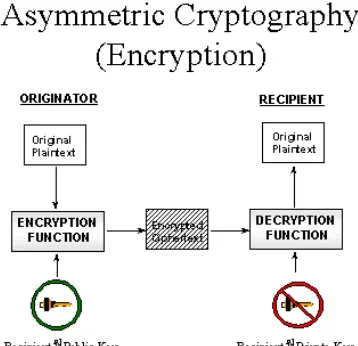
The second, more recent approach is to create digital signatures of sensitive data, such as executable files, using public keys. Using asymmetric cryptography, it is possible to sign files. Briefly, asymmetric cryptography requires two keys, one for encryption and one for decryption. You can encrypt the binaries you want to release with your own (private) key, and post the other (public) key in a secure database. If these files are to be opened, the OS will decrypt the file using the public key and ensure that the file has not been corrupted. In practice, the binary itself is not encrypted. Rather, a hash of the binary is, then this hash is appended. This approach is discussed in [16], and [17].
Finally, most proprietary operating systems are trusted by default, assuming that the OS will work as expected.
Another important flaw in the database approach is the large time intervals between checks in the database, which is a consequence of the large computational requirements involved. For example, an attacker with knowledge of the checking schedule may break into the system between these checking points and change the operating system or the IDS software itself, leaving the system in an insecure state.
This work develops a novel way to overcome the problems of a traditional Integrity Checking Systems. Our approach is to use an independent auditor, i.e. a completely standalone and independent device to perform the integrity detection checking.
More specifically, this work will be focused on implementing an integrity checking system using an ARM microcomputer plugged into the PCI bus. The auditor will run an Open Source version of Linux as well as an open source BIOS. This auditor uses the approaches previously discussed to check the integrity of the system, completely independent of both the host machine and the OS running in the host machine.
In both approaches the auditor provides the system an “in depth” defense. This concept means that an all-powerful attacker (i.e. a supervisor with access to the machine, knowing every security device, program and password) with only the restriction of physical access to the machine will not be able to bypass the integrity checking system.
time, after the comparison is done, the auditor will keep a copy in non-volatile storage of important log-files and data. These log-files cannot be secured using this approach, as they change frequently. But keeping a copy of them in a known secure state will allow us to know, in the event of an alert, information about the state of the machine before the attack, creating a “black box” of your computer. A discussion of the importance of secure audit logs can be found in [10].
In the second approach, the public keys to perform the integrity checking are stored in the auditor. The auditor could make active requests to verify signed files, or act passively by "sniffing" the bus and recreating the file-system in parallel, avoiding execution of signed files in real time. In this approach, not only is the corruption of the system prevented, but only files from trusted parties will be allowed in the machine.
Although this work is based on implementing an integrity checking system using an out-of-band approach, inside the auditor other IDS can be implemented. As an example, the auditor could sniff the traffic passing by the Ethernet card and alert the machine of possible network attacks.
In the next sections some terms used throughout this document are described.
1.1 Embedded Systems
embedded system, composed by a microprocessor and a LCD screen could be used in a plane for sending, receiving and processing positioning signals from the control tower. The software and the hardware in that device are devoted only to this purpose. Examples of embedded systems applications would be VCR, alarm clocks and video-gaming devices. The function of embedded systems can usually be imitated by replacing the embedded system with an equivalent device completely built in hardware, without any kind of processor or software. However, embedded system using multi-purpose processors are easier to build, and are cheaper. In fact, as the availability of cheaper tiny processors have risen in the market, the number of embedded systems has also risen. As an example, PDAs are a new application of embedded system, which is having a great impact in the market. Software is usually designed to be operated by personal computers. A piece of software, designed for one personal computer, will also run in any other personal computer if they share the same architecture and OS. In embedded systems, software is created for a specific platform and hardware, and is unlikely to work in any other platform. In fact, the software in an embedded application is usually highly specific to the hardware to keep low cost. There are several key hardware components common to most embedded systems.
The main component is the microprocessor. Typical target processors are Intel x86, Motoral 68k, MIPS R3xxx, R4xx0, Intel strongARM, etc. In order to run software, the embedded system should have some kind of storage. It has some temporary cheap volatile storage (i.e. RAM) and some non-volatile storage to keep the software and data (i.e. flash storage)
“translated” to the embedded architecture using a cross-compiler, a tool that compiles software in one architecture for use in other architectures.
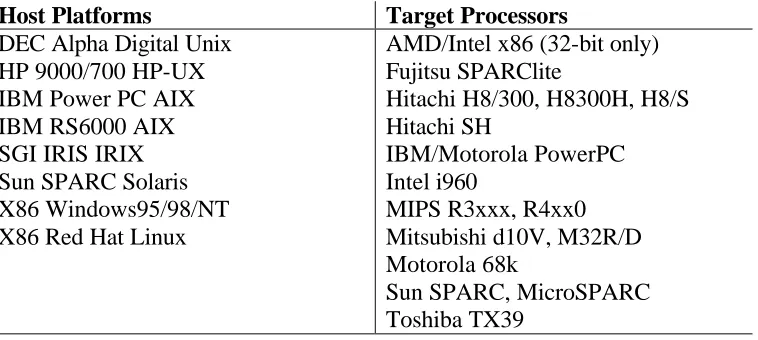
[image:15.612.91.470.375.545.2]Usually, the term Host refers to the computer, in which the software is developed, while the term Target is the embedded system in which the software is ran. Details of the Target, Host and the cross-compiler used to build the embedded coprocessor can be found in chapter 4, Designing the System. A list of common targets and hosts can be found in fig.1.1
Figure 1.1 Common Host platforms and Target Processors
Host Platforms Target Processors DEC Alpha Digital Unix
HP 9000/700 HP-UX IBM Power PC AIX IBM RS6000 AIX SGI IRIS IRIX Sun SPARC Solaris X86 Windows95/98/NT X86 Red Hat Linux
AMD/Intel x86 (32-bit only) Fujitsu SPARClite
Hitachi H8/300, H8300H, H8/S Hitachi SH
IBM/Motorola PowerPC Intel i960
MIPS R3xxx, R4xx0 Mitsubishi d10V, M32R/D Motorola 68k
Sun SPARC, MicroSPARC Toshiba TX39
The Acorn’s ARM architecture is a RISC load/store architecture designed to provide very high code density suitable for embedded applications, which require low power consumption. The base architecture does not provide any hardware support for floating-point arithmetic. However, it could be implemented using software emulators of the floating-point unit.
The first ARM chip was released on April 26 1985, making ARM the first RISC commercial processor. Since then, there have been different revisions, creating four different version of the chip. The last, ARM v4 is the one used by our platform. More information about the ARM architecture can be found in [3].
1.1.1 Memory
Different types of memory are available for the use in embedded systems. Memory devices are usually divided into two main types: RAM (Random-access) and ROM (read-only). This is a very rough division, however, as there are subtypes of each and hybrids of both memory types. RAM devices can be used to read and write, but the storage is volatile. If there is no power, the data stored in the RAM will disappear. In a ROM device, the data stored at each memory location can be read, but not written using software. It is possible, however to erase and rewrite data using hardware.
See figure 1.2 for an overview of the different types of memory and subdivisions.
The Embedded processor used for the project utilizes Flash memory as the non-volatile storage. Flash memories are hybrids between ROM and RAM devices. There are low cost, non-volatile, and fast to read but very slow to write. Nevertheless, it is possible to write to them using software. A file-system can even be created using flash-memory. These advantages actually make flash-memories the most popular type of non-volatile memory for embedded systems.
1.2 Hard disks
with a magnetic medium called a thin-film medium. This stores data in magnetic patterns, with each platter capable of storing a billion or so bits per square inch (bpsi) of platter surface. This data is organized into larger "chunks" tipically to allow for easier and faster access to information. Each platter has two heads, one on the top of the platter and one on the bottom, so a hard disk with three platters (normally) has six surfaces and six total heads. Each platter has its information recorded in concentric circles called tracks. Each track is further broken down into smaller pieces called sectors, each of which holds 512 bytes of information. Nowadays, hard disks are not just dumb devices to store information. Embedded in the device is usually an intelligent controller, which handles the requests from the operating system. For example, the IDE interface is one type of controller. A further explanation of this specific type of controller can be found in chapter 5. The operating system uses a File System as a way to organize files and directories on the hard disk. The File-system is dependant on the operating system. Linux, for example, uses the ext2 system by default, while the desktop version of Windows uses the FAT-32 file-system.
1.3 PCI bus
up to 256 buses; each bus up to 32 devices and each device can handle up to eight different functions. Usually systems have at least two PCI buses. These buses are connected to each other using bridges, a special type of interface designed for this task. The PCI devices share address space, permitting communication between each other. Every device also has specific configuration registers that can be accessed by the system to configure or read information about the device.
1.4 Operating Systems
Any machine could have a huge monolithic program that completes all the tasks of the systems. While this approach is sometime used in embedded systems, it is usually not feasible for more demanding systems where it is desired to complete several tasks or continually develop new software. An Operating System is a program that completes several objectives, including:
• Provides Abstractions: Hardware has low-level physical resources with
complicated, idiosyncratic interfaces. An Operating System provides abstractions, which present clean interfaces. The objective is to make the computer easier to program and provide better communication with hardware devices.
• Provides Standard Interfaces: This allows portability between different systems.
• Mediates Resource Usage: This allows multiple processes to share resources fairly,
The OS is composed of different programs. The core of the Operating System is called the Kernel. When the system boots, the kernel is usually loaded into memory from a non-volatile storage device. As the other programs of the Operating system are not crucial to its work, in this document the terms OS and kernel will be used interchangeably.
There are essential differences between Operating Systems and embedded operating systems. Current Operating systems consist of huge pieces of code, devoted mainly to simplify the usage of the computer making it more attractive to the common user. In the other hand, embedded operating systems are not user oriented, but committed to a precise work. Embedded Operating systems are typically small, as they do not require user interfaces, or the need to communicate with certain hardware devices, such monitors and keyboards. Furthermore, the storage devices are usually reduced, so the OS size is strongly limited by the lack of storage.
There are several Operating Systems for embedded systems. Some examples are ecos [21], Linux [22], windows CE [23] and many others. Actually, anyone could create his own OS. After all, an Operating system is just another piece of software.
The system in this study uses a port of the Operating System Linux for Arm processors. Chapter 4 will discuss why embedded Linux was the chosen Operating system.
1.4.1 Linux Operating System
was placed in the public domain, freely available, a group of LINUX activists formed to develop the operating system. This movement is growing daily a more reliable OS.
Linux is based on the well-known commercial Unix operating system. Looking in the documentation from the last Linux release we can read a self-description of Linux. [24]
Linux is a Unix clone written from scratch by Linus Torvalds with
assistance from a loosely-knit team of hackers across the Net. It aims
towards POSIX compliance.
It has all the features you would expect in a modern fully-fledged Unix,
including true multitasking, virtual memory, shared libraries, demand
loading, shared copy-on-write executables, proper memory management
and TCP/IP networking.
It is distributed under the GNU General Public License.
Linux has some advantages when compared with other operating systems. The first big advantage is that Linux is free. In fact, Linux is distributed under the GPL (General Public License). The GPL not only allow the freely use of Linux, but also allows the user to modify the source code and redistribute the new version, as long as the new code will be distributed under the GPL, this ensures that the new versions of Linux will also be free. Other benefits of Linux are its high compatibility with other OS and the strong technical support available through the Linux community. An extensive literature is available concerning Linux [6].
applications. From the primary x86 platform Linux has been ported to ARM, alpha, m68k, mips, ppc, sparc, sparc64 and s390.
In the system of this study ARM Linux is used, a successful port of Linux to the ARM processor based machines, which was developed mainly by Russel King with contributions from other sources [25].
1.5 Interrupts. Polled mode vs. Interrupt mode
An interrupt is an event that alters the sequence of instructions executed by a processor. These events correspond to electrical signals generated by hardware circuits. Usually we differentiate between synchronous interrupts, generated by the CPU after terminating an instruction, and asynchronous interrupts, generated by other hardware devices at arbitrary time. The synchronous interrupts are usually called exceptions, while the term interrupt is usually used to refer to asynchronous interrupts. For example, the keyboard will generate an interrupt every keystroke, while the CPU will raise an exception if an abnormal situation occur. The interrupt requests by I/O devices are called IRQ.
Interrupts are used because operations with peripherals are usually unpredictable. These events could be a packet arriving at the system or pressing a key in the keyboard. These events are usually stored in a status register, and the operating register should react when this status register is updated. The two techniques available to monitor I/O (Input/Output) operations are polling mode and interrupt mode.
an event occurs, the device will signal the CPU to raise an electrical interrupt. The operating system will have a table with a pointer to the code to call when this certain interrupt is called. The action to the event signaled by the interrupt will be handled by this code.
Using a common comparison, the polling mode is comparable to staring to a door with the door open while waiting for a guest. The interrupt mode could be compared to closing the door and waiting for a knock in the door to open it.
1.6 Hashing, Public key Cryptography and digital signatures
At the beginning of the chapter the terms Hash Functions and file signing were introduced. Here they will be further developed.
As previously stated a hash function is a mathematical function that computes a digest of the message, transforming it from an arbitrary length to a message of fixed length. The principal attributes of a secure hashing function are the following:
• It is a one-way process. It is mathematically infeasible to reconstruct the original
data from the hashed result.
• Given a hashed message, it should be mathematically infeasible to find a message
with the same given digest
• The hashed result is unpredictable. Given a source of data, is extremely difficult to
Hashing functions are usually used in computer security to check the integrity of data by computing the hash function of the message and comparing it with a certain known previously hashed digest. Notice that hash function provides only integrity.
The following are some popular hash functions
MD2 and MD5, created by Ron Rivest, which produces a message digest of 128 bits SHA, proposed by the NIST (National Institute of Standards and Technology), producing a message digest of 160 bits.
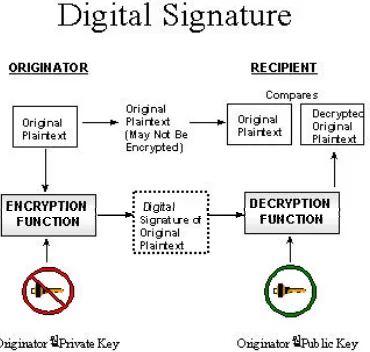
Digital signatures add authentication and non-repudiation to an integrity checking system. It is possible to check if a file has been signed from a certain party. Therefore, this party cannot claim that they are not the creators of this file. Because encrypting the entire message will be computationally expensive, a digest (hash) of the file is first computed. File signing involves using a public key cryptosystem. Although there are different public key algorithms, they share one general concept. There are always two components used for operation in the input data. One of the components is the private key, while the other is named public key. If we encrypt the input data using the public key, encrypting the ciphered data again using the private key will retrieve the original data.
Hence one key can be used to invert the operation performed by the other.
The public key is then distributed and made available in secure databases, which will match the identity of the user with his/her public key.
[image:25.612.134.313.77.250.2]The user then can encrypt a message using his/her own private key. To know if a certain user signed the file, the key can be retrieved from the secure database and used to decrypt the digest. Next the digest of the message will be computed and compared against the decrypt signature. If they are different, either the file has been corrupted or another user has encrypted the digest. If there is no change, then it is certain that that particular user signed the file.
While public key cryptography is a powerful tool, the operations involved require an extensive use of the processor and are usually slow. Signing a complete message would computationally expensive. Usually, not the entire message is encrypted, but rather the hash of the message is. As the computed hash is always the same size, no matter the size of the plaintext, encrypting using asymmetric operations is much easier.
Figure 1.5: Digital Signatures Using Hashing Functions
This work is organized in seven chapters. The first chapter is this introduction, defining some terms that will aid in the comprehension of material in following chapters.
The second chapter is an overview of the intrusion detection systems. Even if the implementation of the system in this project only covers a Integrity Verification System, reviewing the different possibilities and aspects of the Intrusion Detection Systems will give a background for further development, as well for a better understanding of the system.
In the third chapter the implementation of an Out of Band verification system will be explained, which will include details of the system as well as a review of other approaches which use the same system in a theoretical way.
The next chapter is devoted to the technical review of the implemented system, completed in appendix A with the code of the BIOS, applications and Kernel patches.
Chapter number five includes graphics and data on the performance and accuracy of the system, along with a discussion of the results.
In the sixth chapter the overall conclusion of the work will be discussed, and the future work regarding implementing Out of Band intrusion detection systems.
C h a p t e r 2
2 Overview on Intrusion Detection Systems
Diverse security mechanisms are usually implemented in the system to prevent unauthorized access. However, as new security flaws appear, completely preventing them is usually unfeasible. But once the intrusion has occurred, it is possible to detect it and to minimize the damage to the system using special agents.
Intrusion detections systems (IDS) attempt to detect these intruders breaking into your system or a legitimate user misusing system resources
2.1 Definitions
In this section the common concepts used trough this and the following chapters referring to the intrusion detection systems are described. Most of the definitions are extracted from [28] and [1].
2.1.1 Trust
“trusted” state without any warranty of their behavior. A more extensive development of the concept of trust can be found in [27]
2.1.2 Threat
A threat is any event with the potential to harm any essential element of the system. These types of threats can be of diverse nature, and countless. Fire in the building where the computer is hosted is as much a threat as computer virus is (and possibly more harmful). Hence we can divide threats into intentional (viruses, hackers) or incidental (fire, floods). We describe an intrusion or attack as any set of intentional actions that attempts to create a threat.
From the originator point of view we can divide the attacks in:
• External attacks, performed by an intruder foreign to the system
• Internal attacks, performed by authorized users.
Types of penetration include [27]
Espionage, including any disclosure of sensitive data or leakage of information
Denial of Service, including the disruption of any service provided by essential resource elements and the destruction of essential resource elements.
The term penetration is used to refer to a successful intrusion.
2.1.3 Vulnerability
vulnerabilities sometimes occur as a result of a deficient configuration or/and management of the system. These are called management or procedural vulnerabilities.
2.1.4 Security Policy
A security policy documents the producers or models necessary to accomplish security requirements. Security policies can be divided into:
• Procedural security policies, which refer to a document outlining the security goals
and the resources to be used in order to achieve these goals, and
• Formal security policy, which consists in a mathematical model containing the
states and operations to move from one state to another and the constraints of when and how these operations may exist.
2.2 Importance of Intrusion Detection systems
To avoid penetrations, systems usually base their security in tools such as firewalls, access control mechanisms and others.
But incidents like the Internet Worm [30] or recent events, such the apparition of malicious worms like “I love you” [31] or Code Red [32], have shown that today’s systems are far from being secure against possible penetrations.
It could be argued that better, more secure systems with better tools and stronger cryptography will stop these threats from occurring. However, the complete prevention of intrusion is unrealistic in the present days:
run in the system. This is obviously infeasible and almost impossible for most systems, as several software packages and operating systems do not make their source code available. Security tools rely on the competence of the user. Even the best crypto-system can be broken if the password has been written on a piece of paper. Also, an insider could abuse his or her privileges. Humans are usually the weakest link in a secure system.
Strict, secure mechanisms reduce the efficiency of the system. For example, longer passwords will delay the access of the user and better, more sophisticated encryption algorithms will make programs slower.
In [17] evidence is shown that even well known vulnerabilities with available patches are exploited for a long time after the patch is released.
Hence, even in extraordinarily secure systems, penetrations could arise. If a penetration has occurred, a secure system should be able to react, detecting the penetration as soon as possible and storing audit data about the penetration, to prevent such an attack in the future and to trace the attacker. IDSs, however, usually do not perform any reactive measures to an attack.
2.3 Goal for an Intrusion Detection System
The Intrusion Detection Systems should try to achieve the following goals: • It must be difficult to bypass
• It should run continually without human supervision. The system must be reliable
enough to allow it to run in the background of the system being observed.
• It must resist subversion. The system most be capable to detect malicious
corruption of its own code
• It must impose minimal overhead on the system.
• It must be easily tailored to the system in question. Every system has a different
usage pattern, and the defense mechanism should adapt easily to these patterns. The inaccuracy of an Intrusion detection system could be classified in false positives, false negatives and subversion errors.
False positives are legitimate access or actions in the system categorized by the Intrusion Detection system as intrusions. False positives should be minimized, as a large number of false positives obscure the task of separating real attacks from lawful actions. In such a scenario, the maintainer of the system could overlook an attacks, even if it has been detected due to the large amount of detected attacks.
More serious are the false negatives. In this case, an intrusion is not detected, and labeled as a normal behavior of the system. Causes of false negative are diverse, but usually new attacks not catalogued bypass systems based on pattern matching. This issue will be further discussed in the following section.
Subversion errors are similar to false negatives. An intruder with certain knowledge of the intrusion detection system will take advantage of known flaws of the intrusion detection system itself or can change the behavior of the intrusion detection system to allow unlawful action to be labeled as legitimate.
Using the academic model of intrusion detection systems we can divide them in two models
Anomaly detection model: The intrusion detection systems following this model detect intrusions by looking for abnormal activities in the system [33].
Some approaches using this model are:
Statistical approaches where profiles of user behaviors are generated and compared against the actual behavior of the user.
Predictive pattern generation, where the intrusion detection system attempts to predict the future using occurred events, and triggers an alarm if known events occur or if events are matched as an intrusion.
Some examples of IDS using the anomaly detection model are [35] and [39].
The use of this approach usually leads to a large number of false positives but can prevent attacks not previously identified.
Misuse detection model: Intrusion detection systems following this model detect intrusions by matching activities against patterns of known intrusion techniques (signatures) or system vulnerabilities [18].
Approaches using this model include:
• Keystroke monitoring, matching attack patterns using pressed keys.
• State transition analysis, where the system is modeled as state transition diagrams,
and certain state are labeled as “SAFE” and other as “UNSAFE” [36]. Approaches using this model are [37] and [38].
2.5 Integrity Verification Systems
Another, more subtle type of Intrusion Detection System are integrity checkers. Integrity checkers will not detect the intruder even in the case of a successful penetration. The purpose of using integrity checkers as an Intrusion Detection System is to detect change in the files-systems after the penetration. Motives for altering the files-systems are diverse. The intruder could try to cover his or her tracks by removing the logs or place Trojan horses in the system to regain access in the future. Integrity checkers will detect these attempts and trigger alerts.
It could be argued that the use of integrity checkers is not necessary if we use other types of Intrusion Detection Systems, which detect an intruder even if the file-system is not changed during the penetration. However, research performed by DARPA in 1998 showed that even the best IDS had detection rates below 70% [40]. Usually, the undetected intrusions were novel attacks, which could lead to supervisor access to the system. The same research in 1999 showed similar numbers; the detection ratio was still below the 70th percentile [41]. This data shows that intrusion detection systems are likely to fail detecting novel attacks. Using anomaly detection systems may prevent and raise this ratio, but state-of-the-art anomaly detection systems are not suitable for large commercial networks because they provide a large number of false positives.
Integrity file checkers give the system another layer of security, allowing systems to avoid being left in a completely unreliable state after a penetration has been discover.
Integrity file checkers can be divided into two main categories,
Database integrity checkers create a unique identifier for every file to be checked. This identifier, usually some type of hash function, is then stored in a secure database. At certain intervals, the identifier will be recreated and compared against the stored identifier. If the identifiers differ, an alert will be triggered. The saved record usually contains other significant file information such as length, time of last modification and the owner of the file.
The stored identifier should be computationally simple to generate but impractical to reverse. Also, it should be impractical to create a random file with the same identifier as another file. As was discussed in the introduction, these goals can be achieved using one-way-functions, also called hash-functions. The hash functions to be used in the database depend on a balance between performance and security.
Usually, along with the database where the identifiers are stored, a policy file exists where the files to be monitored are declared. The policy file is necessary because not all files in the system can be monitored. Files that change frequently, such as log files and database cannot be checked, as this will lead to numerous false positives. This situation is undesirable as the task of separating the false positives from the real alarms will be complex. Typically the configuration file also gives some parameters, which specify constraints to the file to be monitored. This allows the administrator of the system to check other types of files such as files that only increase or decrease in size, or change contents but not file attributes.
TWPOL=/etc/tripwire; TWDB=/var/lib/tripwire; SIG_MED =66;
#Policy, three files. One of data, one invariable binary, one growingonly
(
rulename = "Thesis", severity = $(SIG_MED), emailto = [email protected]
)
{
$(DIRECTORY)/binary ->$(ReadOnly); $(DIRECTORY)/data ->$(Dynamic); $(DIRECTORY)/growing ->$(Growing);
}
Using a database to insure integrity checking may lead to the following problems:
• The verification of the integrity is conducted at certain intervals, usually every day;
by computing the digest for a large number of files the integrity checker will stall the computer for some time.
• Between checking periods an attacker could change the file-system, reverting the changes before the integrity checker performs the verification.
• The databases, configuration files and policy file should be strongly protected,
possibly in special types of storage.
• If files are changed or new files are added or deleted, the database has to be
• Policy files and configuration files will need to be carefully created and updated.
The efficiency of this integrity checking system is strongly linked to the accuracy used when creating the policy file and the competence of the system administrator to handle the reports.
Examples of integrity checkers using the database approach are Tripwire [13], [14] and AIDE [20].
In conclusion, database integrity systems are highly portable and configurable, but they are not real-time integrity detection methods and are difficult to administrate.
2.5.2 File signing
The second category is to use cryptographically signed files to ensure the integrity of the files. This is accomplished by using digital signatures as introduced in the first chapter. When the file is compiled and linked, a digest of the message, such MD5 or SHA, is computed. Then the message digest is encrypted using the creator’s private key. The digest is embedded into the file being signed, and the header of the file is changed accordingly. Hence, we will have a signed version of the file.
The signed file can then be distributed to different machines which supports this feature. Before the file is opened, the kernel first will check that the file is correctly signed, using the creator’s private key. If the checking is correct, we can assume that the file has not been corrupted and has been created by the owner. If not, either the file is a forgery, or has been corrupted.
The principle is very simple but the implementation of this integrity method is fairly complex. Several problem arise:
• This method is only to be used on files that are not supposed to change. In fact, this
method is mainly designed to ensure the integrity of binaries and possibly other sensitive files such as shared libraries.
• This method is not portable between architectures. Different architectures use different file-system types and compilers. Embedding the signature and patching the kernel to verify the signature will change from operating system to operating system.
• Files usually are not statically linked. Files such as these, called dynamically linked executables, use some functions declared in libraries that are common to the system. Hence, not only the integrity of the file should be checked, but also the integrity of the shared library. This issue is discussed in [12].
• As the file has to be checked before the execution, the execution time of a signed
C h a p t e r 3
3 Out of band verification system
In the previous chapter Integrity Verification Systems were analyzed, revealing that the use of Integrity Verification System will add another layer of security to the system.
However, all Integrity Verification Systems share a common problem. To complete their tasks, Integrity Verification Systems must trust the operating system to operate as anticipated. This assumption is not always valid, as this file integrity system checkers are designed to detect an intruder that possibly has already gained supervisor privileges. With such privileges he or she may be able to change the behavior of the operating system, hence leading the system to false negatives.
To overcome this problem the inspection of the system’s integrity should be performed by completely trusted, non-corruptible software even in the event of a successful intrusion. This goal could be achieved using an out-of-band system as the auditor. In the following sections this system will be described.
3.1 Motivation
[42]. This section will explain how these attacks works. The attacks explained are under Unix-like operating system. However, other operating systems are also vulnerable to these kinds of attacks as will be explained at the end of this section.
Before discussing the actual attack, some background is needed. In the next two sections the operating system calls and the feature of dynamically changing the kernel using Kernel Modules in Unix-like system will be discussed.
3.1.1 System Calls
Figure 3.1 Linux Kernel Space structure. From [45]
The kernel will look at this table and jump to the corresponding address in the kernel. After it returns from the call the kernel will do some system checks and continue in the address of the user space calling process.
3.1.2 Loadable Kernel Modules
A feature of the Unix-like Operating Systems is the possibility of dynamically changing parts of the kernel. This is performed using LKM (Loadable Kernel Modules). When requested, the module code resides in the kernel's address space and executes entirely within the context of the kernel. Command lines functions can be used to load and unload the modules. In Linux these commands are insmod, for loading, and rmmod, for unloading. Also, they can be loaded automatically by a daemon. A daemon is a program that runs continuously and exists for the purpose of handling periodic service requests that a computer system expects to receive. In the Linux case, the daemon used is named kerneld. As part of the kernel, only users with administrator privileges can load and unload modules. However, kernel modules, as they are part of the kernel, when used with malicious purposes can be a powerful tool. There are several legitimate uses for kernel modules. The most important use is to implement device drivers. Statically linking in the Kernel image all the devices drivers could result in a Kernel which is unnecessarily large if these devices are used only at specific times, such as USB devices or PCMCIA cards. These drivers should be loaded only when the device is to be used. LKM can also be used for testing purposes or for supporting file-systems not normally used.
lead to the termination of the process, while a bug in a Loadable Kernel Module could lead to an unstable system and possibly to a system crash.
3.1.3 Attacks in kernel space
An Integrity Verification System which trusts the operating system can be deceived using attacks that involves changing the kernel. These attacks will be explored in the Linux Operating System. Similar attacks could be launched in other Unix like Operating Systems and are briefly discussed at the end of this section.
The straightforward way of changing the kernel is to replace the kernel binary itself. The kernel binary is usually placed in the /boot partition, so an attacker could compile his/her own version of the kernel and replace the binary. This is usually infeasible, for two main reasons
In secure systems, the kernel binary is usually stored in a physically non-writable partition, making it impossible to replace the file
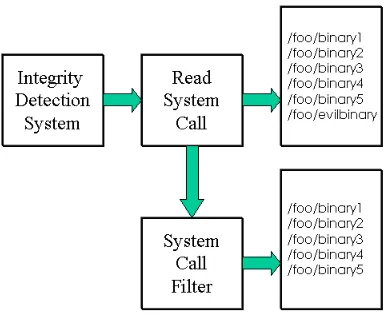
As we have seen, the addresses to jump to when a system call is loaded are stored in a table. When the module is initialized, the kernel module will use code similar to the following
original_syscall=sys_call_table[SYS_sycalltohack]
sys_call_table[SYS_syscalltohack]=hacked_syscall
Where hacked_syscall is a pointer to the function used to replace the system call.
In the function hacked_syscall the attacker will call the original syscall and the change the results. As an example
[image:45.612.137.332.503.663.2]res=(*original_syscall)(parameters) //change res to mislead the system return(res)
Several Rootkits, a set of tools that an attacker uses to mask an intrusion and/or regain access later, take advantage of kernel modules. These tools are available on the web using these techniques. An example is Knark.
Other operating systems, such as Windows NT, are also target for these attacks. Malicious patches to the system or corrupted drivers can be loaded to corrupt the kernel. These tools are also available on the web.
Some efforts have been made to counter the loading of kernel modules. Most of these techniques, as [43] in Windows NT, operate by avoiding modules or drivers to be loaded. However, an intruder could just reboot the machine. This will delay the call to these programs. The attacker will then load the malicious kernel modules or drivers before these tools begin performing the checks. Another method to bypass this type of security measure is to directly access the physical memory and load the module.
3.2 Concepts, terminology and assumptions
In the present and the following sections the terms host processor or host system will be use to define the machine or set of machines to be audited or verified for correct functioning. The term “host” is slightly inaccurate, as the implementation of the independent auditors could be diverse. However, as in this work, the out-of-band verification system is implemented as an embedded coprocessor, and the term host processor will be used in order to avoid confusions. Other terms, such as host operating system, will be used throughout the text to refer to components of the system to be verified.
i. Unrestricted access: Machine A must have unrestricted access to the internal devices of machine B to be verified or needed for the verification, including peripherals, hard disks and interrupts. Notice, however, that unrestricted write access to the internal components of the host system could lead to an unstable system. Hence, the independent auditor should use the write access to the components of the system only in cases of a high-risk alert to avoid further damage to the system.
ii. Secure transactions: The channel used by the independent auditor to retrieve the data should be a secure channel. A secure channel is a channel, which cannot be eavesdropped or intercepted.
iii. Inaccessibility: Machine B must not have access in any way to the internal components of machine A, including memory and internal interrupts.
iv. Continuity: Machine A must run immediately after machine B has setup the internal devices and is in a known trusted state. After this moment, Machine A must run continuously, independently of the behavior of machine B. Notice that power failures or hardware reboots should be the only way to restart machine A and must be labeled as high risk level alerts.
v. Transparency: The access to the internal devices should be transparent to the host system. However, concurrent access to the devices will probably occur. In these situations, the consequences to the host system should be minimized.
the source code available. This includes the firmware, operating system and user space programs in machine A.
vii. Non-volatile Memory: Machine A must be capable of retaining a record of the alerts even in the event of a power failure or reboot. Hence, machine A should have some sort of non-volatile storage to record sensitive data.
viii. Physically secure: Finally, machine A should be physically secure. Mechanisms to accomplish this requirement are discussed in section ensuring the physical security of the system.
Further discussion in this chapter assumes that the independent auditor meets some or all these requirements.
3.3 Modes of operation
The independent auditor could be in three different states. The normal state is the normal mode of operation, and is dependent on the method used for the integrity checking. The second state is the alarm state. This state will be discussed in the section 3.4, and is reached if an alarm is triggered in the normal state. Another mode of operation, which can be accessed only at boot time, is the management mode. This mode is only accessible through a set of secure mechanism, and will allow the administrator to change parameters in the secure coprocessor. This mode is in a secure state, as can only be accesed physically and an independent auditor is physically secure by definition.
database and file signing come directly from the approaches of Integrity Verification System. The third approach involves using the independent auditor in a promiscuous mode. All these modes of operations assume that the host operating system is in a trusted state when the first checking takes place. Using the independent auditor in an untrusted state will not add any security to the system.
3.3.1 Objectives
The modes of operation described in the previous section should achieve the following objectives
• Check the integrity of certain files without trusting any software outside the
independent auditor
• Whenever an alarm occurs, the independent auditor should be able to send an alert
to the administrator
• An attacker with complete knowledge and access to the system, whose only
restriction is physical access to the hardware of the independent auditor, will not be able to bypass the integrity system
• The integrity system should be able to work in real-time. If this is not possible, the
independent auditor should be able to store sensitive data of the machine before the attack.
3.3.2 Independent auditor in database mode
In this case the independent auditor will have a policy file, which is uploaded into the system in management mode, where the files to be checked will be declared along with the parameters of the checking.
[image:50.612.125.434.343.543.2]The files will be accessed every certain period of time, and the set of actions stated by the policy file will occur. The independent auditor will retrieve information of the file, possibly computing the hash function. This information will then be checked against the locally stored information inside the auditor. If the information matches, the new information will be stored in the nonvolatile storage. If they do not match, the alarm state is triggered.
Figure 3.3 Database mode of operation
Using an independent auditor in database mode has several advantages as compared to its counterpart managed by the host operating system.
The system is not vulnerable to subversion errors. An attacker gaining access to the host machine will not be able to corrupt the auditor, as by definition, the machine B cannot have access to any data from the auditor
The system should be able to securely log files and other sensitive data in the case of an alert. The methods and necessity for secure audit logs will be discussed in depth in section 3.5
Although all the computational work is done in the auditor, accessing the file-system could still decrease the performance of the host computer. A mechanism is needed to make the access from the auditor to the drive transparent.
As the security checking should still be scheduled at certain times, an all-powerful attacker could corrupt the file-system between checking and revert to the initial state just before the next inspection. Such an attack would remain unnoticed by the independent auditor. To overcome this attack, the schedule time for the integrity checking should be randomized. In management mode the administrator will set parameters such the average and the variance between inspections. Using this mechanism, even and all powerful attacker will be unable to retrieve information about the next checking, even with administrator access to the host machine and knowledge of the last checking time.
3.3.3 Independent auditor in file signing mode
In file-signing mode the auditor will retrieve all the files in a given partition at every scheduled time. All the files in the given partition should be signed. Any corrupted or unsigned file will trigger an alarm. As in the case of the database mode, this checking should happen at random times.
[image:53.612.129.410.340.569.2]If the file signing is implemented using the metadata parameter of the file-sistem data structures, the independent auditor should match the file with the data structure and fetch the information stored in the metadata.
Figure 3.5 Independent auditor in File Signing mode
consequently, checking the new files or the executed file. As appealing as this method could be, an attacker could just use another kernel module to send erroneous information to the auditor. Hence, the auditor should still verify the partition every scheduled time to ensure that the system has not been compromised. A possible attack could be to send erroneous information to stall the auditor (for example, fake the execution of a file every second) so the auditor will be busy attending these requests. To avoid this attack the scheduled verification should have priority against the information sent by the host operating system
Another important issue is the key management. In this scheme, the auditor will have a public key stored, which can only be changed in management mode. The certificates used to sign the files will be stored in a special file in the partition where the signed files reside. This special file will be signed with the private key, which is in the possession of the administrator only. At boot time, the auditor will retrieve the certificates from this file using the public key. Two points to be noticed are:
• Adding or revoking certificates will change the content of the special file.
• The public key inside the auditor is not a secret. Retrieving the certificates will not give any advantage to the attacker. The only secret is the private key maintained by the administrator.
As in the case of the database system, log files could be stored and retrieved in the case of an alert. This will be discussed in section 3.5
3.3.4 Independent auditor in promiscuous mode
by examining certain hardware component, for example interrupts or registers, in the peripherals.
As in the previous section, the files to be audited should be signed. The auditor will be observing the behavior of the system, and if it infers that a file is being used, it will inspect it.
For example, the auditor could be “listening” to the IDE interrupt controller. The IDE controller will raise an interrupt when a file is written, and a register will be updated. The auditor will “listen” to this interrupt, or poll the register to know what kind of action (read, write) the host processor is requesting.
A read could be either an execution or a reading. From the point of view of the peripheral both actions are the same, requesting a file from the disk. Also, the request could be partial, as part or the entire file could be in the internal cache of the host system. This makes it difficult for the auditor to react to the knowledge of these actions. A write signal, on the other hand, is easier to detect. The auditor can deduce if it is a new write or change to an existing file. In the first case, the auditor should check the integrity of the file once the transmission has finished. In the second case, the auditor should trigger an alarm, as signed files should not be changed.
3.4 Alerts
alert. Although policy files could be implemented in different manners, in this section three possible type of alerts to an alarm will be discussed.
The auditor could trigger physical alerts for critical security problems. Physical alarms are the ones that directly affect the hardware of the system or that trigger a device outside the system. This is possible as the auditor has access at least to the device to be audited, and hence can shut it down for example. This is an extreme solution, but for very sensitive systems such as military system, taking the chance of an intruder retrieving or corrupting data from the system could be unacceptable. Physical alerts have the obvious drawback of being the perfect target for Denial of Service attacks. However, if the intruder has arrived to a point where it could trigger this kind of alarms, this eventuality is a minor evil.
Other physical alerts, which are not as severe, could be that of printing a message to the screen or sounding an audible alarm.
3.5 Audit Logs
The last set of actions is logging the alarms. Information about the alarm should be stored in the non-volatile storage device in the event of any alert.
Using an independent auditor for integrity also opens the possibility of not only storing the information of the attack but information before the attack. This is useful in the modes where the auditor is not checking the system in real time, as it happens in the database approach. The auditor could log processes, measurements or events. The auditor stores these sensitive logs in a trusted state. The first checking is always assumed to be in a trusted state. Every checking without an alarm will ensure that the system remains in this trusted state. Hence, after the system audit took place, the system will store the sensitive data. In the next audit without an alarm, the auditor will update the data. In the event of an alarm, the data before the system compromise took place will be preserved, allowing the supervisor to retrieve the logs before the attack took place, in a trusted state. The recorded file could be compared to the files to know if the attacker has tampered with the logs, and possibly information about the type of attack and identity of the intruder. A discussion of the importance of secure audit logs can be found in [11].
The following figure represents the logging procedure in the independent auditor.
C h a p t e r 4
4 Implementation of an independent auditor
In this chapter a possible implementation of an independent auditor using an Intel ebsa-285 will be discussed. We will demonstrate that this implementation pursues the properties declared in chapter 3 for independent auditors.
In the first section the hardware used for the implementation will be introduced. Then we will demonstrate that this hardware is suitable for being an independent auditor. Next, the mode of operation of the independent auditor will be explained. In section 4.3 the software used for implementing the independent auditor with the EBSA-285 will be presented. Finally, the operation of the EBSA-285 as an independent auditor will be discussed.
4.1 Hardware description
The board has 3 LEDS that can be used for diverse purposes, a switch with 16 positions used to choose the memory Image in the flash memory (discussed in section 4.x), a 9-way D-type serial port, a JTAG connector, used for debugging purposes and a port for a possible daughter board.
Figure 4.1 Structure of the EBSA-285, from [47]
4.1.1 The SA-110 processor
4.1.2 The 21285 Core Logic for SA-110 Microprocessor
The Intel Semiconductor’s 21285 is a single-chip interface between the SA-110 processor, an SDRAM memory, flash memory and the PCI bus. Some interesting features of this interface are programmable timers, Doorbell register, which could be used by the host processor or any PCI device to communicate with the EBSA-285, I2O message unit, also used by the EBSA-285 to communicate with the host processor (as will be seen in section) an X-bus, power management support, DMA controllers and DAC support. It supports both 5-V and 3.3 V signaling environment.
4.1.3 Operation modes of the EBSA-285 board
The EBSA-285 is a single-board computer in the form of a PCI plug-in card.
configured. This mode of operation is not suitable for building an independent auditor, and hence will not be used.
The second mode of operation, called add-in card mode is the mode to be used in the implementation of an independent auditor. In this mode of operation the motherboard or PCI backplane provides bus arbitration, interrupt controller and pull-ups for the system. The SA-110 is a coprocessor of the system in this configuration. The Host CPU is in charge of configuring the PCI devices. The EBSA-285 appears to the host system as a PCI device. The SA-110 is able to access the system memory as PCI bus master. The SA-110 may allow the host CPU to have a window of the memory in the EBSA-285 mapped in the PCI memory.
There is another mode of operation, called blank programming mode, which maps the local Flash memory into the PCI bus to be rewrote. This mode of operation will be discussed in the next section.
4.1.4 Memory specifications
either flashed as a whole or separately. To program the flash ROM the SA-110 must not be executing from the Flash ROM, because the flash programming requires a well-defined series of read and writes to the flash and code fetches will disrupt this sequence. The 21285 allows the flash to be reprogrammed from the PCI interface while the SA-110 is running. However the EBSA-285 has a special mechanism to reprogram the flash called “Blank programming mode” or “Blank ROM mode”. In this mode the EBSA-285 allocates the resources and maps the ROM in the PCI bus, which allows the host processor to write on it. Also the EBSA-285 can be configured to accommodate an 8-bit ROM emulator.
As a volatile storage the EBSA-285 uses SDRAM memory. The SDRAM memory can be attached to two 168-pin 3.3.V SDRAM DIMMSs. The EBSA-285 is shipped with a 16 MB DIMM.
4.1.5 Buses
The PCI bus in the EBSA-285 is a full PCI local Bus Specification, Revision 2.1, 32 bit, 33 MHz compliant interface. The bus is provided to allow the EBSA-285 to be used as an add-in card. Signaladd-ing levels used are 3.3 Volts although the add-interface is 5 Volts tolerant. In central function the PCI interface is capable of using a number of reserved pins to provide four sets of interrupts, requests and grant pins required. In add-in mode, however, these pins are reserved and the PCI card is only able to use a pin to raise an interrupt with which it may communicate with the host processor. As PCI bus master, the SA-110 is capable to read the entire PCI memory through the PCI interface.
4.2 The EBSA-285 as an independent auditor
In this chapter the suitability of the EBSA-285 to act as an independent auditor will be discussed. In section 3.2 we stated the properties to be accomplished by an independent auditor. As an assumption the Host machine should be physically secure. The term physically secure is used to describe a machine which internals part could not be tampered with by an attacker. The attacker, however, could have access to the peripherals attached to the host, including keyboard and monitor. Hence, the physical security property will be declared as an assumption.
• The unrestricted access property is accomplished using the PCI interface. In our
possible and the EBSA-285 will not be capable to act as an independent auditor of the host processor. The EBSA-285 is not able to “listen” to the interrupts raised by the different devices in the PCI-bus. These interrupts, however are not imperative to the auditing, as a polled method could be used to read and write data to the peripherals.
• The channel used to retrieve the information from the peripherals is the PCI bus.
This channel is secure as it is an internal part of the computer and is supposed to be secure. Hence, the EBSA-285 accomplishes the secure transactions property. • The inaccessibility property is met if the bootloader (see section 4.3.2) acts in
standalone mode. In this mode the EBSA-285 does not map its meory (either ROM or RAM) in the PCI bus, allowing the host processor to access only mailbox registers and PCI registers. Accessing this register does not influence the EBSA-285, hence not breaking the inaccessibility property.
• Once the EBSA-285 starts auditing only a power failure or reset of the host
machine will stop it from functioning, and will be labeled as alarms. The EBSA-285 will begin functioning after the host machine have set up all the internal peripherals. In our case, the EBSA-285 will begin functioning before this happens, so the EBSA-285 should have a mechanism to stall its booting until all the peripherals have been configured. This will be discussed in section 4.3.2. Therefore the continuity property is proven.
• The EBSA-285 can access directly the register of the PCI devices, so accessing the
however, that some mechanism should be implemented to avoid concurrent writes to the register, which would lead to an unstable system. This will be discussed in the next chapter.
• The software running in the EBSA-285 is open source. It is composed by a
minimum bootloader, the Linux operating system and open source software. The code is hence verifiable. To be trusted, the code should come from a trusted party. To ensure that the code is from the claimed party, architecture similar to the SEBOS architecture could be used [46]. However, the implications of trust go beyond the purpose of this work. In our case, we suppose the Linux operating system as trusted and verified. The remaining code has been verified, therefore is also trusted.
• In chapter 4.1.5 the different types of memory in the EBSA-285 were stated. The
EBSA-285 can use the flash ROM to store the alarms and logs. The ROM cannot be reprogrammed if the program executed from the flash ROM. To avoid this problem, the bootloader copies the root file-system and the operating system to the RAM memory before executing it, freeing the flash ROM.
4.3 Software in the ebsa-285
sections these different component will be discussed. All the software in this section can be downloaded from [50].
4.3.1 The toolchain
As we have seen in the first chapter, the term host system was used to define the place were the applications for the embedded systems or target were created. In order to avoid confusion with the terminology, the machine where the applications are cross-compiled for the co-auditor will be called the builder system. The embedded system will be still called the target system or just the embedded system. A toolchain is a set of application that allows a builder system that does not share the same architecture with the embedded system to cross-compile the programs to the architecture of the embedded system.
In our case, our builder system is an Intel Pentium 3, and our Target system is the EBSA-285. So a toolchain to crosscompile from the x86 architecture (the name of the architecture of the Intel Pentium 3 processor) to the ARM architecture (architecture of the SA-110 processor) is needed.
our toolchain are binutils version 2..9.1.0.25 and egcs version 1.1.2. The version of the C library glibc is 2.1.2.
A step-by-step guide on how to build the toolchain can be found at [50].
4.3.2 The bootloader
The bootloader is the first code executed by a machine after a reset or power off. This code usually set up basic registers and configures the memory and peripherals of the system. The bootloader in the EBSA-285 is stored in the flash ROM memory. Mark Van Doesburg created the first version of the bootlader for the pcimsg utilities, which will be described in chapter [x]. From this bootloader, we created two different bootloaders. The first bootloader is used for debugging and testing purposes, and is used in combination with the device driver for the host described in the next section. The second bootloader is used by the EBSA-285 in its normal mode of operation. The bootloader is divided into assembler code and C code. Both versions can be found in Apendix A. Both bootladers share the first part of code, that follows this steps:
• Store the Vectors where the exceptions will go into the ROM memory. This is done
because after reset the 21285 decode the flash ROM in two locations; its normal base address 0x41000000 and 0. After reset, the machine will begin executing at memory address 0. After the first writing operation, this alias is disabled, so the vectors should be transferred to the ROM. For the exacts steps, refer to Section 4.1 in [49].
• Configure the X-bus and SA-110 control status registers. For the exacts steps, refer
• Configure the memory. To configure the memory several steps should be taken.
The main steps are to configure the 21285 memory registers and to configure the mode registers in the SDRAM arrays. For exact steps refer to section 4.7 of [49]. • Copy the first part of the bootloader to RAM and jump to it
• The next part is written in C. In this part both bootloaders differ. The first bootloader, used for testing purpose, will map the SDRAM memory of
![Figure 3.1 Linux Kernel Space structure. From [45]](https://thumb-us.123doks.com/thumbv2/123dok_us/915172.604181/42.612.96.428.137.434/figure-linux-kernel-space-structure-from.webp)


![Figure 4.1 Structure of the EBSA-285, from [47]](https://thumb-us.123doks.com/thumbv2/123dok_us/915172.604181/60.612.90.379.206.463/figure-structure-of-the-ebsa-from.webp)