Abstract
-
The effect of process parameters in the synthesis of alumina-supported calcium oxide (eggshell) catalyst was investigated and optimised. Using a 24 factorial design, the impregnation ratio, time calcination temperature and time as parameters used in catalyst synthesis were investigated on the yield of biodiesel from waste cooking oil. The optimization study showed that; impregnation ratio of 1.17:1 at 1.32 hours of impregnation and calcination temperature of 740.31oC for 2.62 hours gave the best results of 75.4% with 95% confidence level when used biodiesel production. The conditions for transesterification of the waste cooking oil were methanol to oil molar ratio of 12:1, 6wt% catalyst, 60oC reaction time, and mixing speed of 250rpm for 90 minutes. The optimized result agreed with the experimental yield of 76.02% biodiesel using the same conditions. The result of the characterization of the biodiesel produced compares favourably with ASTM standards.Keywords: Eggshell, process parameters, biodiesel, optimization, yield
I. INTRODUCTION
Hitherto, the catalysts used in the synthesis of biodiesel via transesterification have been majorly homogeneous acid or alkaline based catalyst such as sulphuric acid and sodium hydroxide [1]. The advantage of this catalyst is that the ester yield is high and the reaction occurs at a comparatively fast rate. But in most cases, the resulting cost of production using homogeneous catalyst is high because of the need to wash off the soap formed during the production process, thereby increasing the total production cost and limiting biodiesel commercialisation [2]. In recent times, locally sourced heterogeneous catalysts have gotten so much attention in the biodiesel production process because of their reusability, environmental friendliness, low cost, high quality yield and efficiency in transesterification of triglycerides when compared to their homogeneous counterparts. Of greater interest is the fact that some of these heterogeneous catalysts could be sourced from both domestic and industrial wastes, as well as biological resources [3].
Manuscript received May 10, 2018; revised July 7, 2018.
Eterigho, E. J. is with the Federal University of Technology, Minna, Niger State, Nigeria (Corresponding author Phone: +2348067581339, email:
Baaki Monica Alueshima is a post graduate student of federal university of Technonoly Minna, Niger State ([email protected])
S. E. Ejejigbe is with Shell Nigeria (email: [email protected])
Previously, these materials were regarded as waste and
discarded. But with several research and developments in catalysis and biodiesel production, they have been reported to be of great value. This is due to the advantages inherent in these materials as catalysts. The heterogeneous catalysts are biodegradable, reusable and have the activity to produce
highquality biodiesel with high yield [4]. They are regarded
as green catalysts because of their environmental
acceptability. The use of locally sourced heterogeneous catalysts is economically sustainable because they occur in abundance in our environment [6]. Using these bio-materials as catalysts eliminates the problem of disposal. Research has presented these locally sourced heterogeneous catalysts as good alternatives to the synthetic heterogeneous catalysts, particularly, in biodiesel production [7].
Calcium oxide is an example of a heterogeneous catalyst that is abundantly and cheaply available in the environment. It occurs naturally in animal bones, and shells such as eggshells, oyster shells, and snail shells. According to [4,19], eggshells are a rich source of calcium oxide as
heterogeneous catalyst. However, researchers have
encountered the problem of catalyst leaching with the use of calcium oxide [5]. Several authors have reported that after a few cycles, the solid catalyst leach into the reacting medium thereby, reducing the quantity and quality of the ester produced [8]. In order to curb this challenge, several supports have been developed upon which these solid catalysts are anchored inorder to reduce leaching and increase the number of times they can be reused for a reaction. Anchoring the catalyst on a support enhances the value of the catalyst and reduces the risk associated with it. Catalyst supports are of different materials; silica, alumina, potassium hydroxide and chromium have been used by different researchers. A studies by [9] and [10] present gamma-alumina as a good support for eggshell derived calcium oxide. The alumina used in this work was sourced from kaolinite clay, Kutigi, in Nigeria. Calcium oxide supported with alumina has been found to have improved catalytic properties that permit good reactions of the reactants [11]. In view of these, this research attempts to synthesised calcium oxide from eggshell supported on alumina as catalyst with high activity by optimizing the
process parameters. The alumina was dealuminated from
locally sourced clay. The activity of the synthesised catalyst
was tested in the production of biodiesel using waste
cooking oil.
Optimization of Process Parameters for the
Synthesis of Locally Sourced Alumina-Supported
Eggshell Catalyst
II. METHODOLOGY
Kaolinite clay was gotten from Kutigi in Niger State, Nigeria. Alumina was extracted from the clay using hydrochloric acid by leaching [12]; [13]. The waste chicken eggshells were collected from a local restaurant; washed
thoroughly, dried at 100oC for 12 hours, grinded to 125µm
mesh size and calcined at 900oC for 4 hours. The calcium
oxide was dissolved in 50ml of distilled water containing 10g of alumina. The ratios of the calcium oxide to alumina was 1:1 and 2:1. The slurry was stirred for a period of 1 and 2 hours respectively at room temperature using a magnetic
stirrer. After which the slurry was oven dried at 100oC for
12 hours and the dry sample was calcined at temperatures of
650oC and 750oC for 2 and 3 hours. The impregnation ratio,
time, calcination temperature and calcination time were
varied using 24 factorial design. The catalyst was
characterized using FT-IR, XRF, BET, and TGA [10]. 100ml of the waste cooking oil was pre-treated before use. The treated oil was transferred into a conical flask and
heated to a temperature of 600C. A mixture of concentrated
H2SO4 (1 % w /w) with methanol (30 % v/v) was separately
heated at 600C and added to the heated oil in the flask. The
mixture was stirred for 1 hour and allowed to settle for 2 hours in a separating funnel. The clean oil was then withdrawn. 30 ml of pre-treated waste cooking oil was poured into a conical flask and heated in a water bath until
the oil attained a temperature of 60oC. 50 ml of methanol
and 6 wt. % catalyst was added to the oil and the mixture
was returned back to the water bath at 60oC and mixture
stirred as 250 rpm for 90 minutes. The methanol to oil ratio was 12:1 [10]. The conical flask was equipped with a stopper to prevent the escape of methanol by evaporation. After 90 minutes the mixture was removed and the catalyst was separated by filtration. The liquid was then decanted into a separating funnel and left overnight for separation of the biodiesel from the glycerol by gravity. The glycerol which formed the lower layer was collected and the biodiesel yield was determined [14]. The catalyst reusability was tested for 5 runs under the same conditions of reaction. The biodiesel was characterized to determine the physicochemical properties and the fatty acid profile was determined by gas chromatography.
III. RESULTS AND DISCUSSIONS
The X-ray fluorescence carried out on the CaO/Al2O3
catalyst showed that CaO and alumina were present as major components in the catalyst in nearly equal amounts. While other oxides like silicon oxide, zinc oxide, titanium oxide, and iron oxide were present in very minute quantities as impurities, the alumina and calcium oxide have the largest percentage compositions of 46.163% and 45.472% respectively. This result reflects the 1:1 ratio of impregnation used in preparing the catalyst. For the FTIR, in
the O–H stretching region, the sample shows prominent
bands at 3672 - 3996cm-1 corresponds to Al–OH stretching.
Inner hydroxyl groups, lying between the tetrahedral and
octahedralsheets
,
give the absorption at 3672cm-1. A strongband at 3620cm−1 is related to the in phase symmetric
stretching and a weak absorption at 3561cm−1 is assigned to
out-of-plane stretching vibrations. The band observed at
3063 - 3562cm−1, is assigned to the high amount of water
physisorbed on the surface of the clay [15]. In the bending region mode, the catalyst shows series of IR bands with
peak maxima at 1065, 1427 and 1512cm-1. The peak at
1512cm−1 is quite intense and could be attributed to the
bending vibration mode of physisorbed water on the surface of catalyst produced due to leaching [16]. The 1065 and
1427cm-1 bands is due to the stretching vibrations of the
CO32- which is as a result of the complete decomposition of
the CaCO3 in the chicken eggshell [17]. IR peaks at 2654 -
2809cm−1 and 2021 - 2577cm−1 is assigned to the Al–Al–OH
and Si–O–Al vibration of the catalyst sheet. Again well
resolved strong bands at 525 and 578cm−1 regions are due to
Si–O stretching in the catalyst. Strong IR spectral lines characteristic for CaO are placed in the far-infrared range (~400cm-1 and 290cm-1) and a weak band in the range of
500cm-1 to 560cm-1 indicates the formation of amorphous
catalyst. The BET analysis revealed a very high surface area
of 340m2/g for the alumina supported calcium oxide catalyst
with a pore volume and mean pore radius of 0.1351cm3g-1
and 7.208 respectively. The surface area is actually high
compared to the previous studies reported in various
literatures. [18] reported a surface area of 83.77m2g-1 for
alumina supported calcium oxide catalyst, though the alumina loading was just 30% unlike the 100% loading used in this research. This result also varies with the report by [10] where the surface area for the calcium oxide supported
with alumina in a 1:1 ratio was 82.74m2g-1. [19] earlier
reported that alumina has very large specific area which enhances high dispersion of active sites. According to [20] a combination of high surface area, large pore volume and smaller pore sizes allows triglycerides of different sizes to enter the pores of the catalyst, and as well gives a large surface for proper transesterification. This combination therefore, makes for a highly active catalyst. The thermal stability of the catalyst was determined via thermos-gravimetric analysis (TGA). A plot of the results obtained showed three different stages of weight loss with increasing temperature. At the first stage, the weight of the catalyst was seen to have reduced steadily between temperature ranges of
60oC -160oC. This was followed by a second stage between
160oC and 360oC which showed a drastic weight loss as the
temperature was increased. According to [17] this weight loss could be attributed to loss in organic matter. The last stage of weight loss was similar to the first stage, the weight
loss occurred steadily between 360oC and 600oC. Above
600oC, the catalyst maintained a constant weight. This
means that the catalyst is thermally stable above 600oC.
The analysis of variance, (ANOVA) revealed that each parameter had a significant effect on the yield of biodiesel as they were all represented in the final model equation for biodiesel yield. The analysis of the experimental data obtained showed that all the four factors had a considerable effect on the biodiesel yield with the impregnation ratio and
the calcination temperature being of greater effect with
F-value of 624.53. But in terms of interaction of the factors,
the calcination temperature and calcination time had the greatest effect on the yield of biodiesel. There could be a
calcium oxide-alumina catalyst from chicken eggshell and kaolinite clay is calcined at a higher temperature and time with lower impregnation ratio and time. This result agrees with the study done by [9] and [10] where calcium oxide from chicken eggshell impregnated with gamma alumina in
a 1:1 ratio and calcined at 718oC gave the optimum
[image:3.595.307.549.233.341.2]biodiesel yield. Figures 1 – 6 clearly represent the effect of the interactions of the process variables used in the production of the catalyst on the yield of the biodiesel. In Figure 1, it is observed that higher yields of biodiesel were gotten with a combination of lower impregnation ratio and higher impregnation time. the response of the biodiesel model equation, showed that impregnation ratio alone has a significant negative effect on the biodiesel response while the impregnation time has a significant positive effect.
Fig. 1: A three- dimensional factorial plot on effect of impregnation ratio and time on biodiesel yield
Since the impregnation ratio-time term of the biodiesel yield model equation is a linear term, the effect of the impregnation ratio will be more pronounced on the response. This means that loading a higher quantity of the calcium oxide on the alumina will require more time for impregnation in order to get a higher biodiesel yield. Lower biodiesel yields at lower impregnation time and high impregnation ratio could be due to improper mixing since the time of impregnation is shorter and catalyst loading higher. This result also agrees with the report by [10] that once the loading of calcium oxide on alumina increases beyond a ratio of 1:1, the yield of biodiesel begins to drop because of blockage of catalyst pore spaces by the precursor. Graphically, Figure 2 represents the effect of the interaction of calcination temperature and impregnation ratio on the yield of biodiesel.
Fig. 2: A three- dimensional factorial plot on effect of impregnation ratio and calcination temperature on biodiesel yield
The biodiesel yield can be seen to have increased with an increase in temperature and a decrease in impregnation ratio.
This means that in order to get a higher yield, a combination of lower ratio of impregnation ratio and a higher temperature of calcination is suitable. Figure 3 shows the effect of the interaction between the ratio of impregnation and the time of calcination. From the Figure a better biodiesel response was observed with a combination of longer hours of calcination and a lower impregnation ratio.
Fig. 3: A three- dimensional factorial plot for effect of impregnation ratio and calcination time on biodiesel yield
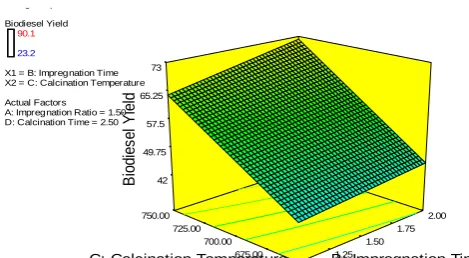
It was also seen that between two to three hours of calcination, the response is high with low impregnation ratio. But as the impregnation ratio increased, the response begins to drop even with long hours of calcination. This could be seen in the model equation as earlier explained. This means that the ratio used in impregnation is of utmost importance as it has a strong effect on the biodiesel response [9]. In Figure 4, it can be seen that the yield of biodiesel increased with increase in calcination temperature and impregnation time. Worthy of mention is the fact that there seems to be a very slight difference in the yield at lower impregnation time than that at higher time.
Fig. 4: A three- dimensional factorial plot for effect of impregnation time and calcination temperature on biodiesel yield
From the plot, there seems to be a greater effect on the yield from the calcination temperature than that from the hours used in impregnation. From the model equation, it can be seen that the calcination temperature-impregnation time Design-Expert® Software
Biodiesel Yield 90.1
23.2
X1 = A: Impregnation Ratio X2 = B: Impregnation Time
Actual Factors
C: Calcination Temperature = 700.00 D: Calcination Time = 2.50
1.00 1.25
1.50 1.75
2.00
1.00 1.25 1.50 1.75 2.00
39 47.75 56.5 65.25 74
B
io
di
es
el
Y
ie
ld
A: Impregnation Ratio B: Impregnation Time
Design-Expert® Software
Biodiesel Yield 90.1
23.2
X1 = A: Impregnation Ratio X2 = C: Calcination Temperature
Actual Factors B: Impregnation Time = 1.50 D: Calcination Time = 2.50
1.00 1.25
1.50 1.75
2.00
650.00 675.00 700.00 725.00 750.00
30 43.5 57 70.5 84
B
io
di
es
el
Y
ie
ld
A: Impregnation Ratio C: Calcination Temperature
Design-Expert® Software
Biodiesel Yield 90.1
23.2
X1 = A: Impregnation Ratio X2 = D: Calcination Time
Actual Factors B: Impregnation Time = 1.50 C: Calcination Temperature = 700.00
1.00 1.25
1.50 1.75
2.00
2.00 2.25 2.50 2.75 3.00
39 48.75 58.5 68.25 78
B
io
di
es
el
Y
ie
ld
A: Impregnation Ratio D: Calcination Time
Design-Expert® Software
Biodiesel Yield 90.1
23.2
X1 = B: Impregnation Time X2 = C: Calcination Temperature
Actual Factors A: Impregnation Ratio = 1.50 D: Calcination Time = 2.50
1.00 1.25
1.50 1.75
2.00
650.00 675.00 700.00 725.00 750.00
42 49.75 57.5 65.25 73
B
io
di
es
el
Y
ie
ld
[image:3.595.49.278.249.362.2] [image:3.595.307.542.544.673.2] [image:3.595.48.276.626.747.2]
term of the equation is linear and has a positive term. It implies that the interaction of these factors have a significant positive effect on the biodiesel response. That is, when the catalyst is impregnated for longer hours and calcined at higher temperatures, the yield will be higher. The response from the interaction of calcination time and impregnation time is shown in Figure 5 as positive. This can be seen as the biodiesel yield increased linearly with increase in calcination time and impregnation time.
Fig. 5: A three- dimensional factorial plot for effect of impregnation time and calcination temperature on biodiesel yield
A similar occurrence is observed as the biodiesel yield increased from low to high with increase in calcination time and calcination temperature with calcination temperature giving a greater effect on the response, Figure 6.
Fig. 6: A three- dimensional factorial plot for effect of calcination temperature and time on biodiesel yield
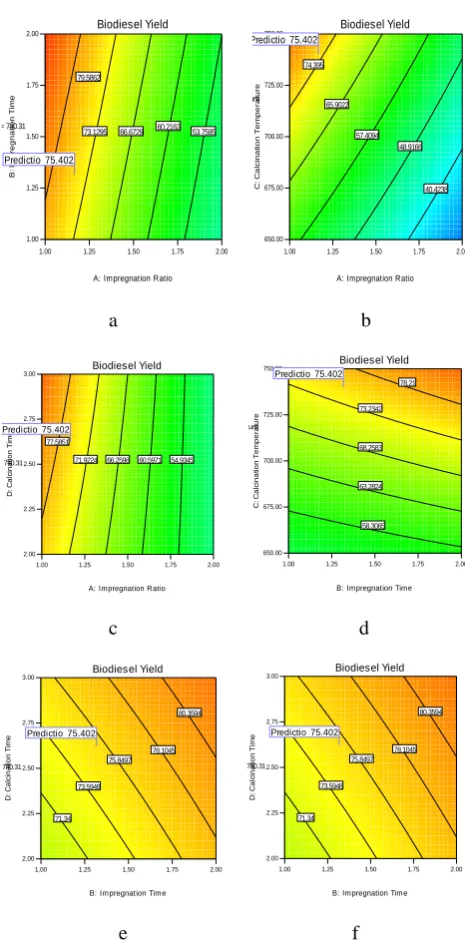
Figure 7 showed representation of the contour plots for the biodiesel yield predicted within the ranges of the variables studied. From the plots in each Figure, each contour represents two factors, at the centre points of which the biodiesel yield can be seen.
a b
c d
e f
Fig. 7: Contour plots (a, b, c, d, e, & f) for the biodiesel yield predicted within the ranges of the variables studied
IV. Conclusion
From the design of experiment using 24 factorial design,
the interaction between the calcination temperature and calcination time had the greatest effect on the yield of biodiesel. From the results, the optimum conditions of the reaction were obtained from calculations using numerical optimization methods. These conditions are; impregnation ratio of 1.17:1, 1.32 hours of impregnation, calcination at
740.31oC for 2.62 hours. The biodiesel yield from these
optimum conditions was predicted to be 75.4% with 95% confidence level. The conditions for transesterification were
12:1 methanol to oil molar ratio, 6wt% catalyst, 60oC
reaction time, and mixing speed of 250rpm for ninety minutes.
Design-Expert® Software
Biodiesel Yield 90.1
23.2
X1 = B: Impregnation Time X2 = D: Calcination Time
Actual Factors A: Impregnation Ratio = 1.50 C: Calcination Temperature = 700.00
1.00 1.25 1.50 1.75 2.00 2.00 2.25 2.50 2.75 3.00 47 51 55 59 63 B io d ie s e l Y ie ld
B: Impregnation Time D: Calcination Time
Design-Expert® Software
Biodiesel Yield 90.1
23.2
X1 = C: Calcination Temperature X2 = D: Calcination Time
Actual Factors A: Impregnation Ratio = 1.50 B: Impregnation Time = 1.50
650.00 675.00 700.00 725.00 750.00 2.00 2.25 2.50 2.75 3.00 35 43.75 52.5 61.25 70 B io di es el Y ie ld
C: Calcination Temperature D: Calcination Time
Design-Expert® Software
Biodiesel Yield 90.1
23.2
X1 = A: Impregnation Ratio X2 = B: Impregnation Time
Actual Factors C: Calcination Temperature = 740.31 D: Calcination Time = 2.62
1.00 1.25 1.50 1.75 2.00 1.00
1.25 1.50 1.75
2.00 Biodiesel Yield
A: Impregnation Ratio
B : Im p re g n a ti o n T im e 53.7595 60.2162 66.6729 73.1295 79.5862 Predictio 75.4025 Design-Expert® Software Biodiesel Yield 90.1 23.2
X1 = A: Impregnation Ratio X2 = C: Calcination Temperature
Actual Factors B: Impregnation Time = 1.32 D: Calcination Time = 2.62
1.00 1.25 1.50 1.75 2.00 650.00
675.00 700.00 725.00
750.00 Biodiesel Yield
A: Impregnation Ratio
C : C a lc in a ti o n T e m p e ra tu re 40.4238 48.9166 57.4094 65.9022 74.395 Predictio 75.4025 Design-Expert® Software Biodiesel Yield 90.1 23.2 X1 = A: Impregnation Ratio X2 = D: Calcination Time Actual Factors B: Impregnation Time = 1.32 C: Calcination Temperature = 740.31
1.00 1.25 1.50 1.75 2.00
2.00 2.25 2.50 2.75
3.00 Biodiesel Yield
A: Impregnation Ratio
D : C a lc in a ti o n T im e 54.9345 60.5971 66.2598 71.9224 77.5851 Predictio 75.4025 Design-Expert® Software Biodiesel Yield 90.1 23.2 X1 = B: Impregnation Time X2 = C: Calcination Temperature Actual Factors A: Impregnation Ratio = 1.17 D: Calcination Time = 2.62
1.00 1.25 1.50 1.75 2.00 650.00
675.00 700.00 725.00
750.00 Biodiesel Yield
B: Impregnation Time
C : C a lc in a ti o n T e m p e ra tu re 58.3065 63.2824 68.2583 73.2342 78.21 Predictio 75.4025 Design-Expert® Software Biodiesel Yield 90.1 23.2 X1 = B: Impregnation Time X2 = D: Calcination Time Actual Factors A: Impregnation Ratio = 1.17 C: Calcination Temperature = 740.31
1.00 1.25 1.50 1.75 2.00
2.00 2.25 2.50 2.75
3.00 Biodiesel Yield
B: Impregnation Time
D : C a lc in a ti o n T im e 71.34 73.5948 75.8497 78.1045 80.3594 Predictio 75.4025 Design-Expert® Software Biodiesel Yield 90.1 23.2 X1 = B: Impregnation Time X2 = D: Calcination Time Actual Factors A: Impregnation Ratio = 1.17 C: Calcination Temperature = 740.31
1.00 1.25 1.50 1.75 2.00
2.00 2.25 2.50 2.75
3.00 Biodiesel Yield
B: Impregnation Time
[image:4.595.304.537.48.520.2] [image:4.595.49.286.175.304.2] [image:4.595.49.284.460.572.2]REFERENCES
[1] Sharma, Y. C., Singh, B., and Korstad, J. (2010). Application of an Efficient Nonconventional Heterogeneous Catalyst for Biodiesel Synthesis from Pongamia pinnata Oil Energy Fuels, 1-9.
[2] Fadhil, A., Aziz, A. M., and Al-Tamer, M. H. (2016). Biodiesel production from Silybum marianum L. seed oil with high FFA content using sulfonated carbon catalyst for esterification and base catalyst for transesterification. Energy Conversion and Management, 255-265.
[3] Sanjay, B. (2013). Heterogeneous catalyst derived from natural resources for biodiesel production: A review. Research journal of chemical sciences, 3(6), 95-101.
[4] Eterigho, E. J., T. S. Farrow, D.O. Agbajelola, S. E. Ejejigbe, Adam P. Harvey (2016),’’Harnessing Alternative Technology for the Sustainability of Biodiesel Production’’, Iranica Journal of Energy
and Environment, Vol. 7, Issue 1, pp 7 – 11 www.IJEE.net
[5] Eterigho, E. J., T. S. Farrow and S. E. Ejejigbe (2017),’’Sulphated Zirconia Catalyst Prepared from Solid Sulphates by Non-aqueous Method’’, Iranica Journal of Energy and Environment, Vol. 8, Issue 2, pp 142 – 146 www.IJEE.net
[6] Tan Y., Abdullah, M., Nalasco-Hipolito, C., and Taufiq-Yap, Y. (2015). waste ostrich- and chicken eggshells as catalyst for biodiesel production from waste cooking oil: Catalyst charaterization and biodiesel yield performance. Applied energy, 160, 58-70.
[7] Semwal, S., Arora, A. K., Badoni, R. P., and Tuli, D. K. (2011). Biodiesel production using heterogeneous catalysts. Bioresource
Technology, 2151-2161.
[8] Singh, V. y. (2017). Effect of co-solvent on biodiesel production using calcium aluminium oxide as a reusable catalyst and waste vegetable oil. Fuel, 203, 360-369.
[9] Zabeti, M., Wan Daud, A. W., and Aroua, M. K. (2009). Activity of solid catalysts for biodiesel production: A review. Fuel Processing
Technology, 770-777.
[10] Zabeti, M., Daud, W. M., and Aroua, M. K. (2010). Biodiesel Production using alumina supported calcium oxide: An optimization study. Fuel processing technology, 91, 243-248.
[11] Muthu, K., and Viruthagiri, T. (2015). Study on solid base calcium oxide as a heterogeneous catalyst for the production of biodiesel.
Journal of advanced chemicalsciences, 1(4), 160-163.
[12] Ajemba, O. R and Onukwuli, O. D. (2012). Kinetic model for Ukpor clay dissolution in Hydrochloric acid solution. Journal of emerging trends in engineering and applied sciences, 3(3), 448-454.
[13] Olaremu, A. (2015). sequencial leaching for the production of alumina from nigerian clay. International journal of engineering
technology, management and applied sciences, 3(7), 103-109.
[14] Mahesh, S., Ramanathan, A., Begum, K., and Narayanan, A. (2015). Biodiesel production from waste cooking oil using KBr impregnated CaO as catalyst. Energy conversion and management, 91, 442-450. [15] Madejova, J. (2003). FTIR Techniques in Clay Mineral Studies.
Vibration Spectroscopy, 31, 1-10.
[16] Dudkin, B., Loukhina, I., Avvakumov, E., and Isupov, V. (2004). Application of Mechnochemical Treatment of Disintegration of Kaolinite with Sulphuric Acid. Chem.Sust. Dev., 12, 327-330 [17] Rohazriny, R., Razi, A., Naimah, I., Nasrul, H., and Abidin, C.
(2014). Characterization of Calcium oxide catalyst from eggshell waste. Advances in Environmental Biology, 8(22), 35-38.
[18] Asri, N., Diah, A., Puspita, S., Bambang, P., and Suprapto. (2015). Utilization of Waste Cooking Oil for Biodiesel Production Using Alumina Supported Base Catalyst. 3rd International Conference on
Biological, Chemical and Environmental Sciences (pp. 59-63).
[19] Pandit, P., and Fulekar, M. (2017). Eggshell waste as heterogeneous nanocatalyst for biodiesel production: optimized by response surface methodology. Journal of environmental management, 198, 319-329. [20] Sulaiman, N. B. (2017). Response surface methodology for the
optimum production of biodiesel over Cr/Ca/r-Al2O3 catalyst: catalytic performance and physicochemical studies. Renewable energy, 113, 697-705.