biotechnologicallly acquired pharmacological recep-tor proteins to generate drug}receptor interaction data and by applying QSRR analysis, the preselection of drug candidates can be facilitated and experiments on animals reduced.
See also: II/Chromatography: Liquid: Mechanisms: Reversed Phases.
Further Reading
Carr PW, Martire DE and Snyder LR (eds) (1993) The retention process in reversed-phase liquid chromatogra-phy. Special Volume of Journal of Chromatography A656: 1}618.
ForgaHcs E and CserhaHti T (1997) Molecular Bases of Chromatographic Separations. Boca Raton, FL: CRC Press.
Giddings JC (1991)UniTed Separation Science. New York: Wiley.
Jinno K (ed.) (1997)Chromatographic Separations Based on Molecular Recognition. New York: Wiley-VCH. Jurs PC (1996)Computer Software Applications in
Chem-istry, 2nd edn. New York: Wiley.
Kaliszan R (1987) Quantitative Structure} Chro-matographic Retention Relationships. New York: Wiley. Kaliszan R (1997) Structure and Retention in Chro-matography. A Chemometric Approach. Amsterdam: Harwood Academic Publishers.
Kier LB and Hall LH (1986) Molecular Connectivity in Structure}Activity Analysis. Letchworth: Research Study Press.
Plis\ka V, Testa B and van de Waterbend H (eds) (1996)
Lipophilicity in Drug Action and Toxicology. Wein-heim: VCH.
Smith RM (1995) Retention and Selectivity in Liquid Chromatography. Amsterdam: Elsevier.
REACTIVE DISTILLATION
S. M. Mahajani, Monash University, Clayton, Victoria, Australia
S. P. Chopade, Michigan State University, East Lans-ing, MI, USA
Copyright^ 2000 Academic Press
Introduction
Reactive distillation is a combination of separation and reaction in a single process. Commercial reactive distillation processes for the manufacture of methyl
t-butyl ether (MTBE) and methyl acetate were suc-cessfully commissioned in 1981 and 1983, respective-ly. These processes have a distinct edge over their conventional predecessors. The reactive distillation process is particularly advantageous in the case of reversible reactions where the conversion is limited by thermodynamic equilibrium. Some of the important beneRts of reactive distillation are: reduced capital cost; employment of low mole ratios of reactants; energy saving owing to utilization of the heat of reaction; and automatic temperature control and elimination of hot spots. The commercial process of MTBE manufacture has shown that heterogeneous catalysts such as ion exchange resins can be advantage-ously used in reactive distillation columns. Innovative techniques of conRning the small size resin particles (0.3}2 mm) in the column, allowing efRcient solid}liquid contact and high void fraction, have been
developed by CDTech, Sulzer, Koch Engineering and BASF. An alternative approach is to prepare a cata-lyst in the form of conventional column packing and pack it directly into the reactive distillation column. Recognizing the potential of reactive distillation for a particular process is a difRcult task, as not all the reactions can be conducted effectively in this way. Once its potential has been identiRed, the next step is to design the reactive distillation column for the re-quired task. The simultaneous existence of multiple processes such as mixing, mass transfer and reaction are involved, and the design method requires thor-ough knowledge of both chemical and physical equi-libria as well as the reaction kinetics. Graphical representations of liquid phase compositions, called residue curve maps or distillation maps, are com-monly used to analyse the reactive distillation pro-cess. Though some efforts have been made to study the underlying theory of the design method, the work is still at its preliminary stage. Another approach to understanding the behaviour of this process is to perform computer simulations and predict the perfor-mance of a column of known conRguration.
processes such as hydrolysis of methyl acetate and recovery of chemicals from aqueous streams is dis-cussed.
MTBE Production
The area of particular interest where reactive distilla-tion can be used is the producdistilla-tion of fuel ethers such as MTBE. Gasoline reformulation using these ethers as environmentally benign octane boosters has been driven by various Clean Air Acts, which have boosted MTBE production to a new level. By 2001 the pro-duction of MTBE is expected to be 25;106tonnes per annum worldwide.t-Amyl methyl ether (TAME) and ethyl t-butyl ether (ETBE) are also emerging as promising fuel additives. In addition to its property as an antiknock agent to enhance the octane number of the fuel, MTBE improves the water tolerance limit of the fuel and has a higher caloriRc value than that of other additives such as methanol.
Another important aspect of carrying out the etheriRcation to near complete conversion is its efR -cient use in separating theiso-oleRns from the reRnery stream containing both normal and secondary bu-tenes (C4or C5), which are otherwise very difRcult to isolate. A reactive distillation column can handle the mixed oleRns quite effectively and exploits the pres-ence of inert butenes to improve performance. This separation is necessary because n-butenes are re-quired in the pure form for homopolymerization and as a feed for the oxidative production of butadiene.
Reaction Details
MTBE is a product of the liquid-phase reaction of isobutylene and methanol, catalysed by a strong acidic macroreticular ion exchange resin. The reaction is highly selective, so that methanol reacts only with isobutylene in the presence of other C4oleRns [I].
CH3OH methanol
#(CH3)2C"CH2 isobutylene
0(CH3)3COCH3 MTBE
[I]
H0
298"!37.7 kJ mol\1
The favourable temperature and pressure ranges for the reaction to occur are 323}373 K and 5}15 atm, respectively. The useful side reactions are the dimeriz-ation and oligomerizdimeriz-ation of isobutylene and bu-tadiene as well as the formation of codimers. Since, until recently, only butadiene-extracted C4 reRnery streams were used for MTBE production, the only important by-product is diisobutylene, which consists of the isomers trimethyl-1-pentene and
2,4,4-trimethyl-2-pentene. The other side reactions, which are of less importance, are formation oft-butanol by reaction of isobutylene with water present as a feed impurity, the formation of traces of dimethyl ether by methanol condensation, and the double bond isomer-ization of 1-butene. Amberlyst 15威, a macroporous cation exchange resin, is widely used as a catalyst for this reaction. Numerous investigations on the kinetics of this reaction system have been reported in the literature. A model based on systematic studies of reaction kinetics (eqn [1]) and equilibrium of this system incorporating the activities of the compounds has been developed and is used by many investigators for column simulation studies.
r"mcatqacidkf
aIB
aMeOH! 1
Keq
aMTBE
a2 MeOH
[1]
In eqn [1],mcatis the catalyst loading,qacidis the ion exchange capacity andaiis the activity coefRcient of the corresponding component (IB, isobutylene, MeOH, methanol). The forward reaction rate con-stantkf and the equilibrium constantKeq have been Rtted experimentally. As a result of the high polarity of methanol, the reaction mixture is highly nonideal and involves formation of two binary azeotropes and one ternary reactive azeotrope. The activities of the components can sometimes be up to 20 times their mole fractions.
Commercial Process
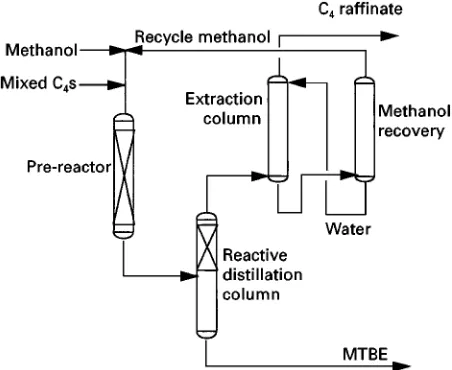
Conventional processes for the manufacture of MTBE (see Figure 1) use a catalytic reactor with a slight excess of methanol (methanol/ isobuty-lene"1.05}2). The products correspond to the near-equilibrium conversion of about 90}95%. The reaction mixture is separated using distillation, but suffers from complications resulting from the forma-tion of binary azeotropes methanol}MTBE and iso-butylene}methanol. The unreacted isobutylene is also difRcult to separate from other volatile C4products. With the reactive distillation process, almost com-plete conversion of isobutylene is obtained, thereby eliminating the separation and recycle problems.
Figure 2provides a schematic representation of this
Figure 1 Conventional process for MTBE manufacture.
Figure 2 Reactive distillation process for MTBE manufacture. excess methanol, while the bottom section separates out MTBE in pure form. The boiling points of MTBE and methanol are 328 K and 337.5 K, respectively. This may seem surprising, as MTBE is the bottom product while unreacted high boiling methanol is collected through the distillate. The behaviour is caused by the formation of an MTBE}methanol low boiling azeotrope, which lifts methanol from the stripping section of the column.
The pioneering work to commercialize this techno-logy was performed by Smith from Chemical Re-search and Licensing Company, who has been awarded several patents for different catalyst struc-tures, column internals design and Sow schemes. Some patents have also been assigned to researchers from ELF who claim to have used alternating cata-lytic and noncatacata-lytic zones successfully to carry out the etheriRcation. The efforts in these studies were directed towards minimizing the pressure drop in the catalyst bed and providing maximum residence time
for the liquid in the catalytic zone. This was achieved by providing separate free passage to the upSowing vapour stream either by packing the catalyst in the downcomers or by providing annular space in the catalyst bed, thereby isolating reaction and distilla-tion zones in a single column. UOP, Koch Engineer-ing and HuKls AG have jointly developed the Ethermax process for producing ethers by reactive distillation. The process uses Koch Engineering’s Katamax packing, where a solid acid catalyst is con-Rned in screen envelopes.
Simulation Studies
Following the successful commercialization of the MTBE process, numerous studies simulating a cata-lytic distillation column have appeared in the litera-ture. The basic idea behind simulation studies is to predict the overall conversion of either isobutylene or methanol, and examine the product purity at a steady state for a known column conRguration and feed composition. Various software packages such as ASPEN PLUS, SPEEDUP, etc, have been used effectively for this purpose.
The interesting discovery of multiple steady states for a column operated under identical conditions has attracted the attention of many researchers in the recent past. Several studies examining the reasons for the existence of these steady states have been re-ported. ExperimentalRndings conRrmed this fact and showed that the same column conRguration operated under similar conditions can give rise to two dif-ferent conversions. Simulation studies using an ASPEN PLUS Sowsheet simulator for a column with a total of 17 reactive and nonreactive stages, operated at 11 atm with two different feed streams of methanol and butenes, result in either 36% or 99% isobutylene conversion when methanol is fed to the 10th stage. The methanol feed plate was varied by following either top-to-bottom or bottom-to-top se-quence and it was found that only at certain feed plates (9}12) were multiple conversions realized (see
Figure 3). The steady-state conversion in this
multi-plicity region depends upon which sequence is fol-lowed to simulate the column. In the upgoing sequence low conversions are obtained, while the downgoing sequence is associated with high conver-sions. Subsequent efforts on column simulation have conRrmed this Rnding. Installation of the methanol feed at more than one location has been suggested to avoid the unwanted steady state caused by column misoperation.
[image:3.568.53.279.505.690.2]Figure 3 Steady-state multiplicity behaviour of the MTBE process.
decide whether a steady-state simulation would con-verge to a high conversion or a low conversion solu-tion. In order to obtain a high conversion solution, the lower section of the column must contain sufR -cient MTBE to lift the entire amount of methanol to the reactive zone. Second, in the reactive zone, the reaction mixture must be diluted to avoid a substan-tial amount of MTBE decomposition. Inisubstan-tial esti-mates of the composition at the lowest stage in the reactive zone are crucial in deciding the nature of the steady state. This is expected to be due to the inherent coupling between ‘lift’ and ‘dilution’ effects that takes place on this stage.
Recent simulation studies on reactive distillation of MTBE and TAME indicate two types of multiple steady states. TheRrst, discussed above, arises out of the interaction between reaction and vapour}liquid equilibrium. The second multiple steady state is re-lated exclusively to the chemical reaction and arises because of the highly nonlinear concentration de-pendence of methanol activity at low operating pres-sures. The only experimental evidence of multiple steady states reported so far comes from work on etheriRcation for TAME synthesis in a pilot plant of Nestle Oy. It is therefore necessary to perform dy-namic simulations during theRrst steps of the design process in order to avoid dynamic surprises.
Another interesting Rnding of MTBE simulation studies is the oscillatory behaviour of the reactive distillation column. Sustained oscillations of boiling temperature and reSux have been reported in experi-mental studies on reactive distillation. It has been proved that the nonreactive and nonideal interactions
between methanol and isobutylene are responsible for these effects.
Methyl Acetate Production
Methyl acetate is another high volume commodity chemical that is manufactured commercially using reactive distillation. ItRnds applications as an inter-mediate in the manufacture of a variety of polyesters such as photographic Rlm base, cellulose acetate, Tenite cellulosic plastics and Estron acetate.
Reaction Details
The reaction of methanol and acetic acid to give methyl acetate (reaction [II]) has equilibrium limitations.
CH3OH methanol
#CH3COOH
acetic acid
0CH3COOCH3 methyl acetate
#H2O water
[II]
H0
298"!8.0 kJ mol\1
Keq"
aMeOAcaH2O
aAcOHaMeOH
"5.2 [2]
Equation [2] gives the equilibrium constant Keq as a function of the activity coefRcients aMeOAc (methyl acetate),aH2O(water), andaAcOH(acetic acid).
Thus the reaction product will contain all four components even if one of the reactants is used in excess. The reaction can be conducted in the temper-ature range 310}393 K and at a pressure of 1 atm. The only important side reaction is the formation of dimethyl ether by the condensation of methanol. This reaction is predominant at high temperatures.
Though the reaction has been commercialized in a reactive distillation column, it is surprising that a systematic study on the kinetics of this reaction in the presence of sulfuric acid as catalyst is not evident in the open literature. As in the MTBE system, the rate expression in the form of activities is strongly preferred because the high polarity of water and methanol compared to that of methyl acetate leads to strongly nonideal solution behaviour. Because of the commercial success of reactive distillation and the proven potential of the ion exchange resins, some efforts have been made to propose a rate expression for an ion exchange resin-catalysed reaction. The expression for the rate,r, based on kinetic data gener-ated over a range of molar feed ratios more typical of reactive distillation conditions, is given by:
r" k(aHOAcaMeOH(!aMeOAcaH2O/Keq))
(1#KHOAcaHOAc#KMeOHaMeOH#KMeOAcaMeOAc#KH2OaH2O)
[3]
Figure 4 Reactive distillation process for methyl acetate manufacture.
involved in the Langmuir}Hinshelwood/Hougen} Watson model (HOAc, methyl acetate, MeOH, methanol; MeOAc, methyl acetate, H2O, water). The expression has been successfully used to verify the experimentally observed residue curve maps of this system. The residue curve maps shows no distillation boundaries and hence, ultrahigh purity methyl acet-ate and wacet-ater can be obtained through a proper design of reactive distillation column.
Commercial Process
Conventional processes before the 1980s used mul-tiple reactors with a large excess of one of the react-ants to achieve high conversion of the other. The product is difRcult to purify because of the formation of methyl acetate}methanol and methyl acetate}water azeotropes. Different means to break the methyl acetate}methanol azeotrope were em-ployed, such as use of several atmospheric and vac-uum distillation columns or extractive distillation. A typical process contained two reactors and eight distillation columns, making it complex and capital intensive.
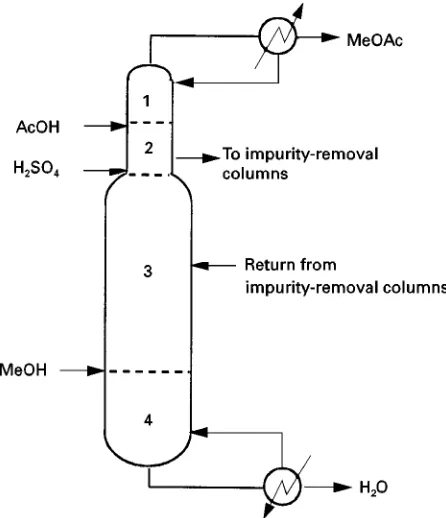
Eastman Kodak has developed a reactive distilla-tion process for the manufacture of high purity and ultrahigh purity methyl acetate. The remarkable fac-tor is that, in spite of the reaction having unfavour-able equilibrium limitation, high purity product is obtained using a near-stoichiometric mole ratio of methanol and acetic acid. The reactive distillation column used in the process is shown inFigure 4. In order to explain the process, the column can be divided in four stages starting from the top as: (1) methyl acetate enrichment; (2) water extraction; (3) reaction; and (4) methanol stripping. The reaction occurs in the middle section (section 3) in a series of countercurrent Sashing stages with sulfuric acid as the catalyst. In section 2, acetic acid acts as an ex-tracting agent and extracts water (breaking the methyl acetate}water azeotrope) and some methanol. Acetic acid and methyl acetate are separated above the acetic acid feed, in the methyl acetate-enriching section (section 1), allowing pure methyl acetate to be recovered as the overhead product. Methanol is strip-ped from water in the bottom section (section 4) and water is the bottom product. Some intermediate boiling compounds are formed because of the impu-rities present in feed. Hence, a small stream is with-drawn just above the catalyst feed point and treated separately in an impurity-removal system. The impu-rities are stripped and concentrated, and the meth-anol#methyl acetate stream is recycled to the reaction zone. The reactive distillation column has been successfully operated at a near-stoichiometric mole ratio of acetic acid and methanol, yielding high
purity methyl acetate as the product. The whole pro-cess is integrated in a single column, eliminating the need for a complex distillation column system and recycle of the methanol}methyl acetate azeotrope. A single reactive distillation column at Eastman Kodak’s Tennessee plant produces 180 000 metric tons per year of high purity methyl acetate. The composition proRle of the column shown inFigure 5
demonstrates that the methyl acetate can be manufac-tured in a single column without need for additional puriRcation steps.
Hydrolysis of Methyl Acetate
Methyl acetate}water mixture is produced in large quantities from puriRed terephthalic acid (PTA) plants. The manufacture of poly(vinyl alcohol) (PVA) also produces large quantities of methyl acetate (1.68 kg per kg PVA). Since methyl acetate is a com-paratively low value solvent, it has to be sold at a lower price; hence it would be a better idea to hydrolyse it economically and recover methanol and acetic acid for reuse in the process.
Figure 5 Composition profile in methyl acetate reactive distillation column.
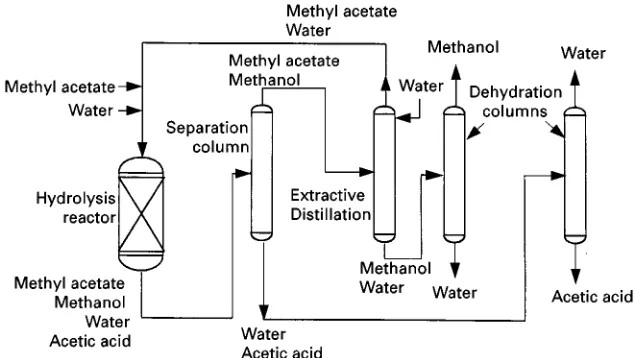
Figure 6 Conventional process for hydrolysis of methyl acetate. acetate has to be separated and recycled. A schematic diagram of a typical conventional process is given in
Figure 6. The reaction is carried out in a Rxed-bed
reactor and the product stream contains all four com-ponents. Four additional columns are required to separate methanol and acetic acid streams and recycle unconverted methyl acetate, along with methanol, to the reactor.
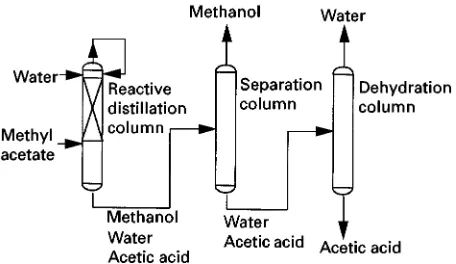
The above has shown how reactive distillation sim-pliRes the process in the case of the manufacture of methyl acetate. A similar concept can be applied to the hydrolysis reaction. A reactive distillation process has been developed on a laboratory scale for the hydrolysis of methyl acetate using an ion exchange resin catalyst in a special form. Converting the pro-cess from conventional to reactive distillation offers the possibility of eliminating many complicated steps. The use of solid acid catalysts obviates the need for recovery of the spent acid and the use of exotic
[image:6.568.126.443.512.691.2]Figure 7 Reactive distillation process for hydrolysis of methyl acetate.
column for recovery of water-diluted methanol. Con-versions to the tune of 99% are achieved in this process. The estimated heat savings are 50% that of the conventional process.
Recovery and Puri
\
cation
of Chemicals
The esteriRcation reaction has also been successfully employed for the recovery of acetic acid from aque-ous streams. Dilute acetic acid is produced in large quantities in many processes, such as the manufacture of cellulose esters, terephthalic acid and dimethyl terephthalate; and also in reactions such as acetyla-tion and nitraacetyla-tion. The recovery of acetic acid from these streams is a daunting problem. The conven-tional methods for recovery are azeotropic distilla-tion, simple distillation and liquid}liquid extraction. With the advent of reactive distillation processes, esteriRcation of acetic acid with methanol seems an attractive alternative. Laboratory experiments have been carried out to recover acetic acid in a reactive distillation column. The column contained commer-cially available ion exchange resin along with Rashig rings. The use of a solid acid catalyst offers noncor-rosive conditions so that a less expensive construction material can be used. Up to 84% recovery of acetic acid as methyl acetate was achieved. Hoechst Cel-anese Corporation has recently described a reactive distillation process for the recovery of acetic acid from aqueous solutions as methyl acetate. With the use of acidic ion exchange resin as catalyst, more than 90% recovery from 5}30% aqueous acetic acid is claimed. They also suggest the use of Koch Engineer-ing’s Katamax packing as catalyst.
Reactive distillation can be applied for the recovery of many other chemicals from dilute streams. The polymer industry is often faced with the challenge of treatment of aqueous formaldehyde solutions, as it is a nuisance to the environment and it is difRcult to
remove trace quantities of formaldehyde. Reactive distillation with methanol, ethanol or ethylene glycol not only brings down the formaldehyde concentra-tion to the ppm level, but also yields useful acetal products. Similarly, nonboiling chemicals such as glyoxal and glyoxylic acid can be recovered from their aqueous solutions through the formation of their corresponding acetals or esters, which can be separated by distillation. CDTech has recently de-veloped a reactive distillation process for hydrodesul-furization, called the CDHDS process, which is aimed at producing low sulfur fuels to meet stringent future environmental regulations at the lowest cost.
Reactive distillation has reportedly been employed for the puriRcation of bisphenol A of polycarbonate grade, where impurities in the form of carbonyl com-pounds such as acetone, mesityl oxide, hydrotropal-dehyde, etc., have to be reduced from about 3000 ppm to(10 ppm. A continuous reactive distil-lation column has been claimed to be a versatile method to achieve this objective.
Concluding Remarks
distillation mayRnd a place in many other processes such as hydrolysis of methyl acetate, recovery of carboxylic acid from their aqueous solutions, hy-drodesulfurization and puriRcation of phenols.
See also: II/ Distillation: Energy Management; Historical Development; Instrumentation and Control Systems; Theory of Distillation.
Further Reading
Agreda VH, Partin LR and Heise WH (1990) High purity methyl acetate via reactive distillation.Chemical Engin-eering Progress86(2): 40}46.
Ancillotti F, Pescarollo E, Szatmari E and Lazar L (1987) MTBE from butadiene-rich C4s.Hydrocarbon
Process-ing66: 50}53.
Bravo JL, Pyhalahti A and Jarvelin H (1993) Investigations in a catalytic distillation pilot plant: vapour/liquid equilibrium, kinetics, and mass transfer issues.
Industrial and Engineering Chemistry Research 32: 2220}2225.
Chopade SP and Sharma MM (1997) Reaction of ethanol and formaldehyde: use of versatile cation exchange resins as catalysts in batch reactors and reactive distilla-tion columns.Reactive and Functional Polymers32(1): 53}65.
Chopade SP and Sharma MM (1997) Acetalization of ethy-lene glycol with formaldehyde using cation exchange resins as catalysts: batch versus reactive distillation. Re-active and Functional Polymers34(1): 37}45.
DeGarmo JL, Parulekar VN and Pinjala V (1992) Consider reactive distillation. Chemical Engineering Progress
88(3): 43}50.
Fuchigami Y (1990) Hydrolysis of methyl acetate in distilla-tion column packed with reactive packing of ion ex-change resin.Journal of Chemical Engineering of Japan
23: 354}359.
Hauan S, Hertzberg T and Lein KM (1995) Why methyl
tert-butyl ether production by reactive distillation may yield multiple soultions. Industrial and Engineering Chemistry Research34: 987}991.
Jacobs R and Krishna R (1993) Multiple solutions in react-ive distillation for methyltert-butyl ether synthesis. In-dustrial and Engineering Chemistry Research 32: 1706}1709.
Kolah AK, Mahajani SM and Sharma MM (1996) Acetaliz-ation of formaldehyde with methanol in batch and continuous reactive distillation columns. Industrial and Engineering Chemistry Research 35(10): 3707}3720.
Mohl KD, Kienle A, Gilles ED, Rapmund P, Sundmacher K and Hoffman U (1997) Nonlinear dynamics of react-ive distillation processes for the production of fuel ethers. Computers and Chemical Engineering 21: S989}S994.
Neumann R and Sasson Y (1984) Recovery of acetic acid by esteriRcation in a packed chemorectiRcation column.
Industrial and Engineering Chemistry Process Design and Development23: 654}659.
Nijhuis SA, Kerkhof FPJM and Mak ANS (1993) Multiple steady states during reactive distillation of methyltert -butyl ether.Industrial and Engineering Chemistry Re-search32: 2767}2774.
Nocca JL, Leonard J, Gaillard JF and Amigues P (1989) Process for manufacturing a tertiary alkyl ether by react-ive distillation. US Patent 4 847 431.
RehRnger A and Hoffman U (1990) Kinetics of methyl tertiary butyl ether liquid phase synthesis catalysed by ion exchange resin}I. Intrinsic rate expression in liquid phase activities. Chemical Engineering Science 45(6): 1605}1617.
Scates MO, Parker SE, Lacy JB and Gibbs RK (1997) Recovery of acetic acid from dilute aqueous streams formed during a carbonylation process. US Patent 5 599 976.
Sharma MM (1995) Some novel aspects of cationic ex-change resins as catalysts.Reactive and Functional Poly-mers26: 3}23.
Smith LA (1980) Catalyst system for separating isobutene fron C4 streams. US Patent 4 215 011.
Smith LA (1981) Catalytic distillation process. US Patent 4 307 254.
Song W, Venimadhavan G, Manning JM, Malone MF and Doherty MF (1998) Measurement of residue curve maps and heterogeneous kinetics in methyl acetate system.
Industrial and Engineering Chemistry Research 37: 1917}1928.
Sundmacher K and Hoffmann U (1995) Oscillatory vapour}liquid transport phenomena in a packed reactive distillation column for fuel ether production.Chemical Engineering Journal and the Biochemical Engineering Journal57: 219}228.
RESINS AS BIOSORBENTS:
ION EXCHANGE
S. Belfer, The Institutes for Applied Research, Ben-Gurion University of the Negev, Beersheva, Israel
Copyright^ 2000 Academic Press