EFFICACY OF TOPICAL CURCUMIN IN THE MANAGEMENT OF ORAL LICHEN PLANUS
Anuradha Pai and
Department of oral Medicine and Radiology, The oxford Dental College, Bengaluru, Karnataka, India
ARTICLE INFO ABSTRACT
Background:
unknown aetiology, characterized by alternating
Different treatment modalities have been tried, but with limited success.
treatment and the side effects of current treatments, efforts are still being made to find new treatment modalities
Planus (OLP) by
topical Curcumin can be suggested for treatment of OLP because of its desirable anti analgesic, antimicrobial, anti
efficacy and Methods:
into two groups. The control grou study group (
daily for 2 weeks. The patients were reviewed every week for two weeks.
using SPSS v.22 software IBM., Corp. The intergroup comparison using independent student t test showed significant improvement in the pain (
reduction in ulceration (
comparison using repeated measures of ANOVA followed by Bonferroni’s Post hoc analysis showed statistically significant reduction in the pain(
Conclusion:
It could be considered as an alternative treatment of OLP with fewer side effects compared to steroids. However further studies with larger sample size and follow up per
Copyright©2018, Anuradha Pai and Hemcle Shalma Ganesan
permits unrestricted use, distribution, and reproduction
INTRODUCTION
OLP is a chronic immune mediated, mucocutaneous disease of unknown origin. It was first described by Wilson in 1869. It can affect the oral mucosa, skin, genital mucosa, scalp, and nails.1-3 Globally, Lichen Planus affects about 1
population and prevalence in India ranges from 0.1% to 1.5%. This disease has most often reported in middle
30-60 years of age and is more common in females than in males (1.4:1).Rarely, OLP is seen in children (Lodi Boorghani et al., 2010; Jayachandran
Approximately, two-thirds of OLP patients report discomfort, especially in association with erosive and atrophic OLP. A greater malignant potential has been found for these two forms of LP (Patil et al., 2012; Dinkova et al., 2010). Managem should aim at the resolution of painful symptoms, oral mucosal lesions, the risk of oral cancer and the maintenance of good oral hygiene.
*Corresponding author: Hemcle Shalma Ganesan.,
Department of oral Medicine and Radiology, The oxford Dental College, Bengaluru, Karnataka, India.
ISSN: 0975-833X
Article History: Received 20th August, 2018
Received in revised form 30th September, 2018
Accepted 15th October, 2018
Published online 29th November, 2018
Citation: Anuradha Pai and Hemcle Shalma Ganesan.
Journal of Current Research, 11, (11), 75113-75117.
Key words:
Oral Lichen Planus, Curcumin, Triamcinolone Acetonide, Antioxidants.
RESEARCH ARTICLE
EFFICACY OF TOPICAL CURCUMIN IN THE MANAGEMENT OF ORAL LICHEN PLANUS
A PILOT STUDY
Anuradha Pai and *Hemcle Shalma Ganesan
of oral Medicine and Radiology, The oxford Dental College, Bengaluru, Karnataka, India
ABSTRACT
Background: Lichen Planus is an inflammatory, immune mediated, mucocutaneous disease of unknown aetiology, characterized by alternating periods of symptomatic remission and exacerbation. Different treatment modalities have been tried, but with limited success.
treatment and the side effects of current treatments, efforts are still being made to find new treatment modalities. Steroids have been found to be the first line of drugs in treating symptomatic Oral Lichen Planus (OLP) by reducing pain and inflammation however withpotential side effects.
topical Curcumin can be suggested for treatment of OLP because of its desirable anti analgesic, antimicrobial, anti – tumour properties and insignificant sid
efficacy of topical Curcumin with 0.1% Triamcinolone Acetonide
and Methods: The research group consisted of 20 adult OLP patients, who were randomly divided into two groups. The control group (n = 10) was treated with Triamcinolone Acetonide 0.1% and the study group (n = 10) with commercially available topical Curcumin ointment each to be applied thrice daily for 2 weeks. The patients were reviewed every week for two weeks.
using SPSS v.22 software IBM., Corp. The intergroup comparison using independent student t test showed significant improvement in the pain (P = 0.001) and erythema (
reduction in ulceration (P = 0.05) in the study group as compared to the control group. Intragroup comparison using repeated measures of ANOVA followed by Bonferroni’s Post hoc analysis showed statistically significant reduction in the pain(P=0.001) and erythema(
Conclusion: Topical application of Curcumin can bring about clinical improvements in OLP
It could be considered as an alternative treatment of OLP with fewer side effects compared to steroids. However further studies with larger sample size and follow up periods may be required.
Hemcle Shalma Ganesan.This is an open access article distributed under the Creative in any medium, provided the original work is properly cited.
OLP is a chronic immune mediated, mucocutaneous disease of unknown origin. It was first described by Wilson in 1869. It can affect the oral mucosa, skin, genital mucosa, scalp, and 3 Globally, Lichen Planus affects about 1-2% of alence in India ranges from 0.1% to 1.5%. This disease has most often reported in middle-aged patients 60 years of age and is more common in females than in males (1.4:1).Rarely, OLP is seen in children (Lodi et al.;
et al., 2012).
thirds of OLP patients report discomfort, especially in association with erosive and atrophic OLP. A greater malignant potential has been found for these two forms 2010). Management should aim at the resolution of painful symptoms, oral mucosal lesions, the risk of oral cancer and the maintenance of good
Department of oral Medicine and Radiology, The oxford Dental College,
The current accepted mode of treatment is the use of corticosteroids. The chronic and recalcitrant nature of the disease demands the use of steroids for long durations with subsequent increase in dose. However, the topical drugs result in various side effects which include thinning of the oral mucosa, secondary candidiasis, stomatopyrosis and altered taste sensation (Thongprasom and Dhauthai, 2008). A constant search for an alternative natural or herbal drug with anti inflammatory properties which could be
or in combination with the mainstay drugs used in the treatment of OLP on a long term basis with minimal side effects (Hatcher et al., 2008).
Turmeric and its ingredients Curcumin are being studied as chemo preventive agent that inhibits the development of oral cancer. Curcumin have been found to inhibit many diseases processes through their ant inflammatory, antioxidant and anticancer properties (Lodi et al.,
to investigate the efficacy of Curcumin as an alternative means of treatment of OLP.
International Journal of Current Research Vol. 10, Issue, 11, pp.75113-75117, November, 2018
DOI: https://doi.org/10.24941/ijcr.32918.11.2018
Hemcle Shalma Ganesan. 2018.“Efficacy of topical curcumin in the management of oral lichen planus
EFFICACY OF TOPICAL CURCUMIN IN THE MANAGEMENT OF ORAL LICHEN PLANUS –
of oral Medicine and Radiology, The oxford Dental College, Bengaluru, Karnataka, India
Lichen Planus is an inflammatory, immune mediated, mucocutaneous disease of periods of symptomatic remission and exacerbation. Different treatment modalities have been tried, but with limited success. Due to the lack of a definitive treatment and the side effects of current treatments, efforts are still being made to find new treatment . Steroids have been found to be the first line of drugs in treating symptomatic Oral Lichen potential side effects. Application of topical Curcumin can be suggested for treatment of OLP because of its desirable anti- inflammatory, tumour properties and insignificant side effects. Aim: To compare the Acetonide in the treatment of OLP. Materials The research group consisted of 20 adult OLP patients, who were randomly divided = 10) was treated with Triamcinolone Acetonide 0.1% and the = 10) with commercially available topical Curcumin ointment each to be applied thrice daily for 2 weeks. The patients were reviewed every week for two weeks. Results: Data was analyzed using SPSS v.22 software IBM., Corp. The intergroup comparison using independent student t test = 0.001) and erythema (P =0.02), but non-significant group as compared to the control group. Intragroup comparison using repeated measures of ANOVA followed by Bonferroni’s Post hoc analysis showed ) and erythema(P=0.001) in both the groups. Topical application of Curcumin can bring about clinical improvements in OLP patients. It could be considered as an alternative treatment of OLP with fewer side effects compared to steroids.
iods may be required.
Creative Commons Attribution License, which
The current accepted mode of treatment is the use of corticosteroids. The chronic and recalcitrant nature of the disease demands the use of steroids for long durations with subsequent increase in dose. However, the topical drugs result cts which include thinning of the oral mucosa, secondary candidiasis, stomatopyrosis and altered taste sensation (Thongprasom and Dhauthai, 2008). A constant search for an alternative natural or herbal drug with anti-inflammatory properties which could be taken as monotherapy or in combination with the mainstay drugs used in the treatment of OLP on a long term basis with minimal side 2008). Research studies suggest that Turmeric and its ingredients Curcumin are being studied as o preventive agent that inhibits the development of oral cancer. Curcumin have been found to inhibit many diseases processes through their ant inflammatory, antioxidant and
et al., 2005). Hence this was done
fficacy of Curcumin as an alternative means
OF CURRENT RESEARCH
MATERIALS AND METHODS
This pilot clinical trial interventional study was conducted in the Department of Oral Medicine and Radiology of our institute from July 2017 till May 2018. Ethical approval was obtained from Institutional Review Board following which 20 patients with symptomatic (atrophic/erosive) OLP were selected. The subjects were randomly divided into study group and control groups consisting of 10 and 10 patients, respectively. Patients diagnosed with atrophic/erosive form of OLP and who had not used systemic or topical glucocorticosteroids, analgesics and anesthetics in either topical/systemic form for atleast past two weeks were selected. Patients with lichenoid lesions, pregnant and lactating female patients, patients with systemic diseases and history of allergies to Curcumin and Triamcinolone Acetonide were excluded from the study. Patients included in the study were informed about the study parameters and signed informed consent was taken. Age, gender, medical history, type and location of the oral lesion, duration of illness and type of treatment that the patient had previously received for his or her Lichen Planus disease were recorded in a standard case sheet proforma.
The selected 20 patients were allocated into two groups of 10 subjects each by simple randomization. Patients of the study group was prescribed topical Curcumin (commercially available as Curenext oral gel Abbott pharmaceuticals, India) and the patients of the control group was given triamcinolone acetonide 0.1% (Kenacort oral paste 0.1% Abbott pharmaceuticals, India) to be applied thrice daily for two weeks over the lesion. The burning sensation in the mouth was recorded by using Numerical Rating Scale (NRS) by asking the patients to assign a numerical score representing the intensity of their burning sensation on the scale ranging from 0 (no burning sensation) to 10 (worst imaginable burning sensation) (Chainani-Wu et al., 2008). Similarly, clinical signs of OLP were measured using a semi quantitative scale (modified mucosal index) developed by Schubert MM et al. (2008).
An intensity score for erythema ranging from 0 to 3 was used
0 = Normal 1 = Mild erythema 2 = Moderate erythema 3 = Severe erythema
In each group, the patients were recalled every week for two weeks. On each follow up visit, the NRS Score as well as the erythema were recorded and the clinical photographs were taken. Patients were enquired about any adverse drug reactions during the study period. The assessment of the grades was performed by a single calibrated examiner in order to reduce intra examiner variability.
Statistical analysis
All the collected data was tabulated and subjected to statistical analysis using SPSS v.22 software IBM. The demographic data including age and gender was recorded and represented in tables using Mann Whitney test & Chi Square test. At baseline, all the parameters were tested for randomization between two groups using independent student t-test. Repeated measures ANOVA followed by Bonferroni’s Post hoc analysis was
applied to verify the differential changes in parameters between study and control groups from baseline to second follow-up.
RESULTS
25 patients participated in the study among them 5 patients lost to follow up and the remaining 20 patients consisted of 9 males and 11 females with a mean age of 43.9 years and age range of 21- 70 years. The Curenext group consisted of 4 males and 6 females with a mean age of 42.1 years (range: 21- 70 years) and the Triamcinolone group consisted of 5males and 5 females with a mean age of 45.7 years (range: 32- 60 years). (Table 1).
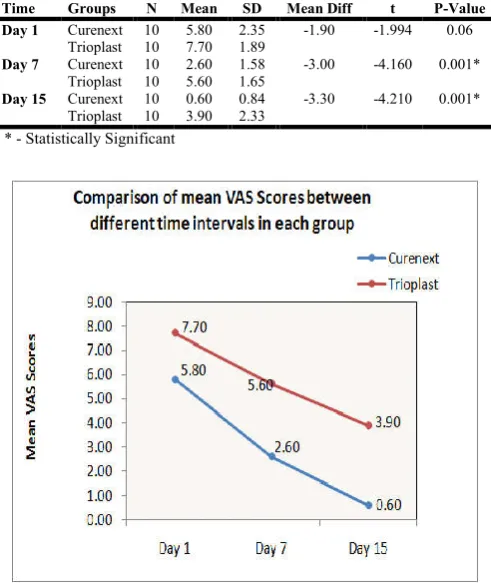
The mean VAS score was 5.80 in the Curcumin group at baseline, which decreased to 2.60 and 0.60 at the second and third follow-ups, respectively. The mean VAS score in the triamcinolone group was 7.70 at baseline, which decreased to 5.60 and 3.90 at the second and third visits, respectively. When comparison of the mean VAS score between the two groups at different time interval, the difference was found to be statistically significant at day 7(p=0.001) and day 15(p=0.001) (Table 2 and Graph 1).
Table 1. Age and Gender distribution among 2 groups
Variables Curenext [N=10] Trioplast [N=10] P-Value
Mean SD Mean SD
Age Mean & SD 42.1 12.7 45.7 10.8 0.40a
Range 21 - 70 32 – 60
n % n %
Gender Males 4 40% 5 50% 0.65b
Females 6 60% 5 50%
[image:2.595.311.557.504.796.2]a. Mann Whitney Test b. Chi Square Test
Table 2.Comparison of mean VAS Scores between 2 groups at different time intervals using Independent Student t Test
Time Groups N Mean SD Mean Diff t P-Value
Day 1 Curenext 10 5.80 2.35 -1.90 -1.994 0.06
Trioplast 10 7.70 1.89
Day 7 Curenext 10 2.60 1.58 -3.00 -4.160 0.001*
Trioplast 10 5.60 1.65
Day 15 Curenext 10 0.60 0.84 -3.30 -4.210 0.001*
Trioplast 10 3.90 2.33
The mean erythema score was 5.80 in the Curcumin group at baseline, which decreased to 2.60 and 0.60 at the second and third follow-ups, respectively. The mean VAS score in the triamcinolone group was 2.55 at baseline, which decreased to 1.83 and 1.99 at the second and third visits, respectively. When comparison of the mean VAS score between the two groups at different time interval, the difference was found to be statistically significant at day 7(p=0.002) and day 15(p=0.02). (Table 3 and Graph 2).
Table 3.Comparison of mean Erythema scores between 2 groups at different time intervals using Independent Student t Test
Time Groups N Mean SD Mean Diff t P-Value
Day 1 Curenext 10 1.90 0.57 -0.50 -2.060 0.05#
Trioplast 10 2.40 0.52
Day 7 Curenext 10 1.00 0.67 -0.70 -2.689 0.02*
Trioplast 10 1.70 0.48
Day 15 Curenext 10 0.70 0.48 -0.50 -2.466 0.02*
Trioplast 10 1.20 0.42
* - Statistically Significant # - Borderline Significance
DISCUSSION
OLP should be considered a precancerous lesion, emphasizing
the importance of periodic follow-ups in all the patients. The
aim of treatment is to reduce symptoms and also eliminate erythematous or ulcerative lesions (Xiong et al.). Corticosteroid therapy is the most common treatment of choice. However, several side effects may be encountered with the usage of topical steroids, namely candidiasis, burning or stinging sensation, mucosal atrophy, bad taste, nausea, sore throat, dry and swollen mouth. Nowadays, using natural and herbal remedies are taken into consideration in disease treatments (Thongprasom and Dhauthai, 2008).
Aloe vera gel, cedar honey, oral lycopene, ignatia homeopathic remedy, angustifolia, and curcuminoids have been used in treating OLP. However, most of the herbal remedies are still in their nascent stage of research and require large scale studies in order to establish their efficacy (Salazar-Sánchez et al., 2010; Sanatkhani et al., 2014; Saawarn et al., 2011; Mousavi et al.,
2009; Taheri et al., 2010).Curcumin is one among them and it is found to be an effective treatment in OLP even in the cases where topical steroids have been used and recurrence was seen. It exhibits antioxidant, anti-inflammatory, antimicrobial, and
anti-carcinogenic activities, antiproliferative, antimutagenic, neuroprotective, and immune-system modulating properties, which have been well documented in literature to date. Several animal studies have shown that Curcumin inhibits the cancer cell growth process at the stage of forming, suppresses tumour promotion and expansion of cancerous changes. Also it is safe even at very high doses. The clinical efficacy of Curcumin was compared with that of a topical corticosteroid, which is the standard treatment for OLP (Vijay et al., 2010). Chainani-Wu
et al. in 2007 conducted a study in which he used Curcumin
for treatment of OLP and they were prescribed as tablets, at a dosage of 2000mg/day for seven weeks. The authors concluded that systemic administration of Curcumin was not successful for treatment of OLP. Systemic administration of Curcumin in the study by Chainani-Wu et al. was different from its topical administration in the current study; the topical administration increases the efficacy of the drug (Chainani-Wu
et al., 2008). The mean age of the study population was 43.9
years which is almost similar to the inference obtained by the study done by Chitturi et al. (2015) Studies in various parts of the world show a difference in the mean age of occurrence and this difference could be attributed to ethnicity and geographic locations. OLP can affect both sexes; however, a slight female predominance has been reported. In this study there are 9 males and 11 females with a male: female ratio of 1:1.22. These results are in accordance with the results obtained by Kumar et al. (2014) (64%), Omal et al. (2012) (63%) and Silvermann et al. (1985) (68%) as they too suggest a female predilection for the disease. This could be due to the influence of hormones like oestrogen.
The reduction of the burning sensation and the clinical signs of OLP (erythema) reflected by the Modified Mucosal Index and NRS score in our study could be attributed to the anti-inflammatory property of Curcumin. Though, the exact etiopathogenesis of OLP cannot be pointed out, it is said to be a chronic inflammatory disease with the immune system having a primary role in the development of the disease, as there is a dense sub epithelial inflammatory infiltrate which is dominated by T-lymphocytes . According to Rao CV et al., Curcumin is a dual inhibitor of arachidonic acid metabolism, as it inhibits both cycloxygenase and lipoxygenase pathways of inflammation, thus, inhibiting the products of inflammation such as prostaglandins and leukotreines thereby, minimizing the signs and symptoms of inflammation (Rao et al., 1993).
Figure 1. (a)(b)Patient with atrophic lichen planus at baseline visit included in the study group (Curcumin group), (c) (d) shows reduction in erythema, at the first follow-up visit, (e) (f) shows further reduction in erythema at the second follow-up visit
Figure 2. (a)(b)Patient with atrophic lichen planus at baseline visit included in the control group (Trioplast group), (c) (d) Shows reduction in erythema, size of the ulcer at the first follow-up visit, (e) (f) Shows further reduction in erythema at the second follow-up visit
Conclusion
In light of our study, Steroids and Curcumin have been proved to be effective in the remission of OLP. It can be concluded that Curcumin can be used as an adjuvant. Hence, its use as an alternative is questionable. However, further studies are recommended with larger samples and longer follow up to evaluate the efficacy of Curcumin.
REFERENCES
Boorghani M, Gholizadeh N, Taghavi Zenouz A, Vatankhah M, Mehdipour M. 2010. Oral lichen planus: Clinical features, etiology, treatment and management; A review of literature. J Dent Res Dent Clin Dent Prospects, 4:3-9. Chainani-Wu N, Silverman S Jr, Reingold A, Bostrom A,
Lozada-Nur F, Weintraub J. 2008. Validation of instruments to measure the symptoms and signs of oral lichen planus. Oral Surg Oral Med Oral Pathol Oral
Radiol Endod., 105:51-8.
Chitturi RT, Sindhuja P, Parameswar RA, Nirmal RM, Reddy BV, Dinesdshankar J, et al. 2015. A clinical study on oral lichen planus with special emphasis on hyper pigmentation.
J Pharm Bioall Sci., 7:495-98.
Dinkova A, Gospodinov D, Gavasova G, Cholakova R, Daskalov H, Chenchev I. 2010. Interdisciplinary approach in complex treatment of oral lichen ruber planus review and a case report. J IMAB, 16:14-8.
Hatcher H, Planalp R, Cho J, Torti FM, Torti SV. 2008, Curcumin: From ancient medicine to current clinical trials.
Cellular and Molecular Life Sciences, 2008;
65(11):1631-52.
Jayachandran S, Koijam Sashikumar S. 2012. Management of oral lichen planus: A clinical study. Management, 25:205. Kumar T, Puri G, Laller S, Bansal T, Malik M. 2014.
Association of ABO blood grouping with oral lichen planus. Univ Res J Dent., 4:93-96.
Lodi G, Scully C, Carrozzo M, Griffiths M, Sugerman PB, Thongprasom K. Current controversies in oral lichen planus: Report of an international consensus meeting. Part 1. Viral infections and etiopathogenesis. Oral Surg Oral
Med Oral Pathol Oral Radiol Endod., 2005;100:40-51.
Lodi G, Scully C, Carrozzo M, Griffiths M, Sugerman PB, Thongprasom K. Current controversies in oral lichen planus: Report of an international consensus meeting. Part 2. Clinical management and malignant transformation.
Oral Surg Oral Med Oral Pathol Oral Radiol Endod.,
100:164‑78.
Mousavi F, Sherafati S, Mojaver YN. 2009. Ignatia in the treatment of oral lichen planus. Homeopathy, 98(1):40-4. Omal PM, Jacob V, Prathap A, Thomas NG. 2012. Prevalence
of oral, skin and oral and [19] skin lesions of lichen planus in patients visiting a dental school in southern India. Indian
J Dermatol., 57:107-09.
Patil S, Khandelwal S, Sinha N, Kaswan S, Tipu FR. 2012. Treatment modalities of oral lichen planus: An update. J
Oral Diagn., 1:47-52.
Rao CV, Simi B, Reddy BS. 1993. Inhibition by dietary curcumin of azoxymethane induced ornithine decarboxylase, tyrosine proteinkinase, arachidonic acid metabolism and aberrant crypt foci formation in the rat colon. Carcinogenesis, 14:2219.
[image:4.595.46.280.56.360.2] [image:4.595.47.281.428.739.2]oral lichen planus: a placebo-controlled study. Indian J
Dent Res., 22(5):639.
Salazar-Sánchez N, López-Jornet P, Camacho-Alonso F, Sánchez-Siles M. 2010. Efficacy of topical Aloe vera in patients with oral lichen planus: a randomized double-blind study. J Oral Pathol Med., 39(10):735-40.
Sanatkhani M, Mosannen Mozafari P, Amirchaghmaghi M, Najafi Fathi M, Sanatkhani M, Sarjami N, et al. 2014. Effect of cedar honey in the treatment of oral lichen planus.
Iran J Otorhinolaryngol, 26(3):151-61.
Silverman S Jr, Gorsky M, Lozada-Nur F. 1985. A prospective follow-up study of [20] 570 patients with oral lichen planus: Persistence, remission, and malignant association.
Oral Surg Oral Med Oral Pathol., 60:30–34.
Sumairi B. Ismail, Satish K.S. Kumar, Rosnah B. Zain. 2007.
Oral lichen planus andlichenoid reaction: etiopathogenesis,
diagnosis, management and malignant transformation.
Journal of Oral Sciences, Vol. 49, No.2, 89-lk106.
Taheri JB, Anbari F, Maleki Z, Boostani S, Zarghi A, Pouralibaba F. 2010. Efficacy of Elaeagnus angustifolia topical gel in the treatment of symptomatic oral lichen planus. J Dent Res Dent Clin Dent Prospects, 4(1):29-32. Thongprasom K, Dhauthai K. 2008. Steroids in the treatment
of lichen: a review. J Oral Sci., 50(4):377-85.
Vijay K, Pramod KS, Nitin K, Rupesh D, Jonish V. 2010. Pharmacological activity of turmeric. Pharma Sci Mnnitor.,
2(2):102-14.
Xiong C, Li Q, Lin M, Li X, Meng W, Wu Y, et al. 2009. The efficacy of topical intralesional BCG-PSN injection in the treatment of erosive oral lichen planus: a randomized controlled trial. J Oral Pathol Med., 38(7):551-8.