Journal of Software Engineering and Applications, 2011, 4, 320-328
doi:10.4236/jsea.2011.45036 Published Online May 2011 (http://www.SciRP.org/journal/jsea)
FPGA Simulation of Linear and Nonlinear
Support Vector Machine
Davood Mahmoodi1, Ali Soleimani1, Hossein Khosravi1, Mehdi Taghizadeh2
1Department of Electrical Engineering and Robotic, Shahrood University of Technology, Shahrood, Iran; 2Department of Electrical Engineering, Kazerun Branch, Islamic Azad University, Kazerun, Iran
Email: [email protected], [email protected], [email protected], [email protected]
Received April 10th, 2011; revised April 30th, 2011; accepted May 8th, 2011.
ABSTRACT
Simple hardware architecture for implementation of pairwise Support Vector Machine (SVM) classifiers on FPGA is presented. Training phase of the SVM is performed offline, and the extracted parameters used to implement testing phase of the SVM on the hardware. In the architecture, vector multiplication operation and classification of pairwise classifiers is designed in parallel and simultaneously. In order to realization, a dataset of Persian handwritten digits in three different classes is used for training and testing of SVM. Graphically simulator, System Generator, has been used to simulate the desired hardware design. Implementation of linear and nonlinear SVM classifier using simple blocks and functions, no limitation in the number of samples, generalized to multiple simultaneous pairwise classifiers, no complexity in hardware design, and simplicity of blocks and functions used in the design are view of the obvious char-acteristics of this research. According to simulation results, maximum frequency of 202.840 MHz in linear classifica-tion, and classification accuracy of 98.67% in nonlinear one has been achieved, which shows outstanding performance of the hardware designed architecture.
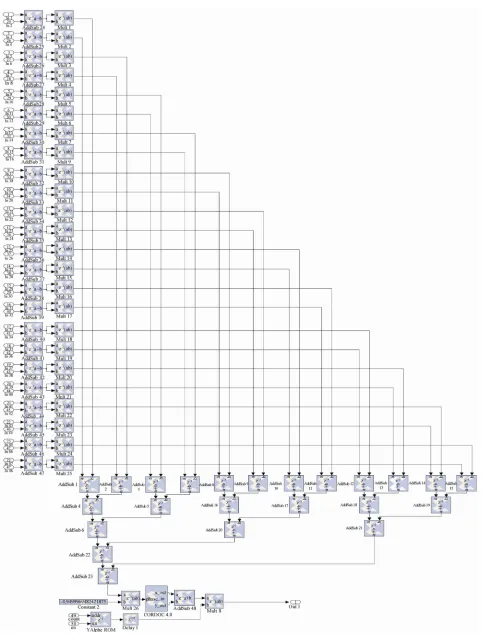
Keywords:Hardware Architecture, Support Vector Machine, FPGA, Persian Handwritten Digits, System Generator
1. Introduction
Today, many algorithms in the fields of signal proc-essing, including speech procproc-essing, image procproc-essing, machine vision, data mining and pattern recognition, is developed on software and every day new progress in their development is achieved. Many of these algo- rithms run with lower frame rates because of computa- tional complexity. Fast and real-time processing re- quirement yield hardware implementation of these al- gorithms. But, implementing these algorithms on hardware such as microprocessors, DSP or FPGA pro- cessors continue to be an important challenge [1].
Recently FPGAs have been introduced as one of the hardware used in the field of digital signal processing and provided acceptable results in real-time applica-tions, using parallel processing [2].
SVM is one of the trusted and ultra high-perform-ance algorithms, has been widely used in the fields of linear and nonlinear classification and regression prob- lems [3]. As regards that the structure of SVM includes a second optimization process, so practical applications
of this classifier will be limited, due to the computa- tional complexity and power consumption of training phase.
Obviously useful applications of online SVM require a hardware implementation suitable for training and testing phase. But considering the type of application, training phase of SVM can be performed offline in a computer by software. Therefore in these cases only testing phase of the SVM, that includes a decision function for classification target and is performed very fast, will be implemented on hardware [4].
b
but always may be difficulties in converting real num- bers to their equivalent logarithmic. Ramirez [4] im- plemented a linear SVM for classification of three- dimensional MRI images. Classification accuracy and processing time was 95% and 109.7s respectively, which was 5% less and 1.84 times more than a 550 MHz PC. In this research maximum frequency of 202.840 MHz in linear classification, and classification accuracy of 98.67% in nonlinear one has been achieved, while processing time is much more than PC, which is comparable in literatures [1,7,8].
The rest of this paper is organized as follow: after introduction, Section 2 describes the basics of linear, nonlinear and multiclass SVM. In Section 3 proposed algorithm for SVM hardware implementation, include- ing software implementation and hardware architecture design has been described. Finally our simulation re- sults are given in Section 4, followed by conclusion and suggestions in Section 5.
2. Support Vector Machine
SVM is a technique of classification and regression introduced in 1990s by Vapnik [9,10]. SVM is essen- tially a binary classification, but possible to classify samples of multiple classes. Also it can be used to solve either linear and nonlinear classification or re- gression problems.
2.1. Linear SVM
Consider a linear classification problem aiming to find optimal separating hyperplane with maximum margin. Suppose xiis the feature vector set of training samples that are linearly separable and have been labeled in classes1 and 2, as Figure 1. There might be some data that fall into the margin, called slack variables.
So decision function is defined as follow:
Td x sign w x (1) Optimal separating hyperplane can be obtained by solving the following dual Lagrange problem:
1 , 1
1
1 Maximize
2 0
Subject to 0
N N
T
d i i j i j
i i j
i N
i i i
L y y
C
y
x x
i j
(2)
in which C is a trade-off parameter between maximiza-tion the margin and minimizamaximiza-tion the error, and is deter- mined by user [11].
[image:2.595.341.509.85.223.2]By solving dual Lagrange function, α is obtained. Sub-sequently w and b are achieved too, according to the
Figure 1. Optimal separating hyperplane with maximum margin and slack variables.
following:
1
SV i i i i
x y
w (3)
T i
by w xi (4) where SV is the number of support vectors.
Now we can classify an unknown data x, by utilizing (3) and (4) into the decision function Equation (1), which yield to the following equation:
1
SV T i i i i
y
d sign
b
x x x (5)
2.2. Nonlinear SVM
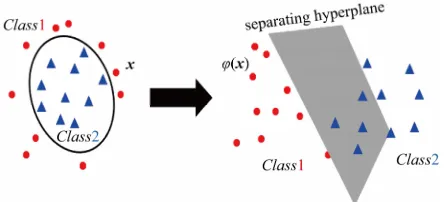
A question that is being asked here is that what to do if data are not linearly separable? Is it possible to general-ize the idea of a linear SVM to nonlinear systems? Ex-tensive studies conducted in this area resulted in Mercer theory [12]. The idea behind this theory is to transfer vector x from limited space (input space) to the higher space (feature space), using Hilbert conversion, as Fig-ure2. In this context a vector x in the feature space is converted into the φ(x).
[image:2.595.313.535.585.686.2]According to this theorem, decision function of Nonlinear SVM can be acquired as following:
FPGA Simulation of Linear and Nonlinear Support Vector Machine 322
1
,
SV
i i i i
d sign y K b
x x x
x
(6)
where:
1
,
SV
i i i i
i
b y y K
x x (7)in which the term has been replaced with a kernel function defined as follow:
T xi
,
TK x xi xi x (8)
where, well-known kernel functions have been intro-duced in literatures [13-15].
2.3. Multi Class SVM
SVM is a binary classifier, but some methods can be used to solve multi-class problems with this classifier. Four methods of multi-class SVM are:
• One against All Method
• Pairwise Classifiers Method
• Error-correcting Output Code (ECOC) Method
• All Classes at Once Method
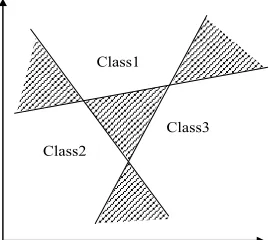
In one against all method, if we have n class, n binary SVM classifier will be formed, so that in i-th classifier, class i is separated from the others. But in this status still there will be unclassified regions according to Figure3
[11].
To solve this problem, Krebel [16] proposed pairwise classifiers method, in which to solve n class problem,
1 2
n n binary classifier will be formed. This method compared to one against all is better but still there will be unclassified region according to Figure 4.
In the pairwise classifier method, for classification of an input data x, in each binary decision function dij(x) a
class is selected, and finally the one with the most votes is selected as desired class.
3. The Proposed Algorithm for SVM
Hardware Implementation
To implement SVM classifier architecture on the hard-
Class1
Class2
[image:3.595.355.483.86.199.2]Class3
Figure 3. Unclassified regions in one against all method.
Class1
Class2
[image:3.595.105.242.578.698.2]Class3
Figure 4. Unclassified region in pairwise classifiers method.
ware, we must first perform learning phase of the SVM, which has a complicated algorithm, offline on the soft-ware, and then use extracted parameters to implement testing phase on the hardware. In this research training phase of the SVM is implemented in the MATLAB software environment utilizing libsvm [17] model, and the graphical hardware simulator, System Generator, will be used to design and implement of testing phase.
In order to realize designed architecture and desired results, three different classes of data related to Persian handwritten digits, 1, 4 and 8, are used for training and testing samples of the SVM [18]. We named class1 for 1, class2 for 4, and class3 for 8. So the architecture will be designed for a 3-class SVM, according to pairwise method. 800 data from each class (total 2400 samples) is provided. From each class of data, 600 samples have been used for training and 200 samples for testing. Data has feature vector dimension of 7 and 24, which have been extracted by using of geometric moments approach [19]. We use 7-d data for linear and 24-d data for nonlin-ear SVM.
3.1. Software Implementation of SVM
Before hardware implementing of the SVM architecture, it is necessary to run both training and testing phase in MATLAB. The target is to get the lowest classification error rate by changing various parameters. In additions, in that lowest error rate, necessary parameters will be extracted for offline classification on the hardware. In order to implement software SVM, despite SVM toolbox of the MATLAB, many other codes written by research-ers have been proposed. Libsvm model has been intro-duced as one of the best and trusted tools for implemen-tation of SVM, and is used in most of academic papers and researches, so we utilize Libsvm too.
In general, before SVM implementation, the type of kernel function must be specified. We used linear and Gaussian kernel functions to implement SVM.
3.2. SVM Software Implementation with Linear Kernel
Figure 6. Diagram curve of nonlinear classification error rate versus changing parameter γ.
Figure 5. Diagram curve of linear SVM classification error rate versus changing parameter C.
stead, there is a parameter γ in Gaussian kernel, affecting the classification error rate, which defined as following: Because of its simplicity in structure, and fast
computa-tion, it is a very good choice to for hardware implemen-tation. In this research, experiments show that by chang-ing the parameter C, the classification error rate will be in change too. In order to achieve the lowest error rate, we draw diagram curve of error rate versus changing parameter C of SVM structure. Figure5 shows this dia-gram in classification of Persian handwritten digits with
7-d data.
2
1 2
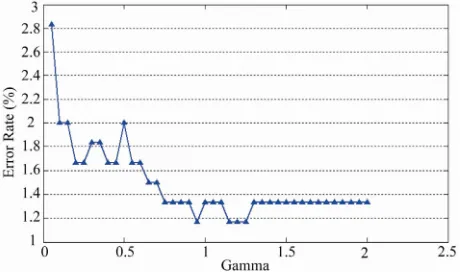
(9) Choosing appropriate gamma value is a very important issue to find the optimal classification error rate. Exact formulation doesn’t exist to calculate an appropriate value of gamma, and often try and error method is used to get that. In order to attain that value in nonlinear clas-sification of Persian handwritten digits with 24-d sam- ples, a diagram curve of error rate versus changing of
gamma is considered in Figure 6, which shows that
gamma = 0.95 offers the lowest error rate. So in the next step we use gamma = 0.95 and again run training and testing phases of SVM. Table 2 shows numerical results of this classification.
Figure 5 shows that the best classification error rate is obtained at C = 5500. But if the same value of C is used for implementation on hardware, have to assign much number of bits. If the value of C is equal to 100, due to the low number of bits, desired hardware design can be implemented, while increasing in error rate is not very sensible.
3.4. Hardware Architecture Design
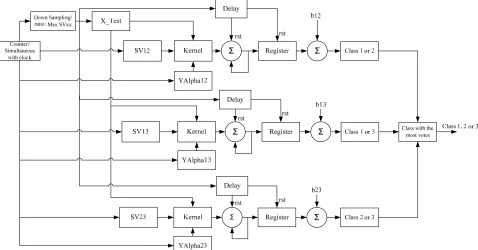
Table 1 shows numerical results of linear SVM classi-fication by using C = 100, in which SV and b indicate the
number of support vectors and bias term, respectively. Figure 7design for 3-class SVM classification according to si- shows block diagram of hardware architecture multaneous pairwise classifiers method. This design is the same for linear and nonlinear SVM, but only kernel
block is differently designed.
3.3. SVM Software Implementation with Nonlinear Kernel
Gaussian kernel function is one of the kernel functions that mostly has been used in support vector machines, and provided much better results compared to other ones [20]. In this research, the Gaussian kernel function is used for training and testing nonlinear SVM. Here the results show that by changing the parameter C, classifi-cation error rate will not be changed anymore. But in-
3.5. System Generator Design of Linear SVM
Before FPGA implementation, in order to simplify com-putational operations it is better to merge dot product of vectors α and y into a new vector called yα. Figure 8
[image:4.595.309.539.85.221.2]shows matrix form of linear SVM decision function for classification of Class1 & 2, i.e.d12(x).
Table 1. Numerical results of linear SVM classification with
C=100. Table 2. Numerical results of nonlinear SVM classification with γ = 0.95.
Class1 & 2 Class1 & 3 Class2 & 3 Class1 Class2 Class1 Class2 Class1 Class2
SV 35 35 6 7 243 243
b –0.7895 3.7228 –10.4076
Error
Rate 10.25% 10.5% 20.75%
Class1 & 2 Class1 & 3 Class2 & 3 Class1 Class2 Class1 Class2 Class1 Class2
SV 19 22 18 18 33 35
b –3.8358 –3.2601 –3.1587 Error
[image:4.595.59.287.651.719.2] [image:4.595.308.538.653.719.2]FPGA Simulation of Linear and Nonlinear Support Vector Machine 324
Figure 7. Block diagram of 3-class SVM hardware architecture design.
To design hardware architecture of above function, a combination of series and parallel methods have been used. Figure 9 shows part of designed architecture using System Generator. Each array of rows of matrix SV is located in SV ROM 1 to SV ROM 7 outputs, which called by counter1. Test data are in blocks X_Test ROM1 to
X_Test ROM 7 addressing by Counter 2 with a period of 70 (as the number of support vectors of Class1 & 2).
Vector of yα located in YAlpha ROM which its counter is the same as SV ROMs. Blocks of Mult1 to Mult7 and
Addsub1 to Addsub6 perform inner product between test data and support vectors; this result is multiplied by cor-responding array of yα vector in Mult9. The remaining operations is sum of this values, that is done serially by
Accumulator and +b blocks.
3.6. System Generator Design of Nonlinear SVM
For implementation of nonlinear SVM, 24-d data from Persian handwritten digit database has been used. Deci-sion function equation of Nonlinear SVM with Gaussian kernel function is as follows:
21
exp( )
SV
i i i
i
d y x x
b
x (10)
Due to the structural limitations in the FPGA, it is bet-ter to simplify above function, before implementation of it. Suppose that A is a vector as follows:
1 2
=a a
A (11) Norm A is defined as:
1,1 1,2 1,7 1
2,1 2,2 2,7 2
1,1 1,2 1,3 1,7
70,1 70,2 70,7 70
...
...
...
...
...
...
...
...
...
T
sv
sv
sv
y
sv
sv
sv
y
x
x
x
x
sv
sv
sv
y
[image:5.595.71.525.540.696.2]b12 -0.7890625 YAlpha ROM addr en z-1
X_Test ROM 7 addr z-1
X_Test ROM 6 addr z-1
X_Test ROM 5 addr z-1
X_Test ROM 4 addr z-1
X_Test ROM 3 addr z-1
X_Test ROM 2 addr z-1
X_Test ROM 1 addr z-1
SV ROM 7 addr
en z-1
SV ROM 6 addr
en z-1 SV ROM 5 addr
en z-1
SV ROM 4 addr
en z-1
SV ROM 3 addr
en z-1
SV ROM 2 addr
en z-1 SV ROM 1 addr en z-1 Relational a b a=b z-1 Register d en q z-1 Mult 9 a b (ab ) z-3 Mult 7 a b (ab ) z- 6
Mult 6 a
b (ab ) z- 3
Mult 5 a
b (ab ) z- 3 Mult 4 a
b (ab ) z- 3
Mult 3 a
b (ab ) z- 3
Mult 2 a
b (ab ) z- 3
Mult 1 a
b (ab ) z- 3
Delay 4 z-69 Delay 3 z-1 Delay 2 z-13 Delay 1 z-13 Counter 2 out Counter 1 en out Constant 4 69 Constant 3 1 AddSub 6 a b a + b z-3 AddSub 5 a b a + b z-3 AddSub 4 a b a + b z-3 AddSub 3 a b a + b
[image:6.595.61.541.81.528.2]z- 3 AddSub 2 a b a + b z-3 AddSub 1 a b a + b z-3 Accumulator b rst q +b a b en a + b z-1
Figure 9. Hardware architecture for computation of αiyixTxi.
2 2
1 21 2 ...
a a
A (12)
And Square of norm A:
2 2 2
1 2 ...
a a
A
(13) The above equation can be simpler as follows:
2 2 2
1 2 ...
a a
A
(14) So we can easily implement x x i 2 by using (14).For implementation of exp function, there is a CORDIC
block in System Generator that produces sinh and cosh
outputs. By knowing following equation, exp function can be implemented utilizing a CORDIC block and an
Adder.
exp x Sinh x Cosh x
(15)Figure 10 shows FPGA architecture for computation of αiyiK(xi, x) in nonlinear Gaussian SVM, while other
parts of design are the same as linear one, except that here data dimension is 24-d. The value of is located in
constant2 block.
4. Simulation Results
FPGA Simulation of Linear and Nonlinear Support Vector Machine 326
Table 3. Hardware simulation results of linear SVM com-pared with MATLAB.
tion. Fixed point numbers is used for quantization. For linear simulation Q24.16 and for nonlinear one Q24.14 quantization format is used. To avoid increasing the word length in serial computations, truncation method is used.
[image:8.595.307.539.110.277.2]4.1. Linear SVM Simulation
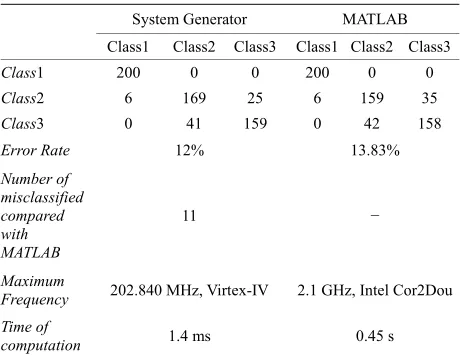
Table 3 shows FPGA simulation results of linear SVM hardware architecture compared with software imple-mentation in MATLAB. Rows of 1 through 3 show the number of samples of each class that classify into the correct class or misclassify into the others.
It might seem slightly strange that error rate in System Generator simulation is lower than MATLAB, but we know that because of quantization errors in System Gen- erator maybe some test samples classify into correct class, while misclassified in MATLAB.
The considerable result of this table is maximum fre-quency and total time of computation of classification which are 202.840 MHz and 1.4 ms, respectively.
[image:8.595.57.286.600.707.2]In Table 4 hardware resources used in Virtex4 device for implementation of above classifier is shown.
Table 4. Hardware resources used in Virtex4 device for implementation of linear SVM.
Table 5. Hardware simulation results of nonlinear SVM compared with MATLAB.
System Generator MATLAB
Class1 Class2 Class3 Class1 Class2 Class3
Class1 199 1 0 199 1 0
Class2 3 194 3 3 195 2
Class3 0 1 199 0 1 199
Error Rate 1.33% 1.17%
Number of Misclassified Compared with MATLAB
1 −
Maximum
Frequency 151.286 MHz, Virtex-IV 2.1 GHz, Intel Cor2Dou
Time of
Computation 0.27 ms 0.11 s
4.2. Nonlinear SVM Simulation
Simulation result of hardware designed architecture of nonlinear SVM is shown in Table 5. In this case classi-fication error rate of 1.33% and total time of computation of 0.27 ms are considerable.
In Table 6 hardware resources used in Virtex4 device for implementation of nonlinear SVM classifier is shown.
5. Conclusions
In this research FPGA architecture of linear and nonlin-ear pairwise SVM classifiers for detection of 3-class of Persian handwritten digits has been proposed. This de-sign can be generalized to other SVM classification ap-plications with no limitation in the number of training and testing data. Also it is Possible to increase the num-ber of pairwise classifiers. But there is a restriction only on the FPGA hardware resources. This problem can be solved by utilizing multi FPGAs or some external mem-ory devices.
[image:8.595.307.538.611.708.2]In order to continue the research, proposing a method for implementation of other nonlinear kernel functions is recommended. Since that for a certain application one of
Table 6. Hardware resources used in Virtex4 device for implementation of nonlinear SVM.
Logic Utilization Available Used Utilization Rate
Slice Flip Flop 30720 11589 37%
4 input LUT 30720 9141 29%
Occupied Slice 15360 7261 47%
Bonded IOB 448 241 53%
BUFG 32 1 3%
RAMB16 192 99 51%
DSP48 192 81 42%
System Generator MATLAB Class1 Class2 Class3 Class1 Class2 Class3
Class1 200 0 0 200 0 0
Class2 6 169 25 6 159 35
Class3 0 41 159 0 42 158
Error Rate 12% 13.83%
Number of misclassified compared with MATLAB
11 −
Maximum
Frequency 202.840 MHz, Virtex-IV 2.1 GHz, Intel Cor2Dou Time of
computation 1.4 ms 0.45 s
Logic Utilization Available Used Utilization Rate
Slice Flip Flop 30 720 1422 4%
4 input LUT 30 720 748 2%
Occupied Slice 15 360 849 5%
Bonded IOB 448 167 37%
BUFG 32 1 3%
RAMB16 192 31 16%
FPGA Simulation of Linear and Nonlinear Support Vector Machine 328
the kernel functions respond better classification results than the others, if the solutions to implement all these functions exist, the designer will have a tendency to achieve the best classification accuracy.
Another suggestion is to implement the entire process of SVM, including training and testing phase, on the FPGA. Training phase of the SVM includes optimization problem Equation (2), which has a very time consuming and complicated process of solution for hardware im-plementation purpose. If an appropriate and hardware friendly solution is found to simplify the problem, then whole process of SVM implemented on the FPGA, so that no need to implement the training phase in software environment which may cause quantization errors in testing phase hardware implementation.
REFERENCES
[1] M. Ruiz-Llata and M. Yébenes-Calvino, “FPGA Imple-mentation of Support Vector Machines for 3D Object Identification,” Artificial Neural Networks–ICANN 2009, Limassol, 14-17 September, 2009, pp. 467-474.
[2] U. Meyer-Baese, “Digital Signal Processing with Field Programmable Gate Arrays,” Springer Verlag, Berlin, 2007. [3] A. Ganapathiraju, et al., “Applications of Support Vector
Machines to Speech Recognition,” IEEE Transactions on Signal Processing,Vol. 52, No. 8, 2004, pp. 2348-2355.
doi:10.1109/TSP.2004.831018
[4] O. Pina-Ramfrez, et al., “An FPGA Implementation of Linear Kernel Support Vector Machines,” IEEE Interna-tional Conference on the Reconfigurable Computing and FPGA’s,San Luis, September 2006, pp. 1-6.
[5] D. Anguita, et al., “A Digital Architecture for Support Vector Machines: Theory, Algorithm, and FPGA Imple-mentation,” Neural Networks, IEEE Transactions on,Vol. 14, No. 5, 2003, pp. 993-1009.
doi:10.1109/TNN.2003.816033
[6] F. M. Khan, et al., “Hardware-Based Support Vector Machine Classification in Logarithmic Number Systems,”
Circuits and Systems, Vol. 5, 2004, pp. 5154-5157. [7] C. F. Hsu, et al., “Support Vector Machine FPGA
Im-plementation for Video Shot Boundary Detection
Appli-cation,” System-on-Chip Conference, 4-5 November 2009, pp. 239-242.
[8] M. Moradi, et al., “A New Method of FPGA Implemen-tation of Farsi Handwritten Digit Recognition,” European Journal of Scientific Research, Vol. 39, No. 3, 2010, pp. 309-315.
[9] V. Vapnik, “Statistical Learning Theory,” John Wiley & Sons Inc., New York, 1998.
[10] V. Vapnik, “The Nature of Statistical Learning Theory,” Springer Verlag, Berlin, 1995.
[11] S. Abe, “Support Vector Machines for Pattern Classifica-tion (Advances in Pattern RecogniClassifica-tion),” Springer-Verlag New York, 2005.
[12] M. Martínez-Ramón and C. G. Christodoulou, “Support Vector Machines for Antenna Array Processing and Elec-tromagnetics,” Morgan & Claypool, California, 2006. [13] J. Diederich, “Rule Extraction from Support Vector
Ma-chines,” Springer-Verlag, New York, 2008.
doi:10.1007/978-3-540-75390-2
[14] B. Schölkopf and A. J. Smola, “Learning with Kernels: Support Vector Machines, Regularization, Optimization, and Beyond,” The MIT Press, Cambridge, 2002.
[15] T. M. Huang, et al., “Kernel Based Algorithms for Min-ing Huge Data Sets: Supervised, Semi-Supervised, and Unsupervised Learning,” Springer Verlag, Berlin, 2006. [16] U. H. G. Kreßel, “Pairwise Classification and Support
Vector Machines,” MIT Press, Cambridge, 1999.
[17] C. Chih-Chung and L. Chih-Jen, “LIBSVM: A Library for Support Vector Machines,” 2001.
http://www.csie.ntu.edu.tw/~cjlin/libsvm
[18] H. Khosravi and E. Kabir, “Introducing a Very Large Dataset of Handwritten Farsi Digits and a Study on Their Varieties,” Pattern Recognition Letters,Vol. 28, 2007, pp. 1133-1141.doi:10.1016/j.patrec.2006.12.022
[19] S. Theodoridis and K. Koutroumbas, “Pattern Recogni-tion,” 3rd Edition, Elsevier, Amsterdam, 2006.