doi:10.4236/ojpm.2011.11001 Published Online May 2011 (http://www.SciRP.org/journal/ojpm/).
Counting steps in research: A comparison of accelerometry
and pedometry
Melody Oliver1,2, Hannah M Badland1,3, Janine Shepherd1, Grant M Schofield1
1Centre for Physical Activity and Nutrition, Auckland University of Technology, Auckland, New Zealand 2School of Public Health and Psychosocial Studies, Auckland University of Technology, Auckland, New Zealand 3Division of Population Health, University College London, London, United Kingdom
Email: [email protected]
Received 3 March 2011; revised 10 May 2011; accepted 12 May 2011.
ABSTRACT
The objective of this study was to assess the validity of the step count functions in Actical accelerometers and activPAL inclinometers, compared with pe-dometer-derived step count data. Firstly, directly observed step counts over 3 treadmill speeds were compared with steps collected from 3 pedometers, accelerometers, and inclinometers in 10 adults. Sec-ondly, step count data were derived from 22 partici-pants who wore a pedometer, accelerometer, and in-clinometer over 48 hours. Agreement between meas-urement tools was determined. All monitors appro-priately measured steps in the laboratory conditions. In free living conditions, the mean percentage differ-ences with pedometer-determined step counts were –7.3% and 7.0% for the Actical and activPAL moni-tors, respectively. With the exception of slow walking for the Actical units (ICC < 0.001), acceptable reli-ability was found within units for all treadmill speeds, and across units during the free living condition. The 95% prediction interval ranges were wide, ranging from –68.8% to 54.2% for the Acticals, and from –39.1% to 53.2% for the activPALs. Step counts gathered from Actical and activPAL units should not be used interchangeably with pedometer-derived step count data.
Keywords:Physical Activity; Measurement; Pedometer; Inclinometer; Accelerometer; Validation; Reliability
1. INTRODUCTION
Accurate quantification of free-living physical activity is important to enable researchers to derive reliable infor-mation on associations with health outcomes and de-velop public health recommendations, identify determi-nants of activity and individuals/population groups at
risk of insufficient activity for health, and to accurately assess intervention effectiveness. Accelerometers are increasingly being used for this purpose, due to the util-ity of these monitors to provide objective and precise information on activity intensity accumulated over sus-tained periods. No best practice has yet been determined for accelerometer data treatment; inconsistencies in ap-proaches to data reduction have made it especially chal-lenging to accurately track activity behaviors or compare results across studies. Indeed, increasingly sensitive measurement instruments may offer a decrease in speci-ficity of measurement especially at the lower intensity end of measurement. Moreover, understanding and in-terpreting physical activity intensity concepts can be challenging, making it difficult to translate and dissemi-nate practical health promotion messages. In contrast, the measurement of physical activity in the form of steps is relatively straightforward to measure via pedometry, and the data are (relatively) simple to analyze and dis-seminate and make inferences to the general public. Body composition-referenced step count recommenda-tions have been developed [1] and pedometer-based programs have been shown to be effective in increasing physical activity (especially where step goals are in-cluded) and improving health outcomes (e.g., reducing body mass index and blood pressure) [2].
date and time stamped information on time spent sitting, lying, standing, walking, and number of steps accumu-lated. The Actical accelerometer has been shown to be valid for estimating physical activity intensity in adults [3]. Validity of the new step-count function in Actical accelerometers has been assessed using laboratory-based activities [4], however to our knowledge, no assessment of the validity of this function in measuring steps accu-mulated during free-living physical activity over sus-tained periods of time (i.e., > 1 d) has been conducted. activPAL monitors have shown acceptable reliability [5,6] and validity [7] for measuring time spent being sedentary and active (including walking) under con-trolled/laboratory conditions. Evidence suggests that the accuracy of these monitors may be lowest when assess-ing time spent walkassess-ing [5]. The only studies to assess the activPAL step-count function in measuring actual steps taken have also been undertaken in laboratory/controlled conditions [8,9]. Findings indicate these monitors are reliable [8] and accurate to within 1.3% for treadmill and outdoor walking [8,9].
Generally, laboratory-based testing has provided suf-ficient evidence for the validity of both the Actical and activPAL monitors to accurately assess steps in adults. This research now needs to be extended to application in free-living situations for durations greater than the 6 hours employed to date. Research aims were thus to as-sess the reliability, validity, and agreement of step-count data gathered from Actical accelerometers and activPAL inclinometers with standard practice for step count measurement (pedometry) in free-living conditions over multiple days.
2. METHODS
2.1. Participants
Convenience samples of university employees in Auck-land, New Zealand were recruited for each testing stage. For the laboratory-based testing, 10 university staff were invited to participate. Participants for the free-living testing were recruited as part of a wider study investi-gating measurement of sedentary behavior [10,11]. As such, these participants were included only if they re-ported spending the majority of their occupational time sitting. No other inclusion/exclusion criteria were em-ployed. Ethical approval to conduct the study was pro-vided by Auckland University of Technology Ethics Committee (AUTEC reference 09/253, granted 25 No-vember 2009). Written informed consent was gathered from all participants. Data were collected on weekdays between December 2009 and March 2010.
2.2. Measurement Tools
Three Actical accelerometers (Mini-Mitter, Respironics
Inc Company, Bend, OR), three activPAL inclinometers (PAL Technologies Ltd, Glasgow), and three Yamax Digiwalker CW-700 pedometers (Yamax Corp., Kuma-moto, Japan) were used in the current study. Yamax Di-giwalker (e.g., SW-701, SW-200) pedometers are valid and reliable for measuring steps in adults [12,13]. The CW-700 improves over previous Digiwalker models by including a multi-day-memory function, but otherwise the mechanical properties of these units are identical to earlier models. Performance of all units was first as-sessed in laboratory conditions prior to application in free-living conditions.
2.3. Procedures
2.3.1. Laboratory Testing
Tests were conducted on a Powerjog GX C200 motor-ized treadmill (PowerSport International Inc., Bridgend, UK). Participants underwent a 5 min familiarization procedure, including practicing starting and stopping at each speed. Units were then attached, with the three ac-tivPAL units placed medially and vertically on the right vastus medialis with Physiomed TheraFIX Underwrap tape, and the three pedometers and accelerometers at-tached to elastic belts and placed above the right iliac crest. Participants then walked for 5 min at three speeds:
54 m·min–1, 107 m·min–1, and 80 m·min–1, with a 1 min
rest between each test. Walking speeds were identified as being the lowest, highest, and median values used in previous research [8,12]. Pedometers were set to 0 be-fore each trial and readings from each pedometer were taken immediately post each test. During the tests, one research assistant counted down start and stop times, recorded measurement times, and pedometer steps, and a second research assistant counted observed steps using a manual step counter.
2.3.2. Free-Living Testing
collection), and were called once during the measure-ment period to confirm monitor wear. Monitors were collected by the research assistant exactly 48 h after they were delivered. On collection, the researcher recorded the time of unit removal and pedometer steps accumu-lated for that day. Participants reported their height in meters and weight in kilograms. Body mass index (BMI)
was calculated as kg·m–2, and thresholds of 25 kg·m–2
and 30 kg·m–2 were used to define overweight and
obe-sity, respectively.
2.4. Statistical Analyses
2.4.1. Laboratory Testing
Accelerometer and inclinometer data were downloaded using Actical 2.04 and activPAL 5.8.3.5, respectively, and combined by time in Microsoft Excel. Step count data for the accelerometers and inclinometers were then summed for each 5 min bout and matched with the pe-dometer and observed step counts. Intraclass correlation coefficients (ICC) for step counts from each unit at each speed were calculated. Agreement between observed steps (criterion) and step counts from pedometers, accel-erometers, and inclinometers (comparison measures) was assessed using the Bland-Altman method [14,15]. Initially, Bland-Altman plots and associated lowess curves were produced and assessed for each of the mea-surement units against the observed steps at each ambu-latory speed to determine whether combined or sub- grouped analyses were necessary. Average values of the observed step counts and each comparison measure were compared against the difference of the observed step counts and steps from each comparison measure. Per-centage differences between the observed steps and comparison measures were then calculated and the cor-responding mean differences and 95% limits of agree-ment (±1.96 SE) calculated and plotted. Equality in va-riance between percentage differences in step count readings at each gait speed was formally determined for each comparison measure using the Brown and Forsythe test for equality [16]. Statistical analyses were under-taken using Stata IC version 10 (StataCorp, TX) and = 0.05 was used to determine statistical significance.
2.4.2. Free-living Testing
Self-reported compliance in wearing the units was com-pared with information gathered during the random phone calls for accuracy. Participants not meeting mini-mal compliance criteria of wearing the units for at least one full (> 10 h on day 2) and one partial (afternoon of day 1 or morning of day 3) day were excluded from fur-ther analyses. Accelerometer and inclinometer data were downloaded using the Actical and activPAL software, respectively, and then combined by date and time in Ex-cel. Data for the 48 h measurement period were
manu-ally extracted for each individual using the unit delivery and collection times from the compliance diary, and step counts for the measurement period were summed from the extracted data. Researcher-reported pedometer step counts for the day of collection (day 3) were obtained from the compliance diary, and steps for previous days (days 1 and 2) were gathered from the pedometer mem-ory. Days where pedometer step counts were greater than 30 000 or less than 1 000 (or proportionate values for partial days) were considered outliers and removed from analyses [17]. Only participants with at least one full and one partial day of pedometer data remaining and concurrent accelerometer and/or inclinometer data were included in further analyses.
Remaining step count data were combined for each
measurement tool. Average pedometer steps·h–1 were
calculated and differences by sex, BMI status (dichoto-mized as normal, overweight/obese), and age group (di-chotomized as 20-43y, 44-58y) were determined using independent t tests. Pedometer data were matched with available accelerometer and inclinometer data by times worn. Associations between the unit types for steps counted (i.e., pedometer, Actical accelerometer, ac-tivPAL inclinometer) was determined by ICC. Agree-ment between step counts from the pedometer and 1) Actical accelerometer step counts and 2) activPAL in-clinometer step counts were assessed using the Bland- Altman method [14,15] as per the laboratory testing analyses above.
3. RESULTS
3.1. Laboratory Testing
Ten adults (9 females) completed the measurement
pro-tocol. Table 1 shows the mean (SD) of the observed step
counts and step counts from comparison measures at each gait speed, the mean (SD) for the percentage dif-ferences between observed steps and comparison meas-ures, and the related ICC values for steps counted. With the exception of the accelerometers at slow walking speeds (ICC < 0.001), units demonstrated acceptable reli-ability across all walking speeds (ICC = 0.335 - 0.998). Unit reliability increased with walking speed for pe-dometers and accelerometers, while activPAL perform-ance was consistent across all pace conditions (ICC = 0.998). Visual analysis of Bland-Altman plots and asso-ciated lowess curves indicated that the use of combined analyses was appropriate. activPAL units performed to 98.2% accuracy across all pace conditions. Significant heterogeneity was found in the variances of observed- comparison measurements over gait speed for the pe-dometers and accelerometers (Brown-Forsythe test p < 0.001) indicating that the accuracy of these measurement
Table 1. Median (SD) of steps observed and recorded from the Yamax Digiwalker pedometer, Actical accelerometer, and activPAL inclinometer under three treadmill pace conditions, and relative percentage differences between observed steps and comparison units in 10 adults.
OB Yamax Pedometer Actical accelerometer activPAL inclinometer
Treadmill
speeda Steps
mean (SD) mean (SD) Steps
% difference from OB
mean (SD) ICC
Steps mean (SD)
% difference from OB
mean (SD) ICC
Steps mean (SD)
% difference from OB
mean (SD) ICC
Slow 477 (21.6) 394 (109.4) –17.4 (23.1) 0.387 394 (93.8) –17.2 (19.6) <0.001 468 (21.6) –1.9 (0.3) 0.998
Medium 568 (29.5) 557 (80.7) –2.1 (12.7) 0.369 546 (63.1) –3.8 (9.3) 0.335 557 (28.8) –1.9 (0.4) 0.998
Fast 627 (32.1) 631 (33.1) 0.5 (0.4) 0.997 621 (38.2) –1.0 (3.8) 0.590 616 (31.5) –1.8 (0.4) 0.998
Combined 557 (68.3) 527 (127.6) –6.3 (17.0) n/a 521 (116.8) –7.3 (14.4) n/a 547 (67.1) –1.8 (0.4) n/a
Notes: ICC = Intraclass Correlation Coefficient, n/a = not applicable, OB = Observed Steps, SD = Standard Deviation; a. Slow = 54 m·min–1, Medium = 80
[image:4.595.64.278.253.409.2]m·min–1, Fast = 107 m·min
Figure 1. 95% limits of agreement for difference between
observed step counts and Yamax Pedometer step counts, Actical accelerometer step counts, and activPAL inclinometer step counts over 5 minutes treadmill walking, by ambulatory gait speed.
95% limits of agreement for differences between the observed step counts and each of the measurement tools, by ambulatory gait speed. Performance of all units was similar to previous validation studies [4,8,9,12] and so these were considered acceptable for further testing in free-living conditions.
3.2. Free-Living Testing
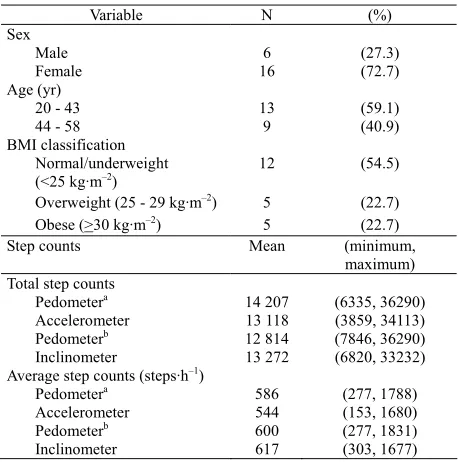
Twenty-five adults aged 41.6 ± 11.8 y participated in the study, with an average BMI of 26.1 ± 5.0 kg·m–2. Self- reported compliance matched that reported in the phone calls, and participants wore the units for an average of 26.8 h (range 15.7 - 34.0 h) over the 48 h period. In total, 22 participants met the minimum pedometer compliance criteria. Of these, corresponding accelerometer and in-clinometer data were gathered from 22 and 19 partici-pants, respectively. Table 2 displays the participant characteristics and average step counts for participants meeting the pedometer data inclusion criteria. Average (minimum, maximum) wear times for pedometer and
accelerometer data included in analyses was 24.5 h (15.7 h, 31.3 h), and for inclinometer data was 22.3 h (13.3 h, 31.2 h). No significant differences in average pedometer steps·h–1 were found for sex, age, or BMI status (p > 0.05). A high degree of correlation was found across all units for the within-participant step counts (ICC = 0.850, 0.807, and 0.666 for pedometer-Actical, pedometer- activPAL, and Actical-activPAL, respectively).
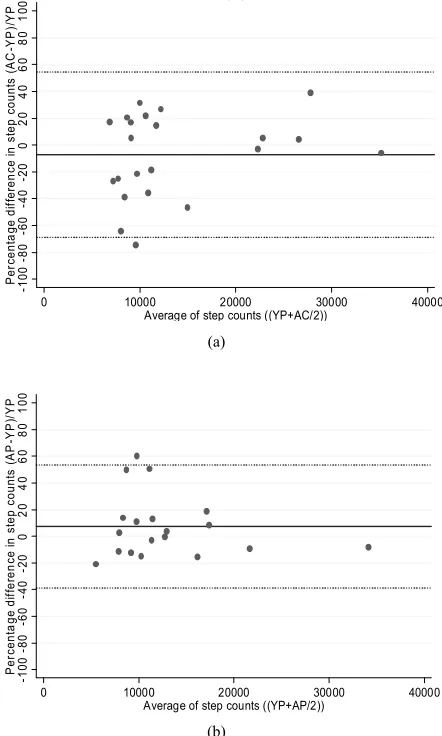
Figure 2 shows the Bland Altman plot for agreement and associated 95% limits of agreement for the Actical and activPAL step counts relative to the pedometer- de-termined step counts. The mean percentage differences with pedometer-determined step counts were –7.3% and 7.0% for the Actical and activPAL monitors, respectively. The 95% prediction interval ranges were wide for both
Table 2. Descriptive characteristics and step counts for
free-liv-ing study participants meetfree-liv-ing pedometer data inclusion criteria.
Variable N (%)
Sex
Male 6 (27.3)
Female 16 (72.7)
Age (yr)
20 - 43 13 (59.1)
44 - 58 9 (40.9)
BMI classification Normal/underweight
(<25 kg·m–2) 12 (54.5)
Overweight (25 - 29 kg·m–2) 5 (22.7)
Obese (>30 kg·m–2) 5 (22.7)
Step counts Mean (minimum,
maximum) Total step counts
Pedometera 14 207 (6335, 36290)
Accelerometer 13 118 (3859, 34113)
Pedometerb 12 814 (7846, 36290)
Inclinometer 13 272 (6820, 33232)
Average step counts (steps·h–1)
Pedometera 586 (277, 1788)
Accelerometer 544 (153, 1680)
Pedometerb 600 (277, 1831)
Inclinometer 617 (303, 1677)
aMatched for times worn with Actical accelerometer; bMatched for times
[image:4.595.310.539.468.699.2]comparison measures, however, ranging from –68.8% to 54.2% for the Actical accelerometer (width 122.9%), and
from –39.1% to 53.2% for the activPAL inclinometer
(width 92.3%). Within-individual inconsistencies in the direction and scale of misclassification for the
compari-son units were also found; Figure 3 shows the
percent-age difference between the comparison measures and the average steps gathered from the pedometer and each comparison measure for each participant.
4. DISCUSSION
To our knowledge, this is the first study to investigate the agreement between pedometer steps and steps gath-ered from Actical accelerometers and activPAL incli-nometers in free-living conditions over multiple days. Our initial laboratory testing showed similar results to previous research, with step count underestimation in Yamax pedometers [8,9,12] and Actical accelerometers [4] at slower speeds but acceptable accuracy and reli-ability for medium speed and fast walking. For the ac-tivPAL steps we found a high degree of accuracy and reliability (>98%, ICC = 0.998) with observed steps for
all walking speeds [8,9]. In line with Esliger et al. [4] we
also noted considerable variability in within-individual inconsistencies in the percentage differences for the Ac-tical and activPAL monitors, indicating there was no consistent pattern that could be related to the unit or in-dividual participants.
Considering the laboratory-based results of the current research and previous studies [8,9], it is likely that the activPAL yielded the most accurate measure of steps ac-cumulated in free living conditions, which are likely to include walking at lower speeds. The only other study to consider the accuracy of activPAL units in free living conditions (albeit for approximately 6 h only) showed a high degree of accuracy in classifying time spent stepping [7]. A second-by second analysis of activPAL- derived classification of time spent stepping, sitting/lying, and standing showed an overall agreement of 95% with di-rectly observed activities, however the limits of agreement were widest for walking (range –16.1% to 12.1%) [5].
While findings from the current study corroborate pre-vious research findings, the reduced accuracy of the Ya-max Digiwalker pedometers at lower speeds clearly lim-its their accuracy in measuring actual steps taken in free- living conditions, and therefore their utility as a crite-rion/comparison measure in the current study. Pedometer steps are the most common and widely referenced basic unit of objectively measured physical activity. As such, the inclusion of pedometers in the current study was still deemed important, to determine whether steps gathered from Actical and activPAL units could appropriately be used interchangeably with pedometer steps as a measure
-1 00 -8 0 -6 0 -4 0 -2 0 0 20 40 60 80 10 0 P er cent a ge di ff er en ce i n st ep count s ( A C -Y P )/ Y P
0 10000 20000 30000 40000 Average of step counts ((YP+AC/2))
( ) (a) -1 00 -8 0 -6 0 -4 0 -2 0 0 20 40 60 80 10 0 P er ce nt a ge di ff er en ce in s tep c oun ts ( A P -Y P )/ Y P
0 10000 20000 30000 40000 Average of step counts ((YP+AP/2))
[image:5.595.316.537.79.447.2](b)
Figure 2. Bland Altman plots demonstrating agreement between
Yamax Digiwalker pedometer steps and Actical accelerometer steps (a), and activPAL inclinometer steps (b).
-1 0 0 -5 0 0 50 P e rcent a ge di ff eren ce fr om pe dom et er st eps
1 2 3 4 5 6 7 8 9 10 1112 13 14 1516 17 1819 20 21 2223 24 25
Actical activPAL
Figure 3. Percentage difference between Yamax Digiwalker
[image:5.595.311.529.501.674.2]of health-related physical activity.
The limits of agreement with pedometer steps for both the Actical accelerometers and activPAL inclinometers were wide, at 123% and 92%, respectively. As we may expect daily step counts of between 7000 and 13 000 in healthy adults [18], an example of the outcome of this is provided using the mean of these values: Findings from the current study can be interpreted as meaning that when an observed step count of 10 000 is recorded by a pedometer, in 95% of instances the Actical monitors will record a step count between 3120 and 15 420 steps (width 12 300 steps), and the activPAL between 6090 and 15 320 steps (width 9230 steps). Detecting changes in daily step counts of 2500 steps as a result of an inter-vention has been associated with improvements in health outcomes [19] and generally equates to one ‘band’ of physical activity level classification [20]. Such changes in daily step counts may be considered clinically impor-tant. The results from the present study clearly show that the prediction widths observed for the Actical and ac-tivPAL units were too great for these units to be consid-ered as being in agreement with pedometer steps meas-ured. Based on our findings we conclude that step count data observed in Actical accelerometers and activPAL inclinometers cannot be used interchangeably with pe-dometer steps, nor should they be used to classify indi-vidual activity levels based on step count criteria.
Taken together, the results of the current study indi-cate that the activPAL monitor will provide the best rep-resentation of actual steps taken in free-living situations. This is not surprising given the placement of the unit on a participant’s upper leg, where the detection of walking at any velocity is based on large gross limb movement. The hip-mounted pedometer and accelerometer must rely on more subtle vertical displacements to detect a step, and these displacements reduce when walking ve-locity decreases. The Digiwalker is a spring-levered pe-dometer whereby upon vertical displacement, an internal spring-suspended arm moves vertically, opening and closing an electrical circuit to register a step. There is some evidence that piezoelectric pedometers (compris-ing a piezoelectric crystal which is moved in response to acceleration, e.g., New Lifestyles, Kenz Lifecorder) may be more accurate at slower speeds than other pedometer technologies, especially in overweight or obese indi-viduals [12,21]. Accurate quantification of low velocity physical activity may be a very important part of under-standing the differences between lean and obese adults
[22]. Levine et al. [22] observed that lean subjects
ac-cumulated an extra 3.5 miles·d–1 of low velocity walking
(∼1 mile·h–1) than obese subjects. It is also plausible
that slower velocity walking provides a lower metabolic benefit than walking at higher speeds and the under-
reading of pedometer steps at lower velocities provides a reasonable proxy for such a difference in benefit.
Additionally, activPAL monitors are not necessarily suitable for all types of physical activity measurement in the same way pedometers, and to a certain extent accel-erometers, may be. While they may be most accurate in step count assessment, they are not able to assess subtle movements such as shifting weight while standing, and measurement is limited to the site/limb of placement (e.g., right leg movement only). Notably, these limita-tions also apply to pedometers and accelerometers (al-beit some accelerometers are sensitive enough to capture small movements such as weight shifts). It is also worthwhile noting that this lack of sensitivity actually improves accuracy in step counting; for example,
Mad-docks et al. [9] found that vibrations caused by car travel
influenced activity data collected by Digiwalker pe-dometers and PALlite accelerometers, while no activity was recorded by activPAL units under the same condi-tions. In comparison to pedometers, activPAL monitors are expensive (approximately $US400 per unit) and mounting the unit with tape on a participant’s thigh is difficult and more invasive than fitting belt-mounted pedometers or accelerometers. When activity measure-ment is over multiple days, monitor removal and re- attachment needs to be managed by the participants themselves, and this may present both compliance and other measurement consistency problems. These issues make larger population epidemiology, and work with younger and older populations less feasible. Finally, it is worth noting that the relatively small sample in this study was predominantly female, employed, and likely to be well educated, thus limiting the generalisability of the results from the free-living conditions. Further re-search would benefit from including a larger and more representative sample in order to capture a broad variety of daily activities across a wide range of population groups.
5. CONCLUSION
[10] Oliver, M., Badland, H.M., Schofield, G.M. and Shepherd, J. (in press) Identification of non-wear time and sedentary behavior using accelerometry. Research Quarterly for Exercise and Sport.
of walking speeds.
6. ACKNOWLEDGEMENTS
At the time of writing, Melody Oliver and Hannah Badland were sup-ported by National Heart Foundation of New Zealand research fellow-ships. A Faculty of Health and Environmental Sciences Auckland University of Technology Summer Studentship supported Janine Shepherd.
[11] Oliver, M., Schofield, G.M., Badland, H.M. and Shepherd, J. (2010) Utility of accelerometer thresholds for classifying sitting in office workers. Preventive Medicine, 51, 357-360.doi:10.1016/j.ypmed.2010.08.010
[12] Crouter, S.E., Schneider, P.L., Karabulut, M. and Bassett, D.R., Jr. (2003) Validity of 10 electronic pedometers for measuring steps, distance, and energy cost. Medicine & Science in Sports & Exercise, 35, 1455-1460.
doi:10.1249/01.MSS.0000078932.61440.A2
REFERENCES
[1] Tudor-Locke, C., Ainsworth, B.E., Whitt, M.C., Thompson, R.W., Addy, C.L. and Jones, D.A. (2001) The relationship between pedometer-determined ambulatory activity and body composition variables. International Journal of Obesity, 25, 1571-1578.
doi:10.1038/sj.ijo.0801783
[13] Le Masurier, G.C., Lee, S.M. and Tudor-Locke, C. (2004) Motion sensor accuracy under controlled and free-living conditions. Medicine & Science in Sports & Exercise, 36, 905-910. doi:10.1249/01.MSS.0000126777.50188.73 [14] Bland, J.M. and Altman, D.G. (1999) Measuring
agreement in method comparison studies. Statistical Methods in Medical Research, 8, 135-160.
doi:10.1191/096228099673819272 [2] Bravata, D.M., Smith-Spangler, C., Sundaram, V.,
Gienger, A.L., Lin, N., Lewis, R., et al. (2007) Using pedometers to increase physical activity and improve health. A systematic review. Journal of the American Medical Association, 298, 2296-2304.
doi:10.1001/jama.298.19.2296
[15] Bland, J.M. and Altman, D.G. (2003) Applying the right statistics: Analyses of measurement studies. Ultrasound in Obstetrics and Gynecology, 22, 85-93.
doi:10.1002/uog.122 [3] Heil, D.P. (2006) Predicting activity energy expenditure
using the Actical® activity monitor. Research Quarterly for Exercise and Sport, 77, 64-80.
[16] Brown, M.B. and Forsythe, A.B. (1974) Robust tests for equality of variances. Journal of the American Statistical Association, 69, 364-367.doi:10.2307/2285659
[4] Esliger, D.W., Probert, A., Gorber, S.C., Bryan, S., Laviolette, M. and Tremblay, M.S. (2007) Validity of the Actical accelerometer step-count function. Medicine & Science in Sports & Exercise, 39, 1200-1204.
doi:10.1249/mss.0b013e3804ec4e9
[17] Tudor-Locke, C., Giles-Corti, B., Knuiman, M. and McCormack, G. (2008) Tracking of pedometer-determined physical activity in adults who relocate: Results from RESIDE. International Journal of Behavioral Nutrition and Physical Activity, 5, doi:10.1186/1479-5868-5-39 [5] Grant, P.M., Ryan, C.G., Tigbe, W.W. and Granat, M.H.
(2006) The validation of a novel activity monitor in the measurement of posture and motion during everyday activities British Journal of Sports Medicine, 40, 992- 997.doi:10.1136/bjsm.2006.030262
[18] Tudor-Locke, C.E. and Myers, A.M. (2001) Methodological considerations for researchers and practitioners using pedometers to measure physical (ambulatory) activity. Research Quarterly for Exercise and Sport, 72, 1-12. [19] Tudor-Locke, C., Myers, A.M., Bell, R.C., Harris, S.B.
and Rodger, N.W. (2002) Preliminary outcome evaluation of the First Step Program: a daily physical activity intervention for individuals with type 2 diabetes. Patient Education and Counseling, 47, 23-28.
doi:10.1016/S0738-3991(01)00169-0 [6] Busse, M.E., van Deursen, R.W. and Wiles, C.M. (2009)
Real- life step and activity measurement: Reliability and validity. Journal of Medical Engineering & Technology,
33, 33-41.doi:10.1080/03091900701682606
[7] Godfrey, A., Culhane, K.M. and Lyons, G.M. (2007) Comparison of the performance of the activPAL™ Professional physical activity logger to a discrete accelerometer-based activity monitor. Medical Engineering & Physics, 29, 930-934.
doi:10.1016/j.medengphy.2006.10.001
[20] Tudor-Locke, C. and Bassett Jr, D.R. (2004) How many steps/ day are enough? Preliminary pedometer indices for public health. Sports Medicine, 34, 1-8.
doi:10.2165/00007256-200434010-00001
[21] Crouter, S.E., Schneider, P.L. and Bassett, D.R. (2005) Spring-Levered versus Piezo-Electric Pedometer Accuracy in Overweight and Obese Adults. Medicine & Science in Sports & Exercise, 37, 1673-1679.
doi:10.1249/01.mss.0000181677.36658.a8 [8] Ryan, C.G., Grant, P.M., Tigbe, W.W. and Granat, M.H.
(2006) The validity and reliability of a novel activity monitor as a measure of walking. British Journal of Sports Medicine, 40, 779-784.
doi:10.1136/bjsm.2006.027276
[22] Levine, J.A., McCrady, S.K., Lanningham-Foster, L.M., Kane, P.H., Foster, R.C. and Manohar, C.U. (2008) The role of free-living daily walking in human weight gain and obesity. Diabetes, 57, 548-554.
doi:10.2337/db07-0815 [9] Maddocks, M., Petrou, A., Skipper, L. and Wilcock, A.
(2008) Validity of three accelerometers during treadmill walking and motor vehicle travel. British Journal of Sports Medicine, Online First,