Why Predicting Post-Edition is so Hard?
Failure Analysis of LIMSI Submission to the APE Shared Task
Guillaume Wisniewski and Nicolas P´echeux and Franc¸ois Yvon
Universit´e Paris Sud and LIMSI-CNRS 91 403 ORSAY CEDEX, France
{wisniews,pecheux,yvon}@limsi.fr
Abstract
This paper describes the two systems sub-mitted by LIMSI to the WMT’15 Shared Task on Automatic Post-Editing. The first one relies on a reformulation of the APE task as a Machine Translation task; the second implements a simple rule-based approach. Neither of these two systems manage to improve the automatic transla-tion. We show, by carefully analyzing the failure of our systems that this counter-performance mainly results from the in-consistency in the annotations.
1 Introduction
This paper describes LIMSI submission to the WMT’15 Shared Task on Automatic Post-Editing (APE). This task aims at automatically correcting errors produced by an unknown Machine Transla-tion (MT) system by learning from human post-editions.
For the first edition of this Shared Task we have submitted two APE systems. The first one, de-scribed in Section 3, is based on the approach of Simard et al. (2007) and considers the APE task as the automatic translation between a transla-tion hypothesis and its post-editransla-tion. This straight-forward approach does not succeed in improving translation quality. To understand the reasons of this failure, we present, in Section 4 a detailed analysis of the training data that highlights some of the difficulties of training an APE system.
The second submitted system implements a se-ries of sieves, applying, each, a simple post-editing rule. The definition of these rules is based on our analysis of the most frequent error correc-tions. Experiments with this approach (Section 5) show that this system also hurts translation quality. However, analyzing its failures allows us to show that the main difficulties in correcting MT errors
result from the inconsistency between the differ-ent post-editions.
2 Data Preprocessing
The Shared Task organizers provide training and development data that consist of respectively 11,272 and 1,000 examples. Each example is made of an English source sentence, its automatic translation in Spanish by an unknown MT sys-tem and a human revision of this translation. All sentences are tokenized. There are, on average, 22.88 words in each edition, the longest post-edition having 199 words and the shortest 3.
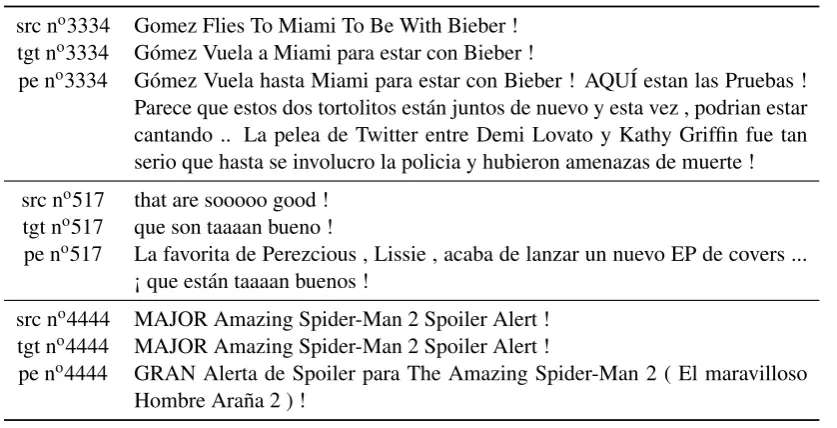
In a first pre-processing step we have removed all examples for which the ratio between the length of the automatic translation and the length of the corresponding post-edition was higher than 1.2 or lower than 0.8. As shown in Table 1, these ex-amples correspond mainly to errors in sentence boundaries or to ‘over-translation’ (e.g. when the post-editor added the translated title in the third example of Table 1), that could have a negative impact on the training of an APE system. At the end, the training set we used in all our experiments is made of 10,404 sentences.
The source sentences and the automatic trans-lation of the training and development set have been aligned at the word level using FASTAL -IGN (Dyer et al., 2013) and the grow-diag-final
symmetrization heuristic. To improve alignment quality, the sources and the translations have been first concatenated to the English-Spanish Europarl dataset and the resulting corpus has been aligned as a whole. Spanish MT outputs and post-editions have also been PoS-tagged using FREELING,1 a
state-of-the-art rule-based PoS tagger for Spanish. We used a CRF-based model trained on the Penn Treebank for the English source sentences. All PoS tags have been mapped to the universal PoS
1http://nlp.lsi.upc.edu/freeling/
src no3334 Gomez Flies To Miami To Be With Bieber !
tgt no3334 G´omez Vuela a Miami para estar con Bieber !
pe no3334 G´omez Vuela hasta Miami para estar con Bieber ! AQU´I estan las Pruebas !
Parece que estos dos tortolitos est´an juntos de nuevo y esta vez , podrian estar cantando .. La pelea de Twitter entre Demi Lovato y Kathy Griffin fue tan serio que hasta se involucro la policia y hubieron amenazas de muerte ! src no517 that are sooooo good !
tgt no517 que son taaaan bueno !
pe no517 La favorita de Perezcious , Lissie , acaba de lanzar un nuevo EP de covers ...
¡ que est´an taaaan buenos !
src no4444 MAJOR Amazing Spider-Man 2 Spoiler Alert !
tgt no4444 MAJOR Amazing Spider-Man 2 Spoiler Alert !
pe no4444 GRAN Alerta de Spoiler para The Amazing Spider-Man 2 ( El maravilloso
[image:2.595.70.489.60.274.2]Hombre Ara˜na 2 ) !
Table 1: Examples of automatic translations and their post-editions for which the ratio between their length is higher than 1.2.
tagset of Petrov et al. (2012) to make interpretation easier. Note that these two procedures are error-prone (especially as we have no information about the tokenization) and may introduce some noise in our analysis (cf. Section 4).
We have also computed an edit distance be-tween the automatic translations and their post-editions using Python standard difflib mod-ule that allows us to define an ‘alignment’, at the phrase-level,2 between these two
sen-tences. The difflib module implements the Ratcliff-Obershelp algorithm (Ratcliff and Met-zener, 1988) that finds a sequence of edits trans-forming a sentence into another. While this se-quence is not necessarily of minimal length, it is faster to compute, easier to use and, above all, more interpretable than the one computed using the standard minimum edit distance algorithm. In particular,difflibis able to automatically find edits between ‘phrases’ rather than between single words.
3 Automatic Post-Editing as Machine Translation
The first system we have developed for the Shared Task is inspired by the approach of Simard et al. (2007) and reduces the Automatic Post-Edition task as a Machine Translation task. Ignoring the source sentence, we train a standard phrase-based machine translation system using the
auto-2As usual in MT, we use ‘phrase’ to denote a sequence of consecutive words.
matic translation as a source sentence and its post-edition as the target sentence.
The word alignment between the automatic translation and the post-edited sentence, used as input in our APE-MT pipeline, has been computed using Meteor (Denkowski and Lavie, 2014). The APE-MT system has then been trained following the usual steps.3 In our experiments, we used our
in-house MT system NCODE(Crego et al., 2011)
that implements an-gram based translation model. As main features we used a3-gram bilingual lan-guage model on words, a 4-gram bilingual lan-guage model on PoS factors and a4-gram target language model trained only on the post-editions sentences, along with the conventional features (4 lexical features, 6 lexicalized reordering, distor-tion model, word and phrase penalty). We did allow reorderings during decoding. The training data is used to extract and compute the different models while the development data is used to per-form the tuning step.
The results, evaluated by the hTER score4
be-tween the predicted and the human post-editions, are summarized in Table 2. This straightforward approach actually hurts performance and the re-sults show that we are not able to predict post-editions: the output of the MT system is closer to the post-edition than the prediction of our
train development test MT output 23.32 23.21 22.91 APE-MT output 21.64 23.95 23.57
Table 2: hTER score achieved by MT system train to predict the post-edition from the MT output.
MT system. This is true even for the development data on which our system was tuned.
4 Data Analysis
To understand the results of our first APE model, we analyzed thoughtfully the data provided by the shared task organizers.
The risk of over-correcting The first important observation is that the MT system used to translate the source sentences achieves an hTER score of 23.32 on the training data, meaning that, roughly, more than three words out of four are correct and must not be modified. As a consequence, predict-ing which words must be post-edited is an highly unbalanced problem. It is, therefore, very likely that any modifications of the MT output could hurt translation quality. Let n denote the num-ber of word of in the dataset and a the percent-age of words that are mistranslated. If we are able to detect mistranslated words with a precision p
and a recallr and to correct them with precision
c, the number of errors after the automatic post-editing equals to the sum of the number of errors that have not been corrected (n×a×(1−r)), the number of errors the correction of which is erroneous (n×a×r×(1−c)) and of the number correct words that have been modified
(n×a×r×(1−p)÷p). For the shared task training data, n = 238,332, a = 0.25 and we assume thatc = 0.8, which is an optimistic esti-mate. To avoid introducing new error, the F1score
of the system detecting mistranslated word must be higher that0.7, which is far better than the per-formance achieved by most state-of-the-art word-level confidence estimation system.
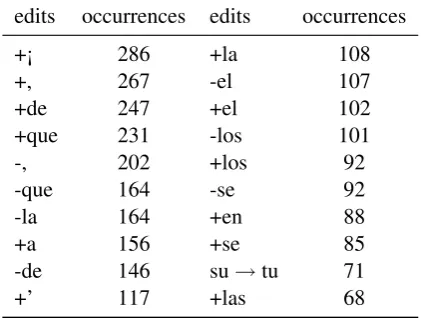
Uniqueness of edits To characterize annotators edits, we have computed the distribution of the three basic operations (Table 3) as well as the 20 most frequent ‘lexicalized’ edits (Table 4). Sev-eral observations, similar to the findings of our analysis of an English-French post-editions cor-pus (Wisniewski et al., 2013), can be made from
operation count %
deletion 4,795 15.56%
insertion 5,873 19.07%
substitution 20,129 65.37%
[image:3.595.311.522.199.358.2]total 30,797 100%
Table 3: Distribution of the edit types in the train-ing set.
edits occurrences edits occurrences
+¡ 286 +la 108
+, 267 -el 107
+de 247 +el 102
+que 231 -los 101
-, 202 +los 92
-que 164 -se 92
-la 164 +en 88
+a 156 +se 85
-de 146 su→tu 71
+’ 117 +las 68
Table 4: Most frequent post-edits on the training set. Additions and deletion are denoted by ‘+’ and ‘-’; substitutions by ‘→’ .
these two tables. First, and most importantly, it appears that most edits are unique: even the most frequent edit (insertion of ‘¡’) only accounts for a negligible part of all edits. Overall, 24.74% of all edits are unique. As a consequence, it is very un-likely that any approach, such as the one described in Section 3, that relies solely on word-level pat-tern recognition and transformation, will be able to generalize the observed corrections to new sen-tences. This explains why our APT-MT systems improves on the training data, on which transfor-mation where learned, but fails to generalize (Ta-ble 2).
Importance of edits related to punctuation
gram-edits count % addition 581 1.88 deletion 394 1.27 substitution 85 0.27 Total 1,060 3.42
Table 5: Number of edits involvingonly punctua-tion.
Accesorios→accesorios Gu´ıa→gu´ıa
Campo→campo est´a loco→Est´a Loco algas→alGAS Ingl´es→ingl´es legi´on→Legi´on poderes→PODERES thefamily→TheFamily mucho→MUCHO
Table 6: Examples of substitutions that involve only changes in case.
matically correct. In particular, in Spanish, all in-terrogative and exclamatory sentences or clauses have to begin with an inverted question mark (¿) or exclamation mark (¡). These long-range depen-dencies are difficult to capture with a phrase-based system, which explains why inverted punctuation often have to be inserted by the post-editors. How-ever, many other modifications (especially the in-sertion and deletion of comas) are more an im-provement of style and their presence in a ‘min-imal’ post-edition can be questioned.
We will now consider the most frequent types of edits and focus on three different kind of substi-tutions.
Importance of edits related to change in case
We first looked at changes in case: it appears that 1.16% of all edits are solely a change in case. Ta-ble 6 gives some examples of such edits. The high proportion of edits related to case is not really sur-prising as it can be assumed that the MT system has been trained on lower-cased data and its output has been re-cased in a second, independent step, which is a difficult task. However, as for the punc-tuations, word case rarely affects the meaning of a sentence and its correction can be considered more as ‘normalization’ rather than ‘mandatory’ edits.
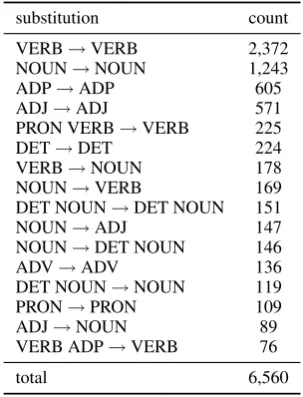
Correcting verb endings To better character-ize the different kind of substitutions, we have represented, Table 7, the PoS of the words in-volved in a substitution. This table shows that many of the substitutions that occur during post-edition keep the grammatical structure of the
sen-substitution count
VERB→VERB 2,372
NOUN→NOUN 1,243
ADP→ADP 605
ADJ→ADJ 571
PRON VERB→VERB 225
DET→DET 224
VERB→NOUN 178
NOUN→VERB 169
DET NOUN→DET NOUN 151
NOUN→ADJ 147
NOUN→DET NOUN 146
ADV→ADV 136
DET NOUN→NOUN 119
PRON→PRON 109
ADJ→NOUN 89
VERB ADP→VERB 76
[image:4.595.115.247.62.147.2]total 6,560
Table 7: PoS of the words involved in a substitu-tion.
tence unchanged and only modify lexical choices: in 26.7% of the substitutions, the PoS of the words that are edited are kept unchanged. Interestingly, as for lexicalized edits presented in Table 4 most of the ‘PoS substitutions’ are unique. But, when looking at the tail of the distribution, it appears that many of these unique transformations are due to error in alignment (e.g. when a single word is replaced by 6 or 7 words) or to error in PoS pre-diction.
Looking more closely at verb modifications, it appears that, in 39.68% of them, the prefix5of the
words is the same, suggesting that a lot of edits consist in changing the verb conjugation, which might be surprising as it could be expected that the language model would resolve such difficulties. Table 8 gives some examples of verb post-editings. Surprisingly, this observation is no longer true for modifications of nouns: in less than 10% of them, the prefix is the same before and after post-editing.
5 A Multi-Sieve Approach to Automatic Post-Editing
5.1 Main Principles
We consider a simple Automatic Post-Edition ar-chitecture based on a sieve that applies simple post-editing rules. Using such a simple rule-based approach has two main motivations. First, by fo-cusing on very precise categories of errors, we ex-pect to avoid ‘over-correcting’ the translation hy-potheses as our APE-MT model; second,
[image:4.595.73.291.195.250.2]same prefix different prefix
piensa→piense(thinks) significa→representa(means) escritos→escritas(NULL) significa→representa(NULL) guardar→guardan(save) superar→batirbeat afeitado→afeitadas(shaven) preocupa→ocupapreoccupies visita→visitas(visit) Ofender→ofendiendoOffending tratando→tratar(trying) meti´o→met´ı(NULL)
adecuado→adecuada(suited) tengo→consegu´ı(I) presentan→presente(come) dejar→deje(quit) pregunta→preguntaste(asking) seguir→cumplir(keep) ense˜nado→ense˜n´o(taught) invertido→investido(invested)
Table 8: Example of verb substitutions with the source word they are aligned with.
ing the errors of these simple rules will be much easier than analyzing the output of a complete MT system such as the one presented in Section 3 and we expect to gain some insights about the interplay between the different factors at stake.
In this work, we have considered three post-editing rules that correspond to the main cate-gories of errors identified in Section 4. These rules aim at:
• predicting word case;
• predicting exclamation and interrogation marks;
• predicting verbal endings.
Prediction of word case We used a very naive approach to predict the case of a word by assuming that a translated word should have the same case as the source word it is aligned with. We there-fore converted all words that were aligned with a lower-cased, upper-cased or title-cased word to their lower-cased, upper-cased or title-cased ver-sion, respectively. To account for missing align-ment links, we also converted all target word in upper-case when all the words of the source sen-tence were upper-cased.
Prediction of exclamation and interrogation marks As explained in Section 4, in Spanish, in-terrogative and exclamatory sentences or clauses have to begin with an inverted question mark (¿) or exclamation mark (¡). We use the method de-scribed in Algorithm 1 to insert question marks6
at the beginning and end of clauses. This method simply inserts the same punctuation mark as in the source sentence7 at the end of the sentence and
6The same method was used to insert exclamation marks. 7Only inserting the inverted punctuation mark slightly hurts performance: it appears that not all interrogative sen-tence are translated into an interrogative sensen-tence.
finds the beginning of the clause by looking for a set of specific characters to insert the inverted punctuation mark right after it. When the begin-ning of the clause can not be found, the inverted punctuation mark is inserted at the beginning of the sentence.
Algorithm 1:Insert question marks at end and beginning of clauses .
input:s= (si)|s|i=1 a source sentence
remove ‘?’ and ‘¿’ from target sentence
if‘?’ ∈/ sthen
return s
add ‘?’ at end of target sentence
fori∈J|s|,0Kdo
ifi= 0 or si∈‘–:,”“-’then
insert ‘¿’ at the (i+1)thposition
break
Correcting Verbs Ending We used a two-step models to correct verb endings. In a first step we generate, for each verb identified in the trans-lation hypothesis, a list of candidates containing conjugation variants for this verb form. We then choose the verb form which maximizes the lan-guage model score of the modified sentence as the correction. To generate the list of candidates, we extracted automatically the conjugation tables of Spanish Wiktionary8, building a list of 587,832
verb forms with their lemma. We used, as a scor-ing model, a 5-gram language model trained on the Spanish data of the WMT campaign.
This post-edition rule is more prone to errors than the previous two rules as it relies on a lan-guage model (that was trained on data with a dif-ferent tokenization) and on an external resource to generate the candidates (that is neither complete nor completely accurate).
5.2 Experimental Results
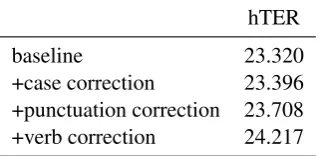
Table 9 shows the result, evaluated on the Shared Task development set, of the multi-sieve approach described in the previous section. As for the MT model presented in Section 3, our model de-grades translation quality, even if it makes only a small number of precise modifications, showing that there are more errors introduced by our
hTER baseline 23.320 +case correction 23.396 +punctuation correction 23.708 +verb correction 24.217
Table 9: hTER score achieved by our multi-sieve approach on the development data.
sieve approach than there are errors that are cor-rected.
The analysis of our errors shows that the ob-served drop in performance can be explained by the inconsistencies in the post-editions. For in-stance, in the case of interrogative sentences, there are 558 translation hypotheses in the training set that end with an interrogative mark, 203 of which do not contain an inverted mark. Applying Algo-rithm 1, will correct all of them. However, it also appears that, in 108 of these 203 sentences (53%) no inverted interrogative marks were added by the post-editors — resulting in ‘un-grammatical’ sen-tences. At the end, even the correct introduction of inverted question marks would make translation hypotheses less similar to the human post-edition. A similar observation can be made for the exclam-atory sentences.
Regarding the correction of case, the proposed post-edition rule achieves very good performance when its application is restricted to the word that have to be edited (i.e. when using the post-edition as an oracle to identify which words must be corrected): it is able to correctly predict the case of the word in almost 85% of the case. The er-roneous corrections mainly result from alignment errors. However, when applied on the whole cor-pora it will also change the case of many words the post-editors have not modified. When we looked at these words we did not see any reasons why they should not have been modified.
6 Discussion and Conclusion
We described two different approaches to Auto-matic Post-Editing: the first one casts the prob-lem as a monolingual MT task; the second one uses a series of simple, yet effective, post-edition sieves. Unfortunately, none of our systems was able to outperform the simplest do-nothing base-line. While better post-editions methods have yet to be found, we argue that this negative result is
mainly explained by the difficulty of the task at hand and the small amount of available data. In-deed, none of the participants to this pilot Shared Task managed to outperform the baseline. This is confirmed by an in-depth analysis of the task which shows that: (a) most of the post-edition op-erations are nearly unique, which makes very dif-ficult to generalize from a small amount of data; and (b) even when they are not, inconsistencies in the annotations between the different post-editions prevent from improving over the baseline.
Acknowledgments
This work was partly supported by the French “National Research Agency” (ANR) under project ANR-12-CORD-0015/Transread.
References
Josep Maria Crego, Franc¸ois Yvon, and Jos´e B. Mari˜no. 2011. N-code: an open-source Bilingual
N-gram SMT Toolkit. Prague Bulletin of
Mathe-matical Linguistics, 96:49–58.
Michael Denkowski and Alon Lavie. 2014. Meteor universal: Language specific translation evaluation for any target language. InProceedings of the EACL 2014 Workshop on Statistical Machine Translation. Chris Dyer, Victor Chahuneau, and Noah A. Smith.
2013. A simple, fast, and effective
reparameteriza-tion of ibm model 2. InNAACL, pages 644–648,
At-lanta, Georgia, June. Association for Computational Linguistics.
Slav Petrov, Dipanjan Das, and Ryan McDonald. 2012. A universal part-of-speech tagset. InLREC, Istan-bul, Turkey, may.
John W. Ratcliff and D. E. Metzener. 1988. Pattern
matching: The gestalt approach. Dr. Dobb’s
Jour-nal.
Michel Simard, Cyril Goutte, and Pierre Isabelle. 2007. Statistical phrase-based post-editing. In Hu-man Language Technologies 2007: The Conference of the North American Chapter of the Association for Computational Linguistics; Proceedings of the Main Conference, pages 508–515, Rochester, New York, April. Association for Computational Linguis-tics.
Guillaume Wisniewski, Anil Kumar Singh, Natalia Se-gal, and Franc¸ois Yvon. 2013. Design and analysis of a large corpus of post-edited translations: qual-ity estimation, failure analysis and the variabilqual-ity of
post-edition. Machine Translation Summit, 14:117–