Proceedings of the TextInfer 2011 Workshop on Textual Entailment, EMNLP 2011, pages 50–58,
Strings over intervals
Tim Fernando
Computer Science Department Trinity College, Dublin 2
Ireland
Abstract
Intervals and the events that occur in them are encoded as strings, elaborating on a con-ception of events as “intervals cum descrip-tion.” Notions of satisfaction in interval temporal logics are formulated in terms of strings, and the possibility of computing these via finite-state machines/transducers is inves-tigated. This opens up temporal semantics to finite-state methods, with entailments that are decidable insofar as these can be reduced to inclusions between regular languages.
1 Introduction
It is well-known that Kripke models for Linear Termporal Logic(LTL) can be formulated as strings (e.g. Emerson, 1990). For the purposes of natu-ral language semantics, however, it has been argued since at least (Bennett and Partee, 1972) that inter-vals should replace points. It is less clear (than in the case of LTL) how to view models as strings for intervals drawn (say) from the real lineR, as in one of the more recent interval temporal logics proposed for English, the system T PL of (Pratt-Hartmann, 2005). But if we followT PLin restricting our mod-els to finite sets, we can encode satisfaction of a for-mulaψin a setL(ψ)of stringsstr(A, I) represent-ing modelsAand intervalsI
(†) A |=I ψ ⇐⇒ str(A, I)∈ L(ψ).
The present paper shows how to devise encodings str(A, I)andL(ψ) that establish (†) in a way that opens temporal semantics up to finite-state methods
(e.g. Beesley and Karttunen, 2003). Notice that the entailment fromψtoψ0given by
(∀A, I) if A |=Iψ then A |=I ψ0
is equivalent, under (†), to the inclusion L(ψ) ⊆ L(ψ0). This inclusion is decidable provided L(ψ) andL(ψ0)are regular languages. (The same cannot be said for context-free languages.)
1.1 T PL-models and strings
We start with T PL, a model in which is defined, relative to an infinite setE ofevent-atoms, to be a finite setAof pairshI, eiof closed, bounded inter-vals I ⊆ R and event-atoms e ∈ E. (A closed, bounded interval inRhas the form
[r1, r2] def
= {r∈R|r1 ≤r ≤r2}
for somer1, r2 ∈ R.) The idea is that hI, ei
repre-sents “an occurrence of an event of typeeover the interval”I (Pratt-Hartmann, 2005; page 17). That is, we can think ofAas a finite set of events, con-ceived as “intervals cum description” (van Benthem, 1983; page 113). Our goal below is to string out this conception beyond event-atoms, and consider rela-tions between intervals other than sub-intervalhood (the focus ofT PL). To get some sense for what is involved, it is useful to pause for examples of the strings we have in mind.1
1Concrete English examples connected with text infer-ence can be found in (Pratt-Hartmann, 2005; Pratt-Hartmann, 2005a), the latter of which isolates a fragmentT PL∗
ρX(α1· · ·αn) def
= (α1∩X)· · ·(αn∩X)
bc(s)def=
bc(αs0) ifs=ααs0
αbc(α0s0) ifs=αα0s0andα6=α0
[image:2.612.86.281.64.117.2]s otherwise
Table 1: Two useful functions
Example A Given event-atomseande0, letAbe theT PL-model{x1, x2, x3}, where
x1 def
= h[1,4], ei
x2 def= h[3,9], ei
x3 def
= h[9,100], e0i.
Over the alphabet Pow(A) of subsets of A, let us representAby the string
s(A) def= x1 x1, x2 x2 x2, x3 x3
of length 5, each box representing a symbol (i.e. a subset of A) and arranged in chronological order with time increasing from left to right much like a film/cartoon strip (Fernando, 2004). Precisely how
s(A) is constructed fromA is explained in section 2. Lest we think that a box represents an indivisible instant of time, we turn quickly to
Example B The 12 months, January to December, in a year are represented by the string
sy/m def
= Jan Feb · · · Dec
of length 12, and the 365 days of a (common) year by the string
sy/m,d def
= Jan,d1 Jan,d2 · · · Dec,d31
of length 365. These two strings are linked by two functions on strings: a functionρmonths that keeps
only the months in a box so that
ρmonths(sy/m,d) = Jan 31
Feb28· · · Dec 31
and block compression bc, which compresses con-secutive occurrences of a box into one, mapping
ρmonths(sy/m,d)to
bc( Jan31Feb28· · · Dec31) = sy/m.
to examples discussed in (Fernando, 2011a) and papers cited therein. These matters are given short shrift below (due to space and time constraints); I hope to make amends at my talk in the workshop.
(A1) xx (i.e. is reflexive)
(A2) xx0 =⇒ x0x
(A3) x≺x0 =⇒ notxx0
(A4) x≺x0x00≺x000 =⇒ x≺x000
(A5) x≺x0 or xx0 or x0 ≺x
Table 2: Axioms for event structures
That is,
bc(ρmonths(sy/m,d)) = sy/m
where, as made precise in Table 1, ρX “sees only X” (equating monthswith{Jan, Feb, . . .Dec}to makeρmonths an instance ofρX), whilebcdiscards
duplications, in accordance with the view that time passes only if there is change. Or rather: we observe time passing only if we observe a change in the con-tents of a box. The point of this example is that tem-poral granularity depends on the setX of what are observable — i.e., theboxables(we can put inside a box). That setXmight be aT PL-modelAor more generally the setE of events in anevent structure
hE,,≺i, as defined in (Kamp and Reyle, 1993). Example C Given aT PL-modelA, letand≺
be binary relations onAgiven by
hI, ei hI0, e0i ⇐⇒def I∩I0 6=∅
hI, ei ≺ hI0, e0i ⇐⇒def (∀r ∈I)(∀r0 ∈I0)r < r0
for all hI, ei and hI0, e0i ∈ A. Clearly, the triple
hA,,≺i is an event structure — i.e., it satisfies axioms (A1) to (A5) in Table 2. But for finiteA, the
temporal structure the real line R confers on A is reduced considerably by the Russell-Wiener-Kamp derivation of time from event structures (RWK). In-deed, for the particular T PL-model A in Exam-ple A above, RWK yields exactly two temporal points, constituting the substring x1, x2 x2, x3 of
the string s(A) of length 5. As an RWK-moment from an event structurehE,,≺iis required to be a⊆-maximal set of pairwise-overlapping events, RWK discards the three boxes x1 , x2 and x3 in s(A). There is, however, a simple fix from (Fer-nando, 2011) that reconciles RWK not only with
-events, turnings(A)into
x1,pre(x2),pre(x3) x1, x2,pre(x3)
x2,post(x1),pre(x3) x2, x3,post(x1)
x3,post(x1),post(x2) .
Note thatpre(xi)andpost(xi)mark the past and
fu-ture relative to xi, injecting, in the terminology of
(McTaggart, 1908), A-series ingredients for tense into the B-series relations≺ and (which is just
≺-incomparability). For our present purposes, these additional ingredients allow us to represent all 13 re-lations between intervalsxandx0 in (Allen, 1983) by event structures over{x, x0,pre(x),post(x0)}, in-cluding the sub-interval relationx duringx0 at the center of (Pratt-Hartmann, 2005),2which strings out to
pre(x), x0 x, x0 post(x), x0 .
It will prove useful in our account ofT PL-formulas below to internalize the demarcation ofxbypre(x) andpost(x)when formingstr(A, I).
1.2 Outline
The remainder of the paper is organized as follows. Section 2 fills in details left out in our presentation of examples above, supplying the ingredientstr(A, I) in the equivalence
(†) A |=I ψ ⇐⇒ str(A, I)∈ L(ψ).
The equivalence itself is not established before sec-tion 3, where everyT PL-formulaψis mapped to a language L(ψ) via a translation ψ+ of ψ to a
mi-nor variant T PL+ of T PL. That variant is de-signed to smoothen the step in section 4 fromT PL
to other interval temporal logics which can be strung out similarly, and can, under natural assumptions, be made amenable to finite-state methods.
2
Or to be more correct, the version of T PL in (Pratt-Hartmann, 2005a), as the strict subset relation⊂between in-tervals assumed in theArtificial Intelligencearticle amounts to the disjunction of the Allen relationsduring,startsandfinishes. For concreteness, we work with⊂below; only minor changes are required to switch toduring.
2 Strings encoding finite interval models
This section forms the string str(A, I) in three stages described by the equation
str(A, I) def= s(AI)• .
First, we combineAandIinto the restrictionAIof Ato pairshJ, eisuch thatJis a strict subset ofI
AI def= {hJ, ei ∈ A |J ⊂I}
Second, we systematize the construction of the string s(A) in Example A. And third, we map a string s to a string s• that internalizes the borders externally marked by the pre- and post-events de-scribed in Example C. The mapA 7→ s(A) is the business of§2.1, ands 7→ s• of§2.2. With an eye to interval temporal logics other thanT PL, we will consider the full setIvl(R)of (non-empty) intervals inR
Ivl(R) def= {a⊆R|a6=∅and(∀x, y∈a) [x, y]⊆a},
and write]r1, r2[for the open interval
]r1, r2[ def
= {r∈R|r1 < r < r2}
where we allowr1 =−∞for intervals unbounded
to the left and r2 = +∞ for intervals unbounded
to the right. The constructs±∞are convenient for associatingendpointswith every intervalI, whether or notI is bounded. For I bounded to the left and to the right, we refer to real numbersrandr0asI’s endpoints providedI ⊆[r, r0]and
[r, r0]⊆[r00, r000] for allr00andr000such thatI ⊆[r00, r000].
We writeEndpoints(I)for the (non-empty) set con-sisting ofI’s endpoints (including possibly±∞). 2.1 Order, box and compress
Given a finite subsetA ⊆Ivl(R)×E, we collect all endpoints of intervals inAin the finite set
Endpoints(A) def= [ hI,ei∈A
Endpoints(I)
Step 1 OrderEndpoints(A)into an increas-ing sequence
r1< r2 <· · ·< rn.
Step 2 Box the A-events into the sequence of2n−1intervals
{r1},]r1, r2[,{r2},]r2, r3[, . . .{rn}
(partitioning the closed interval [r1, rn]), forming the string
α1β1α2β2· · ·αn
(of length2n−1) where
αj def
= {hi, ei ∈ A |rj ∈i}
βj def
= {hi, ei ∈ A |]rj, rj+1[⊆i}.
Step 3 Block-compressα1β1α2β2· · ·αn
s(A) def= bc(α1β1α2β2· · ·αn).
For example, revisiting Example A, where A is
{x1, x2, x3}and
x1 def
= h[1,4], ei
x2 def= h[3,9], ei
x3 def
= h[9,100], e0i
we have from Step 1, the 5 endpoints
~r= 1,3,4,9,100
and from Step 2, the 9 boxes
x1 x1 x1, x2 x1, x2 x1, x2 x2 x2, x3 x3 x3
that block-compresses in Step 3 to the 5 boxess(A)
x1 x1, x2 x2 x2, x3 x3 .
Notice that if we turned the closed intervals in x1
andx3 to open intervals ]1,4[and ]9,100[
respec-tively, then Step 2 gives
x1 x1, x2 x1, x2 x2 x2 x2 x3
which block-compresses to the 6 boxes
x1 x1, x2 x2 x3 .
2.2 Demarcated events
Block compression accounts for part of the Russell-Wiener-Kamp constuction of moments from an event structure (RWK). We can neutralize the re-quirement of ⊆-maximality on RWK moments by addingpre(xi),post(xi), turning, for instance,s(A)
forAgiven by Example A into
x1,pre(x2),pre(x3) x1, x2,pre(x3)
post(x1), x2,pre(x3) post(x1), x2, x3
post(x1),post(x2), x3
(whichρA maps back tos(A)). In general, we say a stringα1α2· · ·αnisA-delimitedif for allx∈ A
and integersifrom 1 ton,
pre(x)∈αi ⇐⇒ x∈( n [
j=i+1 αj)−
i [
j=1 αj
and
post(x)∈αi ⇐⇒ x∈( i−1 [
j=1 αj)−
n [
j=i αj.
Clearly, for every string s ∈ Pow(A)∗, there is a uniqueA-delimited strings0 such thatρA(s0) = s. Lets±be that unique string.
Notice thatpre(x)andpost(x)explicitly mark the borders of x ins±. For the application at hand to
T PL, it is useful to internalize the borders withinx
so that, for instance in Example A,s(A)±becomes
x1,begin-x1 x1, x2, x1-end,begin-x2
x2 x2, x3, x2-end,begin-x3 x3, x3-end
(with pre(xi) shifted to the right as begin-xi and post(xi) to the left asxi-end). The general idea is
that given a stringα1α2· · ·αn∈Pow(A)nandx∈ Athat occurs at someαi, we addbegin-xto the first
box in whichx appears, andx-end to the last box in whichx appears. Or economizing a bit by pick-ing out the first componentIin a pairhI, ei ∈ A, we form thedemarcation(α1α2· · ·αn)•ofα1α2· · ·αn
by addingbgn-Itoαiprecisely if
ϕ ::= mult(e)| ¬ϕ|ϕ∧ϕ0| hβiϕ
α ::= e|ef |el
[image:5.612.329.516.152.271.2]β ::= α|α<|α>
Table 3:T PL+-formulasϕfrom extended labelsβ
and addingI-endtoαiprecisely if
there is someesuch thathI, ei ∈αiand either i=norhI, ei 6∈αi+1 .
Returning to Example A, we have
s(A)• = x1,bgn-I1 x1, x2, I1-end,bgn-I2
x2 x2, x3, I2-end,bgn-I3 x3, I3-end
which is str(A, I) for any interval I such that [1,100]⊂I.
3 T PL-satisfaction in terms of strings
This section defines the setL(ψ)of strings for the equivalence(†)
(†) A |=I ψ ⇐⇒ str(A, I)∈ L(ψ)
by a translation to a language T PL+ that differs
ever so slightly fromT PLand its extensionT PL+
in (Pratt-Hartmann, 2005). As inT PLandT PL+,
formulas inT PL+are closed under the modal op-erator hei, for every event-atom e ∈ E. Essen-tially,hei>says at least onee-transition is possible. In addition, T PL+ has a formula mult(e) stating that multiple (at least two)e-transitions are possible. That is,mult(e)amounts to theT PL+-formula
hei> ∧ ¬{e}>
where theT PL+-formula{e}ψcan be rephrased as
heiψ∧ ¬mult(e)
(and > as the tautology ¬(mult(e) ∧ ¬mult(e))). More formally, T PL+-formulas ϕ are generated
according to Table 3 without any explicit mention of the T PL-constructs {α}, {α}< and{α}>. In-stead, aT PL+-formulaψis translated to aT PL
+
-formula ψ+ so that (†) holds with L(ψ) equal to
T(ψ+), where T(ϕ) is a set of strings (defined
below) characterizing satisfaction in T PL+. The
translationψ+commutes with the connectives
com-mon toT PL+andT PL +
e.g., (¬ψ)+ def
= ¬(ψ+)
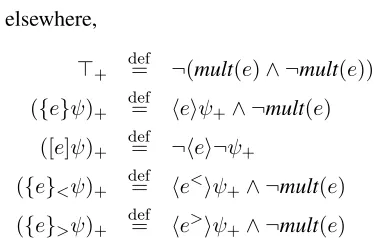
and elsewhere,
>+ def
= ¬(mult(e)∧ ¬mult(e))
({e}ψ)+ def= heiψ+∧ ¬mult(e)
([e]ψ)+ def
= ¬hei¬ψ+
({e}<ψ)+ def
= he<iψ
+∧ ¬mult(e)
({e}>ψ)+ def
= he>iψ+∧ ¬mult(e)
and as minimal-first and minimal-last subintervals are unique (Pratt-Hartmann, 2005, page 18),
({eg}<ψ)+ def
= heg<iψ+ forg∈ {f, l}
({eg}>ψ)+ def= heg>iψ+ forg∈ {f, l}.
3.1 The alphabetΣ = ΣI,Eand its subscripts
The alphabet from which we form strings will de-pend on a choice I, E of a set I ⊆ Ivl(R) of real intervals, and a set E of event-atoms. Recall-ing that the demarcation s(A)• of a string s(A) contains occurrences ofbgn-I and I-end, for each
I ∈domain(A), let us associate withIthe set
I• def= {bgn-I|I ∈I} ∪ {I-end|I ∈I}
from which we build the alphabet
ΣI,E def
= Pow((I×E)∪I•)
so that a symbol (i.e., element ofΣI,E) is a set with
elements of the formhI, ei,bgn-IandI-end. Notice that
(∀A ⊆I×E) str(A, I)∈Σ∗I,E
for any real intervalI. To simplify notation, we will often drop the subscripts I and E, restoring them when we have occasion to vary them. This applies not only to the alphabetΣ = ΣI,E but also to the
3.2 The truth setsT(ϕ)
We start withmult(e), the truth setT(mult(e))for which consists of strings properly containing at least two e-events. We first clarify what “properly con-tain” means, before turning to “e-events.” The no-tion of containment needed combines two ways a string can be part of another. The first involves delet-ing some (possibly null) prefix and suffix of a strdelet-ing. Afactor of a stringsis a strings0such thats=us0v
for some strings u and v, in which case we write
sfacs0
sfacs0 ⇐⇒def (∃u, v)s=us0v .
A factor ofsisproperif it is distinct froms. That is, writingspfacs0 to means0 is a proper factor of
s,
spfacs0 ⇐⇒ (∃u, v)s=us0v
anduv 6=
whereis the null string. The relationpfacbetween strings corresponds roughly to that of proper inclu-sion⊃between intervals.
The second notion of part between strings applies specifically to stringssands0 of sets: we says sub-sumess0, and writess0, if they are of the same length, and⊇holds componentwise between them
α1· · ·αnα01· · ·α0m def
⇐⇒ n=mand
α0i⊆αifor
1≤i≤n
(Fernando, 2004). Now, writingR;R0 for the com-position of binary relationsR andR0 in which the output ofRis fed as input toR0
s R;R0s0 ⇐⇒def (∃s00)sRs00ands00R0s0,
we composefacwithforcontainmentw w def= fac; (=; fac) andpfacwithforproper containmentA
A def= pfac; (=; pfac).
Next, fore-events, givenI ∈I, let
D(e, I) def= {s•|s∈ hI, ei +}
and summing over intervalsI ∈I,
DI(e) def= [
I∈I
D(e, I).
Dropping the subscripts on Σ and D(e), we put into T(mult(e)) all strings inΣ∗ properly contain-ing more than one strcontain-ing inD(e)
s∈ T(mult(e)) ⇐⇒def (∃s1, s2 ∈ D(e))s16=s2
andsAs1andsAs2.
Moving on, we interpret negation¬and conjunc-tion∧classically
T(¬ϕ) def= Σ∗− T(ϕ)
T(ϕ∧ϕ0) def= T(ϕ)∩ T(ϕ0)
and writingR−1Lfor{s ∈ Σ∗ |(∃s0 ∈ L)sRs0}, we set
T(hβiϕ) def= R(β)−1T(ϕ)
which brings us to the question ofR(β). 3.3 The accessibility relationsR(β)
Having definedT(mult(e)), we let R(e) be the re-striction of proper containmentAtoD(e)
sR(e)s0 ⇐⇒def s A s0ands0∈ D(e).
As foref andel, some preliminary notation is use-ful. Given a languageL, let us collect strings that have at most one factor in L in nmf(L) (for n on-multiplefactor)
nmf(L) def= {s∈Σ∗|at most one factor ofs
belongs toL}
and let us shorten−1LtoL
s∈L ⇐⇒def (∃s0 ∈L)ss0.
Now,
sR(ef)s0 ⇐⇒def (∃u, v)s=us0v
anduv6=
and similarly,
sR(el)s0 ⇐⇒def (∃u, v)s=us0v
anduv6=
ands0 ∈ D(e)
ands0v ∈nmf(D(e)).
Finally,
sR(α<)s0 ⇐⇒def (∃s00, s000)s=s0s00s000
andsR(α)s00 sR(α>)s0 ⇐⇒def (∃s00, s000)s=s000s00s0
andsR(α)s00.
A routine induction on T PL+-formulas ψ estab-lishes that for I equal to the set I of all closed, bounded real intervals,
Proposition 1.For all finiteA ⊆ I ×EandI ∈ I,
A |=I ψ ⇐⇒ str(A, I)∈ TI,E(ψ+)
for everyT PL+-formulaψ.
3.4 T PL-equivalence andIrevisited
When do two pairsA, I andA0, I0 of finite subsets
A,A0 ofI ×E and intervals I, I0 ∈ I satisfy the same T PL-formulas? A sufficient condition sug-gested by Proposition 1 is thatstr(A, I)is the same asstr(A0, I0)up to renaming of intervals. More pre-cisely, recalling thatstr(A, I) = s(AI)•, let us de-fineA to be congruent with A0, A ∼= A0, if there is a bijection between the intervals ofAandA0that turnss(A)intos(A0)
A ∼=A0 ⇐⇒def (∃f :domain(A)→domain(A0))
fis a bijection, and
A0={hf(I), ei | hI, ei ∈ A}
andf[s(A)] =s(A0)
where for any strings∈Pow(domain(f)×E)∗,
f[s] def= safter renaming each
I ∈domain(f)tof(I).
As a corollary to Proposition 1, we have
Proposition 2. For all finite subsets A and A0 of
I ×Eand allI, I0 ∈ I, ifAI ∼=A0I0 then for every
T PL+-formulaψ,
A |=I ψ ⇐⇒ A0 |=I0 ψ .
The significance of Proposition 2 is that it spells out the role the real line R plays in T PL — nothing apart from its contribution to the stringss(A). In-stead of picking out particular intervals over R, it suffices to work with interval symbols, and to equate the subscript I on our alphabet Σ and truth rela-tions T(ψ) to say, the set Z+ of positive integers
1,2, . . .. But lest we confuseT PLwith Linear Tem-poral Logic, note that the usual order onZ+doesnot
shape the accessibility relations inT PL. We useZ+
here only because it is big enough to include any fi-nite subsetAofI ×E.
Turning to entailments, we can reduce entail-ments
ψ|−I,E ψ0 ⇐⇒def (∀finiteA ⊆ I ×E)(∀I ∈ I) A |=I ψimpliesA |=I ψ0
to satisfiability as usual
ψ|−I,Eψ0 ⇐⇒ TI,E(ψ∧ ¬ψ0) =∅.
The basis of the decidability/complexity results in (Pratt-Hartmann, 2005) is a lemma (number 3 in page 20) that, for any T PL+-formula ψ, bounds the size of a minimal model of ψ. That is, as far as the satisfiability of a T PL+-formula ψ is con-cerned, we can reduce the subscriptIonT(ψ)to a finite set — or in the aforementioned reformulation, to a finite segment {1,2, . . . , n} ofZ+. We shall
consider an even more drastic approach in the next section. For now, notice that the shift from the real lineRtowards strings conforms with
The Proposal of (Steedman, 2005)
4 The regularity ofT PLand beyond
Having reformulated T PL in terms of strings, we proceed now to investigate the prospects for a finite-state approach to temporal semantics building on that reformulation. We start by bringing out the finite-state character of the connectives inT PL be-fore considering some extensions.
4.1 T PL+-connectives are regular
It is well-known that the family of regular languages is closed under complementation and intersection — operations interpreting negation and conjunction, re-spectively. The point of this subsection is to show that all the T PL+-connectives map regular
lan-guages and regular relations to regular lanlan-guages and regular relations. A relation is regular if it is computed by a finite-state transducer. IfIandEare both finite, then DI,E(e) is a regular language and
Ais a regular relation. WritingRLfor the relation {(s, s0)∈R|s0 ∈L}, note that
R(e) = AD(e)
and that in general, ifRandLare regular, then so is
RL.
Moving on, the set of strings with at least two fac-tors belonging toLis
twice(L) def= Σ∗(LΣ∗∩(Σ+LΣ∗)) +
Σ∗(LΣ+∩L)Σ∗
and the set of strings that have a proper factor be-longing toLis
[L] def= Σ+LΣ∗+ Σ∗LΣ+.
It follows that we can capture the set of strings that properly contain at least two strings inLas
Mult(L) def= [twice(L)].
Note that
T(mult(e)) = Mult(D(e))
and recallingR(ef)andR(el)usenmf,
nmf(L) = Σ∗−twice(L).
R(ef)isminFirst(D(e))where
sminFirst(L)s0 ⇐⇒def (∃u, v)s=us0v
anduv 6=
ands0 ∈L
andus0 ∈nmf(L)
andR(el)isminLast(D(e))where
sminLast(L)s0 ⇐⇒def (∃u, v)s=us0v
anduv6=
ands0∈L
ands0v∈nmf(L).
Finally,R(α<)isinit(R(α))where
sinit(R)s0 ⇐⇒def (∃s00, s000)s=s0s00s000
ands R s00
whileR(α>)isfin(R(α))where
sfin(R)s0 ⇐⇒def (∃s00, s000)s=s000s00s0
ands R s00.
Proposition 3.IfLis a regular language andRis a regular relation, then
(i) Mult(L), R−1L, and nmf(L) are regular lan-guages
(ii) RL, minFirst(L), minLast(L), init(R) and fin(R)are regular relations.
4.2 Beyond sub-intervals
As is clear from the relations R(e), T PL makes do with the sub-interval relation ⊂ and a “quasi-guarded” fragment at that (Pratt-Hartmann, 2005, page 5). To string out the interval temporal logic
HS(Halpern and Shoham, 1991), the key is to com-bineAandI using some r 6∈ E to markI (rather than formingAI)
Ar[I] def= A ∪ {hI, ri}
and modifystr(A, I)to define
Let us agree that (i) a stringα1· · ·αn r-marksI if hI, ri ∈ Sn
i=1αi, and that (ii) a string is r-marked
if there is a unique I that it r-marks. For every r -marked strings, we define two strings: letsr be the factor ofswithbgn-Iin its first box andI-endin its last, wheres r-marksI; and lets−rbeρΣ(sr).3
We can devise a finite-state transducer convertingr -marked stringssintos−r, which we can then apply
to evaluate an event-atomeas anHS-formula
s∈ Tr(e) ⇐⇒def (∃s0 ∈ D(e))s−rs0 .
It is also not difficult to build finite-state transducers for the accessibility relationsRr(B),Rr(E), Rr(B), andRr(E), showing that, as in T PL, the connec-tives inHSmap regular languages and regular rela-tions to regular languages and regular relarela-tions. The question for bothT PLandHSis can we start with regular languagesD(e)? As noted towards the end of section 3, one way is to reduce the setIof inter-vals to a finite set. We close with an alternative. 4.3 A modest proposal: splitting event-atoms
An alternative to D(e) = S
I∈ID(e, I) is to ask what it is that makes ane-event ane-event, and en-code that answer inD(e). In and of itself, an interval [3,9] cannot makeh[3,9], ei an e-event, because in and of itself,h[3,9], eiisnotane-event.h[3,9], eiis ane-event onlyina modelAsuch thatA([3,9], e).
PuttingI aside, let us suppose, for instance, that
e were the event Pat swim a mile. We can repre-sent the “internal temporal contour” ofethrough a parametrized temporal propositionf(r)with param-eterrranging over the reals in the unit interval[0,1], andf(r)sayingPat has swumr·(a mile). LetD(e) be
f(0) f↑
+ f(1)
wheref↑abbreviates the temporal proposition
(∃r <1)f(r)∧ Previously¬f(r).
3
Σis defined as in§3.1, andρX as in§1.1above. Were
we to weaken⊂to⊆in the definition ofAIand the semantics
ofT PL, then we would have(strr(A, I))−r=str(A, I), and
truth setsTr(ϕ)and accessibility relationsRr(β)such that
T(ϕ) = {s−r|s∈ Tr(ϕ)}
R(β) = {hs−r, s−0ri |sRr(β)s0}
forT PL+-formulasϕand extended labelsβ.
Notice that the temporal propositions f(r) and f↑ are to be interpreted over points (as in LTL); as il-lustrated in Example B above, however, these points can be split by adding boxables. Be that as it may, it is straightforward to adjust our definition of a model
Aandstrr(A, I) to accommodate such changes to D(e). Basing the truth setsT(ϕ)on setsD(e)ofe -denotations independent of a model A (Fernando, 2011a) is in line with the proposal of (Steedman, 2005) mentioned at the end of§3.4above.
References
James F. Allen. 1983. Maintaining knowledge about temporal intervals. Communications of the Associa-tion for Computing Machinery26(11): 832–843. Kenneth R. Beesley and Lauri Karttunen. 2003. Finite
State Morphology. CSLI, Stanford, CA.
Michael Bennett and Barbara Partee. 1972. Toward the logic of tense and aspect in English. Indiana Univer-sity Linguistics Club, Bloomington, IN.
J.F.A.K. van Benthem. 1983.The Logic of Time. Reidel. E. Allen Emerson. 1990. Temporal and modal logic. In (J. van Leeuwen, ed.)Handbook of Theoretical Com-puter Science, volume B. MIT Press, 995–1072. Tim Fernando. 2004. A finite-state approach to events in
natural langue semantics. J. Logic & Comp14:79–92. Tim Fernando. 2011. Constructing situations and time.
J. Philosophical Logic40(3):371–396.
Tim Fernando. 2011a. Regular relations for temporal propositions. Natural Language Engineering 17(2): 163–184.
Joseph Y. Halpern and Yoav Shoham. 1991. A Proposi-tional Modal Logic of Time Intervals. J. Association for Computing Machinery38(4): 935–962.
Hans Kamp and Uwe Reyle. 1993. From Discourse to Logic. Kluwer, Dordrecht.
John E. McTaggart. 1908. The Unreality of Time.Mind
17:456–473.
Ian Pratt-Hartmann. 2005. Temporal prepositions and their logic.Artificial Intelligence166: 1–36.
Ian Pratt-Hartmann. 2005a. From TimeML to TPL∗. In (G. Katz et al., eds.)Annotating, Extracting and Rea-soning about Time and Events, Schloss Dagstuhl. James Pustejovsky, Jos´e Casta˜no, Robert Ingria, Roser
Saur´ı, Robert Gaizauskas, Andrea Setzer and Graham Katz. 2003. TimeML: Robust Specification of Event and Temporal Expressions in Text. In5th International Workshop on Computational Semantics. Tilburg. Mark Steedman. 2005. The Productions of Time: