Analysing the Effect of Out-of-Domain Data on SMT Systems
Barry Haddow and Philipp Koehn School of Informatics
University of Edinburgh Edinburgh, EH8 9AB, Scotland
{bhaddow,pkoehn}@inf.ed.ac.uk
Abstract
In statistical machine translation (SMT), it is known that performance declines when the training data is in a different domain from the test data. Nevertheless, it is frequently nec-essary to supplement scarce in-domain train-ing data with out-of-domain data. In this pa-per, we first try to relate the effect of the out-of-domain data on translation performance to measures of corpus similarity, then we sep-arately analyse the effect of adding the out-of-domain data at different parts of the train-ing pipeline (alignment, phrase extraction, and phrase scoring). Through experiments in 2 do-mains and 8 language pairs it is shown that the out-of-domain data improves coverage and translation of rare words, but may degrade the translation quality for more common words.
1 Introduction
In statistical machine translation (SMT), domain adaptation can be thought of as the problem of train-ing a system on data mainly drawn from one do-main (e.g. parliamentary proceedings) and trying to maximise its performance on a different domain (e.g. news). There is likely to be some parallel data similar to the test data, but as such data is expen-sive to create, it tends to be scarce. The concept of “domain” is rarely given a precise definition, but it is normally understood that data from the same domain is in some sense similar (for example in the words and grammatical constructions used) and data from different domains shows less similarities. Data from the same domain as the test set is usually referred to asin-domainand data from a different domain is referred to asout-of-domain.
The aim of this paper is to shed some light on what domain actually is, and why it matters. The fact that a mismatch between training and test data domains reduces translation performance has been observed in previous studies, and will be confirmed here for multiple data sets and languages, but the question of why domain matters for performance has not been fully addressed in the literature. Exper-iments in this paper will be conducted on phrase-based machine translation (PBMT) systems, but similar conclusions are likely to apply to other types of SMT systems. Furthermore, we will mainly be concerned with the effect of domain on the transla-tion model, since it depends on parallel data which is more likely to be in short supply than monolingual data, and domain adaptation for language modelling has been more thoroughly studied.
The effect of a shift of domain in the parallel data is complicated by the fact that training a translation model is a multi-stage process. First the parallel data is word-aligned, normally using the IBM mod-els (Brown et al., 1994), then phrases are extracted using some heuristics (Och et al., 1999) and scored using a maximum likelihood estimate. Since the ef-fect of domain may be felt at the alignment stage, the extraction stage, or the scoring stage, we have de-signed experiments to try to tease these apart. Exper-iments comparing the effect of domain at the align-ment stage with the extraction and scoring stages have already been presented by (Duh et al., 2010), so we focus more on the differences between extraction and scoring. In other words, we examine whether adding more data (in or out-of domain) helps im-prove coverage of the phrase table, or helps imim-prove the scoring of phrases.
A further question that we wish to address is
whether adding out-of-domain parallel data affects words with different frequencies to different de-grees. For example, a large out-of-domain data set may improve the translation of rare words by pro-viding better coverage, but degrade translation of more common words by providing erroneous out-of-domain translations. In fact, the evidence presented in Section 3.5 will show a much clearer effect on low frequency words than on medium or high frequency words, but the total token count of these low fre-quency words is still small, so they don’t necessarily have much effect on overall measures of translation quality.
In summary, the main contributions of this paper are:
• It presents experiments on 8 language pairs and 2 domains showing the effect onBLEU of adding out-of-domain data.
• It provides evidence that the difference be-tween in and out-of domain translation perfor-mance is correlated with differences in word distribution and out-of-vocabulary rates.
• It develops a method for separating the effects of phrase extraction and scoring, showing that good coverage is nearly always more important than good scoring, and that out-of-domain data can adversely affect phrase scores.
• It shows that adding out-of-domain data clearly improves translation of rare words, but may have a small negative effect on more common words.
2 Related Work
The most closely related work to the current one is that of (Duh et al., 2010). In this paper they consider the domain adaptation problem for PBMT, and in-vestigate whether the out-of-domain data helps more at the word alignment stage, or at the phrase extrac-tion and scoring stages. Extensive experiments on 4 different data sets, and 10 different language pairs show mixed results, with the overall conclusion be-ing that it is difficult to predict how best to include out-of-domain data in the PBMT training pipeline. Unlike in the current work, Duh et al. do not sepa-rate phrase extraction and scoring in order to anal-yse the effect of domain on them separately. They make the point that adding extra out-of-domain data
may degrade translation by introducing unwanted lexical ambiguity, showing anecdotal evidence for this. Similar arguments were presented in (Sennrich, 2012).
A recent paper which does attempt to tease apart phrase extraction and scoring is (Bisazza et al., 2011). In this work, the authors try to improve a system trained on in-domain data by including extra entries (termed “fill-up”) from out-of-domain data – this is similar to thenc+epEandst+epEsystems in Section 3.4. It is shown by Bisazza et al. that this fill-up technique has a similar effect to using MERT to weight the in and out-of domain phrase tables. In the experiments in Section 3.4 we confirm that fill-up techniques mostly provide better results than us-ing a concatenation of in and out-of domain data.
3 Experiments
3.1 Corpora and Baselines
The experiments in this paper used data from the WMT09 and WMT11 shared tasks (Callison-Burch et al., 2009; Callison-(Callison-Burch et al., 2011), as well as OpenSubtitles data1 released by the OPUS project (Tiedemann, 2009).
From the WMT data, both
news-commentary-v6 (nc) and europarl-v6 (ep) were used for
training translation models and language
mod-els, with nc-devtest2007 used for tuning and
nc-test2007for testing. The experiments were run on all language pairs used in the WMT shared tasks, i.e. English (en) into and out of Spanish (es), German (de), French (fr) and Czech (cs).
From the OpenSubtitles (st) data, we chose
8 language pairs – English to and from Span-ish, French, Czech and Dutch (nl) – selected be-cause they have at least 200k sentences of parallel data available. 2000 sentence tuning and test sets (st-dev and st-devtest) were selected from the parallel data by extracting every nth sentence, and a 200k sentence training corpus was selected from the remaining data.
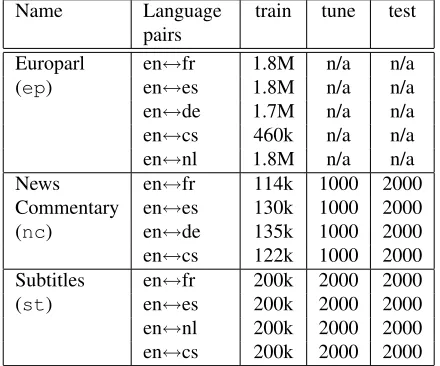
Using test sets from both news-commentary and OpenSubtitles gives two domain adaptation tasks, where in both cases the out-of-domain data is eu-roparl, a significantly larger training set than the in-domain data. The three data sets in use in this paper are summarised in Table 1.
The translation systems consisted of phrase ta-bles and lexicalised reordering tata-bles estimated us-ing the standard Moses (Koehn et al., 2007) train-ing pipeline, and 5-gram Kneser-Ney smoothed lan-guage models estimated using the SRILM toolkit (Stolcke, 2002), with KenLM (Heafield, 2011) used at runtime. Separate language models were built on the target side of the in-domain and out-of-domain training data, then linearly interpolated us-ing SRILM to minimise perplexity on the tunus-ing
set (e.g. Koehn and Schroeder (2007)). Tuning
of models used minimum error rate training (Och, 2003), repeated 3 times and averaged (Clark et al., 2011). Performance is evaluated using case-insensitive BLEU (Papineni et al., 2002), as
imple-1www.opensubtitles.org
mented using the Mosesmulti-bleu.plscript.
Name Language
pairs
train tune test
Europarl en↔fr 1.8M n/a n/a
(ep) en↔es 1.8M n/a n/a
en↔de 1.7M n/a n/a
en↔cs 460k n/a n/a
en↔nl 1.8M n/a n/a
News en↔fr 114k 1000 2000
Commentary en↔es 130k 1000 2000
(nc) en↔de 135k 1000 2000
en↔cs 122k 1000 2000
Subtitles en↔fr 200k 2000 2000
(st) en↔es 200k 2000 2000
en↔nl 200k 2000 2000
[image:3.612.316.536.82.265.2]en↔cs 200k 2000 2000
Table 1: Summary of the data sets used, with ap-proximate sentence counts
3.2 Comparing In-domain and Out-of-domain
Data
The aim of this section is to provide both a quali-tative and quantiquali-tative comparison of the three data sets used in this paper.
Firstly, consider the extracts from the English sec-tions of the three training sets shown in Figure 1. The first extract, from the Europarl corpus, shows a formal style with long sentences. However this is still spoken text so contains a preponderance of first and second person forms. In terms of subject mat-ter, the corpus covers a broad range of topics, but all from the angle of European legislation, institutions and policies. Where languages (e.g. English, French and Spanish) have new world and old world variants, Europarl sticks to the old world variants.
The extract from the News Commentary corpus again shows a formal tone, but because this is news analysis, it tends to favour the third person. It is writ-ten text, and covers a wider range of subjects than Europarl, and also encompasses both new and old world versions of the European languages.
er-Although, as you will have seen, the dreaded ’millennium bug’ failed to materialise, still the people in a number of countries suffered a series of natural disasters that truly were dreadful.
You have requested a debate on this subject in the course of the next few days, during this part-session. In the meantime, I should like to observe a minute’ s silence, as a number of Members have requested, on behalf of all the victims concerned, particularly those of the terrible storms, in the various countries of the European Union.
(a) Europarl
Desperate to hold onto power, Pervez Musharraf has discarded Pakistan’s constitutional framework and declared a state of emergency.
His goal?
To stifle the independent judiciary and free media.
Artfully, though shamelessly, he has tried to sell this action as an effort to bring about stability and help fight the war on terror more effectively.
(b) News commentary I’il call in 30 minutes to check
Is your mother here, too? Why are you outside?
It’s no fun listening to women’s talk Well, why don’t we go in together
(c) OpenSubtitles
Figure 1: Extracts from the English portion of the training corpora
rors. It is likely to contain a mixture of regional vari-ations of the languages, reflecting the diversity of the film sources.
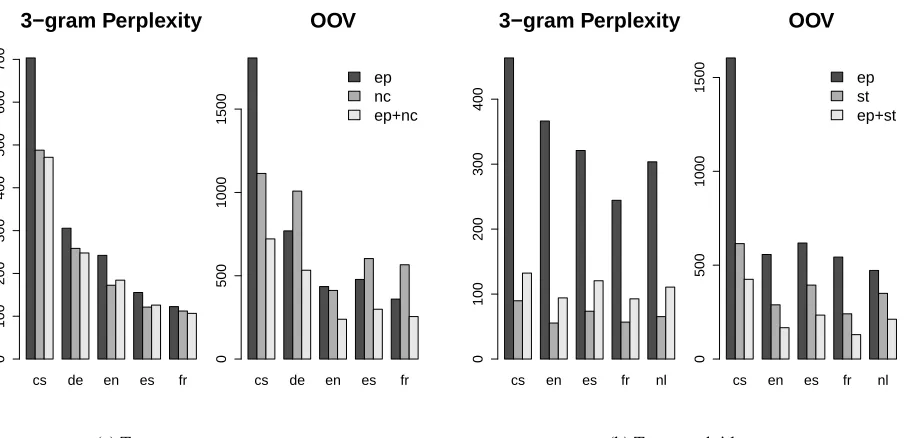
In order to obtain a quantitative measure of do-main differences, we used both language model (LM) perplexity, and out-of-vocabulary (OOV) rate, in the two test domains. For the nc domain, per-plexity was compared by training trigram LMs (with SRILM and Kneser-Ney smoothing) on each of the
ep, nc andep+nc training sets, taking the inter-section of the ep and nc vocabularies as the LM vocabulary. The perplexities of the nctest set wer calculated using each of the LMs. A correspond-ing set of LMs was trained to compare perplexities on the st test set, and all perplexity comparisons were performed on all five languages. The SRILM toolkit was also used to calculate OOV rates on the test set, by training language models with an open vocabulary, and using no unknown word probability estimation.
The perplexities and OOV rates on each test cor-pora are shown in Figure 2. The pattern of perplexi-ties is quite distinct across the two test domains, with
the perplexity from out-of-domain data relatively much higher for thesttest set. The in-domain data LM also shows the lowest perplexity consistently on this test set, whilst for nc, the in-domain LM has a similar perplexity to the ep+nc LM. In fact for 3/5 languages (fr,cs and de) theep+ncLM has the lowest perplexity.
cs de en es fr 3−gram Perplexity
0
100
200
300
400
500
600
700
cs de en es fr
ep nc ep+nc
OOV
0
500
1000
1500
(a) Test on news commentary.
cs en es fr nl 3−gram Perplexity
0
100
200
300
400
cs en es fr nl
ep st ep+st
OOV
0
500
1000
1500
[image:5.612.90.542.74.293.2](b) Test on subtitles.
Figure 2: Comparison of perplexities and OOV rates on in-domain test data
3.3 Comparing Translation Performance of In
and Out-of-domain Systems
Translation performance was measured on each of the test sets (ncandst) using systems built from just the in-domain parallel data, from just the out-of-domain parallel data, and on a concatenation of the in and out-of domain data. In other words, systems built from theep,ncandep+ncparallel texts were evaluated on thenctest data, and systems built from
ep, standep+st were evaluated on the sttest data. In all cases, the parallel training set was used to build both the phrase table and the lexicalised re-ordering models, the language model was the inter-polated one described in Section 3.1, and the system was tuned on data from the same domain as the test set.
From Figure 3 it is clear that the difference be-tween the in and out-of domain training sets is much bigger forstthan fornc. TheBLEUscores onnc
for thenctrained systems are on average 1.3BLEU
points higher than those for theeptrained systems, whilst the scores onstgain an average of 6.0BLEU
points when the training data is switched from ep
tost. The patterns are quite consistent across lan-guages for the st tested systems, with the gains varying just from 5.2 to 7.2. However for the nc
tested systems there are some language pairs which show a gain of more than 2BLEUpoints when mov-ing from out-of to in-domain trainmov-ing data (cs-en, en-es and es-en), whereas en-fr shows no change. The main link between the perplexity and OOV re-sults in Figure 2 and the BLEU score variations in Figure 3 is that the larger in/out differences between the two domains is reflected in largerBLEU differ-ences. However it is also notable that the two lan-guages which display a rise in perplexity between
ncandep+ncare es and en, and for both es-en and en-es theep+nctranslation system performs worse than thenctrained system.
TheBLEUgain from concatenating the in and
out-of domain data, over just using the in-domain data can be quite small. For thencdomain this averages at 0.5BLEU(with 3/8 language pairs showing a
cs−en en−cs de−en en−de fr−en en−fr es−en en−es
ep nc ep+nc
Bleu
0
5
10
15
20
25
30
35
(a) Test on news commentary
cs−en en−cs nl−en en−nl fr−en en−fr es−en en−es
ep st ep+st
Bleu
0
5
10
15
20
25
[image:6.612.155.525.89.271.2](b) Test on subtitles
Figure 3: Comparison of translation performance using models from in-domain, out-of-domain and joint data.
3.4 Why Does Adding Parallel Data Help?
In the previous section it was found that, across all language pairs and both data sets, adding in-domain data to an out-of-domain training set nearly always has a positive impact on performance, whilst adding out-of-domain data to an in-domain training set can sometimes have a small positive effect. In this sec-tion several experiments are performed with “inter-mediate” phrase tables (built from a single parallel corpus, augmented with some elements of the other parallel corpus) in order to determine how different aspects of the extra data affect performance. In par-ticular, the experiments are designed to show the ef-fect of the extra data on the alignments, the phrase scoring and the phrase coverage, whether adding in-domain data to an existing out-of-in-domain trained system, or vice-versa.
For each of the language pairs used in this paper, and each of the two domains, two series of experi-ments were run comparing systems built from a sin-gle parallel training set, intermediate systems, and systems built from a concatenation of the in and out-of-domain parallel data sets. Only the parallel data was varied, the language models were as described
in Section 3.1, and the lexicalised reordering mod-els were built from both training sets in all cases, except for the systems built from a single parallel data set2. This gives a total of four series of experi-ments, where the ordered pair of data sets (x,y) was set to one of (ep,nc), (nc,ep), (ep,st), (st,ep). In each of these series, the following translation sys-tems were trained:
x The translation table and lexicalised reordering model were estimated from thexcorpus alone.
x+yThe translation system built from thexandy
parallel corpora concatenated.
x+yAAsxbut using the additionalycorpus to cre-ate the alignments. This means that GIZA++ was run across the entirex+ycorpus, but only thexsection of it was used to extract and score phrases.
x+yW As x+yA but using the phrase scores from
the x+y phrase table. This is effectively the
x+ysystem, with any entries in the phrase table that are just found in theycorpus removed.
2
x+yE As x+yAbut adding the extra entries from the x+y phrase table. This is effectively the
x+ysystem, but with the scores on all phrases that are found inxphrase table set to their val-ues from that table.
All systems were tuned and tested on the appro-priate in-domain data set (either nc orst). Note that in the intermediate systems, the phrase table scores may no longer correspond to valid probability distributions, but this is not important as the proba-bilistic interpretation is never used in decoding any-way.
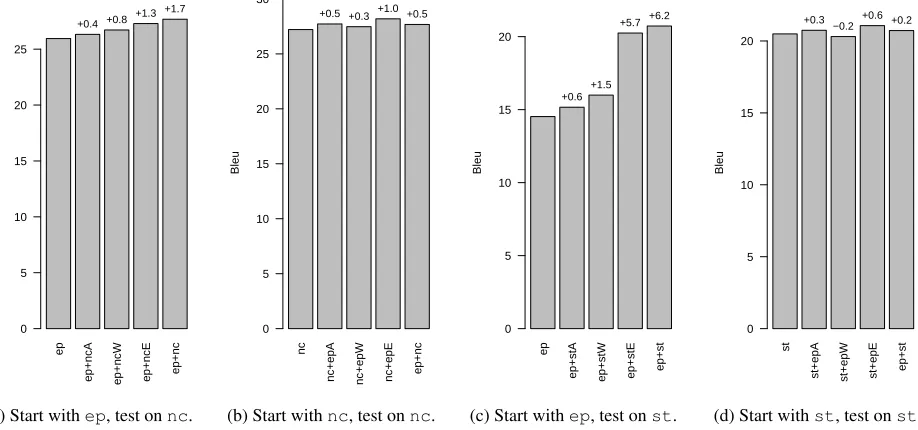
The graphs in Figure 4 show the performance comparison between the single corpus systems, the intermediate systems, and the concatenated corpus systems, averaged across all 8 language pairs. Table 2 shows the full results broken down by language pair, for completeness, but the patterns are reason-ably consistent across language pair.
Firstly, compare thex+yWandx+yEsystems, i.e. the systems where we add just the weights from the second parallel data set versus those where we add just the entries. Whenxis the out-of-domain (ep) data, then it is clearly more profitable to update the phrase-table entries than the weights from the in-domain data. In fact for the systems tested onst, the difference is quite striking with a +5.7 BLEU
gain for the ep+stEsystem over the baseline ep
system, but only a+1.5 gain for theep+stW sys-tem. For the systems tested on thenc, adding the entries from nc gives a larger gain in BLEU than adding the weights (+1.3 versus +0.8), but both improve theBLEUscores over theep+ncAsystem. The conclusion is that the extra entries from the in-domain data (the “fill-up” of Bisazza et al. (2011)) are more important than the improvements in phrase scoring that in-domain data may provide.
Looking at the other two sets ofx+yWandx+yE
systems, i.e. those where x is the in-domain data, tells another story. In this case, the results on both thencandsttest sets (Figure 4(b)) suggest that it is generally more useful to use the out-of-domain data as only a source of extra phrase-table entries. This is because thex+epEsystems are the highest scoring in both cases, scoring higher than systems built from all the data concatenated by margins of0.5(fornc) and0.4 (forst). This pattern is consistent across all the language pairs for nc, and across 5 of the 8
language pairs forst. Using the out-of-domain data set to update only the weights (thex+epWsystems) generally degrades performance when compared to the systems that only use the epdata at alignment time (thex+epAsystems).
The size of the effect of adding extra data to the alignment stage only is mixed (as observed by (Duh et al., 2010)), but in general all thex+yA systems show an improvement over thexsystems. In fact, for thestdomain, addingepat the alignment stage is the only consistent way to improveBLEU. Adding the weights, entries, or the complete out-of-domain data set does not always help.
3.5 Word Precision Versus Frequency
The final set of experiments addresses the question of whether the change of translation quality when adding out-of-domain has a different effect
depend-ing on word frequency. To do this, the systems
trained on in-domain only are compared with the systems trained on all data concatenated, using a technique for measuring the precision of the trans-lation for each word type.
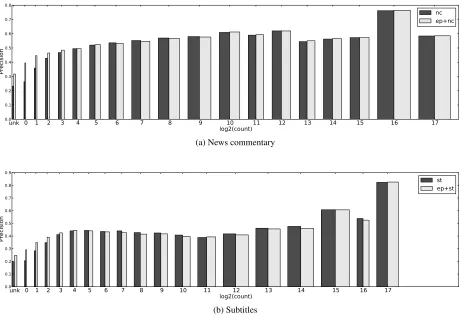
To calculate the precision of a word type, it is necessary to examine each translated sentence to see which source words were translated correctly. This is done by recording the word alignment in the phrase mappings and tracking it through the transla-tion process. If a word is produced multiple times in the translation, but occurs a fewer number of times in the reference, then it is assigned partial credit. Many-to-many word alignments are treated simi-larly. Precision for each word type is then calculated in the usual way, as the number of times that word appears correctly in the output, divided by the to-tal number of appearances. The word types are then binned according to the log2 of their frequency in the in-domain corpus and the average precision for each bin calculated, then these are in turn averaged across language pairs.
over-ep
ep+ncA ep+ncW ep+ncE ep+nc
Bleu
0 5 10 15 20 25
+0.4 +0.8 +1.3 +1.7
(a) Start withep, test onnc.
nc
nc+epA nc+epW nc+epE ep+nc
Bleu
0 5 10 15 20 25 30
+0.5 +0.3 +1.0 +0.5
(b) Start withnc, test onnc.
ep
ep+stA ep+stW ep+stE ep+st
Bleu
0 5 10 15 20
+0.6 +1.5
+5.7 +6.2
(c) Start withep, test onst.
st
st+epA st+epW st+epE ep+st
Bleu
0 5 10 15 20
+0.3 −0.2
+0.6 +0.2
[image:8.612.88.547.108.323.2](d) Start withst, test onst
Figure 4: Showing the performance change when starting with either in or out-of domain data, and adding elements of the other data set. The “A” indicates that the second data set is only used for alignments, the “W” indicates that it contributes alignments and phrase scores, and the “E” indicates that it contributes alignments and phrase entries. The figures above each bar shows the performance change relative to the single corpus system.
System cs-en en-cs de-en en-de fr-en en-fr es-en en-es
ep 23.3 13.4 25.5 17.5 28.9 29.2 35.4 34.5
ep+ncA 23.5 (+0.2) 13.8 (+0.4) 25.9 (+0.4) 17.9 (+0.4) 29.3 (+0.4) 29.6 (+0.4) 35.7 (+0.3) 34.9 (+0.5) ep+ncW 24.0 (+0.7) 14.2 (+0.8) 26.3 (+0.8) 18.2 (+0.7) 29.4 (+0.5) 29.8 (+0.6) 36.3 (+0.9) 35.6 (+1.1) ep+ncE 26.2 (+2.9) 14.0 (+0.6) 27.0 (+1.5) 18.5 (+1.0) 29.7 (+0.9) 30.0 (+0.8) 37.0 (+1.7) 35.7 (+1.3) nc 26.1 (+2.9) 14.3 (+0.9) 26.7 (+1.2) 18.0 (+0.6) 29.3 (+0.4) 29.1 (-0.1) 37.6 (+2.2) 36.5 (+2.1) nc+epA 26.8 (+3.5) 14.6 (+1.2) 27.5 (+2.0) 18.5 (+1.0) 30.4 (+1.5) 29.9 (+0.7) 37.7 (+2.3) 36.4 (+2.0) nc+epW 26.6 (+3.3) 14.4 (+1.0) 27.4 (+1.9) 18.4 (+1.0) 29.5 (+0.6) 29.8 (+0.6) 37.2 (+1.8) 36.5 (+2.0) nc+epE 27.4 (+4.1) 14.7 (+1.3) 28.1 (+2.6) 19.0 (+1.5) 30.9 (+2.0) 30.2 (+1.0) 38.4 (+3.0) 36.9 (+2.4) ep+nc 26.9 (+3.6) 14.2 (+0.8) 27.4 (+1.9) 18.8 (+1.3) 30.4 (+1.5) 30.0 (+0.8) 37.4 (+2.0) 36.4 (+2.0)
System cs-en en-cs nl-en en-nl fr-en en-fr es-en en-es
ep 10.9 6.9 18.2 15.7 14.5 13.8 19.1 17.1
ep+stA 11.9 (+1.0) 7.5 (+0.6) 19.0 (+0.8) 16.3 (+0.5) 15.0 (+0.5) 14.1 (+0.3) 19.8 (+0.7) 17.8 (+0.7) ep+stW 12.2 (+1.3) 8.1 (+1.2) 20.0 (+1.7) 17.4 (+1.7) 15.8 (+1.3) 14.9 (+1.1) 20.8 (+1.7) 18.8 (+1.8) ep+stE 18.0 (+7.1) 12.4 (+5.5) 22.5 (+4.2) 20.6 (+4.9) 19.6 (+5.1) 19.9 (+6.1) 25.6 (+6.5) 23.3 (+6.3) st 18.0 (+7.2) 12.2 (+5.3) 23.4 (+5.1) 21.3 (+5.6) 19.7 (+5.2) 19.8 (+6.0) 26.3 (+7.2) 23.2 (+6.1) st+epA 18.4 (+7.6) 12.4 (+5.5) 23.6 (+5.4) 21.3 (+5.6) 20.2 (+5.7) 20.1 (+6.3) 26.4 (+7.3) 23.5 (+6.5) st+epW 18.2 (+7.3) 12.2 (+5.3) 22.4 (+4.2) 21.0 (+5.3) 19.9 (+5.4) 19.8 (+6.0) 25.8 (+6.7) 23.2 (+6.1) st+epE 19.1 (+8.3) 12.5 (+5.6) 24.0 (+5.8) 21.7 (+6.0) 20.6 (+6.1) 20.9 (+7.1) 26.0 (+6.9) 23.7 (+6.6) ep+st 18.5 (+7.6) 12.5 (+5.6) 23.0 (+4.8) 21.2 (+5.5) 20.4 (+5.9) 20.2 (+6.5) 26.0 (+6.9) 23.8 (+6.8)
[image:8.612.76.551.411.638.2]unk 0 1 2 3 4 5 6 7 8 9 10 11 12 13 14 15 16 17 log2(count)
0.0 0.1 0.2 0.3 0.4 0.5 0.6 0.7 0.8
Precision
nc ep+nc
(a) News commentary
unk 0 1 2 3 4 5 6 7 8 9 10 11 12 13 14 15 16 17
log2(count) 0.0
0.1 0.2 0.3 0.4 0.5 0.6 0.7 0.8 0.9
Precision
st ep+st
[image:9.612.83.544.75.390.2](b) Subtitles
Figure 5: Performance comparison of in-domain systems versus systems built from in and out-of domain data concatenated. Precision is plotted against log2 of in-domain training frequency, and averaged across all 8 language pairs. The width of the bars indicates the average total number of occurrences in the test set.
all measures of translation quality. For the words with moderate training set frequencies, the precision is actually slightly higher for the systems built with just in-domain data, an effect that is more marked for thestdomain.
4 Conclusions
In this paper we have attempted to give an in-depth analysis of the domain adaptation problem for two different domain adaptation problems in phrase-based MT. The differences between the two prob-lems are clearly illustrated by the results in Fig-ures 2 and 3, where we see that the difference be-tween the in-domain and out-of-domain data are larger for the OpenSubtitles domain than for the News-Commentary domain. This can be detected by the differences in word distribution and
out-of-vocabulary rates observed in Figure 2, and is re-flected by the differing translation results in Figure 3.
simply concatenating data sets. It also suggests that the way forward is to look for methods that use the out-of-domain data mainly for rarer words, and not to change translations which have a lot of evidence in the in-domain data.
5 Acknowledgments
This work was supported by the EuroMatrixPlus3 and Accept4projects funded by the European Com-mission (7th Framework Programme).
References
Amittai Axelrod, Xiaodong He, and Jianfeng Gao. 2011. Domain Adaptation via Pseudo In-Domain Data Se-lection. In Proceedings of the 2011 Conference on Empirical Methods in Natural Language Processing, pages 355–362, Edinburgh, Scotland, UK., July. As-sociation for Computational Linguistics.
Arianna Bisazza, Nick Ruiz, and Marcello Federico. 2011. Fill-up versus Interpolation Methods for Phrase-based SMT Adaptation. InProceedings of IWSLT. Peter F. Brown, Stephen Della Pietra, Vincent J.
Della Pietra, and Robert L. Mercer. 1994. The Mathe-matics of Statistical Machine Translation: Parameter Estimation. Computational Linguistics, 19(2):263– 311.
Chris Callison-Burch, Philipp Koehn, Christof Monz, and Josh Schroeder. 2009. Findings of the 2009 Workshop on Statistical Machine Translation. In Proceedings of the Fourth Workshop on Statistical Machine Translation, pages 1–28, Athens, Greece, March. Association for Computational Linguistics. Chris Callison-Burch, Philipp Koehn, Christof Monz,
and Omar Zaidan. 2011. Findings of the 2011 Work-shop on Statistical Machine Translation. In Proceed-ings of the Sixth Workshop on Statistical Machine Translation, pages 22–64, Edinburgh, Scotland, July. Association for Computational Linguistics.
Jorge Civera and Alfons Juan. 2007. Domain Adaptation in Statistical Machine Translation with Mixture Mod-elling. InProceedings of the Second Workshop on Sta-tistical Machine Translation, pages 177–180, Prague, Czech Republic, June. Association for Computational Linguistics.
Jonathan Clark, Chris Dyer, Alon Lavie, and Noah Smith. 2011. Better hypothesis testing for statistical machine translation: Controlling for optimizer instability. In Proceedings of ACL.
3www.euromatrixplus.net 4www.accept.unige.ch
Kevin Duh, Katsuhito Sudoh, and Hajime Tsukada. 2010. Analysis of translation model adaptation in sta-tistical machine translation. InProceedings of IWSLT. George Foster and Roland Kuhn. 2007. Mixture-model adaptation for SMT. In Proceedings of the Second Workshop on Statistical Machine Translation, pages 128–135, Prague, Czech Republic, June. Association for Computational Linguistics.
George Foster, Cyril Goutte, and Roland Kuhn. 2010. Discriminative Instance Weighting for Domain Adap-tation in Statistical Machine Translation. In Proceed-ings of the 2010 Conference on Empirical Methods in Natural Language Processing, pages 451–459, Cam-bridge, MA, October. Association for Computational Linguistics.
Kenneth Heafield. 2011. KenLM: Faster and Smaller Language Model Queries. InProceedings of the Sixth Workshop on Statistical Machine Translation, pages 187–197, Edinburgh, Scotland, July. Association for Computational Linguistics.
Philipp Koehn and Josh Schroeder. 2007. Experiments in Domain Adaptation for Statistical Machine Transla-tion. InProceedings of the Second Workshop on Sta-tistical Machine Translation, pages 224–227, Prague, Czech Republic, June. Association for Computational Linguistics.
Philipp Koehn, Hieu Hoang, Alexandra Birch, Chris Callison-Burch, Marcello Federico, Nicola Bertoldi, Brooke Cowan, Wade Shen, Christine Moran, Richard Zens, Chris Dyer, Ondrej Bojar, Alexandra Con-stantin, and Evan Herbst. 2007. Moses: Open Source Toolkit for Statistical Machine Translation. In Pro-ceedings of the ACL Demo Sessions, pages 177–180, Prague, Czech Republic, June. Association for Com-putational Linguistics.
Saab Mansour, Joern Wuebker, and Hermann Ney. 2011. Combining Translation and Language Model Scoring for Domain-Specific Data Filtering. InProceedings of IWSLT.
Jan Niehues and Alex Waibel. 2010. Domain Adapta-tion in Statistical Machine TranslaAdapta-tion using Factored Translation Models. InProceedings of EAMT. Franz J. Och, Christoph Tillman, and Hermann Ney.
1999. Improved Alignment Models for Statistical Ma-chine Translation. In Joint SIGDAT Conference on Empirical Methods in Natural Language Processing and Very Large Corpora.
Franz J. Och. 2003. Minimum Error Rate Training in Statistical Machine Translation. InProceedings of ACL.
Annual Meeting of the Association for Computational Linguistics, pages 311–318, Philadelphia, Pennsylva-nia, USA, July. Association for Computational Lin-guistics.
Holger Schwenk, Patrik Lambert, Lo¨ıc Barrault, Christophe Servan, Sadaf Abdul-Rauf, Haithem Afli, and Kashif Shah. 2011. LIUM’s SMT Machine Trans-lation Systems for WMT 2011. In Proceedings of the Sixth Workshop on Statistical Machine Translation, pages 464–469, Edinburgh, Scotland, July. Associa-tion for ComputaAssocia-tional Linguistics.
Rico Sennrich. 2012. Perplexity Minimization for Trans-lation Model Domain Adaptation in Statistical Ma-chine Translation. InProceedings of EACL.
Kashif Shah, Lo¨ıc Barrault, and Holger Schwenk. 2010. Translation Model Adaptation by Resampling. In Pro-ceedings of the Joint Fifth Workshop on Statistical Ma-chine Translation and MetricsMATR, pages 392–399, Uppsala, Sweden, July. Association for Computational Linguistics.
Andreas Stolcke. 2002. SRILM – An Extensible Lan-guage Modeling Toolkit. InProc. Intl. Conf. on Spo-ken Language Processing, vol. 2, pages 901–904. J¨org Tiedemann. 2009. News from OPUS - A Collection
of Multilingual Parallel Corpora with Tools and Inter-faces. In N. Nicolov, K. Bontcheva, G. Angelova, and R. Mitkov, editors,Recent Advances in Natural Lan-guage Processing (vol V), pages 237–248. John Ben-jamins, Amsterdam/Philadelphia.