Review of Hypothesis Alignment Algorithms for MT System Combination
via Confusion Network Decoding
Antti-Veikko I. Rostia∗, Xiaodong Heb, Damianos Karakosc, Gregor Leuschd†, Yuan Caoc, Markus Freitage, Spyros Matsoukasf, Hermann Neye, Jason R. Smithc and Bing Zhangf
aApple Inc., Cupertino, CA 95014
bMicrosoft Research, Redmond, WA 98052
cJohns Hopkins University, Baltimore, MD 21218
{damianos,yuan.cao,jrsmith}@jhu.edu dSAIC, Monheimsallee 22, D-52062 Aachen, Germany
eRWTH Aachen University, D-52056 Aachen, Germany
{freitag,ney}@cs.rwth-aachen.de
fRaytheon BBN Technologies, 10 Moulton Street, Cambridge, MA 02138
{smatsouk,bzhang}@bbn.com
Abstract
Confusion network decoding has proven to be one of the most successful approaches to machine translation system combination. The hypothesis alignment algorithm is a cru-cial part of building the confusion networks and many alternatives have been proposed in the literature. This paper describes a sys-tematic comparison of five well known hy-pothesis alignment algorithms for MT sys-tem combination via confusion network de-coding. Controlled experiments using identi-cal pre-processing, decoding, and weight tun-ing methods on standard system combina-tion evaluacombina-tion sets are presented. Transla-tion quality is assessed using case insensitive BLEU scores and bootstrapping is used to es-tablish statistical significance of the score dif-ferences. All aligners yield significant BLEU score gains over the best individual system in-cluded in the combination. Incremental indi-rect hidden Markov model and a novel incre-mental inversion transduction grammar with flexible matching consistently yield the best translation quality, though keeping all things equal, the differences between aligners are rel-atively small.
∗
The work reported in this paper was carried out while the authors were at Raytheon BBN Technologies and
†
RWTH Aachen University.
1 Introduction
Current machine translation (MT) systems are based on different paradigms, such as rule-based, phrase-based, hierarchical, and syntax-based. Due to the complexity of the problem, systems make various assumptions at different levels of processing and modeling. Many of these assumptions may be suboptimal and complementary. The complemen-tary information in the outputs from multiple MT systems may be exploited by system combination. Availability of multiple system outputs within the DARPA GALE program as well as NIST Open MT and Workshop on Statistical Machine Translation evaluations has led to extensive research in combin-ing the strengths of diverse MT systems, resultcombin-ing in significant gains in translation quality.
System combination methods proposed in the lit-erature can be roughly divided into three categories: (i) hypothesis selection (Rosti et al., 2007b; Hilde-brand and Vogel, 2008), (ii) re-decoding (Frederking and Nirenburg, 1994; Jayaraman and Lavie, 2005; Rosti et al., 2007b; He and Toutanova, 2009; De-vlin et al., 2011), and (iii) confusion network de-coding. Confusion network decoding has proven to be the most popular as it does not require deepN -best lists1and operates on the surface strings. It has
1N-best lists of aroundN = 10have been used in confu-sion network decoding yielding small gains over using 1-best
also been shown to be very successful in combining speech recognition outputs (Fiscus, 1997; Mangu et al., 2000). The first application of confusion net-work decoding in MT system combination appeared in (Bangalore et al., 2001) where a multiple string alignment (MSA), made popular in biological se-quence analysis, was applied to the MT system out-puts. Matusov et al. (2006) proposed an alignment based on GIZA++ Toolkit which introduced word reordering not present in MSA, and Sim et al. (2007) used the alignments produced by the translation edit rate (TER) (Snover et al., 2006) scoring. Extensions of the last two are included in this study together with alignments based on hidden Markov model (HMM) (Vogel et al., 1996) and inversion transduc-tion grammars (ITG) (Wu, 1997).
System combinations produced via confusion net-work decoding using different hypothesis alignment algorithms have been entered into open evalua-tions, most recently in 2011 Workshop on Statistical Machine Translation (Callison-Burch et al., 2011). However, there has not been a comparison of the most popular hypothesis alignment algorithms us-ing the same sets of MT system outputs and other-wise identical combination pipelines. This paper at-tempts to systematically compare the quality of five hypothesis alignment algorithms. Alignments were produced for the same system outputs from three common test sets used in the 2009 NIST Open MT Evaluation and the 2011 Workshop on Statistical Machine Translation. Identical pre-processing, de-coding, and weight tuning algorithms were used to quantitatively evaluate the alignment quality. Case insensitive BLEU score (Papineni et al., 2002) was used as the translation quality metric.
2 Confusion Network Decoding
A confusion network is a linear graph where all paths visit all nodes. Two consecutive nodes may be connected by one or more arcs. Given the arcs repre-sent words in hypotheses, multiple arcs connecting two consecutive nodes can be viewed as alternative words in that position of a set of hypotheses encoded by the network. A special NULL token represents a skipped word and will not appear in the system combination output. For example, three hypotheses
outputs (Rosti et al., 2011).
“twelve big cars”, “twelve cars”, and “dozen cars” may be aligned as follows:
twelve big blue cars twelve NULL NULL cars dozen NULL blue cars
This alignment may be represented compactly as the confusion network in Figure 1 which encodes a total of eight unique hypotheses.
4 0 twelve(2) 1
dozen(1) 2 big(1)
NULL(2) 3
blue(2) NULL(1)
cars(3)
Figure 1: Confusion network from three strings “twelve big blue cars”, “twelve cars”, and “dozen blue cars” us-ing the first as the skeleton. The numbers in parentheses represent counts of words aligned to the corresponding arc.
Building confusion networks from multiple ma-chine translation system outputs has two main prob-lems. First, one output has to be chosen as the skele-ton hypothesis which defines the final word order of the system combination output. Second, MT system outputs may have very different word orders which complicates the alignment process. For skeleton se-lection, Sim et al. (2007) proposed choosing the out-put closest to all other hypotheses when using each as the reference string in TER. Alternatively, Ma-tusov et al. (2006) proposed leaving the decision to decoding time by connecting networks built using each output as a skeleton into a large lattice. The subnetworks in the latter approach may be weighted by prior probabilities estimated from the alignment statistics (Rosti et al., 2007a). Since different align-ment algorithm produce different statistics and the gain from the weights is relatively small (Rosti et al., 2011), weights for the subnetworks were not used in this work. The hypothesis alignment algorithms used in this work are briefly described in the follow-ing section.
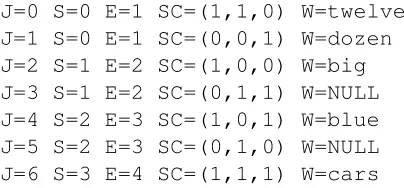
J=0 S=0 E=1 SC=(1,1,0) W=twelve J=1 S=0 E=1 SC=(0,0,1) W=dozen J=2 S=1 E=2 SC=(1,0,0) W=big J=3 S=1 E=2 SC=(0,1,1) W=NULL J=4 S=2 E=3 SC=(1,0,1) W=blue J=5 S=2 E=3 SC=(0,1,0) W=NULL J=6 S=3 E=4 SC=(1,1,1) W=cars
Figure 2: A lattice in text format representing the con-fusion network in Figure 1. J is the arc index, S and E are the start and end node indexes, SC is a vector of arc scores, and W is the word label.
system was aligned to a given link2. These may be viewed as system specific word confidences, which are binary when aligning 1-best system outputs. If no word from a hypothesis is aligned to a given link, a NULL word token is generated provided one does not already exist, and the corresponding element in the NULL word token is set to one. The system specific word scores are kept separate in order to exploit system weights in decoding. Given system weightswn, which sum to one, and system specific word scoressnjfor each arcj(the SC elements), the weighted word scores are defined as:
sj =
Ns
X
n=1
wnsnj (1)
whereNs is the number of input systems. The hy-pothesis score is defined as the sum of the log-word-scores along the path, which is linearly interpolated with a logarithm of the language model (LM) score and a non-NULL word count:
S(E|F) = X
j∈J(E)
logsj+γSLM(E) +δNw(E)
(2) whereJ(E)is the sequence of arcs generating the hypothesis E for the source sentence F, SLM(E) is the LM score, and Nw(E) is the number of non-NULL words. The set of weights θ =
{w1, . . . , wNs, γ, δ}can be tuned so as to optimize
an evaluation metric on a development set.
Decoding with an n-gram language model re-quires expanding the lattice to distinguish paths with
2
A link is used as a synonym to the set of arcs between two consecutive nodes. The name refers to the confusion network structure’s resemblance to a sausage.
uniquen-gram contexts before LM scores can be as-signed the arcs. Using longn-gram context may re-quire pruning to reduce memory usage. Given uni-form initial system weights, pruning may remove desirable paths. In this work, the lattices were ex-panded to bi-gram context and no pruning was per-formed. A set of bi-gram decoding weights were tuned directly on the expanded lattices using a dis-tributed optimizer (Rosti et al., 2010). Since the score in Equation 2 is not a simple log-linear inter-polation, the standard minimum error rate training (Och, 2003) with exact line search cannot be used. Instead, downhill simplex (Press et al., 2007) was used in the optimizer client. After bi-gram decod-ing weight optimization, another set of 5-gram re-scoring weights were tuned on 300-best lists gener-ated from the bi-gram expanded lattices.
3 Hypothesis Alignment Algorithms
3.1 Pairwise GIZA++ Enhanced Hypothesis Alignment
Matusov et al. (2006) proposed using the GIZA++ Toolkit (Och and Ney, 2003) to align a set of tar-get language translations. A parallel corpus where each system output acting as a skeleton appears as a translation of all system outputs corresponding to the same source sentence. The IBM Model 1 (Brown et al., 1993) and hidden Markov model (HMM) (Vo-gel et al., 1996) are used to estimate the alignment. Alignments from both “translation” directions are used to obtain symmetrized alignments by interpo-lating the HMM occupation statistics (Matusov et al., 2004). The algorithm may benefit from the fact that it considers the entire test set when estimating the alignment model parameters; i.e., word align-ment links from all output sentences influence the estimation, whereas other alignment algorithms only consider words within a pair of sentences (pairwise alignment) or all outputs corresponding to a single source sentence (incremental alignment). However, it does not naturally extend to incremental align-ment. The monotone one-to-one alignments are then transformed into a confusion network. This aligner is referred to as GIZA later in this paper.
3.2 Incremental Indirect Hidden Markov Model Alignment
He et al. (2008) proposed using an indirect hidden Markov model (IHMM) for pairwise alignment of system outputs. The parameters of the IHMM are estimated indirectly from a variety of sources in-cluding semantic word similarity, surface word sim-ilarity, and a distance-based distortion penalty. The alignment between two target language outputs are treated as the hidden states. A standard Viterbi al-gorithm is used to infer the alignment. The pair-wise IHMM was extended to operate incrementally in (Li et al., 2009). Sentence specific alignment or-der is not used by this aligner, which is referred to as iIHMM later in this paper.
3.3 Incremental Inversion Transduction Grammar Alignment with Flexible Matching
Karakos et al. (2008) proposed using inversion trans-duction grammars (ITG) (Wu, 1997) for pairwise
alignment of system outputs. ITGs form an edit distance, invWER (Leusch et al., 2003), that per-mits properly nested block movements of substrings. For well-formed sentences, this may be more nat-ural than allowing arbitrary shifts. The ITG algo-rithm is very expensive due to itsO(n6)complexity.
The search algorithm for the best ITG alignment, a best-first chart parsing (Charniak et al., 1998), was augmented with anA∗ search heuristic of quadratic complexity (Klein and Manning, 2003), resulting in significant reduction in computational complexity. The finite state-machine heuristic computes a lower bound to the alignment cost of two strings by allow-ing arbitrary word re-orderallow-ings. The ITG hypothesis alignment algorithm was extended to operate incre-mentally in (Karakos et al., 2010) and a novel ver-sion where the cost function is computed based on the stem/synonym similarity of (Snover et al., 2009) was used in this work. Also, a sentence specific alignment order was used. This aligner is referred to as iITGp later in this paper.
3.4 Incremental Translation Edit Rate Alignment with Flexible Matching
Sim et al. (2007) proposed using translation edit rate scorer3to obtain pairwise alignment of system out-puts. The TER scorer tries to find shifts of blocks of words that minimize the edit distance between the shifted reference and a hypothesis. Due to the computational complexity, a set of heuristics is used to reduce the run time (Snover et al., 2006). The pairwise TER hypothesis alignment algorithm was extended to operate incrementally in (Rosti et al., 2008) and also extended to consider synonym and stem matches in (Rosti et al., 2009). The shift heuristics were relaxed for flexible matching to al-low shifts of blocks of words as long as the edit dis-tance is decreased even if there is no exact match in the new position. A sentence specific alignment or-der was used by this aligner, which is referred to as iTER later in this paper.
3.5 Incremental Translation Edit Rate Plus Alignment
Snover et al. (2009) extended TER scoring to con-sider synonyms and paraphrase matches, called
3
TER-plus (TERp). The shift heuristics in TERp were also relaxed relative to TER. Shifts are allowed if the words being shifted are: (i) exactly the same, (ii) synonyms, stems or paraphrases of the corre-sponding reference words, or (iii) any such combina-tion. Xu et al. (2011) proposed using an incremental version of TERp for building consensus networks. A sentence specific alignment order was used by this aligner, which is referred to as iTERp later in this paper.
4 Experimental Evaluation
Combination experiments were performed on (i) Arabic-English, from the informal system combi-nation track of the 2009 NIST Open MT Evalua-tion4; (ii) German-English from the system com-bination evaluation of the 2011 Workshop on Sta-tistical Machine Translation (Callison-Burch et al., 2011) (WMT11) and (iii) Spanish-English, again from WMT11. Eight top-performing systems (as evaluated using case-insensitive BLEU) were used in each language pair. Case insensitive BLEU scores for the individual system outputs on the tuning and test sets are shown in Table 1. About 300 and 800 sentences with four reference translations were available for Arabic-English tune and test sets, re-spectively, and about 500 and 2500 sentences with a single reference translation were available for both German-English and Spanish-English tune and test sets. The system outputs were lower-cased and to-kenized before building confusion networks using the five hypothesis alignment algorithms described above. Unpruned English bi-gram and 5-gram lan-guage models were trained with about 6 billion words available for these evaluations. Multiple com-ponent language models were trained after dividing the monolingual corpora by source. Separate sets of interpolation weights were tuned for the NIST and WMT experiments to minimize perplexity on the English reference translations of the previous evaluations, NIST MT08 and WMT10. The sys-tem combination weights, both bi-gram lattice de-coding and 5-gram 300-best list re-scoring weights, were tuned separately for lattices build with each hy-pothesis alignment algorithm. The final re-scoring
4http://www.itl.nist.gov/iad/mig/tests/
mt/2009/ResultsRelease/indexISC.html
outputs were detokenized before computing case in-sensitive BLEU scores. Statistical significance was computed for each pairwise comparison using boot-strapping (Koehn, 2004).
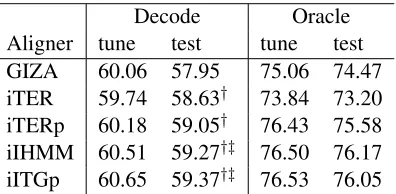
[image:5.612.316.514.125.222.2]Decode Oracle Aligner tune test tune test GIZA 60.06 57.95 75.06 74.47 iTER 59.74 58.63† 73.84 73.20 iTERp 60.18 59.05† 76.43 75.58 iIHMM 60.51 59.27†‡ 76.50 76.17 iITGp 60.65 59.37†‡ 76.53 76.05
Table 2: Case insensitive BLEU scores for NIST MT09 Arabic-English system combination outputs. Note, four reference translations were available. Decode sponds to results after weight tuning and Oracle corre-sponds to graph TER oracle. Dagger (†) denotes statisti-cally significant difference compared to GIZA and double dagger (‡) compared to iTERp and the aligners above it.
Arabic German Spanish System tune test tune test tune test A 48.84 48.54 21.96 21.41 27.71 27.13 B 49.15 48.97 22.61 21.80 28.42 27.90 C 49.30 49.50 22.77 21.99 28.57 28.23 D 49.38 49.59 22.90 22.41 29.00 28.41 E 49.42 49.75 22.90 22.65 29.15 28.50 F 50.28 50.69 22.98 22.65 29.53 28.61 G 51.49 50.81 23.41 23.06 29.89 29.82 H 51.72 51.74 24.28 24.16 30.55 30.14
Table 1: Case insensitive BLEU scores for the individual system outputs on the tune and test sets for all three source languages.
Decode Oracle Aligner tune test tune test GIZA 25.93 26.02 37.32 38.22 iTERp 26.46 26.10 38.16 38.76 iTER 26.27 26.39† 37.00 37.66 iIHMM 26.34 26.40† 37.87 38.48 iITGp 26.47 26.50† 37.99 38.60
Table 3: Case insensitive BLEU scores for WMT11 German-English system combination outputs. Note, only a single reference translation per segment was available. Decode corresponds to results after weight tuning and Oracle corresponds to graph TER oracle. Dagger (†) denotes statistically significant difference compared to iTERp and GIZA.
The BLEU scores for German-English system combination outputs are shown in Table 3. Again, the graph TER oracle scores do not follow the same order as the decoding scores. The scores for GIZA and iTERp are statistically indistinguishable, and iTER, iIHMM, and iITGp are significantly better than the first two. However, they are not statistically different from each other. Without flexible match-ing, iITG yields a BLEU score of 26.47 on test. The absolute BLEU gain over the best individual system was between 1.9 and 2.3 points on the test set.
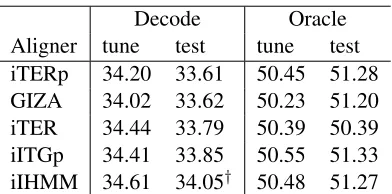
The BLEU scores for Spanish-English system combination outputs are shown in Table 4. All align-ers but iIHMM are statistically indistinguishable and iIHMM is significantly better than all other align-ers. Without flexible matching, iITG yields a BLEU score of 33.62 on test. The absolute BLEU gain over the best individual system was between 3.5 and 3.9
Decode Oracle Aligner tune test tune test iTERp 34.20 33.61 50.45 51.28 GIZA 34.02 33.62 50.23 51.20 iTER 34.44 33.79 50.39 50.39 iITGp 34.41 33.85 50.55 51.33 iIHMM 34.61 34.05† 50.48 51.27
Table 4: Case insensitive BLEU scores for WMT11 Spanish-English system combination outputs. Note, only a single reference translation per segment was available. Decode corresponds to results after weight tuning and Oracle corresponds to graph TER oracle. Dagger (†) denotes statistically significant difference compared to aligners above iIHMM.
points on the test set.
5 Error Analysis
Error analysis was performed to better understand the gains from system combination. Specifically, (i) how the different types of translation errors are af-fected by system combination was investigated; and (ii) an attempt to quantify the correlation between the word agreement that results from the different aligners and the translation error, as measured by TER (Snover et al., 2006), was made.
5.1 Influence on Error Types
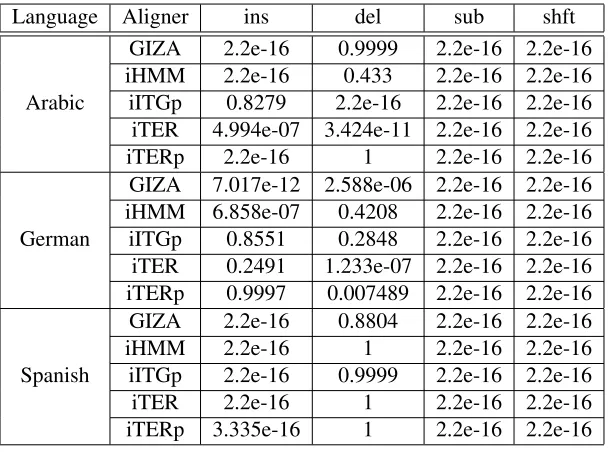
[image:6.612.314.510.243.340.2] [image:6.612.73.271.245.341.2]down into insertions/deletions/substitutions/shifts based on the TER scorer.
The error counts at the document level were ag-gregated. For each document in each collection, the number of errors of each type that resulted from each individual system as well as each system combina-tion were measured, and their difference was com-puted. If the differences are mostly positive, then it can be said (with some confidence) that system combination has a significant impact in reducing the error of that type. A paired Wilcoxon test was per-formed and the p-value that quantifies the probabil-ity that the measured error reduction was achieved under the null hypothesis that the system combina-tion performs as well as the best system was com-puted.
Table 5 shows all conditions under consideration. All cases where the p-value is below10−2 are con-sidered statistically significant. Two observations are in order: (i) all alignment schemes significantly reduce the number of substitution/shift errors; (ii) in the case of insertions/deletions, there is no clear trend; there are cases where the system combination increases the number of insertions/deletions, com-pared to the individual systems.
5.2 Relationship between Word Agreement and Translation Error
This set of experiments aimed to quantify the rela-tionship between the translation error rate and the amount of agreement that resulted from each align-ment scheme. The amount of system agreealign-ment at a levelx is measured by the number of cases (con-fusion network arcs) where x system outputs con-tribute the same word in a confusion network bin. For example, the agreement at level 2 is equal to 2 in Figure 1 because there are exactly 2 arcs (with words “twelve” and “blue”) that resulted from the agreement of 2 systems. Similarly, the agreement at level 3 is 1, because there is only 1 arc (with word “cars”) that resulted from the agreement of 3 sys-tems. It is hypothesized that a sufficiently high level of agreement should be indicative of the correctness of a word (and thus indicative of lower TER). The agreement statistics were grouped into two values: the “weak” agreement statistic, where at most half of the combined systems contribute a word, and the “strong” agreement statistic, where more than half
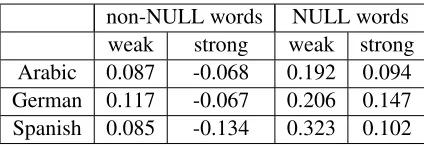
non-NULL words NULL words weak strong weak strong Arabic 0.087 -0.068 0.192 0.094 German 0.117 -0.067 0.206 0.147 Spanish 0.085 -0.134 0.323 0.102
Table 6: Regression coefficients of the “strong” and ”weak” agreement features, as computed with a gener-alized linear model, using TER as the target variable.
of the combined systems contribute a word. To sig-nify the fact that real words and “NULL” tokens have different roles and should be treated separately, two sets of agreement statistics were computed.
A regression with a generalized linear model (glm) that computed the coefficients of the agree-ment quantities (as explained above) for each align-ment scheme, using TER as the target variable, was performed. Table 6 shows the regression coeffi-cients; they are all significant atp-value < 0.001. As is clear from this table, the negative coefficient of the “strong” agreement quantity for the non-NULL words points to the fact that good aligners tend to result in reductions in translation error. Further-more, increasing agreements on NULL tokens does not seem to reduce TER.
6 Conclusions
[image:7.612.320.532.56.129.2]per-Language Aligner ins del sub shft GIZA 2.2e-16 0.9999 2.2e-16 2.2e-16 iHMM 2.2e-16 0.433 2.2e-16 2.2e-16 Arabic iITGp 0.8279 2.2e-16 2.2e-16 2.2e-16 iTER 4.994e-07 3.424e-11 2.2e-16 2.2e-16 iTERp 2.2e-16 1 2.2e-16 2.2e-16 GIZA 7.017e-12 2.588e-06 2.2e-16 2.2e-16 iHMM 6.858e-07 0.4208 2.2e-16 2.2e-16 German iITGp 0.8551 0.2848 2.2e-16 2.2e-16 iTER 0.2491 1.233e-07 2.2e-16 2.2e-16 iTERp 0.9997 0.007489 2.2e-16 2.2e-16 GIZA 2.2e-16 0.8804 2.2e-16 2.2e-16 iHMM 2.2e-16 1 2.2e-16 2.2e-16 Spanish iITGp 2.2e-16 0.9999 2.2e-16 2.2e-16 iTER 2.2e-16 1 2.2e-16 2.2e-16 iTERp 3.335e-16 1 2.2e-16 2.2e-16
Table 5:p-values which show which error types are statistically significantly improved for each language and aligner.
formance gains from system combination can be at-tributed to reductions in substitution errors and word re-ordering errors. Finally, better alignments of sys-tem outputs, which tend to cause higher agreement rates on words, correlate with reductions in transla-tion error.
References
Necip Fazil Ayan, Jing Zheng, and Wen Wang. 2008. Improving alignments for better confusion networks for combining machine translation systems. InProc. Coling, pages 33–40.
Srinivas Bangalore, German Bordel, and Giuseppe Ric-cardi. 2001. Computing consensus translation from multiple machine translation systems. InProc. ASRU, pages 351–354.
Peter F. Brown, Stephen A. Della Pietra, Vincent J. Della Pietra, and Robert L. Mercer. 1993. The mathematics of statistical machine translation: Parameter estima-tion. Computational Linguistics, 19(2):263–311. Chris Callison-Burch, Philipp Koehn, Christof Monz,
and Omar F. Zaidan. 2011. Findings of the 2011 workshop on statistical machine translation. InProc. WMT, pages 22–64.
Eugene Charniak, Sharon Goldwater, and Mark Johnson. 1998. Edge-based best-first chart parsing. In Proc. Sixth Workshop on Very Large Corpora, pages 127– 133. Morgan Kaufmann.
Jacob Devlin, Antti-Veikko I. Rosti, Shankar Ananthakr-ishnan, and Spyros Matsoukas. 2011. System
combi-nation using discriminative cross-adaptation. InProc. IJCNLP, pages 667–675.
Jonathan G. Fiscus. 1997. A post-processing system to yield reduced word error rates: Recognizer output vot-ing error reduction (ROVER). In Proc. ASRU, pages 347–354.
Robert Frederking and Sergei Nirenburg. 1994. Three heads are better than one. InProc. ANLP, pages 95– 100.
Xiaodong He and Kristina Toutanova. 2009. Joint opti-mization for machine translation system combination. InProc. EMNLP, pages 1202–1211.
Xiaodong He, Mei Yang, Jianfeng Gao, Patrick Nguyen, and Robert Moore. 2008. Indirect-hmm-based hy-pothesis alignment for combining outputs from ma-chine translation systems. InProc. EMNLP, pages 98– 107.
Almut S. Hildebrand and Stephan Vogel. 2008. Combi-nation of machine translation systems via hypothesis selection from combined n-best lists. InAMTA, pages 254–261.
Shyamsundar Jayaraman and Alon Lavie. 2005. Multi-engine machine translation guided by explicit word matching. InProc. EAMT.
Damianos Karakos, Jason Eisner, Sanjeev Khudanpur, and Markus Dreyer. 2008. Machine translation sys-tem combination using ITG-based alignments. In
Proc. ACL, pages 81–84.
Dan Klein and Christopher D. Manning. 2003. A* parsing: Fast exact Viterbi parse selection. In Proc. NAACL, pages 40–47.
Philipp Koehn. 2004. Statistical significance tests for machine translation evaluation. In Proc. EMNLP, pages 388–395.
Gregor Leusch, Nicola Ueffing, and Hermann Ney. 2003. A novel string-to-string distance measure with appli-cations to machine translation evaluation. InProc. MT Summit 2003, pages 240–247, September.
Chi-Ho Li, Xiaodong He, Yupeng Liu, and Ning Xi. 2009. Incremental hmm alignment for mt system com-bination. InProc. ACL/IJCNLP, pages 949–957. Lidia Mangu, Eric Brill, and Andreas Stolcke. 2000.
Finding consensus in speech recognition: Word error minimization and other applications of confusion net-works. Computer Speech and Language, 14(4):373– 400.
Evgeny Matusov, Richard Zens, and Hermann Ney. 2004. Symmetric word alignments for statistical ma-chine translation. InProc. COLING, pages 219–225. Evgeny Matusov, Nicola Ueffing, and Hermann Ney.
2006. Computing consensus translation from multiple machine translation systems using enhanced hypothe-ses alignment. InProc. EACL, pages 33–40.
Franz J. Och and Hermann Ney. 2003. A systematic comparison of various statistical alignment models.
Computational Linguistics, 29(1):19–51.
Franz J. Och. 2003. Minimum error rate training in sta-tistical machine translation. InProc. ACL, pages 160– 167.
Kishore Papineni, Salim Roukos, Todd Ward, and Wei-Jing Zhu. 2002. BLEU: a method for automatic eval-uation of machine translation. In Proc. ACL, pages 311–318.
William H. Press, Saul A. Teukolsky, William T. Vetter-ling, and Brian P. Flannery. 2007. Numerical recipes: the art of scientific computing. Cambridge University Press, 3rd edition.
Antti-Veikko I. Rosti, Spyros Matsoukas, and Rirchard Schwartz. 2007a. Improved word-level system com-bination for machine translation. InProc. ACL, pages 312–319.
Antti-Veikko I. Rosti, Bing Xiang, Spyros Matsoukas, Richard Schwartz, Necip Fazil Ayan, and Bonnie J. Dorr. 2007b. Combining outputs from multiple machine translation systems. In Proc. NAACL-HLT, pages 228–235.
Antti-Veikko I. Rosti, Bing Zhang, Spyros Matsoukas, and Richard Schwartz. 2008. Incremental hypothesis alignment for building confusion networks with appli-cation to machine translation system combination. In
Proceedings of the Third Workshop on Statistical Ma-chine Translation, pages 183–186.
Antti-Veikko I. Rosti, Bing Zhang, Spyros Matsoukas, and Richard Schwartz. 2009. Incremental hypothesis alignment with flexible matching for building confu-sion networks: BBN system description for WMT09 system combination task. In Proc. WMT, pages 61– 65.
Antti-Veikko I. Rosti, Bing Zhang, Spyros Matsoukas, and Richard Schwartz. 2010. BBN system descrip-tion for WMT10 system combinadescrip-tion task. In Proc. WMT, pages 321–326.
Antti-Veikko I. Rosti, Evgeny Matusov, Jason Smith, Necip Fazil Ayan, Jason Eisner, Damianos Karakos, Sanjeev Khudanpur, Gregor Leusch, Zhifei Li, Spy-ros Matsoukas, Hermann Ney, Richard Schwartz, Bing Zhang, and Jing Zheng. 2011. Confusion network de-coding for MT system combination. In Joseph Olive, Caitlin Christianson, and John McCary, editors, Hand-book of Natural Language Processing and Machine Translation: DARPA Global Autonomous Language Exploitation, pages 333–361. Springer.
Khe Chai Sim, William J. Byrne, Mark J.F. Gales, Hichem Sahbi, and Phil C. Woodland. 2007. Con-sensus network decoding for statistical machine trans-lation system combination. InProc. ICASSP.
Matthew Snover, Bonnie Dorr, Richard Schwartz, Lin-nea Micciula, and John Makhoul. 2006. A study of translation edit rate with targeted human annotation. InProc. AMTA, pages 223–231.
Matthew Snover, Nitin Madnani, Bonnie Dorr, and Richard Schwartz. 2009. Fluency, adequacy or HTER? exploring different human judgments with a tunable MT metric. InProc. WMT, pages 259–268. Stephan Vogel, Hermann Ney, and Christoph Tillman.
1996. HMM-based word alignment in statistical trans-lation. InProc. ICCL, pages 836–841.
Dekai Wu. 1997. Stochastic inversion transduction grammars and bilingual parsing of parallel corpora.
Computational Linguistics, 23(3):377–403, Septem-ber.