Learning Verb Classes in an Incremental Model
Libby Barak, Afsaneh Fazly, and Suzanne Stevenson Department of Computer Science
University of Toronto Toronto, Canada
{libbyb,afsaneh,suzanne}@cs.toronto.edu
Abstract
The ability of children to generalize over the linguistic input they receive is key to acquiring productive knowledge of verbs. Such generalizations help children extend their learned knowledge of constructions to a novel verb, and use it appropriately in syntactic patterns previously unobserved for that verb—a key factor in language productivity. Computational models can help shed light on the gradual development of more abstract knowledge during verb acquisition. We present an incremental Bayesian model that simultaneously and incrementally learns argument structure constructions and verb classes given nat-uralistic language input. We show how the distributional properties in the input lan-guage influence the formation of general-izations over the constructions and classes.
1 Introduction
Usage-based accounts of language learning note that young children rely on verb-specific knowl-edge to produce their early utterances (e.g., Tomasello, 2003). However, evidence suggests that even young children can generalize their verb knowledge to novel verbs and syntactic frames (e.g., Fisher, 2002), and that the abstract knowledge gradually strengthens over time (e.g., Tomasello and Abbot-Smith, 2002). One area of verb usage where more sophisticated abstraction appears necessary for fully adult productivity in language is the knowledge of verb alternations. A verb alternation is a pairing of constructions shared by a number of verbs, in which the two constructions express related argument structures (Levin, 1993): e.g., the dative alternation involves the related forms of the prepositional dative (PD;
X gave Y to Z) and the double-object dative (DO;X
gave Z Y). Such alternations enable language users to readily adapt new and low frequency verbs to appropriate constructions of the language by gen-eralizing the observed use of one such form to the other.1
For example, Conwell and Demuth (2007) show that 3-year-old children understand that a novel verb observed only in the DO dative (John gor-ped Heather the book) can also be used in the PD form (John gorped the book to Heather), though the children can only generalize such knowledge under certain experimental conditions. Wonnacott et al. (2008) demonstrate the proficiency of adults in making such generalizations within an artificial language learning scenario, which enables the re-searchers to explore the distributional properties of the linguistic input that facilitate the acquisition of such generalizations. The results suggest that the overall frequency of the syntactic patterns as well as the distribution of verbs across the patterns play a facilitatory role in the formation of abstract verb knowledge (in the form of verb alternations) in adult language learners.
In this work, we propose a computational model that extends an existing Bayesian model of verb argument structure acquisition (Alishahi and Stevenson, 2008)[AS08] to support the learning of verb classes over the acquired constructions. Our model is novel in its approach to verb class forma-tion, because it clusters tokens of a verb that reflect the distribution of the verb over the learned con-structions each time the verb is used in an input. That is, the model forms verb classes by cluster-ing verb tokens that reflect the evolvcluster-ing usages of the verbs in various constructions.
We use this new model to analyze the role of the classes and the distributional properties of the input in learning abstract verb knowledge, given
1Thegeneralization of an alternationrefers to a speaker
using one variant of an alternation for a verb (e.g., PD) having only observed the verb in the other variant (e.g., DO).
naturalistic input that contains many verbs and many constructions. The model can form higher-level generalizations such as learning verb alterna-tions, which is not possible with the AS08 model (cf. the findings of Parisien and Stevenson, 2010). Moreover, because our model gradually forms its representations of constructions and classes over time (in contrast to other Bayesian models, such as Parisien and Stevenson, 2010; Perfors et al., 2010), it is possible to analyze the monotonically-growing representations and show their compati-bility with the developmental patterns seen in chil-dren (Conwell and Demuth, 2007). We also repli-cate some of the observations of Wonnacott et al. (2008) on the role of distributional properties of the language in influencing the degree of general-ization over an alternation.
2 Related Work
To explore the properties of learning mechanisms that are capable of mimicking child and adult psy-cholinguistic observations, a number of cognitive modeling studies have focused on learning ab-stract verb knowledge from individual verb usages (e.g., Alishahi and Stevenson, 2008; Perfors et al., 2010; Parisien and Stevenson, 2010). Here we fo-cus on such computational models that enable the sort of higher-level generalization that people do across verb alternations, unlike the AS08 model.
The hierarchical Bayesian models of Perfors et al. (2010) and Parisien and Stevenson (2010) focus on learning this kind of higher-level general-ization. The model of Perfors et al. (2010) learns verb alternations, i.e., pairs of syntactic patterns shared by certain groups of verbs. By incorpo-rating this sort of abstract knowledge into their model, Perfors et al. are able to simulate the abil-ity of adults to generalize across verb alternations (as in Wonnacott et al., 2008). That is, Perfors et al. predict the ability of a novel verb to occur in a syntactic structure after exposure to it in the alternative pattern of that alternation. However, this model is trained on data that contains only a limited number of verbs and syntactic patterns un-like naturalistic Child-directed Speech (CDS) and moreover incorporates built-in information about verb constructions.
The hierarchical Dirichlet model of Parisien and Stevenson (2010) addresses these limitations by working with natural child-directed speech (CDS) data. Moreover, the model of Parisien and
Stevenson simultaneously learns constructions as in AS08 and verb classes based on verb alterna-tion behaviour, showing that the latter level of ab-straction is necessary to support effective learn-ing of verb alternations. Still, the models of both Parisien and Stevenson and Perfors et al. can only be utilized as a batch process and hence are lim-ited in the analysis of developmental trajectories. Although it is possible to simulate development by training such models on increasing portions of in-put, such an approach does not ensure that the rep-resentations givenn+iinputs can be developed from the representation givenninputs.
In this paper, we propose a significant extension to the model of AS08, by adding an extra level of abstraction that incrementally learns verb classes by drawing on the distribution of verbs over the learned constructions. The new model combines the advantages of having a monotonic clustering model that enables the analysis of developing clus-ters, with the simultaneous learning of construc-tions and verb classes.
3 The Computational Model
As mentioned above, our model is an extension of the model of AS08 in which we add a level of learned abstract knowledge about verbs. Specif-ically, our model uses a Bayesian clustering pro-cess to learn clusters of verb usages that occur in similar argument structure constructions, as in the original model of AS08. To this, we add another level of abstraction that learns clusters of verbs that exhibit similar distributional patterns of oc-currence across the learned constructions—that is, classes of verbs that occur in similarsets of con-structions, and in similar proportions. To distin-guish between the clusters of the two levels of ab-straction in our new model, we refer to the clusters of verb usages as constructions, and to the group-ings of verbs given their distribution over those constructions as verb classes.
3.1 Overview of the Model
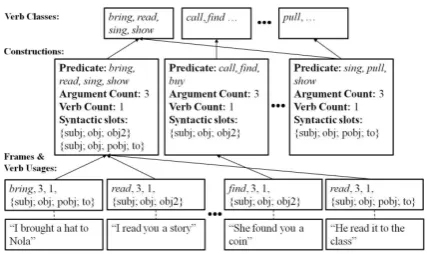
indepen-Figure 1: A visual representation of the two levels of ab-straction in the model, with sample verb usages input (and extracted input frames), constructions, and classes.
dently of their meaning, as in some relevant psy-cholinguistic (Wonnacott et al., 2008) and com-putational studies (Parisien and Stevenson, 2010). We focus particularly on properties such as syn-tactic slotsandargument count. (These features, as in Parisien and Stevenson (2010), provide a more flexible and generalizable representation of a syntactic structure than the syntactic pattern string used by AS08.) See the bottom rows of boxes in Figure 1 for sample input verb usages with their extracted frames.
The model incrementally clusters the extracted input frames into constructions that reflect prob-abilistic associations of the features across simi-lar verb usages; see the middle level of Figure 1. Each learned cluster is a probabilistic (and possi-bly noisy) representation of an argument structure construction: e.g., a cluster containing frames cor-responding to usages such asI eat apples,She took the ball, andHe got a book, etc., represents a Tran-sitive Action construction.2 Such constructions
al-low for some degree of generalization over the ob-served input; e.g., when seeing a novel verb in a Transitive utterance, the model predicts the simi-larity of this verb to other Action verbs appearing in that pattern (Alishahi and Stevenson, 2008).
Grouping of verb usages into constructions may not be sufficient for making higher-level generizations across verb alternations. Knowledge of al-ternations is only captured indirectly in construc-tions (because usages of the same verb can oc-cur in multiple clusters). Following Parisien and Stevenson (2010), we hypothesize that true gen-eralization behaviour requires explicit knowledge that verbs have commonalities in their patterns of occurrenceacross constructions; this is the basis
2Because the associations are probabilistic, a linguistic
construction may be represented by more than one cluster.
for verb classes (Levin, 1993; Merlo and Steven-son, 2000; Schulte im Walde and Brew, 2002).
To capture this, our model learns groupings of verbs that have similar distributions across the learned constructions. These groupings form verb classes that provide a higher-level of abstraction over the input; see the top level in Figure 1. Con-sider the dative alternation: the classes capture the fact that some verbs may occur only in preposi-tional dative (PD) forms, such assing, while oth-ers occur only in double object (DO) forms (call), while still othersalternate– i.e., they occur in both (bring).
Our model simultaneously learns both of these types of knowledge: constructions are clusters of verb usages, and classes are clusters of verb dis-tributions over those constructions. Importantly, it does so incrementally, which allows us to exam-ine the developmental trajectory of acquiring al-ternations such as the dative as the learned ters grow over time. Moreover, both types of clus-tering are monotonic, i.e., we do not re-structure the groupings that our model learns. However, the model in both levels is clusteringverb tokens– i.e., the features corresponding to the verb at that time in the input, its usage or its current distribution – so that the same verb type may be added to various clusters at different stages in the training.
3.2 Learning Constructions of Verb Usages
The model of AS08 groups input frames into clus-ters on the basis of the overall similarity in the values of their features. Importantly, the model learns these clusters incrementally in response to the input; the number and type of clusters is not predetermined. The model considers the creation of a new cluster for a given frame if the frame is not sufficiently similar to any of the existing clus-ters. Formally, the model finds the best cluster for a given input frameF as in:
BestCluster(F) = argmax
k∈ClustersP(k|F) (1)
wherekranges over all existing clusters and a new one. Using Bayes rule:
P(k|F) = P(k)P(F|k)
P(F) ∝P(k)P(F|k) (2)
[image:3.595.76.290.50.177.2]prior more frequent constructions. The likelihood P(F|k) is estimated based on the match of fea-ture values inF and in the frames ofk(assuming independence of the features):
P(F|k) = Y
i∈F eatures
Pi(j|k) (3)
where j is the value of the ith feature ofF, and Pi(j|k)is calculated using a smoothed version of:
Pi(j|k) = countni(j, k)
k (4)
wherecounti(j, k)is the number of times featurei has the valuejin clusterk, andnkis the number of frames ink. We compare the slot features as sets to capture similarities in overlapping syntactic slots rather than enforcing an exact match. The model uses the Jaccard similarity score to measure the degree of overlap between two feature sets, instead of the direct count of occurrence in Eqn. (4):
sim score(S1, S2) = ||SS1∩S2|
1∪S2| (5)
whereS1 andS2 in our experiments here are the
sets of syntactic slot features.
3.3 Learning Verb Classes
Our new model extends the construction-formation model of AS08 by grouping verbs into classes on the basis of their distribution across the learned constructions. That is, verbs that have statistically-similar patterns of occurrence across the learned constructions will be considered as forming a verb class. For example, in Figure 1 we see thatbring andread may be put into the same class because they both occur in a similar relative frequency across the DO and PD constructions (the leftmost and rightmost constructions in the figure).
We use the same incremental Bayesian cluster-ing algorithm for learncluster-ing the verb classes as for learning constructions. At the class level, the fea-ture used for determining similarity of items in clustering is the distribution of each verb across the learned constructions. As for constructions, the model learns the verb classes incrementally; the number and type is not predetermined. More-over, just as constructions are gradually formed from successively processing a particular verb us-age at each input step, the model forms verb classes from a sequence of snapshots of the input
verb’s distribution over the constructions at each input step. This means that our model is forming classes of verb tokens rather than types; if a verb’s behaviour changes over the duration of the input, subsequent tokens (the distributions over construc-tions at later points in time) may be clustered into a different class (or classes) than earlier tokens, even though prior decisions cannot be undone.
Formally, after clustering the input frame at timetinto a construction, as explained above, the model extracts the current distribution dvt of its head verbvover the learned constructions; this is estimated as a smoothed version ofv’s relative fre-quency in each construction:
P(k|v) = count(n v, k)
v (6)
wherecount(v, k)is the number of times that in-puts with verbvhave been clustered into construc-tion k, and nv is the number of times v has oc-curred in the input thus far.
To cluster this snapshot of the verb’s distribu-tion, dvt, it is compared to the distributions en-coded by the model’s classes. The distributiondc of an existing class c is the weighted average of the distributions of its member verb tokens:
dc= |1c| X
v∈c
count(v, c)×dv (7)
where|c|is the size of classc, count(v, c)is the number of occurrences of v that have been as-signed toc, anddvis the distribution of the verbv given by the tokens ofv(the “snapshots” of distri-butions ofvassigned to classc). That is,dv incis an average of the distributions of alldvt for verbv that have been clustered intoc.
The model finds the best class for a given verb distributiondvt based on its similarity to the dis-tributions of all existing classes and a new one:
BestClass(dvt) = argmax
c∈Classes(1−DJS(dckdvt)) (8) wherecranges over all existing classes as well as a new class that is represented as a uniform dis-tribution over the existing constructions. Jensen– Shannon divergence,DJS, is a popular method for
measuring the distance between two distributions: It is based on the KL–divergence, but it is symmet-ric and has a finite value between 0 and 1:
DJS(pkq) = 1
2DKL(pk 1
2(p+q)) + 1
2DKL(qk 1
non-ALT ALT
DO-only PD-only DO PD
Number of verbs 12 5 6
[image:5.595.76.288.62.105.2]Relative frequency 14% 2% 2% 1%
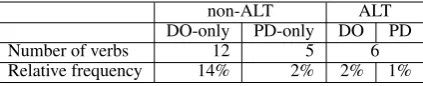
Table 1: Number of non-alternating (non-ALT) and alter-nating (ALT) verbs in our lexicon, as well as the relative fre-quency of each construction in our generated input corpora.
4 Experimental Setup
4.1 Generation of the Input Corpora
We follow the input generation method of AS08 to create naturalistic corpora that are based on the distributional properties of verbs over various con-structions, as observed in child-directed speech (CDS). Ourinput-generation lexicon contains71
verbs drawn from AS08 (11 action verbs) and Barak et al. (2013) (31 verbs of varying syntac-tic patterns), plus an additional40of the most fre-quent verbs in CDS, in order to have a range of verbs that occur with the PD and DO construc-tions. Table 4.1 shows the number of verbs that appear in the DO or PD construction only (non-alternating), as well as those that alternate across the two. (The table also gives the relative fre-quency of each dative construction in our gener-ated input corpora.) Each verb lexical entry in-cludes its overall frequency, and its relative fre-quency with each of a number of observed syn-tactic constructions. The frequencies are extracted from a manual annotation of a sample of 100
child-directed utterances per verb from a collec-tion of eight corpora from CHILDES (MacWhin-ney, 2000).3 An input corpus is generated by
it-eratively selecting a random verb and a syntactic construction based on their frequencies according to the lexicon, so that all input corpora used in our simulations have the distributional properties ob-served in CDS, but show some variation in precise make-up and ordering of verb usages. The gener-ated input consists offrames(a set of features) that correspond to verb usages in CDS.
4.2 Simulations
Because the generation of the input data is prob-abilistic, we conduct 100 simulations for each experiment (each using a different input cor-pus) to avoid any dependency on specific id-iosyncratic properties of a single generated cor-pus. For each simulation, we train our model
3Brown (1973); Suppes (1974); Kuczaj (1977); Bloom
et al. (1974); Sachs (1983); Lieven et al. (2009).
on an automatically-generated corpus of 15,000
frames, from which the model learns construc-tions and verb classes. At specified points in the input, we present the model with usages of a novel verb in a DO and/or PD frame, and then test the model’s generalization ability by predicting DO and PD frames given that verb. Since we are interested in the relative likeli-hoods of the two frames, we report the differ-ence between the log-likelihood of the DO frame and the log-likelihood of the PD frame, i.e.,
log-likelihood(DO)−log-likelihood(PD). Specifically, we form a partial frameFtest
(con-taining all usage features except for the verb) that reflects either the PD or the DO syntax, and assess the probabilityP(Ftest|v)for each of these, as in:
P(Ftest|v) =
X
k∈Constructions
P(Ftest|k)P(k|v)
(10) whereP(Ftest|k)is calculated as in Eqn. (3).
We can calculateP(k|v)in two different ways: using only the knowledge in the constructions of the model, and using the knowledge that takes into account the verb classes over the constructions. For model predictions based on the construction level only, we calculate P(k|v) as in Eqn. (6), which is the smoothed relative frequency of the verbvover constructionk.
Predictions using knowledge of the verb classes will instead determine P(k|v) drawing on the fit of verb v to the various classes (specifically, the similarity ofv’s distribution over constructions to the distribution encoded in each class), and the likelihood of each constructionkfor each classc (specifically, the likelihood ofkgiven the distribu-tion over construcdistribu-tions encoded inc), as in:
P(k|v)≈ X
c∈Classes
P(k|c)P(c|v) (11)
where P(k|c) is the probability of construction k given class c’s distribution over constructions (dc); andP(c|v)is the probability ofcgiven verb v’s distribution dv over the constructions (using Jensen-Shannon divergence as in Eqn. (9)).
5 Evaluation
In this section we examine whether and how our model generalizes across the two variants of the dative alternation, the double-object dative (DO) and the prepositional dative (PD). To do so, we measure the tendency of the model to produce a novel verb observed in one dative frame in that same frame, or in the other dative frame (unob-served for that verb). Our goal is to understand the impact of the learned constructions and classes on this generalization behaviour. Following Parisien and Stevenson (2010), we examine three input conditions in which the novel verb occurs: (i) twice with the DO syntax (non-alternating); (ii) twice with the PD syntax (non-alternating); or (iii) once each with DO and PD syntax (alternating).4
We then ask the model to predict the likelihood of producing each dative frame with that verb. Our focus here is on comparing the generalization abil-ities of the two levels of abstract knowledge in our model: the constructions versus the verb classes.
As a reminder, we use the dative alternation as one example for considering this kind of higher-level generalization behaviour observed in adults and to a lesser extent in children. Moreover, we perform the analysis in the context of naturalistic input that contains many verbs (those that appear in the dative and those that do not), and a variety of constructions , to provide a realistic setting for the task. Our settings differ from the psycholinguis-tic studies in the variability of constructions com-pared with the artificial language used by Won-nacott et al., and in focusing only on the syntac-tic properties unlike Conwell and Demuth. How-ever, we follow the settings of these studies in an-alyzing the syntactic properties of a generated ut-terance given minimal exposure to a novel verb. Therefore, we aim to replicate their general ob-servations by showing that (i) children are limited in their ability to generalize across verb alterna-tions compared with adults, and (ii) the frequency of a construction has a positive correlation with the generalization rate of the construction.
5.1 Generalization of Learned Knowledge
We examine the generalization patterns of our model when presented with a novel verb in DO/PD forms after being trained on15,000inputs, which we compare to the performance of adults in such
4For the alternating condition, half the simulations have
[image:6.595.333.499.58.170.2]DO first, and half have PD first.
Figure 2:The difference between the log-likelihood values of the DO and PD frames, given each of the three input con-ditions: DO only, PD only, and Alternating. Values above zero denote a higher likelihood for the DO frame, and values below zero denote a higher likelihood for the PD frame.
language tasks. We first consider the case where the model predictions are based solely on the knowledge of constructions. Here we expect the predictions to correspond to the syntactic proper-ties of the two inputs observed for the novel verb, with limited generalization. That is, we expect a non-alternating verb to be much more likely in the observed dative frame, and an alternating verb to be equally likely in both frames. The left hand side of Figure 2 presents the differences in log-likelihoods of the predicted DO and PD frames for the novel verb using the construction-based prob-abilities. The results confirm our expectation that the knowledge of constructions can support only limited generalizationacrossthe variants of an al-ternation. For the non-alternating conditions, the observed frame is highly favoured, and for the Alternating test scenario, the DO and PD frames have nearly equal likelihoods.
We next turn to using the knowledge of verb classes, which we expect to enable generaliza-tions that correspond to verb alternation behaviour — that is, we expect the model predictions here to reflect the knowledge that verbs that occur in one form of the alternation also often occur in the other form of the alternation. This is possible because the classes in the model encode the dis-tributional patterns of verbs across constructions. In the absence of other factors, we would expect the Alternating condition to again show near equal likelihoods for the two frames, and the two non-alternating conditions to show a slight preference for the observed frame (rather than the strong pref-erence seen in the construction-based predictions), because the unobserved frame is also likely due to the knowledge here of the alternation.
difference in the log-likelihoods of the DO and PD frames when using the knowledge encoded in the verb classes. The results are not directly in line with the simple prediction above: The non-alternating (DO-only and PD-only) condi-tions show a weak preference (as expected) for one frame over another, but both favour the DO frame, as does the Alternating condition. That is, the PD-only and Alternating conditions show a preference for the DO frame that does not follow simply from the knowledge of alternations.
The DO preference in the PD-only and Alter-nating conditions arises due to distributional fac-tors in the input, related to the frequencies of the constructions reported in Table 1. First, the DO frame is overall much more likely than the PD frame, causing generalization in the PD-only and Alternating conditions to lean more to that frame. Second, fully1/3 of the uses of the PD frame in the corpus are with verbs that alternate (i.e., 1% of the corpus are PD frames of alternating PD-DO verbs, out of a total of 3% of the corpus be-ing PD frames), while only1/8of the uses of the DO frame are with alternating rather than non-alternating verbs. Recall that our classes encode the distribution (roughly relative frequency) of the verbs in the class occurring across the different constructions. This means that in our class-based predictions, greater weight will be given to con-structions with DO when observing a PD frame than to constructions with PD when observing a DO frame. These results underline the importance of using naturalistic input and considering the im-pact of various distributional factors on general-ization of verb knowledge.
In contrast to the construction-based results, our class-based results conform with the experimental findings of Wonnacott et al. (2008), who show that adult (artificial) language learners robustly gener-alize a newly-learned verb observed in a single syntactic form by producing it in the alternating syntactic form under certain language conditions. Moreover, we show similar distributional effects to theirs – the overall frequency of the syntactic patterns, as well as the distribution of verbs across those patterns – in the level of preference for one form over another, within the context of our nat-uralistic data with multiple verbs, constructions, and alternations. These results show that the verb classes in the model are able to capture useful ab-stract knowledge that is key to understanding the
human ability to make high-level generalizations across verb alternations.
5.2 Development of Generalizations
Next, we present the results of our model evalu-ated throughout the course of training in order to understand the developmental pattern of general-ization. We perform the same construction-based or class-based prediction tasks (the likelihoods of a DO and PD frame), following the same input conditions (a novel verb with two DO frames, two PD frames, or one of each) at given points during the15,000inputs. As above, we present the dif-ference in the log-likelihood values of the DO and the PD frames in order to focus on the relative like-lihoods of the two frames within each condition of construction-based or class-based predictions.
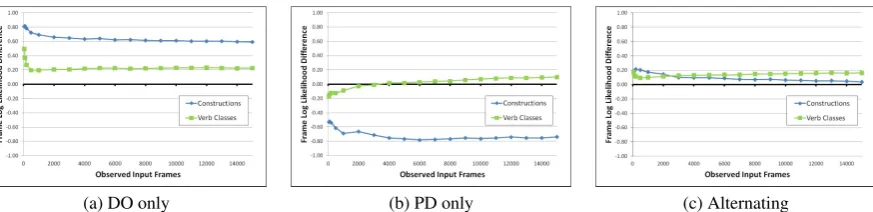
Figure 3(a) presents the results for the DO-only test scenario. As in Section 5.1, for both construction-based and class-based predic-tions there is a higher likelihood for the DO frame throughout the course of training. In contrast, the incremental results for the PD-only test scenario, in Figure 3(b), display a developing level of gen-eralization throughout the training stage for the class-based predictions. While the construction-based predictions reflect a much higher likelihood for the PD frame, the results from the verb classes are in favor of the PD frame only initially; after training on 5000 input frames, the likelihood of the DO frame becomes higher for this test sce-nario. These results indicate that using construc-tion knowledge alone does not enable generaliza-tion from the PD frame to the DO frame; in con-trast, the verb class knowledge enables the grad-ual acquisition of generalization ability over the course of training.
(a) DO only (b) PD only (c) Alternating
Figure 3:Difference of log-likelihood values of the DO and PD frames over the course of training for the constructions and the verb classes for each of the3test scenarios. Values above zero denote a higher likelihood for the DO frame, and values below zero denote a higher likelihood for the PD frame.
DO frame and the higher association of PD frames with DO alternates. These results again empha-size the importance of further exploring the role of distributional factors on generalization of verb knowledge in children.
The developmental results presented here are in line with the suggestions of Tomasello (2003) that the productions of younger children follow ob-served patterns in the input, and only later reflect robust generalizations of their knowledge across verbs. Conwell and Demuth (2007) for example, found evidence of generalization across verb al-ternations in 3-year-old children, but their produc-tion of unobserved forms for a novel verb was very sensitive to the precise context of the ex-periment and the distributional patterns across the novel verbs. In accord with these observations, the developmental trajectories in our model show that our class-based predictions increase in their degree of generalization over time, and are sensitive to various distributional factors in the input, such as the overall expectation for a frame and the expec-tation that a verb will alternate.
6 Discussion
We present a novel computational model that probabilistically learns two levels of abstractions over individual verb usages: constructions that are clusters of similar verb usages, and classes of verbs with similar distributional behaviour across the constructions. Specifically, we extend the model of AS08 by incrementally learning token-based verb classes that generalize over the con-struction knowledge level. In contrast to the mod-els of Parisien and Stevenson and Perfors et al., our model is incremental, and hence enables the analysis of the monotonically developing classes to show the relation to the development of gener-alization ability in human learners.
We analyze how generalization is supported by each level of learning in our model: constructions and verb classes. Our results confirm (cf. Parisien and Stevenson, 2010) that a higher-level knowl-edge of the verb classes is required to replicate the observed patterns of generalization, such as pro-ducing a novel verbgorpin the in the prepositional dative pattern after hearing it in the double object dative pattern. In addition, our analysis of the in-crementally developing verb classes shows that the generalization knowledge gradually emerges over time, similar to what is observed in children.
The flexibility of input representation of our model enables us to further explore the properties of the input in learning abstract knowledge, fol-lowing psycholinguistic studies. Our results repli-cate the findings of Wonnacott et al. on the role of the distributional properties over the alternat-ing syntactic forms, but in naturalistic settalternat-ings of many constructions. In future, we plan to extend this analysis by manipulating the distributions of our input data to replicate the exact settings of the artificial language used by Wonnacott et al.. More-over, in this study, we followed the settings of pre-vious computational and psycholinguistic studies that focused on the syntactic properties of the in-put (Perfors et al., 2010; Parisien and Stevenson, 2010; Wonnacott et al., 2008; Conwell and De-muth, 2007). However, we can further our anal-ysis by incorporating semantic features in the in-put to study syntactic bootstrapping effects (Scott and Fisher, 2009) as well as the role of seman-tic properties in constraining the generalizations across the alternating forms.
Acknowledgments
References
Afra Alishahi and Suzanne Stevenson. 2008. A computational model of early argument struc-ture acquisition. Cognitive Science, 32(5):789– 834.
Libby Barak, Afsaneh Fazly, and Suzanne Steven-son. 2013. Acquisition of desires before beliefs: A computational investigation. InProceedings of CoNLL-2013.
Lois Bloom, Lois Hood, and Patsy Lightbown. 1974. Imitation in language development: If, when, and why. Cognitive Psychology, 6(3):380–420.
Roger Brown. 1973. A first language: The early stages. Harvard Univ. Press.
Erin Conwell and Katherine Demuth. 2007. Early syntactic productivity: Evidence from dative shift. Cognition, 103(2):163–179.
Cynthia Fisher. 2002. The role of abstract syntac-tic knowledge in language acquisition: A reply to Tomasello. Cognition, 82(3):259–278. A. Kuczaj, Stan. 1977. The acquisition of regular
and irregular past tense forms.Journal of Verbal Learning and Verbal Behavior, 16(5):589–600. B. Levin. 1993. English verb classes and alterna-tions: A preliminary investigation, volume 348. University of Chicago press Chicago, IL. Elena Lieven, Doroth´e Salomo, and Michael
Tomasello. 2009. Two-year-old children’s pro-duction of multiword utterances: A usage-based analysis. Cognitive Linguistics, 20(3):481–507. B. MacWhinney. 2000. The CHILDES project: Tools for analyzing talk, volume 2. Psychology Press.
P. Merlo and S. Stevenson. 2000. Automatic verb classification based on statistical distributions of argument structure. Computational Linguis-tics, 27(3):373–408.
Christopher Parisien and Suzanne Stevenson. 2010. Learning verb alternations in a usage-based bayesian model. In Proceedings of the 32nd annual meeting of the Cognitive Science Society.
Amy Perfors, Joshua B. Tenenbaum, and Eliz-abeth Wonnacott. 2010. Variability, negative evidence, and the acquisition of verb argu-ment constructions.Journal of Child Language, 37(03):607–642.
Jacqueline Sachs. 1983. Talking about the There and Then: The emergence of displaced refer-ence in parent–child discourse. Children’s lan-guage, 4.
Sabine Schulte im Walde and Chris Brew. 2002. Inducing German semantic verb classes from purely syntactic subcategorisation information. In Proceedings of the 40th Annual Meeting of the Association for Computational Linguistics, pages 223–230, Philadelphia, PA.
Rose M Scott and Cynthia Fisher. 2009. Two-year-olds use distributional cues to interpret transitivity-alternating verbs. Language and cognitive processes, 24(6):777–803.
Patrick Suppes. 1974. The semantics of children’s language. American psychologist, 29(2):103. Michael Tomasello. 2003. Constructing a
lan-guage: A usage-based theory of language ac-quisition.
Michael Tomasello and Kirsten Abbot-Smith. 2002. A tale of two theories: Response to Fisher. Cognition, 83(2):207–214.