Exploring Consensus in Machine Translation for Quality Estimation
Carolina Scarton and Lucia Specia
Department of Computer Science, University of Sheffield Regent Court, 211 Portobello, Sheffield, S1 4DP, UK
{c.scarton,l.specia}@sheffield.ac.uk
Abstract
This paper presents the use of consensus among Machine Translation (MT) systems for the WMT14 Quality Estimation shared task. Consensus is explored here by com-paring the MT system output against sev-eral alternative machine translations using standard evaluation metrics. Figures ex-tracted from such metrics are used as fea-tures to complement baseline prediction models. The hypothesis is that knowing whether the translation of interest is simi-lar or dissimisimi-lar to translations from multi-ple different MT systems can provide use-ful information regarding the quality of such a translation.
1 Introduction
While Machine Translation (MT) evaluation met-rics can rely on the similarity of the MT system output to reference (human) translations as a proxy to quality assessment, this is not possible for MT systems in use, translating unseen texts. Quality Estimation (QE) metrics are used in such settings as a way of predicting translation quality. While reference translations are not available for QE, previous work has explored the so called pseudo-references(Soricut and Echihabi, 2010; Soricut et al., 2012; Soricut and Narsale, 2012; Shah et al., 2013). Pseudo-references are alternative transla-tions produced by MT systems different from the system that we intend to predict quality for (Al-brecht and Hwa, 2008). These can be used to pro-vide additional features to train QE models. Such features are normally figures resulting from au-tomatic metrics (such as BLEU, Papineni et al. (2002)) computed between pseudo-references and the output of the given MT system.
Soricut and Echihabi (2010) explore pseudo-references for document-level QE prediction to
rank outputs from an MT system. The pseudo-references-based features are BLEU scores ex-tracted by comparing the output of the MT sys-tem under investigation and the output of an off-the-shelf MT system, for both the target and the source texts. The statistical MT system training data is also used as pseudo-references to compute training data-based features. The use of pseudo-references has been shown to outperform strong baseline results. Soricut and Narsale (2012) pro-pose a method that uses sentence-level prediction models for document-level QE. They also use a pseudo-references-based feature (based in BLEU) and claim that this feature is one of the most pow-erful in the framework.
For QE at sentence-level, Soricut et al. (2012) use BLEU based on pseudo-references combined with other features to build the best QE system of the WMT12 QE shared task.1 Shah et al. (2013)
use pseudo-references in the same way to ex-tract a BLEU feature for sentence-level prediction. Feature analysis on a number of datasets showed that this feature contributed the most across all datasets.
Louis and Nenkova (2013) apply pseudo-references for summary evaluation. They use six systems classified as “best systems”, “mediocre systems” or “worst systems” to make the compar-ison, with ROUGE (Lin and Och, 2004) as quality score. They also experiment with a combination of the “best systems” and the “worst systems”. The use of only “best systems” led to the best results. Examples of “bad summaries” are said not to be very useful because a summary close to the worst systems outputs can mean that either it is bad or it is too different from the best systems outputs in terms of content. Albrecht and Hwa (2008) use pseudo-references to improve MT evaluation by combining them with a single human reference. They show that the use of pseudo-references
im-1http://www.statmt.org/wmt12/
proves the correlation with human judgements. Soricut and Echihabi (2010) claim that pseudo-references should be produced by systems as dif-ferent as possible from the MT system of interest. This ensures that the similarities found among the systems’ translations are not related to the similar-ities of the systems themselves. Therefore, the as-sumption that a translation from system X shares some characteristics with a translation from sys-temY is not a mere coincidence. Another way to make the most of pseudo-references is to use an MT system known as generally better (or worse) than the MT system of interest. In that case, the comparison will lead to whether the MT system of interest is similar to a good (or bad) MT system.
However, in most scenarios it is difficult to rely on the average translation quality of a given sys-tem as an absolute indicator of its quality. This is particularly true for sentence-level QE, where the quality of a given system can vary signifi-cantly across sentences. Finding translations from MT systems that are considerably different can also be a challenge. In this paper we exploit pseudo-references in a different way: measuring the consensus among different MT systems in the translations they produce. As sources of pseudo-references, we use translations given in a multi-translation dataset or those produced by the par-ticipants in the WMT translation task for the same data. While some MT systems can be similar to each other, for some language pairs, such as English-Spanish, a wide range of MT systems with different average qualities are available. Our hypothesis is that by using translations from sev-eral MT systems we can find consensual
infor-mation (even if some of the systems are similar
to the one of interest). The use of more than one MT system is expected to smooth out the effect of “coincidences” in the similarities between sys-tems’ translations.
This paper describes the use of consensual information for the WMT14 QE shared task (USHEFF-consensus system), simulating a sce-nario where we do not know the quality of the pseudo-references, nor the characteristics of any MT systems (the system of interest or the systems which generated the pseudo-references). We par-ticipated in all variants of Task 1, sentence-level QE, for both for scoring and ranking. Section 2 explains how we extracted consensual information for all tasks. Section 3 shows our official results
compared to the baselines provided. Section 4 presents some conclusions.
2 Consensual information extraction
The consensual information is exploited in two different ways in Task 1. Task 1.1 used“perceived” post-editing effort labels as quality scores for scor-ing and rankscor-ing in four languages pairs. These la-bels vary within [1-3], where:
• 1 = perfect translation
• 2 = near miss translation (sentences with 2-3 errors that are easy to fix)
• 3 = very low quality sentence.
The training and test sets for each language pair in Task 1.1 contain 3-4 translations of the same source sentences. The language pairs are German-English (DE-EN) with 150 source sen-tences for test and 350 source sensen-tences for train-ing, English-German (EN-DE) with 150 source sentences for test and 350 source sentences for training, English-Spanish (EN-ES) with 150 source sentences for test and 954 source sentences for training, and Spanish-English (ES-EN) with 150 source sentences for test and 350 source sen-tences for training. The translations for each lan-guage pair include a human translation and trans-lations produced by a statistical MT (SMT) sys-tem, a rule-based MT (RBMT) syssys-tem, and a hy-brid system (for the EN-DE and EN-ES language pairs only).
By inspecting the source side of the training set, we noticed that the translations were ordered per systems, since the source file had sentences re-peated in batches. For example, the EN-ES lan-guage pair had 954 English sentences and 3,816 Spanish sentences. In the source file, the English sentences were repeated in batches of 954 sen-tences. Based on that, we assumed that in the tar-get file each set of 954 translations in sequence corresponded to a given MT system (or human).
For each system (human translation is consid-ered as a system, since we do not know the or-der of the translations), we calculate the consen-sual information considering the other 2-3 systems available as pseudo-references.
The datasets were a mixture of test sets from the WMT13 and WMT12 translation shared tasks for the EN-ES language pair only. In this case, the consensual information was extracted by using systems submitted to the WMT translation shared tasks of both years. Therefore, for each source sentence in the WMT12/13 data, all translations produced by the participating MT systems of that year were used as pseudo-references. The uedin
system outputs for both WMT13 and WMT12 were not considered, since the datasets in Tasks 1.2 and 1.3 were created from translations gener-ated by this system.2
The Asyia Toolkit3 (Gim´enez and M`arquez,
2010) was used to extract the automatic metrics considered as features. BLEU, TER (Snover et al., 2006), METEOR (Banerjee and Lavie, 2005) and ROUGE (Lin and Och, 2004) are used in all task variants. For Tasks 1.2 and 1.3 we also use metrics based on syntactic similarities from shallow and dependency parser information (met-rics SPOc(*) and DPmHWCM c1, respectively, in Asyia). BLEU is a precision-oriented metric that compares n-grams (n=1-4 in our case) from refer-ence documents against n-grams of the MT out-put, measuring how close the output of a system is to one or more references. TER (Translation Error Rate) measures the minimum number of ed-its required to transform the MT output into the closest reference document. METEOR (Metric for Evaluation of Translation with Explicit OR-dering) scores MT outputs by aligning them with given references. This alignment can be done by exact, stem, synonym and paraphrases matching (here, exact matching was used). ROUGE is a recall-oriented metric that measures similarity be-tween sentences by considering the longest com-mon n-gram statistics between a translation sen-tence and the corresponding reference sensen-tence. SPOc(*) measures the lexical overlap according to the chunk types of the syntactic realisation. The ‘*’ means that an average of all chunk types is computed. DPmHWCM c1 is based on the match-ing of head-word chains. We considered the match of grammatical categories of only one head-word. These consensual features are combined with the 17 QuEst baseline features provided by the shared task organisers.
2WMT14 QE shared task organisers, personal
communi-cation, March 2014.
3http://asiya.lsi.upc.edu/
3 Experiments and Results
The results reported herein are the official shared task results, that is, they were computed using the true scores of the test set made available by the organisers after our submission.
For training the QE models, we used Sup-port Vector Machines (SVM) regression algorithm with a radial basis function (RBF) kernel with the hyperparameters optimised via grid search. The scikit-learn algorithm available in the QuEst Framework4 (Specia et al., 2013) was used for
that.
We compared the results obtained against using only the QuEst baseline (BL) features, which is the same system used as the official baseline for the shared task. For the scoring variant we also compare our results against a baseline that ”pre-dicts“ the average of the true scores of the train-ing set as scores for each sentence of the test set (Mean – each sentence has the same predicted score).
For all language pairs in Task 1.1, Table 1 shows the average results for the scoring variant using MAE (Mean Absolute Error) as evaluation met-ric, while Table 2 shows the results for the ranking variant using DeltaAvg.
The results for scoring improved over the base-lines with the use of consensual information for language pairs DE-EN and EN-ES. For EN-DE and ES-EN the consensual features achieved simi-lar results to BL. The best result for consensual in-formation features was achieved with EN-ES (0.03 of MAE difference from BL).
For the ranking variant, the consensual informa-tion improved the results for all language pairs. The largest improvement from consensual-based features was achieved for ES-EN, with a differ-ence of 0.11 from the baseline. It is worth men-tioning that for ES-EN our system achieved the best ranking result in Task 1.1.
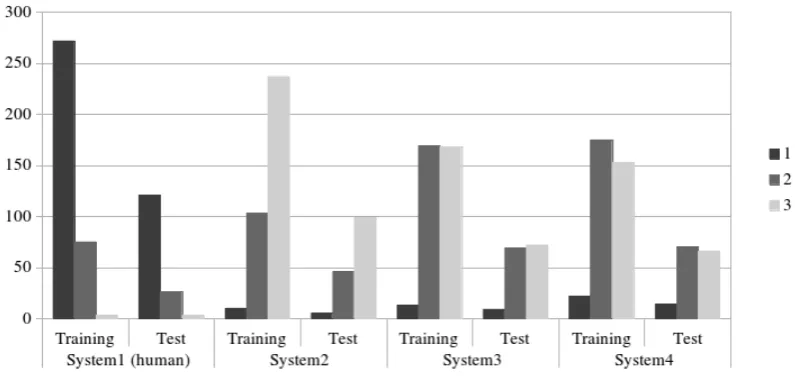
Since the results varied for different languages pairs, we further inspected them for each language pair. First, we looked at the true scores distribution and realised that the first batch of translations for each language pair was probably the human refer-ence since the percentage of 1s – the best quality score – was much higher for this system (see Fig-ure 1 for EN-DE as an example). By using this human translation as a reference for the other MT systems, we computed BLEU for each sentence
DE-EN EN-DE EN-ES ES-EN Mean 0.67 0.68 0.46 0.58
BL 0.65 0.64 0.52 0.57
[image:4.595.174.426.62.120.2]BL+Consensus 0.63 0.64 0.49 0.57
Table 1: Scoring results for Task 1.1 in terms of MAE
DE-EN EN-DE EN-ES ES-EN
BL 0.21 0.23 0.14 0.12
BL+Consensus 0.28 0.26 0.21 0.23
Table 2: Ranking results for Task 1.1 in terms of DeltaAvg
and averaged these values. The results are shown in Table 3.
For DE-EN, EN-DE and EN-ES, the various systems appeared to be less dissimilar in terms of BLEU, when compared to ES-EN. For ES-EN, the difference between the two MT systems was higher than for other language pairs (0.12 for the test set and 0.11 for the training set). Moreover, for DE-EN, EN-DE and EN-ES, the difference be-tween the averaged BLEU score of the training set and the average BLEU score of the test set is very small (smaller than 0.01). For ES-EN, however, the difference between the scores for the training and test sets was also higher (0.04 for System1 and 0.03 for System2). This can be one reason why the consensual features did not show improvements for this language pair. Since the systems are con-siderably different and also there is a considerable difference between training and test sets, the data can be too noisy to be used as pseudo-references.
For EN-DE, the reasons for the bad perfor-mance of consensual features are not clear. This language pair showed the worst average quality scores for all systems. Reasons for this can include characteristics of German language, such as com-pound words which are not well treated in MT, and complex grammar. One hypothesis is that these low BLEU scores (as Table 3 shows) introduce noise instead of useful information for QE. An-other difference that appeared only in EN-DE was the distributions of the scores across the different systems. As Figure 1 shows, System1 has a dis-tribution considerably different from the other two systems. For the other language pairs, the distribu-tions across different systems were more uniform. This difference can be another factor influencing the results for this language pair.
Table 4 shows the results for scoring (MAE) and Table 5 shows the results for ranking (DeltaAvg)
for Tasks 1.2 and 1.3.
Task 1.2 Task 1.3 Mean 16.93 23.34
BL 15.23 21.49
[image:4.595.321.506.257.314.2]BL+Consensus 13.61 21.48
Table 4: Scoring results of Tasks 1.2 and 1.3 in terms of MAE
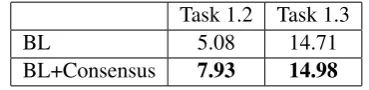
Task 1.2 Task 1.3
BL 5.08 14.71
[image:4.595.323.508.370.415.2]BL+Consensus 7.93 14.98
Table 5: Ranking results of Tasks 1.2 and 1.3 in terms of DeltaAvg
For Tasks 1.2 and 1.3 the use of consensual information only slightly improved the baseline results for scoring. For the ranking variant, BL+Consensus achieved better results, but only significantly so for Task 1.2. Therefore, consen-sual information seems useful to rank sentences according to predicted HTER, its contribution to predicting actual HTER is not noticeable. For post-editing time as quality labels, the improve-ment achieved with the use of consensual infor-mation was marginal.
4 Conclusions
DE-EN EN-DE EN-ES ES-EN Sys1 Sys2 Sys1 Sys2 Sys3 Sys1 Sys2 Sys3 Sys1 Sys2 Average BLEU
(test) 0.31 0.25 0.20 0.19 0.21 0.36 0.29 0.32 0.44 0.32
Average BLEU
[image:5.595.87.511.61.148.2](training) 0.31 0.26 0.21 0.18 0.22 0.35 0.29 0.31 0.40 0.29
Table 3: Average BLEU of systems in Task 1.1
Figure 1: Distribution of true quality scores for the EN-DE language pair
The use of several references with the hypoth-esis that they share consensual information has been shown useful in some settings, particularly in Task 1.1. In others, the results were inconclu-sive. In particular, the approach does not seem ap-propriate for scenarios where the MT systems are considerably different (as shown in Table 3). In those cases, better ways to exploit consensual in-formation need to be investigated further.
Acknowledgements: This work was supported
by the EXPERT (EU Marie Curie ITN No. 317471) project.
References
Joshua S. Albrecht and Rebecca Hwa. 2008. The role of pseudo references in mt evaluation. In Pro-ceedings of WMT 2008, pages 187–190, Columbus, Ohio, USA.
Satanjeev Banerjee and Alon Lavie. 2005. Meteor: An automatic metric for mt evaluation with improved correlation with human judgments. InProceedings of the ACL 2005 Workshop on Intrinsic and Extrinsic Evaluation Measures for MT and/or Summarization. Jes´us Gim´enez and Llu´ıs M`arquez. 2010. Asiya: An
Open Toolkit for Automatic Machine Translation (Meta-)Evaluation. The Prague Bulletin of Mathe-matical Linguistics, (94):77–86.
Chin-Yew Lin and Franz J. Och. 2004. Automatic Evaluation of Machine Translation Quality Using Longest Common Subsequence and Skip-Bigram Statics. In Proceedings of ACL 2004, Barcelona, Spain.
Annie Louis and Ani Nenkova. 2013. Automatically assessing machine summary content without a gold standard. Computational Linguistics, 39(2):267– 300, June.
Kishore Papineni, Salim Roukos, Todd Ward, and Wei jing Zhu. 2002. Bleu: a method for automatic evalu-ation of machine translevalu-ation. InProceedings of ACL 2002, pages 311–318, Philadelphia, USA.
Kashif Shah, Trevor Cohn, and Lucia Specia. 2013. An Investigation on the Effectiveness of Features for Translation Quality Estimation. InProceedings of the XIV MT Summit, pages 167–174, Nice, France. Matthew Snover, Bonnie Dorr, Richard Schwartz,
Lin-nea Micciulla, and John Makhoul. 2006. A study of translation edit rate with targeted human annotation. InProceedings of AMTA 2006, pages 223–231. Radu Soricut and Abdessamad Echihabi. 2010.
[image:5.595.99.497.185.373.2]Transla-tions via Ranking. InProceedings of the ACL 2010, pages 612–621, Uppsala, Sweden.
Radu Soricut and Sushant Narsale. 2012. Combin-ing Quality Prediction and System Selection for Im-proved Automatic Translation Output. In Proceed-ings of WMT 2012, Montreal, Canada.
Radu Soricut, Nguyen Bach, and Ziyuan Wang. 2012. The SDL Language Weaver Systems in the WMT12 Quality Estimation Shared Task. InProceedings of WMT 2012, Montreal, Canada.