Recognizing Biomedical Named Entities using Skip-chain Conditional
Random Fields
Jingchen Liu Minlie Huang∗ Xiaoyan Zhu Department of Computer Science and Technology
Tsinghua University, Beijing 100084, China [email protected]
{aihuang, zxy-dcs}@tsinghua.edu.cn
Abstract
Linear-chain Conditional Random Fields (CRF) has been applied to perform the Named Entity Recognition (NER) task in many biomedical text mining and infor-mation extraction systems. However, the linear-chain CRF cannot capture long dis-tance dependency, which is very common in the biomedical literature. In this pa-per, we propose a novel study of capturing such long distance dependency by defin-ing two principles of constructdefin-ing skip-edges for a skip-chain CRF: linking sim-ilar words and linking words having typed dependencies. The approach is applied to recognize gene/protein mentions in the lit-erature. When tested on the BioCreAtIvE II Gene Mention dataset and GENIA cor-pus, the approach contributes significant improvements over the linear-chain CRF. We also present in-depth error analysis on inconsistent labeling and study the influ-ence of the quality of skip edges on the la-beling performance.
1 Introduction
Named Entity Recognition (NER) is a key task in most text mining and information extraction sys-tems. The improvement in NER can benefit the final system performance. NER is a challenging task, particularly in the biomedical literature due to the variety of biomedical terminologies and the complicated syntactic structures.
Many studies have been devoted to biomedical NER. To evaluate biomedical NER systems, sev-eral challenge competitions had been held, such as BioNLP/NLPBA in 20041, BioCreAtIvE I in
∗
Corresponding author
1
http://research.nii.ac.jp/˜collier/ workshops/JNLPBA04st.htm
2004 and BioCreAtIvE II in 20062. The overview reports from these competitions, presenting state-of-the-art of biomedical NER studies, show that linear-chain Conditional Random Fields (CRF) is one of the most commonly used models and has the most competitive results (Yeh et al., 2005; Smith et al., 2008). Linear-chain CRF has also been successfully applied to other NLP tasks such as POS-tagging (Lafferty et al., 2001) and sen-tence chunking (Sha and Pereira, 2003). However, in most of these applications, only linear-chain CRF was fully exploited, assuming that only adja-cent words are inter-dependent. The dependency between distant words, which occurs frequently in the biomedical literature, is yet to be captured.
In the biomedical literature, the repeated ap-pearance of same or similar words in one sentence is a common type of long distance dependencies. This phenomenon is due to the complicated syn-tactic structures and the various biomedical termi-nologies in nature. See the following example:
“Both GH deficiency and impaired spinal growth may result in short stature, whereas the occurrence of early puberty in association with GH defi-ciency reduces the time available for GH therapy.”
the mentions of GH are repeated three times. If the entity are referred by a pronoun, the meaning of the sentence will be confusing and unclear be-cause of the complex sentence structure. In this sentence:
“These 8-oxoguanine DNA glycosy-lases, hOgg1 (human) and mOgg1 (murine) , are homologous to each other and to yeast Ogg1.”
the wordshOgg1, mOgg1andOgg1are homolo-gous genes belonging to different species, having
2http://www.biocreative.org/
very similar entity names. Some other types of long distance dependencies also occur frequently in the biomedical literature. For example, in this sentence
“Western immunoblot analysis detected p55gag and its cleavage products p39 and p27 in purified particles derived by expression of gag and gag-pol, respec-tively.”
the words p55gag, p39 and p27 conjuncted by
and, have similar semantic meanings but they are separated by several tokens. A human curator can easily recognize such long distance dependen-cies and annotate these words consistently. How-ever, when applying the linear-chain CRF, incon-sistency errors in annotating these entities could happen due to the inability of representing long distance dependency.
In this paper, we present an approach of cap-turing long distance dependencies between words. We adopte the skip-chain CRF to improve the per-formance of gene mention recognition. We de-fine two principles of connecting skip-edges for skip-chain CRF to capture long distance depen-dencies. The efficacy of the principles is inves-tigated with extensive experiments. We test our method on two data sets and significant improve-ments are observed over the linear-chain CRF. We present in-depth error analysis on inconsistent la-beling. We also investigat whether the quality of connected edges affect the labeling performance.
The remainder of this paper is organized as fol-lows: We survey related studies in Section 2. We introduce linear-chain CRF and skip-chain CRF in Section 3. The method of connecting skip-chain edges is described in Section 4 . In Section 5 we present our experiments and in-depth analysis. We summarize our work in Section 6.
2 Related work
NER is a widely studied topic in text mining research, and many new challenges are seen in domain-specific applications, such as biomedical NER (Zhou et al., 2004). The dictionary based method is a common technique as biomedical the-sauruses play a key role in understanding such text. Most dictionary based NER systems fo-cused on: (1) integrating and normalizing differ-ent biomedical databases to improve the quality of the dictionary to be used; (2) improving matching
strategies that are more suitable for biomedical ter-minologies; and (3) making filtering rules for post-processing to refine the matching results or to ad-just the boundary of entities, see (Fukuda et al., 1998; Narayanaswamy et al., 2003; Yang et al., 2008). Many information extraction systems had a dictionary matching module to perform prelim-inary detection of named entities (Schuhmann et al., 2007; Kolarik et al., 2007; Wang et al., 2010).
Applying machine learning techniques gener-ally obtains superior performance for the biomedi-cal NER task. The automated learning process can induce patterns for recognizing biomedical names and rules for pre- and post-processing. Gener-ally speaking, there are two categories of ma-chine learning based methods: one treats NER as a classification task, while the other treats NER as a sequence labeling task. For the first cate-gory, Support Vector Machine (SVM) was a com-monly adopted model (Kazama et al., 2002; Zhou et al., 2004). Lee et al. (2004) proposed a two-step framework to perform biomedical NER using SVM: firstly detecting the boundaries of named entities using classifiers; secondly classifying each named entity into predefined target types. For the second category, a sentence was treated as a se-quence of tokens and the objective was to find the optimal label sequence for these tokens. The label space was often defined as {B,I,O}, where B in-dicates the beginning token of an entity, I denotes the continuing token and O represents the token outside an entity. The sequence labeling task can be approached by Hidden Markov Model (HMM), Conditional Random Field (CRF) , or a combina-tion of different models (Zhou et al., 2005; Tatar and Cicekli, 2009).
to enhance the recall. Finkel et al. (2005) used Gibbs Sampling to add non-local dependencies into linear-chain CRF model for information ex-traction. However, the CRF models used in these systems were all linear-chain CRFs. To the best of our knowledge, no previous work has been done on using non-linear-chain CRF in the biomedical NER task.
Beyond the biomedical domain, skip-chain CRF has been used in several studies to model long distance dependency. In (Galley, 2006), skip edges were linked between sentences with non-local pragmatic dependencies to rank meetings. In (Ding et al., 2008), skip-chain CRF was used to detect the context and answers from online fo-rums. The most close work to ours was in (Sut-ton and McCallum, 2004), which used skip-chain CRF to extract information from email messages announcing seminars. By linking the same words whose initial letter is capital, the method obtained improvements on extracting speakers’ name. Our work is in the spirit of this idea, but we approach it in a different way. We found that the problem is much more difficult in the biomedical NER task: that is why we systematically studied the princi-ples of linking skip edges and the quality of con-nected edges.
3 linear-chain and skip-chain CRF
Conditional Random Field is a probabilistic graphic model. The model predicts the output variablesyfor each input variables inxby calcu-lating the conditional probability p(y|x) accord-ing to the graph structure that represents the de-pendencies between the y variables. Formally, given a graph structure overy, the CRF model can be written as:
p(y|x) = 1 Z(x)
Y
Cp∈ζ
Y
Ψc∈Cp
Ψc(xc,yc;θp) (1)
Z(x)is a normalization factor.
In this definition, the graph is partitioned into a set of cliques ζ = {C1, C2, . . . Cp}, where each Cp is a clique template. EachΨc, called a factor, is corresponding to one edge in the cliquec, and can be parameterized as:
Ψc(xc,yc;θp) = exp
X
k=1
λpkfpk(xc,yc) (2)
Each feature function fpk(xc,yc) represents one feature ofxand theλpkis the feature weight.
In the training phrase, the parameters is esti-mated using an optimization algorithm such as limited memory BFGS etc. In the testing phrase, CRF finds the most likely label sequence for an unseen instance by maximizing the probability de-fined in (1).
In the NER task, one sentence is firstly tok-enized into a sequences of tokens and each token can be seen as one word. Each node in the graph is usually corresponding to one word in a sentence. Eachxvariable represents a set of features for one word, and eachy is the variable for the label of one word. Note that when one edge is linked tween two words, the edge is actually linked be-tween their correspondingyvariables. Theylabel is one of{B,I,O}, in which B means the beginning word of an entity, I means the inside word of an entity, and O means outside an entity.
If we link each word with its immediate preced-ing words to form a linear structure for one sen-tence, we get a linear-chain CRF, defined as:
pθ(y|x) = 1 Z(x)
T
Y
t=1
Ψt(yt, yt−1,x) (3)
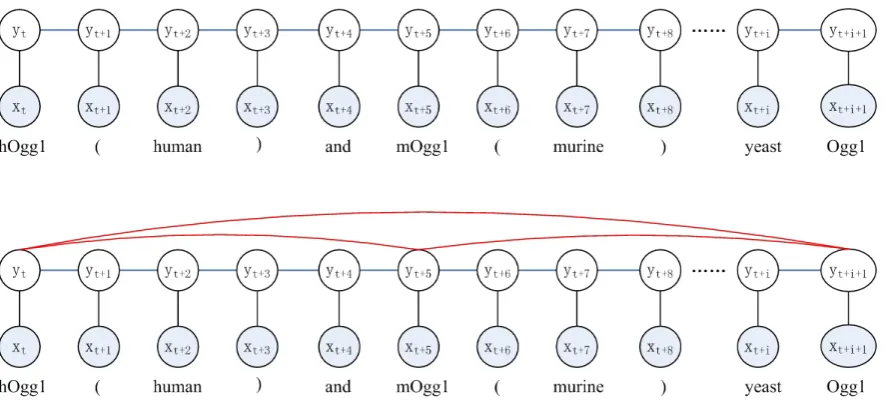
This structure contains only one clique template. If we add an extra clique template that contains some skip edges between nonadjacent words, the CRF become a skip-chain CRF, formulated as fol-lows:
pθ(y|x) = 1 Z(x)
T
Y
t=1
Ψt(yt, yt−1,x)·
Y
(u,v)∈τ
Ψuv(yu, yv,x) (4)
Figure 1: The illustration of chain CRF and skip-chain CRF. The blue edges represent the linear-chain edges belonging to one clique template, while the red edges represent the skip edges belonging to another clique template.
skip edges to avoid making the model impracti-cal. Therefore, it is absolutely necessary to study which kinds of edges will contribute to the perfor-mance while avoiding over-connected edges.
3.1 Features
As our interest is in modifying the CRF graph structure rather than evaluating the effectiveness of features, we simply adopted features from the state-of-the-art such as (McDonald and Pereira, 2005) and (Kuo et al., 2007).
• Common Features: the original word, the stemmed word, the POS-tag of a word, the word length, is or not the beginning or end-ing word of the sentence etc.
• Regular Expression Features: a set of reg-ular expressions to extract orthographic fea-tures for the word.
• Dictionary Features: We use several lexi-cons. For example, a protein name dictionary compiled from SWISS-PROT, a species dic-tionary from NCBI Taxonomy, a drug name dictionary from DrugBank database, and a disease name dictionary from several Internet web site.
• N-gram Features: For each token, we ex-tract the corresponding 2-4 grams into the
feature set.
Each word will include the adjacent words’ fea-tures within{−2,−1,0,1,2}offsets. The features used in the linear-chain CRF and skip-chain CRF are all the same in our experiment.
4 Method
As the limitations discussed above, detecting the necessary nodes to link should be the first step in constructing a skip-chain CRF. In the speaker name extraction task (Sutton and Mc-Callum, 2004), only identical capitalized words are linked, because there is few variations in the speaker’s name. However, gene mentions often involve words without obvious orthographic fea-tures and such phenomena are common in the biomedical literature such asRGC DNA sequence
and multisubunit TFIID protein. If we link all the words likeDNA,sequenceandprotein, the ef-ficiency and performance will drop due to over-connected edges. Therefore, the most important step of detecting gene mentions is to determine which edges should be connected.
4.1 Detect keywords in gene mention
keyword in Gal4 proteinandNS1AinNS1A pro-tein. These words can distinguish gene mentions from other common English words and phrases, and can distinguish different gene mentions as well. We define such words as the keyword of a gene mention. The skip edges are limited to only connect these keywords. We use a rule-based method to detect keywords. By examining the an-notated data, we defined keywords as those con-taining at least one capital letter or digit. And at the same time, keywords must conform to the fol-lowing rules:
• Keywords are not stop words, single letters, numbers, Greek letters, Roman numbers or nucleotide sequence such asATTCCCTGG.
• Keywords are not in the form of an upper-case initial letter followed by lowerupper-case let-ters, such asComparisonandWatson. These words have capital letters only because they are the first word in the sentences, or they are the names of people or other objects. This rule will miss some correct candidates, but reduces noise.
• Keywords do not include some common words with capital letters such as DNA,
cDNA,RNA,mRNA,tRNAetc. and some fre-quently appearing non-gene names such as
HIV and mmHg. We defined a lexicon for such words on the training data.
4.2 Link similar keywords
After keyword candidates are detected, we judge each pair of keywords in the same sentence to find similar word pairs. Each word pair is examined by these rules:
• They are exactly the same words.
• Words only differ in digit letters, such as
CYP1andCYP2.
• Words with the same prefix, such asIgAand
IgG, or with the same suffix, such asANFand
pANF.
The token pair will be linked by a skip edge if they match at least one rule.
4.3 Link typed dependencies
Some long distance dependency cannot be de-tected simply by string similarity. To capture such
dependency, we used stanford parser3to parse sen-tences and extract typed dependencies from parsed results. The typed dependencies are a set of bi-nary relations belonging to 55 pre-defined types to provide a description of the grammatical relation-ships in a sentence (Marneffe and Manning, 2008). Some examples of typed dependencies are listed in Table 1.
Type Description
conj conjuncted by the conjunc-tion such asand
prep prepositional modifier nn noun compound modifier amod adjectival modifier dep uncertain types
Table 1: Examples for typed dependencies.
The output of the parser is pairs of dependent words, along with typed dependencies between two words in a pair. For example, in the sentence:
“. . . and activate transcription of a set of genes that includes G1 cyclins CLN1, CLN2, and many DN, synthesis genes.”
a typed dependencynn(G1,CLN1)is extracted by the parser, meaning the wordsG1andCLN1has a typed dependency ofnnbecause they form a noun phrase under a dependency grammar: modifica-tion. Similarly, in the sentence
“Using the same approach we have shown that hFIRE binds the stimula-tory proteins Sp1 and Sp3 in addition to CBF.”
the wordsSp1andSp3can be detected to have a typed dependency ofconj and, and the two words have a typed denpendency ofprep in addition to
with CBF, respectively. The most common type dependencies areconj and,nnanddep. The key-words having typed dependencies will be linked by a skip edge.
5 Experiment
We tested our method on two datasets: the Gene Mention (GM) data in BioCreAtIvE II (BCIIGM)
3http://nlp.stanford.edu/software/
4and GENIA corpus5. The BCIIGM dataset was
used in the BioCreAtIvE II Gene Mention Recog-nition task in 2006. It was built from the GENE-TAG corpus (Tanabe et al., 2005) with some mod-ification of the annotation. The dataset contains 15000 sentences for training and 5000 sentences for testing. Two gold-standard sets, GENE and ALTGENE, were provided for evaluation and an official evaluation procedure in Perl script was provided. The ALTGENE set provides alternate forms for genes in the GENE set. In the official evaluation, each identified string will be looked up in both GENE and ALTGENE. If the correspond-ing gene was found in either GENE or ALTGENE, the identified string will be counted as a correct answer.
The GENIA corpus is a widely used dataset in many NER and information extraction tasks due to its high quality annotation. The GENIA corpus contains 2000 abstracts from MEDLINE, with ap-proximately 18500 sentences. The corpus was an-notated by biomedical experts according to a pre-defined GENIA ontology. In this work, we only used the annotated entities that have a category of protein, DNA, or RNA. These categories are re-lated to the definition of gene mention in BioCre-AtIvE II. We only used strict matching evaluation (no alternate forms check) for the GENIA corpus as no ALTGENE-like annotation is available.
The performance is measured by precision, re-call and F score. Each identified string is counted as a true positive (TP) if it is matched by a gold-standard gene mention, otherwise the identified string is a false positive (FP). Each gold standard gene mention is counted as a false negative (FN) if it is not identified by the approach. Then the pre-cision, recall and their harmonic average F score is calculated as follows:
precision= T P T P +F P
recall= T P T P +F N
F = 2·precision·recall precision+recall
To implement both linear-chain CRF and
skip-4http://sourceforge.net/projects/
biocreative/files/
5http://www-tsujii.is.s.u-tokyo.ac.jp/
GENIA/home/wiki.cgi?page=Technical+Term+ Annotation
chain CRF, we used the GRMM Java package6 which is an extended version of MALLET. The package provides an implement of arbitrary struc-ture CRF.
5.1 Result Comparison
We evaluated our approach on the BCIIGM dataset and GENIA corpus. For the BCIIGM dataset, two evaluation criteria were used: official
- exactly the same as that used in the BioCreAtIvE II competition, with the official evaluation proce-dure; andstrict- strict matching for each identi-fied string without checking its alternate forms in ALTGENE. The GENIA dataset were randomly divided into 10 parts to perform a 10-fold cross validation. However, we didn’t do cross validation on the BCIIGM dataset because the BioCreAtIvE II competition annotations and evaluation proce-dure were tailored to evaluating participating sys-tems.
The comparative results are listed in Table 2. We compared the two edge linking principles, linking similar words and linking words having typed dependencies. The F score from the skip-chain CRF is better than that from the linear-skip-chain CRF. Significance tests were performed to check whether these results have significant differences. Paired two-tail t-tests were conducted with respect to the F scores of linear-chain CRF vs. those of the two skip-chain CRFs, respectively. The p-value was1.989×10−7for the skip-chain CRF linked by similar words vs. linear-chain CRF. The p-value was3.971×10−5 for the skip-chain CRF linked by typed dependencies vs. linear-chain CRF. This shows that the improvement is significant.
Note that we did not compare our results on the BCIIGM dataset to those submitted to the compe-tition. There are two reasons for this: First, our focus is on comparing the skip-chain CRF with the linear-chain CRF. Second, in the competition, most participating systems that used CRF also applied other algorithms, or sophisticated rules for adjusting detected boundaries or refining the recognized results, to achieve competitive perfor-mance. By contrast, we did not employ any post-processing rule or algorithm to further improve the performance. In this sense, comparing our results to those has become unfair.
6http://mallet.cs.umass.edu/grmm/
Data Model Precision(%) Recall(%) F score(%)
BCIIGM official
linear-chain CRF 85.16 81.50 83.29
skip-chain CRF linked by sim-words 86.68 82.75 84.67 skip-chain CRF linked by typed-dep 86.73 82.36 84.49
BCIIGM strict
linear-chain CRF 74.09 69.49 71.73
skip-chain CRF linked by sim-words 76.26 71.53 73.82 skip-chain CRF linked by typed-dep 75.99 70.49 73.14
GENIA
linear-chain CRF 76.77 74.92 75.83
skip-chain CRF linked by sim-words 78.57 77.12 77.82 skip-chain CRF linked by typed-dep 78.18 76.87 77.52
Table 2: The result comparison between the linear-chain CRF and skip-chain CRF. BCIIGM is the BioCreAtIvE II Gene Mention Recognition dataset. official means using the official provided evalua-tion procedure andstrictmeans using strict matching to evaluate the results. sim-wordsmeans similar words andtyped-depmeans typed dependencies. The results for GENIA are averaged over 10-fold cross validation.
5.2 Discussion
We provided in-depth analysis of our results on the BCIIGM dataset. As one of our motivations for connecting words with skip edges is to enhance the consistency of labeling, we firstly examined whether the proposed approach can provide con-sistent labeling. Let us start from two typical ex-amples. In the first sentence
“The response sequences were localized between -67 and +30 in the simian cy-tomegalovirus IE94 promoter and up-stream of position +9 in the HCMV IE68 promoter.”
the word IE94 is missed (not labeled) while its similar word IE68 is labeled correctly by the linear-chain CRF. In the second sentence
“It is suggested that biliary secretion of both TBZ and FBZ and their metabolites may contribute to this recycling.”
the word TBZ is labeled as a gene mention in-correctly (false positive) while its similar word
FBZ is not labeled at all (true negative) by the linear-chain CRF. Both sentences are correctly la-beled by the skip-chain CRF. Similar improve-ments are also made by the skip-chain CRF model linked by typed dependencies. To study label-ing consistency, we counted the statistics of in-consistency errors, as shown in Table 3. Two kinds of inconsistency errors were counted: false negatives correctable by consistency (FNCC) and false positives correctable by consistency (FPCC).
An FNCC means that a gold-standard mention is missed by the system while its skip edge linked gene mention is correctly labeled, which is simi-lar to theinconsistent missin (Sutton and McCal-lum, 2004), as the IE94in the first example. An FPCC means a non-gene mention is labeled as a gene while its skip edge linked mention (also non-gene mention) is not recognized, asTBZin the sec-ond example. These two kinds of inconsistency er-rors lead to inconsistent false negatives (FN) and false positives (FP). A good model should reduce as much inconsistency errors as possible. The in-consistency errors are reduced substantially as we expected, showing that the reduction of inconsis-tency errors is one reason for the performance im-provements.
Skip edge
Model FPCC FNCC type
sim-words linear-chain 112 70 skip-chain 48 20 Percentage of reduction 57.14% 71.43%
typed-dep linear-chain 32 29
skip-chain 9 5
Percentage of reduction 71.88% 82.76%
Table 3: Statistics of inconsistency errors for the linear-chain CRF and skip-chain CRF. FPCC
is false positives correctable by consistency and
FNCC is false negatives correctable by consis-tency in the table. The percentage is calculated by dividing the reduction of errors by the error number of linear-chain CRF, for example(112−
48)/48 = 57.14%.
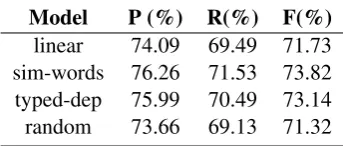
approximately equals to that in the skip-chain CRF linked by similar words. The percentage of cor-rect skip-edges in this model is small, as shown in the last row of Table 4. We tested this skip-chain CRF model on the BCIIGM dataset under the strict matching criterion. The performance of the randomly linked skip-chain CRF is shown in Table 5. As can be seen from the table, the perfor-mance of the randomly connected skip-chain CRF droped remarkably, even worse than that of the linear-chain CRF. This confirms that the quality of skip edges is a key factor for the performance improvement.
Model Edges Correct Percentage edges
sim-words 1912 1344 70.29% typed-dep 728 425 53.38%
[image:8.595.330.502.64.137.2]random 1906 41 2.15%
Table 4: Statistics of skip edges and correct skip edges for the skip-chain CRF models. sim-words means the skip-chain CRF linked by sim-ilar words, typed-dep means the CRF linked by typed dependencies and random means the skip-chain CRF has randomly connected skip edges. The edges are counted in the BCIIGM testing data.
From the above discussion, we summarize this section as follows: (1) the skip-chain CRF with high quality skip edges can reduce inconsistent la-beling errors, and (2) the quality of skip edges is crucial to the performance improvement.
[image:8.595.74.289.66.178.2]Model P (%) R(%) F(%) linear 74.09 69.49 71.73 sim-words 76.26 71.53 73.82 typed-dep 75.99 70.49 73.14 random 73.66 69.13 71.32
Table 5: Performance comparison between the randomly linked skip-chain CRF and other mod-els. The result was tested on the BCIIGM dataset under the strict matching criterion. P, R and F
denote the precision, recall and F score respec-tively. linear denotes the linear-chain CRF. sim-wordsdenotes the skip-chain CRF linked by sim-ilar words. typed-depdenotes the skip-chain CRF linked by typed dependencies. random denotes the skip-chain CRF having randomly linked skip edges.
6 Conclusion
This paper proposed a method to construct a skip-chain CRF to perform named entity recognition in the biomedical literature. We presented two prin-ciples to connect skip edges to address the issue of capturing long distance dependency: linking similar keywords and linking words having typed dependencies. We evaluated our method on the BioCreAtIvE II GM dataset and GENIA corpus. Significant improvements were observed. More-over, we presented in-depth analysis on inconsis-tent labeling errors and the quality of skip edges. The study shows that the quality of linked edges is a key factor of the system performance.
The quality of linked edges plays an important role in not only performance but also time effi-ciency. Thus, we are planning to apply machine learning techniques to automatically induce pat-terns for linking high-quality skip-edges. Further-more, to refine the recognition results, we are plan-ning to employ post-processing algorithms or con-struct refinement rules.
Acknowledgments
References
Shilin Ding, Gao Cong, Chin-Yew Lin and Xiaoyan Zhu. 2008. Using Conditional Random Fields to Extract Contexts and Answers of Questions from On-line Forums. In Proceedings of 46th Annual Meet-ing of the Association for Computational LMeet-inguistics (ACL’08), pp 710-718.
Jenny Rose Finkel, Trond Grenager, and Christopher Manning. 2005. Incorporating Non-local Informa-tion into InformaInforma-tion ExtracInforma-tion Systems by Gibbs Sampling. Proceedings of the 43rd Annual Meeting of the ACL, pages 363C370.
K. Fukuda, A. Tamura, T. Tsunoda and T. Takagi. 1998. Toward information extraction: identifying protein names from biological papers. Pacific Sym-posium on Biocomputing. 1998.
Michel Galley. 2006. A Skip-Chain Conditional Ran-dom Field for Ranking Meeting Utterances by Im-portance. Proceedings of the 2006 Conference on Empirical Methods in Natural Language Processing (EMNLP 2006), pages 364-372.
Han-Shen Huang, Yu-Shi Lin, Kuan-Ting Lin, Cheng-Ju Kuo, Yu-Ming Chang, Bo-Hou Yang, I-Fang Chung and Chun-Nan Hsu. 2007. High-recall gene mention recognition by unification of multiple back-ward parsing models. Proceedings of the Second BioCreative Challenge Evaluation Workshop, pages 109-111.
Jun’ichi Kazama, Takaki Makino, Yoshihiro Ohta and Jun’ichi Tsujii. 2002. Tuning support vector machines for biomedical named entity recognition. Proceedings of the ACL-02 workshop on Natural language processing in the biomedical domain - Vol-ume 3.
Corinna Kolarik, Martin Hofmann-Apitius, Marc Zim-mermann and Juliane Fluck. 2007. Identification of new drug classification terms in textual resources. Bioinformatics 2007 23(13):i264-i272
Cheng-Ju Kuo, Yu-Ming Chang, Han-Shen Huang, Kuan-Ting Lin, Bo-Hou Yang, Yu-Shi Lin, Chun-Nan Hsu and I-Fang Chung. 2007. Rich Feature Set, Unification of Bidirectional Parsing and Dictio-nary Filtering for High F-Score Gene Mention Tag-ging. Proceedings of the Second BioCreative Chal-lenge Evaluation Workshop, pages 105-107.
Ki-Joong Lee, Young-Sook Hwang, Seonho Kim and Hae-Chang Rim. 2004. Biomedical named entity recognition using two-phase model based on SVMs. Journal of Biomedical Informatics, Volume 37, Issue 6, December 2004, Pages 436-447.
John Lafferty, Andrew McCallum and Fernando Pereira. 2001. Conditional random fields: Prob-abilistic models for segmenting and labeling se-quence data. In Proc. ICML-01, pages 282-289, 2001.
Ryan McDonald and Fernando Pereira. 2005. Identi-fying gene and protein mentions in text using con-ditional random fields. BMC Bioinformatics 2005, 6(Suppl 1):S6.
Marie-Catherine de Marneffe and Christopher D. Man-ning. 2008. Stanford typed dependencies manual.
M. Narayanaswamy, K.E. Ravikumar and K. Vijay-Shanker. 2003. A biological named entity recog-nizer. Pacific Symposium on Biocomputing. 2003.
Dietrich Rebholz-Schuhmann, Harald Kirsch, Miguel Arregui, Sylvain Gaudan, Mark Riethoven and Pe-ter Stoehr. 2007. EBIMedłtext crunching to gather facts for proteins from Medline. Bioinformatics 2007 23(2):e237-e244
Fei Sha and Fernando Pereira. 2003. Shallow Pars-ing with Conditional Random Fields. Proceedings of HLT-NAACL 2003, Main Papers, pp.134-141
Larry Smith, Lorraine K Tanabe, et al. 2008.
Overview of BioCreative II gene mention recogni-tion. Genome Biology 2008, 9(Suppl 2):S2.
Charles Sutton and Andrew McCallum. 2004. Collec-tive Segmentation and Labeling of Distant Entities in Information Extraction. ICML workshop on Sta-tistical Relational Learning, 2004.
Lorraine Tanabe, Natalie Xie, Lynne H Thom, Wayne Matten and W John Wilbur. 2005. GENETAG: a tagged corpus for gene/protein named entity recog-nition. BMC Bioinformatics 2005, 6(Suppl 1):S3
Serhan Tatar and Ilyas Cicekli. 2009. Two learning approaches for protein name extraction. Journal of Biomedical Informatics 42(2009) 1046-1055
Xinglong Wang, Jun’ichi Tsujii and Sophia Anani-adou. 2010. Disambiguating the species of biomed-ical named entities using natural language parsers. Bioinformatics 2010 26(5):661-667
Zhihao Yang, Hongfei Lin and Yanpeng Li. 2008. Ex-ploiting the performance of dictionary-based bio-entity name recognition in biomedical literature. Computational Biology and Chemistry 32(2008) 287-291.
Alexander Yeh, Alexander Morgan, Marc Colosimo and Lynette Hirschman. 2005. BioCreAtIvE Task 1A: gene mention finding evaluation. BMC Bioin-formatics 2005, 6(Suppl 1):S2.
GuoDong Zhou, Jie Zhang, Jian Su, Dan Shen, ChewLim Tan. 2004. Recognizing names in biomedical texts: a machine learning approach. Bioinformatics 2004, Vol.20(7),pp.1178C1190.