Concept Classification with Bayesian Multi-task Learning
Marcel van Gerven Radboud University Nijmegen
Intelligent Systems Heyendaalseweg 135 6525 AJ
Nijmegen, The Netherlands [email protected]
Irina Simanova
Max Planck Institute for Psycholinguistics Wundtlaan 1 6525 XD
Nijmegen, The Netherlands [email protected]
Abstract
Multivariate analysis allows decoding of sin-gle trial data in individual subjects. Since dif-ferent models are obtained for each subject it becomes hard to perform an analysis on the group level. We introduce a new algorithm for Bayesian multi-task learning which imposes a coupling between single-subject models. Us-ing the CMU fMRI dataset it is shown that the algorithm can be used for concept classifica-tion based on the average activaclassifica-tion of regions in the AAL atlas. Concepts which were most easily classified correspond to the categories shelter, manipulation and eating, which is in accordance with the literature. The multi-task learning algorithm is shown to find regions of interest that are common to all subjects which therefore facilitates interpretation of the ob-tained models.
1 Introduction
Multivariate analysis allows decoding of neural rep-resentations at the single trial level in single sub-jects. Its introduction into the field of cognitive roscience has led to novel insights about the neu-ral representation of cognitive functions such as lan-guage (Mitchell et al., 2008), memory (Hassabis et al., 2009), and vision (Miyawaki et al., 2008).
However, interpretation of the models obtained using a multivariate analysis can be hard due to the fact that different models are obtained for indi-vidual subjects. For example, when analyzing K
separately acquired datasets, K sets of model pa-rameters will be obtained which may or may not show a common pattern. In some sense, we are in
need of a second-level analysis such that we can draw inferences on the group level, as in the con-ventional analysis of neuroimaging data using the general linear model. One way to achieve this in the context of multivariate analysis is by means of multi-task learning, a special case of transfer learn-ing (Thrun, 1996) where model parameters for dif-ferent tasks (datasets) are estimated simultaneously and no longer assumed to be independent (Caru-ana, 1997). In an fMRI context, multi-task learning has been explored using canonical correlation anal-ysis (Rustandi et al., 2009).
In a Bayesian setting, multi-task learning is typ-ically realized by assuming a hierarchical Bayesian framework where shared prior distributions condi-tion task-specific parameters (Gelman et al., 1995). In this paper, we explore a new Bayesian approach to multi-task learning in the context of concept clas-sification; i.e., the prediction of the semantic cate-gory of concrete nouns from BOLD response. Effec-tively, we are using a shared prior to induce param-eter shrinkage. We show that Bayesian multi-task learning leads to more interpretable models, thereby facilitating the interpretation of the models obtained using multivariate analysis.
2 Bayesian multi-task learning
The goal of concept classification is to predict the semantic categoryy of a presented (and previously unseen) concrete noun from the measured BOLD re-sponsex. In this paper, we will use Bayesian logis-tic regression as the underlying classification model. Let B(y;p) = py(1−p)1−y denote the Bernoulli distribution andl(x) = log(x/(1−x))the logit link
s=0
β
1β
2−2 −1
0 1 2
−2
−1
0
1
2
s=10
β
1β
2−2 −1
0 1 2
−2
−1
0
1
2
s=100
β
1β
2−2 −1
0 1 2
−2
[image:2.612.84.528.63.223.2]−1
0
1
2
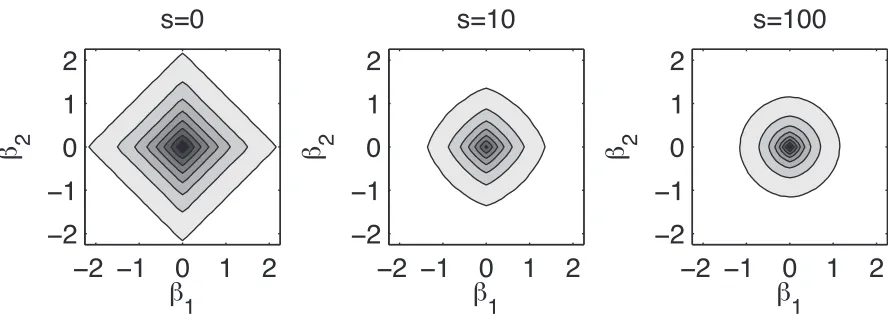
Figure 1: Contour plots of samples drawn from the prior for two regression coefficientsβ1andβ2given three different values of the coupling strengths. For uncoupled covariates, the magnitude of one covariate has no influence on the magnitude of the other covariate. For strongly coupled covariates, in contrast, a large magnitude of one covariate increases the probability of a large magnitude in the other covariate.
function. We are interested in the following predic-tive density:
p(y|x,D,Θ) =
Z
B(y;l−1(xTβ))p(β|D,Θ)dβ
where we integrate out the regression coefficientsβ
and condition on the response x, observed training data D = (y,X) and hyper-parameters Θ. Using Bayes rule, we can write the second term on the right hand side as
p(β|D,Θ)∝p(D|β)p(β|Θ) (1)
where
p(D|β) =Y
n
B(yn;l−1(xTnβ))
is the likelihood term, which does not depend on the hyper-parameters Θ, andp(β | Θ) is the prior on the regression coefficients.
Let N(x;µ,Θ) denote a multivariate Gaussian with meanµand covariance matrixΘ. In order to couple the tasks in a multi-task problem, we will use the multivariate Laplace prior, which can be written as a scale-mixture using auxiliary variables u and
v(van Gerven et al., 2010):
p(β|Θ) =
Z Y
k
N(βk; 0, u2k+v2k) !
× N(u;0,Θ)N(v;0,Θ)dudv
The multivariate Laplace prior allows one to con-trol the prior variance of the regression coefficients
βthrough the covariance matrixΘof the auxiliary variablesuandv. This covariance matrix is conve-niently specified in terms of the precision matrix:
Θ−1 = 1
θVRV.
Here, θ is a scale parameter which controls regu-larization of the regression coefficients towards zero andRis a structure matrix whererij = −s speci-fies a fixed coupling strengthsbetween covariatei
and covariatej. A negativerij penalizes differences between covariates i and j, see van Gerven et al. (2010) for details. Vis a scaling matrix whose sole purpose is to ensure that the prior variance of the auxiliary variables is independent of the coupling strength.1 Figure 1 shows the multivariate Laplace prior for two covariates and three different coupling strengths.
The specification of the prior in terms of θ and
R promotes sparse solutions and allows the inclu-sion of prior knowledge about the relation between covariates. The posterior marginals for the latent variables (β,u,v) can be approximated using ex-pectation propagation (Minka, 2001) and the poste-rior variance of the auxiliary variablesui (orvi by symmetry) can be interpreted as a measure of
im-1Vis a matrix withp
portance of the corresponding covariate xi since it eventually determines how large the regression co-efficientsβican become.
Interpretation becomes complicated whenever we have collected multiple datasets for the same task since each corresponding model may give differ-ent results regarding the importance of the co-variates used when solving the classification prob-lem. Multi-task learning presents a solution to this problem by dropping the assumption that datasets {D1, . . . ,DK} are independent. Here, this is eas-ily realized using the multivariate Laplace prior by working with the augmented dataset
D∗=
y1 y2 .. . yK ,
X1 0 0 0
0 X2 0 0
0 0 . .. 0
0 0 0 XK
and by assuming that each covariate is coupled be-tween datasets. I.e., the structure matrix is given by elements
rij =
−s ifi6=jand
(i−j)modP = 0 1 + (K−1)·s ifi=j
0 otherwise
whereP stands for the number of covariates in each dataset. In this way, we have coupled covariates over datasets with coupling strengths. Note that this cou-pling is realized on the level of the auxiliary vari-ables and not on the regression coefficients. Hence, coupled auxiliary variables control the magnitude of the regression coefficientsβbut theβ’s themselves can still be different for the individual subjects.
3 Experiments
In order to test our approach to Bayesian multi-task learning for concept classification we have made use of the CMU fMRI dataset2, which consists of sixty concrete concepts in twelve categories. The dataset was collected while nine English speakers were presented with sixty line drawings of objects with text labels and were instructed to think of the same properties of the stimulus object consistently during each presentation. For each concept there are
2http://www.cs.cmu.edu/∼tom/science2008
six instances per subject for which BOLD response in multiple voxels was measured.
In our experiments we assessed whether previ-ously unseen concepts from two different categories (e.g.,building-tool) can be classified correctly based on measured BOLD response. To this end, all con-cepts belonging to two out of the twelve semantic categories were selected. Subsequently, we trained a classifier on all concepts belonging to these two categories save one. The semantic category of the six instances of the left-out concept were then pre-dicted using the trained classifier. This procedure was repeated for each of the concepts and classifi-cation performance was averaged over all concepts. This performance was computed for all of the 66 possible category pairs.
In order to determine the effect of multi-task learning, results were obtained when assuming no coupling between datasets (s= 0) as well as when assuming a very strong coupling between datasets
(s = 100). The scale parameter was fixed toθ = 1. In order to allow the coupling to be made, all datasets are required to contain the same features. One way to achieve this is to warp the data for each subject from native space to normalized space and to perform the multi-task learning in normalized space. Here, in contrast, we computed the average activa-tion in 116 predefined regions of interest (ROIs) us-ing the AAL atlas (Tzourio-Mazoyer et al., 2002). ROI activations were used as input to the classifier. This considerably reduces computational overhead since we need to couple just 116 ROIs instead of approximately 20000 voxels between all nine sub-jects.3Furthermore, it facilitates interpretation since results can be analyzed at the ROI level instead of at the single voxel level. Of course, this presupposes that category-specific information is captured by the average activation in predefined ROIs, which is an important open question we set out to answer with our experiments.
4 Results
4.1 Classification of category pairs
We achieved good classification performance for many of the category pairs both with and
with-3
animal
bodypart building buildpart clothing furniture
insect
kitchen
manmade
tool
vegetable
vehicle
animal bodypart building buildpart clothing furniture insect kitchen manmade tool vegetable vehicle
0.5 0.55 0.6 0.65 0.7 0.75
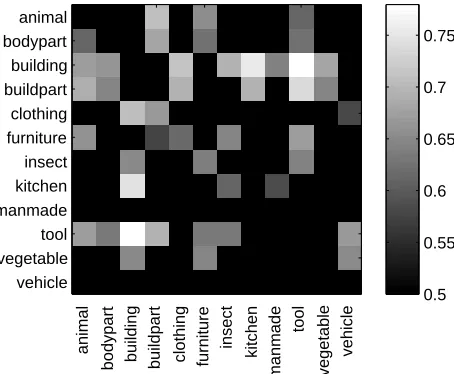
Figure 2: Accuracies for concept classification of the 66 category pairs. The upper triangular part shows the re-sults of multi-task learning whereas the lower triangular part shows the results of standard classification. Non-significant outcomes have been masked (Wilcoxon rank sum test on outcomes for all nine subjects, p=0.05, Bon-ferroni corrected).
out multi-task learning. Figure 2 shows these re-sults where non-significant outcomes have been masked. Interestingly, outcomes for all subjects showed a preference for particular category pairs. The concepts from building-tool, building-kitchen
andbuildpart-toolhad the highest mean classifica-tion accuracies (proporclassifica-tion of correctly classifier tri-als) of 0.78, 0.76 and 0.74, closely followed by con-cepts from building-clothing and animal-buildpart
with a mean classification accuracy of 0.71.
This result bears a strong resemblance to the re-cent work of Just et al. (2010). The authors con-ducted a factor analysis of fMRI brain activation in response to presentations of written words of differ-ent categories and discovered three semantic factors with the highest predictive potential: manipulation, eating and shelter-entry. They subsequently used these factors to select voxels for a features set and were able to accurately identify the activation gen-erated by concrete word using multivariate learning methods on the basis of selected voxels. Moreover, using the factor-related activation profiles they were able to identify common neuronal signatures for par-ticular words across participants. The authors
sug-Table 1: Stimulus words from the semantic categories that showed best classification accuracies. Superscripts indicate the words belonging to the list of ten words with highest factor scores in the study by Just et al. (Just, 2010). We use the following abbreviations: s = shelter, m = manipulation, e = eating.
Building Buildpart Tool Kitchen
apartments window chiselm glasse
barn doors hammerm knifem
houses chimney screwdriverm bottle
churchs closets pliersm cupe
igloo arch sawm spoonm
gest the revealed factors to represent major semantic dimensions that relate to the ways the human being can interact with an object. Although they assume the existence of other semantic attributes that deter-mine conceptual representation, the factors shelter, manipulation and eating are proposed to be domi-nant for the particular set of nouns. It is easy to draw an analogy as the set of words used by Just and col-leagues was exactly the same as in the current study. Although the taxonomic categorization used in our study does not exactly match the factor-based cate-gorization, most of the items from categories build-ing,buildpart,toolandkitchenshow a strong corre-spondence with one of the semantic factors and are listed among ten words with highest factor scores according to Just et al. (2010) (see Table 1).
The subsets of items that are set far apart in the suggested semantic dimensions appear to be pre-ferred by the classifier in our study. The classifier was not able to identify the category of an unseen concept in pairsbuilding-buildpartandtool-kitchen, possibly since they these categories shared the same semantic features. Thus, the current study brings an independent corroboration for the finding on the se-mantic dimensions underlying concrete noun repre-sentation.
4.2 Single versus multi-task learning
[image:4.612.75.302.62.249.2]1 2 3 4 5 6 7 8 9 0.5
0.55 0.6 0.65 0.7 0.75 0.8
subject
accuracy
[image:5.612.77.298.57.199.2]standard multi-task
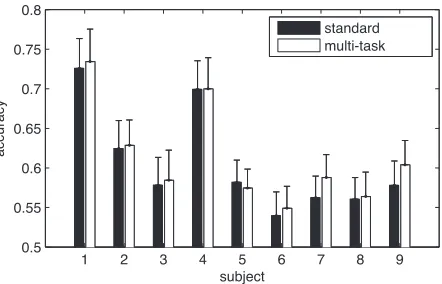
Figure 3: Classification performance per subject aver-aged over all category pairs for standard classification and multi-task learning (error bars show standard error of the mean).
to multi-task learning seems to improve classifica-tion results slightly in most of subjects, although the improvement is not significant.
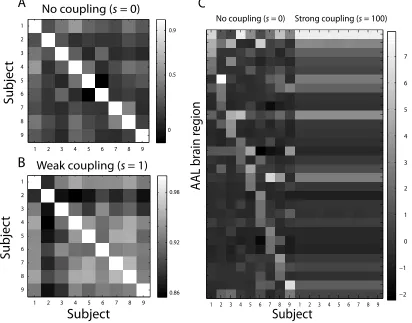
The main outcome and advantage of our approach to multi-task learning is the convergence of models obtained from different subjects. Figure 4 shows that the subject-specific models become strongly correlated when they are obtained in the multi-task setting, even for weak coupling strengths. For strong coupling strengths, the models are almost perfectly correlated, resulting in identical models for all the nine subjects as shown in Fig. 4 for the category pair
building-tool. It is important to realize here that the model is defined in terms of the variance of the aux-iliary variables, which acts as a proxy to the impor-tance of a region. At the level of the regression coef-ficients β, the model will still find subject-specific parameters due to the likelihood term in Eq. (1). Even though the contribution of each brain region is constrained by the induced coupling, this does not impede but rather improve classification perfor-mance. This fact entitles us to believe that our ap-proach to multi-task learning tracks down the com-mon task-specific activations while ignoring back-ground noise.
Our study demonstrates that Bayesian multi-task learning allows generalization across subjects. Our algorithm identifies identical cortical locations as being important in solving the classification prob-lem for all individuals within the group. The iden-tified regions agree with previously published
sults on concept encoding. For example, the re-gions which were considered important for the cat-egory pair building-tool (Fig. 5) are almost indis-tinguishable from those described in a recent study by Shinkareva et al. (2008). These are regions that are traditionally considered to be involved in read-ing, objects meaning retrieval and visual semantic tasks (Vandenberghe et al., 1996; Phillips et al., 2002).
Strikingly, very similar regions were picked by the classifier for the other two category pairs with high classification accuracy, i.e., building-kitchen
andbuildpart-tool. This fact brings back the issue about the semantic factors relevant for the discrimi-nation of the entities from these categories. The fac-tors shelter, manipulation and eating are associated with the concepts from the first three addressed cat-egory pairs. The locations of voxel clusters associ-ated with the semantic factors in (Just et al., 2010) match the brain regions that contributed to the clas-sification for the three most optimal pairs in our ex-periment. In the Just et al. study these were left and right fusiform gyri, left and right precuneus and left inferior temporal gyrus for shelter, left supra-marginal gyrus, left postcentral gyrus and left infe-rior temporal gyrus for manipulation and left infeinfe-rior frontal gyrus, left middle/inferior frontal gyri, and left inferior temporal gyrus for eating. The occipital lobes detected exclusively in our experiment might be explained by the fact that in our experiment the subjects were viewing picture-text pairs in contrast to only text in (Just et al., 2010).
5 Discussion
We have demonstrated that Bayesian multi-task learning can be realized through Bayesian logistic regression when using a multivariate Laplace prior that couples features between multiple datasets. This approach has not been used before and yields promising results. As such it complements other Bayesian and non-Bayesian approaches to multi-task learning such as those reported in (Yu et al., 2005; Dunson et al., 2008; Argyriou et al., 2008; van Gerven et al., 2009; Obozinski et al., 2009; Rustandi et al., 2009).
1 2 3 4 5 6 7 8 9 1
2
3
4
5
6
7
8
9 0
0.5 0.9
1 2 3 4 5 6 7 8 9 1 2 3 4 5 6 7 8 9
−2 −1 0 1 2 3 4 5 6 7 No coupling (s = 0)
AAL br
ain r
eg
ion
Subjec
t
Subject
A
C
Strong coupling (s = 100)
No coupling (
s
= 0)
1 2 3 4 5 6 7 8 9
1
2
3
4
5
6
7
8
9 0.86
0.92 0.98
Subject
Subjec
t
Weak coupling (
s
= 1)
[image:6.612.103.515.69.392.2]B
Figure 4: Correlation matrices for subject-specific models for standard classification (A) and multi-task learning (B) with weak coupling (s=1) forbuildingversustool. The right panel (C) shows the difference between the obtained models for standard classification and strong coupling (s=100) for the thirty most important AAL regions.
in the AAL template. Although obtained accura-cies are lower than those which would have been ob-tained using single-voxel activations, it is interesting in its own right that the activation in just 116 pre-defined regions still allows concept decoding. How-ever, it remains an open question to what extent clas-sifiability truly reflects semantic processing instead of sensory processing of words and/or pictures.
The coupling induced by multi-task learning leads to interpretable models when using auxiliary vari-able variance as a measure of importance. The ob-tained models for the pairs which were easiest to classify corresponded well to the results reported in (Shinkareva et al., 2008) and mapped nicely onto the semantic featuresshelter,manipulationand eat-ingidentified in (Just et al., 2010).
In this paper we used the multivariate Laplace
prior to induce a coupling between tasks. It is straightforward to combine this with other coupling constraints such as coupling nearby regions within subjects. Our algorithm also does not preclude multi-task learning on thousands of voxels. Com-putation time depends on the number of non-zeros in the structure matrix R and matrices containing hundreds of thousands of non-zero elements are still manageable with computation time being in the or-der of hours.
sim-Figure 5: The brain regions contributing to the identification ofbuildingversustoolcategories.
ilarity. An interesting direction for future research is to perform multi-task learning on the level of the semantic features that define a concept instead of on the concepts themselves. If we are able to predict the semantic features reliably then we may be able to predict previously unseen concepts from their con-stituent features (Palatucci et al., 2009).
References
A. Argyriou, T Evgeniou, and M. Pontil. 2008. Con-vex multi-task feature learning. Machine Learning, 73(3):243–272.
R. Caruana. 1997. Multitask learning. Machine Learn-ing, 28(1):41–75.
D. Dunson, Y. Xue, and L. Carin. 2008. The ma-trix stick-breaking process: flexible Bayes meta anal-ysis. Journal of the American Statistical Association, 103(481):317–327.
A. Gelman, J. B. Carlin, H. S. Stern, and D. B. Rubin.
1995. Bayesian Data Analysis. Chapman and Hall, London, UK, 1st edition.
D. Hassabis, C. Chu, G. Rees, N. Weiskopf, P. D. Molyneux, and E. A. Maguire. 2009. Decoding neu-ronal ensembles in the human hippocampus. Current Biology, 19:546–554.
M. A. Just, V. L. Cherkassky, S. Aryal, and T. M. Mitchell. 2010. A neurosemantic theory of concrete noun representation based on the underlying brain codes.PLoS ONE, 5(1):e8622.
T. Minka. 2001. Expectation propagation for approxi-mate Bayesian inference. In J. Breese and D. Koller, editors,Proceedings of the Seventeenth Conference on Uncertainty in Artificial Intelligence, pages 362–369. Morgan Kaufmann.
T. M. Mitchell, S. V. Shinkareva, A. Carlson, K.-M. Chang, V. L. Malave, R. A. Mason, and M. A. Just. 2008. Predicting human brain activity associated with the meanings of nouns. Science, 320(5880):1191– 1195.
[image:7.612.110.502.54.388.2]2008. Visual image reconstruction from human brain activity using a combination of multiscale local image decoders. Neuron, 60(5):915–929.
G. Obozinski, B. Taskar, and M. I. Jordan. 2009. Joint covariate selection and joint subspace selection for multiple classification problems. In Statistics and Computing. Springer.
M. Palatucci, D. Pomerleau, G. Hinton, and T. Mitchell. 2009. Zero-shot learning with semantic output codes. In Y. Bengio, D. Schuurmans, J. Lafferty, C. K. I. Williams, and A. Culotta, editors,Neural Information Processing Systems, pages 1410–1418.
J. A. Phillips, U. Noppeney, G. W. Humphreys, and C. J. Price. 2002. Can segregation within the semantic system account for category-specific deficits? Brain, 125(9):2067–2080.
I. Rustandi, M. A. Just, and T. M. Mitchell. 2009. Inte-grating multiple-study multiple-subject fMRI datasets using canonical correlation analysis. InProceedings of the MICCAI 2009 Workshop.
S. V. Shinkareva, R. A. Mason, V. L. Malave, W. Wang, and T. M. Mitchell. 2008. Using fMRI brain activa-tion to identify cognitive states associated with percep-tion of tools and dwellings. PLoS ONE, 3(1):e1394.
S. Thrun. 1996. Is learning the n-th thing any easier than learning the first? InAdvances in Neural Information Processing Systems, pages 640–646. The MIT Press. N. Tzourio-Mazoyer, B. Landeau, D. Papathanassiou,
F. Crivello, O. Etard, N. Delcroix, B. Mazoyer, and M. Joliot. 2002. Automated anatomical labeling of ac-tivations in SPM using a macroscopic anatomical par-cellation of the MNI MRI single-subject brain. Neu-roimage, 15(1):273–289.
M. A. J. van Gerven, C. Hesse, O. Jensen, and T. Heskes. 2009. Interpreting single trial data using groupwise regularisation.NeuroImage, 46:665–676.
M. A. J. van Gerven, B. Cseke, F. P. de Lange, and T. Hes-kes. 2010. Efficient Bayesian multivariate fMRI anal-ysis using a sparsifying spatio-temporal prior. Neu-roImage, 50(1):150–161.
R. Vandenberghe, C. Price, R. Wise, O. Josephs, and R. S. Frackowiak. 1996. Functional anatomy of a com-mon semantic system for words and pictures. Nature, 383(6597):254–256.