University of Canterbury 1985
udi o Res onse Systems
Research project for
Batche 1 or of Science with Honours in Computer ~;ci ence
Audio F~esponse S!J$tems
Abstract
This proJect details the implementation of an electronic voice synthesiser that can be programme,j v·ti th a custom vocat,ul ary and a custom voice. Tr-le techno 1 og!d use,j f m- the voi c:e S!dnthesi s is Linear Predictive co,ji ng, and the hardv·iare is implemented using a Z80 microprocessor- driving a TMS5220 LPC voice swnthesiser chip.
·-Acknow1 edgements
This proJect
'rtas
sponsered by Business Computers Limite,j_, v·tho provided funrjs for the purchase of the hard'·Nare cornponents of the voiceS!dnthesiser. Thanks are tjue to .. John Kell~d of BCL for obtaining this sponsor-sf-lip for- rne.
I arn also intjebted to Nigel Briesernan arnj Steven Turner_. for their part in mq proiect. The diqitised speech I use for the Trv1S5220 chip is provide,j bq ~
-
~ ~ SGPRC, a genera 1 purpose speech-ana 1 ysi s program v·trit ten by Ni ge 1 for his Ph.D H1esis. The design for the hardv·tare of my project is copied frorn Steven Turner's 3nj pro. engineering project.Contents
1. Aims and otrjectives 2. Availatde Technologies
2.2 Pt·nJneme Syntt"lesi s 2.3 Linear- Pre,ji ct
i
ve Coding 2.4 Propri etry Systems 3. The Appr-oach Chosen3. 1 Description 3. 1. 1 Hardvv·ar-e 3. 1.2 Soft \Nare 3.2 .Justification
3.2.
1
Har-dv·lare 3.2.2 Soft ware4. Implementation
4. 1 Hardvv·are 4.2 Ttv1S5220 cr1ip 4.3 ~;oft:·..vare
4.4 Producing a Vocat,ulary 5. Editor
5.1 /r'L9/s-o.~7 d'
8tre
5.2 Planned Use
5.3 Desi qn Consi de rations 5.3.1 User Interface 5.3.2 Compiler 5.4 Implementation
5.4.1 User Interface
5.4.1.1 Screen Mode Editing
5.4. 1.2 Non Screen tvlode Operations 5.4.2 Cornpi l er
Audio Response Systems ~·
5.5 Possi b 1 e Improvements
1:" 1:"
1 ,.
t .. J .. J. ,_,r-ap 11 cs
5.5.2 Speech Recognition 6. Results
6.1 Speech Synthesiser
6. 1. 1
I
nte 11i
git1i
11 ty of the speech produced 6.1.2 Consi de rations in producing the vocabulary 6.2 Editor7. Cone lusi ons
8. ~\/here to from here?
Appendices
A: TMS5220 Speech synthesi ser chip B: Softwar-e operation
Audio Response Systems
1.
A 1 ms and Objectives
Data preperation operators do not .. a::; a rule, spend much tirne looking at the screen of tr1eir computer terminal. tvluch of their time is spent
enterin!~ data from printe1j forms etc, so that 1t is possit!le for tbern to type ahea1j of a mistake for quite a ·.,.vt-Jile before looking up at the screen and rea 1 i sin!~ their error.
4
The aim of this project is to proviJje audible feedback to the operator .. for error and other systern rnessages .. of a more informative nature than a beep from the tet-rninal. In a ~Nord .. Speech.
The speech gener-ator shoul,j take thE! form of an "awjible terminal" that is contro 11 e1j vi a an asynchronous communications line:
Speech
Synthesiser
.. ··
Data Prep_
Operator
The specialised nature of the app 1 i cation for the speech generator requires a custorn vocat,ulary. For instance, if accounting data was being entered into a system from sever-al companies it might be desirat,le to refer to a particular cornpan4 bq name. ~ ~
Audio Respon:~e Sy:~•tems
The desiqn qoals of u·,e proiec:t can thus tre surnrnarise,j:
"' "' .
1. To produce an "aurjible terminal" that can tre controlled from a host computer vi a an asqnchronous communications line.
2. To program the awji tile terrni na 1 ·vvith a custorn vocabulary. 3. To give the atJdi trl e terrni na l a custom voice (accent).
2_ AvaHab1e Technologies
There are several \'·tell ,jeve1oped speech SIJtrthesis technolo•,ies available ~ ~ today. They a 11 represent cornpromi ses t•et ween the tti t rate of speec:t-1 ,jata they need .. the i nte 11 i ~~i bil i ty of the speech produced and Hs "naturalness".
2.1
Digita1 Recording6
This is a very "brute force" approach to speect·r synthesis. The electrical signa 1 produced from recorded speech is direct 1 y digiti se•j and store•j. Synthesised speech is ~n-o•juced by feeding the digitised speech to a digital to analogue converter to reprcujuce ttle original signal. An example of digital recot-ding is the compact disc music reprcujuction system (•jigital recording can reprcujuce any sound).
Digital Speech
Samples in. Signal out. Electrical Speech
f1
g 2:
[.HgHa
1 ReconH
ng~(!eechsynthes1 ser
Digita1 recording can produce very higr1 quality speech (the compact di::;c music recording system t1as t•etter performance than analogue systems such as r-ecords and cassettes), anrj can produce a custom voice and vocatnJlary. Text-to-speech is not really feasitlle with digital recording, ::;ince you must store every \·vord you wish to synu-,esise in its entirety. If ,jigital recording '?Yas used for the speech S!Jnthesiser eacrt message would t·tave to be stored in its ent i ret!J.
The main disadvantage of the Di gi ta 1 Recording method is tt1e very high t•i t rate required to reprorjuce speech. Human speec:t-1 uses the frequencies from 300 to 3000 Hertz, and to reproduce tr1e highest frequencies requires •jata at the rate of
at
least 6000 bytes (48 K ttits) per second (assuming eacJt speech sample is to 8 t•it precision). Digital recording speechsynthesis systems typically require data rates from 16 K to 64 K bits per-second. Five seconds of speecJ1 would require approximately 32 K b!Jtes of memory, assuming a bit rate of 50 K bits per second.
2.2 Phoneme Synthes1 s
Phoneme speech synthesis systerns take as U1eir input data binary co,jes corresponding to phonemes, an,j produce synthesised speech as their output. The nature of the pr1onerne synthesis system means U1at a
text-to-speech system is easily realisable_. giving an infinitely variatde vocat1LJlary. (see reference
1,
chapter 6).An e;,arnple of a phoneme speech SIJnthesis S''Stern is the ~ ::t Votra:~ SC-0 1
speech synthesiser chip. The Votra;, system uses an "alphabet" of sounds to produce its speech. For exarnple, there are 6 "E" sounds in the Votrax aplhabet:
EH3 .. as in jackEt EH2 .. as in Enlist EH 1, as in hEAvy E, as in mEEt EH .. as in gEt
E1 .. as in t1Efore
A \·vonj such as "CAT" is decomposed into its individual phonemes; K AE 1
AE 1 T. Tr1e binary codes for these phonemes are sent to U1e synthesiser to produce the spo~~en v·tm-d.
K AE 1 AE 1 T
- +
Phoneme Speech ~ .. CAT''Synttlesiser Chip
Phoneme speech data Synthesised
S~·eech
fi
g3: Phoneme SP-eech synthes1 s systemBecause an individual phoneme ta!(es a good deal of time to speak (20-300 mS). the bit rate required to produce pt1oneme syntt1esised speect1 is
7
• ... •ery l o\N, in the range of 30 to
1
00 bits per second. The storage required for a mess;:~ge of 5 secon,js in lengU1 is only 32 t•ytes, assuming a data rate of 50 bits per second.The main drav·tt,acf( of phoneme synthesis is that the quality and
i nte 11 i gi bil ity of the speech produced is · ... •ery poor .. because of the • ... ·ari abi l i t!d of human speech. The pi tctl, 1 ength and stressing of a '·Nor-d ,jepends very much on the context in which it is spoken, but the phonemes stored in U1e synthesiser must t1e gener-al purpose and so do not merge very ··,···,··e 11 v·then forming words. Because of this, speech pro1juced ft-orn a
Audio Response Systems
2.3 Unear Predictive Coding_(lPCl
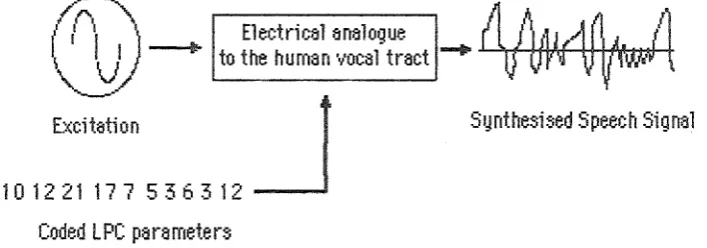
LPC is a speech sqnU1esis S11stern that uses an electrical model of the
~ :j
human vocal tract (see reference 1, chapters 5 and 1 0). The parameters U1at contro 1 the e 1 ectri ca 1 model are continuous 1 y vari e,j to give an electrical analogue of human speech. An example of a LPC speech synthesi ser is the the Texas Instruments Tt1S5220 1 ntegrated circuit. The muscles that contr-ol the human vocal tract change their position at a
rna~-<irnurn rate of about once ever-y 25 rnS. Because of tt1is, a ne·w set of electrical pararneters is supplied to the LPC mo,jel once ever!d 25 rnS. Each set of parameters supplied to the LPC model requires from 2 to 15 t1ytes on average, depen,ji ng on the actua 1 imp 1 ernentat ion or the LPC mc11je 1. An LPC synthesiser therefore requires a bit rate of from 800 to 6000 bits per secon1J t1ost modern LPC sqnthesi ser chips, such as the Texas I nstnm·,ents TMS5220, require at, out 1200 bits per- second. A messaqe 5 seconds in ... 1 ength Y.ioul d thus require 750 bytes of storage.
0~\
~~
(I\ )
8~ri~a~w~ 11
lVI
--mr- to the human vocal- tract -+ •.~/ ···---~
Excitation
J
StJnthesisedS~reech
Signal101221177 536312
Coded LPC parameters
fig
4:
lPC SP-eech synthesis system
LPC speect·, synthesis can supply t1oth a custom voice and vocat,ulary, although rnanf acturers supp 1 y j;:[1~·1 sets to program their LPC chips vvith a standard vocabul ar4. Transf ormi nq human speech into sets of LPC ~ ...
par-ameters is a complicated task, requiring at least minicomputer facilities.
[image:9.595.118.472.347.471.2]t!tudio ~!esponse Systerns 9
Codes
I
Controller:~
~.. I' Speech S•Jnthesiserchip
...
!"-...,. "'ZERO''
se 1 ec:ti ng --~~"
·w·ords
~
,.
F.~O M co ntili ni ng
speech data
An example of a proprietarw swstern is National Serniconducters Diqitalker ~ ~ ~
II system. This system consists of a speech synthesiser chiP .. along witrr standard vocat.ulari es in ROM and semi -custom vocatlulari es on disc: (approximately 1000 words availattle, cost $US150). The quality of U1e speech produced tty the Digitalker system is very higrr, albeit ~vith an American accent.
Te;:t-to-speecJJ \·vould be possible with the Digitalker system, provided the vocat•ul ary of the text was a sut•set of the vocabulary t~vailattl e from the manufacturer. Tt1e ttit rate of the Digitalker system is very 101iV, in the
3_ The 8P.J,!roach chosen 3_ 1 Descri P-t 1 on
3_ 1_ 1 Hardware
U near Predictive Coding (LPC) · ... vas used to implement the speech synthesi ser .. the particular chip used being the Texas Instruments T~t35220.
10
Some way of controlling the TMS5220 cJiip '·Nas necessary, along v·llth a method of communicating with the host computer for the audible ter-rninal, via an asynchronous communications link. The best way to implement the controller is a rnicroprocessor chip. LPC ,jat_a for the Tt'1S5220 chip could tt1en be stored in EPRC!t-1 and sent to the Tt~1S5220 by the rni croprocessor chip.
3_ 1.2 Soft ware
The audible tenninal must be contr-olled frorn the host computer via an asynchronous communications link: which could be either de,jicated to the audible terminal .. or tapped off U"1e line to the operators visual terminaL On the receipt of a trigger character(s) .. the audible terminal ·would speak a rnessaqe. This messaqe · ._ ·- ... voul,j be selecte,j from a collection of rnessaqes ._ stored in U"1e audi b 1 e termi na 1 .. by means of one or more i nde:o-~ cr1aracters
f o 11 OY.li ng the tri g!~er sequence.
It vv·as mentioned above that u-,e asynchronous comrnunications line for the audible terminal could be tapped off the line to the operators visual
terrni na 1 · ... vas mentioned. In H"1i s case the operators termi na 1 ·· .. voul d t'e have to be di sa tiled (by its "di sab 1 e termi na 1" contro 1 cilaracter{s}) t1ef ore the audible terminal could be activated. Both of these tasks (disatrllng the visual tenninal and activating the audio terrninal) could be performed at the same time by making the audi b 1 e terrni nal s trigger character(s) the ~;arne as the visual terminals disat1le c:haracter(s).
3.2 Just
H1
cation 3_2_ 1 HardwareLPC tec:hnolo!~Y was used to implernent the speech S!dnthesiser for the fo11ov·ling reasons:
(a) LPC is by far the most popular technology used today for speec:h analysis aruj synthesis. There are over 15 manufacturers offering speech synthesis chips based on the LPC sqstern.
~ ~
Audio ~~esponse Systems 1 1
i nte 111 !~i bll ity. Hand "tune,j" LPC speech .. such as is supp 11 ed 1 n ROt-'1 by some manufacturers for starujard vocabularies .. can sound very human. n-,e tqpi ca ....
1
bit rate of 1200 bits per second means that about 7.5 minutes of speect·, could be stored in 64 K bytes of EPROt-1, ·which vroul d cost about $100.(c) The principles of LPC speech analysis are V·lell knm·vn and documente,j_ Pro,jucing LPC speech data from human speech is possible using
mini computer facilities.
(d) Tt·te most cornpelling reason fot- using LPC technology is that there is a large knovv·ledge t1ase of LPC technology here at the University of
Canterbtu-y. The Schoo 1 of Engineering have a group of lecturers an,j Students ·vvho are i rnp
1
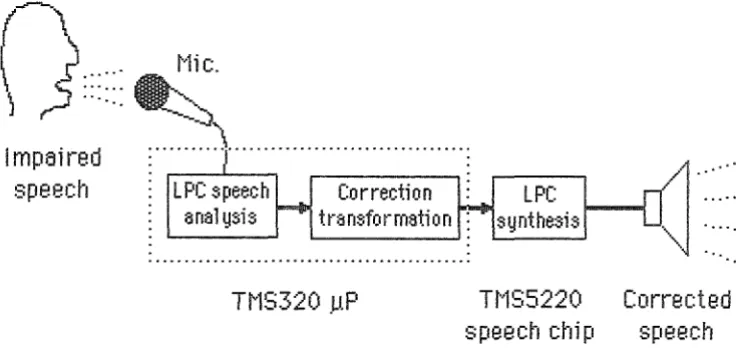
ernent i ng a system for cotTect i ng i rnpai re,j speech (see references 2 and 3). The t1asi c scheme of Uti s system is to:1. Read the impaired speecr·t into the systern .. and transform it into LPC parameters.
2. Transform the LPC parameters to corn3ct the impaired speech .. using some predermi ne•j transformation.
3. Synthesise the corrected LPC parametet-s back into norma 1 speech.
The eventua
1
aim of the project is to perf orrn the above three stepsin
rea1
time .. using a TMS320 microprocessm- to perform steps 1 and 2, and a TMS5220 speech synthesiser chip to perform step 3 .
I
rnpai red speech... ···
. .
. .
: LPC s~·eech Correction
~ analysis transformation :
[image:12.597.112.480.503.679.2]. .
... -... ~ ... ..
TI'"1S320 JJ.P
LPC
synthesis
Tt·'1S5220 Corrected
speech chip speech
fig. 6: School of Engineering ImP-aired SP-eech system
At present the LPC speech analysis is performed on tr1e School of
Engineerings
VAX
11/750 computer using SGPRC .. a program ·r.tritten for LPC speech analh!:::is (see reference 3). The LPC analysis is not performe,j in real time. The speech synthesiser part of the system has been2) try means of a ZCiO rn1crocomputer system dr-iving a TM~;5220 speecr·, synthesiser chip:
RAM EPROfyl
(Program and speech
data)
Z60
JJ.P;-""
Serial Link
t
Asynchronous link to host
Tt--155220 S
Synthesi
;:ro
serecl1
···-....·1 ::::::
·\. . ...
Synthesised speech output
fig. 7: School of Engineering_§J~eech synthesiser
12
A monitor program (see reference 4) nms the serial communications link, and some soft Y·tare YYTit ten as part of the 3rd pro. Engineering project (see reference 2) drives the TMS5220 speech synthesiser. The audible terminal is required to do much the same tasks as this system, and so the same microprocessor hardY·tare should suffice.
Th TMe C"I::""/')" ·-·~~-"-~.J c 1p h. 1._. ·c- one o f th e more mo ern d LF·-· L ~.peec c- ·h syn th e~.1ser c-· · c h. 1P~·
c-available, and is capable of producing good quality speech. There ·was no reason to use a different LPC chip, because none available are markedly better.
The ref ore, the technology to imp 1 ement the audible termi na 1 hard··Nare a 1 ready exists at the University of Canterbury. SGPRC can be used to produce the custom voice and vocabulary, and the hardw·are sho·v-m in fig. 7 can be used to implement the audible terminal of fig. 1, by ·writing a new sofbvare system.
3.:2.2 Software
[image:13.597.126.473.101.287.2]Audio ~~esponse Systems 13
4_ I mP-1 ementat 1 on
4_1 Hardware (see a1so
fig_
71
The hardvmre used ·vvas deve 1 ope,j by the Schoo 1 of Engineering (see reference 2). The Z80 CPU is driven by a progr-am in EPRm1, w·hich takes approximately 200 bytes. Ther-efore, almost the entire 64 K t1ytes of memory will be available to store messages in, enough for 7.5 minutes of speech. Typically a system error message ta~~es
3-
5 seconds to speak, so over- a hundre,j messages could t1e stored in EPRot1. In the prototype speech synthesiser board only 24 K bytes of EPRm··i is available to store speech, enough for 1.5 rni nutes. This is more than adequate for testing purposes. The protot!-]pe sqstern also has a monitor proqram in EPROt1 (see references~ ~ ~
2 and 4) .. that enab 1 es mernory data to be exarni ne,j an1j change,j_, and data to be sent to the devices controlled bq the sqstern. Tr1e monitor requir-es ~ ~
about 1 K bytes of EPRot1 space starting at address 0, plus some RA!1 1 ocated at address 8000 16 to store system vari at1l es.
A serial communications cr1ip interfaces to a terminal at 9600 baud .. via an F.~S232 1 ink.
The TMS5220 crlip is driven off the system data bus, vvith the ZSO microprocessor sending it control bytes and data from EPRDt1.
0
Moniter
815
Synthesiser 2000 driver program
2082 Address and
length arrays
2B43
LPC data
I
I I I
r - - - 1
aooo
SIJStem RAM
...___ _ _ _ __, Ci800
14
The speech synthesiser- t·,ard..,-vare developed by the school
ofEngineerinQ
uses U1e Tt1S5220 speech synU1esi ser chip. The Tt"1S5220 uses an
-electrical model of tJ1e human vocal tract to synthesise speech (see fig. 9).
Tt·1i s e
1ectri ca
1rncuje
1is contm
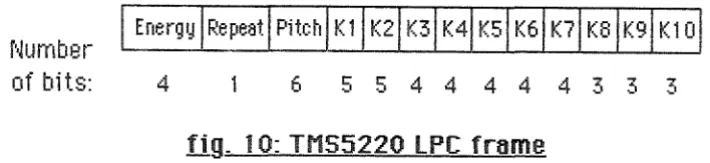
11ed
b~J"frames" of
LPCparameters:
Number
of bits:
4 6 5 5 4 4 4 4 4 3 3 3fig.
10: TMS5220 lPCframe
The energy par-ameter- sets the volume of tr1e output .. for the current frame.
The pitch parameter sets the timtwe of the "voice". An unvoiced sound is
made by selecting a pitch of zero. The ten K parameters set the
character·istics of the electrical analogue of the human vocal tract.
Because the muscles of the human vocal tract change their position on
average once every 25 ms .. a ne··N set of parameters is ::;upplied to the
TMS5220 chip once every 25 mS.
Ordinarly the Tf"lS5220 chip ·would need 40 (frames/sec)* 50 (bits/frame)
=
2000 bits per- second .. but several "tricks" are used to reduce the
effective bit rate required:
(a) lln".·'Oiced speech requires a less precise vocal tract model than voiced
speech .. because unvoiced speech does not use the 1
arynx as its sound
source. f1ost consonants .. suctl as "b" and "t", are unvoiced, as oppose1j to
vov·tels such as "e" and "o", and consonants such as "y", wtlicr1 are voiced
(set:! also reference 1, pp 48-52). Only the Energy, Pitch and K 1 - K4
parameters need be supplied to the Tfy1S5220 to synthesise unvoiced
speech.
(t1) Tr1e human vocal tract cr,emges
srn:~pequite slowly .. often slower than
the maximum rate of once every 25 ms. Because of this, a ··repear· bit has
t1een a1jded to the Tf-'155220 fr-ame. A repeat frame has on11J tt1e
~ enerQJ~ ~~and
pitch specified .. the pr-evious K par-ameters being retained.
(c) Wt1en tr1e energy is zero, silence is pr-oduced so ther-e is no nee1j to
specify any other parameters.
(d) There is a stop code to tell the rr·1S5220 to stop synthesising speech;
this has an energy of 15 and no other- parameter-s.
[image:15.597.112.467.169.250.2]fig_ 9: Comparison of Human end lPC speech synthesiser-s
/
---
>---
-...ard&.S~-t~
--
----~
:ech
+-·~---~
(up~
Tongue '.,
Speech sf gnal
Electrical -tube-
/1
n
/1
controHed
by K~lJNVv{r(~
parameters..
~
V
s'imu1at'ing the
f"
Human vocal tract_
~Kl--+
K2-mm-K3-+
K4-mm-
K5-mm-1<6--mm.
1<7--mm.
K8-+
K9--+
K 10
--11-Switch to
choose voice
source_
Trachea
T
Air from
lungs
Voiced
(tonal)
source
Unvoiced
-white
noise-source
Audio Response Systems
Energy Repeat Pitch K 1 K2 K3 K4 K5 K6 K7 K8 K9 K 1 0
·,,,. oi ced
Unvoiced
I
j;.~epeat
C.
111
J
Silence
L
oooo
I
Stop 1111
Hg 11: TyP-eS of TMS5220 lPC: fn~mes
The Tl1S5220 is controlle1j via an 8 bit parallel interface, over wt·1ich commands and data are sent (see apper11jh~ A).
4.3
Soft wareAs sho'1'1TI in section 3.2.2, the audible terminal had to t1e controlled by characten:;. On thE! prototype audi tile ter-rni nal the trigger character is the A~;CII "carriage retur-n" character (character code 13).
Selection of the message to be spoken is done by using the A~:;CII code of the character follo·vving the trigger character as an index. Thus ASCII "null" ct·1aracter (character code 0) selects the first message stored in memory_. tr1e "start of header" character (code 1) se 1 ects tr1e sec:on,j message, and so on. Using the ASCII character set in this Vv't!!d 127
messt~ges could be stored in the audible terrnint~L If this number v·tt!s not enough up to 16129 messages could be store1j by using hvo t..SCII
char-t~cters f o 11 o··Ni ng U1e trigger character.
15
The sofhvare to drive the audible terminal is VvTitten in Z80 machine code. It w·orks as follo\Ns (see also figure 12):
The T~·1S5220 is i nit i a 1 i sed ··Nhen the program t1egi ns. The next steps are then repeated in an infinite loop:
Characters are read from the ser-i a 1 communications 1 ink unti 1 the trigger character(s) are received. Once this has happened, the next character is read and stor-ed as an index. A character is then sent from the audit1le ter-minal to the host computer by '·Nay of an ackno·· .. vledgement.
f'ig_ 12: Program and Data structures
Program
f1ow chart
Data
&.
program storage 1 n EPROM
Read
Character
Read
Character
Send
- Ack:nowl edged·
character
Use character to
access message
address and 1
eng~harrays
Send
Nbytes to
TMS5220 voice
synthesiser
Wa'i t for TMS5220
to stop talk:1ng
....
..
F
...
message 1
message 0
length N
I
I
I
length 1
length 0
address N
I
I
I
I
address
1
address 0
At present a vocabulary is pmduce,j for the speech synthesiser as fo11ov·ts (see also fi!=jure .... 13):
1. Human speech is recorded on tape and digitised by SGPRC on the Engineer-in!J Schools 'vt·lS VAX to pr-oduce LPC encoded speech. The LPC files are transfet-re,j_, via tape_. to the Computet- Science UN I~: VA~:.
2. A proqram called hexconv is ~
nm
on the files, to create the t'·No arra~s ~the pro!~ram on the speech syntt1esiser board requires, and to concatenate the files together-.
3. The ,jata is appended to the end of the ZEiO "audible terminal" prograrn .. rea,jy to t1e burnt into EPRot1 .
16
.:::t
lntelconv is run on the combined program/data files. This converts the files into the format required by the Engineerin!J Schools EPROf1 burnin!J progr-arn. The converte,j files are then transfetTe,j_, via tape, back to the Engi neeri tl!J Schoo 1 s VMS VAX.fig_ 13: Procedure for creating a vocabulary
)
··· ..... .. . . .. ..
man
eech
Microphone
Formatting
US1ng
Hexconva
lnte1conv
VAX
Supermini
running
UNIX
Intel
MDS
System
runn1ng
ISIS
Filtering
and Digita1
-Analogue
Conversion
C0
~--Serial
link
EPROM
Burner
SGPRC performs
LPC analysis
VAX
Supermini
running VMS
Transfers via
magnetic tape
VAX
Supermini
running
Audio Response S'Jstems 17
5_ Editor
5_1
Roisotl
d·etre
Tile speech output frorn the SGPRC prograrn is not perfect. SGPRC has trouble kno·~·ving '·Nhen speech is voiced or- unvoiced} and a lot of t1ackground noise is intro,juced into the synthesise,j speech by the analysis.
An editor running on a speech synthesiser board would be useful v·thile producing the vocabulary for the euditde terminal. Because of the lo··ri date r-ate required
trw
~ the Tt1S5220 (one frame even~ .... 25 mS) e,jitinq the LPC .... speech should provide reasonet,le results for the investment of tirne require,j.The e1jitor v·toul,j be used on an awjible terminal as a speech development systern} to improve the output from SGPRC. The resulting edite,j speech could then be loade,j into a ,jedicated audittle tet-rninel.
An LPC editor does e:r.:ist on a Texas Instruments development tu)ard for the Tt-'155220 at u-1e schoo 1 of Engineering_. but it does not ··,·vork proper-1 y.
5_2 ~larmed Use
The editor V·l0Ul1j be used as f o ll o·vvs:
1. Ravv' LPC speech is dov·mloaded into RAM in Ute audit!le terminal/editor system from a rtost cornputer.
2. The speech is change,j on a "trial and error-" basis: The editor is used to e Her Ute LPC data and the Tt-t35220 chip on the t1oard is used to speak the c:f'tanqed data.
3. After an edit i nq session the LPC speect1 is up 1 oade,j back to the host .... computer .. r-eedy for use in a dedicated audi b 1 e terminal system.
5_3_1 User Interface
The editor should be a screen-t,ased interactive editor .. ··,·YiUt the e11jded
,ji rnensi on of speaking the edited LPC spE!ech ,jata.
The editor should be VvTitten 1n e high level language (HLLt as an aid to portability bebveen S!:fSterns. 'w'riting in a HLL is consi,jerably easier than VvTit
i
ng in assernb 1 er, and portability bet'ween systems is greatlyC is prottab 1
y
the t1est language for ·vvri t i ng the e1ji tor. C has extensive facilities for lo'·N level trit manipulation such as shifts aruj t1itvdse ANDs an,j DRs .. anrj good facilities for pointer manipulation. Bit manipulation is essential for harujling the Tt···1S5220 LF'C frames. C also produces compact obJect code .. an important consideration for- the editor 'rthose eventual ,jest i nation·vvi 11
be a microprocessor system.5.4 I mP-1 ementat 1 on 5.4. 1 User Interface
In cn-der to make the editor- as i ndepernjant of terminal type as possi b 1 e .. on 1 y the most basic terrni na 1 operations were use1t pr-inting ct1arac:ters ..
1 i nef eeds and carriage retw-ns _. and verti ca 1 tat1s .. to move the cursor-up· ... var-ds. In
vi
e·rt
of these restrictions .. tr1e screen for-mat use1jby
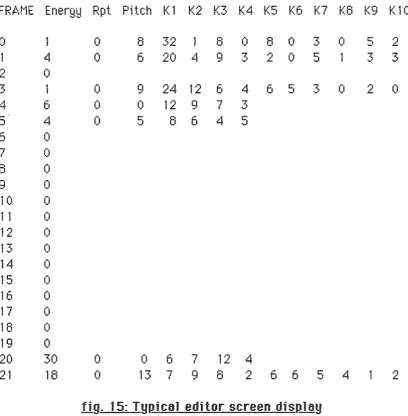
the Te>~as I nstrurnents' editor seerned to be quite a goo,j one to use:FR.tJ1E Energy Rpt Pitch K 1 K2 K3 K4 K5 K6 K7 K8 K9 K 1 0 0 1 2
3
4 5 14
0 1 64
6
0
7
0
8
0
9
0
10 0
11 0
12 0
13
0
14
0
15 0
16 0
17 0
18 0
19 20 21 0 30 18 0 0 0 0
0
0
0a
32 1a
6
204
9
9 0
c
._I
24 12 6 12 9 7
8
6
4
o a o
3 2 04
6 5
5
0
6
7
12
4
13 7 9 8
2
6
6
3
5
c
._I
fig.
15: TyP-ical editor screen disP-lay0
1
0
4
5
2
3
3
2 0
2
18
The top ro··N of the screen identifies the different fields of the LPC frames (see section3 .. "Tr·1S5220 chip") .. which are displayed one after the other .. ,jown the screen. Each frame is numbered .. for selection when etjiting the
[image:22.595.88.497.337.754.2]Audio ~~esponse Systems 19
edite,j .. \·Vhi ch can be shifted around in memory.
5.4. L 1 Screen Mode EdH1ng
The t1asic oper-ation to be perfm-med on the LPC data are to make srnall changes in the coefficients. This is accomplished t1y first selecting the frame to t1e ct-Jange,j_. then the LPC pararneter to be changed. The frames f1re selected by entering the number of the frame at the side of the display. The LPC parameter is selected as follov·ls:
"e" for the energy parameter. "p" .. .. pitct·,
"r'' .. .. repeat
"1" to "9" forK parameters 1 to 9. "0 forK pan::Hneter 10.
Once an LPC parameter has t1een selected .. the terminal cursor is moved to the position on the screen of the parameter .. and tt1e replacinq value can t1e .... typed in. t..dding .. deleting and changing LPC frames on the screen ar-e done ··,·vith the "a" .. "d" and "c" characters respectively, follo'·Ned by fields
specHyinq the number of the frame to be operated on and the tqpe of frame
·-
._ ._ to add/ change.The screen di sp 1 ay can be scro 11 ed up or dovvTI by means of the "f" and ''ti"
ke!JS.
The 'T' key is used to move the screen for"vvanj in memory from the current position .. and the "b" key is used to move it backwards.See appen,jix C for more detailed information on the operation of the editor.
5.4. 1.2 Non Screen Mode OP-erations
Other operations of the LPC editor are:
Loadinq a file to edit This operation is selected with an "r" (read file)
"
character. In the cw-rent implernentation of the e,jitor .. on the Computer Science VAX. . the r cornman,j is follov·ted t11~ .... the filename of tt1e LPC ,jata to edit. In the pr-opose,j imp 1 ernentat ion on U1e speech synthesi set- boat-d, the LPC fi 1 e will be dov-m 1 oaded vi a the asynchronous communications 1 ink.
The '\v" ('rlrite file) writes the edited data. The cw-rent implementation of the editor over-writes the or-igina1 LPC file ·with the edite1j data. The proposed imp 1 ementati on of the e1jitor, on the speech S!dnthesi ser board,
\·Vi
11
send the edited file along the asynct"ln:mous11
nk.The character "q" quits frorn the editor .. back to the UNIX shell on the
Audio ResponsE! Systems
5.4.2 ComP-11 er
At present, the only C compiler in the Computer Science Department that produces Z80 code is for a subset of C, ·vvritten b~ ..
J
E Hendrix (see'"
reference 5). This compiler at the moment prodtJces
aoao
assembler mnemonics, but fortunately u·re ZEW instructlon set is a superset of the 80Ei0 instruction set .. so on 1 y the code-producing section of the com pi 1 er need be changed to produce the equivalentzao
mnernoni cs.The C cornpiler has an associated runtime library consisting of about 350
20
1
i nes of Ei080 assemb1
er .. and this must also be changed to Z80 rnnemoni cs.1/0 proce,jw-es such as getcharO and putchar(c) rnust also ·written, to cornmunicate ~nith the terminal link on the speech sqnthesiser . ...
The user interface discussed above does not present information in a ver~d "user-friendly" v·la!J. The scr-een display could be rnade to relate more closely to the actual speech being reproduced. For instance .. it \f'iould be useful to knov·l \·vhat sort of soun,j V·las being reproduced by the sets of LPC parameters, and this sour11j could be displayed alongside the parameters on the screen.
A grapf·f1cal display of the parameters would be easy to implement .. as an aid to ,jetecting poorly reproduced speech. Because each of the Pitch, Energ!d and K parameter-s change value smoott"tl!J .. it · ... voul,j t1e possitlle to present them in a graphical · ... vay .. and so detect any irregularities visually. Large irregularities ··,.vould probably be due to errors in H1e LPC analysis process .. and smoothing them orJt v1ould irnprove the quality of the speech. One ·way of implementing a graphical display might be an option on the editor that displa~ed ~ a chosen par-ameter- as a line ~:waph ~ for the LPC ,jata t1ei ng ana 1 ysed. Each of the LPC parameters could thus be ex ami ne,j visually.
5.5.2 SP-eech Recogni t 1 on
An editor that v·tas able to display ·vvhat sounds the LPC frames it was e1jit i ng repr-esented would t1e a very powerful too
1,
making prec:i sealterations to the LPC speech data much easier than the editor currentlq ~ imp 1 emented.
Audio F~esponse Systems 21
6. ResuHs
6. 1 SP-eech Synthesi ser
Tt1e speech sqnthesi ser has been successful ltd imp 1 em en ted as described in
~ ~
section
4.
At present Ute speech is pr-oduced from "raw" LPC par-ameters, strai qht from SGPRC. The result ._ i nq speech is recoqni satt .... .... 1 e, tiiJt the qual itld ._is lo\'v.
6.1.1 lnte1Hg1bHHy of the SP-eech P-roduced
The lo'·N quality of the LPC synthesised speech is due to the ,jiffic:uHy that SGPRC h;:~s in extracting the char-acteristics of hurnan speech use,j tty the LPC mcujel. Hurnan speech is very variable, an,j no fi::<ed set of rules exists for LPC analysis that v·tork 100% of the tirne. As result of this .. all the standard LPC vocabularies sold by manufacturers are produced tty hand tuning the output frorn speech analysis programs.
The intelligibility of the LPC speech can be improved by improving the input to SGPRC as follo· ... vs:
Lov·t pitche,j male voices generally provide U1e t1est results, because of the lan~e ._ lov·l-frequenc!-1 cornponent. Hov·tever. women generall!-1 speak more ._ . ._ ...
clearly than men .. so some female voices provide a good source for SGPRC. SGPRC is more sensitive to vov·tel s (voiced soun,j~;) as opposed to the consonants (unvoiced), so emphasising the consonants helps the qual it~!
or
the synthesised speech.
The speech use,j shoultj be spoken slov·lly and clearly.
6.1.2 Considerations in P-roducing the vocabulary
\"'''hen trans lati nq the test vocabulanJ for the prototype voice sqnthesi ser ._ ._ ._ ._
from a visual messages to audio, U"1e nature of some of the systern messages require,j that they be altered:
F cw instance, tbe message "r1ontb 1 y 01) or Annua 1 (A) accounts?" is near1 y meanin!~less if spok:en vettratirn. This sentence was broken up into t.Yvo consecutive sentences: "Enter r--1 fm- t·'1ontt11y accounts". "Enter A for Annual accounts".
Thus, His not feasible to translate sorne sentences directly frorn the \·vritten form to speech. In the at,ove exarnple this is because the t·wo letters (M) and (A) are intermixed with the text, but in fact they
Audio Resp•)rtse Systems 22
added to the original message.
6.2 EdHor
The editor at present runs on the Cornputer Science VAX, as described in section 5. It can e1jit ,jata, but no graphical facilities are available .. and the editor is still in the prototype stage. The \"'tork still to be done for the editor inc 1 udes:
Ad,jing sorne of the facillties mentione,j in section 5.5.
Changing the C compiler to produce ZCiO code, and altering the runtime libr-ary.
Porting the editor to the speech synthesiser tuJard.
7. Cone 1 us1 ons
A 1thougt1 the speech synthesi ser has been successfully i rnp 1 emente,j it is not reallq suitatrle for commercial use
in
it~; present form, because the qualit~ ~ of the "raw" LPC speech is too lov·t. Edited LPC speech maq t1e ~ suitat,le .. although the amount of time necessary to edit speech may not be cost-effective.The !=!Oals of
-
8 custom vocabularq and 8 custom voice have been realised,~
but largely negated by the quality of the speech produced.
For cornrnerci al use a proprietary system such as Nation a 1 Semi conductors "Oigltalker" may t1e t1est supplying a high quality, semi-custom vocabulary at a reasonable price
(in
the $100 range). Using this system requires the sacrifice of one of the goals of the project: U1e atdlity to synthesise acustom voice. Eiecause of the semi-custom nature of the vocabular~. ~. some system messages that use v·tot-ds not available frorn the manufacturers may have to be altered.
The editor runs on the Computer Science Vt\X at the moment, and v1hen ported to the speech sqnUies·iser board should make a useful LPC speech development system . ._
8. Where to from here?
From a commercial point of vie··t(. tbe speech synthesis technology used in the speech synthesiser should pt-obably be changed to
a
proprietarysystem, v·thich v·..-ould provide a feasitde audit,le terminal at 8 reasonable
cost.
Audio Response Systems
added to this sqstern trq tbe Tt·-tS320 LPC emalqsis systern used for the ~ ~ ~ ~
ScJwol of Erll;Jineer·inqs speech proiect (see section 3).
V·lith
tt"le TMS320~
-
"e 1
The speech synthesiser chip used b~d the School of Engineer-ing group is the Texas Instruments TMS5220. It implements an electrical rnodel of the
t1uman vocal tract (see fig. 9). The model consists of a series of electrical filters .. ·with e~'{citation provide,j from hvo sources:
(a)
A
sav~··tooth waveform for voiced sounds (vowels, and consonants such as z).(b)
A
V·lhite noise generator for unvoiced sounds (consonants such ask andThe filters c:t"!i3nge u·,e character of the sound sent through ttlem from U1e excitation sout-ce,
in
a way that mirrors the way sounds from the lungs aruj vocal cords are changed by the r1uman vocal tract. Pen-ameters to these filten:: and to the excitation source are sent to ttle TMS5220 chip from an external source .. to produce speect1 output.The basic form of these parameters is a "frame", which contains several categories of i nf ormation:
Number
of ttits: 4 6 5 5 4 4 4 4 4 3 3 3
fig. a
1: TM55220 lPCframe
The enerQ~ parameter sets the volume of
Un=.
output, for the current frame. The pitch parameter sets the t i rnbre of tt1e e:z:citat ion source. An W1'·lOi c:e,jso w-ee is se 1 ec:ted by a pitch of zero. The ten K par-ameters set the char-acteri st i c:s of the e 1 ectri ca 1 fi 1 ters that the excitation is passed thrOU!~h.
Because the muscles of tt1e human vocal tract ct1ange their position on avera!~e once every 25 mS, a ne·w set of parameters is supplied to the TMS5220 chip once evet-y 25 mS.
The Tt1S5220 chip uses sever-al "tricks" to reduce the bit rate that it nee,js to syntt1esi se speech:
(a) The minimum possit1le number of t1its is used for each parameter. The higher order K parameters have less effect on the speech produce,j, so Urey are assigne,j fev·ler bits for tt1eir representation.
Audio Response Systems a2
supplied to the TnS5220 for unvoice•j speech.
{c) The human vocal tract changes shape quite slo··..vly_. often slo·rter than the maximum rate of once every 25 rnS. Because of this, a "repeat" bit has been ad•jed to the Tt'1S5220 frame. A r-epeat frame has only the energy and pitch specified .. the previous K parameters being retained.
(d) ''l'lhen the energy is zero, si 1 ence is produce,j so there is no need to specify any other parameters.
(e) There is a stop ccuje to tell the Ttv1S5220 to stop synthesising speect·1; this has an energy of 15 and no other parameters.
Thus, the TMS5220 requires five different types of frames:
Energy Repeat Pitch K 1 K2 K3 K4 K5 K6 K7 K8 K9 K 1 0
Voiced ··~·r-cl··
..
=r-·r·c·r-r=r·J
Unvoiced
I ol oooooo I
"0~
k~epeat
!1
I
J
0000
I
Stop 1111
ng
a2: .Im:~es of TM55220 lPC framesThe Ttt;5220 chip is interface•j to its controller t•y an
a
bit parallel bus. The bus connects to an internal FIFO \rlhich buffers data. Tt·1is is essentialbecause the LPC pararnetel'-s supplied to the TMf;5220 don't necessarily start aruj en•j on a byte t•olm,jary
The rr·1S5220 is controlled try sending a control byte, specifying the
operation it is to perform, followe•j by any data required by the operation:
Command b'Jte
_,,_
DataI I
I
r
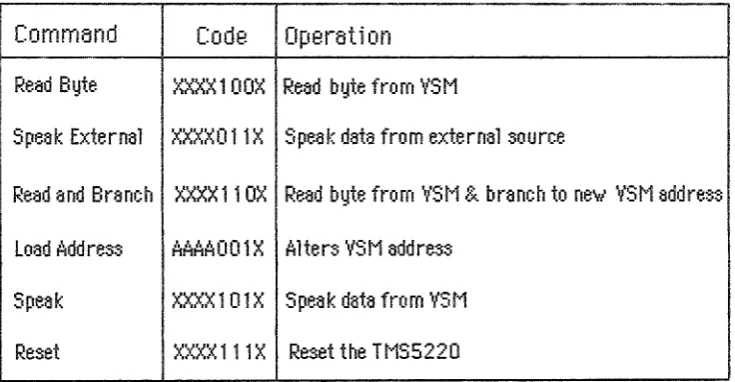
Ther-e are s1x different comrnanrjs the Tt'"1S5220 can execute. The only commands used in tt1e audible ter-minal are the "reset", "read trqte" and ._ "speak external" commands. The other comrnanrjs are for use Vlith Texas Instruments ROt1 sets, that have custorn vocabularies. The custorn
Rotvl
is H1e "VSt·1" (Voice Synthesis t1emory) that is ref et-red to in these commands:...
Command Code Operation
f---·
Read Byte xxx:~ 1
o
o:r~ Read brJte from VSMSpeak External X:XX~011X Speak data from external source
Read and Branch XXXX11 0>"~ ~~ead byte from VStv1 & branch to ne'w' 'y'SI'·1 address Load Address AAAA001X Alters V~iM address
Speak XXXX1 01X Speak data from VSf1
Reset X~v~X~< 1 1 1 X Reset the Tt1S5220
fig.
a3: TMS5220 commandsThe "speak external" command makes the Tt1S5220 accept LPC data from an e>~terna1 source vi a the 8 tilt tiiJS. . and use it to s~nthesi ._ se speech.
The "reset" command makes the Tt1S5220 do an internal reset.
The Tt1S5220 has a status tryte that can tre read from the 8 trit trus .. vvhich 1'1as the following format:
BH :tt:: 7 6 5 4 3
2
1 0ng.
a4: TMS5220 StatusByte
The T a 1 k Status (TS) trit is set if H1e TMS5220 is tal ki nq, and is cleared if
[image:30.595.124.492.170.361.2]Audio j::~esponse S•Jstems b 1
A;u;~endi x B: Soft ware 1. Sl}eech synthesi ser soft ware ol}erati on
The sofbvare written to operate Ure aud·itde terminal operates as follows (see also fig. 12):
1. The Tf1S5220 is initialise,j bq sendinQ 10 "reset" comrnands to ~ ~ it.
2. The serial communications chips status is continually read until it
signals tt1at it has a ct1aracter rea,jy.
3. The character is examined to see if it is the escape character. At
present the escape character is the ASCII carriage return char-acter. If the received character isn't U1e escape character the program returns to step 2.
4. If the character is the escape character, the ner~t character received
by
Uie serial communications chip is assumed to be a binary inder~ to the rnessaQe to speak.
5. An characte1·- is sent back do··Nn U1e asynchr-onous communications line_. to signal to the host computet- that the character sequence was received. 6. The chosen message is sent to the Tf1S~5220 chip from EPRDr1.
7. The T~1S5220 "TS" status tlit (see . fiQure a2) is repeate•jl!-1 examined ~ ~
until it signals H1at ~;peech synthesis has finished.
Ei. The program returns to step 2, V·laiting for the ne:d character.
2. Data Structures
Trre rnessaqes are stored in EPRot1 as follov·ts (see also fig.12): ~ ~
The first 1 024 bytes after the program contain two arrays, indexed by the message nurnt•er to be spoken:
An array of 256 16 bit addresses. Tt·1ese ewe the ad•jresses of the rnessages stored in EPRot1.
An array of 256 16 bit integers. These are the lengths of the messages .. in bits.
Audio Response Systems b2
3_ Hexconv
Hexconv is a prograrn that concatenates the individual LPC message files together and creates the address and lengu-1 arrays t-equired tty the
zao
program in the ~;peech synthesiser. Hexeonv runs on the Computer ScienceVAX urnjer UN I
X.
V-lhen it is nJn, hexconv asks for the start address of the data in rnernory. This enables the LPC data U1at fo11o'·Ns the Z80 program to be relocated. He:x:conv then repeatedlq asks for- files of LPC data, until it is indicated that there are no more.
Each LPC data file is sequentially assignerj a location in the address anrj 1 ength arrays. The 1 engths of the LPC files are used to set up the address arrays. Each LPC rjata file is appended on to the current block of data. In this way the data structure of
f1
g. 12 is tiiJi 1t up.4_ I nte 1 conY
lntelconv is a pt-ograrn that runs on Ute Computer Science VAX. It converts files of he~-<adecirnal character-s into the for-mat required t1y the Intel t1DS
s~stem ~ EPROty1 burner proqrarn. This format is: ~
:<1
i ne 1 ength> <addr-ess> <da1ta> <checksum><line length> is U1e 2 digit hexadecimal number
of
bytes of data in the line. This number must be ei u-,er 1 0 16, 20 16 or 40 16.<address> is a 4 digit hexadecimal number \·Vith the current address of the line of data. <address> must be increase in increments of <line length>. <data> is <line length> bytes of hexadecimal bytes.
A •Jdi o Re"' po nse Systems
A1meruHx C: Using the lPC Editor
c
1. Invoking the Ed1 torThe editor can be accessed on the Computer Science VAX under the directory:
/usr /users/ cosc802/ da.I e/ ed
c2. User Interface
Once the editor is running, the screen is set up in the format of fig. a 1.
When the editor first runs, all the data fields are blank, since there is as yet no data in the editors workspace. All e•jitor commands are single characters, f o 11 O¥ted by parameters for the command. Commands can be either upper or
1
ower case1
etters.c1
FRAME Energy Rpt Pitch K 1 K2 K3 K4 1<5 K6 1<7 1<8 K9 I< 1 0
0
5
2
l
4
3
3
2
0
3
2
()
4
5
6
78
9 10 1 1 12 13 14 15 16 17 18 19 20 211 2
6
4 0 () () () () 0 ()0
0 0 0 () 0 0 30 180
0 00
00
0
8
328
0
8
()
3
()
6 20 4 9
3
2 ()9
24 126
4
6
5 3 ()0 12 9 7 3
5
8
6
4
5
()
6
7
13
7
9
12
4
8 2 6 6 5 4
The editor requires that all numerical values entered are 2-digit decimal numbers. For example .. the value 2 is entered as 02. This is done so that no delimiter characters (such as the carriage return key) are needed
for-numbers.
t1istakes .. such as an unkno·-rm command .. or- a letter entered where a number was expected, are signalled by a beep from the terminal. The editor then waits for the next command.
c2.1 loading a file
The character "r" selects this operation. After this command, the editor wi 11 ask for the name of the file to
1
oad. If the fll e is accessi b1
e, it wi 11 be loaded, and if not the editor will reply "<filename> does not exist'' and ask again for a file to load.c2.2 WrH1ng a fHe
A file is ·written by the "y{' (write file) operation. The name of the file
that was
1
oaded (see section c2.1)
is overwritten with the edited data. 2.3Screen-mode Ed1
t1 ng
Screen-mode editing is done using single letter commands. A command is followed by the number of the LPC frame to be operated on (from the FRAtylE field at the left of the display, see fig. a
1 ),
and optionally by a frame type or LPC field specifier.c2.3.1
LPC data is changed using the "e" (edit) command. The syntax of the edit command is:
e<frame numtrer><LPC field>
c3
<LPC field> selects one of the individual parameters in the LPC frame to be
edited, as follows:
e: selects the energy parameter
r:
..
.. repeat parameter
p:
" pitch parameter
1:
" K 1 par-ameter
2: .. K2
... etc ... .
9: .. K9
0: .. K 10
Once the LPC frame and field have been selected, the terminals cursor is
moved to this posH ion on the screen. The nev·t value for the
f1
e 1 d can then
be typed in.
c2.3.2 Adding a frame
This operation inserts a new LPC frame at a specified positions. The add
operatlon has the following syntax:
a<frarne numben<frame t!JPe>
<frame number> is specified as in section c2.3.1, and selects the frame
before which the new frame is to be inserted.
<frame type> is one of the fo11m·ving:
v: selects a voiced frame
u:
an unvoiced frame
r:
a repeat frame
s:
a silence ..
e:
an end
The parameters of the new frame are initialised to zero except where they
must be non-zero to specify the frame type, in 'rthich case they are
initialised to one. For instance, an unvoiced frame must have its energy
field non-zero, or
itwill be interpreted (and displayed) as a silence frame
(see also fig. 11). The energy field is therefore initialised to one.
c2.3.3 Deleting a frame
The "d" (delete) command removes a frame from the LPC data, at a
The syntax of the delete command is: d<frame number>
Where <frame number> (specified in section c2.3.1) selects the position on the screen of the frame to be deleted.
c2.3.4 Changing the tyP-e of a frame
The type of a frame is changed using the "c" (change) command, which has the following syntax:
c<frame number><frame type>
<frame number> is specified as for section c2.3.1, and selects 'vvhich frame on the screen is to be changed.
<frame type> se 1 ects the type that the frame is to be changed to, and is specified as for section c2.3.2.
When a frame is changed, the parameter-s of the old frame type are retained for the new type as much as possible. For instance, if a voiced frame is changed to a repeat frame, the energy and pitch parameters of the voiced frame are retained, and their values used in the energy and pitch parameters of the repeat frame.
c2.5 ManiP-ulating the screen
The screen display represents a "window" on to the LPC data being edited, that can be moved forwards and backwards, from the start of the data to its end. There are two single letter commands that move the screen around in memory:
f (forward): This command moves the screen forward 1 0 LPC frames. b(back): This command moves the screen backwards 1 0 LPC frames. In case the screen display is corrupted from an external source .. the "p" (print screen) command redraws
it.
c3_ File formats
The editor expects its input files to be ASCII characters. These char-acters mt...tst be in the range 0-9, end A - F (ore - f), end characters outside this range are ignored when reading in a file.
Audio Response S~st.ems
0 to F 16. Pairs of nibbles are assumed to be bytes, the most significant nibble first. If there are an odd number of nibbles in the file that is read in then the last ni bb 1 e is discarded.
'When an edited file is written by the editor, H1e output format is ASCII characters representing hexadecimal bytes, as described above.
c4. Command Summary
a <frame number> <frame tyge>: Add a frame of type <frame type> at position <frame number> on the screen.
Examgle: To insert an unvoiced frame at frame number 2 on the screen, enter "a02u".
J!:
f1ove the screen display forward 1 0 LPC frames.c5
c <frame number> <frame tyge>: Change a frame at posttlon <frame number> to <frame type>. All parameters compatible with the frame are conserved. ExamQle: To change an unvoiced frame to a voiced frame at frame number
12 on H1e screen, type "c 12v".
d <frame number>: Delete a frame at position <frame number> on the screen.
Exam~lle: To delete frame number 3 on the screen, enter "d03".
e <frame number> <LPC field sgec>: Edit an LPC parameter selected by <LPC field spec> at frame <frame number> on H1e screen.
Exarng 1 e: To change the K9 parameter of frame number 3 on the screen to the
va
1 ue 7, enter "e03907".f:
t1ove H1e screen display forward 10 LPC frames.11: Redravv the screen display.
_g:
Quit from t~1e editor.r:
Read a file of LPC coefficients.ExamQle: To read in the file "LPC.data" enter "rLPC.data <carriage return>".
Audio ~~esponse S!JSterns
References:
[ 1
J
Br1. ~•-=-to"· ("· et
'('(,, 0. • . ij •· ~ 1 · J..J~(..~ ~In/~. ~'J.'L·I::' r ;.-. -. -';-r.·n.; -~ c-~ a-Dc·;.'i •. ~.:;o:lJLifL·.:>/.:>,, c:;·,.t ·~ t l-a-..-·.; ... ·[2] Turnet-, S. G.: "l.PC Speecl! Sl;'!Jtlles-is-er:. A re_~.?art s-tlltlnit ted lar 3ro'p.ra. Eiectricfli f!.1~..,d Electratlic Et!pitleerfll§.. /96'4':.·
[3] Breisernan, N. B.: "/nlpflireo' Speecll li'ecagl~'itialJ" (tll"~ Eiec. E;;:g .
. Pl!.D pflper-_. pet ta t'B ptlb/is-l..,ed):