A Comparative Study of Community Detection
Methods in Social Network Analysis
Ms. Prajakta Vispute1, Dr. Shirish Sane2
1
PhD Scholar, 2Head, Computer Department, K.K. Wagh Institute of Engineering Education & Research, Nashik, Savitribai Phule Pune University (formerly, University of Pune), Pune
Abstract: With the immense use of mobile devices and online services in the world, the online social interaction in social networks is getting high attention. A billion of users are attracted towards social networking sites and generates a massive social networking data. That provides both opportunities and challenges for analyzing the user’s behavior. The users of social networks are structured in the form of community. Community means a group of nodes (users of social network) who posses dense inter-cluster relations than intra-cluster relations in the network. Community detection and analysis is needed to understand the social network structure. Community identification unveils properties shared by nodes like common work area, common interest, sports etc. Also, the community detection could be useful in several applications like viral marketing, recommendation system, group search and tracking. This paper deals with the introduction of variety of social networks types, community structure and its type along with comparison between few prominent community detection algorithms. Paper provides insight into applications of community detection in social network analysis, with further research directions.
Keywords: Community detection, Graph mining, Networks, Social Network Analysis (SNA).
I. INTRODUCTION
In the field of computer science, Information plays an important role. This information is used at local level or at global level. Network is a medium to transfer information from one to another. Network representation varies in different domains like Collaboration network, biological network, social network etc. Information is represented using different data structures like set, sequence of data. In addition to these basic data structures, trees, lattice, graphs, networks and other complex data structures could be used. The global increase in social media usage opens new opportunities and challenges to the researchers. According to Digital 2019 reports, there are 3.499 billion active social media users who are about 55% of the total population. According to the survey most popular social networks based on share of minutes are Twitter, Facebook, Instagram and Snapchat. Social media generates tremendous amount of useful data which could be analyzed for future enhancements in the field of SNA.
Social network consist of a set of members (individuals, group of people, organizations etc.) and the communication between the members. Graph is the most powerful structure to represent social network. In a graph, nodes represent individuals (or group of people of organizations etc) and link represents interaction between them. With the change in social interactions, there could be a huge number of actors in the network which leads to increased availability of large-scale, real-world data. Social network analysis is the study of relations between individuals and the analysis of social structure, social positions, role analysis and many more. Use of social networks penetrated in various fields like email communication network, cell phone network, messenger network etc. In addition to these networks some complex networks like co-author and citation network of researcher, co-worker network, and spread of computer virus network are also analyzed. Social network is characterized by variety of parameters. The first parameter is degree. The number of edges incident to node is nodes degree, could be used to find the role of a node, its position and its importance. The distances between two nodes are measured by the shortest path length known as Geodesic. It could be used to find the structure in social network like k-clique, k-clan, k-club etc. Network diameter defines the maximum distance between two nodes. Over the period of time, the graph representation of social network evolves with addition and deletion of nodes.
II. DIFFERENT TYPES OF NETWORKS
In Social network analysis, networks are represented depending upon the interaction and behavior of nodes. Following are the types of networks to be used in social networks.
1) Directed Networks: It is a type of network with directed edges between the nodes. A directed arrow ek between vertex Vi and
Vj shows the communication from Vi to Vj node and not vice a verse. Directed graphs provide ordered pair of vertices (Vi, Vj).
In directed graphs, depending upon the direction of the edge in-degree and out-degree of a node is calculated.
2) Undirected Networks: When no direction was assigned to the edge between the nodes in a graph, it is known as undirected network. An edge ek between vertex Vi and Vj could be considered going from Vi to Vj or Vj to Vi. Applications where status of
interacting node is more important than the direction of flow, undirected graphs are used. Normally in social network analysis an undirected graph is used.
3) Weighted Networks: In weighted graphs, nodes and attributes characterized by significance described by particular value. The weight of node and edge implies different parameters required to provide additional information. For example weight of node described by its degree, number of interactions between the two nodes gives edge weight. Edge weight parameter can either define statically or derived based on other parameters. These graphs could be directed or undirected.
4) Heterogeneous Networks: In social network, a different type of relations between nodes exists. Every relation could be treated as relation network. A social network with different types of relations is known as heterogeneous or multi-relational social networks. To understand these types of networks consider an employee community, consist of many relationships, some students work at same place, some share same area of work, some have same interest in sports etc. This could be represented by large graph, where nodes represent employee and edges evaluates their relationship strength.
5) Signed Networks: In some applications, similarity (proximity) and dissimilarity (distances) of links helps to analyze social networks especially when studying interactions in social media. The signed network uses positive and negative notations to represent the similarity and dissimilarity of the links respectively. These networks may be directed or undirected.
6) Probabilistic Networks: Uncertainty introduced in the network due to several conditions. Probabilistic graphs captures uncertainty. In these graphs, every edge associated with its probability of existence. These networks could be directed or undirected.
One of the most effective ways to represent networks in social media is “Graphs”. A graph consists of vertices and edges. Vertices represent an individual (could be a person, group or an organization) where as edge represents communication between the vertices. Edges could be directed, weighted, undirected or unweighted depending upon the application. The graph could also be represented using adjacency matrix. In matrix representation, number of vertices indicates rows and communication between the vertices in terms of weight represented as column. For vertex i and j, wij represents weight (no. of communication) between them. In matrix, wij
= 0 when i and j are not connected whereas wij > 0, when connected.
III. COMMUNITY AND ITS TYPES
One promising approach for network analysis in terms of graphs is to analyze communities. Community analysis is one of the key areas in the social network analysis. Community is a group of nodes in graphs. The objective of community is to divide the dataset into groups (clusters) such that node in the same cluster are highly connected than outside of the cluster.
A. Static Community
The clustering of users by fixed or unchanged behavior in a social network over a large time span represents the static community structure. But, such clustering based on single time view of network does not depict the appropriate structure of social network. The static approach is unable to cover all the necessary characteristics of a network. Social network over time misreport the existing and changing community structure. So, there is a necessity to find a way to capture the dynamism in a network such that interpretable communities could be discovered.
B. Dynamic Community
C. Overlapping Community
Many social networks exhibit an organization into communities that more densely interconnected than between each other. The social networks such as LinkedIn, Twitter, Instagram, and Facebook divide into groups of friends/colleagues/business partners. Naturally, these networks form so many related communities without knowing to user. Analyzing the nature and number of communities reveals the structure and organization of work. In real world, the people characterized by multiple community membership i.e. a student belong to different social groups like family, classmates and friends. Hence, it is more practicable to identify overlapping communities than non-overlapping ones.
D. Non-overlapping Community
Non overlapping communities are nothing but the partitions of the nodes in disjoint clusters. In a non-overlapping community no one user of a community belongs to any other community in a network. In some applications it is very important to focus on one of the attribute and analyze the social network. In such Non-overlapping communities are also known by disjoint communities.
E. Different Ways to Detect and Analyze Communities
1) Find Common Communities: Depending upon the number of interactions between the nodes and way they communicate there are some common communities. The nodes interact more frequently within a group as compared to other nodes in the network. The nature and communication in common community doesn’t change very frequently. Common communities form a base in many community detection methods. It is important to discover such communities, because it is helpful to simplify other related issues in a social network analysis.
2) Using Correlation: Modularity based community detection methods are getting high attention now a day, but it has a problem of resolution limit. To solve this problem, use of correlation analysis is a natural and effective way for community detection in graphs [6]. For this, methods based on modularity in connection with correlation analysis used. By using correlation analysis resolution limit problem solved. Also, to measure the performance of different correlation measures an upper bound analysis performed. In correlation analysis, to measure correlation there are four types: Simplified ᵪ2, Leverage, Probability Ratio and Likelihood Ratio.
3) Parallel Community Detection: One of the effective methods to find communities in social network analysis in case of large data is parallel community detection. It achieves high quality, scalable and parallel community detection [7] in large real graphs. To reduce computational cost in larger and larger graphs some level of parallelism is required.
4) Cross Community Detection: A wide range of applications needs to know the effects of community on the behavior of individuals, not only the communities itself but also other communities. To increase the quality as well as accuracy of community analysis, cross community analysis has potential [9]. The methodology for cross community detection involves community detection and tracking, topic detection, community life-cycle measures and community topic evolution measures [8].
5) Formal Concept Analysis (FCA): FCA is a classic technique for analysis of data. It defines the formal concept to constitute the relationship between objects and attributes in a domain. For community detection in social networks, FCA based algorithm [16] used. FCA derives concept hierarchy from collection of objects and their properties. In social network analysis FCA helps to find communities based on nodes and relations between them.
6) Using Edge Contents: Communities in a social network define the graph structure. Many community detection algorithms use links between the nodes for detecting dense regions in a graph. Edge content leverage the flexibility and effectiveness of community detection process [11]. The representation of edges in social network is in the form of user tags, comments, shared videos and images. Edge content provides nature of the interactions between the members of community. In this way, edge content better helps to get richer insights for detecting the communities more effectively.
7) Dense Sub-graph Detection: One of the very useful and effective methods for detecting communities is to find dense-subgraph in the network. In this type of method the number of clusters is not specified at the initial stage. Depending upon the interactions between the nodes, dense subgraph defined. As nodes interact more frequently within the group of nodes community detection using dense subgraph is easier and effective way.
discovered in first stage. New data processed and updated in the graph without reconstruction of original graph. To reduce the community computational cost this is one of the very useful method.
9) Link and node Features: Many effective community detection algorithms have been proposed. But they use either link or node features for community detection. But combination of link and node features is also useful alternative. A joint probabilistic model used to discover communities which combine node attributes and topological structure [14].
10) Using Genetic Algorithms: Traditionally, for community detection and optimization only single objective function used. Such objective function contains a group of nodes having better inter-connectivity than intra-connectivity. Genetic Algorithm (GA) is a useful optimization technique for community detection as a single-objective and multi-objective problem [18].
11) Transitivity Based Community Detection: In transitivity based community analysis and detection [15], the degree of community structure independent of the size and number of clusters inside the network calculated. Transitivity based community detection gives robust performance and performs better than the modularity based community detection.
IV. EVALUATING COMMUNITY QUALITY
Community detection is the process of finding strong social groups depending upon social network properties. Evaluation of the extracted communities performed using different parameters. Some of the commonly used performance parameters are explained in this section.
1) Internal Density [19]: In a community, ratio of edges and total number of edges defines internal density of a community. 2) Conductance [19]: The ratio of the external degree and the total degree of Community is known as Conductance. It denoted by
Cc
=
3) Cut, Cut Ratio and Normalized Cut (n-cut): A graph partitioned into two subsets X and Y using Cut. Set of edges that have one endpoint in subset X and another in subset Y is known as Cut-Set. Consider a graph with n number of nodes, partitioned into two disjoint sets X and Y. Let Cut (X, Y) be the number of edges that connect a node in X to a node in Y. Then the normalized cut value for X and Y is
( , )
( ) =
( , ) ( )
4) Modularity [21]: The strength of community measured by Modularity. Dense connection between the nodes indicates high modularity within community whereas sparse connections between nodes indicate low modularity.
The general expression of modularity is
= 1
2 − ( , )
Where,
Q: Scalar valued function (ranges from -1/2 to 1)
m: the sum of the weights over all edges (in case of weighted graphs) and the total number of links (in case of unweighted graph) Aij: Total number of edges within community
Pij: Expected number of edges in community
Ci: The community to which node i is assigned.
Here, (Ci, Cj) = 1 if Ci = Cj
(Ci, Cj) = 0 otherwise
5) Entropy [22]: Similarity between the elements in a group (community) measured with Entropy H(C). Ordered community represented with low entropy.
The entropy of a group is given by:
Where,
Sij: Similarity measure between nodes i and j and → = 0 The overall quality of partition using Entropy is :
= (
∈ )
6) Normalized Mutual Information [NMI] [23]: Normalized mutual information is normalization of mutual information. NMI results scales between 0 (no mutual information) and 1 (perfect correlation).
[image:5.612.35.579.371.734.2]( , ) = 2∗ ( ; )
[ ( ) + ( )] Where:
Y: Class label C: Class label H (.): Entropy
I(Y; C): Mutual information between Y and C
To measure quality of cluster NMI is used. To determine NMI, the class labels of the instances required. As it normalizes different clustering with different number of clusters measured and compared.
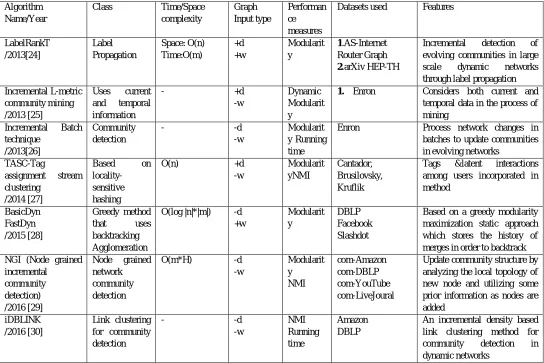
In social network analysis, data mining techniques successfully detects the communities but are mainly limited to the static perspective. With increase in use of internet and smart phones tremendous data generated as well as changed over the period of time that leads to need of dynamic social network analysis. In this focuses on current dynamic methods for community detection and detailed comparison is as shown in table 1.
Table 1: Comparison of community detection methods Algorithm
Name/Year
Class Time/Space
complexity Graph Input type Performan ce measures
Datasets used Features
LabelRankT /2013[24] Label Propagation Space: O(n) Time:O(m) +d +w Modularit y 1.AS-Internet Router Graph
2.arXiv HEP-TH
Incremental detection of evolving communities in large scale dynamic networks through label propagation Incremental L-metric
community mining /2013 [25]
Uses current and temporal information
- +d
-w
Dynamic Modularit y
1. Enron Considers both current and temporal data in the process of mining
Incremental Batch technique
/2013[26]
Community detection
- -d
-w
Modularit y Running time
Enron Process network changes in batches to update communities in evolving networks
TASC-Tag
assignment stream clustering
/2014 [27]
Based on locality-sensitive hashing
O(n) +d
-w Modularit yNMI Cantador, Brusilovsky, Kruflik
Tags &latent interactions among users incorporated in method
BasicDyn FastDyn /2015 [28]
Greedy method that uses backtracking Agglomeration
O(log |n|*|m|) -d +w Modularit y DBLP Facebook Slashdot
Based on a greedy modularity maximization static approach which stores the history of merges in order to backtrack NGI (Node grained
incremental community detection) /2016 [29]
Node grained network community detection
O(m*H) -d
-w Modularit y NMI com-Amazon com-DBLP com-YouTube com-LiveJoural
Update community structure by analyzing the local topology of new node and utilizing some prior information as nodes are added
iDBLINK /2016 [30]
Link clustering for community detection
- -d
-w NMI Running time Amazon DBLP
PHARS /2017 [31]
Subgraph and time interval detection w.r.t. Conductance
O(TlogT) -d
+w
Conducta nce Pruning time
An method PHARS (pruning, hash & refine) for local temporal communities to detect subgraph
DyPrem /2018[32]
Local community scoring metric optimization (Permanence)
O(m) -d
-w
NMI ARI
Dynamic community detection method which optimizes local community scoring metric called Permanence
IDCE /2018[33]
Incremental community finding in distributed evolving network using parallel method
- -d
w
NMI 1.American college football
2.Dolphin social network
3.Books about US politics
4.Arxiv general relativity
5.Arxiv high energy physics theory 6.Enron
This method can detect both disjoint & overlapping communities simultaneously in dynamic distributed network
Incremental
community miner for dynamic
networks[34]
Based on local information
O(Kn2) -d
-w
Modularit y NMI Harmonic mean
Enron HEP-PH Face book LFR-I LFR-II
This approach detects initial cores in the communities of previous snapshots to detect communities in current state
Where,
n: # of nodes -w: Unweighted
m: # of edges H: Average degree of all vertices
+d: Directed K: Average degree of each node
-d: Undirected NMI: Normalized mutual information
+w: Weighted ARI: Adjusted random index
Incremental L-metric community mining[25]
V. APPLICATIONS AND RESEARCH OPPORTUNITIES
With the rapid growth of social networks, community plays a vital role in various applications. Community detection and analysis applications includes Visualizing and navigating huge networks, Website mirror server assignment, Social network role detection, Recommendation system, Graph coarsening and summarization, Network hierarchy inference, functional model in biological networks, Link prediction, Viral marketing etc.
Community analysis has different aspects and used with different parameters and methods. The research on community analysis has different challenges like- in enormous networks, need of effective identification and use of community, evaluation and visualization of communities. With the rapid growth of the networks, evaluation of communities and extracting required information from the same is a challenging task. Identifying the performance parameters used in different types of social network applications and to improve scalability of existing techniques to adapt to the large scale networks is needed.
VI. CONCLUSION
REFERENCE
[1] Lei Tang and Huan Liu. “Graph Mining Applications to Social Network Analysis”, Springer Science and Business Media, LLC 2010.
[2] Fragkiskos D. Malliarosa, Michalis Vazirgiannisa,b “Clustering and Community Detection in Directed Networks: A Survey”, Accepted Author Manuscript,
Physics Reports August 6, 2013.
[3] The Anh Dang, Emmanuel Viennet “Community Detection based on Structural and Attribute Similarities”, IARIA, 2012. ISBN: 978-1-61208-176-2.
[4] Maryam pourkazemi, Mohammadreza Keyvanpour “A survey on community detection methods based on the nature of social networks”, 3rd International
Conference on Computer and Knowledge Engineering (ICCKE 2013), October 31 & November 1, 2013, Ferdowsi University of Mashhad.
[5] Bapuji Rao, Anirban Mitra , “A New Approach for Detection of Common Communities in a Social Network using Graph Mining Techniques”, 2014 IEEE.
[6] Lian Duan , Willian Nick Street , Yanchi Liu , Haibing Lu, Community detection in graphs through correlation, Proceedings of the 20th ACM SIGKDD
international conference on Knowledge discovery and data mining, August 24-27, 2014, New York, New York, USA [doi 10.1145/2623330.2623629]
[7] Arnau Prat-Pérez , David Dominguez-Sal , Josep-Lluis Larriba-Pey, High quality, scalable and parallel community detection for large real graphs, Proceedings
of the 23rd international conference on World wide web, April 07-11, 2014, Seoul, Korea [doi 10.1145/2566486.2568010]
[8] Belak, V., Karnstedt, M. and Hayes, C. (2011), ‘Life-cycles and mutual effects of scientific communities’, Procedia Social and Behavioral Sciences
[9] Karnstedt, M., & Hayes, C. (2009). Towards cross-community effects in scientific communities. In KDML’09. (pp. 52-55).
[10] Zi Yang , Jie Tang , Juanzi Li , Wenjun Yang, Social Community Analysis via a Factor Graph Model, IEEE Intelligent Systems, v.26 n.3, p.58-65, May 2011 [doi 10.1109/MIS.2010.55]
[11] G. Qi, C. Aggarwal, T. Huang. Community Detection with Edge Content in Social Media Networks, ICDE Conference, 2012.
[12] Jie Chen , Yousef Saad, Dense Subgraph Extraction with Application to Community Detection, IEEE Transactions on Knowledge and Data Engineering, v.24
n.7, p.1216-1230, July 2012 doi 10.1109/TKDE.2010.271
[13] Rozenshtein P, Tatti N, Gionis A (2014) Discovering dynamic communities in interaction networks. In: Calders T, Esposito F, Hüllermeier E, Meo R (eds)
Machine learning and knowledge discovery in databases, vol 8725., Lecture notes in computer scienceSpringer, Berlin, pp 678–693
[14] F. Zhang et al., “Community detection based on links and node features in social networks,” in Proceeding of the MultiMedia Modeling: 21st International Conference, Part I, I. He and T., Eds., pp. 418–429, Springer International Publishing, Switzerland, 2015.
[15] M Aghagolzadeh, H Radha, Transitivity based community analysis and detection, 2013 IEEE Global Conference on Signal and Information Processing,
DOI: 10.1109/GlobalSIP.2013.6736909
[16] Hao, F.; Min, G.; Pei, Z.; Park, D.S.; Yang, L.T. K-clique communities detection in social networks based on formal concept analysis. IEEE Syst. J. 2015, 99,
1–10, doi:10.1109/JSYST.2015.2433294.
[17] Falkowski, T., Barth, A., & Spiliopoulou, M. (2008). Studying community dynamics with an incremental graph mining algorithm. In Proceedings of the 14th
Americas Conference on Information Systems AMCIS 08.
[18] Shang, R.; Bai, J.; Jiao, L.; Jin, C. Community detection based on modularity and an improved genetic algorithm. Phys. A Stat. Mech. Appl. 2013, 392, 1215–
1231.
[19] Fortunato, S., and Hric, D. 2016. Community detection in networks: A user guide. arXiv preprint arXiv:1608.00163
[20] Jure Leskovec, California, Anand Rajaraman, Jeffrey David Ullman, Stanford University, California, Mining Social network graph, Chapter 10 (2014)
Publisher: Cambridge University Press DOI: https://doi.org/10.1017/CBO9781139924801.011 pp 325-383
[21] M. Girvan and M. E. J. Newman, Community structure in social and biological networks, Proc. Natl. Acad. Sci. USA, 99 (2002), pp. 8271–8276.
[22] Cruz,J.D., Bothorel, C., Poulet, F. “Entropy based community detection in augmented social networks.”, Computational Aspects of Social Networks (CASoN
2011),pp. 163-168 (2011)
[23] Lancichinetti A, Fortunato S, Kertész J (2009) Detecting the overlapping and hierarchical community structure in complex networks. New J Phys 11: 033015.
[24] J. Xie, M. Chen, B. K. Szymanski, LabelRankT: Incremental Community Detection in Dynamic Networks via Label Propagation, in: Proc. Workshop on
Dynamic Networks Management and Mining, DyNetMM ’13, ACM, New York, NY, USA, 2013, pp. 25–32.
[25] W. H. Chong, L. N. Teow, An incremental batch technique for community detection in: Information Fusion (FUSION) 2013 16th International Conference on,
pp. 750-757, 2013.
[26] Mansoureh Takaffoli , Reihaneh Rabbany , Osmar R. Zaïane, Incremental local community identification in dynamic social networks, Proceedings of the 2013
IEEE/ACM International Conference on Advances in Social Networks Analysis and Mining, August 25-28, 2013, Niagara, Ontario, Canada [doi 10.1145/2492517.2492633]
[27] Wu, Z., & Zou, M. (2014). An incremental community detection method for social tagging systems using locality-sensitive hashing. Neural Networks, 58, 14–
28. doi:10.1016/j.neunet.2014.05.019.
[28] Anita Zakrzewska,and David A. Bader, Fast Incremental Community Detection on Dynamic Graphs, PAM 2015, Part I, LNCS 9573, pp. 207–217, 2016.DOI:
10.1007/978-3-319-32149-320
[29] Yin, S., et al. “Node-grained incremental community detection for streaming networks.” IEEE 28th International Conference on Tools with Artificial
Intelligence, pp.585-592. IEEE(2016)
[30] F. Meng, F. Zhang, M. Zhu, Y. Xing, Z. Wang, and J. Shi, ”Incremental Density-Based Link Clustering Algorithm for Community Detection in Dynamic
Networks,” Mathematical Problems in Engineering, vol. 2016, p. 11, 2016.
[31] Daniel J DiTursi, Gaurav Ghosh, and Petko Bogdanov 2017. “ Local Community Detection in Dynamic Networks.” In Proceedings of the IEEE International
Conference on Data Mining (ICDM), New Orleans, USA
[32] P. Agarwal, R. Verma, A. Agarwal, and T. Chakraborty, “Dyperm: Maximizing permanence for dynamic community detection,” CoRR, vol. abs/1802.04593,
2018.
[33] Nath, KeshabRoy, Swarup, “ An Incremental Parallel Approach for Finding Communities in Evolving Networks”, Journal of Computational and Theoretical
Nanoscience, Volume oham15, Numbers 6-7, June 2018,pp2454-2460(7)
[34] Mohammad Ali Tabarzad, Ali Hamzeh, “Incremental community miner for dynamic networks”, Applied Intelligence, October 2018, Volume