ISSN Online: 2164-3032 ISSN Print: 2164-3024
DOI: 10.4236/ojrad.2018.81003 Mar. 5, 2018 22 Open Journal of Radiology
Devic’s Disease: A MRI Finding Case
E. V. Acko-Ohui
1*, A. Setchéou
2, I. Garba
2, U. V. Acko
3, A. Konan
2, P. Yapo
11Department of Radiodiagnosis and Medical Imaging, University Hospital (UH) of Treichville, Abidjan, Côte d’Ivoire 2Department of Radiodiagnosis and Medical Imaging, University Hospital (UH) of Yopougon, Abidjan, Côte d’Ivoire 3Department of Internal Medicine and Geriatrics, University Hospital (UH) of Treichville, Abidjan, Côte d’Ivoire
Abstract
Introduction: Devic’s neuromyelitis optica is an autoimmune and central nervous system demyelinating disease. It mainly affects the spinal chord and optic nerves. Considered for a long time as a special form of Multiple Sclerosis (MS), it is distinguished clinically by its rarity and poor prognostic, biolo-gically by NMO (IgG) antibody, radiolobiolo-gically by extended myelitis. Treat-ment include mega dose of methylprednisolone during relapses and immu-nosuppressive drug in prevention of recurrences. Observation: Devic’s dis-ease manifests itself in outbreaks of neuritis optic or myelitis. We report the case of a patient who had no particular antecedents. She presented a spastic tetraparesis, accompanied by a decreasing left visual acuity (4/10th); the all
evolving by thrust since one year. Spinal chord lesions on MRI, second stage brain damages appearance affecting the white substance and the discovery in the patient serum of anti-aquaporin 4 antibodies (anti-AQP4 Ab) allowed the diagnosis of Devic’s disease. Conclusion: Diagnosis of Devic’s neuromyelitis optica that was initially based on clinical examination and radiological as-sessment is currently confirmed by the discovery in the patient serum of the NMO immunoglobulin G directed against Aquaporin 4.
Keywords
Optic Neuritis, Spinal Chord, Transverse Myelitis, Aquaporin 4, Devic’s Disease, NMO, MRI
1. Introduction
The neuromyelitis optica (NMO) has been described for the first time by Eugène Devic [1] [2] [3]. Devic’s disease is an inflammatory and demyelinating pathol-ogy of the central nervous system. It mainly affects the spinal chord and the op-tic nerves. Long regarded as a special form of sclerosis (MS), it is different. MS is How to cite this paper: Acko-Ohui, E.V.,
Setchéou, A., Garba, I., Acko, U.V., Konan, A. and Yapo, P. (2018) Devic’s Disease: A MRI Finding Case. Open Journal of Radi-ology, 8, 22-29.
https://doi.org/10.4236/ojrad.2018.81003
Received: July 1, 2017 Accepted: March 2, 2018 Published: March 5, 2018
Copyright © 2018 by authors and Scientific Research Publishing Inc. This work is licensed under the Creative Commons Attribution International License (CC BY 4.0).
DOI: 10.4236/ojrad.2018.81003 23 Open Journal of Radiology a cell-mediated autoimmune disease in which the Lymphocytic infiltrate is pre-dominant [4]. Devic’s disease is an autoimmune disease with humoral media-tion. It implies the presence of an antibody directed against the Aquaporin 4. This antibody, recognized under the name of Aquaporin 4 antibody (anti-AQP4 Ab) [4] [5], was originally called immunoglobulin G of the NMO (NMO - IgG). Devic’s disease manifests itself in outbreaks of optic neuritis or myelitis. The mode of entry into the disease is, in more than two thirds of the cases, an optical neuritis. Optic neuritis may be bilateral but is more often unilateral [6]. It is generally of acute installation; the decrease in visual acuity is profound, and the prognosis is severe. Myelopathy during Devic’s disease is also most often acute and associated with back pain [7]. It usually leads to severe disability. Repetition of flare-ups can lead to permanent disability. We report the case of 35 years old patient in whom the MRI allowed to evoke the diagnosis of Devic’s disease.
2. Observation
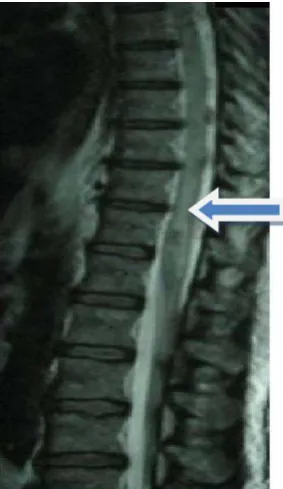
[image:2.595.301.443.446.691.2]Miss TY, 35 years old, was admitted to a neurology department in our town. She had a spastic paraparesis associated with a decrease of the left eye visual acuity. She had no particular antecedents. The symptomatology had evolved for about a week. Three days after her hospitalization, left eye blindness was installed, asso-ciated with urinary retention. The thoracic spine Magnetic Resonance Imaging (MRI) involved highlighted an extended intra medullar signal anomaly from T9 to T12. This anomaly appeared in hypo intensity on EST1 sequences, in hyper intensity on EST2 sequences [Figure 1] and in hyper intensity on STIR se-quences. This hypersignal also extended at the level of the dorsal spine from T2
Figure 1. From T9 to T12. Intra medular hyperintensity on
DOI: 10.4236/ojrad.2018.81003 24 Open Journal of Radiology to T7 on EST2 [Figure 2]. These lesions were not affected by the gadolinium in-jection. Encephalic MRI was normal. The analysis of the cerebro-spinal fluid (CSF) highlighted a rise in its protein content and a rise in its content in cells which reached more than 60 leukocytes/mm3. All of these data was in favour of active transverse myelitis. A corticosteroids intravenous bolus has been initiated at the dose of 1g of methyl prednisolone a day for three days. The relay was tak-en orally with prednisone, 1 mg per kilogram and per day for a month. This treatment was followed by an incomplete recovery of motor function and left eye visual acuity.
[image:3.595.316.429.473.692.2]Two months later, she introduced a new thrust. This time, there was a bilater-al reduction in visubilater-al acuity and the reappearance of sphincter disorders. She was again hospitalized and under corticosteroid therapy at the same doses as above. A week later, her general condition had improved. Six months after this last episode, she introduced a third thrust marked by the worsening of the un-rest. It was about quadriplegia, binocular blindness and sphincter disorders. The MRI of cervical spine, thoracic spine, skull and brain were conducted. At neck and chest, the lesions described above were increased, revealing themselves in the form of an extension of the intra spinal chord hyper intensities from C2 to T10 [Figure 3]. Myelitis involved less than 50% of the transverse diameter of the cervical chord [Figure 4]. The brain, in this third thrust, had signal abnormali-ties. Were observed bilateral protuberantial and sub-ependymal demyelinization lesions [Figure 5]. The discovery of the anti-AQP4 antibody in the patient’s se-rum helped bring certainty diagnosis of Devic’s neuromyelitis optica [Figure 6]. The same treatment was renewed, but it has been spread over a longer period of time (one week of high-dose treatment and three months of maintenance treat-ment).
Figure 2. MRI sagittal EST2 of the dorsal spine. Intra medular
DOI: 10.4236/ojrad.2018.81003 25 Open Journal of Radiology
Figure 3. MRI sagittal EST2 of the cervical and thoracic spine.
Medular hyperintensity extended from C2 to T10.
Figure 4. MRI axial T2 BASG of the cervical spine. Chord
in-jury less than 50%
3. Discussion
[image:4.595.262.485.384.510.2]DOI: 10.4236/ojrad.2018.81003 26 Open Journal of Radiology
Figure 5. Axial EST2 Cranioencephalic MRI. Bilateral
pedun-cular hyperintensity.
Figure 6. Positivity of anti-AQP4 antibody research.
Some authors state that these associations justify the non inclusion of these cases in the nosological framework of Devic’s syndrome [11].
This entity is not a hereditary disease, but there is a reported case of 2 homo-zygous sisters [10] [11].
The viral and bacterial infections preceding or accompanying the NMO are a known phenomenon. The influenza-like illness that precedes the onset of neu-rological disease has been reported in about 25% - 30% of cases [12]. Varicella zoster virus (VZV) and tuberculosis have been the most common infectious triggers; however, other bacterial and viral agents such as chlamydia, cytomega-lovirus, HIV and Epstein Barr virus (EBV) have been reported [12].
Clinically, Devic’s disease is characterized by acute episodes of optic neuritis and myelitis. Optic neuritis is a retrobulbar-like optic neuritis, unilateral or bila-teral, often more severe than that described in MS. Cases of oculomotor abnor-malities, Claude Bernard Horner’s syndrome and nystagmus have been reported by some authors [13].
[image:5.595.260.487.364.420.2]DOI: 10.4236/ojrad.2018.81003 27 Open Journal of Radiology hours or in a few days. The topography is readily cervico-dorsal. The table can be dramatic in the type of flaccid tetraplegia associated with respiratory distress requiring ventilatory assistance. Medullary sprays may also adopt a more limited topography, such as Brown-Sequard syndromes [14] [15], single-paresis, or even isolated sensory disorders. In the state phase, paralysis in a pleural mode of at least one member and its flaccid character would be frequent.
Spinal chord MRI is characteristic. This imaging technic highlights an intra medullar hyper intensity on the EST2 and STIR sequences. Signal abnormalities extend to more than 3 metameres in the sagittal plan [11]. Cerebral MRI is nor-mal outside the extended hypersignal of the two optic nerves dating back to the chiasma. However, most authors admit the presence of brain white hyperinsig-nals on the T2-weighted sequences especially correlated with the duration of evolution, without calling into question the diagnosis of NMO [16].
During the third thrust, the neck and thoracic spine MRI performed in our patient have highlighted the hyper intensity lesions on T2 and STIR sequences that stretched to 5 metameres for the cervical spine and 10 metameres for the thoracic spine. Brain MRI was normal at the beginning.
At the last thrust, it demonstrated bilateral protuberantial and sub-ependymal demyelinization lesions.
The analysis of CSF and blood makes it possible to differentiate on the one hand between the infectious and systemic inflammatory etiologies and on the other hand between NMO and MS [1] [4] [12] [13]. In the NMO, levels of CSF in cells (greater than 50 leukocytes/mm3) and in proteins are high [2] [7] [9]. These were observations we made in our study. The NMO is secondary to the production of an antibody directed against the Aquaporin 4, abbreviated AQP4 (anti-AQP4 antibody). Aquaporins are membrane proteins that provide exclu-sively the passage of water from the extracellular sector to the intracellular envi-ronment. The AQP4 differs from other aquaporins by its tropism for the central nervous system and the retina [3] [10] [14]. In our study, the research of an-ti-AQP4 antibody came back positive.
The current criteria of Devic neuromyelitis are based on the combination of mandatory criteria (optic neuritis, acute myelitis and absence of signs in favor of an attack other than that of the optic nerve and marrow) to a secondary criterion (Normal MRI, extensive medullary lesion on more than 3 vertebrae, plethocyto-sis of the cerebrospinal fluid) or two minor secondary endpoints (bilateral optic neuropathy, severe optic neuropathy with 1/10th visual acuity and severe muscle deficiency At least one member) [17] [18].
However, these criteria do not allow the diagnosis of Devic neuromyelitis subjects with neurological symptoms in regions of the central nervous system other than the optic nerve or spinal cord, and those with cerebral MRI showing lesions identical to Those of multiple sclerosis [19] [20].
tak-DOI: 10.4236/ojrad.2018.81003 28 Open Journal of Radiology en by the corticosteroid at the dose of 1 mg/kg/d [5] [7] [15]. Attacks of myelitis may not stop under this treatment and may even worsen. In this case, plasma transfusions must be considered [15]. One day out of two, 5 to 7 sessions of plasmapheresis are performed [10] [12] [14]. Failing to plasmapheresis, intra-venous immunoglobulin infusions are often considered as an alternative. Most often used immunosuppressive therapy is an oral combination of azathioprine – prednisone [13] [15]. In our study, thrust gave way under corticosteroid therapy. We didn’t need to resort to plasmapheresis or immunosuppressive therapy.
4. Conclusion
Devic’s disease is an extremely rare pathology. It is a rare clinical syndrome in-volving a unilateral or bilateral optic neuritis with a transverse myelitis. Devic’s neuromyelitis optica Clinically similar to multiple sclerosis, albeit with a more rapid and more severe, it is a distinct clinical and pathological entity. The diag-nosis of NMO should be evoked facing clinical symptoms of increased aggrava-tion of spinal and ocular neuritis. On MRI, lesions are localized first to the spinal cord and then to the brain. The diagnosis of certainty is made by the discovery of the anti-aquaporin4 antibody in the patient’s serum.
Conflict of Interest
None.References
[1] Lennon, V.A., et al. (2005) IgG marker of Optic-Spinal Multiple Sclerosis Binds to the Aquaporin-4 Waterchannel. The Journal of Experimental Medicine, 202, 473-477. https://doi.org/10.1084/jem.20050304
[2] Lucchinetti, C., et al. (2000) Heterogeneity of Multiple Sclerosis Lesions: Implica-tions for the Pathogenesis of Demyelination. Annals of Neurology, 47, 707-717.
https://doi.org/10.1002/1531-8249(200006)47:6<707::AID-ANA3>3.0.CO;2-Q
[3] Yu, C.S., Lin, F.C., Li, K.C., Jiang, T.Z., Zhu, C.Z., Qin, W., et al. (2006) Diffusion Tensor Imaging in the Assessment of Normal-Appearing Brain Tissue Damage in Relapsing Neuromyelitis Optica. American Journal of Neuroradiology, 27, 1009-1015. [4] Papeix, C. (2006) Maladie de Devic. La Presse Médicale, 35, 1703-1706.
https://doi.org/10.1016/S0755-4982(06)74884-9
[5] Wingerchuk, D.M. (2006) Neuromyelitis Optica. International MS Journal, 13, 42-50.
[6] Poser, C.M. and Brinar, V.V. (2004) The Nature of Multiple Sclerosis. Clinical Neurology and Neurosurgery, 106, 159-171.
https://doi.org/10.1016/j.clineuro.2004.02.005
[7] Rocca, M.A., Agosta, F., Mezzapeza, D.M., Martinelli, V., Salvi, F., Ghezzi, A., et al. (2004) Magnetization Transfer and Diffusion Tensor MRI Show Gray Matter Dam-age in Neuromyelitis Optica. Neurology, 62, 476-478.
https://doi.org/10.1212/01.WNL.0000106946.08741.41
DOI: 10.4236/ojrad.2018.81003 29 Open Journal of Radiology https://doi.org/10.1212/01.wnl.0000223346.09426.34
[9] Pittock, S.J., et al. (2006) Brain Abnormalities in Neuromyelitis Optica. Archives of Neurology, 63, 390-396. https://doi.org/10.1001/archneur.63.3.390
[10] Pescovitz, M.D. (2006) Rituximab, an Anti-cd20 Monoclonal Antibody: History and Mechanism of Action. American Journal of Transplantation, 6, 859-866.
https://doi.org/10.1111/j.1600-6143.2006.01288.x
[11] Mandler, R.N., Ahmed, W. and Dencoff, J.E. (1998) Devic’s Neuromyelitis Optica : A Prospective Study of Seven Patients Treated with Prednisone and Azathioprine.
Neurology, 51, 1219-1220. https://doi.org/10.1212/WNL.51.4.1219
[12] Nakashima, I., et al. (2006) Clinical and MRI Features of Japanese Patients with Multiple Sclerosis Positive for NMO-IgG. Journal of Neurology, Neurosurgery, and Psychiatry, 77, 1073-1075. https://doi.org/10.1136/jnnp.2005.080390
[13] Weinstock-Guttman, B., et al. (2006) Study of Mitoxantrone for the Treatment of Recurrent Neuromyelitis Optica (Devic Disease). Archives of Neurology, 63, 957-963. https://doi.org/10.1001/archneur.63.7.957
[14] Pittock, S.J., et al. (2006) Neuromyelitis Optica Brain Lesions Localized at Sites of High Aquaporin 4 Expression. Archives of Neurology, 63, 964-968.
https://doi.org/10.1001/archneur.63.7.964
[15] Kira, J. (2003) Multiple Sclerosis in the Japanese Population. The Lancet Neurology, 2, 117-127. https://doi.org/10.1016/S1474-4422(03)00308-9
[16] Wingerchuk, D.M. and Weinshenker, B.G. (2005) Neuromyelitis Optica. Current Treatment Options in Neurology, 7, 173-182.
https://doi.org/10.1007/s11940-005-0010-6
[17] Wingerchuk, D.M., Lennon, V.A., Pittock, S.J., Lucchinetti, C.F. and Weinshenker, B.G. (2006) Revised Diagnostic Criteria for Neuromyelitis Optica. Journal of Neu-rology, 66, 1485-1489.https://doi.org/10.1212/01.wnl.0000216139.44259.74
[18] Weinshenker, B.G., Wingerchuk, D.M., Lindo, L. and Lennon, V. (2005) NMO IgG Predicts Relapse in Patients with Longitudinally Extensive Idiopathic Transverse Myelitis. Journal of Neurology, 64, 128.
[19] Papeix, C.L.C., Moreau, T., Tourbah, A. and Gout, O. (2003) Spinal Cord Magnetic Resonance Characteristics in Devic’s Neuromyelitis Optica. Multiple Sclerosis, 110. [20] Watanabe, S., Nakashima, I., Misu, T., Shiga, Y., Fugihara, K. and Itoyama, Y.
(2007) Therapeutic Efficacy of Plasma Exchange in NMO-IgG Positive Patients with Neuromyelitis Optica. Multiple Sclerosis, 13, 128-132.