RESEARCH ARTICLE
Estimation of the referral rate of suspected cases of central
auditory processing disorders in children aged 8-12 years old in
Oshnavieh, Western Iran, based on auditory processing domain
questionnaire and speech in noise and dichotic digit tests
Arezou Moloudi1, Masoumeh Rouzbahani1*, Nariman Rahbar1, Hasan Saneie2
1
- Department of Audiology, School of Rehabilitation Sciences, Iran University of Medical Sciences, Tehran, Iran
2- Department of Basic Sciences, School of Rehabilitation Sciences, Iran University of Medical Sciences, Tehran, Iran
Received: 10 Feb 2018, Revised: 7 Mar 2018, Accepted: 14 Mar 2018, Published: 15 Jul 2018
Abstract
Background and Aim: Studies have shown that central auditory processing disorder is a sensory processing deficit which has five per-cent prevalence among school-aged children that results in speech, language and learning problems in children. The aim of the current study was investigating the referral rate of chil-dren suspected to central auditory processing disorder (CAPD) by using auditory processing domain questionnaire (APDQ), speech in noise test, and dichotic digit test.
Methods: Three hundred and ninety six APDQ questionnaire was obtained from children’s par-ents among five schools in Oshnaviyeh. The children with low APDQ score underwent spee-ch in noise and dispee-chotic digit test (DDT).
Results: The findings revealed that 37 children were suspected to CAPD based on APDQ. 35 of these participants in DDT and 24 of them in speech in noise test also indicated low scores, respectively. Moreover, results were unrelated to gender, however, age had a positive
correlation with the questionnaire scores.
Conclusion: Based on the findings, the APDQ can be used as a screening questionnaire for detecting CAPD.
Keywords: Central auditory processing disorder; auditory processing domain questionnaire; dichotic digit test; speech in noise test; children
Citation: Moloudi A, Rouzbahani M, Rahbar N,Saneie H. Estimation of the referral rate of suspected cases of central auditory processing disorders in children aged 8-12 years old in Oshnavieh, Western Iran, based on auditory processing domain questionnaire and speech in noise and dichotic digit tests. Aud Vestib Res. 2018;27(3):164-70.
Introduction
Central auditory processing disorder is referred to the conditions in which auditory information, in spite of fully healthy peripheral auditory sys-tem, are altered by injury in each level of neural pathways above the cochlear and can be defined as a deficiency in retrieving, transforming, ana-lysing, organizing and storing the information from the audible acoustic signal [1].
Based on studies, central auditory processing disorder (CAPD) is a sensory processing imp-airment which is seen among about 5% of school children and causes the problems with
* Corresponding author: Department of Audiology,
School of Rehabilitation Sciences, Iran University of Medical Sciences, Shahid Shahnazari St., Madar Square, Mirdamad Blvd., Tehran, 15459-13487, Iran. Tel: 009821-22228051,
discrimination, recognition and comprehension of auditory information. Since learning is often done through sense of hearing, disorder in this sense leads to learning, verbal, vocal and train-ing problems among the children [2]. Symptoms of children with CAPD usually appear as they enter the school which includes numerous sym-ptoms like problem with hearing the verbal message in noisy and resonant environment, problem with fast processing of speech, weak-ness in listening skill, excessive request for rep-eating the already said messages, wrong or dela-yed response to verbal commands [3]. Children with CAPD are often careless and get rapidly tired as they perform the long term or comp-licated intellectual activities [4]. Therefore, imp-ortance of diagnosis and early treatment of this disorder is underlined.
All existing questionnaires in the field of scree-ning the central auditory processing disorder, except the auditory processing domains ques-tionnaire (APDQ), only deal with the child’s auditory behaviour and functioning and hence they likely result in wrong referrals [3,4]. From among the aforementioned questionnaires, APDQ is the only questionnaire in which lan-guage skills and attention are discussed in add-ition to the child’s auditory behaviour [3]. APDQ is a standard questionnaire presented by Brain O’Hara in 2009 during the Annual Con-ference of American Speech-Language-Hearing Association (ASHA) with valid psychometric criteria. It includes 52 items which is completed by the child’s parents or teacher [3].
Ahmadi et al. conducted this questionnaire to examine its validity and reliability on 260 nor-mal children and 101 children with learning dis-order of which the results indicate that APDQ has a high validity and reliability and is an app-ropriate tool for screening the auditory proce-ssing disorder [5].
To exactly assess the children, it is necessary to perform the screening process with a tool like questionnaire and those people suspected to this disorder are assessed with the help tests which can examine the neural pathways of auditory processing. Therefore, we need a test set after the screening stage so that we can examine
the whole neural pathway of central auditory processing. One test is not sufficiently sensitive to CAPD diagnosis [6,7]. Therefore, we inte-nded to investigate the 8-12 age’s children in Oshnavieh by using the APDQ and then assess those who were identified as the suspected persons to central auditory processing disorder based on the questionnaire results by speech in noise and dichotic digit testing.
Methods
This study conducted in two phases. The first phase was to complete and examine the ques-tionnaire and the second one was to perform the speech in noise (SIN) and dichotic digit test (DDT). The research population includes all 8−12 aged male and female students of Oshnavieh, western Iran, from among whom 385 were selected by using the minimum sam-ple size formula. As required coordinated was made with the authorities of Western Azerbaijan Province Education Organization and schools’ principals, 430 questionnaires were distributed randomly among the 8−12 aged students of Oshnavieh and the parents were requested to fill it after studying and signing the letter of cons-tant. After two days, questionnaires were collec-ted from the schools, then reviewed. Out of 430 questionnaires distributed among the schools, 396 ones were filled properly which included 195 male students (37 students with 8 years old, 37 with 9 years old, 46 with 10 years old, 37 with 11 years old, 38 with 12 years old) and 201 female students (38 with 8 years old, 37 with 9 years old, 47 with 10 years old, 41 with 11 years old, 38 with 12 years old). Results obtained for three auditory, language and attention indices were extracted from the questionnaires. 359 students were within the normal range in view of the achieved questionnaire scores and 37 students were in the suspected area to central auditory processing disorder.
Dichotic digit test included 20 pair digits which were presented simultaneously to both ears. Two first digits were presented simultaneously to both ears and then two second digits were presented again simultaneously to the ears and then the subject had to repeat four heard digits. Items were presented in 50 dBSL regarding the speech reception threshold (SRT) [8]. Respon-ses for each person were recorded and scored, then compared with the test norm in Persian language (for 7 years old, the mean score of norm: right ear=92.33 (SD=3.14), left ear=86 (SD=3.05), for 8 years old, the mean score of norm: right ear=93.12 (SD=2.98), left ear=85.93 (SD=14.14), for 9 years old, the mean score of norm: right ear=95.64 (SD=2.38), left ear=89.85 (SD=3.12), for 10 years old, the mean score of norm: right ear=98.83 (SD=1.57), left ear=96.41 (SD=2.17), for 11 years old, the mean score of norm: right ear=99.75 (SD=1), left ear=98.16 (SD=2.17)) as well as the scores of APDQ [5]. Speech in noise included 50 one syllable words
of which 25 words were presented to the right ear and 25 to the left ear. Generally, white noise was used as the competing stimulus and both stimuli were presented simultaneously in one ear in 0 dB signal-to-noise ratio. The items were presented at 40 dBSL re: speech reception thre-shold. Test was conducted monaurally in which both noise and signal were presented into one ear [2]. The subject’s task was to respond the
target signal and ignore the noise. Before start-ing the test, three practice words were presented in each ear for making the child familiar with the test. Results were compared with the test norm in Persian language (for males 0.39 with SD=0.65 and for males 0.25 with SD=0.85) and scores of APDQ [5,2].
To describe the data, mean and standard devi-ation, to compare means, independent t test, and to determine the relationship between age and auditory index, Pearson correlation test were used, respectively.
Results
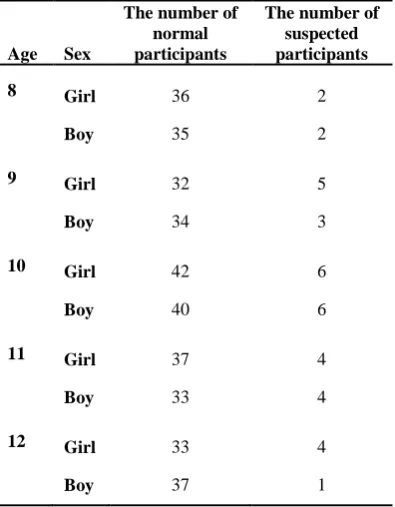
Three hundred and ninety six questionnaires collected from the schools were reviewed revea-ling that out of this number, 359 students (179 males and 180 females) were within the normal range based on the auditory index of APDQ and 39 ones (18 males and 21 females) were in abnormal range. In Table 1, distribution of stu-dents’ age frequency who were in normal range based on the auditory index of APDQ is sepa-rately given for age and gender included 201 females and 195 males in these categories: 75 students with 8 years old, 74 students with 9 years old, 94 students with 10 years old, 78 students with 11 years old and 75 students with 12 years old.
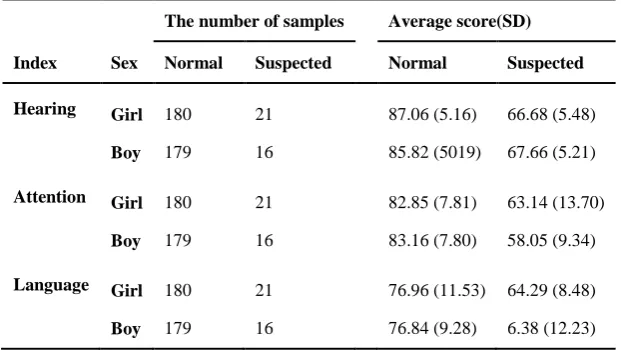
Results indicated that as the age raises, score of questionnaire auditory index is also increased (correlation coefficient=0.402 and p<0.001). T-test results showed that this mean is not signi-ficantly different in normal group among the males and females (p>0.05), but this difference was significant in the group suspected to CAPD (p=0.02).
The mean scores of language and attention indi-ces were compared in both male and female Table 1. Frequency distribution of normal
and suspected individuals to central auditory processing disorder based on the hearing index of the auditory processing domain questionnaire by age and sex
Age Sex
The number of normal participants
The number of suspected participants
8 Girl 36 2
Boy 35 2
9 Girl 32 5
Boy 34 3
10 Girl 42 6
Boy 40 6
11 Girl 37 4
Boy 33 4
12 Girl 33 4
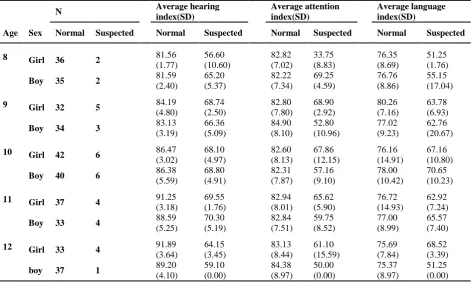
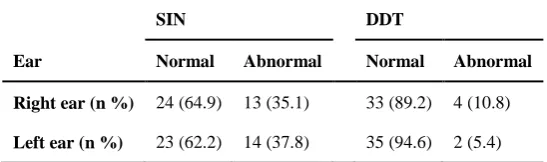
groups and it was specified that mean of such indices are not significantly different in both male and female groups (p>0.05) (Tables 2,3). Thirty seven students suspected to CAPD based on the auditory index of questionnaire, were evaluated by SIN and DDT tests. Among them, 24 persons (64.9%) and 35 (94.6%) received the scores in SIN test and DDT lower than the nor-mal limit (Table 4). In fact, 24 students evalu-ated by these two tests, received the scores lower than the normal limit in both tests.
Discussion
In this study, from 396 students evaluated by the questionnaire, 357 students were normal and 39 were abnormal in terms of auditory proce-ssing index (normal limit of auditory index 79%-100%) [5], from the language index point of view, 387 and 9 students were normal and abnormal, respectively (normal limit of langu-age index 65%-93%) [5], and from the attention point of view, 391 and 5 students were normal and abnormal, respectively, in terms of attention processing index (normal limit of attention index 72%-97%) [5].
In a similar study on investigating the amount of prevalence of CAPD in Arak, central Iran, out of 300 persons reviewed, 15 persons (5%) were suspected to central auditory processing
disor-der [4]. In the present study, from among 396 persons, 39 ones (9.84%) are suspected to this disorder based on the questionnaire’s scores. The mean scores of three auditory, attention and language indices in both male and female gro-ups between normal and abnormal participants were compared indicating that the difference in normal group is significant in terms of auditory index and there are no significant differences in other indices between sexes.
In this study, results show that as the age raises, the score of auditory index and total score of APDQ are increased which is similar to previ-ous studies employing to APDQ [5,3].
On the basis of studies conducted by scholars, different percentages of prevalence of central auditory processing disorder were achieved. For example, in a study, prevalence of such disorder was found 2-3% in schooling students [9]. Some other studies have indicated that real value of this disorder as 7% [10]. In another study, the best approximation of CAPD percentage in sch-ooling population was reported as 20% [11]. In our study, SIN and DDT were conducted on 37 student (two students gave up the colla-boration) who were abnormal in terms of audi-tory index and based on its results, 24 persons (64.9%) and 35 persons (94.6%) obtained lower scores lower than the normal limit SIN and Table 2. Mean )standard deviation( of hearing, attention and
language indices of the auditory processing domain questionnaire in normal and suspected participants in both sexes
The number of samples Average score(SD)
Index Sex Normal Suspected Normal Suspected
Hearing Girl 180 21 87.06 (5.16) 66.68 (5.48)
Boy 179 16 85.82 (5019) 67.66 (5.21)
Attention Girl 180 21 82.85 (7.81) 63.14 (13.70)
Boy 179 16 83.16 (7.80) 58.05 (9.34)
Language Girl 180 21 76.96 (11.53) 64.29 (8.48)
DDT, respectively. Such results indicate the high consistency of APDQ scores and DDT res-ults. Results of present research were compared with the studies developing the Persian versions of SIN [15] and DDT [12] and we used their normal values.
The mean scores of both tests in both male and female groups were compared indicating the differences were not significant (p<0.05).
Utilizing APDQ among the children with lear-ning disorder have shown high validity (63%) and reliability (auditory index: 92%, language index: 88%, attention index: 86%) of the ques-tionnaire. APDQ is considered as an appropriate tool for screening the auditory processing dis-order [5] which is consistent with the present study.
In addition to identifying the problems with lis-tening, APDQ can be used as a screening tool for diagnosing the children suspected with lear-ning disorder, attention/hyperactivity disorder and auditory processing disorder. Regarding the verlapping behaviour existing in children with
CAPD with other neurological disorders like attention-deficit/hyperactivity disorder (ADHD) and learning disorder, CAPD screening is not sufficient without taking the attention control and language-cognitive factors into account and it is likely leading to inappropriate referrals of children. Due to investigating several aspects of attention and language skill, this questionnaire provide a more accurate and appropriate referr-als for children suspected with auditory proce-ssing disorder [13]. For this reason, we used the APDQ for preventing the inappropriate referr-als.
DDT has many advantages for assessing the central auditory processing including the high sensitivity, high resistance to high frequency hearing loss, and high reliability in test-retest among the people with CAPD in various ages. Another advantage of this test is familiarization of different age groups with digits [14]. For this reason, in the present study, DDT was used for evaluating the children for CAPD.
CAPD diagnosis is done based on the test Table 3. Mean (standard deviation) of hearing, attention and language indices of the auditory
processing domain questionnaire in normal and suspected participants in age groups and both sexes
N Average hearing index(SD)
Average attention index(SD)
Average language index(SD)
Age Sex Normal Suspected Normal Suspected Normal Suspected Normal Suspected
8 Girl 36 2 81.56
(1.77) 56.60 (10.60) 82.82 (7.02) 33.75 (8.83) 76.35 (8.69) 51.25 (1.76)
Boy 35 2 81.59
(2.40) 65.20 (5.37) 82.22 (7.34) 69.25 (4.59) 76.76 (8.86) 55.15 (17.04)
9 Girl 32 5 84.19
(4.80) 68.74 (2.50) 82.80 (7.80) 68.90 (2.92) 80.26 (7.16) 63.78 (6.93)
Boy 34 3 83.13
(3.19) 66.36 (5.09) 84.90 (8.10) 52.80 (10.96) 77.02 (9.23) 62.76 (20.67)
10 Girl 42 6 86.47
(3.02) 68.10 (4.97) 82.60 (8.13) 67.86 (12.15) 76.16 (14.91) 67.16 (10.80)
Boy 40 6 86.38
(5.59) 68.80 (4.91) 82.31 (7.87) 57.16 (9.10) 78.00 (10.42) 70.65 (10.23)
11 Girl 37 4 91.25
(3.18) 69.55 (1.76) 82.94 (8.01) 65.62 (5.90) 76.72 (14.93) 62.92 (7.24)
Boy 33 4 88.59
(5.25) 70.30 (5.19) 82.84 (7.51) 59.75 (8.52) 77.00 (8.99) 65.57 (7.40)
12 Girl 33 4 91.89
(3.64) 64.15 (3.45) 83.13 (8.44) 61.10 (15.59) 75.69 (7.84) 68.52 (3.39)
boy 37 1 89.20
battery. Factor analysis made by Schow and Chermark in 1999 indicated that measuring two abilities of SIN and DDT is sufficient to diag-nose auditory processing disorder (APD) [15]. For this purpose, in addition to questionnaire, we used two SIN and DDT tests.
In another descriptive study, psychometric pro-perties of DDT were investigated. The research was conducted on 144 children ranging in 7−12 ages. Results showed that DDT is acceptable in terms of psychometric properties and has a high validity. In addition, it was indicated that as the age rises, scores of right and left are increased and the mean scores in both male and female groups are not significantly different. This study indicated that DDT has a high validity for cliical works and researches related to the central audi-tory system [16].
In a study, SIN was used for investigating the speech perception among the APD and healthy children [17]. In this test, sentences with high predictability and also the sentences with low predictability are used. SIN is able to investigate the auditory function and language function involved in the speech perception. Results sho-wed that the ability to recognise the key words in sentences in presence of noise among the healthy children and children with APD is different and the latter has weaker performance than the former. In this study, speech perception of children suspected to CAPD was assessed by SIN scores test. Our results were consistent with that previous study.
Conclusion
It can be concluded that in this study, APDQ
has a high efficiency for evaluating the children suspected to CAPD. Gender has no impact on the results, but as the age rises, the score of aud-itory processing index increases. It was also showed that results obtained from questionnaire are consistent with the results of both test of speech perception in noise and dichotic digit test.
Since there is not the Kurdish version of speech in noise test in Iran, we used the Persian version which is in accordance with the second lan-guage of children under study.
Acknowledgements
This research is extracted from A. Moloudi’s MSc thesis and supported by grant No 96/d/ 320/5792 from Iran University of Medical Sci-ences. All students and their parents who helped on reaching the goal of this study are highly appreciated.
Conflict of interest
The authors declare that they have no conflict of interest.
REFERENCES
1. Geffner D. Central auditory processing disorder: defi-nition, discription, and behaviors. In: Geffner D, Ross-Swain D,editors. Auditory processing disorders: asse-ssment, management and treatment. 1st ed. San Diego: Plural Publishing Inc; 2007. p. 59-90.
2. Veuillet E, Magnan A, Ecalle J, Thai-Van H, Collet L. Auditory processing disorder in children with reading disabilities: effect of audiovisual training. Brain. 2007; 130(Pt 11):2915-28. doi: 10.1093/brain/awm235
3. O'Hara B. The auditory processing domains ques-tionnaire. APDQ 2012. rev. 1. For parents and teachers of students ages 7 through 17 years. Retrieved from http://www.neuroaudiology.com/APDQ.pdf Richard G, Table 4. Frequency and percentage of normal and
abnormal participants based on the results of the speech perception in noise and dichotic digit tests
SIN DDT
Ear Normal Abnormal Normal Abnormal
Right ear (n %) 24 (64.9) 13 (35.1) 33 (89.2) 4 (10.8)
Ferre J. 2006.
4. Ebadi E, Jarollahi F, Tahaei AA, Ahadi M, Hosseini AF. Development and evaluation of the Persian version of the multiple auditory processing assessment. Aud Vest Res. 2016;25(2):75-81.
5. Ahmadi Z, Jarollahi F, Ahadi M, Hosseini AF. Nor-malization and validation of Auditory Processing Dom-ain Questionnaire in normal 8-12 year-old children. Aud Vest Res. 2017;26(2):93-98.
6. Domitz DM, Schow RL. A new CAPD battery--multiple auditory processing assessment: factor analysis and comparisons with SCAN.Am J Audiol. 2000;9(2):101-11. doi: 10.1044/1059-0889(2000/012)
7. Drake M, Brager M, Leyendecker J, Preston M, Shorten E, Stoos R, et al. Comparison of the CHAPS screening tool and APD diagnosis. Paper presented at the American Speech-Language-Hearing Association Convention. 2006. Retrieved from:
www.eshow2000.com/asha/2006/handouts/855_0427Dr ake_Mary_072995_120106033139.pdf
8. Mahdavi ME, Aghazadeh J, Tahaei AA, Heiran F, Akbarzadeh Baghban A. [Persian randomized dichotic digits test: development and dichotic listening perfor-mance in young adults]. Audiol. 2017;23(6):99-113. Persian.
9. Cameron S, Dillon H. Remediation of spatial processing issues in central auditory processing disorder. In: Cher-mak GD, Musiek FE, editors. Handbook of central audi-tory processing disorder, Volume II: comprehensive intervention. 2nd ed. San Diego: Plural Publishing, Inc.; 2014. p. 201-24.
10. Keith RW. Development and standardization of
SCAN-C Test for Auditory Processing Disorders in Children. J Am Acad Audiol. 2000;11(8):438-45.
11. Medwetsky L, Riddle L, Katz J. Management of central auditory processing disorders. In: Katz J, Medwetsky L, Burkard R, Hood LJ, editors. Handbook of clinical udiology. 6th ed. Baltimore: Lippincott Williams & Wilkins; 2009. p. 642-65.
12. Shahmir B, Hajiabolhassan F, Mohammadkhani G, Tahaei AA, Jalaie S. Development and evaluation of the reliability of Persian version of double dichotic digit test in girls aged 7 to 11 years. Aud Vest Res. 2015;24(3): 164-70.
13. Pickles JO. An introduction to the physiology of hea-ring. 3rd ed. London: Emerald; 2008.
14. Mukari SZ, Keith RW, Tharpe AM, Johnson CD. Development and standardization of single and double dichotic digit tests in the Malay language. Int J Audiol. 2006;45(6):344-52. doi: 10.1080/14992020600582174
15. Moradiju E, Mahdavi M, Zarrinkoob H, Tabatabaee S. [Relative and absolute test-retest reliability of several persian auditory processing tests for dichotic listening and recognition of speech-in-noise in normal children aged 6-12 years]. J Rehab Med. 2018;6(4);160-67. Persian. doi: 10.22037/jrm.2017.110584.1389
16. Nejati V, Alipour F, jalilvand Karimi L, Esfandiari L. Persian version of the dichotic digit test for children: design and evaluation of the psychometric properties. Aud Vest Res. 2016; 25(1):55-62.