Vol. 1, No. 1, Spring 2019 Print ISSN: 2588-6703 Pp. 47-53 Doi: 10.22034/ijsc.2019.86926
The relationship between creativity and intelligence
with wisdom in youths
Hossein MalekMohammadi*1 , Mohammad Moshkani2, Esmail Shirdel Havar3 1 Ph.D. in psychology of exceptional children, Welfare Organization, Rey, Iran
2 Ph.D. in psychology of exceptional children, Special Education office, Gorgan, Iran
3 M.A in Clinical Psychology, Department of Education, Gorgan, Iran
Abstract
Background: One of the theoretical perspectives for the study of wisdom is related to intelligence. Equilibrium theory of wisdom begins with tacit knowledge structure which is a major component of practical intelligence. Hypotheses also show that there is a relationship between creativity and wisdom. Therefore, this research has been conducted in the field of Wisdom with an analytical approach and is a correlation study.
Objectives: The aim of this study was to investigate the relationship between creativity and intelligence with wisdom in youths.
Methods:The research design is correlation. Sample consisted of 120 volunteer. Their mean age was 20(in the range of 16-24) who 50 percent (n = 60) were girl and 50 percent (n = 60) were boy. Wechsler Youth Intelligence Scale (WAIS-R), Torrance Test creativity, Abedi creativity test was used to collect information from three-dimensional scale of wisdom (3D-WS). Pearson correlation test was used to analyze the data. Results:The results showed that there is a significant relationship between creativity and intelligence with wisdom and creativity, if a person gets higher score in creativity and intelligence with wisdom index will get higher score in wisdom. Given the importance of internal and external factors associated with wisdom, understanding these factors will contribute to a better understanding of wisdom structure. Conclusions: The findings indicate that there is a relationship between intelligence and creativity with wisdom. Therefore, further research in this field and the emphasis on the subject of creativity and intelligence in the educational system can enrich the concept of wisdom in the future.
Keywords: Wisdom, Creativity, Intelligence
Introduction
One of the theoretical perspectives for the study of wisdom is related to intelligence (Balts and Smith, 1990).According to Balts and Smith (1995) research in the field of wisdom is useful in developing com-prehensive patterns of intelligence. Intelligence study has been under the performance study, and in the form of lesson plans associated with the school for many years. Over the last decade, dissatisfaction about this focus has been increased, and considerable efforts have been made in the review of the structure and function of intelligence (Sternberg & Wagner, 1986).
These new attempts to define intelligence, on the one hand, take advantage of advances in component theories of mind and studies of cognitive processes (Anderson, 1998), on the other hand, there is main direction about fundamental development of mental behavior (Sternberg & Wagner, 1986). The initial focus on the skills and knowledge related to the school has been questioned, and new fields of life (for example, the social fabric, family, leisure, art and business) were selected as areas where the actual forms and process of intelligence could be properly studied. The study in the field of wisdom is the example of this development (Balts and Smith, 1990).
Also Sternberg (2000) introduces wisdom as a kind of genius. Equilibrium theory of wisdom begins with tacit knowledge structure which is a major component of practical intelligence. Tacit knowledge in-cludes the kind of learning that that are not taught clearly and formally and often are not even expressed verbally (Sternberg, Wagner, Williams and Horvath, 1995),thus, tacit knowledge consists of three main features: (A) is related to the way of working ( B ) is related to goals that are valuable for people ( C ) usu-ally is acquired through experience or taking advantage of others’ experiences than direct teaching class or reading.
In fact, tacit knowledge is derived from the tripartite theory of intelligence (Sternberg, 1997).Sternberg introduces three main types of acumen in his theory of intelligence: analytic, synthetic and practical. An-alytical acumen includes the ability to analyze the problem to its components. The ability to understand the components of problem and the interaction between the elements are a skill that is typically measured by conventional IQ tests. Synthetic acumen includes insight, intuition, creativity and skill to adapt to new situations, skills that are typically associated with high achievement in the arts and sciences. Practical acumen includes the use of academic and synthetic ability to solve daily problems, the types of skills that are characteristic of people who are successful employees.
Although tacit knowledge is achieved in the context of a domain but is related to field more. This dis-tinction has been made by CsiksZentmihalyi (1996).He knows the domain as formal knowledge about a field that is socially defined. So, it seems to be associated with academic intelligence domain, while prac-tical intelligence and especially wisdom is associated with the field. Because the field is the introduction of domain social organization, interpersonal and transpersonal interactions mainly occurred in the field.
pe-riod of time.
Experimental research in the domain of wisdom implicit theories (public comment about the specific structures) has shown that there is some overlap between wisdom and intelligence (for example, Clayton and Birrne, 1980; Staudinger and Balts, 1993; Sternberg, 1990).Of course, there are some attributes that are unique to the wisdom structures (Clayton and Birrne, 1980).For example, based on public opinion , it can be mentioned to reasoning ability, problem solving ability or merit public as overlapping characteristics between intelligence and wisdom and some features such as Knowledge, exceptional understanding and communication skills are limited to wisdom structures(Halliday and Chandler, 1986; Sternberg, 1990).
Two different hypotheses can be observed by the relationship between creativity and wisdom. When we look at creativity from the perspective of divergent thinking, there is low or no relationship with wisdom (for example, Sternberg, 1990). However, when we conceptualize the creativity by the title of integrity of innovation and humor with experience and grown wisdom ,strong positive correlation is to be expected (for example, Csikszentmihalyi & Rathunde, 1990; Gardner, 1983). In this regard, the ancient wisdom literature reports that the intellectual solutions are often formed by the excellence within a given problem or introduction of a new perspective( for example Solomonic solutions and Assmann 1994 ) .In the same framework, Arlin(1990) speaks about problem troubleshooting by the meaning of the problem elements as an important characteristic of wisdom.
Simonton (1990) discusses the implications of the creative productions theories, and believes that there is a contrary longitudinal relationship between creativity and wisdom. However, he believes that the latest masterpiece may be the demonstration of grown wisdom. Sternberg (1985) chose professionals and the public from different parts of America to determine the characteristics of the three concepts of wisdom, intelligence and creativity. The results showed that the correlation between wisdom and intelligence and the correlation between wisdom and creativity are 0.42 to 0.78 and 0.24 to 0.48 , respectively. These results suggest that the concept of wisdom in people believes is closer to intelligence than the creativity. So, the aim of this study was to investigate the relationship between creativity and intelligence with wisdom.
Method
The methodology of this study is co relational one. The study population is consisted of youths. In this research , the sample is consisted of 120 youths age ranging from 15 to 24 who were selected by a state-ment.50% of them were girl (n = 60) and the rest of them were boy (n = 60). In terms of education, 7% (n = 9), 37% (n = 44), 8% (n = 10), 24% (n=29), 13% (n = 16) and 2% (2) had high school diploma, diploma, associate degree, bachelor, master respectively.
The following tools were used to collect data:
wisdom scale ranges from 0.79 to 0.85 in this study.
• Wechsler Youth Intelligence Scale WICS-R: This test is used to measure intelligence. At this scale, practical and verbal IQ score is derived from an average of 11 subtests. Six verbal scales that mainly measure verbal comprehension and understanding and five practical scales measure the visual-spatial abilities. Wechsler test validity and reliability of scales are generally high. Wechsler (1981) reported that the two halves of the test reliability for IQ of overall scale ,verbal scale and practical scale are 97 , 97 and 93 , respectively(Groth and Marnat translated by Sharifiand Nikkhooi, 1387).
• Torrance visual test creativity: Torrance’s creativity test has been most applied to measure creativity among available tests. This test has been used more than others in research and Educational measure-ments. So far, more than two thousand studies which their results have been published in prestigious American journals , have used Torrance test as a means of measuring creativity (Torrance, 1989). Torrance test is made based on his theory and definition of creativity. He briefly knows creativity con-sisted of four main factors. These factors include: fluency, elaboration, flexibility, originality. Torrance creative thinking tests are consisted of 12 tests and are divided into three sets of visual ,audio and ver-bal which are called the creative thinking with the images, and the creative thinking with sounds and the creative thinking with words respectively. In order to create a mental comfortable and stimulating environment and avoid feeling threatened, tests and procedures are defined as activities focused on game and entertainment. Torrance explains that these tests are usable from the kindergarten level to graduate courses .Although the test is available (Anastasi, translated by Baraheni, 1371). Test reliabil-ity is 0.80 by retest (Khodarahmi quoted Abedi, 1383).
• Abedi Verbal Creativity Test: this test has 60 articles with 3 options that there are 22 , 11,16 and 11 articles in fluency , elaboration, originality and flexibility parts, respectively. Test reliability coefficient of fluency, originality , flexibility and elaboration are 0.85, 0.82, 0.84 and 0.80 , respectively (Abedi, 1372).
The subjects were individually tested after talking with them and obtaining their consents and without reference to the fact that the research is measuring which structure .The subjects were assured that their responses would be confidential.
Findings
Data were analyzed by the following steps to determine the relationship between creativity and intelli-gence with wisdom. After determining the normality of the data using one-sample non parametric Kolm-ogorov-Smirnov Test (Table 1) and the linearity of the data (Table 2), the zero-order correlations between variables were calculated (Table 3).
Table 1: Kolmogorov-Smirnov Test
Wisdom The overall IQ Verbal creativity Visual creativity
Total 114 120 111 77
Kolmogorov-Smirnov 1.030 0.995 0.668 0.871
According to Table 1 wisdom data, the overall IQ, verbal creativity and visual creativity are normal.
Table 2: The relationship between wisdom and verbal IQ Sum of
squares Df MeanSquare F sig The overall IQ * Wisdom linearity 131.757 1 131.757 10.204 0.002 verbal creativity* Wisdom linearity 324.663 1 324.663 38.140 0.000 visual creativity* Wisdom linearity 187.418 1 187.418 37.234 0.000
According to Table 2, there is linear relationship between wisdom with the overall IQ, verbal creativity and visual creativity.
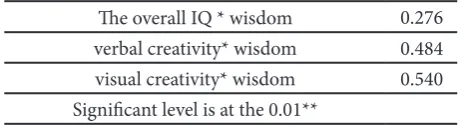
Table: 3 correlation coefficients between creativity and intelligence with wisdom The overall IQ * wisdom 0.276
verbal creativity* wisdom 0.484 visual creativity* wisdom 0.540 Significant level is at the 0.01**
According to Table 3, there is positive correlation between the overall IQ and creativity with wisdom. In other words, if a person gets higher scores in overall IQ and creativity ,will also get higher scores in wisdom.
Discussion and Conclusion
The aim of this study was to examine the relationship between creativity and intelligence with wisdom. Based on the data in Table 3, creativity and intelligence are associated with wisdom.
(Balts and Staudinger, 2000), two analytical components are distinguished: basic Knowledge and high level of cognitive complexity provide using the basic knowledge. Intelligence, abstract reasoning, intro-spection and flexibility provide appropriate conditions for use of the experience and the basic knowledge for problem solving and insightful behavior.
Other results showed a positive relationship between creativity and wisdom. In other words if a person gets higher score in creativity, will get higher score in wisdom. This finding is consistent with results of Staudinger and et al (1997).Their studies how strong predictive relationship between the performance of the wisdom and creativity. Rational behavior requires an adaptive response to a situation where it is necessary to invent and choose the most efficient way to deal with a particular issue .The person must not only have the right information, but must use this information for decision-making and reaching to innovative answer. This suggests that deep insight and good judgment on the difficult problems of life require at least a certain degree of creative potential. In the wisdom literature, its moving to the other side of a given system, which is defined by a given problem situation, is described as the main characteristic of insightful solutions(for example, Assmann, 1994).Wisdom predictive power also suggests that knowledge and judgment related to wisdom , as is sometimes possible, is not conservative in nature (for example, Hahn, 1991).
In general we can say that intelligence and creativity are necessary for wisdom but are not sufficient. The basic process of wisdom requires the integrity or balance between two conflicting aspects of person-ality - typically cognitive and emotional processes. Wisdom puts the separate processes of logic and un-certain conditions together. The results of current study show the psychometric wisdom position. There is a significant overlap between wisdom and intelligence and creativity. Given the importance of internal and external factors associated with wisdom, understanding these factors will contribute to a better un-derstanding of wisdom structures. Also it can be used in educational programs.
At the end of the study, we point out to some limitations. As we know, there are different questionnaires to measure wisdom that every questionnaire is made of different components considering to its theoreti-cal principles. In this study, the wisdom three-dimensional test was used; another limitation is the way of sample selection that people were selected as volunteers.
References
Anderson, B. J. (1998). Development of wisdom-related knowledge in adolescence and young youthhood.Unpublished doctoral dissertation, University of Toronto.
Arlin, P. K. (1990). Wisdom: The art of problem finding. In R. J. Sternberg (Ed.), Wisdom: Its nature, origins, and
development (pp. 230–243). New York: Cambridge University Press.
Assmann, A. (1994). Wholesome knowledge: Concepts of wisdom in a historical and cross-cultural perspective. Life-Span Development and Behavior, 12, 187–224.McDonald, & D. Klaassen (Eds.), Selected Proceedings on Searching for Meaning in the NewMillennium.
Baltes, P. B., & Smith, J. (1990).Toward a psychology of wisdom and its ontogenesis. In R. J. Sternberg (Ed.),
Baltes, P. B., & Staudinger, U. M. (1993). The search for a psychology of wisdom. Current Directions in Psychological Science, 2, 75–80.
Baltes, P. B., & Staudinger, U. M. (2000). Wisdom: A metaheuristic (pragmatic) to orchestrate mind and virtue toward excellence. American Psychologist, 55, 122–136.
Birren, J. E., & Fisher, L. M. (1990). The elements of wisdom: Overview and integration. In R. J. Sternberg (Ed.), Wisdom: Its nature, origins, and development (pp. 317–332). New York: Cambridge University Press.
Clayton, V. P., &Birren, J. E. (1980). The development of wisdomacross the life span: An reexamination of an ancient topic. Life-Span Development and Behavior, 3, 103–135.
Csikszentmihalyi, M. (1996). Creativity: Flow and the psychology of discovery and invention. New York: HarperCollins Publishers.
Csikszentmihalyi, M., &Rathunde, K. (1990). The psychology of wisdom: An evolutionary interpretation. In R.J. Sternberg (Ed.), Wisdom: Its nature, origins, and development (pp. 25–51). Cambridge, UK: Cambridge Uni-versity Press.
Gardner,H. (1983). Frames of mind – The theory of multiple intelligences. New York:Basic Books.
Horn, J., &Masunaga, H. (2000). On theemergence of wisdom: Expertise development.In W. S. Brown (Ed.), Understandingwisdom: Sources, science and society. Lawsof life symposia series, (Vol. 3, pp. 245–276). Holliday, S. G., & Chandler, M. J. (1986). Wisdom: Explorations inyouth competence. Basel, Switzerland: Karger. KhodaRahimi Siamak. (2004). The examination of the relationship between family environment with non-verbal
creativity of secondary grade female students of Shiraz. Master’s thesis, University of Shiraz.
Simonton, D. K. (1990).Creativity andwisdom in aging. In J. E. Birren& K. W.Schaie (Eds.), Handbook of the psychologyof aging (3rd edition, pp. 320–329). SanDiego: Academic Press.
Sternberg, R. J.,Wagner, R. K.,Williams,W. M., & Horvath, J. A. (1995). Testingcommon sense.American Psychologist,
50, 912–927.
Sternberg, R. J. (1997). Successful intelligence. New York: Plenum.
Sternberg, R. J. (2000). Why schools should teach for wisdom: The balance theory of wisdom in educational settings. Educational sychologist, 36, 227–245.
Sternberg, R., & Jordan, J. (Eds.).(2005). Handbookof wisdom. New York, NY: CambridgeUniversity Press.
Sternberg, R. J. (1985). Implicit theories of intelligence, creativity, and wisdom.Journal of Personality and Social
Psychology, 49, 607– 627.
Sternberg, R. J. (Ed.). (1990). Wisdom: Its nature, origins, and development. New York, NY: Cambridge University Press.
Sternberg, R. J. (1998). A balance theory of wisdom.Review of General Psychology, 2, 347–365.
Sternberg, R. J., & Wagner, R. K. (Eds.).(1986). Practical intelligence - Nature and origins of competence in the