Please cite this article as: Parviz Fattahi, Parvaneh Samouei, Mostafa Zandieh, Simultaneous Multi-Skilled Worker Assignment and Mixed-Model Two-Sided Assembly Line Balancing, International Journal of Engineering (IJE), TRANSACTIONS B: Applications Vol. 29, No. 2, (February 2016) 211-221
International Journal of Engineering
J o u r n a l H o m e p a g e : w w w . i j e . i rSimultaneous Multi-skilled Worker Assignment and Mixed-model Two-sided
Assembly Line Balancing
P. Fattahia*, P. Samoueib, M. Zandiehc
aDepartment of Industrial Engineering, Faculty of Engineering, Alzahra University, Tehran, Iran bDepartment of Industrial Engineering, Faculty of Engineering, Bu-Ali Sina University, Hamedan, Iran
cDepartment of Industrial Management, Management and Accounting Faculty, Shahid Beheshti University, Tehran, Iran
P A P E R I N F O
Paper history: Received 28 July 2015
Received in revised form 06 January 2016 Accepted 28 January 2016
Keywords: Worker Assignment Mixed-model Skill
Particle Swarm Optimization Simulated Annealing Taguchi Method
A B S T R A C T
This paper addresses a multi-objective mathematical model for the mixed-model two-sided assembly line balancing and worker assignment with different skills. In this problem, the operation time of each task is dependent on the skill of the worker. The following objective functions are considered in the mathematical model: (1) minimizing the number of mated-stations, (2) minimizing the number of stations, and (3) minimizing the total human cost for a given cycle time. Furthermore, maximizing the weighted line efficiency and minimizing the weighted smoothness are two indices considered simultaneously in this paper. Since this problem is well-known as NP-hard class, a particle swarm optimization (PSO) algorithm is developed to solve it. The performance of the proposed PSO algorithm is evaluated with a simulated annealing (SA) algorithm existing in the literature over several benchmarked test problems for the conditions of the current problem in terms of running time and solution quality. The results show the proposed algorithm is an efficient algorithm.
doi: 10.5829/ idosi.ije.2016.29.02b.10
1. INTRODUCTION1
An assembly line is a production process which usually has several work centers (stations) connected together with a material handling system such as a conveyor belt. In this line, the unfinished products are launched down through the stations and a set of tasks with certain operation times and precedence relationships among tasks are done with robots or human workers in each station.
In the assembly line, worker assignment and line balancing have important effects on the performance of the line. Assembly line balancing is to assign the tasks to the stations in such a way that satisfy all constraints, and the objectives are optimized.
The first scientific article in the assembly line balancing problems (ALBP) was published in 1950s. After that, because of the important role of balancing on
1*Corresponding Author’s Email:
[email protected] (P. Fattahi)
productivity, many researchers have studied this problem with different constraints, objectives and solving methods to make better decisions for the real-world situations.
There are several surveys on the ALBP available in the literature [1-10]. There are several classifications for ALBP. For example, in terms of the number of models in a line, this problem can be categorized into single-model, mixed-model and multi-model. In single-single-model, only one type of product; in mixed-model, different models of one product; and in multi-model several products in batches are assembled.
because this structure has a shorter line length, lower cost of tools and fixtures and fewer material handling systems. Figure 1 shows a two-sided assembly line layout.
In a two-sided assembly line, two operators, each of which placed on the opposite side of the mated-station, work together in parallel on different tasks without interfering with one another on the same individual product [11].
There are two famous objective functions for solving TSALBP (Type-I and Type-II); Type-I is minimization of the number of mated-stations (i.e., the line length) for a given cycle time; and Type-II is minimization of the cycle time for a fixed number of mated-stations.
Since, the number of stations for the same number of mated-stations in Type-I can be different [12], the number of mated-stations as well as the number of stations can be considered in TSALBP.
Also, TSALBP can be categorized to one objective and multi-objective. Some works [13, 14] used one objective function and other studies [11, 12, 15] used more than one objective for two-sided assembly line balancing.
Similar to one-sided ALBP, the two-sided ALBP is NP-hard [16]. Therefore, metaheuristic algorithms are used for solving large-sized assembly line balancing problems in reasonable time to obtain optimal or near optimal solutions. These algorithms can be classified as Simulated Annealing [17], Genetic Algorithm [18-21], Ant Colony Optimization (ACO) ([15, 22, 23]), Tabu Search [24], Particle Swarm Optimization ([11]), and Bee Colony Optimization [14, 25, 26]. For example, Simaria and Vilarinho [15] presented a mathematical model and used ACO algorithm for a mixed-model TSALBP with precedence, zoning, capacity and synchronism constraints. Also, Özcan and Toklu [12] addressed the type-I of mixed-model TSALBP and presented a SA algorithm to solve it. They considered the minimization of number of mated-stations and the number of stations for a given cycle time.
Most of researchers assumed that the operation time is deterministic [27], and is not dependent on the skills of workers. However, in many real-world situations, the assembly tasks are done manually, and a high-skilled worker can assemble products faster than a low-skilled worker. So, the skills of workers can affect the balance of a line. Furthermore, distinguishing between the levels of skills permits a manager to decide which task should be done by which worker, and it causes a good saving for human cost and time. Therefore, some authors verified the assembly line balancing and worker assignment. For example, Ramezanian and Ezzatpanah [28] considered the modeling and solving of multi-objective mixed-model one-sided assembly line balancing and worker assignment problem. They minimized the total cycle time and the operating costs. They used a goal programming approach and imperialist
competitive algorithm to solve it. Also, Sungur and Yavuz [29] introduced assembly line balancing with hierarchical worker assignment to minimize the total cost and formulated the problem as an integer linear programming model. Recently, Zacharia and Nearchou [30] presented a multi-objective evolutionary algorithm for the solution of the bi-criteria single-model one-sided assembly line worker assignment and balancing problem.
There are a few papers which investigated the different classes of workers’ skill in assembly line balancing. For example, Corominas et al. [31] verified ALBP with skilled and unskilled workers.
To the best of our knowledge, there is no paper addressing the worker assignment with different skills for mixed-model TSALBP. So, in this research, a mathematical model is developed for this problem when the operation times are dependent on the skills of workers to minimize the number of mated-stations, the number of stations and the total human cost for a given cycle time. Additionally, a PSO algorithm is used to solve it. The efficiency of the PSO algorithm was compared with the SA algorithm in the literature [12].
The remainder of this paper is structured as follows. The related assumptions and the mathematical model of the problem are given in Section 2. Section 3 presents the proposed PSO algorithm in detail. Section 4 provides numerical experiments. Finally, Section 5 is devoted to conclusions and recommendations for future research.
2. PROBLEM DEFINITION
Mixed-model two-sided assembly lines are often used in a range of industries that assemble large-sized products such as cars. These lines are flexible and permit to produce different models of one product.
There are a few studies for mixed-model TSALBP. This problem and worker assignment with different skill levels to make a better decision for the real-world situation is considered in this research.
In this section, the problem assumptions, the notations and the mathematical model for the mixed-model TSALBP and worker assignment with different skill levels are presented.
2. 1. Problem Assumptions The assumptions of the problem are given as follows:
1. Tasks are performed by operators in parallel at both sides of the line. It means there is a two-sided assembly line.
2. Products with similar production characteristics are assembled on the same two-sided assembly line. 3. Some tasks may be required to be performed at
one-side of the line, while others may be performed at either side of the line.
4. Each task is allowed to assign to only one workstation, and each task should be done only once.
5. Precedence diagram for each model is known. 6. Workers with different skills are available (low-skill,
medium-skill, high-skill) and the operation time depends on the skill of the worker.
7. The workers’ skill levels do not change during the production planning horizon.
8. Similar tasks among different models exist. 9. The travel times of the operators are zero. 10.There is no buffer in the line.
11.The cycle time is given.
2. 2. Mathematical Model With the above assumptions, the mathematical model for
multi-objective mixed-model TSALBP and worker
assignment with different levels of skill is presented using the following notations:
Indices:
i, h, p, r
Task
j, g Mated-station
l Skill
m Product model
k, f Side of the line; (1: indicates a left-side
station) and (2: indicates a right-side station)
(j, k) Station of mated-station j and its operation
direction is k
Parameters:
I Set of tasks in the combined precedence diagram
J Set of mated-stations
L Set of skills (low, high, …)
M Set of product models
SL Set of tasks which should be performed at a
left-side station; SL I
SR Set of tasks which should be performed at a
right-side station; SR I
SE Set of tasks which may be performed at either
side of a station; SE I
P(i) Set of immediate predecessors of task i
Pa(i) Set of all predecessors of task i
Sa(i) Set of all successors of task i
P0 Set of tasks that have no immediate
predecessors; P0={ i I | P(i) = Ø}
timl Operation time of task i for model m with skill l
HCjkl Human cost of worker with skill l in station (j,
k)
ψ A very large positive number
C(i) Set of tasks whose operation directions are
opposite to operation direction of task i;
( ) {
K(i) Set of indicating the preferred operation
directions of task i;
( ) {
C Cycle time
Wjkm Subset of all tasks that can be assigned to
station (j, k) of model m ||Wjkm|| Number of tasks in subset Wjkm
||M|| Number of models
||L|| Number of skills
Variables:
xijkl 1, if task i is assigned to station (j, k) with skill
level l; 0, otherwise
tfiml Finish time of task i for model m with skill l
Fj 1, if mated-station j is utilized; 0, otherwise
Gjkl 1, if station (j, k) is utilized by a worker with
skill l; 0, otherwise
Ujk 1, if the work content of station (j, k) for all
models is different from zero, then station (j, k) is utilized for all models; 0, otherwise.
vjkm 1, if station (j, k) is utilized for model m; 0,
otherwise.
zip 1, if task i is assigned before task p in the same
station; 0, if task p is assigned before task i in the same station
In this paper, a multi-objective mathematical model for mixed-model TSALBP and worker assignment with different levels of skills based on the formulation presented in the literature [12] is proposed. This mathematical model is as follows:
∑ (1)
∑ ∑ ∑ (2)
∑ ∑ ∑ (3)
S.to:
∑ ∑ ( )∑
(4)
∑ ∑ ( )∑ ∑ ∑ ( )∑
( )
(5)
(7)
( ∑ ( ) ) ( ∑ ( ) ) ( ) (8) ( ) ( ) ( ) ( ) { | ( ( ) ( ) ( )) } (9) ( ) ( ) ( ) ( ) ( ) { | ( ( ) ( ) ( )) } (10) ∑ ( ) (11)
∑ | | (12)
∑ (13)
∑ ( ) (14)
( ) (15)
{ | ( ( ) ( ) ( )) } (16)
(17)
( ) (18)
Objective functions (1), (2) and (3) minimize the number of mated-station, the number of stations or operators and the total human cost. Constraint (4) shows each task should be assigned to exactly one station. Constraint (5) indicates all precedence relations among tasks are considered. Constraint (6) and (7) determine the finish time of each task i for model m that is done with a worker with skill l is less than the cycle time, and also it is equal or greater than its operation time. Constraints (8)-(10) simultaneously control the sequence-dependent finishing time of tasks for each model and skill. Relations (11) and (12) guarantee the number of stations is the same for all product models. Constraints (13) and (14) represent each station has only one worker and tasks can be assigned to stations equipped by workers. Constraints (15)-(18) express Fj, Gj, zip and xijkl are binary variables. 3. THE PROPOSED ALGORITHM As described previously, the TSALBP is an NP-hard problem. So, metaheuristic algorithms are used to solve the large-sized problems in a reasonable computational time. In this section, we present a particle swarm optimization to solve the mixed-model TSALBP and worker assignment with different skills. The proposed algorithm is based on the procedure of the SA algorithm presented elsewhere [12]. However, it was changed and adopted for the considered problem. 3. 1. The Standard PSO Algorithm One of the population-based metaheuristic algorithms is PSO that was introduced in 1995. In this algorithm, a swarm of particles searches a D-dimensional space to find the best solution. Each particle at each iteration has a velocity and fitness value, and the velocity of each particle is computed based on the best previous positions of its own and the population [27]. The parameters of this algorithm are two positive constants (c1 and c2) which are called cognitive and social coefficients; two uniform random values (r1 and r2) between 0 and 1; and the inertia weight (W). There are different methods for the selection of these parameters. For example, Kennedy and eberhart [32] used Equation (19) for inertia weight: (19)
where Wmax, Wmin, Itrmax and Itr are the initial inertia weight, final inertia weight, the maximum number of iterations and the number of iteration, respectively. The basic PSO structure is as follows [27]: Step1. Generate the position ( ) and the velocity ( ) of each particle in the initial swarm according to the following relations: ( ) (20)
( ) (21)
Step 2. Compute the news positions and the new velocities of particles: ( ) ( ) (22)
(23) Step 3. Map the positions of particles to solution space and compute the corresponding fitness values according to the fitness function of the optimization problem.
Step 4. Update ,
Step 5. If the stopping criterion (for example, a given maximum number of iterations) is not met, go to Step 2; otherwise stop the algorithm.
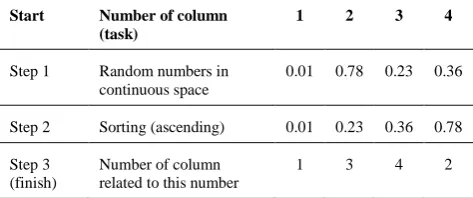
assigned to the stations. The position and the value of each element in an LP represents the priority of each task. For example, if we have four tasks for assignment, a random initial LP can be shown as LP= {2, 1, 4, 3}. It means Task 2 and Task 3 have the highest and lowest priorities, respectively.
Since we are going to use a PSO algorithm, and at the first time, it is developed for a continuous space, applying a method to change continuous space to discrete one is necessary. For this purpose, we use the number of column and sorting method as follows. For the above priority list, we changed theses spaces as Table 1.
At first, this list is generated randomly and the tasks of the list are assigned to the mated-stations with considering their operation direction, precedence constraints and priority values. Then the set of assignable tasks is updated, and this process continues until there is no task for assignment.
Note: In this process, if the time of a station after adding
a new task is greater than the cycle time; a new mated-station is created, and an operator with a random skill is assigned to it. Then the task is added to the new station. 3. 3. A Feasible Solution Task-oriented and station-oriented assignments are two different procedures for balancing assembly lines [6]. In the proposed PSO algorithm, for creating a feasible solution, a station-oriented procedure based on the approach proposed byÖzcan and Toklu [12] for solving mixed-model two-sided ALBP is used. However, it was changed and adopted for the conditions of the mentioned problem.
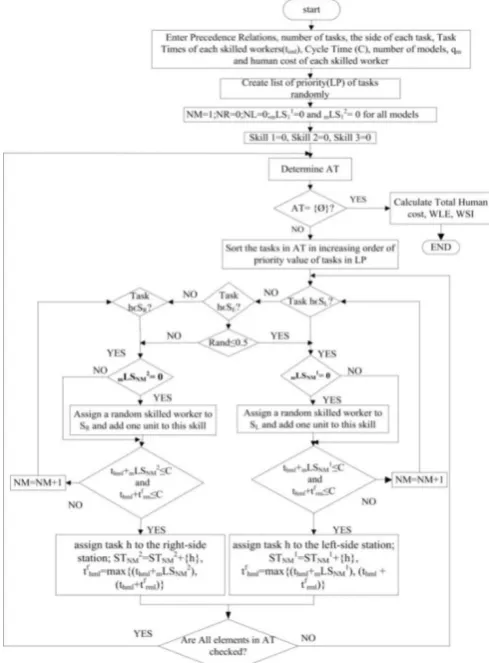
In this paper, if a mated-station is opened, according to the direction and the priority of the task which should be assigned, a worker with a random skill will be assigned to this station. It causes to have a simultaneous worker assignment and line balancing. If both sides of the mated-station are loaded as much as possible, then the current station is closed, and another mated-station will be created to assign the rest of tasks. The flowchart of the current procedure and its notations are shown as follows:
NM Number of mated-station
NL Number of left-side station
NR Number of right-side station
AT Set of assignable tasks
mLSNM1 The load of station including unavoidable idle
times on the left-side station of the current mated-station for all m M
mLSNM2 The load of station including unavoidable idle
times on the right-side station of the current mated-station for all m M
STNM1 The set of tasks which are assigned to the left side
station of the current mated-station
STNM2 The set of tasks which are assigned to the
right-side station of the current mated-station
Sl Number of skill l
TABLE 1. Changing continuous space to discrete space
Start Number of column
(task)
1 2 3 4
Step 1 Random numbers in
continuous space
0.01 0.78 0.23 0.36
Step 2 Sorting (ascending) 0.01 0.23 0.36 0.78
Step 3 (finish)
Number of column related to this number
1 3 4 2
3. 4. Objective Functions The objectives of the proposed algorithm for mixed-model two-sided assembly line balancing problems and worker assignment with different levels of skills for a given cycle time are as follows:
1. Minimizing the number of mated-stations. It is equivalent to maximize the weighted line efficiency. According to the nature of mixed-model assembly line and the skills of workers, the weighted line efficiency for a given line balance is calculated as follows:
WLE=(∑ (∑ )).100 (24)
where qm is computed by Eq. (25). In this equation, Dm
denotes the demand, over the planning horizon, for model m.
∑ (25)
2. Minimizing the weighted smoothness index. By using this index, the idle time between the stations will be as equal as possible. The following equation is used for computing this index:
√∑ (∑ ∑ ( ) )
(26)
where, LSmax is the maximum station time, including unavoidable idle times.
3. Minimizing the total human cost (HC). It can be calculated as follows:
∑ ∑ ∑ (27)
Based on the weighted sum method [33], the objective function of the proposed approach can be shown as:
Figure 2. Flowchart of building a feasible solution
where, WLE0, WSI0 and HC0 are the initial objective
function values and W1, W2 and W3 represent the
importance of each objective in this method.
Equation (28) shows the weighted line efficiency will be maximized and the weighted smoothness index and human cost will be minimized for a given cycle time.
If W1=W2=W3= , then the integrated objective
function (E) can be as follows:
Minimize ( ) ( ) ( ) (29)
3. 5. Lower Bound A lower bound for the number of stations of mixed-model two-sided assembly lines based on the lower bound presented by Hu et al. [34] was presented in the literature [12]. It is adopted for mixed-model TSALBP and worker assignment with different levels of skill. In this equation, tim1is used for
operation time. It means if all tasks are done by high-skilled workers, the number of stations will be minimized.
{[∑ ∑
] [∑ ∑
]}
(30)
{
[
∑ ∑ ( ∑ ∑ )
( ∑ ∑ )
]}
(31)
4. COMPUTATIONAL RESULTS AND DISCUSSION
4. 1. Parameter Settings In metaheuristic algorithms, choosing the best combination of the parameters can intensify the search process and prevents premature convergence. So, setting the parameters can influence on the performance of these algorithms.
In the proposed particle swarm optimization algorithm, the Taguchi method [35] is used for the best parameter selections. Three levels are selected for each parameter (C1, C2, Wmax, Wmin and the swarm size), and
they are shown in Table 2.
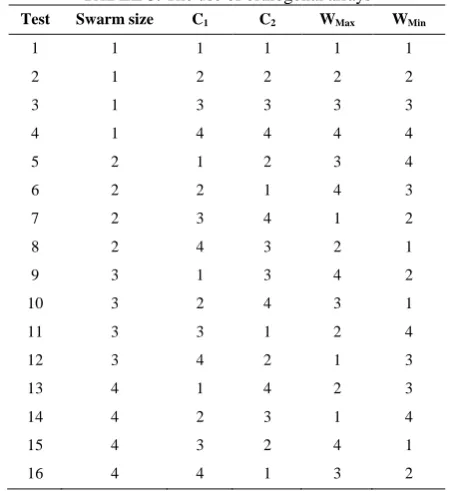
Taguchi method uses orthogonal arrays for decreasing the number of experiments for parameters setting. These arrays for the proposed approach are presented in Table 3 which shows16 tests with different levels are necessary to select the best value for each parameter. We examine these levels for a mixed-model TSALBP with 30 tasks and worker assignment with different three skill levels. Each test is run five times, and the average of the objective function is obtained to calculate the (S/N) ratio. In the Taguchi method, the S/N ratio is as follows [30]:
( ∑ ( ) ) (32)
The larger S/N ratio is equivalent to the least objective function. So, each factor's level which shows the maximum S/N ratio is the best one. Therefore, according to Figure 3, the best level of each factor obtained by Taguchi method is reported in Table 4.
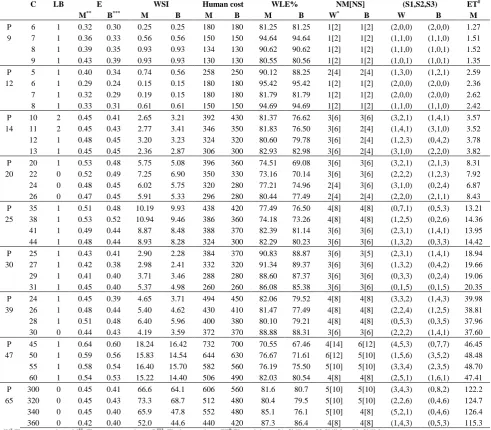
4. 2. Numerical Experiments In this section, the efficiency of the PSO algorithm for solving mixed-model TSALBP and worker assignment with different levels of skills is examined over a set of benchmarked test problems (P9, P12, P14, P20, P25, P30, P39, P47 and P65). In these experiments, it is supposed that the human cost of a worker with skill 1, 2 and 3 are 90, 60 and 40 dollars per period, respectively. Table 5 presents these obtained results.
Also, the results of the proposed PSO algorithm are compared with the SA algorithm published by Özcan and Toklu [12] for mixed-model TSALBP. But we adopted their algorithm for the assumption of this paper.
For this purpose, each test problem is solved five times with both algorithms and then the best and the average objective function (E), and also the average of WSI, WLE, human cost and the running times are reported. Figure 4 and Figure 5 compare the best and the average of both algorithms for minimization of E over several test problems. As can be seen, the PSO algorithm provides better results than the SA algorithm.
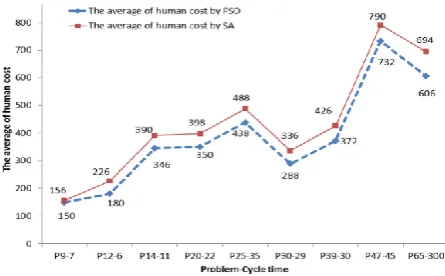
Figure 6 and Figure 7 indicate the obtained results of WSI and human cost for different problems by PSO and SA algorithms. Since minimization of both objective functions are considered, the proposed PSO can have better results than the SA algorithm.
Figure 8 demonstrates the average results for maximization of WLE for both algorithms. Clearly, the PSO has larger values of WLE than the SA algorithm.
As well as the comparisons between the objective functions of these problems, the average running times of the proposed PSO algorithm are compared with the SA algorithm.
Figure 9 shows the running time of the PSO algorithm is more than the SA algorithm. Its reason may be for population-based PSO algorithm. But since assembly line balancing and worker assignment problems are related to long-term decision making problems, these differeces may be ignorable. Because this decision is usually made one time during several years and in this situation, having better results may be more beneficial than taking more time per second.
TABLE 2. Factors and their levels
Factor C1 C2
Level 1 2 3 4 1 2 3 4
Value 0.2 0.6 1.3 2 0.2 0.6 1.3 2
Factor WMax WMin
Level 1 2 3 4 1 1 1 1
Value 1 0.95 0.75 0.6 0.55 0.45 0.4 0.35
Factor Swarm size
Level 1 2 3 4
Value n* 2n 3n 4n
* The number of tasks
TABLE 3. The use of orthogonal arrays
Test Swarm size C1 C2 WMax WMin
1 1 1 1 1 1
2 1 2 2 2 2
3 1 3 3 3 3
4 1 4 4 4 4
5 2 1 2 3 4
6 2 2 1 4 3
7 2 3 4 1 2
8 2 4 3 2 1
9 3 1 3 4 2
10 3 2 4 3 1
11 3 3 1 2 4
12 3 4 2 1 3
13 4 1 4 2 3
14 4 2 3 1 4
15 4 3 2 4 1
TABLE 4. Selected levels of the PSO algorithm
Factor Swarm
size
Cognitive coefficient
(C1)
Social coefficient
(C2)
Maximum inertia weight
(WMax)
Minimum inertia weight
(WMin)
Level 1 2 2 1 2
Value n 0.6 0.6 1 0.45
Figure 3. The mean S/N ratio plot for the selected levels of each factor
TABLE 5. The obtained results of the proposed algorithm for different problems
C LB E WSI Human cost WLE% NM[NS] (S1,S2,S3) ET#
M** B*** M B M B M B W* B W B M
P 9
6 1 0.32 0.30 0.25 0.25 180 180 81.25 81.25 1[2] 1[2] (2,0,0) (2,0,0) 1.27
7 1 0.36 0.33 0.56 0.56 150 150 94.64 94.64 1[2] 1[2] (1,1,0) (1,1,0) 1.51
8 1 0.39 0.35 0.93 0.93 134 130 90.62 90.62 1[2] 1[2] (1,1,0) (1,0,1) 1.52
9 1 0.43 0.39 0.93 0.93 130 130 80.55 80.56 1[2] 1[2] (1,0,1) (1,0,1) 1.35
P 12
5 1 0.40 0.34 0.74 0.56 258 250 90.12 88.25 2[4] 2[4] (1,3,0) (1,2,1) 2.59
6 1 0.29 0.24 0.15 0.15 180 180 95.42 95.42 1[2] 1[2] (2,0,0) (2,0,0) 2.36
7 1 0.32 0.29 0.19 0.15 180 180 81.79 81.79 1[2] 1[2] (2,0,0) (2,0,0) 2.62
8 1 0.33 0.31 0.61 0.61 150 150 94.69 94.69 1[2] 1[2] (1,1,0) (1,1,0) 2.42
P 14
10 2 0.45 0.41 2.65 3.21 392 430 81.37 76.62 3[6] 3[6] (3,2,1) (1,4,1) 3.57
11 2 0.45 0.43 2.77 3.41 346 350 81.83 76.50 3[6] 2[4] (1,4,1) (3,1,0) 3.52
12 1 0.48 0.45 3.20 3.23 324 320 80.60 79.78 3[6] 2[4] (1,2,3) (0,4,2) 3.78
13 1 0.45 0.45 2.36 2.87 306 300 82.93 82.98 3[6] 2[4] (3,1,0) (2,2,0) 3.82
P 20
20 1 0.53 0.48 5.75 5.08 396 360 74.51 69.08 3[6] 3[6] (3,2,1) (2,1,3) 8.31
22 0 0.52 0.49 7.25 6.90 350 330 73.16 70.14 3[6] 3[6] (2,2,2) (1,2,3) 7.92
24 0 0.48 0.45 6.02 5.75 320 280 77.21 74.96 2[4] 3[6] (3,1,0) (0,2,4) 6.87
26 0 0.47 0.45 5.91 5.33 296 280 80.44 77.49 2[4] 2[4] (2,2,0) (2,1,1) 8.43
P 25
35 1 0.51 0.48 10.19 9.93 438 420 77.49 76.50 4[8] 4[8] (0,7,1) (0,5,3) 13.21
38 1 0.53 0.52 10.94 9.46 386 360 74.18 73.26 4[8] 4[8] (1,2,5) (0,2,6) 14.36
41 1 0.49 0.44 8.87 8.48 388 370 82.39 81.14 3[6] 3[6] (2,3,1) (1,4,1) 13.95
44 1 0.48 0.44 8.93 8.28 324 300 82.29 80.23 3[6] 3[6] (1,3,2) (0,3,3) 14.42
P 30
25 1 0.43 0.41 2.90 2.28 384 370 90.83 88.87 3[6] 3[5] (2,3,1) (1,4,1) 18.94
27 1 0.42 0.38 2.98 2.41 332 320 91.34 89.37 3[6] 3[6] (1,3,2) (0,4,2) 19.66
29 1 0.41 0.40 3.71 3.46 288 280 88.60 87.37 3[6] 3[6] (0,3,3) (0,2,4) 19.06
31 1 0.45 0.40 5.37 4.98 260 260 86.08 85.38 3[6] 3[6] (0,1,5) (0,1,5) 20.35
P 39
24 1 0.45 0.39 4.65 3.71 494 450 82.06 79.52 4[8] 4[8] (3,3,2) (1,4,3) 39.98
26 1 0.48 0.44 5.40 4.62 430 410 81.47 77.49 4[8] 4[8] (2,2,4) (1,2,5) 38.81
28 1 0.51 0.48 6.40 5.96 400 380 80.10 79.21 4[8] 4[8] (0,5,3) (0,3,5) 37.96
30 0 0.44 0.43 4.19 3.59 372 370 88.88 88.31 3[6] 3[6] (2,2,2) (1,4,1) 37.60
P 47
45 1 0.64 0.60 18.24 16.42 732 700 70.55 67.46 4[14] 6[12] (4,5,3) (0,7,7) 46.45
50 1 0.59 0.56 15.83 14.54 644 630 76.67 71.61 6[12] 5[10] (1,5,6) (3,5,2) 48.48
55 1 0.58 0.54 16.40 15.70 582 560 76.19 75.50 5[10] 5[10] (3,3,4) (2,3,5) 48.70
60 1 0.54 0.53 15.22 14.40 506 490 82.03 80.54 4[8] 4[8] (2,5,1) (1,6,1) 47.41
P 65
300 0 0.45 0.41 66.6 64.1 606 560 81.6 80.7 5[10] 5[10] (3,4,3) (0,8,2) 122.2
320 0 0.45 0.43 73.3 68.7 512 480 80.4 79.5 5[10] 5[10] (2,2,6) (0,4,6) 124.7
340 0 0.45 0.40 65.9 47.8 552 480 85.1 76.1 5[10] 4[8] (5,2,1) (0,4,6) 126.4
360 0 0.42 0.40 52.0 44.6 440 420 87.3 86.4 4[8] 4[8] (1,4,3) (0,5,3) 115.3
Figure 4.Comparative results obtained for the average of "E" by PSO and SA algorithms
Figure 5. Comparative results obtained for the best of "E" by PSO and SA algorithms
Figure 6. Comparative results obtained for the average of WSI by PSO and SA algorithms
Figure 7. Comparative results obtained for the average of human cost by PSO and SA algorithms
Figure 8.The average results for maximization of WLE for the PSO and SA algorithms
Figure 9. The average running time for the PSO and the SA algorithms
5. CONCLUSION
This paper dealt with a multi-objective mixed-model TSALBP with assignment workers when task operation time is dependent on the skills of workers. Three objectives in this paper were considered: (1) minimizing the number of mated-stations, (2) minimizing the number of stations, and (3) minimizing the total human cost for a given cycle time. The first and the second objectives of this problem are equivalent to maximize the weighted line efficiency and minimize the weighted smoothness index.
A PSO algorithm is presented to solve this problem and also the Taguchi method is used for its parameter settings. Several test problems with different cycle times are solved by the proposed algorithm. Also the efficiency of this algorithm was evaluated with the SA algorithm published by Özcan and Toklu [12] over different problems. The obtained results indicated the solution quality of the proposed algorithm was better than the solution of the SA algorithm.
6. REFERENCES
1. Baybars, I., "A survey of exact algorithms for the simple assembly line balancing problem", Management science, Vol. 32, No. 8, (1986), 909-932.
2. Ghosh, S. and Gagnon, R.J., "A comprehensive literature review and analysis of the design, balancing and scheduling of assembly systems", The International Journal of Production Research, Vol. 27, No. 4, (1989), 637-670.
3. Amen, M., "Heuristic methods for cost-oriented assembly line balancing: A survey", International Journal of Production Economics, Vol. 68, No. 1, (2000), 1-14.
4. Amen, M., "Cost-oriented assembly line balancing: Model formulations, solution difficulty, upper and lower bounds", European Journal of Operational Research, Vol. 168, No. 3, (2006), 747-770.
5. Becker, C. and Scholl, A., "A survey on problems and methods in generalized assembly line balancing", European Journal of Operational Research, Vol. 168, No. 3, (2006), 694-715. 6. Scholl, A. and Becker, C., "State-of-the-art exact and heuristic
solution procedures for simple assembly line balancing", European Journal of Operational Research, Vol. 168, No. 3, (2006), 666-693.
7. Boysen, N., Fliedner, M. and Scholl, A., "A classification of assembly line balancing problems", European Journal of Operational Research, Vol. 183, No. 2, (2007), 674-693. 8. Boysen, N., Fliedner, M. and Scholl, A., "Assembly line
balancing: Which model to use when?", International Journal of Production Economics, Vol. 111, No. 2, (2008), 509-528. 9. Hu, S.J., Ko, J., Weyand, L., ElMaraghy, H., Lien, T., Koren,
Y., Bley, H., Chryssolouris, G., Nasr, N. and Shpitalni, M., "Assembly system design and operations for product variety", CIRP Annals-Manufacturing Technology, Vol. 60, No. 2, (2011), 715-733.
10. Battaïa, O. and Dolgui, A., "A taxonomy of line balancing problems and their solutionapproaches", International Journal of Production Economics, Vol. 142, No. 2, (2013), 259-277. 11. Chutima, P. and Chimklai, P., "Multi-objective two-sided
mixed-model assembly line balancing using particle swarm optimisation with negative knowledge", Computers & Industrial Engineering, Vol. 62, No. 1, (2012), 39-55. 12. Özcan, U. and Toklu, B., "Balancing of mixed-model two-sided
assembly lines", Computers & Industrial Engineering, Vol. 57, No. 1, (2009), 217-227.
13. Xiaofeng, H., Erfei, W., Jinsong, B. and Ye, J., "A branch-and-bound algorithm to minimize the line length of a two-sided assembly line", European Journal of Operational Research, Vol. 206, No. 3, (2010), 703-707.
14. Özbakır, L. and Tapkan, P., "Bee colony intelligence in zone constrained two-sided assembly line balancing problem", Expert Systems with Applications, Vol. 38, No. 9, (2011), 11947-11957.
15. Simaria, A.S. and Vilarinho, P.M., "2-antbal: An ant colony optimisation algorithm for balancing two-sided assembly lines", Computers & Industrial Engineering, Vol. 56, No. 2, (2009), 489-506.
16. Bartholdi, J., "Balancing two-sided assembly lines: A case study", The International Journal of Production Research, Vol. 31, No. 10, (1993), 2447-2461.
17. Özcan, U., "Balancing stochastic two-sided assembly lines: A chance-constrained, piecewise-linear, mixed integer program and a simulated annealing algorithm", European Journal of Operational Research, Vol. 205, No. 1, (2010), 81-97.
18. Kim, Y.K., Kim, Y. and Kim, Y.J., "Two-sided assembly line balancing: A genetic algorithm approach", Production Planning & Control, Vol. 11, No. 1, (2000), 44-53.
19. Kim, Y.K., Song, W.S. and Kim, J.H., "A mathematical model and a genetic algorithm for two-sided assembly line balancing", Computers & Operations Research, Vol. 36, No. 3, (2009), 853-865.
20. Taha, R.B., El-Kharbotly, A.K., Sadek, Y.M. and Afia, N.H., "A genetic algorithm for solving two-sided assembly line balancing problems", Ain Shams Engineering Journal, Vol. 2, No. 3, (2011), 227-240.
21. Purnomo, H.D., Wee, H.-M. and Rau, H., "Two-sided assembly lines balancing with assignment restrictions", Mathematical and Computer Modelling, Vol. 57, No. 1, (2013), 189-199.
22. Baykasoglu, A. and Dereli, T., "Two-sided assembly line balancing using an ant-colony-based heuristic", The International Journal of Advanced Manufacturing Technology, Vol. 36, No. 5-6, (2008), 582-588.
23. Kucukkoc, I. and Zhang, D.Z., "Type-e parallel two-sided assembly line balancing problem: Mathematical model and ant colony optimisation based approach with optimised parameters", Computers & Industrial Engineering, Vol. 84, No., (2015), 56-69.
24. Özcan, U., Gökçen, H. and Toklu, B., "Balancing parallel two-sided assembly lines", International Journal of Production Research, Vol. 48, No. 16, (2010), 4767-4784.
25. Tapkan, P., Ozbakir, L. and Baykasoglu, A., "Modeling and solving constrained two-sided assembly line balancing problem via bee algorithms", Applied Soft Computing, Vol. 12, No. 11, (2012), 3343-3355.
26. Tapkan, P., Özbakır, L. and Baykasoğlu, A., "Bee algorithms for parallel two-sided assembly line balancing problem with walking times", Applied Soft Computing, Vol. 39, No., (2016), 275-291.
27. Hamta, N., Ghomi, S.F., Jolai, F. and Shirazi, M.A., "A hybrid pso algorithm for a multi-objective assembly line balancing problem with flexible operation times, sequence-dependent setup times and learning effect", International Journal of Production Economics, Vol. 141, No. 1, (2013), 99-111.
28. Ramezanian, R. and Ezzatpanah, A., "Modeling and solving multi-objective mixed-model assembly line balancing and worker assignment problem", Computers & Industrial Engineering, Vol. 87, No., (2015), 74-80.
29. Sungur, B. and Yavuz, Y., "Assembly line balancing with hierarchical worker assignment", Journal of Manufacturing Systems, Vol. 37, No., (2015), 290-298.
30. Zacharia, P.T. and Nearchou, A.C., "A population-based algorithm for the bi-objective assembly line worker assignment and balancing problem", Engineering Applications of Artificial Intelligence, Vol. 49, No., (2016), 1-9.
31. Corominas, A., Pastor, R. and Plans, J., "Balancing assembly line with skilled and unskilled workers", Omega, Vol. 36, No. 6, (2008), 1126-1132.
32. Kennedy, J., eberhart, R., "swarm intelligence", morgan kaufmann, san francisco, (2001).
33. Deb, K., "Multi-objective optimization using evolutionary algorithms, John Wiley & Sons, Vol. 16, (2001).
34. Hu, X., Wu, E. and Jin, Y., "A station-oriented enumerative algorithm for two-sided assembly line balancing", European Journal of Operational Research, Vol. 186, No. 1, (2008), 435-440.
Simultaneous Multi-skilled Worker Assignment and Mixed-model Two-sided
Assembly Line Balancing
P. Fattahia, P. Samoueib, M. Zandiehc
aDepartment of Industrial Engineering, Faculty of Engineering, Alzahra University, Tehran, Iran bDepartment of Industrial Engineering, Faculty of Engineering, Bu-Ali Sina University, Hamedan, Iran c
Department of Industrial Management, Management and Accounting Faculty, Shahid Beheshti University, Tehran, Iran
P A P E R I N F O
Paper history: Received 28 July 2015
Received in revised form 06 January 2016 Accepted 28 January 2016
Keywords: Worker Assignment Mixed-model Skill
Particle Swarm Optimization Simulated Annealing Taguchi Method
ديكچ ه
هعسوت هب هلاقم نیا رد سنلااب لئاسم لح یارب یضایر لدم کی ی
لدم هفرطود ژاتنوم طوطخ و یبیکرت یاه
تراهم اب یناسنا یورین نامزمه صیصخت یم هتخادرپ فلتخم یاه
هنوگ هب .دوش نامز هک یا
هب هتسباو ،تایلمع یاه
یم هدنهد ماجنا یاهروتارپا تراهم حطس هدش هتفرگ رظن رد فلتخم فده عبات هس روظنم نیدب .دنشاب
هب هک دنا
لقادح یزاس 1 -ادعت هاگتسیا د ،یجوز یاه 2
-هاگتسیا دادعت و اه
3 -هنیزه نامز کی یازا هب یناسنا یورین لک یاه
یم هجوت نیعم لکیس لقادح و طخ نوزوم ییاراک یزاسرثکادح صخاش ود زا ،نیا رب هولاع .دنک
تافلاتخا یزاس
هاگتسیا یراذگراب آ زا .تسا هدیدرگ هدافتسا رتهب جیاتن هب لوصح روظنم هب اه
هتسد رد هلاسم نیا هک اجن لئاسم ی
NP-hard
یم رارق هنیهب متیروگلا یانبم رب یمتیروگلا اذل ،دریگ و تسا هدش هداد هعسوت نآ یارب تارذ هدوت یزاس
هیلوا راتخاس هک یجیردت دامجنا متیروگلا اب نآ زا لصاح جیاتن طیارش رب انب و تسا دوجوم عوضوم تایبدا رد نآ ی
هلاسم دیدج هب یفلتخم یددع یاه لاثم نینچمه .تسا هتفرگ رارق سایق دروم ،تسا هدش لامعا نآ رد یتارییغت
نآ جیاتن و هدیدرگ لح متیروگلا ود ره کمک جیاتن .تسا هدش هسیاقم ارجا نامز نینچمه و لح تیفیک رظن زا اه
یم ناشن یم هلاقم نیا رد یداهنشیپ متیروگلا رتلااب ییاراک دهد دشاب
.
![Figure 1. A structure of two-sided assembly line [11]](https://thumb-us.123doks.com/thumbv2/123dok_us/220414.2016546/2.595.321.529.661.741/figure-structure-sided-assembly-line.webp)