International Journal of Engineering
J o u r n a l H o m e p a g e : w w w . i j e . i rPerformance Optimization for Skim Milk Powder Unit of a Dairy Plant Using
Genetic Algorithm
S. Kajala,*, P. C. Tewarib
a Department of Mechanical Engineering, University Institute of Engineering and Technology, Kurukshetra University, Kurukshetra-136119, Haryana, India
bDepartment of Mechanical Engineering, National Institute of Technology, Kurukshetra-136119, Haryana, India
A R T I C L E I N F O
Article history:
Received 23December2011
Received in revised form 14Febuary2012
Accepted 17May2012
Keywords:
Availability Markov Process Genetic Algorithm Skim Milk Powder Unit
A B S T R A C T
The paper deals with the performance optimization for skim milk powder unit of a dairy plant at National Dairy Research Institute (N. D. R. I.), Karnal using Genetic Algorithm (G. A.). The skim milk powder unit comprises of six subsystems working in series. The failure and repair rates of the subsystems are taken from maintenance history sheets, which follow the exponential distribution. The mathematical formulation is carried out using probabilistic approach and the Markov birth – death process is used to develop the difference differential equations. The steady state availability expression has been derived using normalizing conditions. The optimal values of failure/repair rates of each subsystem of the skim milk powder unit have been evaluated using Matlab 7.1 G. A. tool. The steady state availability obtained from Markov analysis is also compared with the optimal availability calculated through G. A. tool. So, the findings of the present paper will be highly useful to the plant management for developing proper maintenance strategies which can be implemented in order to enhance system performance.
doi: 10.5829/idosi.ije.2012.25.03b.08
1. INTRODUCTION1
NDRI was established in 1996 and is commercially active research institute at Karnal (India). The plant has the capacity to handle 60,000 liters of milk per day. The supply of raw milk is from the model dairy plant and institute dairy farm. The fat content in the raw milk is weighed and assessed for the SNF (Solid Not Fat) and fat contents. Thereafter, the milk undergoes pasteurization and then cooled to refrigeration temperature (4-5 °C) before it is sent to storage tank. Further processing involves separation of cream by cream separator and its standardization for various purposes. Continuous churning of cream separates butter in a butter making machine. Lassi and Flavored milk is made in this section. In the second section, production of condensed and dried milk products are carried out. Fine powder is made with the help of roller drier machine. The milk is fed into the rotating steam-heating drums or rollers. As the drums revolve, a thin film of milk is adhered to it and dried by the time, a
*Corresponding Author Email: [email protected](S. Kajal)
complete revolution is made and then scrapped by a blade. This material is collected and fed into pulverized machine which converts it in the fine powder form. This fine powder is then packed and stored. Skim milk powder contains calcium chloride, curic acid and sodium citrate not exceeding 0.3% by weight of the end product. The products made in the plant are tested in quality control section by different methods. These products are then finally packed in hygienic conditions in packaging section by means of computerized machine.
identified three basic operators: reproduction, crossover and mutation for obtaining near optimal solutions. Srinivas [2] discussed various optimization techniques and their implementation in the engineering problems. Ishii et al. [3] applied the reliability optimization as the last step in their six step heuristic procedure. Sung et al. [4,5] applied branch and bound approach for reliability optimization. Mettas [6] derived a general model to estimate the minimum reliability requirement for multiple components within a system that would yield the goal reliability value for the system. Kuo et al. [7] discussed the reliability redundancy allocation problem for finding simultaneously optimal redundancy levels and optimal component reliabilities that maximize system reliability subject to resource constraints. Coit et al. [8] proposed a multiple objective formulation for maximizing the system availability. Nahas et al. [9] studied the reliability optimization problem for a series system with multiple choice constraints, to maximize the system reliability. Gen et al. [10] studied the G. A. approach for various reliability optimization problems. Castro et al. [11] proposed a maintenance optimization model for an Engineering system assembled in a series configuration. Dai et al. [12] developed an optimization model for the grid service allocation using G. A.. Taboada et al. [13] studied the reliability optimization of the complex systems. Juang et al. [14] proposed a G. A. based optimization model to optimize the availability of a series parallel system. Gupta et al. [15,16,17] dealt with the development of decision support system and performance modeling of feed water unit,coal handling unit and feed water system of a thermal power plant. They derived the availability expression for feed water and coal handling unit with elements exhibiting independent failures and repairs. Amir Azaron et al. [18] developed a new methodology for reliability evaluation and optimization of non repairable dissimilar component with cold standby redundant systems. Nakagawa et al. [19] analyzed the reliability optimization problem by using the concept of the reversed failure rate. Garg et al. [20] developed a reliability model of a block-board manufacturing system in the plywood industry using time dependent and steady state availability under idealized and faulty Preventive Maintenance (PM). Singh et al. [21] analyzed the mathematical model with the application of cupola. The transition state probabilities, reliability, availability and M.T.T.F. were determined using supplementary variable technique. Khanduja et al. [22] developed a mathematical model and did performance optimization for the digesting system of a paper plant using G. A.. Asha and Nair [23] developed the relationship between mean time to failure in an age replacement model with hazard rate and mean residual life functions. Vasili et al. [24] presented a brief review of existing maintenance optimization models. Several
reliable models and methods in this area were discussed and future prospects were investigated. Khanduja et al.[25] discussed the steady state behavior and maintenance planning of the bleaching system in a paper plant. The development of mathematical modeling was carried out using Markov birth-death process. The literature review discussed here reflects that G. A. has been applied successfully in various complex industries consisting of series and series-parallel system. The approach of performance modeling and development of decision support system has also been discussed by many researchers. Therefore, in order to bridge the gap, G. A. is being proposed in the present paper for performance optimization in dairy industry. The analysis will definitely help the plant management to adopt the strategic maintenance planning and scheduling.
2. SYSTEM CONFIGURATION
The skim milk powder unit of the dairy plant at N.D.R.I consists of the following six subsystems:
1. Pumping subsystem: It is used for unloading the milk brought from milk collection centers. The system consists of two pumps, one in standby having perfect switch-over device. This system never fails.
2. Preheating subsystem (B1): The subsystem is used to heat the roller. The steam is allowed to move onto the rollers. After drum’s surface achieve a temperature high enough to dry the milk film, the flow is allowed over the entire drum length. This subsystem is subjected to major failure only. 3. Agitator (B2): It works on the centrifugal force
principle. Chilled milk from the chiller is taken to the agitator where fat is separated from the milk in the form of cream containing 40 to 50% fats. The skimmed milk is stored in milk silos for preparing milk powder. It consists of three components working in series – motor, bearings and high speed gear box. Failure of any component causes complete failure of the subsystem.
4. Pasteurizer (B3): It pasteurizes the milk coming from pumping system. Here the cream is heated up to 80 to 82˚C with no holding time. The purpose is to destroy pathogenic and undesirable organisms, inactivate the enzymes present, make possible removal of volatile flavors and removal of tanning substances. Failure of machine causes the complete failure of the unit.
to reduced working capacity while major failure causes complete failure of the unit.
6. Pulverized machine (B5): The above material is collected and fed into pulverized machine which converts it to fine powder form. This fine powder is then packed and stored. Partial failure of machine can set the unit to reduced working capacity while major failure causes complete failure of the unit. The pumping system, as mentioned above, never fails. So, working of the unit is affected by rest of the five subsystems. All the above mentioned subsystems, except subsystem B4 and B5 are subjected to major failures while B4and B5can work in reduced state also (Figure 1).
3. ASSUMTIONS AND NOTATIONS
I. Failure and repair rates for each subsystem are constant and statistically independent [26, 27]. II. There are simultaneous failures occurring at a
time.
III. Performance wise a repaired unit as good as new one.
Figure 1.Schematic flow diagram of skim milk powder unit
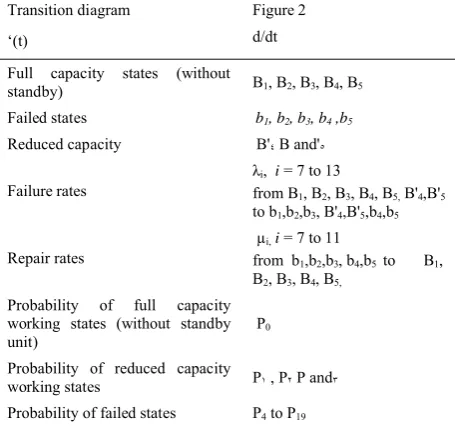
TABLE 1.Notations of skim milk powder unit
Transition diagram Figure 2
‘(t) d/dt
Full capacity states (without
standby) B1, B2, B3, B4, B5
Failed states b1, b2, b3, b4,b5
Reduced capacity B'٤B and'٥
Failure rates
λi, i = 7 to 13
from B1, B2, B3, B4, B5,B'4,B'5
to b1,b2,b3, B'4,B'5,b4,b5
Repair rates
µi,i = 7 to 11
from b1,b2,b3, b4,b5to B1,
B2, B3, B4, B5,
Probability of full capacity working states (without standby unit)
P0
Probability of reduced capacity
working states P١ ,P٢P and٣
Probability of failed states P4to P19
IV. The standby units are of the same nature and capacity as the active units.
The notations associated with the transition diagram are as summarized in Table 1.
4. MATHEMATICAL ANALYSIS OF THE UNIT
The transition diagram (Figure 2) depicts a simulation model showing all the possible states for skim milk powder unit. The model helps to develop the Chapman-Kolmogorov differential equations using mnemonic rule [22]. This rule states that the derivative of the probability of every state is equal to the sum of all probability flows which comes from other states to the given state minus the sum of all probability flows which goes out from the given state to the other states. Probability considerations give the following differential equations associated with the transition diagram:
1 1 9
'
0 0 3 1 0 1 0
1 7 1 7 1 4 i i
i i i
P t P t P t P t
P t
(1 )
9 9
'
1 11 12 1 10 0
11 18
7 7
i i
i i i
P t P t P t P t
P t
(2 )
10 9
'
2 13 2 4 10 1
0 7 9 1 7 1 i
i i i
i
P t P t P t P t
P t
(3 )
9 9
'
3 12 13 3 8 10 2
11 1
7 7
i i
i i
i
P t P t P t P t
P t
(4 ) '
7 7
i i j
P t P t P t
f o r i = 4 , j = 0 ; i = 7 , j = 1 ; i = 1 1 , j = 2 ; i = 1 5 , j = 3 ;
(5 )
'
8 8
i i j
P t P t P t
f o r i = 5 , j = 0 ; i = 8 , j = 1 ; i = 1 2 , j = 2 ; i = 1 6 , j = 3 ;
(6 )
'
9 9
i i j
P t P t P t
for i = 6, j=0; i = 9, j=1; i = 13, j=2; i = 17, j=3;
(7 )
' 10
i i j k
P t P t P t
f o r i = 1 0 , j = 6 , k = 1 ; i = 1 9 , j = 6 , k = 3 ;
(8 )
' 11
i i j k
P t P t P t
for i = 14, j =7,k=2; i =18,j=7, k =3;
(9 )
Initial conditions at time t= 0 are:
( ) 1 i
Figure 2.Transition diagram of skim milk powder system
4. 1. Steady State Availability The skim milk powder unit is required to be available for long duration of time. So, the long run or steady state availability of the skim milk powder unit is obtained by putting
d = 0
dt as t into differential Equations (1) to (9)
and solving these equations recursively, we get: 1 1 0
PL P P2L P2 0 P3L P3 0
1
4 0
P H P P5H P2 0 P6H P3 0
1
7 1 0
P H L P P8H L P2 1 0 P9H L P3 1 0
10 4 1 0
P H L P P11H L P1 2 0 P12H L P2 2 0
3
13 2 0
P H L P P14H L P5 2 0 P15 H L P1 3 0
2
16 3 0
P H L P P17H L P3 3 0 P18H L P5 3 0
4
19 3 0
P H L P where
j i
j
λ
H =
μ ; i= 1, 2, 3; j = 7, 8, 9
12 4
10
λ
H =
μ
13 5
11
λ
H =
μ
μ H L + λ11 5 3 10
L =1 C1
μ H L + λ10 4 3 11 L =2
C2
λ10 11λ (C + C )1 2
L =3
C C C -1 2 3 μ H (C λ11 5 1 10+ C λ2 11)
1 2 7 1 8 2 9 3
C T H H H
2 3 7 1 8 2 9 3
C T H H H
3 4 7 1 8 2 9 3
C T H H H
7 11
1 i
i
T
2 11 127 9
i i
T
10
3 13
7 i
i
T
4 12 137 9
i i
T
Now, using normalizing conditions i.e. sum of all the probabilities is equal to one, we get:
19
0
1
i i
P
1
1 2 3 1 2 3 1 1 2 1
0 3 1 4 1 1 2 2 2 3 2
5 2 1 3 2 3 3 3 5 3 4 3
1 L L L H H H H L H L P H L H L H L H L H L
H L H L H L H L H L H L
probabilities of all working and reduced capacity states i.e.:
1 0 1 2 3 1 1 2 3 0
v
A P P P P L L L P
1 92.82
v
A %
(10)
Taking λ7=0.00007, µ7=0.009, λ8=0.008, µ8=0.55, λ9=0.008, µ9=0.05, λ10=0.005, µ10=0.08, λ11=0.00009, µ11=0.008, λ12=0.005, λ13=0.0002
(Data taken from maintenance history sheets)
The availability (Av1) as given by Equation (10)includes
all possible failure events (i) and the identification of
all the courses of action i.e. repair priorities (i). This model can be used to adopt strategic maintenance policies for skim milk powder unit. Similarly, the various availability levels may be computed for different combinations of failure and repair rates. The optimal availability value for skim milk powder unit is further evaluated using G. A. technique.
4. 2. Performance Optimization Using Genetic Algorithm G. A. is a powerful computerized tool for search and optimization problems. The G. A. optimizes the results using the following steps:
1) Identify all the constraints of the G. A. tool.
2) Randomly generate the initial population and prepare the coded strings.
3) Compute the fitness of each individual and form the mating pool from the old population.
4) Divide the population repeatedly into random tournaments.
5) Determine the new generation pool and select two parents from the mating pool randomly.
6) Perform the crossover of the parents to produce two off springs.
7) Mutate, if required.
8) Place the child strings to new population and compute the fitness of each individual.
9) Replace old population with new population.
10)Repeat the steps 3 to 6 until the best individuals in new population represent the optimum value of the performance function.
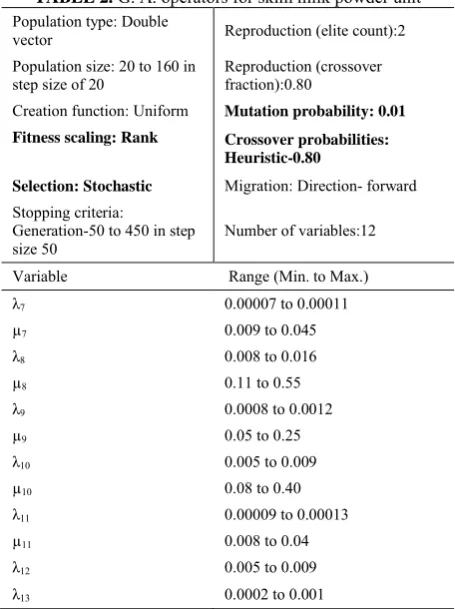
The performance optimization of the skim milk powder unit is influenced by the failure and repair rates of each subsystem. The designed range of failure and repair rates are taken from the maintenance history sheets. In order to optimize the availability, G. A. tool in Matlab 7.1 is being used in the present paper. The following G. A. operators along with permissible range of failure and repair rates are used for the performance optimization
.
TABLE 2.G. A. operators for skim milk powder unit
Population type: Double
vector Reproduction (elite count):2 Population size: 20 to 160 in
step size of 20
Reproduction (crossover fraction):0.80
Creation function: Uniform Mutation probability: 0.01 Fitness scaling: Rank Crossover probabilities:
Heuristic-0.80
Selection: Stochastic Migration: Direction- forward Stopping criteria:
Generation-50 to 450 in step size 50
Number of variables:12
Variable Range (Min. to Max.)
λ7 0.00007 to 0.00011
µ7 0.009 to 0.045 λ8 0.008 to 0.016
µ8 0.11 to 0.55 λ9 0.0008 to 0.0012
µ9 0.05 to 0.25 λ10 0.005 to 0.009
µ10 0.08 to 0.40 λ11 0.00009 to 0.00013
µ11 0.008 to 0.04 λ12 0.005 to 0.009 λ13 0.0002 to 0.001
5. RESULTS AND DISCUSSION
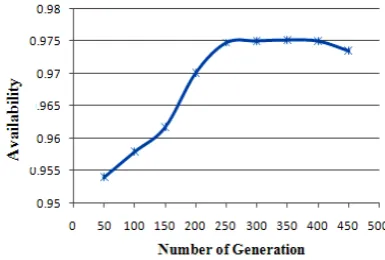
The maximum steady state availability as calculated by Markov analysis comes out to be 92.82% by using the failure and repair rates available through maintenance history sheets. A G. A. is a search strategy that employs random selection to guide a highly exploitative search, striking a balance between explorating of feasible domain and exploting of good solutions. The performance optimization is carried out by varying the number of generations from 50 to 450 in step size 50 as shown in Table 3. It is observed that the optimum availability of skim milk powder unit of an N.D.R.I. plant comes out to be 97.52 % at 350 number of generation. The corresponding values of failure and repair rates are λ7 = 0.00007 (once in 14286 h), µ7 = 0.0449 (once in 22.2 h), λ8= 0.008 (once in 125 h), µ8= 0.5461 (once in 1.83 h), λ9= 0.0008 (once in 1250 h), µ9= 0.2448 (once in 4.08 h), λ10= 0.005 (once in 200 h), µ10= 0. 3989 (once in 2.5 h), λ11= 0.00012 (once in 8333.3 h), µ11=0.029 (once in 34.48 h),λ12= 0.005(once in 200 h),λ13= 0.0002 (once in 5000 h), which is the best possible combination of failure and repair rates of different subsystems. The effect of number of generations on the availability of skim milk powder unit is shown in Figure 3.
varying the population size from 20 to 160 in step size of 20, as shown in Table 4.
It is evident that the best possible combination of failure and repair parameters are λ7= 0.00007, µ7=0.0401, λ8 = 0.008, µ8 = 0.5409, λ9= 0.0008, µ9 =0.2426, λ10=
0.005, µ10 = 0. 3913, λ11= 0.0001, µ11=0.039, λ12 = 0.005, λ13= 0.0002, at which optimum value of system availability is 97.49% with population size 100. The effect of population size on system availability is shown in Figure 4.
TABLE 3.Effect of number of generations on the availability of skim milk powder unit
TABLE 4.Effect of population size on availability of skim milk powder unit
Figure 4.Effect of population size on the availability of skim milk powder system
TABLE 5. Comparison in steady state availability and
optimized availability using genetic algorithm
System Steady state availability
Optimized availability using genetic algorithm
Milk skim
powder unit λ792.82%=0.00007, µ7=0.009, λ8=0.008,
µ8=0.55, λ9=0.008,
µ9=0.05, λ10=0.005,
µ10=0.08, λ11=0.00009,
µ11=0.008, λ12=0.005, λ13=0.0002
97.52%
λ7= 0.00007,
µ7= 0.0449, λ8= 0.008,
µ8= 0.5461, λ9= 0.0008,
µ9= 0.2448, λ10= 0.005,
µ10= 0. 3989, λ11= 0.00012, µ11=0.029,
λ12= 0.005, λ13= 0.0002
6. CONCLUSION
The mathematical formulation has been carried out using probabilistic approach and Markov birth–death process is used to develop the system performance model in terms of availability expression. Then, the system availability of the skim milk powder unit is being optimized in the paper. The derived results from the analysis were discussed with plant management and found to be useful for the management in the following ways:
The steady state availability can be determined at any instant for different combinations of failure and repair rates of each subsystem taken from maintenance history sheets.
The optimized availability value comes out to be 97.52% by selecting various feasible values of failure and repair rates. The selected values of these parameters must be maintained by the plant management.
The corresponding failure rates can be maintained by using redundancy, scheduled preventive maintenance and good inherent design etc.
The optimal repair rates can be achieved by enhancing the skill of maintenance personnel through training, employing sufficient workers and motivating them to attain the target.
The availability has been increased by 10.95% using G. A.. This implies that mean time between failures of the unit has been increased from 339 days to 356 days.
The effect of number of generation and population size on unit availability is also discussed in the paper.
The comparision between steady state availability and optimized availability using G. A. is shown in Table 5.
The major implication lies in the fact that the failure and repair rates are assumed to be constant which follow the exponential distribution in order to simplify the problems.
7. ACKNOWLEDGEMENT
The author is grateful to Dr. A. P. S. Chauhan, Principal Scientist, N.D.R.I., Karnal regarding the concerned research work.
8. REFERENCES
1. Goldberg, D.E., “Genetic Algorithm in Search, Optimization and Machine Learning”, Addison-Wesley, Reading, MA, (1989).
2. Srinivas, N. and Deb, K., “Multi Objective Optimization Using Non Dominated Sorting in Genetic Algorithms”, Evolution of Competition, Vol. 2, (1995), No. 3, 221-248.
3. Ishii, N., Fuchino, T. and Muraki, M., “Life Cycle Orientated Process Synthesis at Conceptual Planning Phase”, Computers and Chemical Engineering, Vol. 21, (1997), 953-958.
4. Sung, C.S. and Lee, H.K., “A Branch and Bound Approach for Spare Unit Allocation in a Series System”, European Journal Operation Research, (1994), 217-232.
5. Sung, C.S. and Cho, Y.K., “Reliability Optimization of a Series System with Multiple-Choice and Budget Constraints”,
European Journal Operation Research, (2000), 159-171.
6. Mettas, A., “Reliability Allocation and Optimization for
Complex Systems”, Proc. Annual Reliability and Maintainability Symposium,(2000), 216-221.
7. Kuo, W., Prassad, V.R., Tillman, F.A., Hwang, C., “Optimal Reliability Design”, Cambridge University Press, (2001).
8. Coit, D.W. and Jin, T., Wattanapongsakorn, N., “System Optimization Considering Component Reliability Estimation Uncertainty: A Multi-Criteria Approach”, IEEE Transactions on Reliability, Vol. 53, (2004), No. 3, 369-380.
9. Nahas, N. and Nourelfath, M., “Artificial Neural Networks for Reliability Maximization Under Budget and Weight Constraints”, Journal of Quality in Maintenance Engineering,
Vol. 11, (2005), No. 2, 139 – 151.
10. Gen, M. and Yun, Y., “Soft Computing Approach for Reliability Optimization: State-of-the-Art Survey”, Reliability Engineering and System Safety, Vol. 91, (2006), 1008-1026.
11. Castro, H.F.D. and Cavalca, K.L., “Maintenance Resources Optimization Applied to a Manufacturing System”, Reliability Engineering and System Safety, Vol. 91, (2006), 413-420. 12. Dai, Y.S. and Wang, X.L., “Optimal Resource Allocation on
Grid Systems for Maximizing Service Reliability Using a Genetic Algorithm”, Reliability Engineering and System Safety, Vol. 91, (2006), 1071-1082.
14. Juang, Y.S., Lin, S.S. and Kao, H.P., “A Knowledge Management System for Series Parallel Availability Optimization and Design”, Journal of Expert System with Application, Vol. 34, (2008), 181-193.
15. Gupta, S., Tewari, P.C. and Sharma, A.K., “Performance Modeling and Decision Support System of Feed Water Unit of a Thermal Power Plant”, South African Journal of Industrial Engineering, Vol. 19, (2008), No. 2, 125-134.
16. Gupta, S., Tewari, P.C. and Sharma, A.K., “A Markov Model for Performance Evaluation of Coal Handling Unit of a Thermal Power Plant”, Journal of Industrial and Systems Engineering (JISE), Vol. 3, (2009), No. 2, 85-96.
17. Gupta, S. and Tewari, P.C., “Performance Modeling of Power Generation System of a Thermal Plant”, IJE Transition A: Basics, Vol. 24, No. 3 (2011), 239-248.
18. Azaron, A., Perkgoz, C., Katagiri, H., Kato, K. and Sakawa, M., “Multi-Objective Reliability Optimization for Dissimilar-Unit Cold-Standby Systems Using a Genetic Algorithm”, Journal Computers and Operations research, Vol. 36, (2009), No. 5,
1562-1571.
19. Nakagawa, T. and Mizutani, S., “Optimum Problems in Backward Times of Models”, IEEE Transactions on Reliability,
Vol. 41, (2009), 65-71.
20. Garg, S., Singh, J. and Singh, D.V., “Availability and Maintenance Scheduling of a Repairable Block-Board Manufacturing System”, International Journal of Reliability and Safety, Vol. 4, (2010), No.1, 104 - 118.
21. Singh, S.B., Ram, M. and Chaube, S., “Analysis of the Reliability of a Three- Component System with Two
Repairmen”, IJE Transition A: Basics, Vol. 24, No. 4 (2011), 395-401.
22. Khanduja, R., Tewari, P.C. and Kumar, D., “Mathematical Modeling and Performance Optimization for the Digesting System of a Paper Plant”, IJE Transition A: Basics, Vol. 23, No. 3 & 4 (2010), 215-225.
23. Asha, G. and Nair, N., “Reliability Properties of Mean Time to Failure in Age Replacement Models”, International Journal of Reliability, Quality and Safety Engineering (IJRQSE), Vol.17,
(2010), No. 1, 15-26.
24. Vasili, M., Hong, T.S., Ismail, N. and Vasili, M., “Maintenance optimization models: a review and analysis”, Proceedings of the International Conference on Industrial Engineering and Operations Management, Kuala Lumpur, Malaysia, January 22 – 24, (2011), pp. 1131-1138.
25. Khanduja, R., Tewari, P.C. and Kumar, D., “Steady State Behaviour and Maintenance Planning of Bleaching System in a Paper Plant”, Journal Industrial Engineering International, Vol.
7, No. 12 (2011), 39-44.
26. Vora, Y., Patel, M.B. and Tewari, P.C., “Simulation Model for Stochastic Analysis and Performance Evaluation of Steam Generation System of a Thermal Power Plant”, International Journal of Engineering Science and Technology, Vol. 3, No. 6,
(2011), 5141-5149.
APPENDIXES
Population Size =60 Population Size =80
Population Size =100 Population Size =120 Population Size =140
Population Size =160 Population Size =40
Performance Optimization for Skim Milk Powder Unit of a Dairy Plant Using
Genetic Algorithm
S. Kajala, P. C. Tewarib
a Department of Mechanical Engineering, University Institute of Engineering and Technology, Kurukshetra University, Kurukshetra-136119, Haryana, India
bDepartment of Mechanical Engineering, National Institute of Technology, Kurukshetra-136119, Haryana, India
A R T I C L E I N F O
Article history:
Received 23 December 2011
Received in revised form 14 Febuary 2012 Accepted 17 May 2012
Keywords:
Availability Markov Process Genetic Algorithm Skim Milk Powder Unit
هﺪﯿﮑﭼ ،ﻪﻟﺎﻘﻣ ﻦﯾا ﻪﻨﯿﻬﺑ يزﺎﺳ دﺮﮑﻠﻤﻋ ﺪﺣاو ﺮﯿﺷ ﮏﺸﺧ نوﺪﺑ ﯽﺑﺮﭼ زا ﻪﻧﺎﺧرﺎﮐ يﺎﻫ ﯽﻨﺒﻟ ﺎﺑ هدﺎﻔﺘﺳا زا ﻢﺘﯾرﻮﮕﻟا ﮏﯿﺘﻧژ (G. A.) رد ﻪﺴﺳﻮﻣ ﯽﻠﻣ تﺎﻘﯿﻘﺤﺗ ﯽﻨﺒﻟ (N.D.R.I) ار ﻫد ﯽﻣ راﺮﻗ ﯽﺳرﺮﺑ درﻮﻣ ﺪ.
ﻪﻧﺎﺧرﺎﮐ ﻪﻠﻤﺟ زا يدﺎﯾز يﺎﻫ ﺶﺨﺑ ﻪﺑ ﺪﺣاو ﺪﺣاو ،ﯽﺑﺎﯾرازﺎﺑ ﻆﯿﻠﻐﺗ و ﮏﺸﺧ ﺪﺣاو ،ندﺮﮐ ﺮﯿﻨﭘ و ،هﺮﮐ ﺪﺣاو لﺮﺘﻨﮐ ،ﺖﯿﻔﯿﮐ ﺪﺣاو ردﻮﭘ ﺮﯿﺷ و ﺪﺣاو ﻪﺘﺴﺑ يﺪﻨﺑ ﻢﯿﺴﻘﺗ ﯽﻣ دﻮﺷ . ﺪﺣاو ردﻮﭘ ﺮﯿﺷ نوﺪﺑ ،ﯽﺑﺮﭼ ﻞﻣﺎﺷ ﺶﺷ ﺮﯾز ﻪﻋﻮﻤﺠﻣ ﺖﺳا . خﺮﻧ ﺖﺴﮑﺷ و ﻢﯿﻣﺮﺗ زا ﻦﯾا ﺮﯾز ﻪﻋﻮﻤﺠﻣ ﺎﻫ زا ﺦﯾرﺎﺗ يﺎﻫ ﺗ ﺮﯿﻤﻌ و ﻪﺑ ﻪﮐ يراﺪﻬﮕﻧ لﺎﺒﻧد
ﻊﯾزﻮﺗ ﯽﯾﺎﻤﻧ ﻪﺘﻓﺮﮔ هﺪﺷ ﺪﻨﮐ ﯽﻣ ﺖﯿﻌﺒﺗ ﺖﺳا . ﻪﺑ رﻮﻈﻨﻣ ﻪﻌﺳﻮﺗ توﺎﻔﺗ تﻻدﺎﻌﻣ لﻮﻣﺮﻓ ،ﻞﯿﺴﻧاﺮﻔﯾد ﯽﺿﺎﯾر ﺎﺑ هدﺎﻔﺘﺳا زا شور ﯽﺗﻻﺎﻤﺘﺣا و ﺪﻟﻮﺗ ﻒﮐرﺎﻣ -ﺪﻨﯾآﺮﻓ گﺮﻣ ﺪﯾآ ﯽﻣ ﺖﺳد ﻪﺑ
. تﻻدﺎﻌﻣ ﻦﯾا ﺎﺑ هدﺎﻔﺘﺳا زا ﻂﯾاﺮﺷ ﺎﺗ ﺪﺷ ﻞﺣ يدﺎﻋ ندﺮﮐ ﻪﻟﻮﻣﺮﻓ