International Journal of Mathematical Archive-9(1), 2018, 100-105
Available online thr ough
ISSN 2229 – 5046
PSO BASED INTUITIONISTIC FUZZY OPTIMIZATION
1
MAHESWARI.A
Assistant Professor/Maths,
Velammal College of Engineering & Technology, Madurai, India.
2
KARTHIKEYAN.S,
Assistant Professor/Maths,
Velammal College of Engineering & Technology, Madurai, India.
3
PALANIVELRAJAN.M,
Assistant Professor/Maths,
Government Arts College, Melur, Madurai Dist., India.
4
SHUNMUGALATHA.A
Professor & Head/EEE,
Velammal College of Engineering & Technology, Madurai, India.
E mail: [email protected]1, [email protected]2,
[email protected]3 and [email protected]4
ABSTRACT:
M
odeling of real life problems involving optimization process rolls out to be a multi-objective programming problem. In order to optimize a linear programming model, numerous approaches have been suggested so far. Problems of decision making with regard to multi-attribute have been carried out using Intuitionistic Fuzzy sets in which optimization was done by conventional methods. This paper intercalates an application of particle swarm optimization method to solve a linear programming problem. First, the theory of Intuitionistic Fuzzy Sets have been employed to formulate multi-objective linear programming problem by already existing methods and then Particle Swarm Optimization is introduced as a tool to optimize the problem. By considering the air condition selection problem, the results are compared and it is proved that the proposed method has a better performance than the conventional methods.Keywords: Intuitionistic Fuzzy set, Decision making, Intuitionistic fuzzy optimization, Particle Swarm Optimization.
Mathematics Subject Classification: 03F55, 08A72.
1. INTRODUCTION
In 1965, Lofti A. Zadeh [20] introduced the notion of a fuzzy subset as a method for representing uncertainty in real world. The concept of intuitionistic fuzzy set was introduced by K. T. Atanassov [1] as a powerful extension of fuzzy set. Atanassov in his studies emphasized that in view of handling imprecision, vagueness or uncertainty in information both the degree of belonging and degree of non-belonging should be considered as two independent properties as these are not complement to each other. H-J .Zimmermann [22] designed crisp optimization models as fuzzy models and then solved it by using existing standard algorithms. As an extension of fuzzy optimization, Plamen G Angelov [16] defined some optimization problems in an Intuitionistic Fuzzy environment. He suggested a new approach for solving the problem of multi objective optimization in Air Conditioning systems through the comfort and discomfort IF definitions [17]. S. K. Bharati and S. R. Singh [4] implied a computational algorithm for solving multi-objective linear programming. Arindam Garai and Tapan Kumar Roy [2] used a technique which is an extension of intuitionistic fuzzy optimization technique, proposed by Plamen P. Angelov in 1997. Manish Agarwala, Kanad K. Biswas, Madasu Hanmandlu, used generalized Intuitionistic fuzzy softs sets in decision making [14]. Deng-Feng Li [5] investigated multi-attribute decision-making using intuitionistic fuzzy sets and constructed several linear programming models to generate optimal weights for criteria. But the method he put forward had to deal bigger calculation. After that Lin Lin, Xue-Hai Yuan, Zun-Quan Xia [11] introduced another method which allows the degrees of satisfiability and non-satisfiability of each alternative with respect to a set of criteria to be represented by intuitionistic fuzzy sets. There they used score function and accuracy function, intuitionistic indices etc. to convert intuitionistic fuzzy problem into LPP. Then by ranking method they identified a better solution. After that many researchers used IFS for multi-criteria decision making problems. Even though many methods are available like using similarity measures, interval valued IFS, Taylor’s series, hesitation index, etc., a better solution will be obtained through this proposed method. Moreover time consumption is less in this method compared to the existing methods.
Particle Swarm Optimization (PSO) is a computational & fast convergence method that by having a population of candidate solutions, and moving these particles around in the simple local best known position but, is also guided toward the best known positions in the search-space, which are updated as better positions are found by other particles. This is expected to move the swarm toward the best solutions. Particle swarm optimization (PSO) was originally introduced by Kennedy and Eberhart in 1995 for the study of social and cognitive behavior (Eberhart & Kennedy, 1995a, 1995b). Currently, PSO algorithm is widely used in fields such as function optimization, combination optimization, Vehicle Scheduling, Graph coloring [8], Neuro Structure Optimization, network training, robot path programming, pattern recognition, fuzzy system control etc. [9].
So far PSO has been used as a tool in Fuzzy mathematics such as Scheduling jobs on Computational Grids [6], economic dispatch problem [19], image segmentation [12], etc. Now we use it with intuitionistic Fuzzy set problems. Section-2 of this paper deals with the definitions and properties of intuitionistic fuzzy sets. In Section 3, the role of IFS in decision making through PSO is analyzed elaborately
2. INTUITIONISTIC FUZZY SETS
Definition 2.1: An Intuitionistic fuzzy set (IFS) A in a non-empty set X is defined as an object of the form A = {< x, μ
A(x), ν A(x)> / x ∈ X} where μA: X → [0, 1] is the degree membership and νA: X → [0, 1] is the degree of non
-membership of the element x ∈ X satisfying 0 ≤ µA(x) + ν A(x) ≤ 1.
In addition for each IFS A in X the degree of indeterminacy is defined by πA(x) = 1 – μ A(x) – ν A(x) which is called the
degree of hesitancy of x to A. It is obvious that 0 ≤ πA(x) ≤ 1 for each x∈X. Especially, if πA(x) = 0, for all x ∈X then
the IFS A is reduced to a fuzzy set.
Definition 2.2: The operations of IFS are defined as follows, for every A, B ∈ IFSs(X):
• A≤ B if and only if μA(x) ≤ μB(x) and νA(x)≥ νB(x) for all x in X.
• A = B if and only if A ≤ B and B≤ A.
• A∩ B = {〈x, min(μA(x),μB(x)), max(νA(x), νB(x))〉 | x ∈ X}.
• A∪B = {〈x, max(μA(x),μB(x)), min(νA(x), νB(x))〉 | x∈ X}.
• The complementary of an IFSA is AC = {(x, νA(x), μA(x)) | x ∈ X}.
3.FORMULATION OF DECISION MAKING USING INTUITIONISTIC FUZZY VALUES
The formulation of the decision making problem as an intuitionistic Fuzzy problems [5] is as follows. Suppose that there exists an alternative set X = {x1, x2, ....xn} which consists of n non-inferior decision making alternatives from
which a most preferred alternative is to be selected. Each alternative is assessed on m attributes. Let the set of all attributes be denoted by A = {a1, a2,...am}. Assume that µijand νij are the degree of membership and the degree of non
membership of the alternative xj ∈X with respect to the attribute ai ∈A to the fuzzy concept “excellence”, respectively,
where 0 ≤ µij ≤ 1, 0 ≤ νij ≤ 1, and 0 ≤ µij+ νij ≤ 1. That is the evaluation of the alternative xj∈X with respect to the
attribute ai∈A is an intuitionistic fuzzy set denoted by Xij = {〈xj, µij, νij〉}. The intuitionistic fuzzy indices πij = 1 – µij – νij
are such that the larger πij the higher a hesitation margin of the decision maker as to the “excellence” of the alternative
xj ∈X with respect to the attribute ai ∈A whose intensity is given by µij. From Intuitionistic indices we can calculate
the best final result or worst one. During the process, the decision maker can increase his evaluation by adding the value of the intuitionistic index. Thus the evaluation lies in the closed interval [𝜇𝑖𝑗𝑙,𝜇𝑖𝑗𝑢] = [𝜇𝑖𝑗,𝜇𝑖𝑗+𝜋𝑖𝑗], where
𝜇𝑖𝑗𝑙 = 𝜇𝑖𝑗 and 𝜇𝑖𝑗𝑢 = 𝜇𝑖𝑗+𝜋𝑖𝑗 = 1 – νij. Clearly 0 ≤ 𝜇𝑖𝑗𝑙 ≤ 𝜇𝑖𝑗𝑢 ≤ 1 for all 𝑥𝑗 ∈ X and 𝑎𝑖 ∈ A.
Similarly, we assume that ρI and τI are the degree of membership and the degree of non-membership of the attribute ai
∈A to the fuzzy concept of “importance” respectively where 0 ≤ ρI ≤ 1, 0 ≤ τI ≤ 1 and 0 ≤ ρI + τI ≤ 1. The intuitionistic
indices ηI = 1 – ρI – τI are such that the larger ηI, the higher a hesitation margin of decision maker as to the
“importance” of the attribute ai ∈A whose intensity is given by ρi. Intuitionistic indices allow us to calculate the
biggest weight or the smallest one. As in the case of alternative evaluation the decision maker can increase his
evaluating weights by adding the value of the intuitionistic index. Thus the weight lies in the interval [𝜔𝑖𝑙,𝜔𝑖𝑢] = [𝜌𝑖, 𝜌𝑖+η𝑖], where 𝜔𝑖𝑙= 𝜌𝑖 and 𝜔𝑖𝑢= 𝜌𝑖+ηI = 1 – τi. Clearly 0 ≤ 𝜔𝑖𝑙 ≤ ω𝑖𝑢 ≤ 1 for each attribute ai ∈ A. In
addition to this we assume that ∑𝑚𝑖=1𝜔𝑖𝑖 ≤ 1 and ∑𝑚𝑖=1𝜔𝑖𝑢 ≥ 1 in order to find weights ωi∈[0, 1] (I = 1,2,……m)
satisfying 𝜔𝑖𝑙 ≤ 𝜔𝑖≤ 𝜔𝑖𝑢 and ∑𝑚𝑖=1𝜔𝑖 = 1.
Now we formulate the above problem into a linear programming problem by one of the conventional methods [5] as follows.
max z = ∑ ∑ (𝜇𝑖𝑗 𝑢− 𝜇
𝑖𝑗 𝑙)𝜔
𝑖 𝑚
𝑖=1 𝑛 𝑗=1
𝑛 , 𝜔𝑖𝑙 ≤ 𝜔𝑖 ≤ 𝜔𝑖𝑢 (I = 1,2,….m) , ∑𝑚𝑖=1𝜔𝑖 = 1.
To generate the optimal weights of the attributes PSO is used in place of conventional methods.
Example: Consider an air-condition system selection problem [5]. Suppose there exist three air-condition systems x1,
x2 and x3. Let the alternate set be X = {x1, x2, x3}. Suppose three attributes a1(economical), a2(function), and a3(being
operative) are taken into consideration in the selection problem. Let the attributes set be A = {a1, a2, a3}. Using
statistical methods, the degrees µijof membership and the degrees νij of non-membership for the alternative xj ∈X with
x1 x2 x3
a1 (0.75, 0.10) (0.80, 0.15) (0.40, 0.45) ((𝜇𝑖𝑗,𝛾𝑖𝑗))3×3 = a2 (0.60, 0.25) (0.68, 0.20) (0.75, 0.05)
a3 (0.80, 0.20) (0.45, 0.50) (0.60, 0.30)
x1 x2 x3
a1 (0.75, 0.90) (0.80, 0.85) (0.40, 0.55) ((𝜇𝑖𝑗′,𝛾𝑖𝑗"))3×3 = a2 (0.60, 0.75) (0.68, 0.80) (0.75, 0.95)
a3 (0.80, 0.80) (0.45, 0.50) (0.60, 0.70)
Similarly, the degrees ρi of membership and degrees τi of non-membership for the three attributes ai∈A to the fuzzy
concept “importance” can be obtained, respectively. Namely a1 a2 a3
((ρi,τi))1×3 = ((0.25, 0.25) (0.35, 0.40) (0.30, 0.65))
i) Now by intuitionistic indices method[5] we are converting the above problem into a linear programming problem as follows:
max z = 0.35𝜔1+0.47𝜔2+0.15𝜔3
3 subject to the constraints
0.25 ≤ ω1 ≤ 0.75
0.35 ≤ ω2 ≤ 0.60
0.30 ≤ ω3 ≤ 0.35
ω1 + ω2 + ω3 = 1
Solving the above linear programming by conventional methods, its optimal solution can be obtained as ω1 = 0.25, ω2 = 0.40, ω3 = 0.35
Then By Deng-Feng Li[5], the index for each alternative is given by ξ1 = 0.7335, ξ2 = 0.6563, ξ3 = 0.6616.
From this we conclude that the best alternative is x1.
ii) Considering the same problem again, it is converted into a linear problem by another method [11] as follows: max z = 1.41 ∗ ω1 +1.765 ∗ ω2 + 0.925 ∗ ω3, subject to the constraints
0.25 ≤ ω1 ≤ 0.75
0.35 ≤ ω2 ≤ 0.60
0.30 ≤ ω3 ≤ 0.35
ω1 + ω2 + ω3 = 1
Solving the above linear programming by simplex method, its optimal solution can be obtained as, ω1 = 0.25, ω2 = 0.40, ω3 = 0.35
Then by applying score function and accuracy function formula [11], the ranking of the alternatives is given by R(a1) = 0.5525, R(a2) = 0.40425 & R(a3) = 0.47125 which shows the best alternative is x1.
SIMULATION RESULTS AND DISCUSSIONS
The control parameters for the best result of PSO are:
Parameter PSO
No. of variables 3 Population Size 1 No. of iterations 372
C1 1.5
Optimum values of the variables
S. No. C1 C2 ω1 ω2 ω3 Max z Time (sec.) Iterations
1. 0.7 3.3 0.2712 0.4143 0.3145 1.4046 0.421624 263 2. 0.9 3.1 0.2525 0.4220 0.3256 1.4020 0.432950 353 3. 1.0 3.0 0.2911 0.4060 0.3030 1.4073 0.421167 331 4. 1.4 2.6 0.2525 0.4446 0.3030 1.4210 0.502841 527 5. 1.5 2.5 0.2525 0.4446 0.3030 1.4210 0.446970 372 6. 1.8 2.2 0.2525 0.4446 0.3030 1.4210 0.497333 514 7. 2.3 1.7 0.2934 0.4036 0.3030 1.4064 0.403399 216 8. 2.5 1.5 0.2525 0.4388 0.3087 1.4161 0.400890 195 9. 2.7 1.3 0.2525 0.4446 0.3030 1.4210 0.476420 437 10. 2.9 1.1 0.2525 0.4446 0.3030 1.4210 0.490540 497
Corresponding to these control variables it was found that all the variables satisfy the lower and upper limits and also the equality constraints.
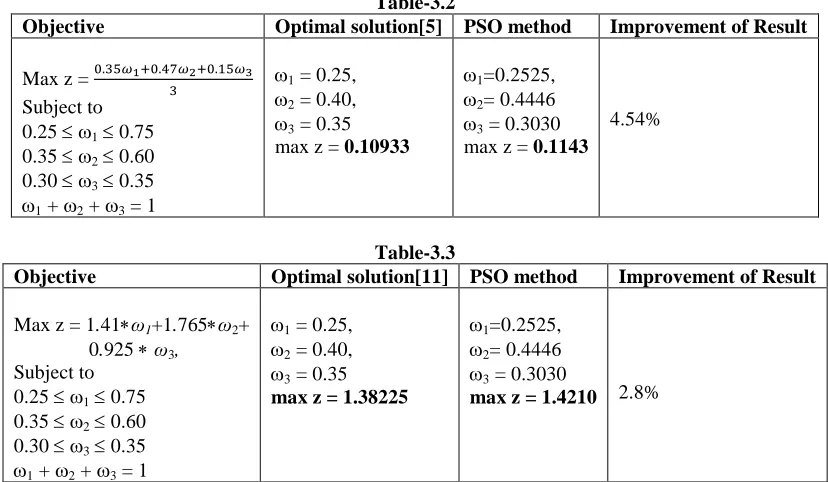
Using conventional method we got ω1 = 0.25, ω2 = 0.40, ω3 = 0.35 and max z = 0.10933
Using PSO method we got ω1 = 0.2525, ω2 = 0.4446, ω3 = 0.3030 and max z = 0.1143.
And the index for each alternative is given by ξ1 = 0.7268, ξ2 = 0.6676, ξ3 = 0.6683 which proves the best alternative is
x1.
Similarly by Lin Lin [11] method we have ω1 = 0.25, ω2 = 0.40, ω3 = 0.35 and max z = 1.38225
But using PSO method we get max z = 1.4210.
And the ranking of the alternatives are R(a1) = 0.5539, R(a2) = 0.4029 & R(a3) = 0.4680 where the best alternative is a1.
Comparison of results:
Table 3.2 and Table 3.3 show the comparison of the proposed method with other existing methods.
Table-3.2
Objective Optimal solution[5] PSO method Improvement of Result
Max z = 0.35𝜔1+0.47𝜔2+0.15𝜔3
3
Subject to 0.25 ≤ ω1 ≤ 0.75
0.35 ≤ ω2 ≤ 0.60
0.30 ≤ ω3 ≤ 0.35
ω1 + ω2 + ω3 = 1
ω1 = 0.25,
ω2 = 0.40,
ω3 = 0.35
max z = 0.10933
ω1=0.2525,
ω2= 0.4446
ω3 = 0.3030
max z = 0.1143
4.54%
Table-3.3
Objective Optimal solution[11] PSO method Improvement of Result
Max z = 1.41∗ω1+1.765∗ω2+
0.925 ∗ ω3,
Subject to 0.25 ≤ ω1 ≤ 0.75
0.35 ≤ ω2 ≤ 0.60
0.30 ≤ ω3 ≤ 0.35
ω1 + ω2 + ω3 = 1
ω1 = 0.25,
ω2 = 0.40,
ω3 = 0.35 max z = 1.38225
ω1=0.2525,
ω2= 0.4446
ω3 = 0.3030
CONCLUSION
In this paper, PSO Algorithm is used for finding the optimal values of a decision making problem with less computation time. Simulation results are compared with the conventional methods. From the comparison, it was observed that the obtained optimal weights are better than that of conventional. Numerical results show the effectiveness of the proposed algorithm for solving optimization problem.
REFERENCES
1. Atanassov K. T., Intuitionistic Fuzzy sets, Fuzzy Sets and Systems, 20 (1986), 87-96.
2. Alireza Zakariazadeh, Shahram Jadid, Pierluigi Siano, Economic-environmental energy and reserve scheduling of smart distribution systems: A multi objective mathematical programming approach, Energy Conversion and Management, 78 (2014), 151–164.
3. Arindam Garai and Tapan Kumar Roy, Intuitionistic Fuzzy Optimization: Usage of hesitation Index, Notes of Intuitionistic Fuzzy Sets, 19 (2013), 60–68.
4. Bharati S. K. and Singh S. R., Solving Multi Objective Linear Programming Problems Using Intuitionistic Fuzzy Optimization Method: A Comparative Study, International Journal of Modeling and Optimization, 4 (2014), 10-16.
5. Deng-Feng Li, Multiattribute decision making models and methods using intuitionistic fuzzy sets, J. Comput. System Sci., 7, (2005), 73 – 85.
6. Hongbo Liu , Ajith Abraham, Aboul Ella Hassanien, Scheduling jobs on computational grids using a fuzzy particle swarm Optimization Algorithm, Future Generation Computer Systems, 26, (2010), 1336-1343. 7. Dr. Irene Hepzibah R., Dr. Nagoor Gani A, Vidhya R., Fuzzy Multi objective Non Linear Programming
Problem (IFMONLPP) using Taylor Series Approach, International Journal of Innovative Research in Science, Engineering and Technology, 3, (2014), 14105-14109.
8. Jitendra Agrawal, Shikha Agrawal, Acceleration Based Particle Swarm Optimization for Graph Coloring Problem, 19th International Conference on Knowledge Based and Intelligent Information and Engineering Systems, Procedia Computer Science, 60, ( 2015 ), 714 – 721.
9. Kuo R.J., Hongb S.M., Lin Y., Huangc Y.C., Continuous genetic algorithm-based fuzzy neural network for learning fuzzy IF–THEN rules, Neuro computing, 71, (2008), 2893–2907.
10. Liang-Hsuan Chen, Chia-Chang Hung, Chien-Cheng Tu, Considering the decision maker’s attitudinal character to solve multi-criteria decision-making problems in an intuitionistic fuzzy environment, Knowledge-Based Systems, 36, (2012), 129–138.
11. Lin Lin, Xue-Hai Yuan, Zun-Quan Xia, Multicriteria fuzzy decision-making methods based on Intuitionistic fuzzy sets, §J. Comput. System Sci., 73, (2007), 84–88.
12. Linyi Li, Deren Li, Fuzzy entropy image segmentation based on particle swarm Optimization, Progress in Natural Science, 18, (2008), 1167–1171.
13. Liyuan Zhang, Tao Li, Xuanhua Xu Consensus model for multiple criteria group decision making under intuitionistic fuzzy environment, Knowledge-Based Systems, 57, (2014), 127– 135.
14. Manish Agarwala, Kanad K. Biswas, Madasu Hanmandlu, Generalized intuitionistic fuzzy soft sets with applications in decision-making, Applied Soft Computing,13, (2013), 3552– 3566.
15. Parvathi R and Malathi C, Intuitionistic Fuzzy Linear Optimization, Notes on Intuitionistic Fuzzy sets, 18, (2012), 48 – 56.
16. Plamen P Angelov, Intuitionistic Fuzzy Optimization, Notes on Intuitionistic Fuzzy Sets, 1, (1995), 123 – 129. 17. Plamen P Angelov, “Multi-objective Optimisation in Air-Conditioning Systems: Comfort / Discomfort
Definition by IF Sets”, Notes on Intuitionistic Fuzzy Sets, 7, (2001), 1, 10 – 21.
18. Sadia Husain, Yasir Ahmad, M. Afshar Alam, A study on the Role of Intuitionistic Fuzzy Set in Decision making problems, International Journal of Computer Applications, 48, (2012), 0975 – 888.
19. A.Shunmugalatha, S.Mary Raja Slochanal, Optimum cost of generation for maximum loadability limit of power system using hybrid particle swarm Optimization, Electrical Power and Energy Systems, 30, (2008), 486-490.
20. Taher Niknam, A new fuzzy adaptive hybrid particle swarm optimization algorithm for linear, non-smooth and non-convex economic dispatch problem, Applied Energy, 87, (2010), 327–339.
21. Zadeh L. A, Fuzzy sets, Inform.Control, 8, (1965), 338-353.
22. Zhi Pei, Li Zheng, A novel approach to multi-attribute decision making based on Intuitionistic fuzzy sets, Expert Systems with Applications,39, (2012), 2560–2566.
23. Zimmermann H. J, Fuzzy Programming and Linear Programming with Several Objective Functions, Fuzzy Sets and Systems, 1 (1978), 45-55.