4th 9 Weeks (Unit 6)
Theme
Title
Essential
Vocabulary
Task
Analysis
Learning
Activities/Assessments
Resources
*see Kindergarten News link for more resources
Standard
Unit 6 Wonders of Nature Individuals Events Ideas Information Topic Illustrations Descriptions Procedures Compare Alike Different Similarities Differences Story Listen Understanding Predictions Events Text Poetry Rhythm Rhyme Word Word parts Meaning Homophone Noun Verb Root/ base word Prefix Suffix Context Identify individuals, events, ideas, or information (pictures, descriptions or procedures) in one text or twotexts Know that
compare means looking
for things that are alike
or different Identify basic similarities in and differences between two texts on the same topic
(e.g., in illustrations, descriptions, or
procedures). Working in a
group Taking turns
Listening
Weather
-Create a cause/effect anchor chart for weather/climate. (What happened? Rainbow, flowers, green grass. What made it happen? Rain).
-Signal words/phrases: “as a result”, “reason why”, “may be due to,” “therefore”, “because of”.
-create word family umbrellas
- interpret information to answer questions and express opinions about “Spring,” including
answering why questions that require recognizing
cause/effect
relationships (RI.K.1) -dentify the main topic and retell
key details from “Spring” (RI.K.2)
-, define and use new words, such as gradually, from the read-aloud and the discussion about
“Spring” (RI.K.4)
-describe an illustration of the cherry blossoms in
www.readinglady.com
Complete weather website (super awesome)
http://www.engageny.org/sites/default/files/ resource/attachments/ckla_gk_d8_anth.pdf
Maisy’s Weather
http://www.youtube.com/watch?v=u7pGl1yXpDE
Non-Fiction Weather books Weather Words
http://www.gscdn.org/library/cms/87/15687.gif
RI.K.9 RL.K.10
4th 9 Weeks (Unit 6)
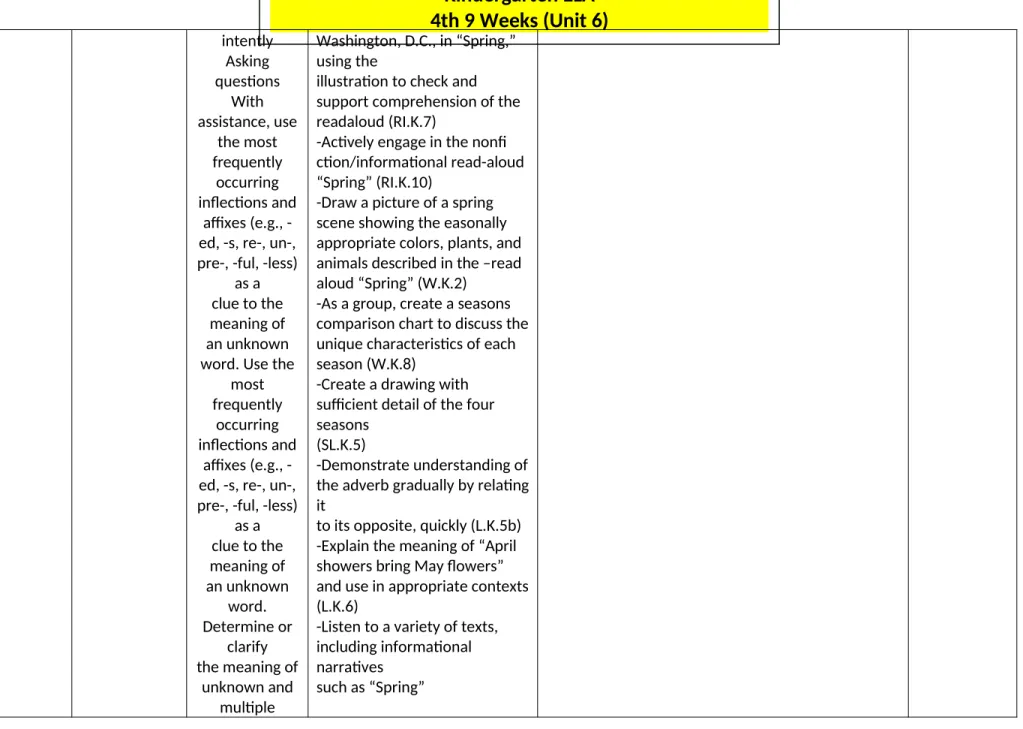
intently Asking questions
With assistance, use
the most frequently
occurring inflections and
affixes (e.g., -ed, -s, re-, un-, pre-, -ful, -less)
as a clue to the meaning of an unknown word. Use the
most frequently
occurring inflections and
affixes (e.g., -ed, -s, re-, un-, pre-, -ful, -less)
as a clue to the meaning of an unknown
word. Determine or
clarify the meaning of
unknown and multiple
Washington, D.C., in “Spring,” using the
illustration to check and support comprehension of the readaloud (RI.K.7)
-Actively engage in the nonfi ction/informational read-aloud “Spring” (RI.K.10)
-Draw a picture of a spring scene showing the easonally appropriate colors, plants, and animals described in the –read aloud “Spring” (W.K.2)
-As a group, create a seasons comparison chart to discuss the unique characteristics of each season (W.K.8)
-Create a drawing with sufficient detail of the four seasons
(SL.K.5)
-Demonstrate understanding of the adverb gradually by relating it
to its opposite, quickly (L.K.5b) -Explain the meaning of “April showers bring May flowers” and use in appropriate contexts (L.K.6)
-Listen to a variety of texts, including informational narratives
4th 9 Weeks (Unit 6)
meaning words and phrases based
on kindergarten
reading and content.
Plants
-Graph your favorite way to eat a potato
-create a flow-map of how a flower changes and grows over a period of time. SW illustrate the seed, roots, stem, flower, and death of a flower in the flow-map
-plant their
own seed or flower
(documents growth in journal) -Living vs. Non-living sorting activity
Orally compare and contrast a houseplant and desert cactus (RI.K.3)
-Define and use new words, such as soil, from the read-aloud and the discussion about “Introduction to Plants” (RI.K.4) -Describe images of living things in “Introduction to Plants,” using the images to check and support
comprehension of the read-aloud (RI.K.7) -Actively engage in the nonfiction/informational read-aloud “Introduction to Plants” (RI.K.10)
-Identify multiple meanings of plant and use them in
Complete plant website (super awesome)
http://www.engageny.org/sites/default/files/ resource/attachments/ckla_gk_d4_anth.pdf
The Flower Seed
http://www.youtube.com/watch?v=cqE3Kcc8Zgg
Seed video
4th 9 Weeks (Unit 6)
appropriate contexts (L.K.4a) -Sort common objects into living and nonliving categories (L.K.5a)
-Prior to listening to “Introduction to Plants,” identify orally what
they know about plants (KWL chart)
Easter/Rabbits/Eggs
-compare and contrast to oviparous animals
-sort oviparous/non-oviparous -make a life cycle of a frog -compare characters in Peter Rabbit
-bubble map of facts about real rabbits
Oviparous Animals
https://docs.google.com/a/duplinschools.net/file/d/ 0B7d_btlrtkXpMmJmUE9YRVpScXk0b0xwZmI2cm0y Zw/edit?pli=1
Chickens Aren’t the Only One Twas the Night Before Easter Peter Rabbit
The Easter Egg
4th 9 Weeks (Unit 6)
Insects
-create a classcaterpillar. This caterpillar will be a word caterpillar. Students will put 1-word of a sentence on a card then put their words in order and create a sentence. All students will write the sentence.
-work with a partner to sequence what the hungry caterpillar ate in order
-Cinco De Mayo
See Kindergarten News
Fish/Ocean Animals
-decorate and make your own Rainbow fish. Use foil and glitter to decorate.
-compare the two rainbow fish stories or two other similar fish stories using a
venn diagram. discuss
similarities and differences with their buddy. illustrate or use pictures to explain
the two stories.
The Very Hungry Caterpillar
http://www.youtube.com/watch?v=_4HI7q38VmQ
The Grouchy Ladybug
http://www.youtube.com/watch?v=RFNZvJbzmms
Rainbow Fish One Fish, Two Fish
The Whale Who Ate Everything
http://www.youtube.com/watch?v=CFq441el_ls
4th 9 Weeks (Unit 6)
-make seaweed
soup: ( noodles, chicken broth, and Spinach leaves). Leaves make broth turn a little green. Just heat up!
- categorize and organize information about the various habitats and the animals that live in each habitat (W.1.8)
-Describe the ocean with relevant details, expressing ideas and feelings clearly to a partner as the partner draws the ocean(SL.1.4)
Fairy Tales
-Distinguish fantasy from realistic text by explaining that certain events in the story could not have happened in real life (RL.1.5)
-Write about and illustrate their favorite character from a fairy tale and explain why it is their favorite
-Discuss personal responses to how they received their names and compare that to the names of characters in fairy tales (W.1.8)
Sleeping Beauty Jack and the Bean Stalk
Super awesome website for common core
http://www.engageny.org/sites/default/files/ resource/attachments/ckla_g1_d9_anth.pdf
4th 9 Weeks (Unit 6)
Beach/Summer
-sort clothing for different seasons
-beach ball with wh questions on them for questioning after read alouds
Wonders of Nature
Point of view Reasons Support Differences Similarities
Believe Main idea
Detail Point (Key
Ideas) Author’s purpose Entertain Persuade Inform Author Identify Informational
text Explicit
Edit Revise Digital tool(s)
Identify the ideas/details
in the text Identify the main
point or idea. Identify the
author’s purpose in writing the text Find a picture or
words that supports the
main point or idea
identify the reasons an author gives to support points in
a text. explore digital media available
in classroom and
school Use digital media
RI.K.8 W.K.6 W.K.3, L.K.1,
4th 9 Weeks (Unit 6)
Publish Type Audience Event Real Imagined Illustration Character Setting Draw Label Write Audience Sequence Beginning Middle End Reaction Author Illustrator Detailsto publish class shared writing Understand that
an event is something that
has happened (real or imagined).
State an event (real) and
tell something about it. Dictate to scribe
event and details. Wonders of Nature Sounds Onset-Rime Rhyme Consonant Vowel Syllable Blend Blending Beginning Middle End Segment C-V-C Consonant blend Phoneme Initial Final Listen, repeat, blend, and segment onset and rimes in single-syllable spoken words Distinguish between similarly spelled words by identifying the sounds of the
letters
North Carolina Guide for the Early Years
(2nd Edition)
A Curricular Plan for the Reading Workshop, Grade K
(Lucy Calkins) The Teacher’s Guide
to Building Blocks Resource Books (Carson Dellosa) Phonemic Awareness: Kindergarten Addition (Michael
Heggerty)
RF.K.2c RF.K.3a, b
4th 9 Weeks (Unit 6)
Syllable Phonics Word analysis
Vowel Vowel team
Diagraphs Spelling
Sound correspondence
High frequency/ sight word Word pattern
Inflectional endings Irregular Silent “e” Determine Recognize
Encoding
that differ. Associate the
long and short sounds
with common spellings (graphemes) for