Learning to Identify Concise Regular Expressions that
Describe Email Campaigns
Paul Prasse [email protected]
University of Potsdam, Department of Computer Science August-Bebel-Strasse 89, 14482 Potsdam, Germany
Christoph Sawade [email protected]
SoundCloud Ltd.
Rheinsberger Str. 76/77, 10115 Berlin, Germany
Niels Landwehr [email protected]
Tobias Scheffer [email protected]
University of Potsdam, Department of Computer Science August-Bebel-Strasse 89, 14482 Potsdam, Germany
Editor:Ivan Titov
Abstract
This paper addresses the problem of inferring a regular expression from a given set of strings that resembles, as closely as possible, the regular expression that a human expert would have written to identify the language. This is motivated by our goal of automating the task of postmasters who use regular expressions to describe and blacklist email spam campaigns. Training data contains batches of messages and corresponding regular expressions that an expert postmaster feels confident to blacklist. We model this task as a two-stage learning problem with structured output spaces and appropriate loss functions. We derive decoders and the resulting optimization problems which can be solved using standard cutting plane methods. We report on a case study conducted with an email service provider.
Keywords: applications of machine learning, learning with structured output spaces, supervised learning, regular expressions, email campaigns
1. Introduction
Typically, mailing campaigns are quite specific. A specific, comprehensible regular ex-pression written by an expert postmaster can be used to blacklist the bulk of emails of that campaign at virtually no risk of covering any other messages. This, however, requires the continuous involvement of a human postmaster.
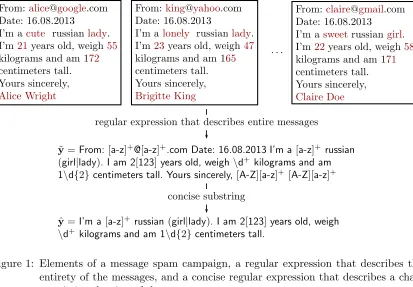
From: [email protected] Date: 16.08.2013
I’m acute russianlady. I’m21years old, weigh55
kilograms and am 172
centimeters tall. Yours sincerely,
Alice Wright
From: [email protected] Date: 16.08.2013
I’m alonely russianlady. I’m23years old, weigh47
kilograms and am 165
centimeters tall. Yours sincerely,
Brigitte King
. . .
From:[email protected] Date: 16.08.2013 I’m asweetrussian girl. I’m22years old, weigh58
kilograms and am 171
centimeters tall. Yours sincerely,
Claire Doe
regular expression that describes entire messages
˜
y= From: [a-z]+@[a-z]+.com Date: 16.08.2013 I’m a [a-z]+ russian
(girl|lady). I am 2[123]years old, weigh\d+kilograms and am
1\d{2}centimeters tall. Yours sincerely,[A-Z][a-z]+ [A-Z][a-z]+
concise substring
ˆ
y= I’m a[a-z]+ russian(girl|lady). I am 2[123] years old, weigh \d+ kilograms and am 1\d{2}centimeters tall.
Figure 1: Elements of a message spam campaign, a regular expression that describes the entirety of the messages, and a concise regular expression that describes a char-acteristic substring of the messages.
Regular expressions are a standard tool for specifying simple grammars. Widely avail-able tools match strings against regular expressions efficiently and can be used conveniently from scripting languages. A regular expression can be translated into a deterministic finite automaton that accepts the language and has an execution time linear in the length of the input string.
a more concise regular expression that characterizes a characteristic substring, and that a postmaster has selected to blacklist the corresponding email campaign.
This paper extends a conference publication (Prasse et al., 2012) that addresses this problem setting with linear models and structured output spaces. In the decoding step, a set of strings is given and the space of all regular expressions has to be searched for an element that maximizes the decision function. Since this space is very large and difficult to search, the approach of Prasse et al. (2012) is constrained to finding specializations of an approximate maximal alignment of all strings. The maximal alignment is a regular expression that contains all character sequences which occur in each of the strings, and uses wildcards wherever there are differences between the strings.
The maximal alignment is extremely specific. By constraining the output to special-izations of the alignment, the method keeps the risk that any message which is not part of the same campaign is accidentally matched at a minimum. However, since all special-izations of this alignment describe the entire length of the strings, the method produces regular expressions that tend to be much longer than the more concise expressions that postmasters prefer. Also, as a consequence of their greater length, the finite state automata which correspond to these expressions tend to have more states, which limits the number of regular expressions that can be matched in parallel against incoming new messages. This paper therefore extends the method by including a mechanism which learns to select ex-pressions that describe only the most characteristic part of the mailing campaign, using regular expressions written by an expert postmaster as training data.
The rest of this paper is structured as follows. Section 2 reviews regular expressions before Section 3 states the problem setting. Section 4 introduces the feature representations and derives the decoders and the optimization problems. In Section 5, we discuss our findings from a case study with an email service. Section 6 discusses related work and Section 7 concludes.
2. Regular Expressions
Before we formulate the problem setting, let us briefly revisit the syntax and semantics of regular expressions. Regular expressions are a popular syntactic convention for the definition of regular languages. Syntactically, a regular expression y ∈ YΣ is either a character from an alphabet Σ, or it is an expression in which an operator is applied to one or several argument expressions. Basic operators are the concatenation (e.g., “abc”), disjunction (e.g., “a|b”), and the Kleene star (“∗”), written in postfix notation (“(abc)∗”), that accepts any number of repetitions of its preceding argument expression. Parentheses define the syntactic structure of the expression. For better readability, several shorthands are used, which can be defined in terms of the basic operators. For instance, the any character symbol (“.”) abbreviates the disjunction of all characters in Σ, square brackets accept the disjunction of all characters (e.g., “[abc]”) or ranges (e.g., “[a-z0-9]”) that are included. For instance, the regular expression [a-z0-9] accepts all lower-case letters and digits. The postfix operator “+” accepts an arbitrary, positive number of reiterations of the
characters, which can occur in a URL. A formal definition of the set of regular expressions can be found in Definition 3 in the appendix.
The set of all regular expressions can be described by a context-free language. The syntactic structure of a regular expressionyis typically represented by itssyntax treeTsyny = (Vsyny , Esyny ,Γysyn,≤ysyn). Definition 4 in the appendix assigns one such tree to each regular expression. Each node v ∈Vsyny of this syntax tree is tagged by a labeling function Γysyn :
Vsyny → YΣ with a subexpression Γysyn(v) =yj. The edges (v, v0)∈Esyny indicate that node
v0 represents an argument expression of v. Relation ≤ysyn⊆Vsyny ×Vsyny defines an ordering on the nodes and identifies the root node. Note that the root node is labeled with the entire regular expressiony.
A regular expression y defines a regular languageL(y). Given the regular expression, a deterministic finite state machine can decide whether a stringx is in L(y) in time linear in|x|(Dub´e and Feeley, 2000). The trace of verification is typically represented as aparse tree Tpary,x = (Vpary,x, Epary,x,Γypar,x,≤ypar), describing how the string,x x can be derived from the regular expression y. At least one parse tree exists if and only if the string is an element of the language L(y); in this case, y is said to generatex. Multiple parse trees can exist for one regular expression y and a string x. Nodes v ∈ Vsyny of the syntax tree generate the nodes of the parse tree v0 ∈ Vpary,x, where nodes of the syntax tree may spawn none (alternatives which are not used to generate a string), one, or several (“loopy” syntactic elements such as “∗” or “+”) nodes in the parse tree. In analogy to the syntax trees, the
labeling function Γypar,x :Vpary,x → YΣ assigns a subexpression to each node, and the relation ≤ypar,x⊆ Vpary,x×Vpary,x defines the ordering of sibling nodes. The set of all parse trees for a regular expressionyand a stringxis denoted byTpary,x. When multiple parse trees exist for a regular expression and a string, a canonical parse tree can be selected by choosing the
left-most parse. Standard tools for regular expressions typically follow this convention and generate the left-most parse tree. Definition 5 in the appendix gives a formal definition.
Γy
syn(v0) = [b0-9]{2}c(aa|b)∗
Γy
syn(v1) = [b0-9]{2}
Γy
syn(v2) = [b0-9]
Γy
syn(v3) =b Γysyn(v4) =0-9
Γy
syn(v5) =c Γysyn(v6) = (aa|b)∗
Γy
syn(v7) =aa|b
Γy syn(v8) =aa
Γy
syn(v9) =a Γysyn(v10) =a
Γy syn(v11) =b
(a) Syntax treeTsyny
Γy,x
par(v′0) = [b0-9]{2}c(aa|b)∗
Γy,x
par(v′1) = [b0-9]{2} Γy,x
par(v′2) = [b0-9] Γy,x
par(v′3) =0-9 Γy,x
par(v′4) =1
Γy,x
par(v′5) = [b0-9] Γy,x
par(v′6) =b Γy,x
par(v7′) =c Γpary,x(v′8) = (aa|b)∗ Γy,x
par(v′9) =ǫ
(b) Parse treeTpary,x
Figure 2: Syntax tree (a) and a parse tree (b) for the regular expression y = [b0-9]{2}c(aa|b)∗ and the stringx=1bc.
labels of nodes which are visited on the path from the root to the thei-th character ofxin the parse tree Tpary,x.
Figure 2 (left) shows an example of a syntax tree Tsyny for the regular expression y = [b0-9]{2}c(aa|b)∗. One corresponding parse treeTpary,xfor the string x=1bcis illustrated in Figure 2 (right). The setTpary,x|2 contains nodes v00, v01, v50, and v60.
Finally, we introduce the concept of a matching list. When a regular expression y
generates a set xof strings, and v∈Vsyny is an arbitrary node of the syntax tree ofy, then the matching list My,x(v) characterizes which substrings of the strings in x are generated
by the nodev of the syntax tree, and thus generated by the subexpression Γysyn(v). A node
v of the syntax tree generates a substringx0 of x∈x, if v generates a nodev0 in the parse tree Tpary,x of x, and there is a path from v0 in that parse tree to every character in the substring x0. In the above example, for the set of strings x = {12c,b4ca}, the matching
list for node v1 that represents subexpression Γysyn(v1) = [b0-9]{2} is My,x(v2) ={12,b4}.
Definition 5 in the appendix introduces matching lists more formally.
3. Problem Setting
Having established the syntax and semantics of regular expressions, we now define our problem setting. An unknown distribution p(x,y) generates regular expressions y ∈ YΣ
from the alphabet Σ and batchesxof stringsx∈xthat are elements of the languageL(y). In our motivating application, the strings x are messages that belong to one particular mailing campaign and have been sampled from a bot net, and theyare regular expressions which an expert postmaster believes to identify the campaign template, and feels highly confident to blacklist.
A w-parameterized predictive model fw : x×yˆ 7→ R maps a batch of strings and a regular expression ˆy to a value of the decision function. We refer to the process of inferring the ˆy that attains the highest scorefw(x,yˆ) for a given batch of stringsx asdecoding; in
this step, a decision function is maximized over ˆywhich generally involves a search over the space of all regular expressions.
A loss function ∆(y,yˆ,x) quantifies the difference between the true and predicted ex-pressions. While it would, in principle, be possible to use the zero-one loss ∆0/1(y,yˆ,x) =
Jy= ˆyK, this loss function would treat nearly-identical expressions and very dissimilar ex-pressions alike. We will later engineer a loss function whose gradient will guide the learner towards expressions ˆy that are more similar to the correct expressiony.
In the learning step, the ultimate goal is to identify parameters that minimize the risk— the expected loss—under the unknown distributionp(x,y):
R[fw] =
ZZ
∆ y,arg max
ˆ y∈YΣ
fw(x,yˆ),x
!
p(x,y)dxdy.
the margin-rescaling approach (Tsochantaridis et al., 2005), with added regularization term Ω(w):
ˆ
R[fw] =
1
m
m
X
i=1
max
¯
y {fw(xi,y¯)−fw(xi,yi) + ∆(y,y¯,xi),0}+ Ω(w). (1)
This problem setting differs fundamentally from traditional language identification settings. In our setting, the actual identification of a language from example strings takes place in the decoding step. In this step, the decoder searches the space of regular expressions. But instead of retrieving an expression that generates all strings in x, it searches for an ex-pression that maximizes the value of aw-parameterized decision function that receives the strings and the candidate expression as arguments. In a separate learning step, the param-etersw are optimized using batches of strings and corresponding regular expressions. The training process has to optimize the model parameterswsuch that the expected deviation between the decoder’s output and a regular expression written by a human postmaster is minimized. Training data of this form, and an optimization criterion that measures the expected discrepancy between the conjectured regular expressions and regular expressions written by a human labeler, are not part of traditional language identification settings.
4. Identifying Regular Expressions
This section details our approach to identifying regular expressions based on generalized linear models and structured output spaces.
4.1 Problem Decomposition
Without any approximations, the decoding problem—the problem of identifying the regular expression ythat maximizes the parametric decision function—is insurmountable. For any string, an exponential number of matching regular expressions of up to the same length can be constructed by substituting constant symbols for wildcards. In addition, constant symbols can be replaced by disjunctions and “loopy” syntactic elements can be added to create infinitely many longer regular expressions that also match the original string. Because the space of regular expressions is discrete, it also does not lend itself well to approaches based on gradient descent.
We decompose the problem into two more strongly constrained learning problems. We decompose the parameters w = (u v)T and the loss function ∆ = ∆
u + ∆v into parts
that are minimized sequentially. In the first step, u-parameterized model fu produces a
regular expression ˜ythat is constrained to being a specialization of the maximal alignment of the strings in x. Specializations of maximal alignments of the strings in x tend to be long regular expressions that characterize the entirety of the strings in x. In a second step,
v-parameterized model fv therefore produces a concise substring ˆyof ˜y.
A specialization of an alignment is a string that has been derived from an alignment by replacing one or several wildcard symbols by another regular expression. Figure 3 illustrates the process of generating a maximal alignment, and the subsequent step of specializing it.
I’m a cute russian lady. I’m 21 years old. I’m a lonely russian lady. I’m 23 years old.
..
.
I’m a sweet russian girl. I’m 22 years old.
elements of message campaign
maximal alignment
I’m a (.∗) russian (.∗). I’m 2(.∗) years old.
specializations of maximal alignment
I’m a [a-z]{4,6}russian (girl|lady). I’m 2[123] years old. I’m a [a-z]+ russian [a-z]+. I’m 2[0-9] years old.
..
.
I’m a [a-z]∗ russian [adgilry]+. I’m 2[0-9]+years old.
Figure 3: Examples of regular expressions, which are specializations of a maximal alignment of strings.
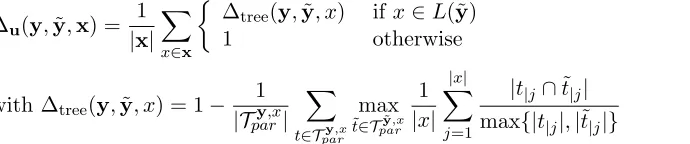
The loss function for this step should measure the semantic and syntactic deviation between the conjecture ˜yand the manually writtenyfor batchx. We define a loss function ∆u(y,y˜,x) that compares the set of parse trees inTpary,x, for each string x ∈x to the most similar tree in Tpary˜,x; if no such parse tree exists, the summand is defined as |x1| (Equation 2). Similarly to a loss function for hierarchical classification (Cesa-Bianchi et al., 2006), the difference of two parse trees for a given string x is quantified by a comparison of the paths that lead to the characters of the string. Two paths are compared by means of the intersection of their nodes (Equation 3). This loss is bounded between zero and one; it is zero if and only if the two regular expressions ˜y and yare equal:
∆u(y,y˜,x) =
1
|x|
X
x∈x
∆tree(y,y˜, x) ifx∈L(˜y)
1 otherwise (2)
with ∆tree(y,y˜, x) = 1−
1
|Tpary,x|
X
t∈Tpary,x
max
˜
t∈Tpar˜y,x
1
|x| |x|
X
j=1
|t|j∩˜t|j| max{|t|j|,|˜t|j|}
(3)
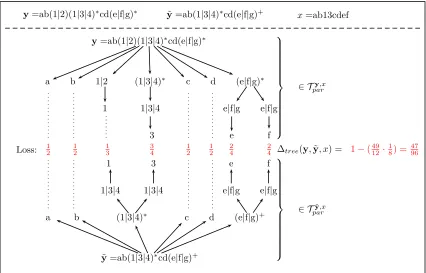
Figure 4 illustrates how the tree loss is calculated for a single string: for each symbol, the corresponding paths of the syntax trees spawned byy and ˜y are compared. Each pair of corresponding paths incurs a loss according to the proportion of nodes that are labeled with differing subexpressions.
y=ab(1|2)(1|3|4)∗cd(e|f|g)∗
a b 1|2
1
(1|3|4)∗
1|3|4
3
c d (e|f|g)∗
e|f|g
e
e|f|g
f
˜
y=ab(1|3|4)∗cd(e|f|g)+
a b (1|3|4)∗
1|3|4 1
1|3|4 3
c d (e|f|g)+
e|f|g e
e|f|g f
y=ab(1|2)(1|3|4)∗cd(e|f|g)∗ y˜=ab(1|3|4)∗cd(e|f|g)+ x=ab13cdef
Loss: 12 12 13 34 12 12 24 24 ∆tree(y,y˜, x) = 1−(4912·18) = 4796
∈ Ty,x par
∈ Ty˜,x par
Figure 4: Calculation of the tree loss ∆tree(y,y˜, x) for a given string x and two regular expressionsy and ˜y.
a regular expression ˆy ∈ YΣ that is a subexpression of ˜y; that is, ˜y = ypreyyˆ suf with ypre,ysuf ∈ YΣ. Loss function ∆v(y,yˆ) is based on the length of the longest common
sub-string lcs(y,yˆ) ofyand ˆy. The loss—defined in Equation 4—is zero, if the longest common substring of yand ˆy is equal to bothy and ˆy. In this case, y= ˆy. Otherwise, it increases as the longest common substring ofy and ˆydecreases:
∆v(y,yˆ) =
1 2
"
|y| − |lcs(y,yˆ)|
|y|
+ |yˆ| − |lcs(y,yˆ)|
|yˆ|
!#
. (4)
In the following subsections, we derive decoders and optimization problems for these two subproblems.
4.2 Learning to Generate Regular Expressions
We modelfu as a linear discriminant functionuTΨu(x,y) for a joint feature representation
of the inputx and outputy (Tsochantaridis et al., 2005):
˜
y= arg max
y∈YΣ
fu(x,y) = arg max y∈YΣ
uTΨ
4.2.1 Joint Feature Representation for Generating Regular Expressions
The joint feature representation Ψu(x,y) captures structural properties of an expressiony
and joint properties of input batchx and regular expressiony.
It captures structural properties of a regular expression y by features that indicate a specific nesting of regular expression operators—for instance, whether a concatenation occurs within a disjunction. More formally, we first define a binary vector
Λu(y) =
Jy=y1. . .ykK Jy=y1|. . .|ykK Jy= [y1. . .yk]K
Jy=y1∗K Jy=y1?K
Jy=y
+ 1K Jy=y1{l}K Jy=y1{l, u}K
Jy=r1K
.. .
Jy=rlK Jy∈ΣK Jy=K
(5)
that encodes the top-level operator used in the regular expression y, where J·K is the indicator function of its Boolean argument. In Equation 5, y1, . . . ,yk ∈ YΣ are regular expressions, l, u ∈ N, and {r1, . . . , rl} is a set of ranges and popular macros. For our ap-plication, we use the set{0-9,a-f,a-z,A-F,A-Z,\S,\e,\d,“.”} (see Table 6 in the appendix) because these are frequently used by postmasters.
For any two nodes v0 and v00 in the syntax tree of y that are connected by an edge—
indicating that y00 = Γysyn(v00) is an argument subexpression of y0 = Γysyn(v0)—the tensor product Λu(y0)⊗Λu(y00) defines a binary vector that encodes the specific nesting of operators
at node v0. Feature vector Ψ
u(x,y) will aggregate these vectors over all pairs of adjacent
nodes in the syntax tree ofy.
Joint properties of an input batch xand a regular expressiony are encoded in a similar way as follows. Recall that for any node v0 in the syntax tree, My,x(v0) denotes the set
of substrings inx that are generated by the subexpressiony0 = Γysyn(v0) that v0 is labeled with. We define a vector Φu(My,x(v0)) of attributes of this set. Any property may be
accounted for; for our application, we include the average string length, the inclusion of the empty string, the proportion of capital letters, and many other attributes. The list of attributes used in our experiments is included in the appendix in Table 3. A joint encoding of properties of the subexpressiony0 and the set of substrings generated by y0 is given by
the tensor product Φu(My,x(v0))⊗Λu(y0).
The joint feature vector Ψu(x,y) is obtained by aggregating operator-nesting
informa-tion over all edges in the syntax tree, and joint properties of subexpressionsy0 and the set
of substrings which they generate over all nodes in the syntax tree:
Ψu(x,y) =
P
(v0,v00)∈Ey
synΛu(Γ
y
syn(v0))⊗Λ
u(Γysyn(v00))
P
v0∈Vy
synΦu(M
y,x(v0))
⊗Λu(Γysyn(v0))
!
4.2.2 Decoding Specializations of the Maximal Alignment
At application time, the highest-scoring regular expression ˜y according to modelfu has to
be decoded. Modelfuis constrained to producing specializations of the maximal alignment;
however, searching the space of all possible specializations of the maximal alignment is still not feasible. The following observation illustrates that fu may not even have a maximum,
because there may always be a longer expression that attains a higher score.
Observation 1 Given a stringa that contains at least one wildcard symbol “(.∗)”, let Ya be the set of all specializations that replace wildcards in a by any regular expression in Y. Then, there are parameters u such that for each y there is ay0∈ Y
a with fu(y0)> fu(y).
Proof Joint feature vector Ψ from Equation 6 contains two parts. The first part contains operator-nesting information over all edges in the syntax tree and the second part contains joint properties of subexpressions and the set of substrings which they generate over all nodes in the syntax tree. We constructuas follows: Let all weights inube zero, except for the entry which weights the count of alternatives within an alternative; this entry receives any positive weight. For any string athat contains a wildcard symbol, by substituting the wildcard for an alternative of a wildcard and arbitrarily many other subexpressions, one can create a string a0 that contains a wildcard within an additional alternative. Repeated
application of this substitution creates arbitrarily many alternatives within alternatives and the inner product of u and Ψu can therefore become arbitrarily large.
Observation 1 implies that exact decoding of arbitrary decision functions fu is not
possible. However, we can follow theunder-generating principle (Finley and Joachims, 2008) and employ a decoder that maximizesfu over a constrained subspace that has a maximum.
Observation 1 implies that the decision-function value of that maximum over the constrained space may be arbitrarily much lower than the decision-function value of some elements of the unconstrained space. But when it comes to formulating the optimization problem in Subsection 4.2.3, we will require that, for each training example, the training regular expression shall have a higher decision function value (by some margin) than the highest-scoring incorrect regular expression that is actually found by the decoder. Hence, despite Observation 1, the learning problem may produce parameters which let the constrained decoder produce the desired output.
regular expressions over constant symbols that occur in the strings inxat the corresponding positions.
The definition of the constrained search space is guided by an analysis of the syntactic variants and maximum nesting depth observed in expressions written by postmasters—a detailed record can be found in the appendix; see Tables 6, 7, and 8. The space contains all specializations of the maximal alignment in which the j-th wildcard is replaced by any element from ˆYMj
D , which is constructed as follows. Firstly, ˆY Mj
D contains any subexpression that occurs within any training regular expression, and that matches the substrings of input xwhich the alignment procedure has substituted for the j-th wildcard. In addition, the alternative of all substring aligned at the j-th wildcard symbol is added. For each character-alternative expression in that set—e.g., [abc]—all possible iterators and range generalizations used by postmasters are added.
Given an alignment ax = a0(.∗)a1. . .(.∗)an of all strings in x, the constrained search space
ˆ
Yx,D={a0y1a1. . .ynan|for all j:yj ∈Yˆ Mj
D } (7)
contains all specializations of ax in which the j-th wildcard symbol is replaced by any
element of a set ˆYMj
D , whereMj is the matching list of thej-th node inTsynax that is labeled with the wildcard symbol “(.∗)”. The sets ˆYMj
D are constructed using Algorithm 1. Each of the lines 7, 9, 10, 11, and 12 of Algorithm 1 adds at most one element to ˆYMj
D and
thus Algorithm 1 generates a finite set of possible regular expressions—hence, the search space of possible substitutions for each of thenwildcard symbols is linear in the number of subexpressions that occur in the training sample.
We now turn towards the problem of determining the highest-scoring regular expres-sion fw(x). Maximization over all regular expressions is approximated by maximization
over the space defined by Equation 7:
arg max
y∈YΣ
uTΨu(x,y)≈arg max y∈Yˆx,D
uTΨu(x,y).
Due to the simple syntactic structure of the alignment and the definition of Ψu we can
state the following theorem:
Theorem 2 The maximization problem of finding the highest-scoring regular expres-sion fu(x) can be decomposed into independent maximization problems for each of the yj
that replaces the j-th wildcard in the alignment ax, given the alignment and the definition of Ψu:
arg max
y1,...,yn
fu(x, a0y1a1. . .ynan) =a0y∗1a1. . .y∗nan
withyj∗= arg max
yj∈YˆDMj
uT Ψu(yj, Mj) +cyj
.
Algorithm 1 Constructing the decoding space
1: Input: SubexpressionsYD and alignment ax=a0(.∗)a1. . .(.∗)an of the strings inx. 2: let Tax
syn be the syntax tree of the alignment and v1, . . . , vn be the nodes labeled Γax
syn(vj) = “(.∗)”. 3: forj= 1. . . ndo 4: let Mj =Max,x(vj).
5: Initialize ˆYDMj to{y∈ YD|Mj ⊆L(y)}
6: let x1, . . . , xm be the elements ofMj; add (x1|. . .|xm) to ˆY Mj
D .
7: let u be the length of the longest string andl be the length of the shortest string in
Mj.
8: if[βy1. . .yk]∈YˆDMj, whereβ∈Σ∗ and y1. . .yk are ranges or special macros (e.g., a-z,\e), then add [αy1. . .yk] to ˆY
Mj
D , whereα∈Σ
∗ is the longest string that satisfies
Mj ⊆ L([αy1. . .yk]), if such anα exists. 9: for all[y]∈YˆDMj do
10: add [y]∗ and [y]{l, u} to ˆYDMj.
11: ifl=u, then add [y]{l} to ˆYDMj.
12: ifu≤1, then add [y]? to ˆYDMj.
13: ifl >0, then add [y]+ to ˆYDMj. 14: end for
15: end for
. . .
. . .
. . .
. . .
. . .
a
0,1. . . a
0,|a0|y
1. . .
y
na
n,1. . . a
n,|an|a
0,1a
0,|a0|y
1y
na
n,1a
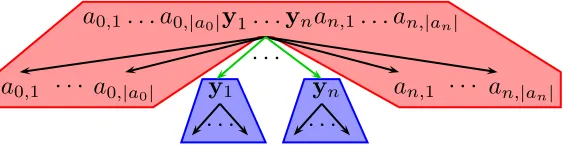
n,|an|Figure 5: Structure of a syntax tree for an element of ˆYx,D.
sum over pairs of adjacent nodes (see Equation 6). The syntax tree of an instantia-tiony=a0y1a1. . .ynanof the alignmentaxconsists of a root node labeled as an alternating
concatenation of constant strings aj and subexpressions yj (see Figure 5). This root node is connected to a layer on which constant stringsaj =aj,1. . . aj,|aj|and subtreesT
yj
syn alter-nate (blue area in Figure 5). However, the terms in Equation 8 that correspond to the root nodeyand theaj are constant for all values of theyj (red area in Figure 5). Since no edges connect multiple wildcards, the feature representation of these subtrees can be decomposed intonindependent summands as in Equation 9.
Ψu(x, a0y1a1. . .ynan) (8)
= n P j=1
Λu(y)⊗Λu(yj) +
n
P
j=0 |Paj|
q=1
Λu(y)⊗Λu(aj,q)
Φu({x})⊗Λc(y) +
n
P
j=0 |Paj|
q=1
Φu({aj,q})⊗Λu(aj,q)
+ n P j=1 P
(v0,v00)∈Eyj syn
Λu(Γ yj
syn(v0))⊗Λu(Γ yj
syn(v00))
n
P
j=1
P
v0∈Vyj syn
Φu(Myj,Mj(v0))⊗Λu(Γysyn(j v0))
= 0
Φu({x})⊗Λu(y)
+ n
X
j=0 |ai|
X
q=1
Λu(y)⊗Λu(aj,q) Φu({aj,q})⊗Λu(aj,q)
+ n X j=1
Ψu(yj, Mj) +
Λu(y)⊗Λu(yj)
0
(9)
Since the top-level operator of an alignment is a concatenation for any y ∈ Yˆx,D, we can write Λu(y) as a constant Λ•, defined as the output feature vector (Equation 5) of a
concatenation.
Thus, the maximization over all y =a0y1a1. . .ynan can be decomposed into n maxi-mization problems over
y∗j = arg max
yj∈YˆDMj uT
Ψu(yj, Mj) +
Λ•⊗Λu(yj)
0
4.2.3 Optimization Problem for Specializations of a Maximal Alignment
We will now address the process of minimizing the portion of the regularized empirical risk ˆR[fw], defined in Equation 1, that depends onufor the`2 regularizer Ωc(u) = 21C||u||2.
The decision functionfw decomposes intofu andfv; loss function ∆wdecomposes into ∆u
and ∆v. While loss function ∆u defined in Equation 2 is not convex itself, the hinged upper
bound used in Equation 1 is. Approximating a loss function by its hinged upper bound in such a way is referred to as margin-rescaling (Tsochantaridis et al., 2005). We define slack termξi as this hinged loss for instancei:
ξi= max
max
¯ y6=yi{
uT(Ψ
u(xi,y¯)−Ψu(xi,yi)) + ∆u(yi,y¯,x)},0
. (10)
The maximum in Equation 10 is over all ¯y ∈ YΣ\ {yi}. When the risk is rephrased as a constrained optimization problem, the maximum produces one constraint per element of ¯
y ∈ YΣ\ {yi}. However, since the decoder searches only the set ˆYxi,D, it is sufficient to
enforce the constraints on this subset which leads to a finite search space.
When the loss is replaced by its upper bound—the slack variable ξ—and for Ωu(u) = 1
2Cu||u||
2, the minimization of the regularized empirical risk (Equation 1) is reduced to
Optimization Problem 1.
Optimization Problem 1 Over parameters u, find
u∗ = arg min
u,ξ 1 2||u||
2+Cu
m
m
X
i=1
ξi, such that (11)
∀i,∀y¯ ∈Yˆxi,D\{yi}:u
T(Ψ
u(xi,yi)−Ψu(xi,y¯)) (12)
≥∆u(yi,y¯,x)−ξi,
This optimization problem is convex, since the objective (Equation 11) is convex and the constraints (Equation 12) are affine in u. Hence, the solution is unique and can be found efficiently by cutting plane methods as Pegasos (Shalev-Shwartz et al., 2011) or SVMstruct (Tsochantaridis et al., 2005).
These algorithms require to identify the constraint with highest slack variable ξi for a given xi,
¯
y= arg max
y∈Yˆxi,D\{yi}
uTΨu(xi,y) + ∆u(yi,y,x),
in the optimization procedure, repeatedly.
Algorithm 1 constructs the constrained search space ˆYxi,D such thatx∈L(y) for each x∈xi and y∈Yˆxi,D. Hence, the “otherwise”-case in Equation 2 never applies within our
Algorithm 2 Most strongly violated constraint 1: Inout: batchx, model fu, correct outputy.
2: Infer alignmentax=a0(.∗)a1. . .(.∗)an forx. 3: Let Tax
syn be the syntax tree of ax and let v1, . . . , vn be the nodes labeled Γasynx (vj) = “(.∗)”.
4: for allj= 1. . . n do
5: Let Mj =Max,x(vj) and calculate the ˆYDMj using Algorithm 1. 6:
¯
yj = arg max
y0j∈YˆDMj uT
Ψu(yj0, Mj) +
Λ•⊗Λu(y0j)
0
+
∆u(y, a0(.∗)a1. . .(.∗)aj−1y0jaj(.∗)aj+1. . .(.∗)an,x) 7: end for
8: Let ¯y abbreviatea0y1¯ a1. . .y¯nan 9: if y¯ =y then
10: Assign a value of ¯y0j ∈YˆDMj to one of the variables ¯yj such that the smallest decrease of fu(x,y¯) + ∆tree(y,y¯) is obtained but the constraint ¯y6=y is enforced.
11: end if 12: Output: y¯
4.3 Learning to Extract Concise Substrings
Modelfu generates regular expressions that tend to be very specific because they are
spe-cializations of a maximal alignment of all strings in the input set x. Human postmasters, by contrast, prefer to focus on only a characteristic part of the message for which they write a specific regular expression. In order to allow the overall modelfw to produce expressions
that characterize only a part of the strings, this section focuses on a second model,fv, that
selects a substring from its input string ˜y. We model fv as a linear discriminant function
with a joint feature representation Ψv of the input regular expression ˜y and the output
regular expression y; decision function fv is maximized over the set Π(˜y) of all substrings
of ˜ythat are themselves regular expressions:
ˆ
y= arg max
y∈Π(˜y)fv(˜y,y) = arg maxy∈Π(˜y)v
TΨ
v(˜y,y), (13)
with Π(˜y) ={yin∈ YΣ|y˜ =ypreyinysuf andypre,ysuf ∈ YΣ}.
4.3.1 Joint Feature Representation for Concise Substrings
The joint feature representation Ψv(˜y,y) captures structural and semantic features
Φinput(˜y) of the input regular expression ˜y, features Φoutput(y) of the output regular
ex-pressiony and all combinations of properties of the input and output expression.
Vector Φinput(˜y) of features of the input regular expression ˜y includes features that
Feature vector Φoutput(y) of the output regular expression y stacks up features which
indicate how many subexpressions and how many words are included in the regular expres-sion. In addition it contains features that test for special phrases that frequently occur in email batches and features that test whether words with a high spam score are included in the subject line. We identify this list of suspicious words by training a linear classifier that separates spam from non-spam emails; the list contains the 150 words which have the highest weights for the spam class. The list of features that we used in the experiments can be found in Table 5 in the appendix.
The final joint feature representation Ψv(˜y,y) is defined as vector that includes the
input features Φinput(˜y) , the output features Φoutput(y), and all products of an input and
an output feature:
Ψv(˜y,y) =
ΦΦoutputinput(˜(yy))
Φinput(˜y)⊗Φoutput(y)
. (14)
4.3.2 Decoding a Concise Regular Expression
At application time, the highest-scoring regular expression ˆy according to Equation 13 has to be identified. The search space Π(˜y) contains all substrings of ˜y; since ˜yis typically a very long string and calculating all features is an expensive operation, evaluating the decision function for all substrings is infeasible. Again, we follow the under-generating principle (Finley and Joachims, 2008) and constrain the search to the space Πs(˜y) contains regular expressions whose string length is at most s. Within this set, the decoder conducts an exhaustive search. One can easily observe that when the highest-scoring regular expression’s string length exceeds s, then the highest-scoring regular expression of size at most s can have an arbitrarily much lower decision function value.
Observation 2 Let yˆ = arg maxy∈Π(˜y)fv(˜y,y) and yˆs = arg maxy∈Π(˜y),|y|≤sfv(˜y,y). If |yˆ| > s, then for each number d, there is a parameter vector v such that fv(˜y,yˆ) >
fv(˜y,yˆs) +d.
Proof The output features of vector Ψv (Equation 14) include the number of constant
symbols and the number of non-constant subexpressions in output expression y. Let
v be all zero except for these two weights which we set to d + 1. Then fv(˜y,y) is
maximized by output ˆy = ˜y. If |yˆs| < |yˆ|, then ˆys is missing at least one initial or trailing constant or non-constant symbol. By the definition of v, decision function
fv(˜y,yˆ) =vTΨv(˜y,y)>vTΨv(˜y,ys) +d=fv(˜y,yˆs) +d.
Choosing too small a constant s can therefore lead to poor decoding results. In our experiments, we choose s to be greater than the longest regular expressions seen in the training data.
4.3.3 Optimization Problem for Concise Expressions
Training dataD={((xi,yi)}mi=1 for the overall learning problem consist of pairs of sets xi of strings and corresponding regular expressions yi. Model fu—discussed in Section 4.2—
model fv(˜yi) gives the final predictions ˆyi. Hence, training data for model fv naturally
consists of the pairs{(˜yi,yi)}mi=1.
We will now derive an optimization problem from the portions of Equation 1 that depend on v. Decision function fw decomposes into fu+fv; loss function ∆w into ∆u and ∆v.
The regularizer decomposes, and we use the `2 regularizer forv as well, Ωs(v) = 21C||v||2.
This leads to Optimization Problem 2.
Optimization Problem 2 Over parameters v, find
v∗= arg min
v,ξ 1 2||v||
2+Cv
m
m
X
i=1
ξi, such that
∀i,∀y¯ ∈Πs(yi)\{yi}:vT(Ψv(˜yi,yi)−Ψs(˜yi,y¯))
≥∆v(¯y,yi)−ξi,
∀i:ξi≥0.
Optimization Problem 2 minimizes the regularized empirical risk under the assumption that the decoder uses the restricted search space Πs(˜y) for some fixed value of the maximal string lengths. We refer to the complete model
ˆ
y= arg max
y∈Π(˜y)v
TΨ
v(˜y,y),
with ˜y=a0y∗1a1. . .yn∗an and y∗j = arg max
yj∈YˆDMj
uT Ψu(yj, Mj) + Λ•⊗Λu(yj)
for predicting concise regular expressions as REx-SVMshort.
5. Case Study
We investigate whether postmasters accept the output ofREx-SVM andREx-SVMshortfor blacklisting mailing campaigns during regular operations of a commercial email service. We also evaluate how accurately REx-SVM and REx-SVMshort and their reference methods identify the extensions of mailing campaigns.
In order to obtain training data for the model fu that generates a regular expression
from an input batch of strings, we apply the Bayesian clustering technique of Haider and Scheffer (2009) to the stream of messages that arrive at an email service during its regular operations; the method identifies 158 mailing campaigns with a total of 12,763 messages. Postmasters of the email service write regular expressions for each batch in order to blacklist the mailing campaign; these expressions serve as labels. We will refer to this data collection as theESP data set.
In order to obtain additional training data for the model fv that selects a concise
and the postmaster-written expressionyas the label. We train a first-stage modelfu on the
158 labeled batches after tuning regularization parameterCu with 10-fold cross validation.
We tune the regularization parameter Cv using leave-one-out cross validation and train a
global model fv that is used in the following experiments.
5.1 Evaluation by Postmasters
Please send the request to my email (simon|george)@(gmail|yahoo).com
... This work takes[0-9-]+hours per
week and requires absolutely no in-vestment. The essence of this work for incoming client requests in your ci-ty. The starting salary is about[0-9]+
EUR per month + bonuses. ...
Please send the request to my email
[a-z]+@(gmail|yahoo).com and I will
answer you personally as soon as pos-sible ...
Please send the request to my email
[a-z]+@(gmail|yahoo).com and I will
answer you personally as soon as pos-sible
Email:wester (payin|pay)@yahoo.com Yours sincerely,
Mr[A-Z][a-z]+[A-Z][a-z]+
... agreed that the sum of US$[0-9,]+
should be transferred to you out of the funds that Federal Government of Nigeria has set aside as a compensation to eve-ryone who have by one way or the other sent money to fraudsters in Nigeria. ...
Email:wester (payin|pay)@yahoo.com Yours sincerely,
Mr[A-Za-z]+[A-Za-z]+...
Email:wester (payin|pay)@yahoo.com Yours sincerely, Mr[A-Za-z]+[A-Za-z]+
(Reply-To|From):(mosk@aven|sevid@donald).com Subject: GET YOUR MONEY
...
(Reply-To|From):(mosk@aven|sevid@donald).com Subject: GET YOUR MONEY
...
I am Mr. Sopha Chum, An Auditing and accoun-ting section staff in National Bank of Cambodia. ...
(Reply-To|From):(mosk@aven|sevid@donald).com Subject: GET YOUR MONEY
P os tm as te r R E x -S V M R E x -S V M s h o r t
Campaign 1 Campaign 2 Campaign 3
Figure 6: Regular expressions created by a postmaster and corresponding output of REx-SVM and REx-SVMshort.
The trained model fu is deployed; the user interface presents newly detected batches
together with the regular expressionsfu(x) generated byREx-SVM and expressionsfw(x)
generated by REx-SVMshort to the postmasters during regular operations of the email service. The postmasters are charged with blacklisting the campaigns with a suitable regular expression. We measure how frequently the postmasters copy the output ofREx-SVMshort, copy a substring from the output ofREx-SVM, copy but edit an output, and how frequently they choose to write an expression from scratch.
Over the course of this study, the postmasters write 153 regular expressions. They copy the exact regular expressions generated by REx-SVMshort in 64.7% of the cases. Another 14.4% of the time, they copy a substring from the output ofREx-SVM and use it without changes. In 7.8% of the cases, the postmasters copy and edit a substring from REx-SVM, and in 13.1% of the cases they write an expression from scratch. Hence, tasked with producing a regular expression that will block the mailing campaign during live operations, the postmasters prefer working with the automatically generated output to writing an expression from scratch 86.9% of the time.
the postmaster prefers to select. Nevertheless, all three regular expressions characterize the extension of the mailing campaign accurately. In the second example,REx-SVM finds a slightly shorter but slightly more general expression for the closing signature (the term “[A-Za-z]+” would allow for capital letters within the name while the term “[A-Z][a-z]+”
does not). The second-stage modelfv has selected the same substring that the postmaster
prefers. In the third example, postmaster andREx-SVMshort agree perfectly.
The fact that postmasters are content to accept generated regular expression does not imply that they would have written the exact same rules. We now want to explore how frequentlyREx-SVMshort is able to produce the same regular expression that postmasters would have written. We execute leave-one-out cross validation over the regular expressions in the ESP data set. In each iteration, a new model fu is trained on all but one regular
expressions (modelfv is only trained once on different data).
We compare the output of REx-SVMshort to the held-out expression. We find that in 59.49% (94) of the cases, REx-SVMshort generates the exact regular expression written by the postmaster; in 11.39% (18) of the cases the held-out expression is a substring of the regular expression created by REx-SVM but distinct to the extracted expression found by REx-SVMshort. In 8.86% (14) of the cases the held-out regular expression can be obtained by modifying a substring of the string created by REx-SVM. In 20.25% (32) of the cases, generated and manually-written regular expression are distinct. These rates are consistent with the acceptance rates of the postmasters. When manually written and automatically generated regular expressions differ from each other, both expressions may still serve their purpose of filtering a particular batch of emails. We will explore to which extent this is the case in the next subsection.
5.2 Spam Filtering Performance
We evaluate the ability ofREx-SVM,REx-SVMshort, and reference methods to identify the exact extension of email spam campaigns. We use the approximately maximalalignment of the strings determined by sequential alignment in a batchx as a reference method. Here, the ReLIE method (Li et al., 2008) serves as an additional reference. ReLIE takes the alignment as starting point of its search for a regular expression that matches the emails in the input batch and does not match any of the additional negative examples by applying a set of transformation rules. ReLIE receives an additional 10,000 emails that are not part of any batch as negative data, which gives it a small data advantage over REx-SVM and REx-SVMshort. REx
0/1-SVM is a variant of the REx-SVM that uses the zero-one loss
instead of the loss function ∆u defined in Equation 2. An additional content-based filter
employed by the provider has been trained on several million spam and non-spam emails.
Additionally, we use a public data set that consists of 100 batches of emails extracted from the Bruce Guenther archive1, containing a total of 63,512 emails. To measure false-positive rates on this public data set, we use 17,419 non-spam emails from theEnron corpus2
and 76,466 non-spam emails of theTREC corpus3. The public data set is available to other researchers.
Experiments on the ESP data set are conducted as follows. We employ a constant model of fv, trained on 478 pairs of predicted expressions ˜y and postmaster-written expressions y. We first carry out a “leave-one-batch-out” cross-validation loop over the 158 labeled batches of the ESP data set. In each iteration, 157 batches are reserved for training of
fu. On this training portion of the data, regularization parameterCu is tuned in a nested
10-fold cross validation loop, then a model is trained on all 157 training batches. An inner loop then iterates over the size of the input batch. For each size |x|, messages from the held-out batch are drawn intoxat random and a regular expression ˆy=fw(x) is generated.
The remaining elements of the held-out batch are used to to measure the true-positive rate of ˆy, and the 135,000 non-spam emails are used to determine its false-positive rate. After that, a model is trained on all 158 labeled batches, and the evaluation iterates over the remaining 42 batches that are not labeled with a postmaster-written regular expression. For each value of|x|, an inputxis drawn, a prediction ˆyis generated, its true-positive rate is measured on the remaining elements of the current batch and its false-positive rate on the 135,000 non-spam messages. Standard errors are computed based on all 200 observations.
For evaluation on the public data set, parameterCuis tuned with 10-fold cross validation
and then a model is trained on all 158 labeled batches of the ESP data set. The evaluation iterates over all 100 batches of the public data set and, in an inner loop, over values of
|x|. An input set x is drawn at random from the current batch, the true-positive rate of ˆ
y=fw(x) is measured on the remaining elements of the current batch and the false-positive
rate of ˆy is measured on the Enron and TREC emails.
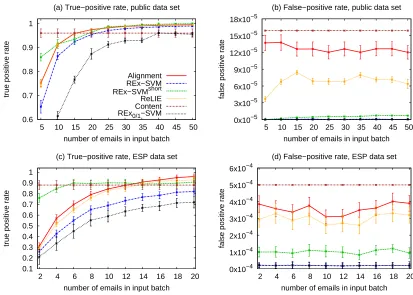
Figure 7 shows the true- and false-positive rates for all methods on both data sets. The horizontal axis displays the number of emails in the input batch x. Error bars indicate the standard error. The true-positive rate measures the proportion of a batch that is recognized while the false-positive rate counts emails that match a regular expression although they are not an element of the corresponding campaign. Thealignmenthas the highest true-positive rate and a high false-positive rate because it is the most general bound of the decoder’s search space. ReLIE only has to carry out very few transformation steps until no negative examples are covered—in some cases none at all. Consequently, it has similarly high true-and false-positive rates. REx-SVM and REx-SVMshort attain a slightly lower true-positive rate, and a substantially lower false-positive rate. The false-positive rates of REx-SVM, REx0/1-SVM, and REx-SVMshort lie more than an order of magnitude below the rate of
the commercial content-based spam filter employed by the email service provider. The zero-one loss leads to comparable false-positive but lower true-positive rates, rendering the loss function ∆u preferable to the zero-one loss. The true-positive rate of REx-SVMshort
is significantly higher than the true-positive rate ofREx-SVM for small sizes of the input batch; it requires only very few input strings in order to generate regular expressions which
1.http://untroubled.org/spam/
0.6 0.7 0.8 0.9 1
5 10 15 20 25 30 35 40 45 50
true positive rate
number of emails in input batch (a) True−positive rate, public data set
Alignment REx−SVM REx−SVMshort ReLIE Content REx0/1−SVM
0x10−5 3x10⁻⁵ 6x10⁻⁵ 9x10⁻⁵ 12x10−5 15x10−5 18x10−5
5 10 15 20 25 30 35 40 45 50
false positive rate
number of emails in input batch (b) False−positive rate, public data set
0.1 0.2 0.3 0.4 0.5 0.6 0.7 0.8 0.9 1
2 4 6 8 10 12 14 16 18 20
true positive rate
number of emails in input batch (c) True−positive rate, ESP data set
0x10−4 1x10⁻⁴ 2x10⁻⁴ 3x10⁻⁴ 4x10⁻⁴ 5x10⁻⁴ 6x10⁻⁴
2 4 6 8 10 12 14 16 18 20
false positive rate
number of emails in input batch (d) False−positive rate, ESP data set
Figure 7: True-positive and false-positive rates over the number of used emails in the input batchxfor the public and ESP data sets.
can be used to describe nearly the entire extension of a batch at a very low false-positive rate.
Finally, we determine the risk of the studied methods producing a regular expression that causes at least one false-positive match of an email which does not belong to the batch. REx-SVM’s risk of producing a regular expression that incurs at least one false-positive match is 2.5%; forREx-SVMshort, this risk is 3.7%; foralignment, the risk is 6.3%, and for ReLIE, it is 5.1%.
5.3 Learning Curves, Execution Time
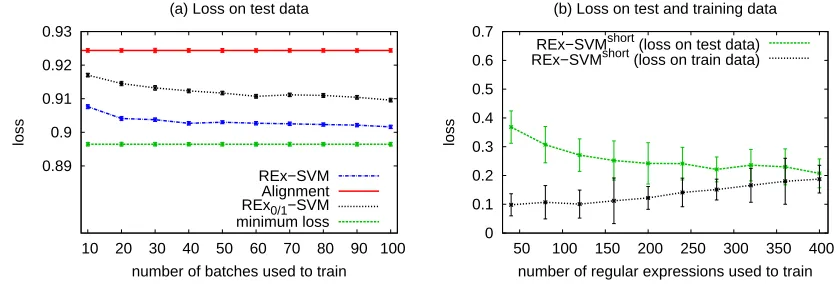
We study learning curves of the loss functions of REx-SVM and REx-SVMshort. Figure 8 (a) shows the average loss ∆u based on cross validation with one batch held out, as a
lower decision function value than the predicted regular expression; the difference between minimum loss and the loss ofREx-SVM and REx0/1-SVM, respectively, can be attributed
to imperfections of the model. Figure 8 (a) also shows the loss of the alignment. This loss serves as an upper bound and visualizes how much the parameterized models contribute to minimizing the error. For completeness, Figure 10 in the appendix shows the learning curves on the training data.
Figure 8 (b) shows the average loss ∆vbased on 10 fold cross validation and the average
loss on the training data. The impact of the regularization parametersCu and Cv is shown
in Figure 11 in the appendix.
0.89 0.9 0.91 0.92 0.93
10 20 30 40 50 60 70 80 90 100
loss
number of batches used to train (a) Loss on test data
REx−SVM Alignment REx0/1−SVM
minimum loss
0 0.1 0.2 0.3 0.4 0.5 0.6 0.7
50 100 150 200 250 300 350 400
loss
number of regular expressions used to train (b) Loss on test and training data
REx−SVMshort (loss on test data) REx−SVMshort (loss on train data)
Figure 8: (a) Loss ∆u of modelfu on the test data (left Figure). (b) Loss ∆v of modelfv
on the training and test data. Error bars indicate standard errors.
Table 5.3 measures how much REx-SVMshort reduces the length of the expressions produced by REx-SVM. We can conclude that REx-SVMshort reduces the length of the output ofREx-SVM by an average of 92%.
Method mean standard error
REx-SVM 2141 2063
REx-SVMshort 95 92
Table 1: Number of characters in automatically-generated regular expressions.
The execution time for learning is consistent with prior findings of between linear and quadratic for the SVM optimization process—see Figure 9(a). Figure 9 (b) shows the execution time of the decoder that generates a regular expression for input batch x at application time. ReLIE does not require training.
0 1000 2000 3000 4000 5000 6000 7000 8000
10 20 30 40 50 60 70 80 90 100
time in sec
number of batches (a) Execution time for training
REx−SVM REx−SVMshort Alignment REx0/1−SVM
ReLIE
1 2 3 4
2 4 6 8 10 12 14 16 18 20
time in sec
number of messages in the input batch (b) Execution time for decoding
Figure 9: Execution time for training a model (a) and decoding a regular expression at application time (b).
The automaton has to be kept in main memory, and therefore the number of states deter-mines the number of regular expressions that can be searched for in parallel. Table 2 shows the average number of states of an acceptor, generated by the method of Dub´e and Feeley (2000) from the regular expressions ofREx-SVM andREx-SVMshort. The average number of states of regular expressions by REx-SVMshort is close to the average number of states of expressions written by a human postmaster, while alignment, ReLIE, and REx-SVM require impractically large accepting automata.
Method mean median standard error
alignment 5709 4059 389.1
REx-SVM 5473 2995 520.8
ReLIE 5632 3587 465.9
REx-SVMshort 72 69 1.8
postmaster 68 48 4.6
Table 2: Number of states of an accepting finite-state automaton.
6. Related Work
Gold (1967) shows that it is impossible to exactly identify any regular language from finitely many positive examples. In his framework, a learner makes a conjecture after each new positive example; only finitely many initial conjectures may be incorrect. Our notion of minimizing an expected difference between conjecture and target language over a distribu-tion of input strings reflects a more statistically-inspired nodistribu-tion of learning. Also, in our problem setting the learner has access to pairs of sets of strings and corresponding regular expressions.
accepted by finite automata, the problems of learning regular languages and learning finite automata are tightly coupled. However, a compact regular language may have an accepting automaton with a large number of states and, analogously, transforming compact automata into regular expressions can lead to lengthy terms that do not lend themselves to human comprehension (Fernau, 2009).
Positive learnability results can be obtained for restricted classes of deterministic finite automata with positive examples (Angluin, 1978; Abe and Warmuth, 1990); for instance expressions in which each symbol occurs at mostktimes (Bex et al., 2008), disjunction-free expressions (Br¯azma, 1993), and disjunctions of left-aligned disjunction-free expressions (Fernau, 2009) have been studied. These approaches aim only at the identification of a target language. By contrast, here the structural resemblance of the conjecture to a target regular expression is integral part of the problem setting. This also makes it necessary to account for the broader syntactic spectrum of regular expressions.
Xie et al. (2008) use regular expressions to detect URLs in spam batches and develop a spam filter with low false-positive rate. The ReLIE-algorithm (Li et al., 2008) (used as a reference method in our experiments) learns regular expressions from positive and negative examples given an initial expression by applying a set of transformation rules as long as this improves the separation of positive and negative examples. Brauer et al. (2011) develop an algorithm that builds a data structure of commonalities of several aligned strings and transforms these strings into a specific regular expression. Because of a high data overhead, their algorithm works best for short strings, such as telephone numbers and names of software products.
Structured output spaces are a flexible tool for a wide array of problem settings, includ-ing sequence labelinclud-ing, sequence alignment, and natural language parsinclud-ing (Tsochantaridis et al., 2005). In our problem setting we are interested in predicting a structured object, i.e. a regular expression. To solve problems with structured output spaces an extension of the sup-port vector machines (SVMs, Vapnik, 1998) can be used. Such structural SVMs were used to solve a several number of prediction tasks ranging from classification with taxonomies, label sequence learning, sequence alignment to natural language parsing (Tsochantaridis et al., 2005). The problem of detecting message campaigns in the stream of emails has been addressed with structured output spaces based on manually grouped training mes-sages (Haider et al., 2007), and with graphical models without the need for labeled training data (Haider and Scheffer, 2009).
7. Conclusions
Complementing the language-identification paradigm, we address the problem of learning to map a set of strings to a concise regular expression that resembles an expression which a human would have written. Training data consists of batches of strings and correspond-ing regular expressions. We phrase this problem as a two-staged learncorrespond-ing problem with structured output spaces and engineer appropriate loss functions. We devise a first-stage decoder that searches a space of specializations of a maximal alignment of the input strings. We devise a second-stage decoder that searches for a substring of the first-stage result. We derive optimization problems for both stages.
From our case study, we conclude that REx-SVMshort frequently predicts the exact regular expression that a postmaster would have written. In other cases, it generates an expression that postmasters accept without or with small modifications. Regarding their accuracy for the problem of filtering email spam, we conclude that REx-SVM and REx-SVMshort give a high true-positive rate at a false-positive rate that is an order of magni-tude lower than that of a commercial content-based filter. REx-SVMshort attains a higher true-positive rate, in particular for small input batches. REx-SVMshort generates regular expressions that can be accepted by a finite-state automaton that has just slightly more states than an accepting automaton for regular expressions written by a human postmaster. REx-SVM and all reference methods, by contrast, can only be accepted by impractically large finite-state automata. REx-SVMshort is being used by a commercial email service provider and complements content-based and IP-address based filtering.
Acknowledgments
This work was funded by a grant from STRATO AG. We would like to thank the anonymous reviewers for their helpful comments.
References
N. Abe and M. K. Warmuth. On the computational complexity of approximating distribu-tions by probabilistic automata. In Proceedings of the Conference on Learning Theory, pages 52–66, 1990.
D. Angluin. On the complexity of minimum inference of regular sets. Information and Control, 39(3):337–350, 1978.
G. Bex, W. Gelade, F. Neven, and S. Vansummeren. Learning deterministic regular ex-pressions for the inference of schemas from XML data. InProceeding of the International World Wide Web Conference, pages 825–834, 2008.
A. Br¯azma. Efficient identification of regular expressions from representative examples. In
Proceedings of the Annual Conference on Computational Learning Theory, pages 236–242, 1993.
N. Cesa-Bianchi, C. Gentile, and L. Zaniboni. Incremental algorithms for hierarchical classification. Machine Learning, 7:31–54, 2006.
A. Clark and F. Thollard. PAC-learnability of probabilistic deterministic finite state au-tomata. Journal of Machine Learning Research, 5:473–497, 2004.
F. Denis. Learning regular languages from simple positive examples. Machine Learning, 44:27–66, 2001.
D. Dub´e and M. Feeley. Efficiently building a parse tree from a regular expression. Acta Informatica, 37(2):121–144, 2000.
H. Fernau. Algorithms for learning regular expressions from positive data. Information and Computation, 207(4):521–541, 2009.
T. Finley and T. Joachims. Training structural SVMs when exact inference is intractable. In Proceedings of the International Conference on Machine Learning, 2008.
E. M. Gold. Language identification in the limit. Information and Control, 10:447–474, 1967.
P. Haider and T. Scheffer. Bayesian clustering for email campaign detection. InProceedings of the International Conference on Machine Learning, 2009.
P. Haider, U. Brefeld, and T. Scheffer. Supervised clustering of streaming data for email batch detection. In Proceedings of the International Conference on Machine Learning, 2007.
D. Hirschberg. A linear space algorithm for computing maximal common subsequences.
Communications of the ACM, 18(6):341–343, 1975.
Y. Li, R. Krishnamurthy, S. Raghavan, S. Vaithyanathan, and H. V. Jagadish. Regular expression learning for information extraction. In Proceedings of the Conference on Em-pirical Methods in Natural Language Processing, pages 21–30, 2008.
R. Parekh and V. Honavar. Learning DFA from simple examples. Machine Learning, 44: 9–35, 2001.
P. Prasse, C. Sawade, N. Landwehr, and T. Scheffer. Learning to identify regular expressions that describe email campaigns. InProceedings of the International Conference on Machine Learning, 2012.
I. Tsochantaridis, T. Joachims, T. Hofmann, and Y. Altun. Large margin methods for structured and interdependent output variables. Journal of Machine Learning Research, 6:1453–1484, 2005.
V. Vapnik. Statistical Learning Theory. Wiley, 1998.
L. Wang and T. Jiang. On the complexity of multiple sequence alignment. Journal of Computational Biology, 1(4):337–348, 1994.
Appendix A
A.1 Syntax and Semantics of Regular Expressions
Definition 3 (Regular Expressions) The setYΣof regular expressions over an ordered alphabet Σ is recursively defined as follows.
• Everyyj ∈Σ∪ {, .,\S,\e,\w,\d}, every rangeyj =lmin–lmax, wherelmin, lmax ∈Σ and lmin< lmax, and their disjunction [y1. . .yk] are regular expressions.
• If y1, . . . ,yk ∈ YΣ are regular expressions, so are the concatenation y = y1. . .yk, the disjunction y =y1|. . .|yk, y = y1?, y = (y1), and the repetitions y =y1∗,y = y+1,y=y1{l}, and y=y1{l, u}, where l, u∈Nand l≤u.
We now define the syntax tree, the parse tree, and the matching lists for a regular expression y and a string x ∈ Σ∗. The shorthand (y → T
1, . . . , Tk) denotes the tree T = (V, E,Γ,≤) with root node v0 ∈ V labeled with Γ(v0) = y and subtrees T1, . . . , Tk. The
order≤maintains the subtree orderings≤i and defines the root node as the minimum over the set V and v0≤v00 for all v0∈V
i and v00∈Vj, wherei < j.
Definition 4 (Syntax Tree) The abstract syntax treeTsyny for a regular expression yis recursively defined as follows. LetTyj
syn = (Vsynyj, Esynyj ,Γysynj ,≤ysyn) be the syntax tree of thej subexpressionyj.
• Ify∈Σ∪ {, .,\S,\e,\w,\d}, or if
y=lmin–lmax,
where lmin, lmax∈Σ, we define
Tsyny = (y→ ∅).
• Ify= (y1),
wherey1 ∈ YΣ, we define Tsyny =Tsyny1 .
• Ify=y∗
1,y=y + 1,
y=y1{l, u}, or ify=y1{l},
where y1 ∈ YΣ,l, u∈N, and there exist no y0,y00 ∈ YΣ such that y1 =y0|y00 or
y1= y0y00, we define Tsyny = (y→Tsyn).y1
• Ify=y1. . .yk,
whereyj ∈ YΣ, and there exist noy0,y00∈ YΣ such thatyj =y0|y00 oryj =y0y00, we define
Tsyny = (y→Tsyny1 , . . . , Tsyn).yk
• Ify=y1|. . .|yk,
where yj ∈ YΣ, and there exist noy0,y00∈ YΣ such that yj =y0|y00, or if
y= [y1. . .yk] and there exist noy0,y00∈ YΣ such thatyj =y0y00, we define
Definition 5 (Parse Tree and Matching List) Given a syntax tree Tsyny = (Vsyny , Esyny ,Γysyn,≤syn) of a regular expressiony ywith nodesv∈Vsyny and a stringx∈L(y), a parse tree Tpary,x and the matching lists My,x(v) for each v ∈ Vsyny are recursively de-fined as follows. Let Tyj,x
par = (V
yj,x
par , E
yj,x
par ,Γ
yj,x
par ,≤
yj,x
par ) be the parse tree and T
yj
syn = (Vyj
syn, Esynyj ,Γsynyj ,≤ysyn) the syntax tree of the subexpressionj yj.
• Ify=x and x∈Σ∪ {}, we define
My,x(v
0) ={x} and Tpary,x= (y→ ∅).
• Ify=.and x∈Σ,
y=lmin–lmax and lmin≤x≤lmax, or if
y∈ {\S,\w,\e,\d}andxis either a non-whitespace character (everything but spaces, tabs, and line breaks), a word character (letters, digits, and underscores), a character in{.,−,#,+}or a word character, or a digit, respectively, we define
My,x(v) ={x}for all v∈Vy
syn and
Tpary,x= (y→Tparx,x).
• Ify= (y1) andx∈Σ∗, we define
My,x(v) =My1,x(v) for all v∈Vy
syn and
Tpary,x=Tpary1,x
• Ify=y∗1,x=x1. . . xk, and k≥0, or if
y=y+1, and k >0, or if
y=y1{l, u}, and l≤k≤u, or if
y=y1{l}, andk=l,
wherexi ∈Σ+, and there exist noy0,y00∈ YΣ such thaty1 =y0|y00ory1 =y0y00,
we define
My,x(v) =
(
{x} , ifv=v0
Sk
i=1My1,xi(v) , ifv∈V y1
syn , and
Tpary,x= (y→Tpary1,x1, . . . , Tpary1,xk).
• Ify=y1. . .yk,x=x1. . . xk,
wherexi ∈Σ∗, and there exist noy0,y00∈ YΣ such thatyj =y0|y00oryj =y0y00, we define
My,x(v) =
(
{x} , ifv=v0 Myj,xi(v) , ifv∈Vyj
syn , and
Tpary,x= (y→Tpary1,x1, . . . , Tparyk,xk).
• Ify=y1|. . .|yk,x∈Σ∗
and there exist noy0,y00∈ YΣ such that yj = y0 |y00, or if
y= [y1. . .yk],x∈Σ+
and there exist noy0,y00∈ YΣ such that yj = y0 y00, we define
My,x(v) =
{x} , ifv=v0 Myj,x(v) , ifv∈Vyj
syn
∅ , otherwise
, and
![Figure 2: Syntax tree (a) and a parse tree (b) for the regular expression y=[b0-9]{2}c(aa|b)∗ and the string x = 1bc.](https://thumb-us.123doks.com/thumbv2/123dok_us/9804899.1966441/4.612.90.520.460.577/figure-syntax-tree-parse-tree-regular-expression-string.webp)